IB Chemistry Power Points

                                Topic 4
                               Bonding
www.pedagogics.ca


                     LECTURE 1
                    Ionic Bonding
STRUCTURE AND BONDING

Key Concept:
The physical properties of a substance (such as hardness, density, melting
point and conductivity) depend on the structure of the substance. Bonding
determines arrangement of particles and therefore, the type of structure.

Basic theory – things you should know

1. The noble gases (He, Ne, Ar, Kr, Xe and Rn) are in Group VIII, they are all
   relatively inert meaning they do not react and bond like other elements.
2. We can conclude that noble gas electron configuration appears to confer
   stability. All noble gases have just filled their ‗outer shell‘ of electrons
3. Other elements have a tendency to obtain the same electron arrangement
   (a full outer shell of valence electrons). Obtaining this electron
   arrangement is accomplished by different methods of chemical bonding.
4. The type of bonding depends on an element‘s position in the periodic
   table
TYPES OF BONDING
CHEMICAL BONDS....
are strong intramolecular bonds that hold atoms
together in molecules, ionic solids and metals. These
bonds are broken and made in chemical reactions.
                  ionic
                  covalent
                  dative covalent (or co-ordinate)
                  metallic

PHYSICAL BONDS....
are intermolecular forces that exist between two or
more separate molecules. These are the attractions
involved in physical changes.
                   van der Waals‗ forces - weakest
                   dipole-dipole interactions
                   hydrogen bonds - strongest
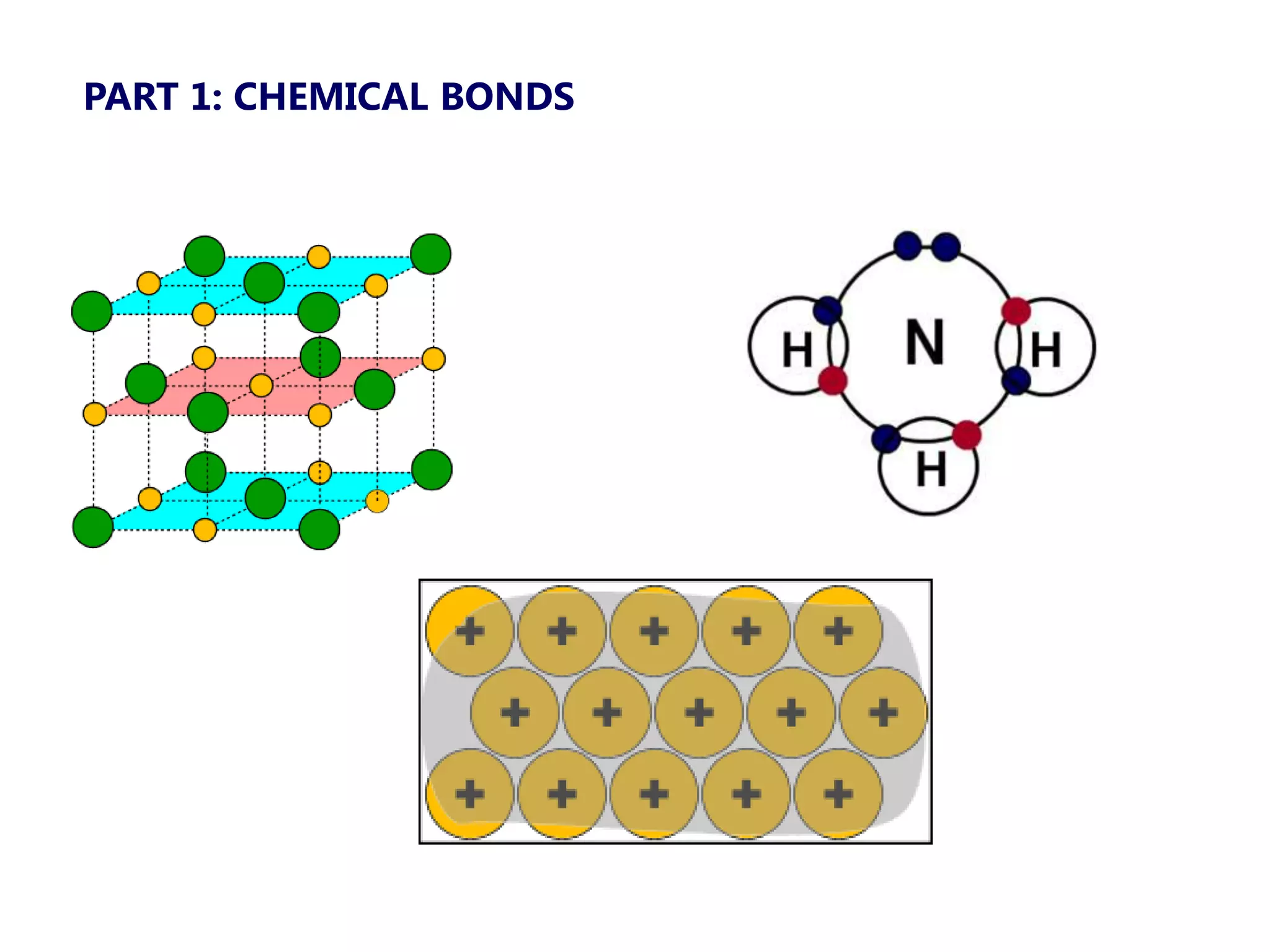
PART 1: CHEMICAL BONDS
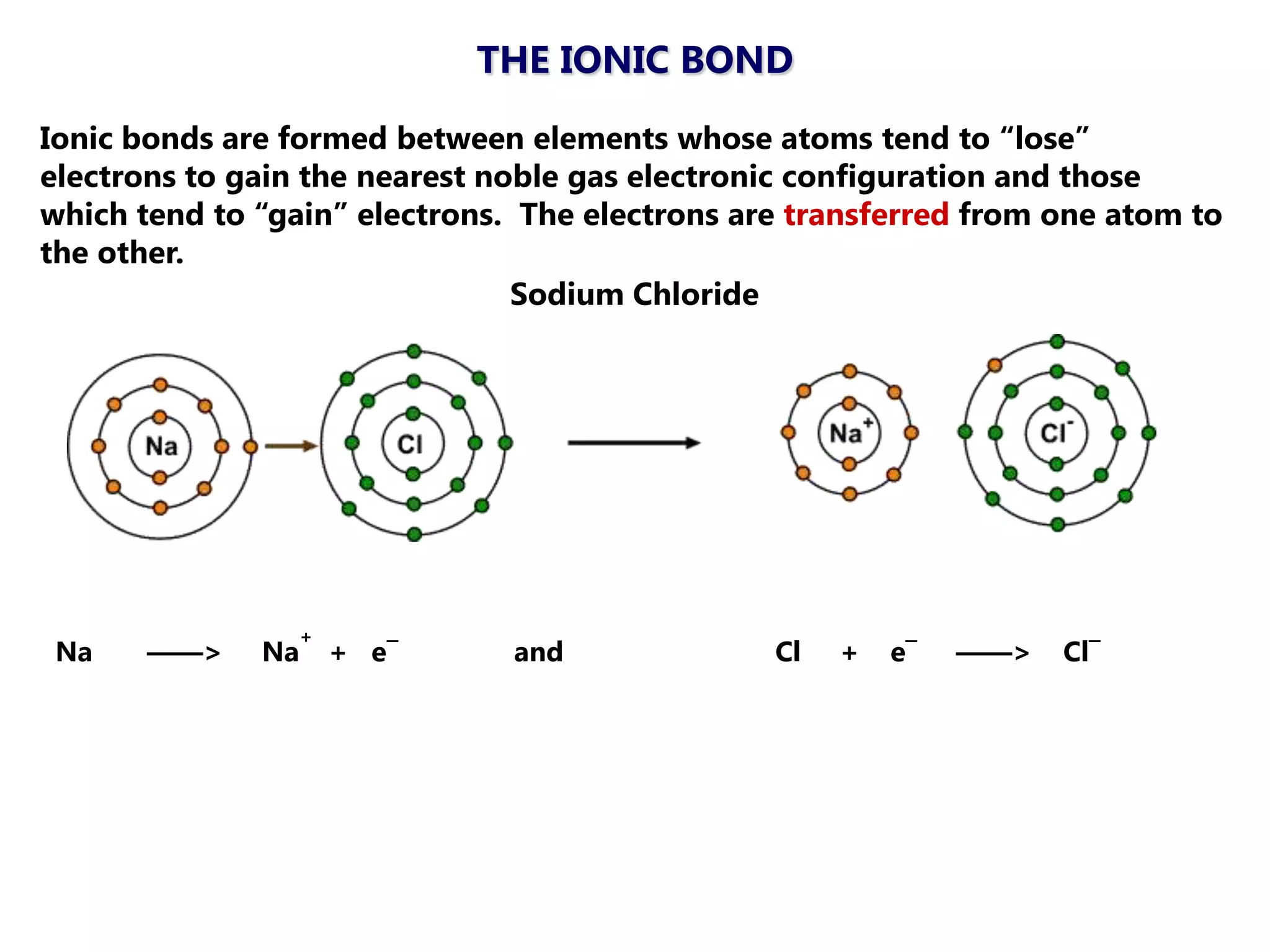
THE IONIC BOND
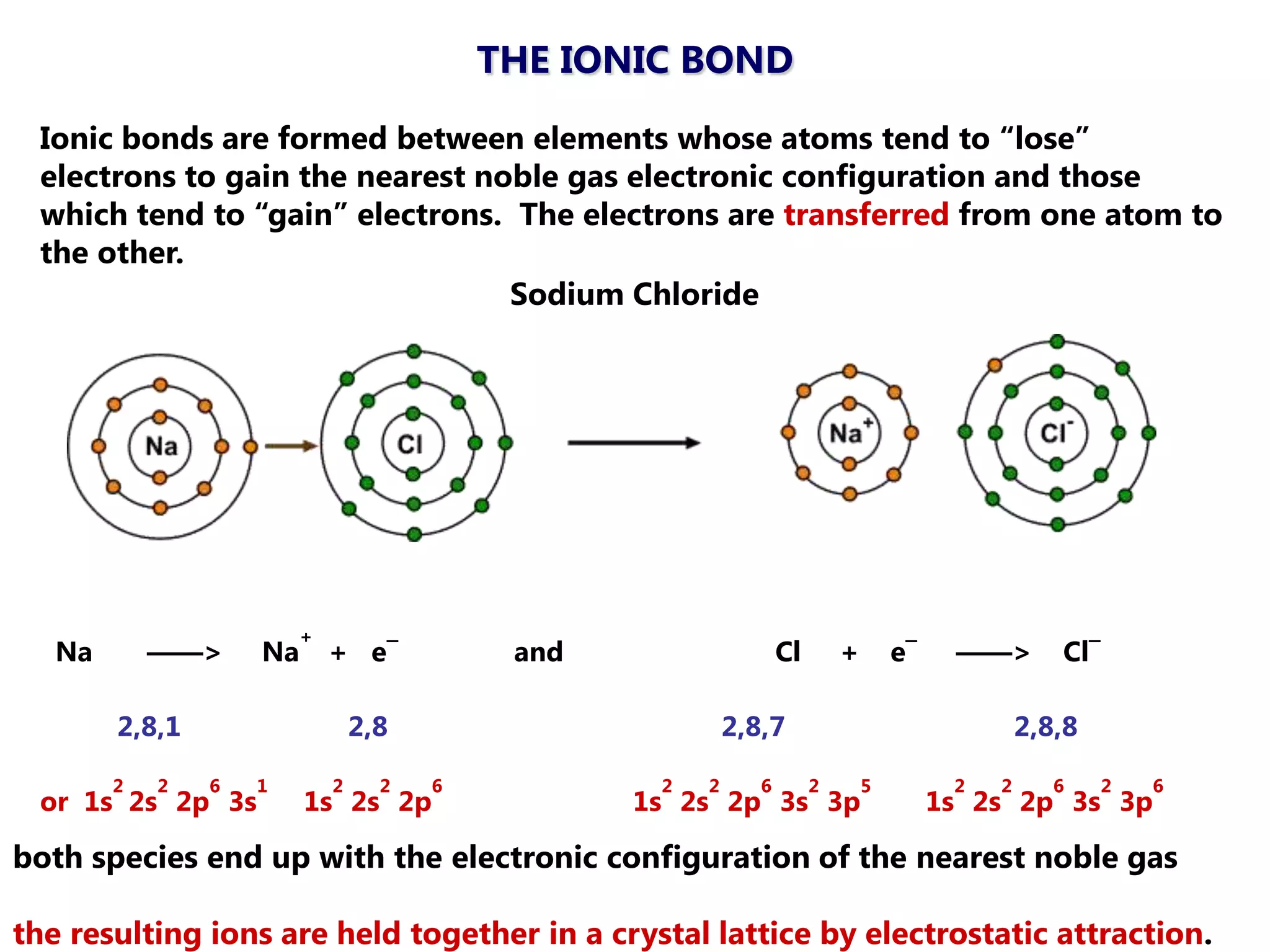
Ionic bonds are formed between elements whose atoms tend to ―lose‖
electrons to gain the nearest noble gas electronic configuration and those
which tend to ―gain‖ electrons. The electrons are transferred from one atom to
the other.
                                Sodium Chloride


                   +
 Na    ——>    Na       + e¯    and              Cl   +   e¯   ——>   Cl¯
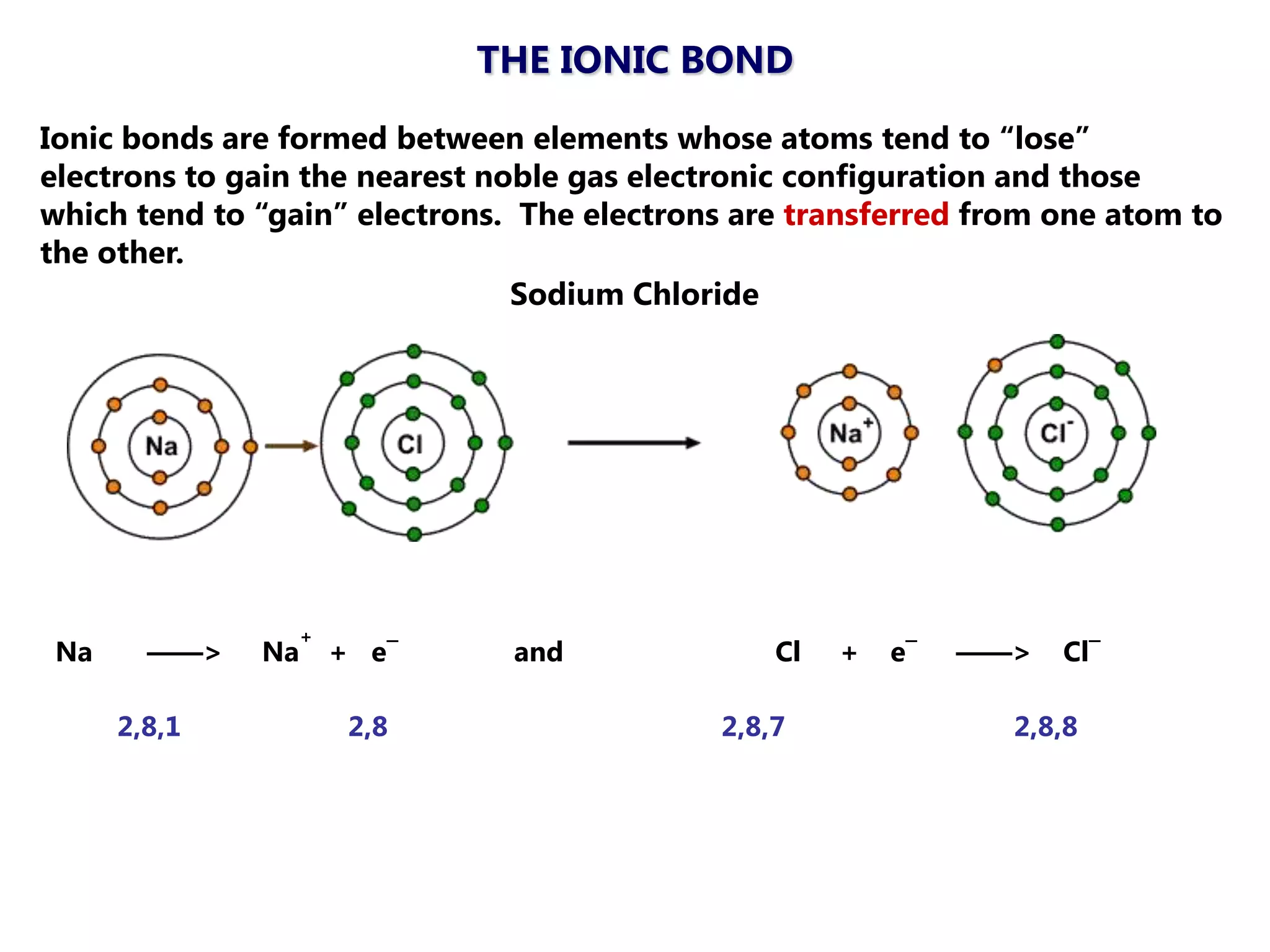
THE IONIC BOND
Ionic bonds are formed between elements whose atoms tend to ―lose‖
electrons to gain the nearest noble gas electronic configuration and those
which tend to ―gain‖ electrons. The electrons are transferred from one atom to
the other.
                                Sodium Chloride


                   +
 Na     ——>   Na       + e¯    and              Cl   +   e¯   ——>   Cl¯

      2,8,1             2,8                 2,8,7               2,8,8
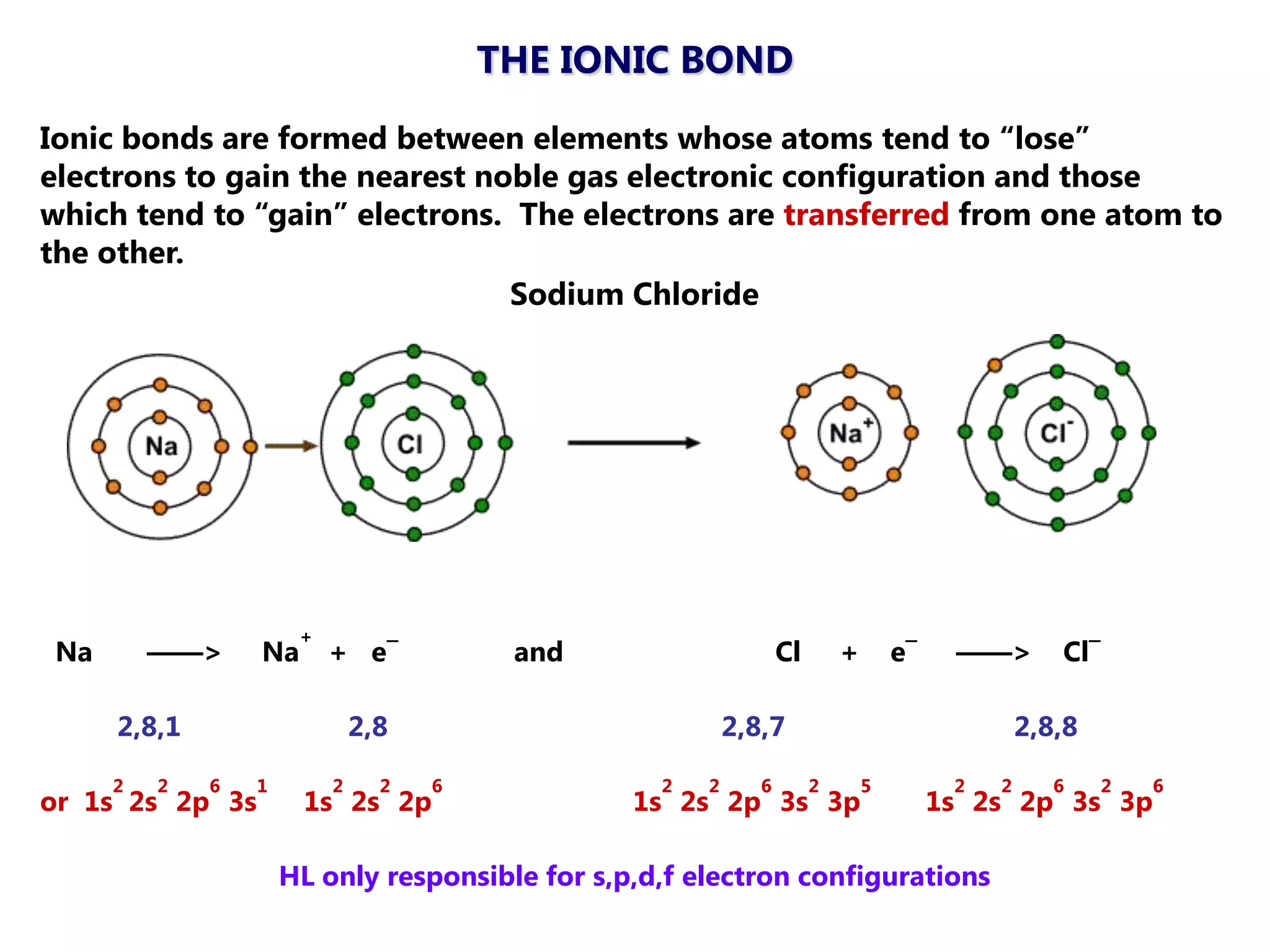
THE IONIC BOND
Ionic bonds are formed between elements whose atoms tend to ―lose‖
electrons to gain the nearest noble gas electronic configuration and those
which tend to ―gain‖ electrons. The electrons are transferred from one atom to
the other.
                                Sodium Chloride


                       +
 Na       ——>     Na       + e¯           and                     Cl       +       e¯    ——>        Cl¯

      2,8,1                    2,8                         2,8,7                                 2,8,8

      2   2   6   1        2     2   6             2   2      6        2       5         2   2      6     2   6
or 1s 2s 2p 3s         1s 2s 2p                  1s 2s 2p 3s 3p                         1s 2s 2p 3s 3p

                      HL only responsible for s,p,d,f electron configurations
THE IONIC BOND
 Ionic bonds are formed between elements whose atoms tend to ―lose‖
 electrons to gain the nearest noble gas electronic configuration and those
 which tend to ―gain‖ electrons. The electrons are transferred from one atom to
 the other.
                                 Sodium Chloride


                         +
   Na       ——>     Na       + e¯           and                   Cl       +       e¯    ——>        Cl¯

        2,8,1                    2,8                       2,8,7                                 2,8,8

        2   2   6   1        2     2   6           2   2      6        2       5         2   2      6     2   6
 or 1s 2s 2p 3s          1s 2s 2p                 1s 2s 2p 3s 3p                        1s 2s 2p 3s 3p

both species end up with the electronic configuration of the nearest noble gas

the resulting ions are held together in a crystal lattice by electrostatic attraction.
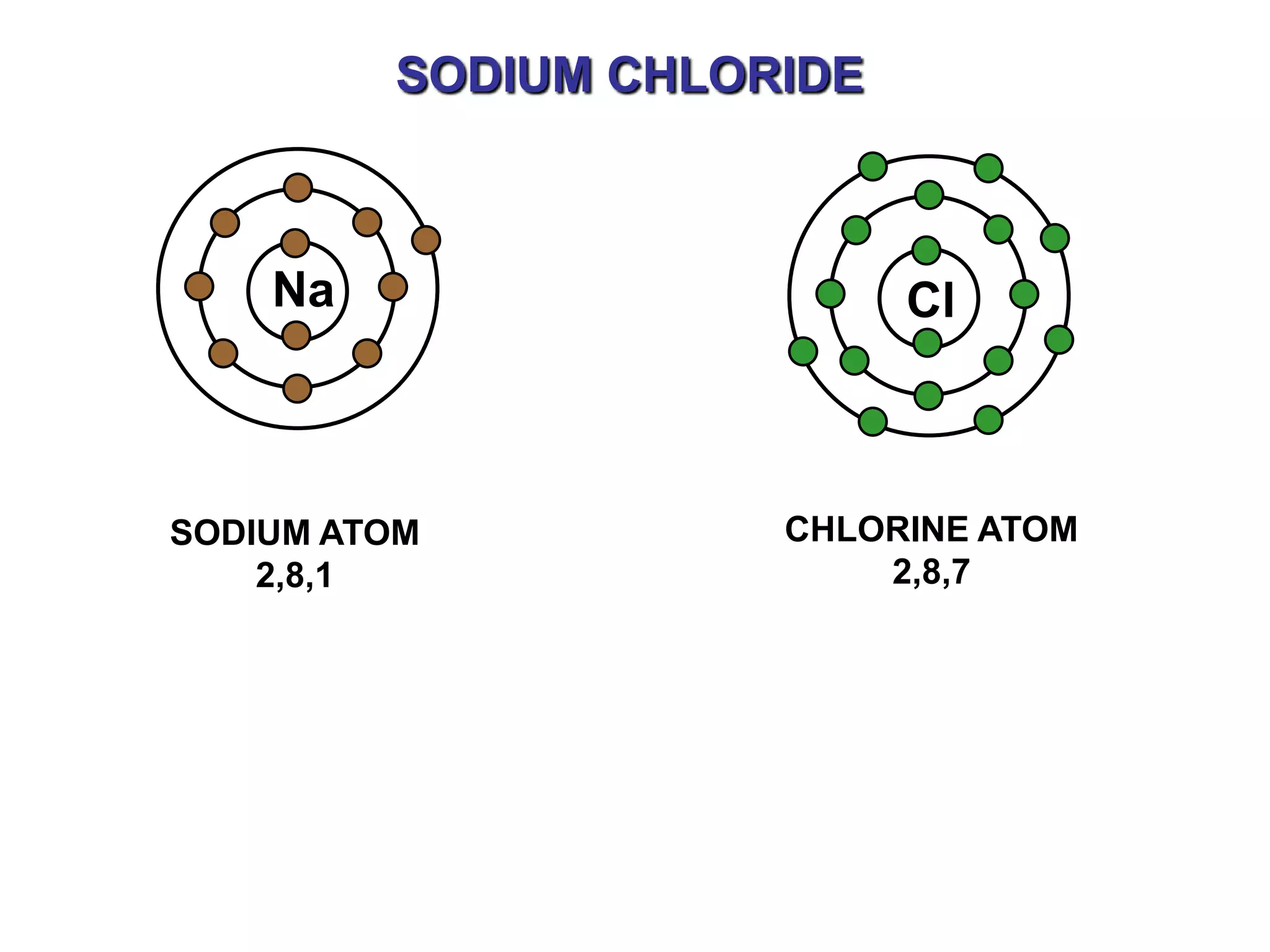
SODIUM CHLORIDE


    Na                     Cl


SODIUM ATOM          CHLORINE ATOM
    2,8,1                2,8,7
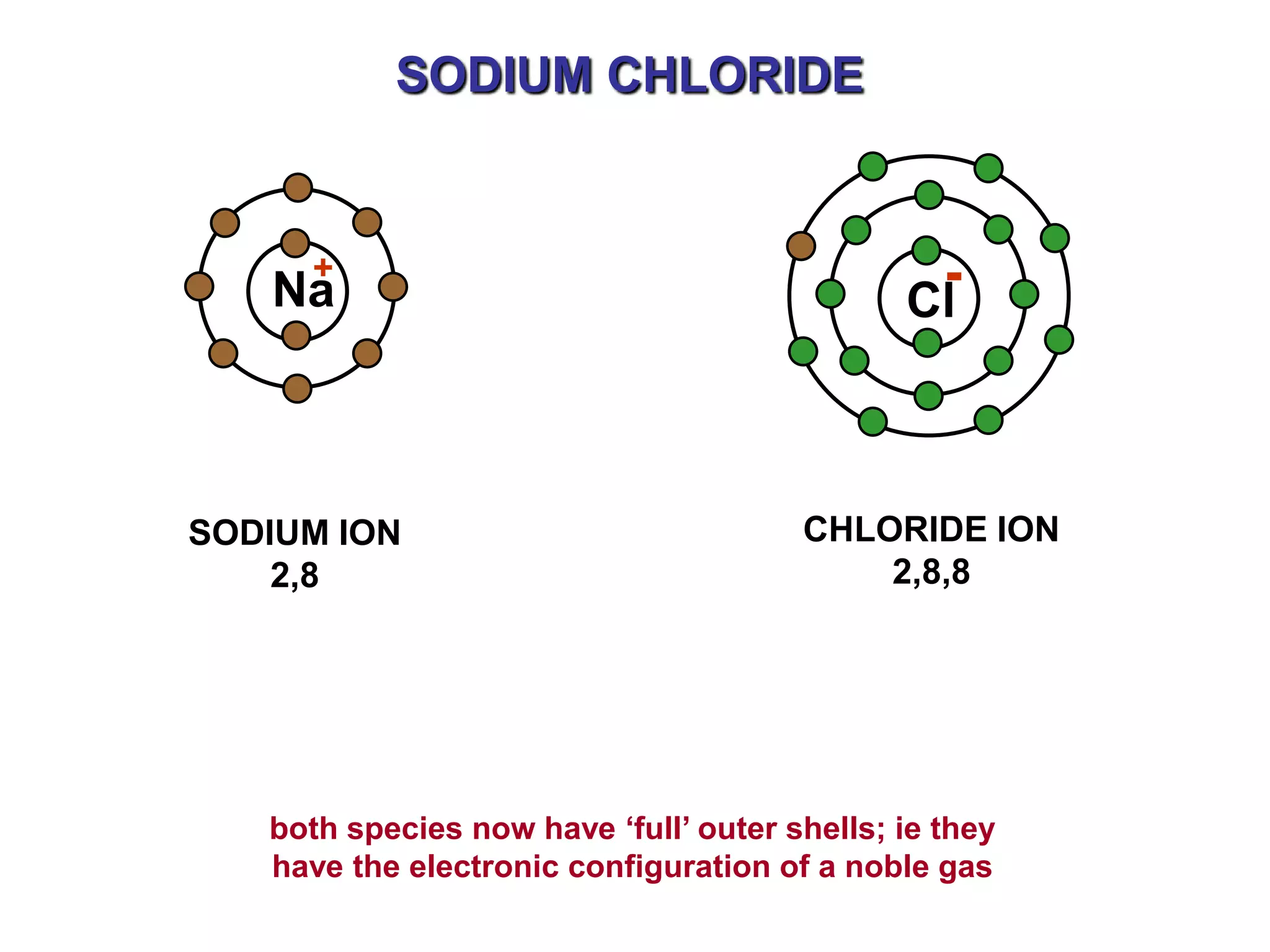
SODIUM CHLORIDE


     +
   Na                                         Cl


SODIUM ION                             CHLORIDE ION
    2,8                                    2,8,8


   both species now have ‘full’ outer shells; ie they
   have the electronic configuration of a noble gas
THE IONIC BOND

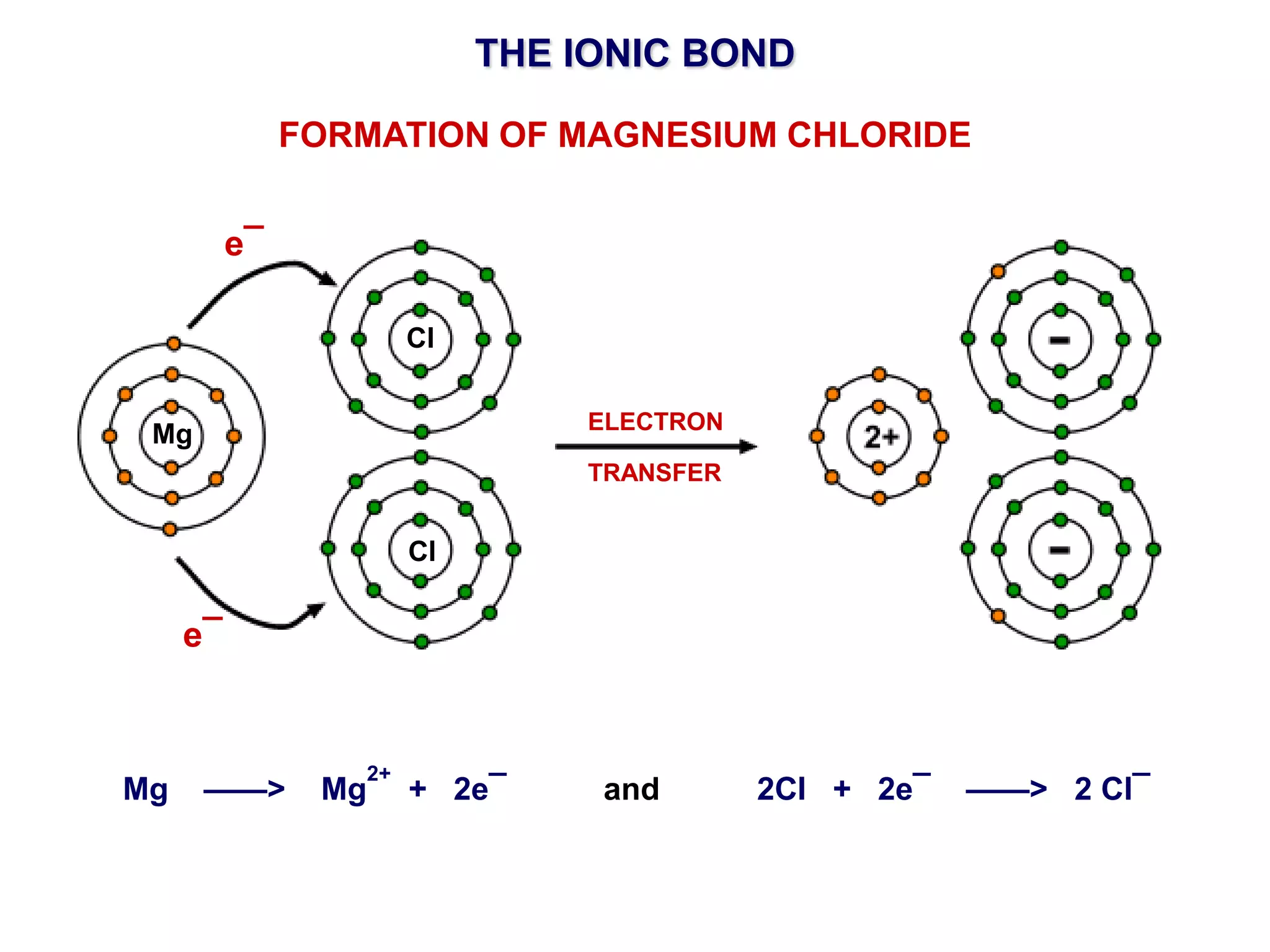
               FORMATION OF MAGNESIUM CHLORIDE


          e¯

                          Cl

                                   ELECTRON
 Mg
                                   TRANSFER


                          Cl


     e¯


                     2+
Mg    ——>       Mg        + 2e¯     and       2Cl + 2e¯   ——> 2 Cl¯
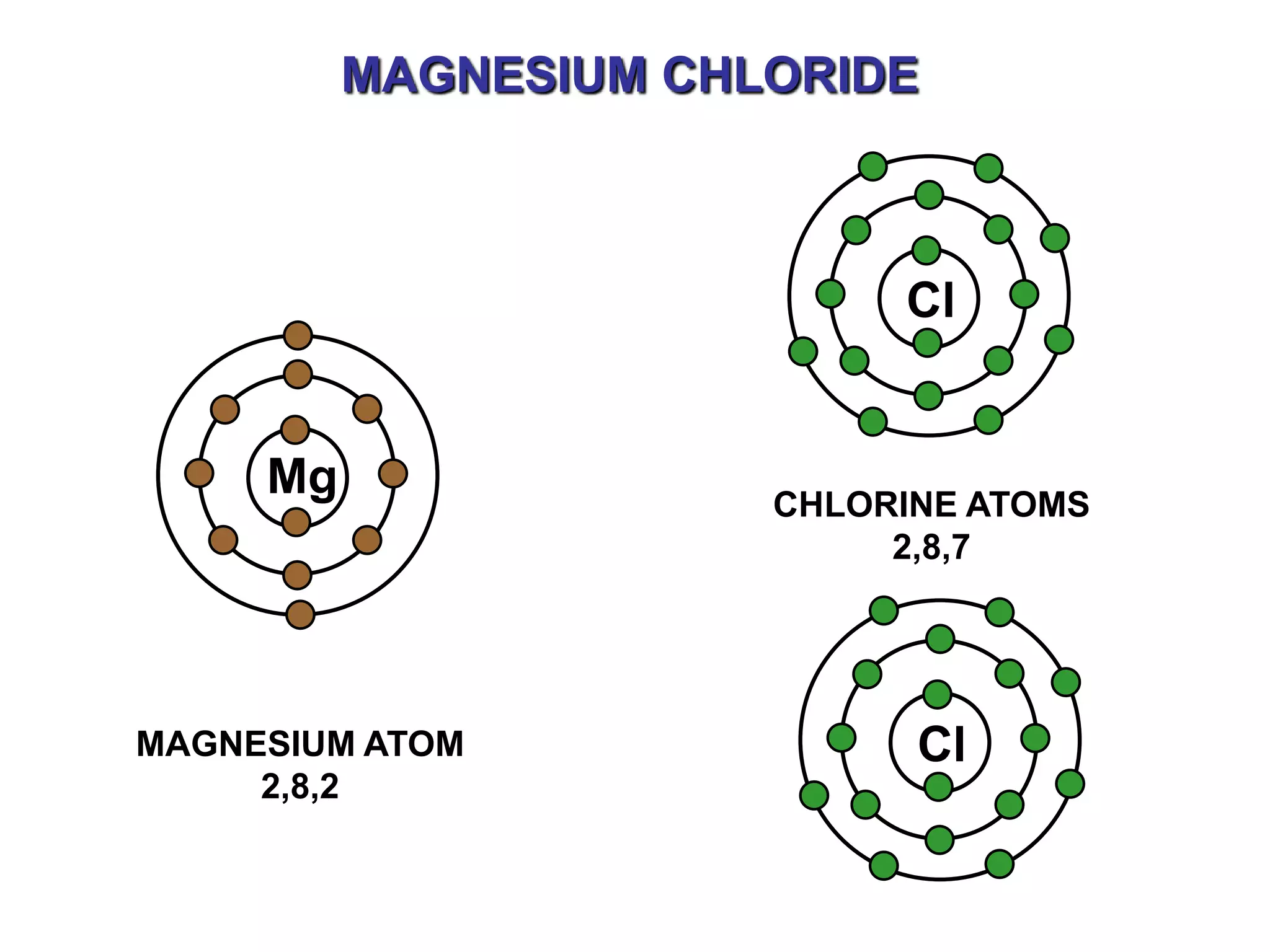
MAGNESIUM CHLORIDE


                            Cl


     Mg                CHLORINE ATOMS
                            2,8,7


MAGNESIUM ATOM               Cl
     2,8,2
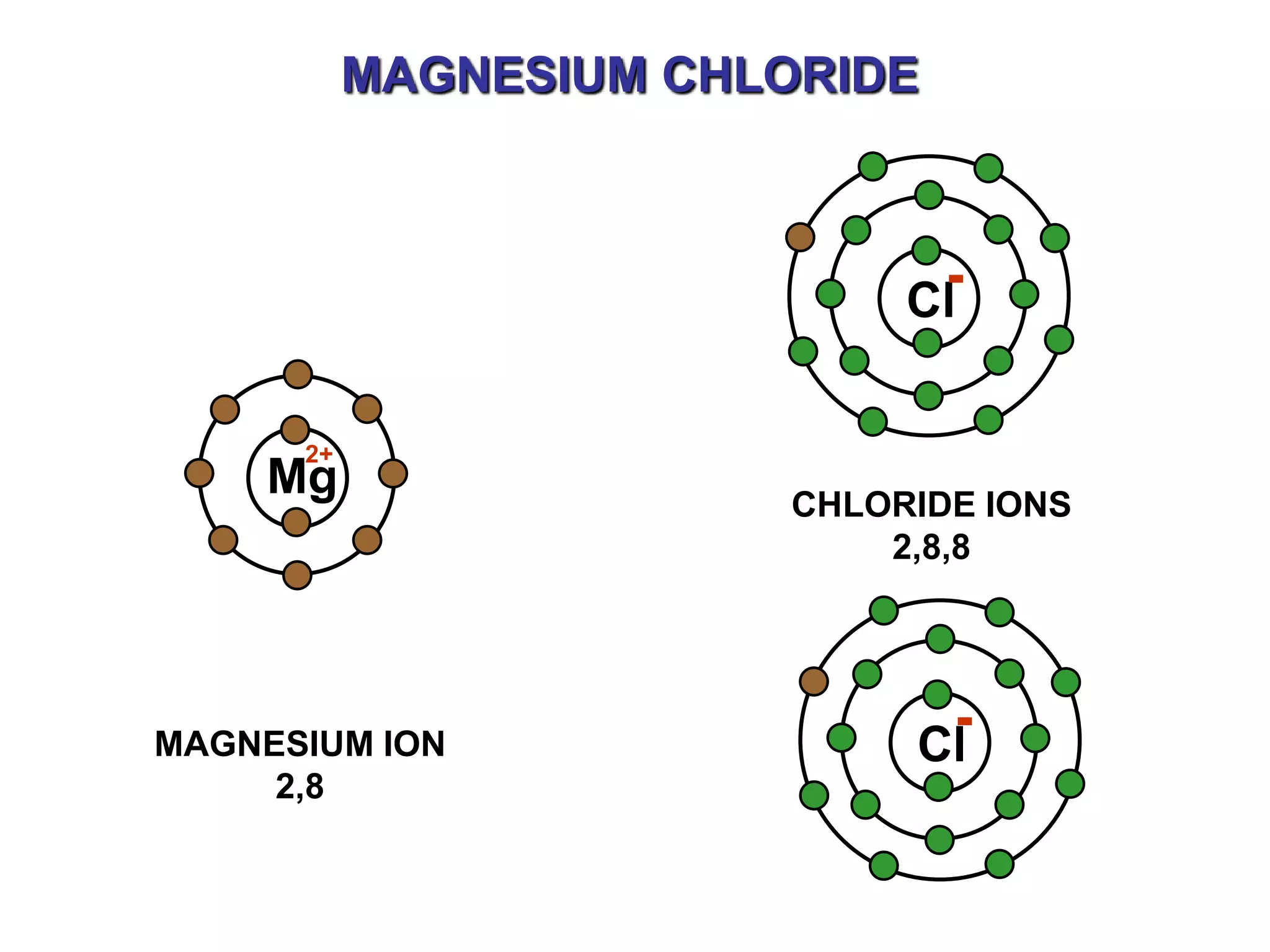
MAGNESIUM CHLORIDE


                              Cl

      2+
     Mg                  CHLORIDE IONS
                             2,8,8


MAGNESIUM ION                 Cl
     2,8
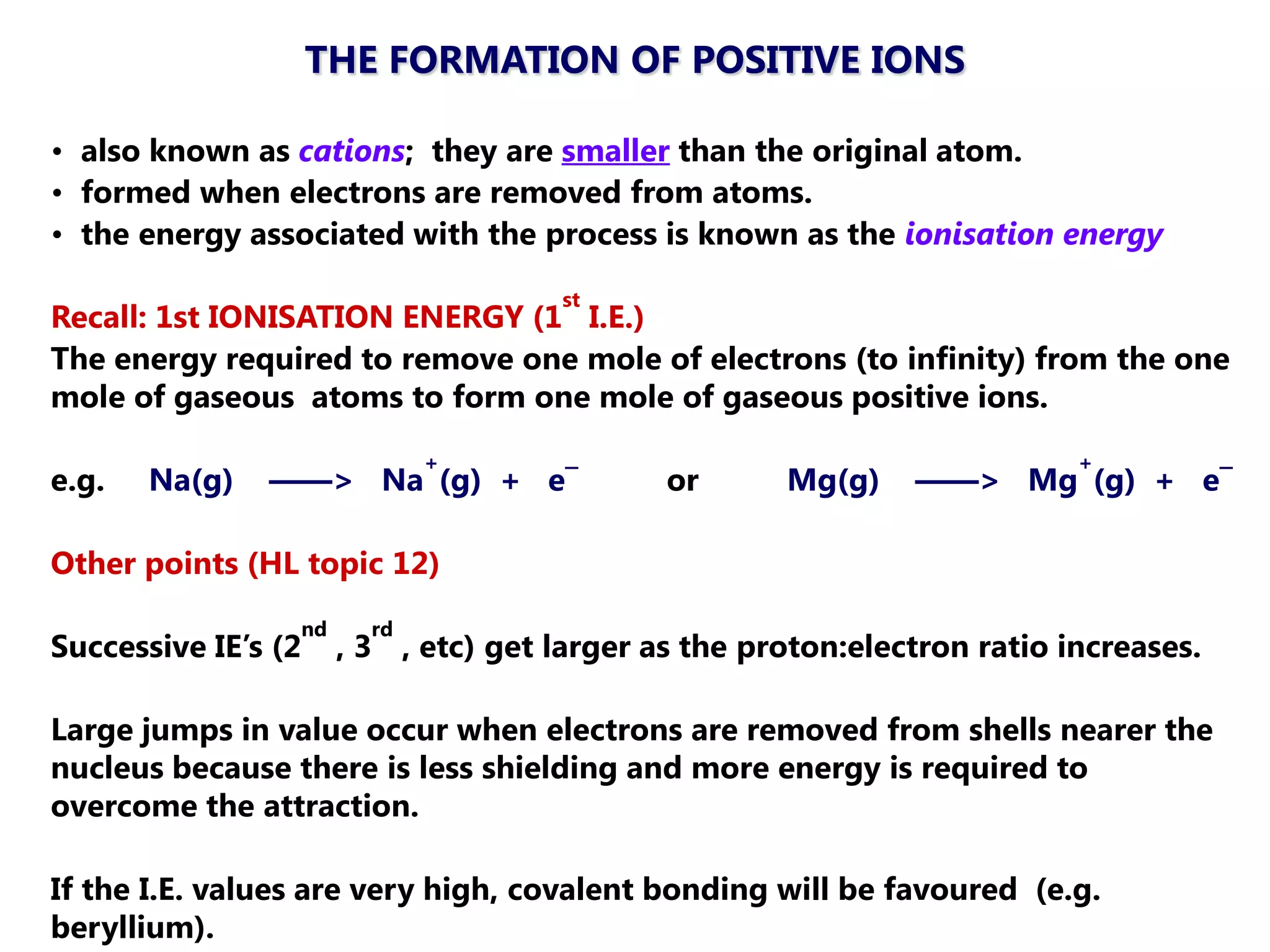
THE FORMATION OF POSITIVE IONS

• also known as cations; they are smaller than the original atom.
• formed when electrons are removed from atoms.
• the energy associated with the process is known as the ionisation energy
                                     st
Recall: 1st IONISATION ENERGY (1 I.E.)
The energy required to remove one mole of electrons (to infinity) from the one
mole of gaseous atoms to form one mole of gaseous positive ions.
                             +                                            +
e.g.   Na(g)   ——> Na (g) + e¯               or      Mg(g)    ——> Mg (g) + e¯

Other points (HL topic 12)
                 nd     rd
Successive IE‘s (2    , 3 , etc) get larger as the proton:electron ratio increases.

Large jumps in value occur when electrons are removed from shells nearer the
nucleus because there is less shielding and more energy is required to
overcome the attraction.

If the I.E. values are very high, covalent bonding will be favoured (e.g.
beryllium).
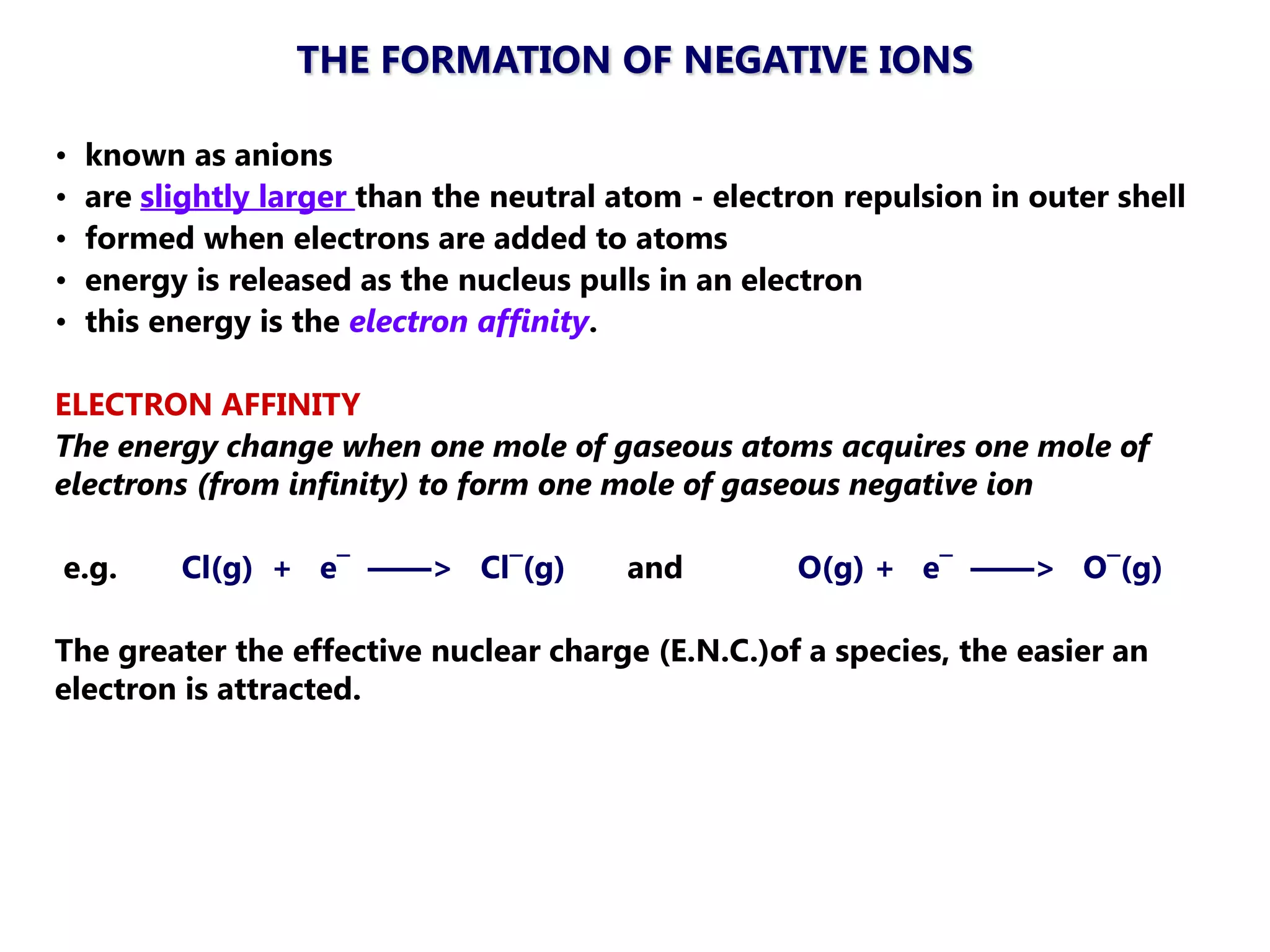
THE FORMATION OF NEGATIVE IONS

•   known as anions
•   are slightly larger than the neutral atom - electron repulsion in outer shell
•   formed when electrons are added to atoms
•   energy is released as the nucleus pulls in an electron
•   this energy is the electron affinity.

ELECTRON AFFINITY
The energy change when one mole of gaseous atoms acquires one mole of
electrons (from infinity) to form one mole of gaseous negative ion

e.g.      Cl(g) + e¯ ——> Cl¯(g)          and         O(g) + e¯ ——> O¯(g)

The greater the effective nuclear charge (E.N.C.)of a species, the easier an
electron is attracted.
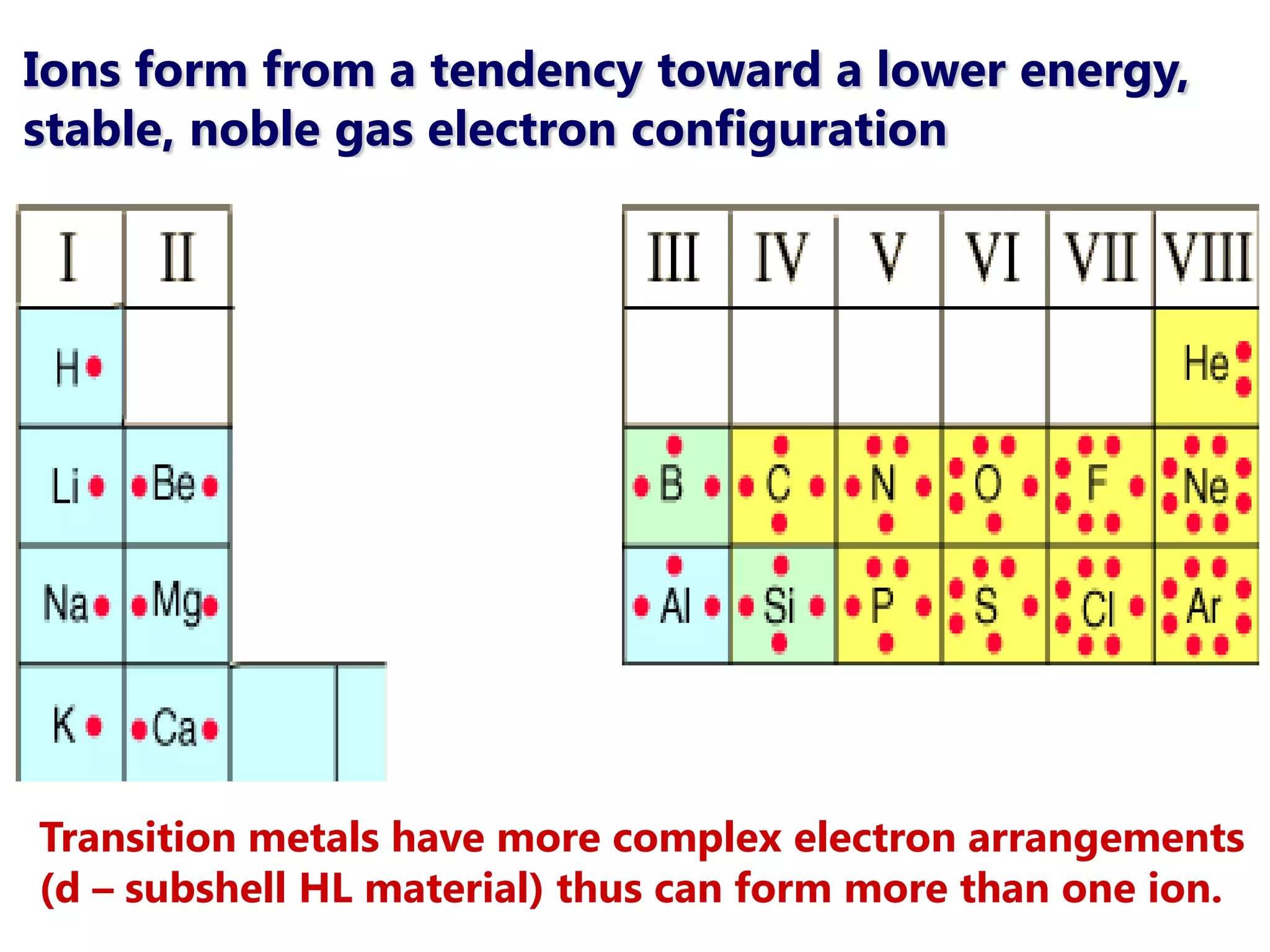
Ions form from a tendency toward a lower energy,
stable, noble gas electron configuration


Transition metals have more complex electron arrangements
(d – subshell HL material) thus can form more than one ion.
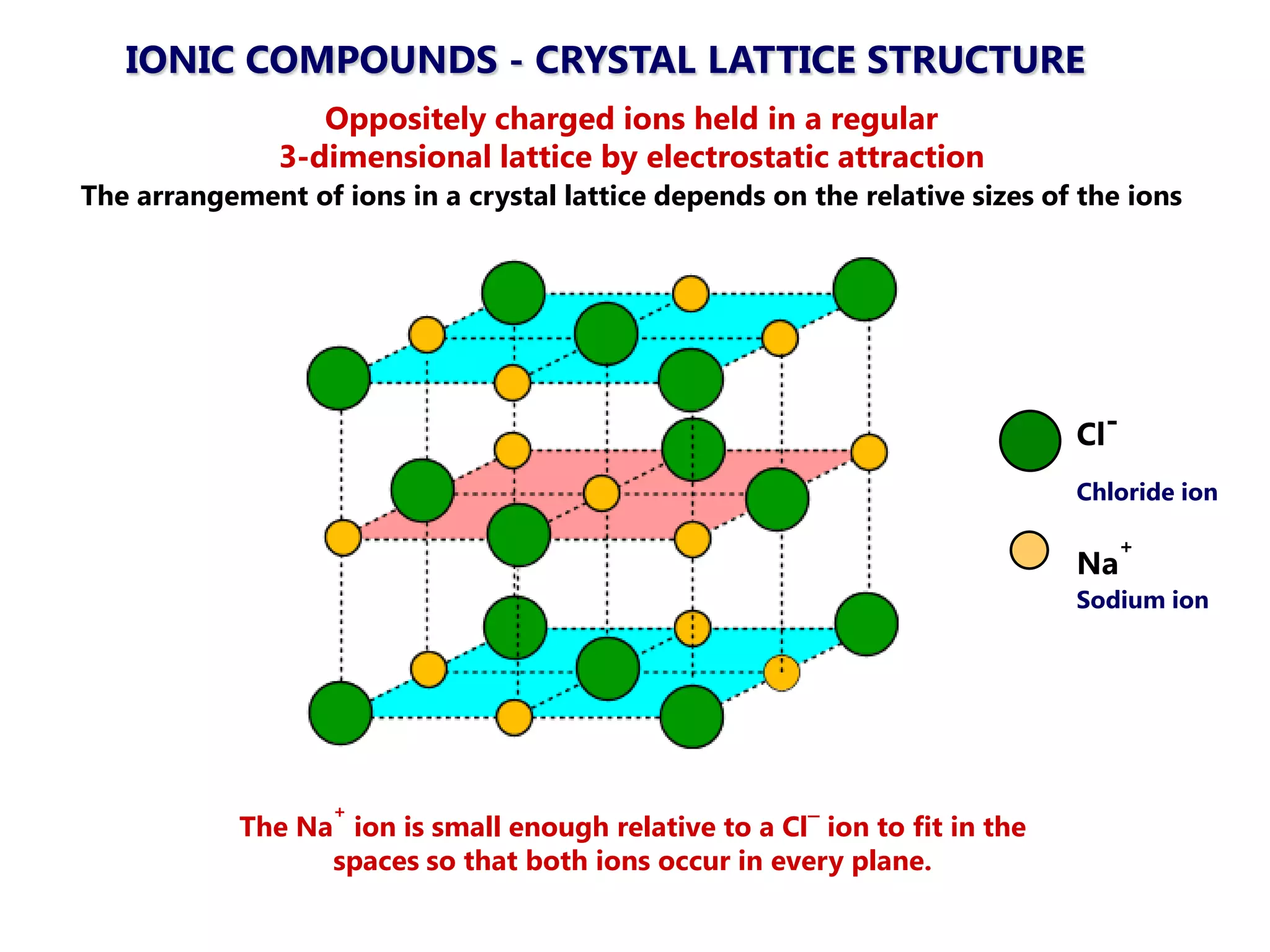
IONIC COMPOUNDS - CRYSTAL LATTICE STRUCTURE
                  Oppositely charged ions held in a regular
               3-dimensional lattice by electrostatic attraction
The arrangement of ions in a crystal lattice depends on the relative sizes of the ions


                                                                             Cl-
                                                                             Chloride ion

                                                                                  +
                                                                             Na
                                                                             Sodium ion


                   +
            The Na ion is small enough relative to a Cl¯ ion to fit in the
                  spaces so that both ions occur in every plane.
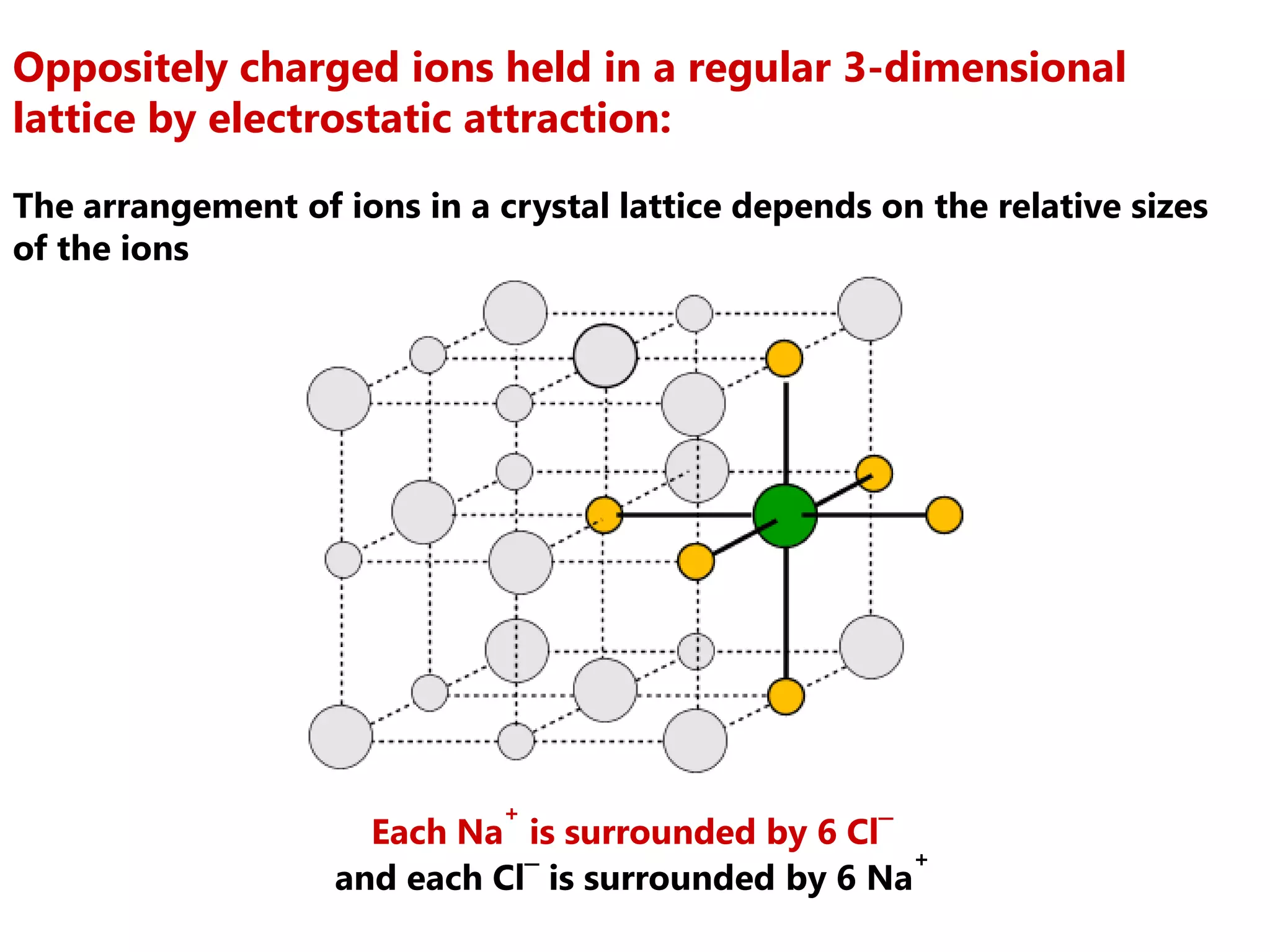
Oppositely charged ions held in a regular 3-dimensional
lattice by electrostatic attraction:

The arrangement of ions in a crystal lattice depends on the relative sizes
of the ions


                              +
                     Each Na is surrounded by 6 Cl¯
                                                      +
                   and each Cl¯ is surrounded by 6 Na
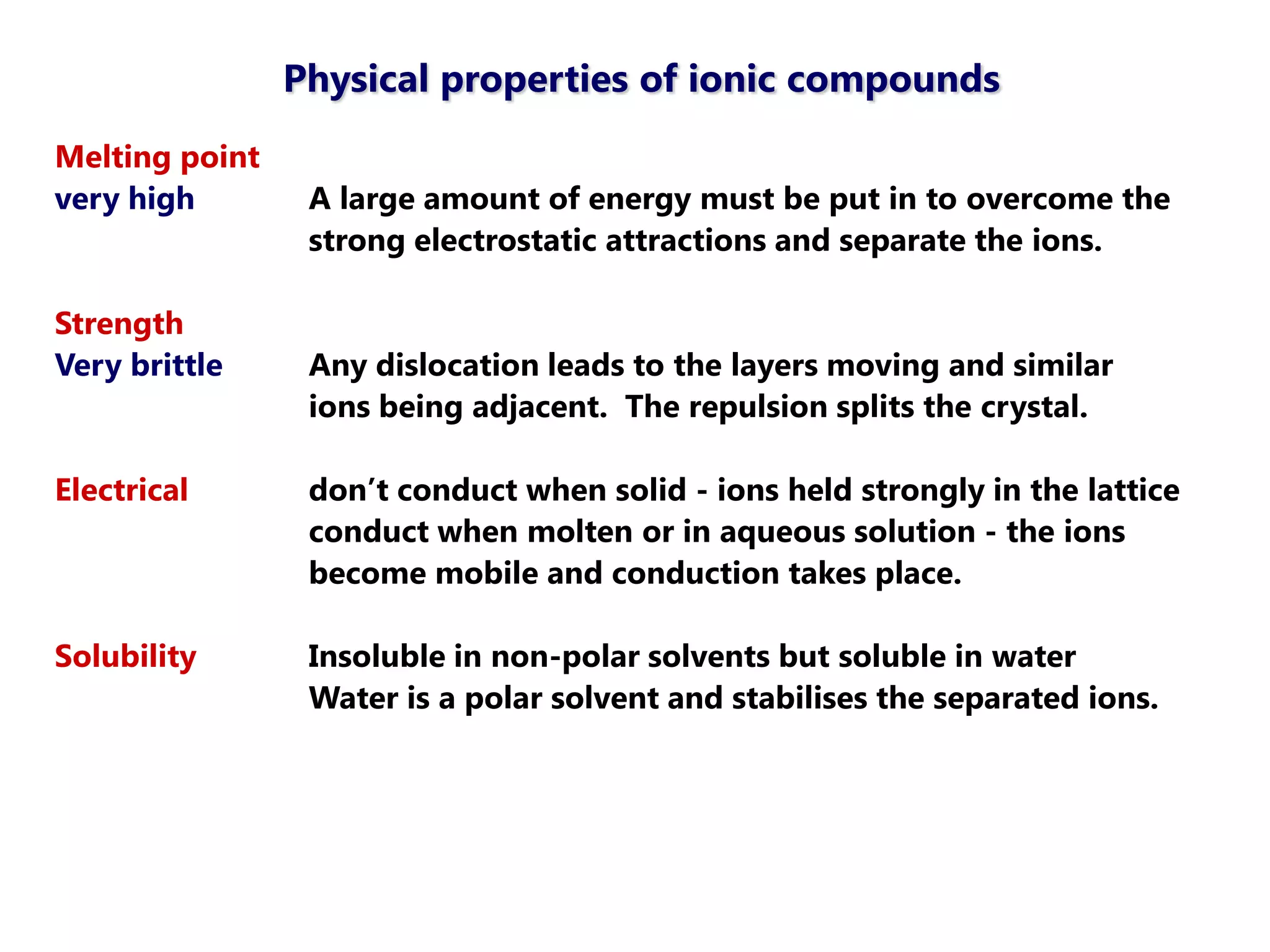
Physical properties of ionic compounds
Melting point
very high        A large amount of energy must be put in to overcome the
                 strong electrostatic attractions and separate the ions.

Strength
Very brittle     Any dislocation leads to the layers moving and similar
                 ions being adjacent. The repulsion splits the crystal.

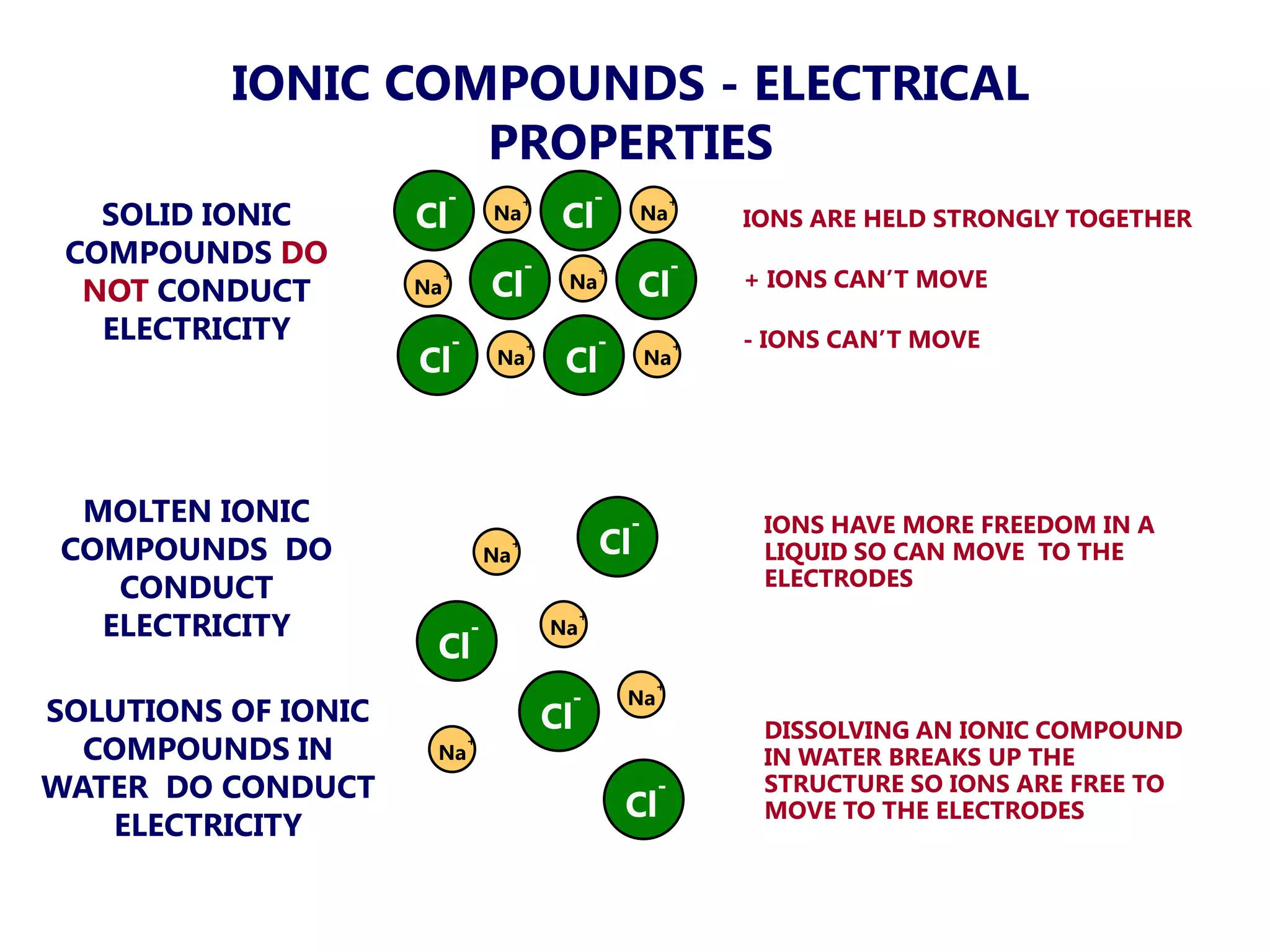
Electrical       don‘t conduct when solid - ions held strongly in the lattice
                 conduct when molten or in aqueous solution - the ions
                 become mobile and conduction takes place.

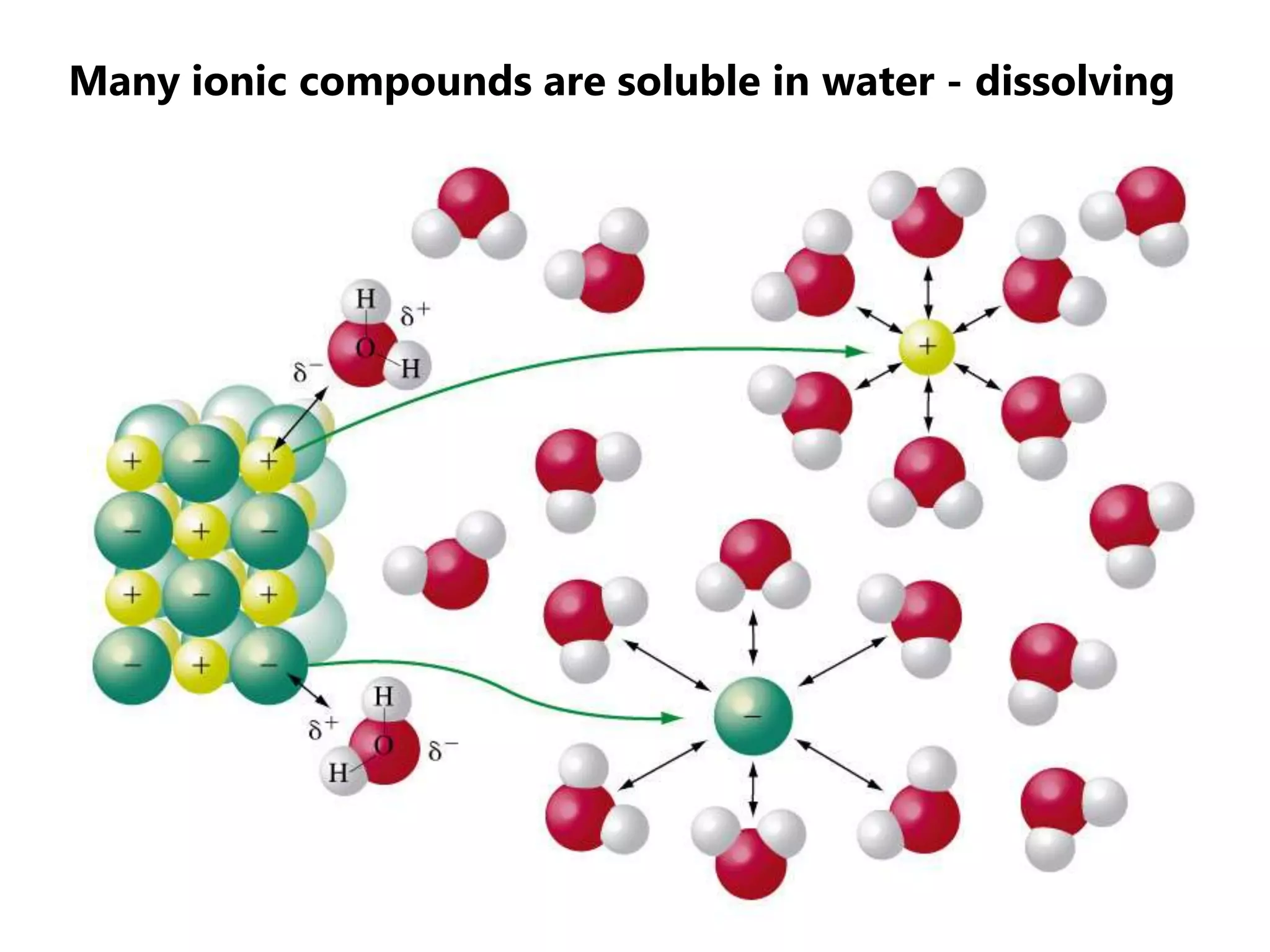
Solubility       Insoluble in non-polar solvents but soluble in water
                 Water is a polar solvent and stabilises the separated ions.
IONIC COMPOUNDS - ELECTRICAL
                   PROPERTIES
                          -                             -
   SOLID IONIC       Cl                         Cl
                                           +                         +
                                  Na                         Na          IONS ARE HELD STRONGLY TOGETHER
 COMPOUNDS DO                              -                         -
                                  Cl                         Cl
                                                        +
                          +
                                                Na                       + IONS CAN‘T MOVE
  NOT CONDUCT        Na

   ELECTRICITY            -                             -                - IONS CAN‘T MOVE
                     Cl                         Cl
                                           +                         +
                                   Na                           Na


  MOLTEN IONIC                                              -             IONS HAVE MORE FREEDOM IN A
 COMPOUNDS DO                     Na
                                       +                Cl                LIQUID SO CAN MOVE TO THE
    CONDUCT                                                               ELECTRODES
   ELECTRICITY                -                Na
                                                    +

                      Cl
                                                                 +
                                                -           Na
SOLUTIONS OF IONIC                             Cl                         DISSOLVING AN IONIC COMPOUND
  COMPOUNDS IN        Na
                              +
                                                                          IN WATER BREAKS UP THE
WATER DO CONDUCT                                                 -        STRUCTURE SO IONS ARE FREE TO
                                                            Cl            MOVE TO THE ELECTRODES
   ELECTRICITY
Many ionic compounds are soluble in water - dissolving

2012 topic 4.1 bonding - ionic

  • 1.
    IB Chemistry PowerPoints Topic 4 Bonding www.pedagogics.ca LECTURE 1 Ionic Bonding
  • 3.
    STRUCTURE AND BONDING KeyConcept: The physical properties of a substance (such as hardness, density, melting point and conductivity) depend on the structure of the substance. Bonding determines arrangement of particles and therefore, the type of structure. Basic theory – things you should know 1. The noble gases (He, Ne, Ar, Kr, Xe and Rn) are in Group VIII, they are all relatively inert meaning they do not react and bond like other elements. 2. We can conclude that noble gas electron configuration appears to confer stability. All noble gases have just filled their ‗outer shell‘ of electrons 3. Other elements have a tendency to obtain the same electron arrangement (a full outer shell of valence electrons). Obtaining this electron arrangement is accomplished by different methods of chemical bonding. 4. The type of bonding depends on an element‘s position in the periodic table
  • 4.
    TYPES OF BONDING CHEMICALBONDS.... are strong intramolecular bonds that hold atoms together in molecules, ionic solids and metals. These bonds are broken and made in chemical reactions. ionic covalent dative covalent (or co-ordinate) metallic PHYSICAL BONDS.... are intermolecular forces that exist between two or more separate molecules. These are the attractions involved in physical changes. van der Waals‗ forces - weakest dipole-dipole interactions hydrogen bonds - strongest
  • 5.
  • 6.
    THE IONIC BOND Ionicbonds are formed between elements whose atoms tend to ―lose‖ electrons to gain the nearest noble gas electronic configuration and those which tend to ―gain‖ electrons. The electrons are transferred from one atom to the other. Sodium Chloride + Na ——> Na + e¯ and Cl + e¯ ——> Cl¯
  • 7.
    THE IONIC BOND Ionicbonds are formed between elements whose atoms tend to ―lose‖ electrons to gain the nearest noble gas electronic configuration and those which tend to ―gain‖ electrons. The electrons are transferred from one atom to the other. Sodium Chloride + Na ——> Na + e¯ and Cl + e¯ ——> Cl¯ 2,8,1 2,8 2,8,7 2,8,8
  • 8.
    THE IONIC BOND Ionicbonds are formed between elements whose atoms tend to ―lose‖ electrons to gain the nearest noble gas electronic configuration and those which tend to ―gain‖ electrons. The electrons are transferred from one atom to the other. Sodium Chloride + Na ——> Na + e¯ and Cl + e¯ ——> Cl¯ 2,8,1 2,8 2,8,7 2,8,8 2 2 6 1 2 2 6 2 2 6 2 5 2 2 6 2 6 or 1s 2s 2p 3s 1s 2s 2p 1s 2s 2p 3s 3p 1s 2s 2p 3s 3p HL only responsible for s,p,d,f electron configurations
  • 9.
    THE IONIC BOND Ionic bonds are formed between elements whose atoms tend to ―lose‖ electrons to gain the nearest noble gas electronic configuration and those which tend to ―gain‖ electrons. The electrons are transferred from one atom to the other. Sodium Chloride + Na ——> Na + e¯ and Cl + e¯ ——> Cl¯ 2,8,1 2,8 2,8,7 2,8,8 2 2 6 1 2 2 6 2 2 6 2 5 2 2 6 2 6 or 1s 2s 2p 3s 1s 2s 2p 1s 2s 2p 3s 3p 1s 2s 2p 3s 3p both species end up with the electronic configuration of the nearest noble gas the resulting ions are held together in a crystal lattice by electrostatic attraction.
  • 10.
    SODIUM CHLORIDE Na Cl SODIUM ATOM CHLORINE ATOM 2,8,1 2,8,7
  • 11.
    SODIUM CHLORIDE + Na Cl SODIUM ION CHLORIDE ION 2,8 2,8,8 both species now have ‘full’ outer shells; ie they have the electronic configuration of a noble gas
  • 12.
    THE IONIC BOND FORMATION OF MAGNESIUM CHLORIDE e¯ Cl ELECTRON Mg TRANSFER Cl e¯ 2+ Mg ——> Mg + 2e¯ and 2Cl + 2e¯ ——> 2 Cl¯
  • 13.
    MAGNESIUM CHLORIDE Cl Mg CHLORINE ATOMS 2,8,7 MAGNESIUM ATOM Cl 2,8,2
  • 14.
    MAGNESIUM CHLORIDE Cl 2+ Mg CHLORIDE IONS 2,8,8 MAGNESIUM ION Cl 2,8
  • 15.
    THE FORMATION OFPOSITIVE IONS • also known as cations; they are smaller than the original atom. • formed when electrons are removed from atoms. • the energy associated with the process is known as the ionisation energy st Recall: 1st IONISATION ENERGY (1 I.E.) The energy required to remove one mole of electrons (to infinity) from the one mole of gaseous atoms to form one mole of gaseous positive ions. + + e.g. Na(g) ——> Na (g) + e¯ or Mg(g) ——> Mg (g) + e¯ Other points (HL topic 12) nd rd Successive IE‘s (2 , 3 , etc) get larger as the proton:electron ratio increases. Large jumps in value occur when electrons are removed from shells nearer the nucleus because there is less shielding and more energy is required to overcome the attraction. If the I.E. values are very high, covalent bonding will be favoured (e.g. beryllium).
  • 16.
    THE FORMATION OFNEGATIVE IONS • known as anions • are slightly larger than the neutral atom - electron repulsion in outer shell • formed when electrons are added to atoms • energy is released as the nucleus pulls in an electron • this energy is the electron affinity. ELECTRON AFFINITY The energy change when one mole of gaseous atoms acquires one mole of electrons (from infinity) to form one mole of gaseous negative ion e.g. Cl(g) + e¯ ——> Cl¯(g) and O(g) + e¯ ——> O¯(g) The greater the effective nuclear charge (E.N.C.)of a species, the easier an electron is attracted.
  • 17.
    Ions form froma tendency toward a lower energy, stable, noble gas electron configuration Transition metals have more complex electron arrangements (d – subshell HL material) thus can form more than one ion.
  • 18.
    IONIC COMPOUNDS -CRYSTAL LATTICE STRUCTURE Oppositely charged ions held in a regular 3-dimensional lattice by electrostatic attraction The arrangement of ions in a crystal lattice depends on the relative sizes of the ions Cl- Chloride ion + Na Sodium ion + The Na ion is small enough relative to a Cl¯ ion to fit in the spaces so that both ions occur in every plane.
  • 19.
    Oppositely charged ionsheld in a regular 3-dimensional lattice by electrostatic attraction: The arrangement of ions in a crystal lattice depends on the relative sizes of the ions + Each Na is surrounded by 6 Cl¯ + and each Cl¯ is surrounded by 6 Na
  • 20.
    Physical properties ofionic compounds Melting point very high A large amount of energy must be put in to overcome the strong electrostatic attractions and separate the ions. Strength Very brittle Any dislocation leads to the layers moving and similar ions being adjacent. The repulsion splits the crystal. Electrical don‘t conduct when solid - ions held strongly in the lattice conduct when molten or in aqueous solution - the ions become mobile and conduction takes place. Solubility Insoluble in non-polar solvents but soluble in water Water is a polar solvent and stabilises the separated ions.
  • 21.
    IONIC COMPOUNDS -ELECTRICAL PROPERTIES - - SOLID IONIC Cl Cl + + Na Na IONS ARE HELD STRONGLY TOGETHER COMPOUNDS DO - - Cl Cl + + Na + IONS CAN‘T MOVE NOT CONDUCT Na ELECTRICITY - - - IONS CAN‘T MOVE Cl Cl + + Na Na MOLTEN IONIC - IONS HAVE MORE FREEDOM IN A COMPOUNDS DO Na + Cl LIQUID SO CAN MOVE TO THE CONDUCT ELECTRODES ELECTRICITY - Na + Cl + - Na SOLUTIONS OF IONIC Cl DISSOLVING AN IONIC COMPOUND COMPOUNDS IN Na + IN WATER BREAKS UP THE WATER DO CONDUCT - STRUCTURE SO IONS ARE FREE TO Cl MOVE TO THE ELECTRODES ELECTRICITY
  • 22.
    Many ionic compoundsare soluble in water - dissolving