Bioinformatics for High-Throughput Sequencing Misha Kapushesky St. Petersburg Russia 2010 Slides: Nicolas Delhomme, Simon Anders, EMBL-EBI
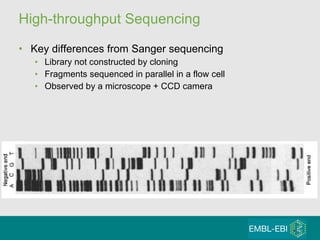
High-throughput Sequencing Key differences from Sanger sequencing Library not constructed by cloning Fragments sequenced in parallel in a flow cell Observed by a microscope + CCD camera
Roche 454 2005 (first to market) Pyrosequencing Read length: 250bp Paired read separation: 3kb 300Mb per day $60 per Mb Error rate: ~ 5% per bp Dominant error: indel, especially in homopolymers
Illumina/Solexa Second to market Bridge PCR Sequencing by synthesis Read length: 32…40bp, newest models up to 100bp Paired read separation: 200bp 400Mb per day (and increasing) $2 per Mb Error rate: 1% per bp, sometimes as good as 0.1% Dominant error: substitutions
ABI SOLiD Third to market (2007) Emulsion PCR, ligase-based sequencing Read length 50bp Paired read separation 3kb 600Mb per day Reads in colour space $1 per Mb Very low error rate <0.1% per bp (Sanger error 0.001%) Dominant error: substitutions
Helicos Recent No amplification Single-molecule polymerase sequencing Read length: 25..45bp 1200Mb per day $1 per Mb Error <1% (manufacturer)
Polonator Recent Emulsion PCR, ligase-based sequencing Very short read length: 13bp Low-cost instrument ($150K) <$1 per Mb
Uses for HTS De-novo sequencing, assembly of small genomes Transcriptome analysis (RNA-seq) Resequencing to identify genetic polymorphisms SNPs, CNVs ChIP-seq DNA methylation studies Metagenomics …
Multiplexing Solexa: 6-12 mln 36bp reads per lane One lane for one sample – wasteful Multiplexing: incorporate tags between sequencing primer and sample fragments to distinguish several samples in the same lane
Targeted Sequencing Instead of whole genome, sequence only regions of interest but  deep Microarrays can help to select fragments of interest
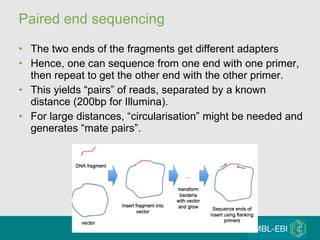
Paired end sequencing The two ends of the fragments get different adapters Hence, one can sequence from one end with one primer, then repeat to get the other end with the other primer. This yields “pairs” of reads, separated by a known distance (200bp for Illumina). For large distances, “circularisation” might be needed and generates “mate pairs”.
Paired end read uses Useful to find: Micro indels Copy-number variations Assembly tasks Splice variants
Bioinformatics Problems Assembly Alignment Statistics Visualization
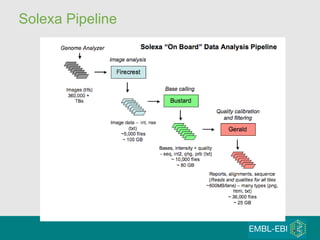
Solexa Pipeline
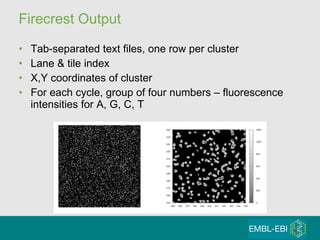
Firecrest Output Tab-separated text files, one row per cluster Lane & tile index X,Y coordinates of cluster For each cycle, group of four numbers – fluorescence intensities for A, G, C, T
Bustard output Two tab-separated text files, one row per cluster “ seq.txt” Lane and tile index, x and y coordinates Called sequence as string of A, G, C, T “ prb.txt” Phred-like scores [-40,40] One value per called base
FASTQ format @HWI-EAS225:3:1:2:854#0/1 GGGGGGAAGTCGGCAAAATAGATCCGTAACTTCGGG +HWI-EAS225:3:1:2:854#0/1 a`abbbbabaabbababb^`[aaa`_N]b^ab^``a @HWI-EAS225:3:1:2:1595#0/1 GGGAAGATCTCAAAAACAGAAGTAAAACATCGAACG +HWI-EAS225:3:1:2:1595#0/1 a`abbbababbbabbbbbbabb`aaababab\aa_`
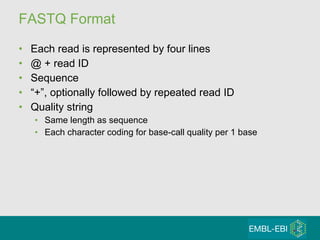
FASTQ Format Each read is represented by four lines @ + read ID Sequence “ +”, optionally followed by repeated read ID Quality string Same length as sequence Each character coding for base-call quality per 1 base
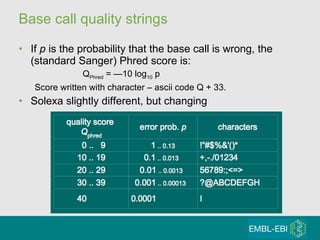
Base call quality strings If  p  is the probability that the base call is wrong, the (standard Sanger) Phred score is:   Q Phred  = —10 log 10  p Score written with character – ascii code Q + 33. Solexa slightly different, but changing
Short Read Alignment Read mapping – position within a reference sequence
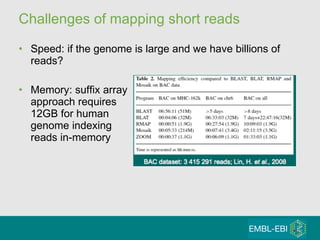
Challenges of mapping short reads Speed: if the genome is large and we have billions of reads? Memory: suffix array approach requires 12GB for human  genome indexing reads in-memory
Additional Challenges Read errors Dominant cause for mismatches Detection of substitutions? Importance of base-call quality Unknown reference genome De-novo assembly Repetitive regions/accuracy ~20% of human genome is repetitive for 32bp reads Use paired-end information
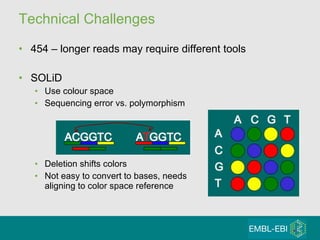
Technical Challenges 454 – longer reads may require different tools SOLiD Use colour space Sequencing error vs. polymorphism Deletion shifts colors Not easy to convert to bases, needs aligning to color space reference
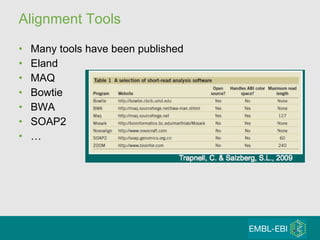
Alignment Tools Many tools have been published Eland MAQ Bowtie BWA SOAP2 …
Short read aligners - differences Speed Use on clusters Memory requirements Accuracy Good match always found? Allowed mismatches Downstream analysis tools SNP/indel callers for output format R package to read the output?
Other differences Alignment tools also differs in whether they can  make use of base-call quality scores estimate alignment quality work with paired-end data report multiple matches work with longer than normal reads match in colour space (for SOLiD systems) deal with splice junctions
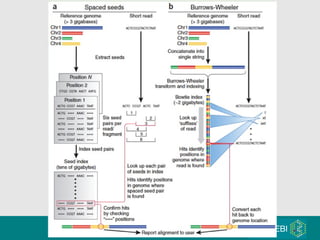
Alignment Algorithm Approaches Hashing  (seed-and-extend paradigm, k-mers + Smith-Waterman) The entire genome Straightforward, easy multi-threading, but large memory The read sequences Flexible memory footprint, harder to multi-thread Alignment by merge sorting Pros: flexible memory Cons: not easy to adapt for paired-end reads Indexing by Burrows-Wheeler Transform Pros: fast and relatively small memory Cons: not easily applicable to longer reads
 
Burrows-Wheeler Transform BWT seems to be a winning idea Very fast Accurate Bowtie, SOAP2, BWA – latest tools
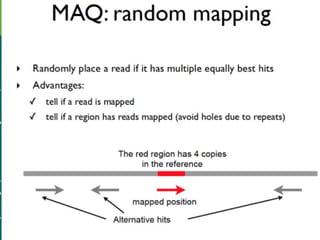
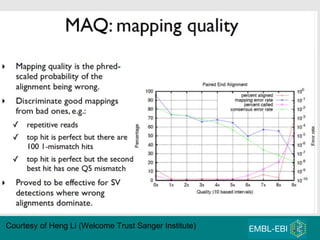
Others ELAND Part of Solexa Pipeline Very fast, does not use quality scores MAQ (Li et al., Sanger Institute) Widely used hashing-based approach Quality scores used to estimate alignment score Compatible with downstream analysis tools Can deal with SOLiD colour space To be replaced with BWA Bowtie (Langmead et al., Maryland U) Burrows-Wheeler Transform based Very fast, good accuracy Downstream tools available
Hashed Read Alignment Naïve Algorithm Make a hash table of the first 28mers of each read, so that for each 28mer, we can look up quickly which reads start with it. Then, go through the genome, base for base. For each 28mer, look up in the hash table whether reads start with it, and if so, add a note of the current genome position to these reads.  Problem: What if there are read errors in the first 28 base pairs?
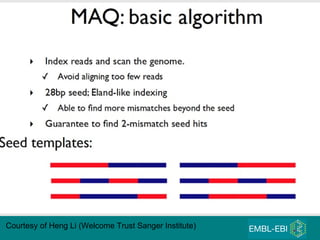
Courtesy of Heng Li (Welcome Trust Sanger Institute)
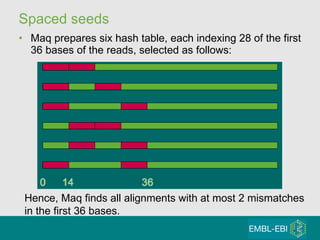
Spaced seeds Maq prepares six hash table, each indexing 28 of the first 36 bases of the reads, selected as follows: Hence, Maq finds all alignments with at most 2 mismatches in the first 36 bases.
 
Courtesy of Heng Li (Welcome Trust Sanger Institute)
Burrows-Wheeler Transform Burrows & Wheeler (1994, DEC Research) Data compression algorithm (e.g. in bzip2)
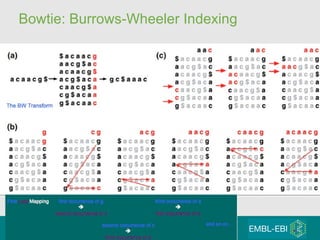
Bowtie: Burrows-Wheeler Indexing
Bowtie Reference genome suffix arrays are BW transformed and indexed Model organism genome indexes are available for download from the Bowtie webpage
Bowtie Pros  small memory footprint (1.3GB for the human genome) fast (8M reads aligned in 8 mins against the Drosophila genome) paired-end able (gapped alignment) Cons less accurate than MAQ does not support SOLiD, Helicos no gapped alignment
Other commonly used aligners SOAP and SOAP2 (Beijing Genomics Institute) with downstream tools SOAP2 uses BWT  SSAHA, SSAHA2 (Sanger Institute) one of the first short-read aligners Exonerate (EBI) not really designed for short reads but still useful  Biostrings (Bioconductor) R package under development
References Langmead, B. et al., 2009. Ultrafast and memory- efficient alignment of short DNA sequences to the human genome.  Genome Biology, 10(3), R25.  Lin, H. et al., 2008. ZOOM! Zillions of oligos mapped.  Bioinformatics, 24(21), 2431-2437.  Trapnell, C. & Salzberg, S.L., 2009. How to map billions of short reads onto genomes.  Nat Biotech, 27(5), 455-457.
HTS Assembly NGS offers the possibility to sequence anything and aligning the reads against “reference” genome is straightforward.  But what if there is no such “reference” genome?  “ de novo” assembly Aligning the reads is only the first step
Assembly Solexa reads are too short for de novo assembly of large genomes.  However, for prokaryotes and simple eukaryotes, reasonably large contigs can be assembled. Using paired-end reads with very large end separation is crucial. Assembly requires specialized software, typically based on de Brujin graphs  Most popular assembly tools:  Velvet (Zerbino et al.)  ABySS (Simpson et al.)
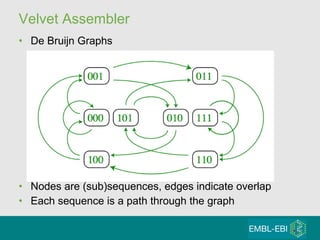
Velvet Assembler De Bruijn Graphs Nodes are (sub)sequences, edges indicate overlap Each sequence is a path through the graph
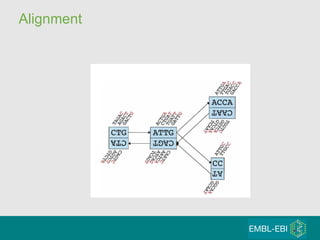
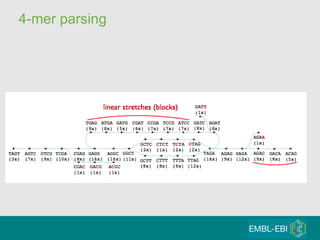
Graph Construction sequence of each read is parsed into k-mers typical k=21 for read length of 25 series of matches(k-1 long) are aligned together called a block the information of each block is the last bp of each k-mer in of the block
Alignment
Links a directed link is drawn if there exists a (k-1) long match between two blocks if everything is perfect, an underlying sequence follows all links in the de Bruijn graph while tracing through every block however, due to the noisy measurement and sequence repeats, many more steps are required
Example
4-mer parsing
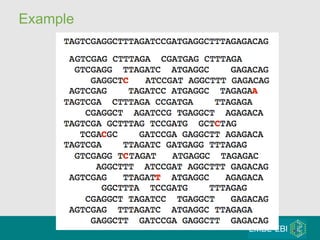
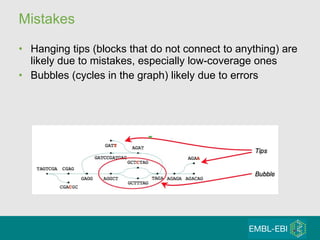
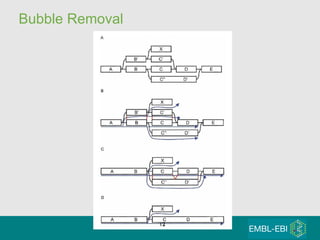
Mistakes Hanging tips (blocks that do not connect to anything) are likely due to mistakes, especially low-coverage ones Bubbles (cycles in the graph) likely due to errors
Bubble Removal
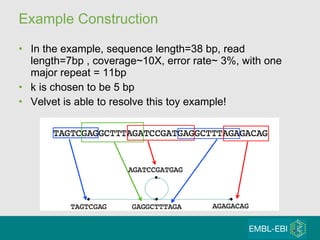
Example Construction In the example, sequence length=38 bp, read length=7bp , coverage~10X, error rate~ 3%, with one major repeat = 11bp k is chosen to be 5 bp Velvet is able to resolve this toy example!
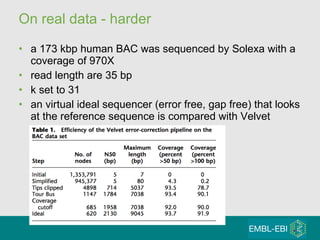
On real data - harder a 173 kbp human BAC was sequenced by Solexa with a coverage of 970X read length are 35 bp k set to 31 an virtual ideal sequencer (error free, gap free) that looks at the reference sequence is compared with Velvet
RNA-seq RNA-Seq has additional challenges Reads may straddle splice junctions Paralogy between genes prevent unique mappings One may want to incorporate or amend known gene models  Specialized tools for RNA-Seq alignment are ERANGE  TopHat  To call differential expression  edgeR  BayesSeq
Summary Alignment & assembly  far from solved A lot of areas for improvement  Performance Accuracy Tool pipelines non-existent, everyone writes their own C/C++ R/Python
Large numbers of genomes sequenced 1000+ Bacterial and Archaeal genomes 100s of fungal genomes 10s of animal and plant genomes 10s of other eukaryotes 1000 human genome project - http://1000genomes.org  1001 Arabidopsis genomes - http://1001genomes.org 1000 Drosophila genomes - http://dpgp.org  15,000 vertebrate genome project (proposed)  Metagenomics
More open areas in computational biology Image processing  Protein 3-D structure analysis and prediction  RNA structure prediction Gene network reconstruction from time series data Gene identification and annotation Gene function prediction
А cknowledgements These presentations have been supported by funding from: Sponsors of the  CS Club (St. Petersburg) EMBL EC – SYBARIS Project We thank again all the authors of the slides used in these presentations.

20100516 bioinformatics kapushesky_lecture08

  • 1.
    Bioinformatics for High-ThroughputSequencing Misha Kapushesky St. Petersburg Russia 2010 Slides: Nicolas Delhomme, Simon Anders, EMBL-EBI
  • 2.
    High-throughput Sequencing Keydifferences from Sanger sequencing Library not constructed by cloning Fragments sequenced in parallel in a flow cell Observed by a microscope + CCD camera
  • 3.
    Roche 454 2005(first to market) Pyrosequencing Read length: 250bp Paired read separation: 3kb 300Mb per day $60 per Mb Error rate: ~ 5% per bp Dominant error: indel, especially in homopolymers
  • 4.
    Illumina/Solexa Second tomarket Bridge PCR Sequencing by synthesis Read length: 32…40bp, newest models up to 100bp Paired read separation: 200bp 400Mb per day (and increasing) $2 per Mb Error rate: 1% per bp, sometimes as good as 0.1% Dominant error: substitutions
  • 5.
    ABI SOLiD Thirdto market (2007) Emulsion PCR, ligase-based sequencing Read length 50bp Paired read separation 3kb 600Mb per day Reads in colour space $1 per Mb Very low error rate <0.1% per bp (Sanger error 0.001%) Dominant error: substitutions
  • 6.
    Helicos Recent Noamplification Single-molecule polymerase sequencing Read length: 25..45bp 1200Mb per day $1 per Mb Error <1% (manufacturer)
  • 7.
    Polonator Recent EmulsionPCR, ligase-based sequencing Very short read length: 13bp Low-cost instrument ($150K) <$1 per Mb
  • 8.
    Uses for HTSDe-novo sequencing, assembly of small genomes Transcriptome analysis (RNA-seq) Resequencing to identify genetic polymorphisms SNPs, CNVs ChIP-seq DNA methylation studies Metagenomics …
  • 9.
    Multiplexing Solexa: 6-12mln 36bp reads per lane One lane for one sample – wasteful Multiplexing: incorporate tags between sequencing primer and sample fragments to distinguish several samples in the same lane
  • 10.
    Targeted Sequencing Insteadof whole genome, sequence only regions of interest but deep Microarrays can help to select fragments of interest
  • 11.
    Paired end sequencingThe two ends of the fragments get different adapters Hence, one can sequence from one end with one primer, then repeat to get the other end with the other primer. This yields “pairs” of reads, separated by a known distance (200bp for Illumina). For large distances, “circularisation” might be needed and generates “mate pairs”.
  • 12.
    Paired end readuses Useful to find: Micro indels Copy-number variations Assembly tasks Splice variants
  • 13.
    Bioinformatics Problems AssemblyAlignment Statistics Visualization
  • 14.
  • 15.
    Firecrest Output Tab-separatedtext files, one row per cluster Lane & tile index X,Y coordinates of cluster For each cycle, group of four numbers – fluorescence intensities for A, G, C, T
  • 16.
    Bustard output Twotab-separated text files, one row per cluster “ seq.txt” Lane and tile index, x and y coordinates Called sequence as string of A, G, C, T “ prb.txt” Phred-like scores [-40,40] One value per called base
  • 17.
    FASTQ format @HWI-EAS225:3:1:2:854#0/1GGGGGGAAGTCGGCAAAATAGATCCGTAACTTCGGG +HWI-EAS225:3:1:2:854#0/1 a`abbbbabaabbababb^`[aaa`_N]b^ab^``a @HWI-EAS225:3:1:2:1595#0/1 GGGAAGATCTCAAAAACAGAAGTAAAACATCGAACG +HWI-EAS225:3:1:2:1595#0/1 a`abbbababbbabbbbbbabb`aaababab\aa_`
  • 18.
    FASTQ Format Eachread is represented by four lines @ + read ID Sequence “ +”, optionally followed by repeated read ID Quality string Same length as sequence Each character coding for base-call quality per 1 base
  • 19.
    Base call qualitystrings If p is the probability that the base call is wrong, the (standard Sanger) Phred score is: Q Phred = —10 log 10 p Score written with character – ascii code Q + 33. Solexa slightly different, but changing
  • 20.
    Short Read AlignmentRead mapping – position within a reference sequence
  • 21.
    Challenges of mappingshort reads Speed: if the genome is large and we have billions of reads? Memory: suffix array approach requires 12GB for human genome indexing reads in-memory
  • 22.
    Additional Challenges Readerrors Dominant cause for mismatches Detection of substitutions? Importance of base-call quality Unknown reference genome De-novo assembly Repetitive regions/accuracy ~20% of human genome is repetitive for 32bp reads Use paired-end information
  • 23.
    Technical Challenges 454– longer reads may require different tools SOLiD Use colour space Sequencing error vs. polymorphism Deletion shifts colors Not easy to convert to bases, needs aligning to color space reference
  • 24.
    Alignment Tools Manytools have been published Eland MAQ Bowtie BWA SOAP2 …
  • 25.
    Short read aligners- differences Speed Use on clusters Memory requirements Accuracy Good match always found? Allowed mismatches Downstream analysis tools SNP/indel callers for output format R package to read the output?
  • 26.
    Other differences Alignmenttools also differs in whether they can make use of base-call quality scores estimate alignment quality work with paired-end data report multiple matches work with longer than normal reads match in colour space (for SOLiD systems) deal with splice junctions
  • 27.
    Alignment Algorithm ApproachesHashing (seed-and-extend paradigm, k-mers + Smith-Waterman) The entire genome Straightforward, easy multi-threading, but large memory The read sequences Flexible memory footprint, harder to multi-thread Alignment by merge sorting Pros: flexible memory Cons: not easy to adapt for paired-end reads Indexing by Burrows-Wheeler Transform Pros: fast and relatively small memory Cons: not easily applicable to longer reads
  • 28.
  • 29.
    Burrows-Wheeler Transform BWTseems to be a winning idea Very fast Accurate Bowtie, SOAP2, BWA – latest tools
  • 30.
    Others ELAND Partof Solexa Pipeline Very fast, does not use quality scores MAQ (Li et al., Sanger Institute) Widely used hashing-based approach Quality scores used to estimate alignment score Compatible with downstream analysis tools Can deal with SOLiD colour space To be replaced with BWA Bowtie (Langmead et al., Maryland U) Burrows-Wheeler Transform based Very fast, good accuracy Downstream tools available
  • 31.
    Hashed Read AlignmentNaïve Algorithm Make a hash table of the first 28mers of each read, so that for each 28mer, we can look up quickly which reads start with it. Then, go through the genome, base for base. For each 28mer, look up in the hash table whether reads start with it, and if so, add a note of the current genome position to these reads. Problem: What if there are read errors in the first 28 base pairs?
  • 32.
    Courtesy of HengLi (Welcome Trust Sanger Institute)
  • 33.
    Spaced seeds Maqprepares six hash table, each indexing 28 of the first 36 bases of the reads, selected as follows: Hence, Maq finds all alignments with at most 2 mismatches in the first 36 bases.
  • 34.
  • 35.
    Courtesy of HengLi (Welcome Trust Sanger Institute)
  • 36.
    Burrows-Wheeler Transform Burrows& Wheeler (1994, DEC Research) Data compression algorithm (e.g. in bzip2)
  • 37.
  • 38.
    Bowtie Reference genomesuffix arrays are BW transformed and indexed Model organism genome indexes are available for download from the Bowtie webpage
  • 39.
    Bowtie Pros small memory footprint (1.3GB for the human genome) fast (8M reads aligned in 8 mins against the Drosophila genome) paired-end able (gapped alignment) Cons less accurate than MAQ does not support SOLiD, Helicos no gapped alignment
  • 40.
    Other commonly usedaligners SOAP and SOAP2 (Beijing Genomics Institute) with downstream tools SOAP2 uses BWT SSAHA, SSAHA2 (Sanger Institute) one of the first short-read aligners Exonerate (EBI) not really designed for short reads but still useful Biostrings (Bioconductor) R package under development
  • 41.
    References Langmead, B.et al., 2009. Ultrafast and memory- efficient alignment of short DNA sequences to the human genome. Genome Biology, 10(3), R25. Lin, H. et al., 2008. ZOOM! Zillions of oligos mapped. Bioinformatics, 24(21), 2431-2437. Trapnell, C. & Salzberg, S.L., 2009. How to map billions of short reads onto genomes. Nat Biotech, 27(5), 455-457.
  • 42.
    HTS Assembly NGSoffers the possibility to sequence anything and aligning the reads against “reference” genome is straightforward. But what if there is no such “reference” genome? “ de novo” assembly Aligning the reads is only the first step
  • 43.
    Assembly Solexa readsare too short for de novo assembly of large genomes. However, for prokaryotes and simple eukaryotes, reasonably large contigs can be assembled. Using paired-end reads with very large end separation is crucial. Assembly requires specialized software, typically based on de Brujin graphs Most popular assembly tools: Velvet (Zerbino et al.) ABySS (Simpson et al.)
  • 44.
    Velvet Assembler DeBruijn Graphs Nodes are (sub)sequences, edges indicate overlap Each sequence is a path through the graph
  • 45.
    Graph Construction sequenceof each read is parsed into k-mers typical k=21 for read length of 25 series of matches(k-1 long) are aligned together called a block the information of each block is the last bp of each k-mer in of the block
  • 46.
  • 47.
    Links a directedlink is drawn if there exists a (k-1) long match between two blocks if everything is perfect, an underlying sequence follows all links in the de Bruijn graph while tracing through every block however, due to the noisy measurement and sequence repeats, many more steps are required
  • 48.
  • 49.
  • 50.
    Mistakes Hanging tips(blocks that do not connect to anything) are likely due to mistakes, especially low-coverage ones Bubbles (cycles in the graph) likely due to errors
  • 51.
  • 52.
    Example Construction Inthe example, sequence length=38 bp, read length=7bp , coverage~10X, error rate~ 3%, with one major repeat = 11bp k is chosen to be 5 bp Velvet is able to resolve this toy example!
  • 53.
    On real data- harder a 173 kbp human BAC was sequenced by Solexa with a coverage of 970X read length are 35 bp k set to 31 an virtual ideal sequencer (error free, gap free) that looks at the reference sequence is compared with Velvet
  • 54.
    RNA-seq RNA-Seq hasadditional challenges Reads may straddle splice junctions Paralogy between genes prevent unique mappings One may want to incorporate or amend known gene models Specialized tools for RNA-Seq alignment are ERANGE TopHat To call differential expression edgeR BayesSeq
  • 55.
    Summary Alignment &assembly far from solved A lot of areas for improvement Performance Accuracy Tool pipelines non-existent, everyone writes their own C/C++ R/Python
  • 56.
    Large numbers ofgenomes sequenced 1000+ Bacterial and Archaeal genomes 100s of fungal genomes 10s of animal and plant genomes 10s of other eukaryotes 1000 human genome project - http://1000genomes.org 1001 Arabidopsis genomes - http://1001genomes.org 1000 Drosophila genomes - http://dpgp.org 15,000 vertebrate genome project (proposed) Metagenomics
  • 57.
    More open areasin computational biology Image processing Protein 3-D structure analysis and prediction RNA structure prediction Gene network reconstruction from time series data Gene identification and annotation Gene function prediction
  • 58.
    А cknowledgements Thesepresentations have been supported by funding from: Sponsors of the CS Club (St. Petersburg) EMBL EC – SYBARIS Project We thank again all the authors of the slides used in these presentations.

Editor's Notes

  • #24 In contrast to other sequencing systems, SOLiD data are not collected directly as DNA sequences, but instead are recorded in ‘color space’, in which the individual values (colors) within a read provide information about (but not a definite identification of) two adjacent bases. Without a decoding step, in which color data are converted to sequence data, they cannot be mapped to a reference genome using conventional alignment tools. Direct conversion of color data to sequence data, however, has a significant drawback—reads that contain sequencing errors cannot be converted accurately (in translating a color space string, all bases after a sequencing error will be translated incorrectly).
  • #29 Algorithms based on spaced-seed indexing, such as Maq, index the reads as follows: each position in the reference is cut into equal-sized pieces, called &apos;seeds&apos; and these seeds are paired and stored in a lookup table. Each read is also cut up according to this scheme, and pairs of seeds are used as keys to look up matching positions in the reference. Because seed indices can be very large, some algorithms (including Maq) index the reads in batches and treat substrings of the reference as queries. (b) Algorithms based on the Burrows-Wheeler transform, such as Bowtie, store a memory-efficient representation of the reference genome. Reads are aligned character by character from right to left against the transformed string. With each new character, the algorithm updates an interval (indicated by blue &apos;beams&apos;) in the transformed string. When all characters in the read have been processed, alignments are represented by any positions within the interval. Burrows-Wheeler–based algorithms can run substantially faster than spaced seed approaches, primarily owing to the memory efficiency of the Burrows-Wheeler search. Chr., chromosome.