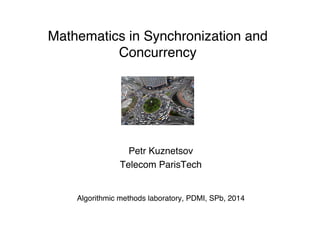
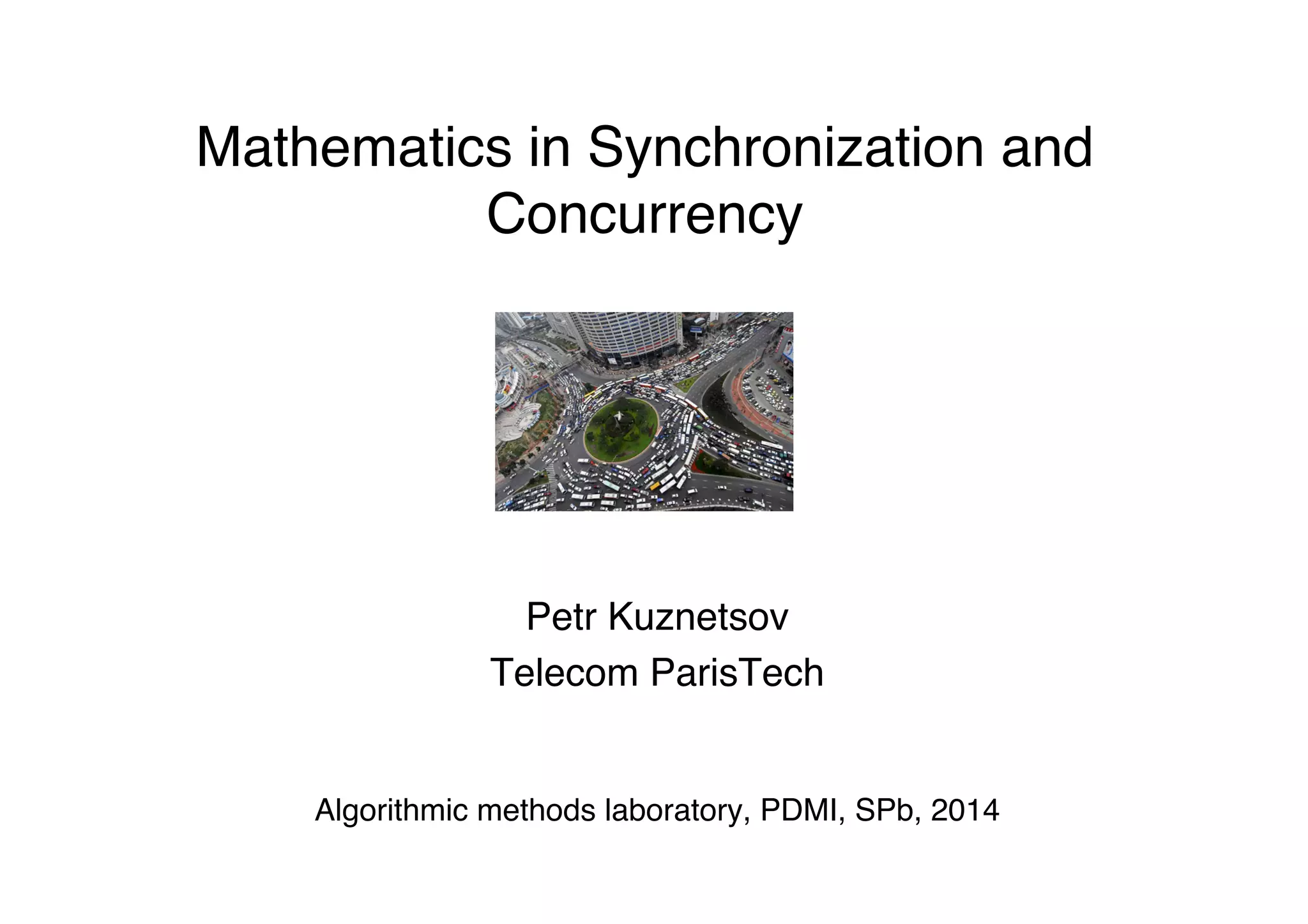

Mathematics in Synchronization and
Concurrency 


"
Petr Kuznetsov"
Telecom ParisTech"
"
"
Algorithmic methods laboratory, PDMI, SPb, 2014"
"
Télécom ParisTech"
§  A.k.a. ENST (École nationale supérieure des
télécommunications)"
§  Member of ParisTech and Mines-Telecom ""
§  One the most known “grandes écoles”"
§  One of the founders of Eurécom"
§  Research labs:"
ü INFRES – computer science and networking"
ü COMELEC – electronics and communication"
ü TSI – signal and image processing "
ü SES – economics and social sciences"
§  Research internship/PhD at INFRES:
petr.kuznetsov@telecom-paristech.fr"
©	
  2014	
  P.	
  Kuznetsov	
  	
  
"
"
What is computing?"
"
"
"
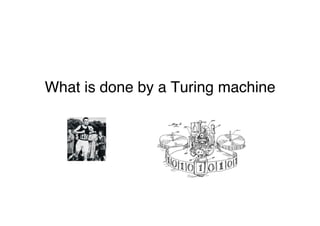
What is done by a Turing machine"
"
"
"
"
"
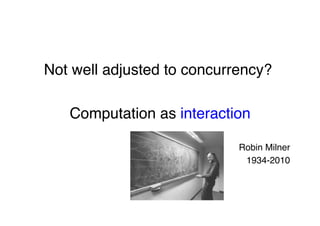
Not well adjusted to concurrency?"
"
Computation as interaction"
"
Robin Milner"
1934-2010"
"
"
Distributed computing model:"
independent sequential processes
that communicate"
"
"
©	
  2014	
  P.	
  Kuznetsov	
  	
  
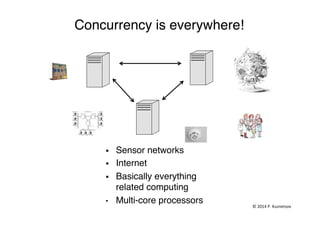
Concurrency is everywhere!"
§  Sensor networks"
§  Internet"
§  Basically everything
related computing"
•  Multi-core processors"
©	
  2014	
  P.	
  Kuznetsov	
  	
  
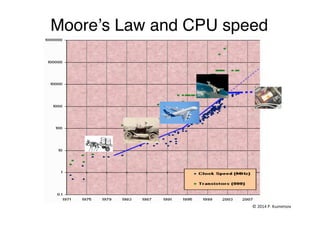
Moore’s Law and CPU speed"
©	
  2014	
  P.	
  Kuznetsov	


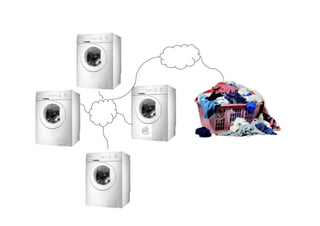
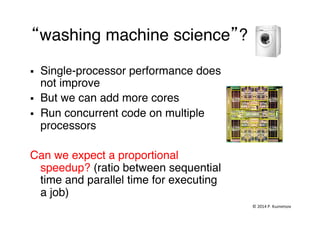
“washing machine science”?"
§  Single-processor performance does
not improve"
§  But we can add more cores"
§  Run concurrent code on multiple
processors"
Can we expect a proportional
speedup? (ratio between sequential
time and parallel time for executing
a job)"
©	
  2014	
  P.	
  Kuznetsov	
  	
  
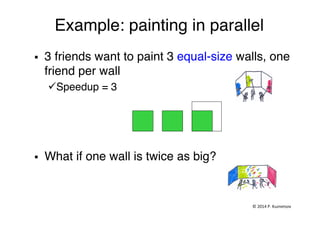
Example: painting in parallel"
§  3 friends want to paint 3 equal-size walls, one
friend per wall"
ü Speedup = 3"
"
§  What if one wall is twice as big?"
©	
  2014	
  P.	
  Kuznetsov	
  	
  
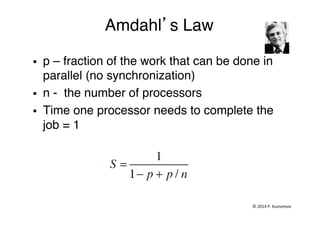
Amdahl’s Law"
§  p – fraction of the work that can be done in
parallel (no synchronization)"
§  n - the number of processors"
§  Time one processor needs to complete the
job = 1"
©	
  2014	
  P.	
  Kuznetsov	
  	
  
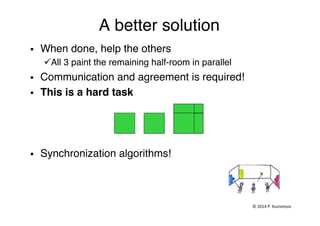
A better solution"
§  When done, help the others "
ü All 3 paint the remaining half-room in parallel "
§  Communication and agreement is required!"
§  This is a hard task!
§  Synchronization algorithms!"
"
©	
  2014	
  P.	
  Kuznetsov	
  	
  
Why synchronize ?"
§  Concurrent accesses to a shared resource (e.g., a file) may
lead to an inconsistent state "
ü Non-deterministic result (race condition): the resulting state
depends on the scheduling"
§  Concurrent accesses need to be synchronized!
ü E. g., decide who is allowed to update a given part of the file at a
given time"
§  Code leading to a race condition is called critical section!
ü Must be (or appear to be) executed sequentially"
§  Synchronization problems: mutual exclusion, readers-
writers, producer-consumer, …"
§  Synchronization abstractions: semaphores, TAS, CAS,
queues, skip-lists, dictionaries, transactional memory "
©	
  2014	
  P.	
  Kuznetsov	
  	
  
Challenges"
§  What is correct?"
ü Safety and liveness"
§  What is the cost of synchronization?"
ü Time and space lower bounds"
§  Failures/asynchrony"
ü Fault-tolerant synchronization?"
§  How to distinguish possible from impossible? "
ü Impossibility results"
"
©	
  2014	
  P.	
  Kuznetsov	
  	
  
Distributed ≠ Parallel"
§  The main challenge is synchronization despite
uncertainty (failures, asynchrony)"
"
§  “you know you have a distributed system
when the crash of a computer you’ve never
heard of stops you from getting any work
done” (Lamport)"
©	
  2014	
  P.	
  Kuznetsov	
  	
  
Why theory of distributed computing?"
§  Every computing system is distributed"
§  Computing getting mission-critical"
ü Understanding fundamentals is crucial"
§  Intellectual challenge "
ü A distinct math domain?"
©	
  2014	
  P.	
  Kuznetsov	
  	
  
History"
§  Dining philosophers, mutual exclusion
(Dijkstra )~60’s"
§  Distributed computing, logical clocks (Lamport),
distributed transactions (Gray) ~70’s"
§  Consensus (Lynch) ~80’s"
§  Distributed programming models ~90’s"
§  Multicores, HTM now"
§  Principal conferences: PODC, DISC, SPAA,
ICDCS, STOC, FOCS, …"
©	
  2014	
  P.	
  Kuznetsov	
  	
  
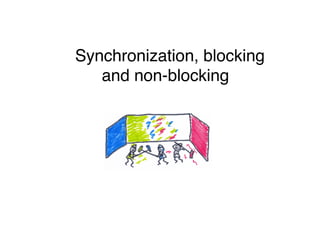
Synchronization, blocking 

and non-blocking

"
Producer-consumer (bounded buffer) problem
§  Producers put items in the buffer (of bounded size)"
§  Consumers get items from the buffer"
§  Every item is consumed, no item is consumed twice"
"(Client-server, multi-threaded web servers, pipes, …)"
Why synchronization? Items can get lost or consumed twice:"
"
Producer!
/* produce item */!
while (counter==MAX);!
buffer[in] = item !
in = (in+1) % MAX;!
counter++; !!
Consumer!
/* to consume item */!
while (counter==0); !
item=buffer[out];!
out=(out+1) % MAX;!
counter--; !
/* consume item */!
!
Race!
©	
  2014	
  P.	
  Kuznetsov	
  	
  
Synchronization tools
§  Semaphores (locks), monitors
§  Nonblocking synchronization
§  Transactional memory
©	
  2014	
  P.	
  Kuznetsov	
  	
  
Semaphores for producer-consumer
§  2 semaphores used :"
ü empty: indicates empty slots in the buffer (to be used by the producer)"
ü full: indicates full slots in the buffer (to be read by the consumer)"
shared semaphores empty := MAX, full := 0;!
Producer" Consumer"
P(empty)!
buffer[in] = item; !
in = (in+1) % MAX;!
V(full)!
!
!
P(full);!
item = buffer[out];!
out=(out+1) % MAX; !
V(empty);!
©	
  2014	
  P.	
  Kuznetsov	
  	
  
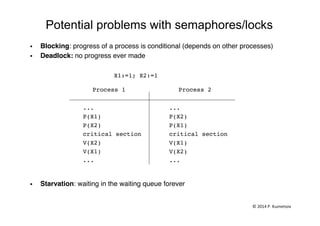
Potential problems with semaphores/locks
§  Blocking: progress of a process is conditional (depends on other processes)"
§  Deadlock: no progress ever made!
"
!
§  Starvation: waiting in the waiting queue forever"
X1:=1; X2:=1!
Process 1! Process 2!
...!
P(X1)!
P(X2)!
critical section!
V(X2)!
V(X1)!
...!
...!
P(X2)!
P(X1)!
critical section!
V(X1)!
V(X2)!
...!
©	
  2014	
  P.	
  Kuznetsov	
  	
  
Non-blocking algorithms"
A process makes progress, regardless of the other processes"
shared buffer[MAX]:=empty; head:=0; tail:=0;"
Producer put(item)! Consumer get()!
if (tail-head == MAX){!
!return(full);!
}!
buffer[tail%MAX]=item; !
tail++;!
return(ok);!
if (tail-head == 0){!
!return(empty);!
}!
item=buffer[head%MAX]; !
head++;!
return(item);!
Problems: "
•  works for 2 processes but hard to say why it works J"
•  multiple producers/consumers? Other synchronization pbs?"
(highly non-trivial in general)"
©	
  2014	
  P.	
  Kuznetsov	
  	
  
Transactional memory"
§  Mark sequences of instructions as an atomic transaction, e.g., the resulting
producer code:"
atomic {!
!if (tail-head == MAX){!
!return full;!
!}!
!items[tail%MAX]=item; !
!tail++;!
}!
return ok;!
§  A transaction can be either committed or aborted!
ü Committed transactions are serializable !
ü + aborted/incomplete transactions are consistent (opacity/local serializability)!
ü Let the transactional memory (TM) care about the conflicts"
ü Easy to program, but performance may be problematic"
©	
  2014	
  P.	
  Kuznetsov	
  	
  
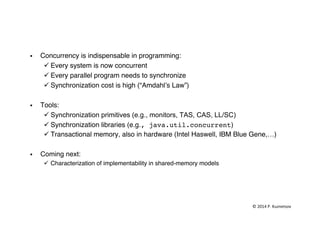
§  Concurrency is indispensable in programming:"
ü Every system is now concurrent"
ü Every parallel program needs to synchronize"
ü Synchronization cost is high (“Amdahl’s Law”)"
§  Tools: "
ü Synchronization primitives (e.g., monitors, TAS, CAS, LL/SC)"
ü Synchronization libraries (e.g., java.util.concurrent)"
ü Transactional memory, also in hardware (Intel Haswell, IBM Blue Gene,…)"
§  Coming next:"
ü  Characterization of implementability in shared-memory models"
" ©	
  2014	
  P.	
  Kuznetsov	
  	
  
Characterization of Distributed
Computing Models

"
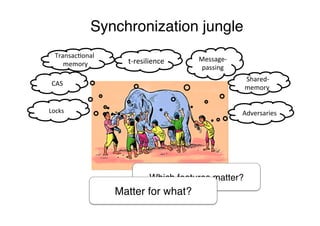
t-­‐resilience	
  
CAS	
  
Locks	
  
Transac>onal	
  
memory	
  
Message-­‐
passing	
  
	
  Shared-­‐
memory	
  
Which features matter?"
Matter for what?"
Synchronization jungle"
	
  Adversaries	
  
A characterization?"
"
§  finding an equivalent (simpler) representation
of an object"
"
§  creating characters for a narrative"
ü Which characters matter? Equivalence results?"
©	
  2014	
  P.	
  Kuznetsov	
  	
  
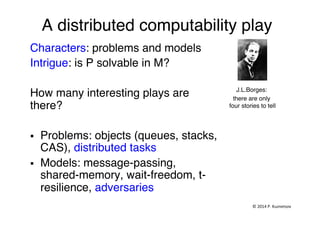
A distributed computability play"
Characters: problems and models"
Intrigue: is P solvable in M? "
"
How many interesting plays are
there?"
""
§  Problems: objects (queues, stacks,
CAS), distributed tasks"
§  Models: message-passing,
shared-memory, wait-freedom, t-
resilience, adversaries"
J.L.Borges:"
there are only
four stories to tell"
©	
  2014	
  P.	
  Kuznetsov	
  	
  
Task solvability in read-write"
§  A task (I,O,Δ):"
ü Set of input vectors I"
ü Set of output vectors O"
ü Task specification Δ: I è 2O"
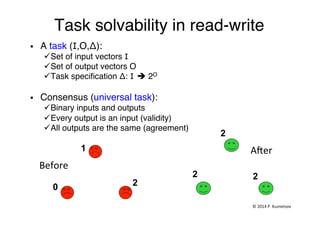
§  Consensus (universal task): "
ü Binary inputs and outputs"
ü Every output is an input (validity)"
ü All outputs are the same (agreement)"
"
"
©	
  2014	
  P.	
  Kuznetsov	
  	
  
Before	
  
AHer	
  
0
1
2
2
2
2
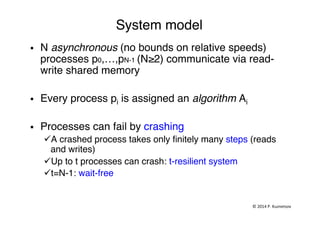
System model"
§  N asynchronous (no bounds on relative speeds)
processes p0,…,pN-1 (N≥2) communicate via read-
write shared memory"
§  Every process pi is assigned an algorithm Ai"
§  Processes can fail by crashing "
ü A crashed process takes only finitely many steps (reads
and writes)"
ü Up to t processes can crash: t-resilient system "
ü t=N-1: wait-free "
"
©	
  2014	
  P.	
  Kuznetsov	
  	
  
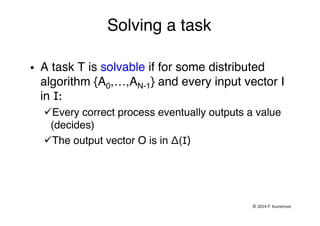
Solving a task"
"
§  A task T is solvable if for some distributed
algorithm {A0,…,AN-1} and every input vector I
in I:"
ü Every correct process eventually outputs a value
(decides)"
ü The output vector O is in Δ(I) "
©	
  2014	
  P.	
  Kuznetsov	
  	
  
An easy story to tell"
"
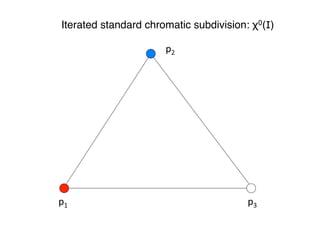
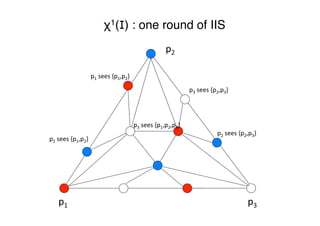
Task solvability in the iterated immediate
snapshot (IIS) memory model "
§  Processes proceed in rounds"
§  Each round a new memory is accessed:"
ü Write the current state"
ü Get a snapshot of the memory "
ü Equivalent the standard (non-iterated) read-write
model [BGK14]"
§  Visualized via standard chromatic subdivision
χk(I) [BG97,Lin09,Koz14]"
©	
  2014	
  P.	
  Kuznetsov	
  	
  
Iterated standard chromatic subdivision: χ0(I)"
p1	
   p3	
  
p2	
  
χ1(I) : one round of IIS"
p1	
   p3	
  
p2	
  
p2	
  sees	
  {p1,p2}	
  
p1	
  sees	
  {p1,p2}	
  
p3	
  sees	
  {p1,p2,p3}	
  
p2	
  sees	
  {p2,p3}	
  
p3	
  sees	
  {p2,p3}	
  
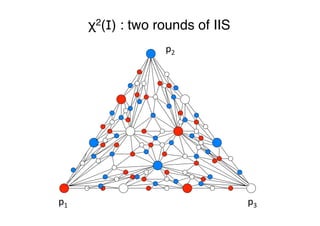
χ2(I) : two rounds of IIS"
p1	
   p3	
  
p2	
  
Impossibility of wait-free consensus [FLP85,LA87]"
Theorem 1 No wait-free algorithm solves consensus"
"
We give the proof for N=2, assuming that "
"p0 proposes 0 and p1 proposes 1"
"
"
Implies the claim for all N≥2"
"
©	
  2014	
  P.	
  Kuznetsov	
  	
  
Proof of Theorem 1"
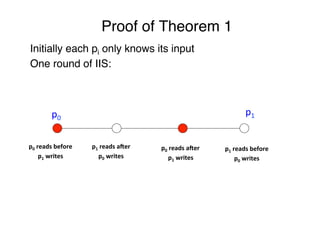
p0	
  
p1	
  
p0	
  reads	
  before	
  	
  
p1	
  writes	
  
p0	
  reads	
  a0er	
  	
  
p1	
  writes	
  
p1	
  reads	
  a0er	
  	
  
p0	
  writes	
  
p1	
  reads	
  before	
  	
  
p0	
  writes	
  
Initially each pi only knows its input"
One round of IIS:"
Proof of Theorem 1"
p0	
  
p1	
  
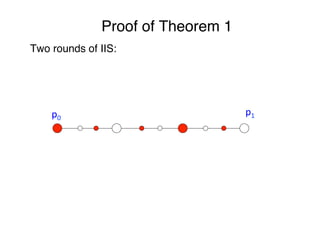
Two rounds of IIS:"
Proof of Theorem 1"
p0	
  
p1	
  
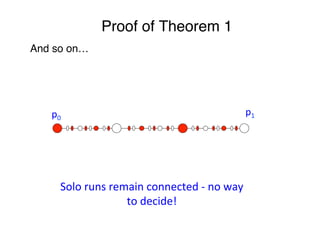
And so on…"
Solo	
  runs	
  remain	
  connected	
  -­‐	
  no	
  way	
  
to	
  decide!	
  	
  
Proof of Theorem 1"
p0	
  
p1	
  
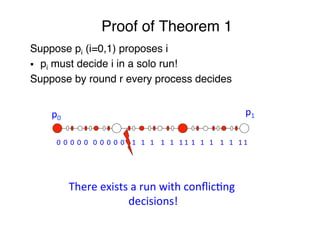
Suppose pi (i=0,1) proposes i"
§  pi must decide i in a solo run!"
Suppose by round r every process decides"
"
There	
  exists	
  a	
  run	
  with	
  conflic>ng	
  
decisions!	
  
0	
   0	
   0	
   0	
   0	
   1	
  1	
  0	
   0	
   0	
   0	
   0	
   1	
  1	
  1	
  1	
  1	
  1	
  1	
  1	
  1	
  1	
  1	
  1	
  
Thus"
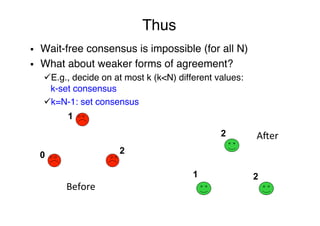
§  Wait-free consensus is impossible (for all N)"
§  What about weaker forms of agreement?"
ü E.g., decide on at most k (k<N) different values:
k-set consensus"
ü k=N-1: set consensus"
"
Before	
  
AHer	
  
0
1
2
1
2
2
Impossibility of set consensus"
Theorem 2 No wait-free algorithm solves set
agreement in read-write"
"
§  Starting with N values, there is no way to drop one
(decide on at most N-1)"
"
§  Implies the impossibility of wait-free k-set consensus
for all k≤N-1"
Solving set consensus in IIS"
§  Each pi proposes its id i"
§  There is an IIS round r, such that each process
(that reaches round r) outputs some id "
§  In each run, the set of output ids is a subset of
participants of size ≤N-1"
"
Implies Sperner coloring of the subdivided simplex
IISr "
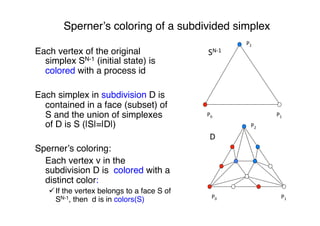
Sperner’s coloring of a subdivided simplex"
Each vertex of the original
simplex SN-1 (initial state) is
colored with a process id "
"
Each simplex in subdivision D is
contained in a face (subset) of
S and the union of simplexes
of D is S (|S|=|D|) "
"
Sperner’s coloring:"
"Each vertex v in the
subdivision D is colored with a
distinct color:"
ü If the vertex belongs to a face S of
SN-1, then d is in colors(S) "
"
P0	
   P1	
  
P2	
  
P0	
   P1	
  
P2	
  
SN-­‐1	
  
D	
  
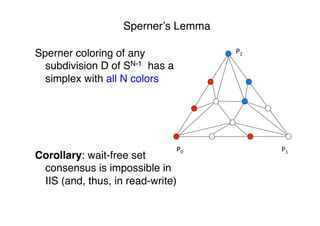
Sperner’s Lemma"
Sperner coloring of any
subdivision D of SN-1 has a
simplex with all N colors"
"
"
"
"
Corollary: wait-free set
consensus is impossible in
IIS (and, thus, in read-write)"
P0	
   P1	
  
P2	
  
Characterization of wait-free task
solvability"
Asynchronous computability theorem[HS93]"
A task (I,O,Δ) is wait-free RW solvable if and
only if there is a chromatic simplicial map from a
subdivision χk(I) to O carried by Δ"
"
Wait-free task computability reduced to the
existence of continuous maps between
geometrical objects"
"
"
1-resilient consensus?

k-resilient k-set agreement?""
"
NO"
"
Operational model equivalence:"
"
§  t-resilient N-process ó wait-free (t+1)-process
[BG93] (for colorless task, e.g. k-set agreement)"
"
[Main tool – protocol simulations]"
"
What about…"
§  Generic sub-models of RW"
ü Many problems cannot be solved
wait-free"
ü So restrictions (sub-models) of RW
were considered"
ü E.g., adversarial models [DFGT09]:
specifying the possible correct sets"
●  Non-uniform/correlated fault probabilities"
●  Hitting set of size 1: a leader can be
elected"
"
"
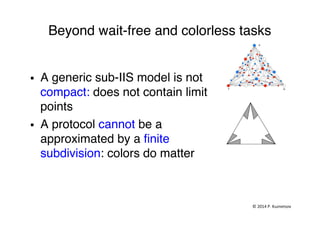
Beyond wait-free and colorless tasks "
§  A generic sub-IIS model is not
compact: does not contain limit
points "
§  A protocol cannot be a
approximated by a finite
subdivision: colors do matter "
©	
  2014	
  P.	
  Kuznetsov	
  	
  
Terminating subdivisions [GKM14]"
A (possibly infinite) subdivision that
allows processes to stabilize (models
outputs): stable simplices stop
subdividing"
A terminating subdivision must be
compatible with the model: every run
eventually lands in a stable simplex "
©	
  2014	
  P.	
  Kuznetsov	
  	
  
Generalized asynchronous
computability theorem [GMK14]"
A task (I,O,Δ) is solvable in a sub-IIS model M if and
only if there exists a terminating subdivision T of I
(compatible with M) and a chromatic simplicial map
from stable simplices of T to O carried by Δ "
"
Topological characterization of every task facing
every (crash) adversary?"
What about stronger ones? What about
long-lived problems?"
"
"
©	
  2014	
  P.	
  Kuznetsov	
  	
  
Open problems"
§  Modeling and characterization"
ü Long-lived abstractions (queues, hash tables,
TMs…)"
ü Byzantine adversary: a faulty process deviates
arbitrarily"
ü Partial synchrony"
§  Complexity bounds"
ü Time (number of steps) and space (amount of
memory/communication)"
ü Optimal algorithm design"
§  Mathematics induced by DC"
ü filling the gap between the (too abstract)
algebraic/combinatorial topology and
algorithms"
"
©	
  2014	
  P.	
  Kuznetsov	
  	
  
ANR-DFG Cooperation 2014 


Mathematical Methods in Distributed
Computing (DISCMAT)"
Partners:"
"
Petr Kuznetsov, Telecom ParisTech (coord.)"
Dmitry Kozlov, U Bremen"
Michel Raynal, U Rennes I"
"
"
"
References"
§  E. Gafni, P. Kuznetsov, C. Manolescu: A
generalized asynchronous computability
theorem. PODC 2014"
§  Z. Bouzid, E. Gafni, P. Kuznetsov: Strong
Equivalence Relations for Iterated Models.
OPODIS 2014"
§  M. Herlihy, S. Kozlov, S. Rajsbaum:
Distributed computing through combinatorial
topology. Morgan Kaufmann, 2014 "
§  More: http://perso.telecom-paristech.fr/
~kuznetso/ "
©	
  2014	
  P.	
  Kuznetsov	
  	
  
"
"
"
Спасибо!"
"

20141223 kuznetsov distributed

  • 1.
    
 Mathematics in Synchronizationand Concurrency 
 
 " Petr Kuznetsov" Telecom ParisTech" " " Algorithmic methods laboratory, PDMI, SPb, 2014" "
  • 2.
    Télécom ParisTech" §  A.k.a.ENST (École nationale supérieure des télécommunications)" §  Member of ParisTech and Mines-Telecom "" §  One the most known “grandes écoles”" §  One of the founders of Eurécom" §  Research labs:" ü INFRES – computer science and networking" ü COMELEC – electronics and communication" ü TSI – signal and image processing " ü SES – economics and social sciences" §  Research internship/PhD at INFRES: petr.kuznetsov@telecom-paristech.fr" ©  2014  P.  Kuznetsov    
  • 3.
  • 4.
    " " What is doneby a Turing machine" " " " "
  • 5.
    " Not well adjustedto concurrency?" " Computation as interaction" " Robin Milner" 1934-2010"
  • 6.
    " " Distributed computing model:" independentsequential processes that communicate" " " ©  2014  P.  Kuznetsov    
  • 7.
    Concurrency is everywhere!" § Sensor networks" §  Internet" §  Basically everything related computing" •  Multi-core processors" ©  2014  P.  Kuznetsov    
  • 8.
    Moore’s Law andCPU speed" ©  2014  P.  Kuznetsov    
  • 11.
    
 “washing machine science”?" § Single-processor performance does not improve" §  But we can add more cores" §  Run concurrent code on multiple processors" Can we expect a proportional speedup? (ratio between sequential time and parallel time for executing a job)" ©  2014  P.  Kuznetsov    
  • 12.
    Example: painting inparallel" §  3 friends want to paint 3 equal-size walls, one friend per wall" ü Speedup = 3" " §  What if one wall is twice as big?" ©  2014  P.  Kuznetsov    
  • 13.
    Amdahl’s Law" §  p– fraction of the work that can be done in parallel (no synchronization)" §  n - the number of processors" §  Time one processor needs to complete the job = 1" ©  2014  P.  Kuznetsov    
  • 14.
    A better solution" § When done, help the others " ü All 3 paint the remaining half-room in parallel " §  Communication and agreement is required!" §  This is a hard task! §  Synchronization algorithms!" " ©  2014  P.  Kuznetsov    
  • 15.
    Why synchronize ?" § Concurrent accesses to a shared resource (e.g., a file) may lead to an inconsistent state " ü Non-deterministic result (race condition): the resulting state depends on the scheduling" §  Concurrent accesses need to be synchronized! ü E. g., decide who is allowed to update a given part of the file at a given time" §  Code leading to a race condition is called critical section! ü Must be (or appear to be) executed sequentially" §  Synchronization problems: mutual exclusion, readers- writers, producer-consumer, …" §  Synchronization abstractions: semaphores, TAS, CAS, queues, skip-lists, dictionaries, transactional memory " ©  2014  P.  Kuznetsov    
  • 16.
    Challenges" §  What iscorrect?" ü Safety and liveness" §  What is the cost of synchronization?" ü Time and space lower bounds" §  Failures/asynchrony" ü Fault-tolerant synchronization?" §  How to distinguish possible from impossible? " ü Impossibility results" " ©  2014  P.  Kuznetsov    
  • 17.
    Distributed ≠ Parallel" § The main challenge is synchronization despite uncertainty (failures, asynchrony)" " §  “you know you have a distributed system when the crash of a computer you’ve never heard of stops you from getting any work done” (Lamport)" ©  2014  P.  Kuznetsov    
  • 18.
    Why theory ofdistributed computing?" §  Every computing system is distributed" §  Computing getting mission-critical" ü Understanding fundamentals is crucial" §  Intellectual challenge " ü A distinct math domain?" ©  2014  P.  Kuznetsov    
  • 19.
    History" §  Dining philosophers,mutual exclusion (Dijkstra )~60’s" §  Distributed computing, logical clocks (Lamport), distributed transactions (Gray) ~70’s" §  Consensus (Lynch) ~80’s" §  Distributed programming models ~90’s" §  Multicores, HTM now" §  Principal conferences: PODC, DISC, SPAA, ICDCS, STOC, FOCS, …" ©  2014  P.  Kuznetsov    
  • 20.
  • 21.
    Producer-consumer (bounded buffer)problem §  Producers put items in the buffer (of bounded size)" §  Consumers get items from the buffer" §  Every item is consumed, no item is consumed twice" "(Client-server, multi-threaded web servers, pipes, …)" Why synchronization? Items can get lost or consumed twice:" " Producer! /* produce item */! while (counter==MAX);! buffer[in] = item ! in = (in+1) % MAX;! counter++; !! Consumer! /* to consume item */! while (counter==0); ! item=buffer[out];! out=(out+1) % MAX;! counter--; ! /* consume item */! ! Race! ©  2014  P.  Kuznetsov    
  • 22.
    Synchronization tools §  Semaphores(locks), monitors §  Nonblocking synchronization §  Transactional memory ©  2014  P.  Kuznetsov    
  • 23.
    Semaphores for producer-consumer § 2 semaphores used :" ü empty: indicates empty slots in the buffer (to be used by the producer)" ü full: indicates full slots in the buffer (to be read by the consumer)" shared semaphores empty := MAX, full := 0;! Producer" Consumer" P(empty)! buffer[in] = item; ! in = (in+1) % MAX;! V(full)! ! ! P(full);! item = buffer[out];! out=(out+1) % MAX; ! V(empty);! ©  2014  P.  Kuznetsov    
  • 24.
    Potential problems withsemaphores/locks §  Blocking: progress of a process is conditional (depends on other processes)" §  Deadlock: no progress ever made! " ! §  Starvation: waiting in the waiting queue forever" X1:=1; X2:=1! Process 1! Process 2! ...! P(X1)! P(X2)! critical section! V(X2)! V(X1)! ...! ...! P(X2)! P(X1)! critical section! V(X1)! V(X2)! ...! ©  2014  P.  Kuznetsov    
  • 25.
    Non-blocking algorithms" A processmakes progress, regardless of the other processes" shared buffer[MAX]:=empty; head:=0; tail:=0;" Producer put(item)! Consumer get()! if (tail-head == MAX){! !return(full);! }! buffer[tail%MAX]=item; ! tail++;! return(ok);! if (tail-head == 0){! !return(empty);! }! item=buffer[head%MAX]; ! head++;! return(item);! Problems: " •  works for 2 processes but hard to say why it works J" •  multiple producers/consumers? Other synchronization pbs?" (highly non-trivial in general)" ©  2014  P.  Kuznetsov    
  • 26.
    Transactional memory" §  Marksequences of instructions as an atomic transaction, e.g., the resulting producer code:" atomic {! !if (tail-head == MAX){! !return full;! !}! !items[tail%MAX]=item; ! !tail++;! }! return ok;! §  A transaction can be either committed or aborted! ü Committed transactions are serializable ! ü + aborted/incomplete transactions are consistent (opacity/local serializability)! ü Let the transactional memory (TM) care about the conflicts" ü Easy to program, but performance may be problematic" ©  2014  P.  Kuznetsov    
  • 27.
    §  Concurrency isindispensable in programming:" ü Every system is now concurrent" ü Every parallel program needs to synchronize" ü Synchronization cost is high (“Amdahl’s Law”)" §  Tools: " ü Synchronization primitives (e.g., monitors, TAS, CAS, LL/SC)" ü Synchronization libraries (e.g., java.util.concurrent)" ü Transactional memory, also in hardware (Intel Haswell, IBM Blue Gene,…)" §  Coming next:" ü  Characterization of implementability in shared-memory models" " ©  2014  P.  Kuznetsov    
  • 28.
  • 29.
    t-­‐resilience   CAS   Locks   Transac>onal   memory   Message-­‐ passing    Shared-­‐ memory   Which features matter?" Matter for what?" Synchronization jungle"  Adversaries  
  • 30.
    A characterization?" " §  findingan equivalent (simpler) representation of an object" " §  creating characters for a narrative" ü Which characters matter? Equivalence results?" ©  2014  P.  Kuznetsov    
  • 31.
    A distributed computabilityplay" Characters: problems and models" Intrigue: is P solvable in M? " " How many interesting plays are there?" "" §  Problems: objects (queues, stacks, CAS), distributed tasks" §  Models: message-passing, shared-memory, wait-freedom, t- resilience, adversaries" J.L.Borges:" there are only four stories to tell" ©  2014  P.  Kuznetsov    
  • 32.
    Task solvability inread-write" §  A task (I,O,Δ):" ü Set of input vectors I" ü Set of output vectors O" ü Task specification Δ: I è 2O" §  Consensus (universal task): " ü Binary inputs and outputs" ü Every output is an input (validity)" ü All outputs are the same (agreement)" " " ©  2014  P.  Kuznetsov     Before   AHer   0 1 2 2 2 2
  • 33.
    System model" §  Nasynchronous (no bounds on relative speeds) processes p0,…,pN-1 (N≥2) communicate via read- write shared memory" §  Every process pi is assigned an algorithm Ai" §  Processes can fail by crashing " ü A crashed process takes only finitely many steps (reads and writes)" ü Up to t processes can crash: t-resilient system " ü t=N-1: wait-free " " ©  2014  P.  Kuznetsov    
  • 34.
    Solving a task" " § A task T is solvable if for some distributed algorithm {A0,…,AN-1} and every input vector I in I:" ü Every correct process eventually outputs a value (decides)" ü The output vector O is in Δ(I) " ©  2014  P.  Kuznetsov    
  • 35.
    An easy storyto tell" " Task solvability in the iterated immediate snapshot (IIS) memory model " §  Processes proceed in rounds" §  Each round a new memory is accessed:" ü Write the current state" ü Get a snapshot of the memory " ü Equivalent the standard (non-iterated) read-write model [BGK14]" §  Visualized via standard chromatic subdivision χk(I) [BG97,Lin09,Koz14]" ©  2014  P.  Kuznetsov    
  • 36.
    Iterated standard chromaticsubdivision: χ0(I)" p1   p3   p2  
  • 37.
    χ1(I) : oneround of IIS" p1   p3   p2   p2  sees  {p1,p2}   p1  sees  {p1,p2}   p3  sees  {p1,p2,p3}   p2  sees  {p2,p3}   p3  sees  {p2,p3}  
  • 38.
    χ2(I) : tworounds of IIS" p1   p3   p2  
  • 39.
    Impossibility of wait-freeconsensus [FLP85,LA87]" Theorem 1 No wait-free algorithm solves consensus" " We give the proof for N=2, assuming that " "p0 proposes 0 and p1 proposes 1" " " Implies the claim for all N≥2" " ©  2014  P.  Kuznetsov    
  • 40.
    Proof of Theorem1" p0   p1   p0  reads  before     p1  writes   p0  reads  a0er     p1  writes   p1  reads  a0er     p0  writes   p1  reads  before     p0  writes   Initially each pi only knows its input" One round of IIS:"
  • 41.
    Proof of Theorem1" p0   p1   Two rounds of IIS:"
  • 42.
    Proof of Theorem1" p0   p1   And so on…" Solo  runs  remain  connected  -­‐  no  way   to  decide!    
  • 43.
    Proof of Theorem1" p0   p1   Suppose pi (i=0,1) proposes i" §  pi must decide i in a solo run!" Suppose by round r every process decides" " There  exists  a  run  with  conflic>ng   decisions!   0   0   0   0   0   1  1  0   0   0   0   0   1  1  1  1  1  1  1  1  1  1  1  1  
  • 44.
    Thus" §  Wait-free consensusis impossible (for all N)" §  What about weaker forms of agreement?" ü E.g., decide on at most k (k<N) different values: k-set consensus" ü k=N-1: set consensus" " Before   AHer   0 1 2 1 2 2
  • 45.
    Impossibility of setconsensus" Theorem 2 No wait-free algorithm solves set agreement in read-write" " §  Starting with N values, there is no way to drop one (decide on at most N-1)" " §  Implies the impossibility of wait-free k-set consensus for all k≤N-1"
  • 46.
    Solving set consensusin IIS" §  Each pi proposes its id i" §  There is an IIS round r, such that each process (that reaches round r) outputs some id " §  In each run, the set of output ids is a subset of participants of size ≤N-1" " Implies Sperner coloring of the subdivided simplex IISr "
  • 47.
    Sperner’s coloring ofa subdivided simplex" Each vertex of the original simplex SN-1 (initial state) is colored with a process id " " Each simplex in subdivision D is contained in a face (subset) of S and the union of simplexes of D is S (|S|=|D|) " " Sperner’s coloring:" "Each vertex v in the subdivision D is colored with a distinct color:" ü If the vertex belongs to a face S of SN-1, then d is in colors(S) " " P0   P1   P2   P0   P1   P2   SN-­‐1   D  
  • 48.
    Sperner’s Lemma" Sperner coloringof any subdivision D of SN-1 has a simplex with all N colors" " " " " Corollary: wait-free set consensus is impossible in IIS (and, thus, in read-write)" P0   P1   P2  
  • 49.
    Characterization of wait-freetask solvability" Asynchronous computability theorem[HS93]" A task (I,O,Δ) is wait-free RW solvable if and only if there is a chromatic simplicial map from a subdivision χk(I) to O carried by Δ" " Wait-free task computability reduced to the existence of continuous maps between geometrical objects" " "
  • 50.
    1-resilient consensus?
 k-resilient k-setagreement?"" " NO" " Operational model equivalence:" " §  t-resilient N-process ó wait-free (t+1)-process [BG93] (for colorless task, e.g. k-set agreement)" " [Main tool – protocol simulations]" "
  • 51.
    What about…" §  Genericsub-models of RW" ü Many problems cannot be solved wait-free" ü So restrictions (sub-models) of RW were considered" ü E.g., adversarial models [DFGT09]: specifying the possible correct sets" ●  Non-uniform/correlated fault probabilities" ●  Hitting set of size 1: a leader can be elected" " "
  • 52.
    Beyond wait-free andcolorless tasks " §  A generic sub-IIS model is not compact: does not contain limit points " §  A protocol cannot be a approximated by a finite subdivision: colors do matter " ©  2014  P.  Kuznetsov    
  • 53.
    Terminating subdivisions [GKM14]" A(possibly infinite) subdivision that allows processes to stabilize (models outputs): stable simplices stop subdividing" A terminating subdivision must be compatible with the model: every run eventually lands in a stable simplex " ©  2014  P.  Kuznetsov    
  • 54.
    Generalized asynchronous computability theorem[GMK14]" A task (I,O,Δ) is solvable in a sub-IIS model M if and only if there exists a terminating subdivision T of I (compatible with M) and a chromatic simplicial map from stable simplices of T to O carried by Δ " " Topological characterization of every task facing every (crash) adversary?" What about stronger ones? What about long-lived problems?" " " ©  2014  P.  Kuznetsov    
  • 55.
    Open problems" §  Modelingand characterization" ü Long-lived abstractions (queues, hash tables, TMs…)" ü Byzantine adversary: a faulty process deviates arbitrarily" ü Partial synchrony" §  Complexity bounds" ü Time (number of steps) and space (amount of memory/communication)" ü Optimal algorithm design" §  Mathematics induced by DC" ü filling the gap between the (too abstract) algebraic/combinatorial topology and algorithms" " ©  2014  P.  Kuznetsov    
  • 56.
    ANR-DFG Cooperation 2014
 
 Mathematical Methods in Distributed Computing (DISCMAT)" Partners:" " Petr Kuznetsov, Telecom ParisTech (coord.)" Dmitry Kozlov, U Bremen" Michel Raynal, U Rennes I" " " "
  • 57.
    References" §  E. Gafni,P. Kuznetsov, C. Manolescu: A generalized asynchronous computability theorem. PODC 2014" §  Z. Bouzid, E. Gafni, P. Kuznetsov: Strong Equivalence Relations for Iterated Models. OPODIS 2014" §  M. Herlihy, S. Kozlov, S. Rajsbaum: Distributed computing through combinatorial topology. Morgan Kaufmann, 2014 " §  More: http://perso.telecom-paristech.fr/ ~kuznetso/ " ©  2014  P.  Kuznetsov    
  • 58.