Genome Assembly
CHRIS FIELDS, HPCBIO
MAYO-ILLINOIS COMPUTATIONAL GENOMICS WORKSHOP
JUNE 20, 2023
2
Overview
◦ Sequencing technologies (2023)
◦ Steps in a standard genome assembly
◦ Assembly quality assessment
◦ Planning an assembly project
◦ Genome graphs
◦ Genome annotation
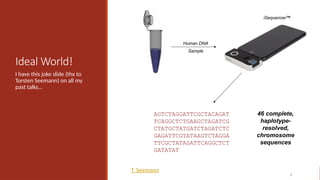
Ideal World!
I have this joke slide (thx to
Torsten Seemann) on all my
past talks…
3
AGTCTAGGATTCGCTACAGAT
TCAGGCTCTGAAGCTAGATCG
CTATGCTATGATCTAGATCTC
GAGATTCGTATAAGTCTAGGA
TTCGCTATAGATTCAGGCTCT
GATATAT
Human DNA
Sample
iSequencer™
46 complete,
haplotype-
resolved,
chromosome
sequences
T. Seemann
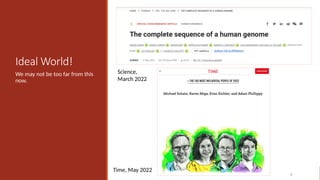
Ideal World!
We may not be too far from this
now.
4
Time, May 2022
Science,
March 2022
Ideal World!
Earth Biogenome Project
Pangenomics
5
Announced 2018,
started early 2022
Nature,
May 2023
HPRC Nature issue
EBP website
6
Current Sequencing Technologies
Illumina
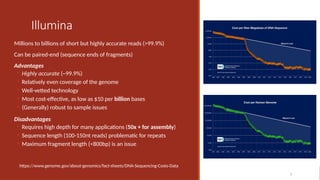
Millions to billions of short but highly accurate reads (>99.9%)
Can be paired-end (sequence ends of fragments)
Advantages
◦ Highly accurate (~99.9%)
◦ Relatively even coverage of the genome
◦ Well-vetted technology
◦ Most cost-effective, as low as $10 per billion bases
◦ (Generally) robust to sample issues
Disadvantages
◦ Requires high depth for many applications (50x + for assembly)
◦ Sequence length (100-150nt reads) problematic for repeats
◦ Maximum fragment length (<800bp) is an issue
7
https://www.genome.gov/about-genomics/fact-sheets/DNA-Sequencing-Costs-Data
8
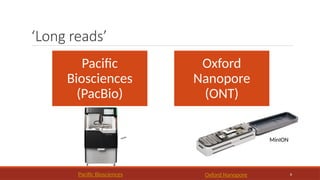
‘Long reads’
Pacific
Biosciences
(PacBio)
Oxford
Nanopore
(ONT)
MinION
Pacific Biosciences Oxford Nanopore
Oxford Nanopore
9
Alberto Magi et al, Briefings in Bioinformatics, Volume 19, Issue 6, November 2018
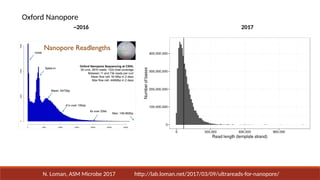
Total bases:
5,014,576,373 (5Gb)
Number of reads:
150,604
N50: 63,747
Mean: 33,296.44
Accuracy: 80-85%
http://lab.loman.net/2017/03/09/ultrareads-for-nanopore/
N. Loman, ASM Microbe 2017
2017
~2016
Oxford Nanopore
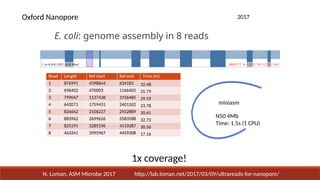
E. coli: genome assembly in 8 reads
Read Length Ref start Ref end Time (m)
1 876991 4398844 634183 32.48
2 696402 470003 1166405 25.79
3 799047 1137438 1936485 29.59
4 642071 1759431 2401502 23.78
5 826662 2106227 2932889 30.61
6 883962 2699626 3583588 32.73
7 825191 3285196 4110387 30.56
8 463341 3995967 4459308 17.16
miniasm
N50 4Mb
Time: 1.5s (1 CPU)
1x coverage!
http://lab.loman.net/2017/03/09/ultrareads-for-nanopore/
N. Loman, ASM Microbe 2017
2017
Oxford Nanopore
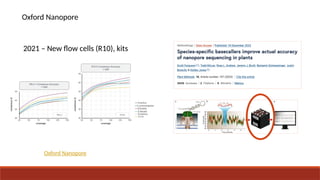
2021 – New flow cells (R10), kits
Oxford Nanopore
Oxford Nanopore
Pacific Biosciences
13
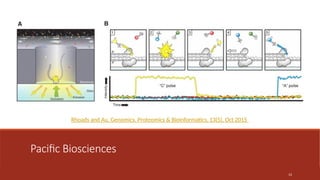
Rhoads and Au, Genomics, Proteomics & Bioinformatics, 13(5), Oct 2015
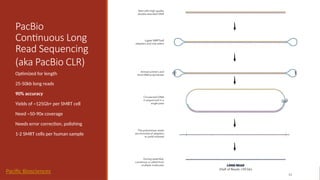
PacBio
Continuous Long
Read Sequencing
(aka PacBio CLR)
Optimized for length
25-50kb long reads
90% accuracy
Yields of ~125Gb+ per SMRT cell
Need ~50-90x coverage
Needs error correction, polishing
1-2 SMRT cells per human sample
14
Pacific Biosciences
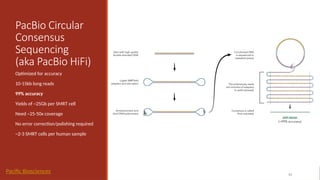
PacBio Circular
Consensus
Sequencing
(aka PacBio HiFi)
Optimized for accuracy
10-15kb long reads
99% accuracy
Yields of ~25Gb per SMRT cell
Need ~25-50x coverage
No error correction/polishing required
~2-3 SMRT cells per human sample
15
Pacific Biosciences
17
‘Long Reads’
Advantages
◦ Reads can be very long (1kb – 100kb)
◦ Relatively even coverage of the genome
◦ PacBio HiFi, ONT using latest release - Highly accurate (99%)
◦ PacBio HiFi, ONT - DNA modifications (RNA mods for ONT)
◦ ONT - real-time sequencing, portable, direct RNA
Disadvantages
◦ Expensive compared to Illumina short reads
◦ Need very high quality, high MW DNA samples
◦ Least expensive options are error-prone
◦ Depending on technology, can have systematic errors (homopolymer issues), but getting better
18
Genome assembly steps
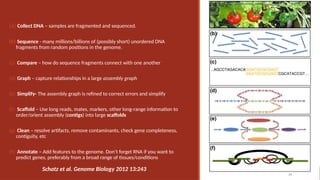
(a) Collect DNA – samples are fragmented and sequenced.
(b) Sequence - many millions/billions of (possibly short) unordered DNA
fragments from random positions in the genome.
(c) Compare – how do sequence fragments connect with one another
(d) Graph – capture relationships in a large assembly graph
(e) Simplify- The assembly graph is refined to correct errors and simplify
(f) Scaffold – Use long reads, mates, markers, other long-range information to
order/orient assembly (contigs) into large scaffolds
(g) Clean – resolve artifacts, remove contaminants, check gene completeness,
contiguity, etc
(h) Annotate – Add features to the genome. Don’t forget RNA if you want to
predict genes, preferably from a broad range of tissues/conditions
19
Schatz et al. Genome Biology 2012 13:243
20
Let’s Do a Genome Assembly!
◦ Sequence a sample, and have the computer do the rest?
◦ How do you find overlaps between sequences (when you have millions to billions of
them)?
◦ You compare them all (overlapping pieces)
◦ You find shorter perfectly overlapping segments
◦ Faster but has a lot of assumptions!!!
◦ How do you store all this information?
◦ How long does it take?
21
The way it used to be…
aka ‘the short read days’
◦ You spent your entire grant on getting sequence data and buy a monster multi-
core high-memory server
◦ You assemble your genome with your favorite genome assembly tool
◦ You waited a week to a month and you now have results!
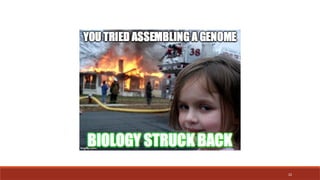
◦ Wait, why do I have a million scaffolds? And why is my server on fire?!?
Biology
22
23
Steps
◦ Basic DNA sequence cleanup and evaluation (pre-assembly)
◦ Contig building
◦ Scaffolding
◦ Post-assembly processing and analyses
24
Basic cleanup and evaluation
◦ Is the DNA sequence high quality?
◦ Does it need to be trimmed?
◦ Evaluate libraries for read ‘coverage’
◦ Any additional sequence preparation steps
25
DNA Quality (FASTQC)
Good!
Bad,
need to
Trim heavily
Illumina Data
https://www.bioinformatics.babraham.ac.uk/projects/fastqc/
26
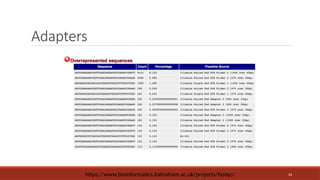
Adapters
https://www.bioinformatics.babraham.ac.uk/projects/fastqc/
27
Coverage
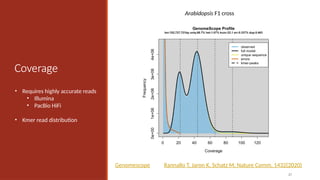
Genomescope
• Requires highly accurate reads
• Illumina
• PacBio HiFi
• Kmer read distribution
Rannallo T, Jaron K, Schatz M, Nature Comm, 1432(2020)
Arabidopsis F1 cross
28
Coverage
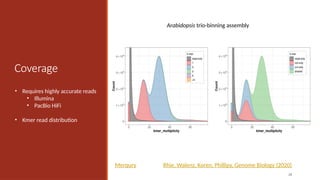
Merqury
• Requires highly accurate reads
• Illumina
• PacBio HiFi
• Kmer read distribution
Rhie, Walenz, Koren, Phillipy, Genome Biology (2020)
Arabidopsis trio-binning assembly
29
Other pre-assembly steps
Depending on the assembler and technology you use, you may want to:
◦ Assess reads for contaminants
◦ Join paired-end reads into longer reads
◦ Error correction of reads (e.g. fix sequencing errors)
30
Starting the assembly
31
Contig building
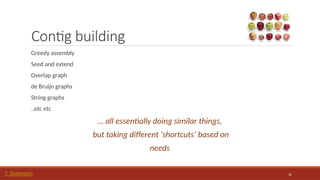
Greedy assembly
Seed and extend
Overlap graph
de Bruijn graphs
String graphs
..etc etc
… all essentially doing similar things,
but taking different ‘shortcuts’ based on
needs
T. Seemann
32
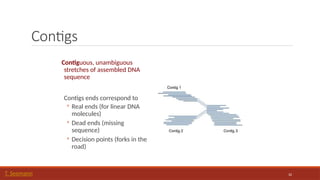
Contigs
Contiguous, unambiguous
stretches of assembled DNA
sequence
Contigs ends correspond to
◦ Real ends (for linear DNA
molecules)
◦ Dead ends (missing
sequence)
◦ Decision points (forks in the
road)
T. Seemann
T. Seemann
34
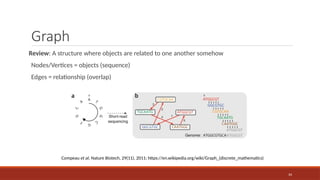
Graph
Review: A structure where objects are related to one another somehow
Nodes/Vertices = objects (sequence)
Edges = relationship (overlap)
Compeau et al, Nature Biotech, 29(11), 2011; https://en.wikipedia.org/wiki/Graph_(discrete_mathematics)
35
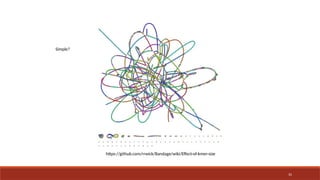
https://github.com/rrwick/Bandage/wiki/Effect-of-kmer-size
Simple?
36
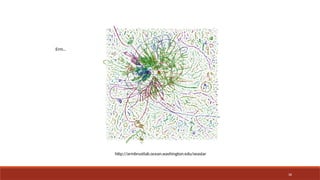
http://armbrustlab.ocean.washington.edu/seastar
Erm…
In essence…
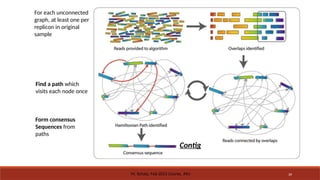
For each unconnected graph:
◦ Find a path which visits each node
once
◦ This is referred to as a
Hamiltonian path/cycle
◦ Form consensus sequences from
paths
◦ use all the overlap alignments
◦ each of these collapsed paths is
a contig
37
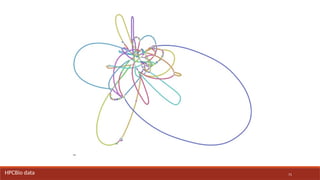
HPCBio data
38
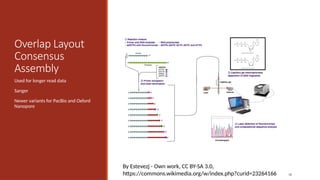
Overlap Layout
Consensus
Assembly
Used for longer read data
Sanger
Newer variants for PacBio and Oxford
Nanopore
By Estevezj - Own work, CC BY-SA 3.0,
https://commons.wikimedia.org/w/index.php?curid=23264166
39
For each unconnected
graph, at least one per
replicon in original
sample
Find a path which
visits each node once
Form consensus
Sequences from
paths
Contig
M. Schatz, Feb 2015 Course, JHU
OLC assembly steps
Calculate overlays
◦ Can use BLAST-like methods, but finding common strings (k-mers) more
efficient
Assemble layout graph, try to simplify graph and remove nodes (reads) – find
Hamiltonian path
Generate consensus from the alignments between reads (overlays)
Some OLC-based assemblers
Canu – is a fork of the Celera Assembler designed for high-noise single-
molecule sequencing (PacBio, Oxford Nanopore)
HiCanu – PacBio HiFi assembler
Newbler, a.k.a. GS de novo Assembler - designed for 454 sequences, but works
with Sanger reads
Hifiasm – a hybrid diploid assembler
42
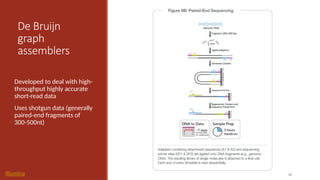
De Bruijn
graph
assemblers
Developed to deal with high-
throughput highly accurate
short-read data
Uses shotgun data (generally
paired-end fragments of
300-500nt)
Illumina
43
M. Schatz, Feb 2015 Course, JHU
44
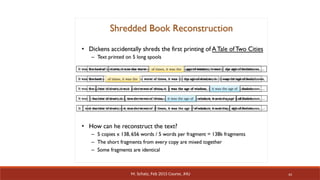
M. Schatz, Feb 2015 Course, JHU
45
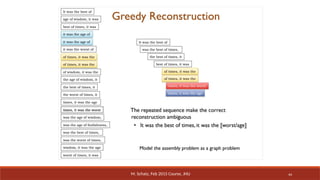
M. Schatz, Feb 2015 Course, JHU
46
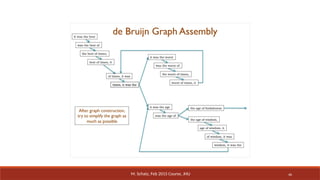
M. Schatz, Feb 2015 Course, JHU
47
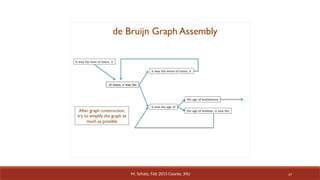
M. Schatz, Feb 2015 Course, JHU
48
M. Schatz, Feb 2015 Course, JHU
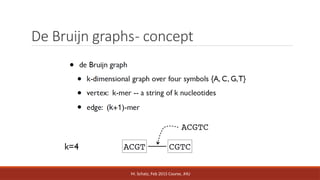
De Bruijn graphs- concept
M. Schatz, Feb 2015 Course, JHU
50
Scaffolding
◦ Now, you have a huge pile of contigs but you want to make them larger. How?
◦ Add context!
◦ Link together contigs using other genomic information
◦ Infer contigs position on the genome relative to one another
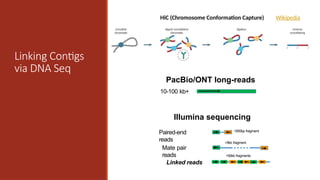
PacBio/ONT long-reads
10-100 kb+
Linking Contigs
via DNA Seq
Illumina sequencing
Paired-end
reads
Mate pair
reads
>5kb fragment
<500bp fragment
Linked reads
>50kb fragments
HiC (Chromosome Conformation Capture) Wikipedia
52
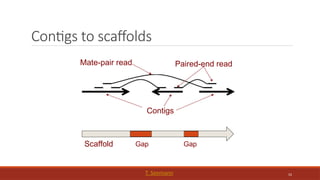
Contigs to scaffolds
Contigs
Paired-end read
Scaffold Gap Gap
Mate-pair read
T. Seemann
53
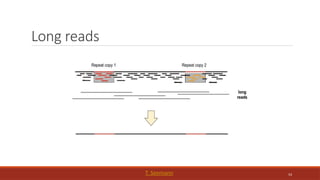
Long reads
T. Seemann
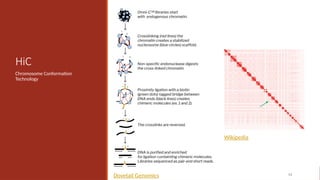
HiC
Chromosome Conformation
Technology
54
Dovetail Genomics
Wikipedia
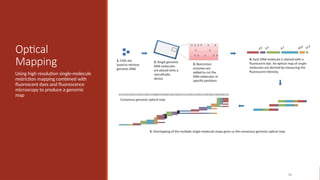
Optical
Mapping
Using high resolution single-molecule
restriction mapping combined with
fluorescent dyes and fluorescence
microscopy to produce a genomic
map
55
56
Starting a new assembly project
57
Planning a genome sequencing project?
BUDGET!!!
◦ Technological costs
◦ Computational costs
◦ Person costs (time)!
Biology!
◦ Size: how large and/or complex is my genome?
◦ Ploidy: number of sets of chromosomes of the genome?
◦ Multinucleated: can cells have more than one nucleus?
◦ Repetitive: How much of the genome is repetitive? Repeat size distribution?
◦ Heterozygosity: Is my genome highly heterozygous? Inbred (homozygous)?
◦ Public data: Is a good quality genome of a related species available?
How do you start (2023)?
• Short reads (billions of
reads)
• Sequencing costs - $$
• Compute costs - $$$$$$$$
• Results – fragmented,
requires significant ‘cleanup’
• Long error-prone reads
• Sequencing costs - $$$$
• Compute costs - $$$$$
• Results –better quality, but
requires polishing, can’t
easily phase
• Long accurate reads
• Sequencing costs - $$$$$$
• Compute costs - $$$
• Results – best (partly)
phased diploid assembly***
58
*** - doesn’t help much if you have higher
ploidy! (though this will likely change)
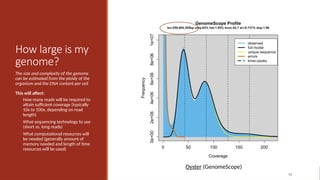
How large is my
genome?
The size and complexity of the genome
can be estimated from the ploidy of the
organism and the DNA content per cell
This will affect:
◦ How many reads will be required to
attain sufficient coverage (typically
10x to 100x, depending on read
length)
◦ What sequencing technology to use
(short vs. long reads)
◦ What computational resources will
be needed (generally amount of
memory needed and length of time
resources will be used)
59
Oyster (GenomeScope)
60
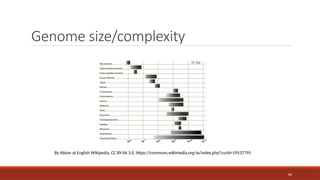
Genome size/complexity
By Abizar at English Wikipedia, CC BY-SA 3.0, https://commons.wikimedia.org/w/index.php?curid=19537795
Heterozygosity
Heterozygous – Locus-specific; diploid
organism has two different alleles at
the same locus.
Heterozygosity is a metric used to
denote the probability an individual
will be heterozygous at a given allele.
Higher heterozygosity == more
diverse == harder to assemble
Unfortunately, assemblies are
represented (for now) as haploid. So
this is a major problem!
62
Oyster: http://qb.cshl.edu/genomescope/genomescope2.0/
Heterozygosity
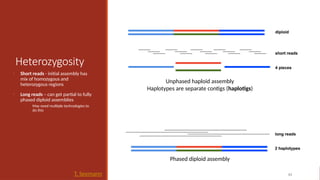
• Short reads - initial assembly has
mix of homozygous and
heterozygous regions
• Long reads – can get partial to fully
phased diploid assemblies
• May need multiple technologies to
do this
63
T. Seemann
Unphased haploid assembly
Haplotypes are separate contigs (haplotigs)
Phased diploid assembly
Ploidy
Number of sets of chromosomes in a
cell (N)
◦ Bacteria – 1N
◦ Vertebrates – 2N (human, mouse,
rat)
◦ Amphibians – 2N to 12N
◦ Plants – 2N to ??? (wheat is 6N)
64
Root knot nematode (GenomeScope)
Repetitive
sequences
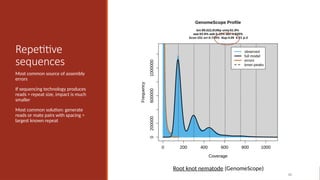
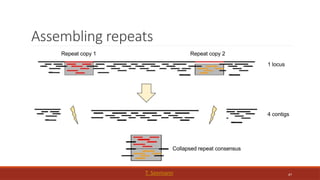
Most common source of assembly
errors
If sequencing technology produces
reads > repeat size, impact is much
smaller
Most common solution: generate
reads or mate pairs with spacing >
largest known repeat
65
Root knot nematode (GenomeScope)
66
T. Seemann
67
Assembling repeats
T. Seemann
68
T. Seemann
69
HPCBio data
70
Long reads
T. Seemann
71
HPCBio data
72
HPCBio data
73
Genome(s) from related species
Preferably of good quality, with large reliable scaffolds
Help verifying the completeness of the assembly
Can themselves be improved in some cases
Help guiding the assembly of the target species
◦ But to be used with caution – can cause errors when genome architecture is different!
◦ Large-scale genomic rearrangement in particular is a problem
74
Typical sequencing strategies
Small genomes (bacteria, fungal)
◦ If you can can get HMW DNA!
◦ PacBio HiFi
◦ Oxford Nanopore sequences at 40-50x coverage, 'polish’ with hybrid correction (using Illumina data) and assembly
using Unicycler, Canu, Flye
◦ This may be changing with newer flow cells (R10.4.1 + ’kit14’, as of May 2022)
◦ 2 x 300bp overlapping paired-end reads from Illumina MiSeq works okay but will get fragments
Larger genomes
◦ If you can afford it and can get HMW DNA
◦ PacBio HiFi
◦ HiC for scaffolding
◦ ONT (ultralong prep)
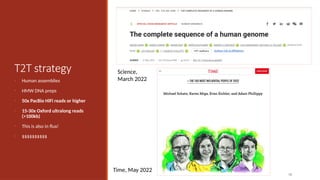
T2T strategy
But we are not too far from this!
• Human assemblies
• HMW DNA preps
• 50x PacBio HiFi reads or higher
• 15-30x Oxford ultralong reads
(>100kb)
• This is also in flux!
• $$$$$$$$$$
76
Time, May 2022
Science,
March 2022
77
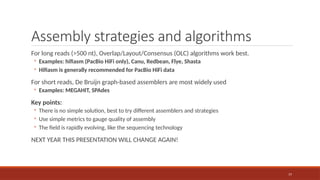
Assembly strategies and algorithms
For long reads (>500 nt), Overlap/Layout/Consensus (OLC) algorithms work best.
◦ Examples: hifiasm (PacBio HiFi only), Canu, Redbean, Flye, Shasta
◦ Hifiasm is generally recommended for PacBio HiFi data
For short reads, De Bruijn graph-based assemblers are most widely used
◦ Examples: MEGAHIT, SPAdes
Key points:
◦ There is no simple solution, best to try different assemblers and strategies
◦ Use simple metrics to gauge quality of assembly
◦ The field is rapidly evolving, like the sequencing technology
NEXT YEAR THIS PRESENTATION WILL CHANGE AGAIN!
78
Assessing your assembly
79
How good is my assembly?
How much total sequence is in the assembly relative to estimated genome size?
How many pieces, and what is their size distribution?
Are the contigs assembled correctly?
Are the scaffolds connected in the right order / orientation?
How were the repeats handled?
Are all the genes I expected in the assembly?
80
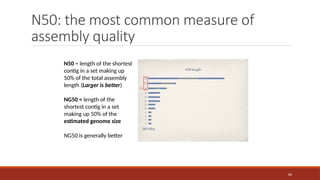
N50: the most common measure of
assembly quality
N50 = length of the shortest
contig in a set making up
50% of the total assembly
length (Larger is better)
NG50 = length of the
shortest contig in a set
making up 50% of the
estimated genome size
NG50 is generally better
81
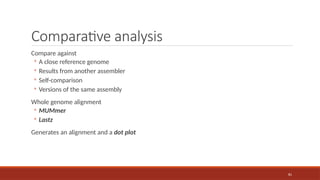
Comparative analysis
Compare against
◦ A close reference genome
◦ Results from another assembler
◦ Self-comparison
◦ Versions of the same assembly
Whole genome alignment
◦ MUMmer
◦ Lastz
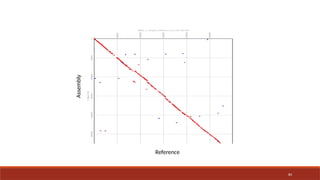
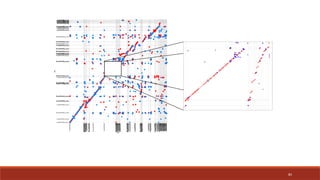
Generates an alignment and a dot plot
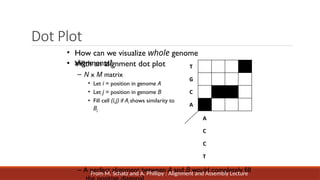
Dot Plot
• How can we visualize whole genome
alignments?
• With an alignment dot plot
– N x M matrix
• Let i = position in genome A
• Let j = position in genome B
• Fill cell (i,j) if Ai shows similarity to
Bj
T
G
C
A
A
C
C
T
– A perfect alignment between A and B would completely fill
From M. Schatz and A. Phillipy : Alignment and Assembly Lecture
A
B
A
B
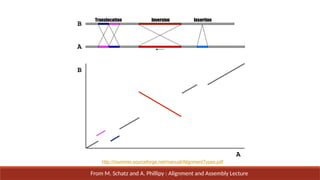
Translocation Inversion Insertion
http://mummer.sourceforge.net/manual/AlignmentTypes.pdf
From M. Schatz and A. Phillipy : Alignment and Assembly Lecture
84
Assembly
Reference
85
86
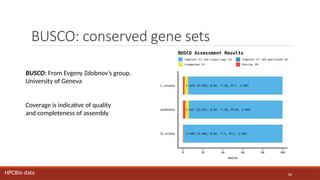
BUSCO: conserved gene sets
BUSCO: From Evgeny Zdobnov’s group,
University of Geneva
Coverage is indicative of quality
and completeness of assembly
HPCBio data
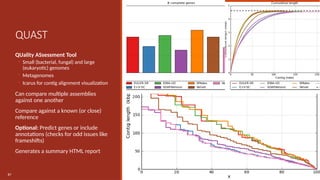
QUAST
QUality ASsessment Tool
◦ Small (bacterial, fungal) and large
(eukaryotic) genomes
◦ Metagenomes
◦ Icarus for contig alignment visualization
Can compare multiple assemblies
against one another
Compare against a known (or close)
reference
Optional: Predict genes or include
annotations (checks for odd issues like
frameshifts)
Generates a summary HTML report
87
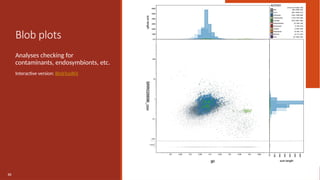
Blob plots
Analyses checking for
contaminants, endosymbionts, etc.
Interactive version: BlobToolKit
88
89
Genome graphs
90
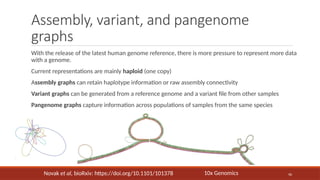
Assembly, variant, and pangenome
graphs
With the release of the latest human genome reference, there is more pressure to represent more data
with a genome.
Current representations are mainly haploid (one copy)
Assembly graphs can retain haplotype information or raw assembly connectivity
Variant graphs can be generated from a reference genome and a variant file from other samples
Pangenome graphs capture information across populations of samples from the same species
Novak et al, bioRxiv: https://doi.org/10.1101/101378 10x Genomics
91
Pangenome
graphs
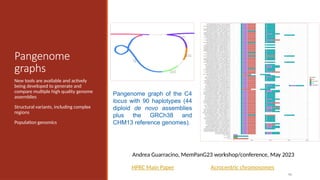
New tools are available and actively
being developed to generate and
compare multiple high quality genome
assemblies
Structural variants, including complex
regions
Population genomics
Pangenome graph of the C4
locus with 90 haplotypes (44
diploid de novo assemblies
plus the GRCh38 and
CHM13 reference genomes).
Andrea Guarracino, MemPanG23 workshop/conference, May 2023
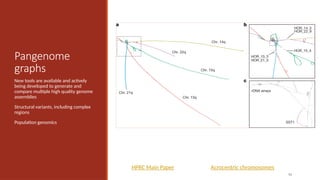
HPRC Main Paper Acrocentric chromosomes
92
Pangenome
graphs
New tools are available and actively
being developed to generate and
compare multiple high quality genome
assemblies
Structural variants, including complex
regions
Population genomics
HPRC Main Paper Acrocentric chromosomes
93
Acknowledgements
Materials from this slide deck include figures and slides from many publications,
Web pages and presentations by:
◦ Carver Biotechnology Center (HPCBio, DNA Sequencing Core)
◦ M. Schatz, A. Phillipy, T. Seemann, S. Salzberg, K. Bradnam, D. Zerbino, M. Pop,
G. Sutton, Nick Loman, Carson Holt, Ryan Wick.
◦ I highly recommend Ben Langmead’s teaching materials; he has a ton fabulous
(and much more in-depth) notes on his lab page:
http://www.langmead-lab.org/teaching-materials/
◦ Thank you!

from genome sequencing to genome assembly

  • 1.
    Genome Assembly CHRIS FIELDS,HPCBIO MAYO-ILLINOIS COMPUTATIONAL GENOMICS WORKSHOP JUNE 20, 2023
  • 2.
    2 Overview ◦ Sequencing technologies(2023) ◦ Steps in a standard genome assembly ◦ Assembly quality assessment ◦ Planning an assembly project ◦ Genome graphs ◦ Genome annotation
  • 3.
    Ideal World! I havethis joke slide (thx to Torsten Seemann) on all my past talks… 3 AGTCTAGGATTCGCTACAGAT TCAGGCTCTGAAGCTAGATCG CTATGCTATGATCTAGATCTC GAGATTCGTATAAGTCTAGGA TTCGCTATAGATTCAGGCTCT GATATAT Human DNA Sample iSequencer™ 46 complete, haplotype- resolved, chromosome sequences T. Seemann
  • 4.
    Ideal World! We maynot be too far from this now. 4 Time, May 2022 Science, March 2022
  • 5.
    Ideal World! Earth BiogenomeProject Pangenomics 5 Announced 2018, started early 2022 Nature, May 2023 HPRC Nature issue EBP website
  • 6.
  • 7.
    Illumina Millions to billionsof short but highly accurate reads (>99.9%) Can be paired-end (sequence ends of fragments) Advantages ◦ Highly accurate (~99.9%) ◦ Relatively even coverage of the genome ◦ Well-vetted technology ◦ Most cost-effective, as low as $10 per billion bases ◦ (Generally) robust to sample issues Disadvantages ◦ Requires high depth for many applications (50x + for assembly) ◦ Sequence length (100-150nt reads) problematic for repeats ◦ Maximum fragment length (<800bp) is an issue 7 https://www.genome.gov/about-genomics/fact-sheets/DNA-Sequencing-Costs-Data
  • 8.
  • 9.
    Oxford Nanopore 9 Alberto Magiet al, Briefings in Bioinformatics, Volume 19, Issue 6, November 2018
  • 10.
    Total bases: 5,014,576,373 (5Gb) Numberof reads: 150,604 N50: 63,747 Mean: 33,296.44 Accuracy: 80-85% http://lab.loman.net/2017/03/09/ultrareads-for-nanopore/ N. Loman, ASM Microbe 2017 2017 ~2016 Oxford Nanopore
  • 11.
    E. coli: genomeassembly in 8 reads Read Length Ref start Ref end Time (m) 1 876991 4398844 634183 32.48 2 696402 470003 1166405 25.79 3 799047 1137438 1936485 29.59 4 642071 1759431 2401502 23.78 5 826662 2106227 2932889 30.61 6 883962 2699626 3583588 32.73 7 825191 3285196 4110387 30.56 8 463341 3995967 4459308 17.16 miniasm N50 4Mb Time: 1.5s (1 CPU) 1x coverage! http://lab.loman.net/2017/03/09/ultrareads-for-nanopore/ N. Loman, ASM Microbe 2017 2017 Oxford Nanopore
  • 12.
    2021 – Newflow cells (R10), kits Oxford Nanopore Oxford Nanopore
  • 13.
    Pacific Biosciences 13 Rhoads andAu, Genomics, Proteomics & Bioinformatics, 13(5), Oct 2015
  • 14.
    PacBio Continuous Long Read Sequencing (akaPacBio CLR) Optimized for length 25-50kb long reads 90% accuracy Yields of ~125Gb+ per SMRT cell Need ~50-90x coverage Needs error correction, polishing 1-2 SMRT cells per human sample 14 Pacific Biosciences
  • 15.
    PacBio Circular Consensus Sequencing (aka PacBioHiFi) Optimized for accuracy 10-15kb long reads 99% accuracy Yields of ~25Gb per SMRT cell Need ~25-50x coverage No error correction/polishing required ~2-3 SMRT cells per human sample 15 Pacific Biosciences
  • 16.
    17 ‘Long Reads’ Advantages ◦ Readscan be very long (1kb – 100kb) ◦ Relatively even coverage of the genome ◦ PacBio HiFi, ONT using latest release - Highly accurate (99%) ◦ PacBio HiFi, ONT - DNA modifications (RNA mods for ONT) ◦ ONT - real-time sequencing, portable, direct RNA Disadvantages ◦ Expensive compared to Illumina short reads ◦ Need very high quality, high MW DNA samples ◦ Least expensive options are error-prone ◦ Depending on technology, can have systematic errors (homopolymer issues), but getting better
  • 17.
  • 18.
    (a) Collect DNA– samples are fragmented and sequenced. (b) Sequence - many millions/billions of (possibly short) unordered DNA fragments from random positions in the genome. (c) Compare – how do sequence fragments connect with one another (d) Graph – capture relationships in a large assembly graph (e) Simplify- The assembly graph is refined to correct errors and simplify (f) Scaffold – Use long reads, mates, markers, other long-range information to order/orient assembly (contigs) into large scaffolds (g) Clean – resolve artifacts, remove contaminants, check gene completeness, contiguity, etc (h) Annotate – Add features to the genome. Don’t forget RNA if you want to predict genes, preferably from a broad range of tissues/conditions 19 Schatz et al. Genome Biology 2012 13:243
  • 19.
    20 Let’s Do aGenome Assembly! ◦ Sequence a sample, and have the computer do the rest? ◦ How do you find overlaps between sequences (when you have millions to billions of them)? ◦ You compare them all (overlapping pieces) ◦ You find shorter perfectly overlapping segments ◦ Faster but has a lot of assumptions!!! ◦ How do you store all this information? ◦ How long does it take?
  • 20.
    21 The way itused to be… aka ‘the short read days’ ◦ You spent your entire grant on getting sequence data and buy a monster multi- core high-memory server ◦ You assemble your genome with your favorite genome assembly tool ◦ You waited a week to a month and you now have results! ◦ Wait, why do I have a million scaffolds? And why is my server on fire?!? Biology
  • 21.
  • 22.
    23 Steps ◦ Basic DNAsequence cleanup and evaluation (pre-assembly) ◦ Contig building ◦ Scaffolding ◦ Post-assembly processing and analyses
  • 23.
    24 Basic cleanup andevaluation ◦ Is the DNA sequence high quality? ◦ Does it need to be trimmed? ◦ Evaluate libraries for read ‘coverage’ ◦ Any additional sequence preparation steps
  • 24.
    25 DNA Quality (FASTQC) Good! Bad, needto Trim heavily Illumina Data https://www.bioinformatics.babraham.ac.uk/projects/fastqc/
  • 25.
  • 26.
    27 Coverage Genomescope • Requires highlyaccurate reads • Illumina • PacBio HiFi • Kmer read distribution Rannallo T, Jaron K, Schatz M, Nature Comm, 1432(2020) Arabidopsis F1 cross
  • 27.
    28 Coverage Merqury • Requires highlyaccurate reads • Illumina • PacBio HiFi • Kmer read distribution Rhie, Walenz, Koren, Phillipy, Genome Biology (2020) Arabidopsis trio-binning assembly
  • 28.
    29 Other pre-assembly steps Dependingon the assembler and technology you use, you may want to: ◦ Assess reads for contaminants ◦ Join paired-end reads into longer reads ◦ Error correction of reads (e.g. fix sequencing errors)
  • 29.
  • 30.
    31 Contig building Greedy assembly Seedand extend Overlap graph de Bruijn graphs String graphs ..etc etc … all essentially doing similar things, but taking different ‘shortcuts’ based on needs T. Seemann
  • 31.
    32 Contigs Contiguous, unambiguous stretches ofassembled DNA sequence Contigs ends correspond to ◦ Real ends (for linear DNA molecules) ◦ Dead ends (missing sequence) ◦ Decision points (forks in the road) T. Seemann
  • 32.
  • 33.
    34 Graph Review: A structurewhere objects are related to one another somehow Nodes/Vertices = objects (sequence) Edges = relationship (overlap) Compeau et al, Nature Biotech, 29(11), 2011; https://en.wikipedia.org/wiki/Graph_(discrete_mathematics)
  • 34.
  • 35.
  • 36.
    In essence… For eachunconnected graph: ◦ Find a path which visits each node once ◦ This is referred to as a Hamiltonian path/cycle ◦ Form consensus sequences from paths ◦ use all the overlap alignments ◦ each of these collapsed paths is a contig 37 HPCBio data
  • 37.
    38 Overlap Layout Consensus Assembly Used forlonger read data Sanger Newer variants for PacBio and Oxford Nanopore By Estevezj - Own work, CC BY-SA 3.0, https://commons.wikimedia.org/w/index.php?curid=23264166
  • 38.
    39 For each unconnected graph,at least one per replicon in original sample Find a path which visits each node once Form consensus Sequences from paths Contig M. Schatz, Feb 2015 Course, JHU
  • 39.
    OLC assembly steps Calculateoverlays ◦ Can use BLAST-like methods, but finding common strings (k-mers) more efficient Assemble layout graph, try to simplify graph and remove nodes (reads) – find Hamiltonian path Generate consensus from the alignments between reads (overlays)
  • 40.
    Some OLC-based assemblers Canu– is a fork of the Celera Assembler designed for high-noise single- molecule sequencing (PacBio, Oxford Nanopore) HiCanu – PacBio HiFi assembler Newbler, a.k.a. GS de novo Assembler - designed for 454 sequences, but works with Sanger reads Hifiasm – a hybrid diploid assembler
  • 41.
    42 De Bruijn graph assemblers Developed todeal with high- throughput highly accurate short-read data Uses shotgun data (generally paired-end fragments of 300-500nt) Illumina
  • 42.
    43 M. Schatz, Feb2015 Course, JHU
  • 43.
    44 M. Schatz, Feb2015 Course, JHU
  • 44.
    45 M. Schatz, Feb2015 Course, JHU
  • 45.
    46 M. Schatz, Feb2015 Course, JHU
  • 46.
    47 M. Schatz, Feb2015 Course, JHU
  • 47.
    48 M. Schatz, Feb2015 Course, JHU
  • 48.
    De Bruijn graphs-concept M. Schatz, Feb 2015 Course, JHU
  • 49.
    50 Scaffolding ◦ Now, youhave a huge pile of contigs but you want to make them larger. How? ◦ Add context! ◦ Link together contigs using other genomic information ◦ Infer contigs position on the genome relative to one another
  • 50.
    PacBio/ONT long-reads 10-100 kb+ LinkingContigs via DNA Seq Illumina sequencing Paired-end reads Mate pair reads >5kb fragment <500bp fragment Linked reads >50kb fragments HiC (Chromosome Conformation Capture) Wikipedia
  • 51.
    52 Contigs to scaffolds Contigs Paired-endread Scaffold Gap Gap Mate-pair read T. Seemann
  • 52.
  • 53.
  • 54.
    Optical Mapping Using high resolutionsingle-molecule restriction mapping combined with fluorescent dyes and fluorescence microscopy to produce a genomic map 55
  • 55.
    56 Starting a newassembly project
  • 56.
    57 Planning a genomesequencing project? BUDGET!!! ◦ Technological costs ◦ Computational costs ◦ Person costs (time)! Biology! ◦ Size: how large and/or complex is my genome? ◦ Ploidy: number of sets of chromosomes of the genome? ◦ Multinucleated: can cells have more than one nucleus? ◦ Repetitive: How much of the genome is repetitive? Repeat size distribution? ◦ Heterozygosity: Is my genome highly heterozygous? Inbred (homozygous)? ◦ Public data: Is a good quality genome of a related species available?
  • 57.
    How do youstart (2023)? • Short reads (billions of reads) • Sequencing costs - $$ • Compute costs - $$$$$$$$ • Results – fragmented, requires significant ‘cleanup’ • Long error-prone reads • Sequencing costs - $$$$ • Compute costs - $$$$$ • Results –better quality, but requires polishing, can’t easily phase • Long accurate reads • Sequencing costs - $$$$$$ • Compute costs - $$$ • Results – best (partly) phased diploid assembly*** 58 *** - doesn’t help much if you have higher ploidy! (though this will likely change)
  • 58.
    How large ismy genome? The size and complexity of the genome can be estimated from the ploidy of the organism and the DNA content per cell This will affect: ◦ How many reads will be required to attain sufficient coverage (typically 10x to 100x, depending on read length) ◦ What sequencing technology to use (short vs. long reads) ◦ What computational resources will be needed (generally amount of memory needed and length of time resources will be used) 59 Oyster (GenomeScope)
  • 59.
    60 Genome size/complexity By Abizarat English Wikipedia, CC BY-SA 3.0, https://commons.wikimedia.org/w/index.php?curid=19537795
  • 60.
    Heterozygosity Heterozygous – Locus-specific;diploid organism has two different alleles at the same locus. Heterozygosity is a metric used to denote the probability an individual will be heterozygous at a given allele. Higher heterozygosity == more diverse == harder to assemble Unfortunately, assemblies are represented (for now) as haploid. So this is a major problem! 62 Oyster: http://qb.cshl.edu/genomescope/genomescope2.0/
  • 61.
    Heterozygosity • Short reads- initial assembly has mix of homozygous and heterozygous regions • Long reads – can get partial to fully phased diploid assemblies • May need multiple technologies to do this 63 T. Seemann Unphased haploid assembly Haplotypes are separate contigs (haplotigs) Phased diploid assembly
  • 62.
    Ploidy Number of setsof chromosomes in a cell (N) ◦ Bacteria – 1N ◦ Vertebrates – 2N (human, mouse, rat) ◦ Amphibians – 2N to 12N ◦ Plants – 2N to ??? (wheat is 6N) 64 Root knot nematode (GenomeScope)
  • 63.
    Repetitive sequences Most common sourceof assembly errors If sequencing technology produces reads > repeat size, impact is much smaller Most common solution: generate reads or mate pairs with spacing > largest known repeat 65 Root knot nematode (GenomeScope)
  • 64.
  • 65.
  • 66.
  • 67.
  • 68.
  • 69.
  • 70.
  • 71.
    73 Genome(s) from relatedspecies Preferably of good quality, with large reliable scaffolds Help verifying the completeness of the assembly Can themselves be improved in some cases Help guiding the assembly of the target species ◦ But to be used with caution – can cause errors when genome architecture is different! ◦ Large-scale genomic rearrangement in particular is a problem
  • 72.
    74 Typical sequencing strategies Smallgenomes (bacteria, fungal) ◦ If you can can get HMW DNA! ◦ PacBio HiFi ◦ Oxford Nanopore sequences at 40-50x coverage, 'polish’ with hybrid correction (using Illumina data) and assembly using Unicycler, Canu, Flye ◦ This may be changing with newer flow cells (R10.4.1 + ’kit14’, as of May 2022) ◦ 2 x 300bp overlapping paired-end reads from Illumina MiSeq works okay but will get fragments Larger genomes ◦ If you can afford it and can get HMW DNA ◦ PacBio HiFi ◦ HiC for scaffolding ◦ ONT (ultralong prep)
  • 73.
    T2T strategy But weare not too far from this! • Human assemblies • HMW DNA preps • 50x PacBio HiFi reads or higher • 15-30x Oxford ultralong reads (>100kb) • This is also in flux! • $$$$$$$$$$ 76 Time, May 2022 Science, March 2022
  • 74.
    77 Assembly strategies andalgorithms For long reads (>500 nt), Overlap/Layout/Consensus (OLC) algorithms work best. ◦ Examples: hifiasm (PacBio HiFi only), Canu, Redbean, Flye, Shasta ◦ Hifiasm is generally recommended for PacBio HiFi data For short reads, De Bruijn graph-based assemblers are most widely used ◦ Examples: MEGAHIT, SPAdes Key points: ◦ There is no simple solution, best to try different assemblers and strategies ◦ Use simple metrics to gauge quality of assembly ◦ The field is rapidly evolving, like the sequencing technology NEXT YEAR THIS PRESENTATION WILL CHANGE AGAIN!
  • 75.
  • 76.
    79 How good ismy assembly? How much total sequence is in the assembly relative to estimated genome size? How many pieces, and what is their size distribution? Are the contigs assembled correctly? Are the scaffolds connected in the right order / orientation? How were the repeats handled? Are all the genes I expected in the assembly?
  • 77.
    80 N50: the mostcommon measure of assembly quality N50 = length of the shortest contig in a set making up 50% of the total assembly length (Larger is better) NG50 = length of the shortest contig in a set making up 50% of the estimated genome size NG50 is generally better
  • 78.
    81 Comparative analysis Compare against ◦A close reference genome ◦ Results from another assembler ◦ Self-comparison ◦ Versions of the same assembly Whole genome alignment ◦ MUMmer ◦ Lastz Generates an alignment and a dot plot
  • 79.
    Dot Plot • Howcan we visualize whole genome alignments? • With an alignment dot plot – N x M matrix • Let i = position in genome A • Let j = position in genome B • Fill cell (i,j) if Ai shows similarity to Bj T G C A A C C T – A perfect alignment between A and B would completely fill From M. Schatz and A. Phillipy : Alignment and Assembly Lecture
  • 80.
  • 81.
  • 82.
  • 83.
    86 BUSCO: conserved genesets BUSCO: From Evgeny Zdobnov’s group, University of Geneva Coverage is indicative of quality and completeness of assembly HPCBio data
  • 84.
    QUAST QUality ASsessment Tool ◦Small (bacterial, fungal) and large (eukaryotic) genomes ◦ Metagenomes ◦ Icarus for contig alignment visualization Can compare multiple assemblies against one another Compare against a known (or close) reference Optional: Predict genes or include annotations (checks for odd issues like frameshifts) Generates a summary HTML report 87
  • 85.
    Blob plots Analyses checkingfor contaminants, endosymbionts, etc. Interactive version: BlobToolKit 88
  • 86.
  • 87.
    90 Assembly, variant, andpangenome graphs With the release of the latest human genome reference, there is more pressure to represent more data with a genome. Current representations are mainly haploid (one copy) Assembly graphs can retain haplotype information or raw assembly connectivity Variant graphs can be generated from a reference genome and a variant file from other samples Pangenome graphs capture information across populations of samples from the same species Novak et al, bioRxiv: https://doi.org/10.1101/101378 10x Genomics
  • 88.
    91 Pangenome graphs New tools areavailable and actively being developed to generate and compare multiple high quality genome assemblies Structural variants, including complex regions Population genomics Pangenome graph of the C4 locus with 90 haplotypes (44 diploid de novo assemblies plus the GRCh38 and CHM13 reference genomes). Andrea Guarracino, MemPanG23 workshop/conference, May 2023 HPRC Main Paper Acrocentric chromosomes
  • 89.
    92 Pangenome graphs New tools areavailable and actively being developed to generate and compare multiple high quality genome assemblies Structural variants, including complex regions Population genomics HPRC Main Paper Acrocentric chromosomes
  • 90.
    93 Acknowledgements Materials from thisslide deck include figures and slides from many publications, Web pages and presentations by: ◦ Carver Biotechnology Center (HPCBio, DNA Sequencing Core) ◦ M. Schatz, A. Phillipy, T. Seemann, S. Salzberg, K. Bradnam, D. Zerbino, M. Pop, G. Sutton, Nick Loman, Carson Holt, Ryan Wick. ◦ I highly recommend Ben Langmead’s teaching materials; he has a ton fabulous (and much more in-depth) notes on his lab page: http://www.langmead-lab.org/teaching-materials/ ◦ Thank you!

Editor's Notes

  • #3 This is a somewhat jokey slide I have in past talks, but it’s now almost prescient in what can now be done depending on the technology
  • #4 The original telomer-to-telomere (T2T) paper covers the assembly of CHM13 Pseudohaploid cell line. Haploid assembly
  • #5 Earth Biogenome Project – ambitious effort from Harris Lewin and Gene Robinson, now in progress with 1000’s of high-quality genomes spanning the Tree of Life coming, and possibly 10k’s more planned. Human Pangenome Project – 47 new high-quality human assemblies (including centromeric and more problematic regions)