Single-Cell RNA-seq analysis
Section 2: Processing Raw scRNA-Seq Sequencing Data
Presented By Alireza Dosutmohammadi
M.Sc. in Bioinformatics, Tarbiat Modares University
Oct 2021
Reference Genome and its
Annotation
Reference Genome:
Most scRNA-seq experiments are done using human or mouse tissues,
organoids, or cell cultures.
popular sources of assembly files:
• UCSC (hg19, hg38, mm10)
• GRC (GRCh37, GRCh38, GRCm38)
Genome assembly is usually distributed as a fasta file.
2
Reference Genome and its
Annotation
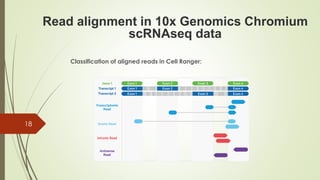
Genome annotation:
Includes defining transcribed regions of genome (genes), as well as
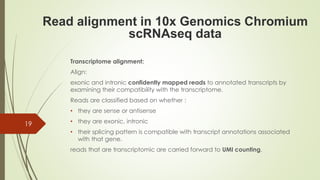
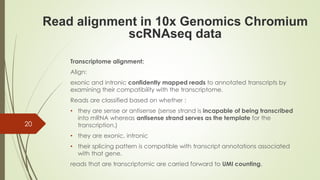
annotating exact transcripts with exon-intron boundaries, and assigning the
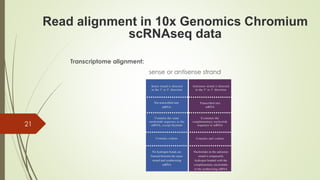
newly defined features a type - e.g. protein coding, non-coding, etc.
3
Reference Genome and its
Annotation
Genome annotation:
Genome annotation is usually provided in either GTF or GFF3 file format,
Popular sources of genome annotation:
• RefSeq (most conservative, and tends to have the fewest annotated transcripts
per gene.)
• ENSEMBL
• GENCODE
ENSEMBL and GENCODE are very similar to each other and can be used
interchangeably for our purposes.
RefSeq transcript IDs start with NM_ or NR, e.g. NM_12345.
Gene names in ENSEMBL and GENCODE start with ENSG (for human) and
ENSMUSG (for mouse); transcripts start with ENST and ENSMUST, respectively.
4
Reference Genome and its
Annotation
Genome annotation:
Current ENSEMBL/GENCODE annotation of the human genome contains
approximately 60k genes, 20k of which are protein coding, and 237k
transcripts.
Most genes can be coarsely divided by type into protein coding genes, long
noncoding RNAs, short noncoding RNAs, and pseudogenes.
5
Raw read processing:
1. read alignment
2. read counting.
Processing of Full-length scRNA-seq
Data
6
Read alignment:
can be done against:
• genome reference: done with a splice-aware aligner
• STAR
• hisat2
• transcriptome reference (many transcripts are very similar to each other)
Some reads perfectly align to more than 1 location; these reads are often
referred to as multimappers.
Processing of Full-length scRNA-seq
Data
7
Read counting:
In case of genome alignment:
• simplest strategy:
count only reads mapping to a unique location (non-multimappers), and only overlapping
one gene.
This creates a bias in gene expression estimates (Pachter, 2011).
• advanced strategy:
includes splitting read counts between features it aligns to.
e.g. if a read aligns equally well to 3 paralogous (homologous) genes, each paralog gets ⅓ of
a count.
Strand-specific RNA-seq reduces the ambiguity of read assignment in case of overlapping
features located on opposite strands.
An example of a program that efficiently implements all of the above-mentioned counting
methods is featureCounts from the Subread package.
Processing of Full-length scRNA-seq
Data
8
Read counting:
In case of transcriptome alignment:
read assignment ambiguity is too great for simple counting. Thus, per-transcript
and per-gene abundances are calculated using maximum likelihood
abundance estimates using the Expectation-Maximization (EM) algorithm.
Reads (and read fractions) that are assigned to transcripts are then
summarized on gene level.
The most widely used and well-supported program implementing this strategy
is RSEM.
Processing of Full-length scRNA-seq
Data
9
Read counting:
In case of transcriptome alignment:
An alternative to a conventional approach is: pseudo-alignment methods.
Two popular tools:
• Kallisto
• Salmon
Their approaches:
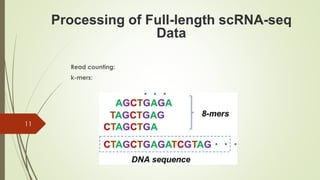
1. Split the reference transcriptome into k-mers
2. Convert RNA-seq reads into k-mers;
3. Use the k-mers to assign reads to a transcript or several transcripts
4. Summarize the resulting counts on a transcript or gene level.
Processing of Full-length scRNA-seq
Data
10
Read counting:
k-mers:
Processing of Full-length scRNA-seq
Data
11
Read counting:
In case of transcriptome alignment:
An alternative to a conventional approach is: pseudo-alignment methods.
Two popular tools:
• Kallisto
• Salmon
Both tools are extremely memory- and CPU-efficient, and quite accurate,
especially for paired-end or long single-end reads.
Pseudoalignment does not generate an alignment BAM file
Processing of Full-length scRNA-seq
Data
12
Read counting:
It is conventional to use within-sample normalization when doing clustering,
PCA, and other types of exploratory analysis.
The most popular method of such normalization is conversion of raw reads to
Transcripts per Million (TPM).
Processing of Full-length scRNA-seq
Data
13
scRNA-seq technologies generate read sequences containing three key
pieces of information:
• cDNA fragment: identifies the RNA transcript;
• Cell barcode (CB): identifies the cell where the RNA was expressed;
• Unique Molecular Identifier (UMI): allows to collapse reads that are PCR
duplicates.
Droplet-based scRNA-seq Data
14
In contrast to bulk RNA-seq, scRNA-seq deals with a much smaller amount of
RNA, and more PCR cycles are performed.
Library sequencing is often done with paired-end reads, with one read
containing CB + UMI (read 1 in 10x Chromium), and the other containing
actual transcript sequence (read 2 in 10x Chromium).
15
Droplet-based scRNA-seq Data
scRNA-seq workflow:
• Mapping the cDNA fragments to a reference;
• Assigning reads to genes;
• Assigning reads to cells (cell barcode demultiplexing);
• Counting the number of unique RNA molecules (UMI deduplication).
The outcome:
a gene/cell count matrix, which is used as an estimate of the number of RNA
molecules in each cell for each gene.
16
Droplet-based scRNA-seq Data
Cell Ranger is the default tool for processing scRNAseq data.
Genome alignment:
It uses STAR aligner(splicing-aware alignment)
After this:
it uses the transcript annotation GTF to bucket the reads into:
• Exonic
• Intronic
• Intergenic.
A read is exonic if:
• at least 50% of it intersects an exon.
A read is intronic if:
• it is non-exonic and intersects an intron, and intergenic otherwise.
for reads that align to a single exonic locus but also align to 1 or more non-exonic
loci, the exonic locus is prioritized.
17
Read alignment in 10x Genomics Chromium
scRNAseq data
Classification of aligned reads in Cell Ranger:
18
Read alignment in 10x Genomics Chromium
scRNAseq data
Transcriptome alignment:
Align:
exonic and intronic confidently mapped reads to annotated transcripts by
examining their compatibility with the transcriptome.
Reads are classified based on whether :
• they are sense or antisense
• they are exonic, intronic
• their splicing pattern is compatible with transcript annotations associated
with that gene.
reads that are transcriptomic are carried forward to UMI counting.
19
Read alignment in 10x Genomics Chromium
scRNAseq data
Transcriptome alignment:
Align:
exonic and intronic confidently mapped reads to annotated transcripts by
examining their compatibility with the transcriptome.
Reads are classified based on whether :
• they are sense or antisense (sense strand is incapable of being transcribed
into mRNA whereas antisense strand serves as the template for the
transcription.)
• they are exonic, intronic
• their splicing pattern is compatible with transcript annotations associated
with that gene.
reads that are transcriptomic are carried forward to UMI counting.
20
Read alignment in 10x Genomics Chromium
scRNAseq data
Transcriptome alignment:
sense or antisense strand
21
Read alignment in 10x Genomics Chromium
scRNAseq data
When the input to the assay consists of nuclei:
a high percentage of the reads comes from:
the unspliced transcripts and align to introns.
In order to count these intronic reads:
• cellranger count
• cellranger multi
pipelines can be run with the option include-introns.
Only uniquely mapping reads are carried forward to UMI counting.(Reads
mapped confidently to transcriptome) multimapping genes are discarded by
Cell Ranger.
22
Read alignment in 10x Genomics Chromium
scRNAseq data
Cell Ranger Reference Preparation:
• Primary genome assembly versions (i.e. without the ALT loci) are used for the
alignment.
• Annotation GTF files are filtered. The following biotypes are retained: protein
coding, long noncoding RNA, antisense, and all biotypes belonging to
BCR/TCR (i.e. V/D/J) genes.
• All pseudogenes and small noncoding RNAs are removed.
23
Read alignment in 10x Genomics Chromium
scRNAseq data
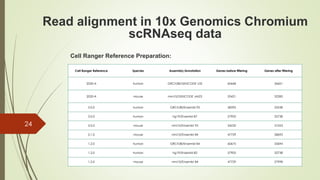
Cell Ranger Reference Preparation:
24
Read alignment in 10x Genomics Chromium
scRNAseq data
Cell Ranger Reference Species Assembly/Annotation Genes before filtering Genes after filtering
2020-A human GRCh38/GENCODE v32 60668 36601
2020-A mouse mm10/GENCODE vM23 55421 32285
3.0.0 human GRCh38/Ensembl 93 58395 33538
3.0.0 human hg19/Ensembl 87 57905 32738
3.0.0 mouse mm10/Ensembl 93 54232 31053
2.1.0 mouse mm10/Ensembl 84 47729 28692
1.2.0 human GRCh38/Ensembl 84 60675 33694
1.2.0 human hg19/Ensembl 82 57905 32738
1.2.0 mouse mm10/Ensembl 84 47729 27998
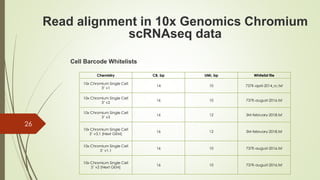
Cell Barcode Whitelists
Cellular barcode sequences are synthetic sequences attached to the beads that
identify individual cells.
The library of unique sequences is called a whitelist and depends on the Chromium
library preparation kit version.
There are three whitelists used for Chromium:
• 737K-april-2014_rc.txt
• 737K-august-2016.txt
• 3M-february-2018.txt
Also, Cell Ranger corrects barcode sequencing errors. (correct putative barcode
sequences against the whitelist)
25
Read alignment in 10x Genomics Chromium
scRNAseq data
Cell Barcode Whitelists
26
Read alignment in 10x Genomics Chromium
scRNAseq data
Chemistry CB, bp UMI, bp Whitelist file
10x Chromium Single Cell
3’ v1
14 10 737K-april-2014_rc.txt
10x Chromium Single Cell
3’ v2
16 10 737K-august-2016.txt
10x Chromium Single Cell
3’ v3
16 12 3M-february-2018.txt
10x Chromium Single Cell
3’ v3.1 (Next GEM)
16 12 3M-february-2018.txt
10x Chromium Single Cell
5’ v1.1
16 10 737K-august-2016.txt
10x Chromium Single Cell
5’ v2 (Next GEM)
16 10 737K-august-2016.txt
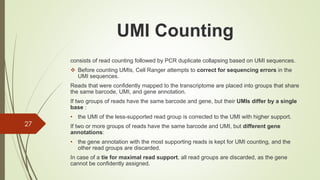
consists of read counting followed by PCR duplicate collapsing based on UMI sequences.
❖ Before counting UMIs, Cell Ranger attempts to correct for sequencing errors in the
UMI sequences.
Reads that were confidently mapped to the transcriptome are placed into groups that share
the same barcode, UMI, and gene annotation.
If two groups of reads have the same barcode and gene, but their UMIs differ by a single
base :
• the UMI of the less-supported read group is corrected to the UMI with higher support.
If two or more groups of reads have the same barcode and UMI, but different gene
annotations:
• the gene annotation with the most supporting reads is kept for UMI counting, and the
other read groups are discarded.
In case of a tie for maximal read support, all read groups are discarded, as the gene
cannot be confidently assigned.
27
UMI Counting
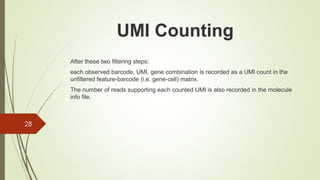
After these two filtering steps:
each observed barcode, UMI, gene combination is recorded as a UMI count in the
unfiltered feature-barcode (i.e. gene-cell) matrix.
The number of reads supporting each counted UMI is also recorded in the molecule
info file.
28
UMI Counting
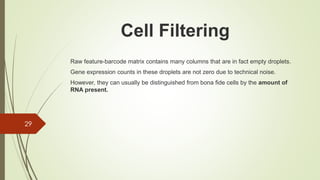
Raw feature-barcode matrix contains many columns that are in fact empty droplets.
Gene expression counts in these droplets are not zero due to technical noise.
However, they can usually be distinguished from bona fide cells by the amount of
RNA present.
29
Cell Filtering
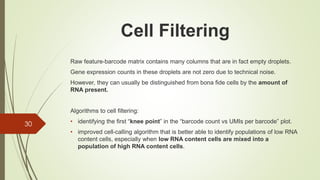
Raw feature-barcode matrix contains many columns that are in fact empty droplets.
Gene expression counts in these droplets are not zero due to technical noise.
However, they can usually be distinguished from bona fide cells by the amount of
RNA present.
Algorithms to cell filtering:
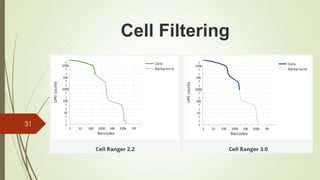
• identifying the first “knee point” in the “barcode count vs UMIs per barcode” plot.
• improved cell-calling algorithm that is better able to identify populations of low RNA
content cells, especially when low RNA content cells are mixed into a
population of high RNA content cells.
30
Cell Filtering
31
Cell Filtering
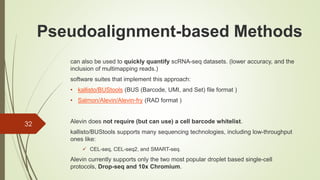
can also be used to quickly quantify scRNA-seq datasets. (lower accuracy, and the
inclusion of multimapping reads.)
software suites that implement this approach:
• kallisto/BUStools (BUS (Barcode, UMI, and Set) file format )
• Salmon/Alevin/Alevin-fry (RAD format )
Alevin does not require (but can use) a cell barcode whitelist.
kallisto/BUStools supports many sequencing technologies, including low-throughput
ones like:
✓ CEL-seq, CEL-seq2, and SMART-seq.
Alevin currently supports only the two most popular droplet based single-cell
protocols, Drop-seq and 10x Chromium.
32
Pseudoalignment-based Methods
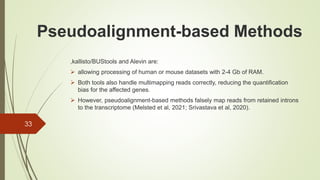
,kallisto/BUStools and Alevin are:
➢ allowing processing of human or mouse datasets with 2-4 Gb of RAM.
➢ Both tools also handle multimapping reads correctly, reducing the quantification
bias for the affected genes.
➢ However, pseudoalignment-based methods falsely map reads from retained introns
to the transcriptome (Melsted et al, 2021; Srivastava et al, 2020).
33
Pseudoalignment-based Methods
STARsolo is:
It was developed with a goal to generate results that are very similar to Cell Ranger.
STARsolo is several times faster than Cell Ranger on the same dataset.
it’s possible to process the data generated by most scRNA-seq approaches.
Alevin with full genome decoy has shown accuracy that is very similar to that of
STARsolo or Cell Ranger (Kaminow et al, 2021).
34
STARsolo and Alevin-full-decoy

Processing Raw scRNA-Seq Sequencing Data

  • 1.
    Single-Cell RNA-seq analysis Section2: Processing Raw scRNA-Seq Sequencing Data Presented By Alireza Dosutmohammadi M.Sc. in Bioinformatics, Tarbiat Modares University Oct 2021
  • 2.
    Reference Genome andits Annotation Reference Genome: Most scRNA-seq experiments are done using human or mouse tissues, organoids, or cell cultures. popular sources of assembly files: • UCSC (hg19, hg38, mm10) • GRC (GRCh37, GRCh38, GRCm38) Genome assembly is usually distributed as a fasta file. 2
  • 3.
    Reference Genome andits Annotation Genome annotation: Includes defining transcribed regions of genome (genes), as well as annotating exact transcripts with exon-intron boundaries, and assigning the newly defined features a type - e.g. protein coding, non-coding, etc. 3
  • 4.
    Reference Genome andits Annotation Genome annotation: Genome annotation is usually provided in either GTF or GFF3 file format, Popular sources of genome annotation: • RefSeq (most conservative, and tends to have the fewest annotated transcripts per gene.) • ENSEMBL • GENCODE ENSEMBL and GENCODE are very similar to each other and can be used interchangeably for our purposes. RefSeq transcript IDs start with NM_ or NR, e.g. NM_12345. Gene names in ENSEMBL and GENCODE start with ENSG (for human) and ENSMUSG (for mouse); transcripts start with ENST and ENSMUST, respectively. 4
  • 5.
    Reference Genome andits Annotation Genome annotation: Current ENSEMBL/GENCODE annotation of the human genome contains approximately 60k genes, 20k of which are protein coding, and 237k transcripts. Most genes can be coarsely divided by type into protein coding genes, long noncoding RNAs, short noncoding RNAs, and pseudogenes. 5
  • 6.
    Raw read processing: 1.read alignment 2. read counting. Processing of Full-length scRNA-seq Data 6
  • 7.
    Read alignment: can bedone against: • genome reference: done with a splice-aware aligner • STAR • hisat2 • transcriptome reference (many transcripts are very similar to each other) Some reads perfectly align to more than 1 location; these reads are often referred to as multimappers. Processing of Full-length scRNA-seq Data 7
  • 8.
    Read counting: In caseof genome alignment: • simplest strategy: count only reads mapping to a unique location (non-multimappers), and only overlapping one gene. This creates a bias in gene expression estimates (Pachter, 2011). • advanced strategy: includes splitting read counts between features it aligns to. e.g. if a read aligns equally well to 3 paralogous (homologous) genes, each paralog gets ⅓ of a count. Strand-specific RNA-seq reduces the ambiguity of read assignment in case of overlapping features located on opposite strands. An example of a program that efficiently implements all of the above-mentioned counting methods is featureCounts from the Subread package. Processing of Full-length scRNA-seq Data 8
  • 9.
    Read counting: In caseof transcriptome alignment: read assignment ambiguity is too great for simple counting. Thus, per-transcript and per-gene abundances are calculated using maximum likelihood abundance estimates using the Expectation-Maximization (EM) algorithm. Reads (and read fractions) that are assigned to transcripts are then summarized on gene level. The most widely used and well-supported program implementing this strategy is RSEM. Processing of Full-length scRNA-seq Data 9
  • 10.
    Read counting: In caseof transcriptome alignment: An alternative to a conventional approach is: pseudo-alignment methods. Two popular tools: • Kallisto • Salmon Their approaches: 1. Split the reference transcriptome into k-mers 2. Convert RNA-seq reads into k-mers; 3. Use the k-mers to assign reads to a transcript or several transcripts 4. Summarize the resulting counts on a transcript or gene level. Processing of Full-length scRNA-seq Data 10
  • 11.
    Read counting: k-mers: Processing ofFull-length scRNA-seq Data 11
  • 12.
    Read counting: In caseof transcriptome alignment: An alternative to a conventional approach is: pseudo-alignment methods. Two popular tools: • Kallisto • Salmon Both tools are extremely memory- and CPU-efficient, and quite accurate, especially for paired-end or long single-end reads. Pseudoalignment does not generate an alignment BAM file Processing of Full-length scRNA-seq Data 12
  • 13.
    Read counting: It isconventional to use within-sample normalization when doing clustering, PCA, and other types of exploratory analysis. The most popular method of such normalization is conversion of raw reads to Transcripts per Million (TPM). Processing of Full-length scRNA-seq Data 13
  • 14.
    scRNA-seq technologies generateread sequences containing three key pieces of information: • cDNA fragment: identifies the RNA transcript; • Cell barcode (CB): identifies the cell where the RNA was expressed; • Unique Molecular Identifier (UMI): allows to collapse reads that are PCR duplicates. Droplet-based scRNA-seq Data 14
  • 15.
    In contrast tobulk RNA-seq, scRNA-seq deals with a much smaller amount of RNA, and more PCR cycles are performed. Library sequencing is often done with paired-end reads, with one read containing CB + UMI (read 1 in 10x Chromium), and the other containing actual transcript sequence (read 2 in 10x Chromium). 15 Droplet-based scRNA-seq Data
  • 16.
    scRNA-seq workflow: • Mappingthe cDNA fragments to a reference; • Assigning reads to genes; • Assigning reads to cells (cell barcode demultiplexing); • Counting the number of unique RNA molecules (UMI deduplication). The outcome: a gene/cell count matrix, which is used as an estimate of the number of RNA molecules in each cell for each gene. 16 Droplet-based scRNA-seq Data
  • 17.
    Cell Ranger isthe default tool for processing scRNAseq data. Genome alignment: It uses STAR aligner(splicing-aware alignment) After this: it uses the transcript annotation GTF to bucket the reads into: • Exonic • Intronic • Intergenic. A read is exonic if: • at least 50% of it intersects an exon. A read is intronic if: • it is non-exonic and intersects an intron, and intergenic otherwise. for reads that align to a single exonic locus but also align to 1 or more non-exonic loci, the exonic locus is prioritized. 17 Read alignment in 10x Genomics Chromium scRNAseq data
  • 18.
    Classification of alignedreads in Cell Ranger: 18 Read alignment in 10x Genomics Chromium scRNAseq data
  • 19.
    Transcriptome alignment: Align: exonic andintronic confidently mapped reads to annotated transcripts by examining their compatibility with the transcriptome. Reads are classified based on whether : • they are sense or antisense • they are exonic, intronic • their splicing pattern is compatible with transcript annotations associated with that gene. reads that are transcriptomic are carried forward to UMI counting. 19 Read alignment in 10x Genomics Chromium scRNAseq data
  • 20.
    Transcriptome alignment: Align: exonic andintronic confidently mapped reads to annotated transcripts by examining their compatibility with the transcriptome. Reads are classified based on whether : • they are sense or antisense (sense strand is incapable of being transcribed into mRNA whereas antisense strand serves as the template for the transcription.) • they are exonic, intronic • their splicing pattern is compatible with transcript annotations associated with that gene. reads that are transcriptomic are carried forward to UMI counting. 20 Read alignment in 10x Genomics Chromium scRNAseq data
  • 21.
    Transcriptome alignment: sense orantisense strand 21 Read alignment in 10x Genomics Chromium scRNAseq data
  • 22.
    When the inputto the assay consists of nuclei: a high percentage of the reads comes from: the unspliced transcripts and align to introns. In order to count these intronic reads: • cellranger count • cellranger multi pipelines can be run with the option include-introns. Only uniquely mapping reads are carried forward to UMI counting.(Reads mapped confidently to transcriptome) multimapping genes are discarded by Cell Ranger. 22 Read alignment in 10x Genomics Chromium scRNAseq data
  • 23.
    Cell Ranger ReferencePreparation: • Primary genome assembly versions (i.e. without the ALT loci) are used for the alignment. • Annotation GTF files are filtered. The following biotypes are retained: protein coding, long noncoding RNA, antisense, and all biotypes belonging to BCR/TCR (i.e. V/D/J) genes. • All pseudogenes and small noncoding RNAs are removed. 23 Read alignment in 10x Genomics Chromium scRNAseq data
  • 24.
    Cell Ranger ReferencePreparation: 24 Read alignment in 10x Genomics Chromium scRNAseq data Cell Ranger Reference Species Assembly/Annotation Genes before filtering Genes after filtering 2020-A human GRCh38/GENCODE v32 60668 36601 2020-A mouse mm10/GENCODE vM23 55421 32285 3.0.0 human GRCh38/Ensembl 93 58395 33538 3.0.0 human hg19/Ensembl 87 57905 32738 3.0.0 mouse mm10/Ensembl 93 54232 31053 2.1.0 mouse mm10/Ensembl 84 47729 28692 1.2.0 human GRCh38/Ensembl 84 60675 33694 1.2.0 human hg19/Ensembl 82 57905 32738 1.2.0 mouse mm10/Ensembl 84 47729 27998
  • 25.
    Cell Barcode Whitelists Cellularbarcode sequences are synthetic sequences attached to the beads that identify individual cells. The library of unique sequences is called a whitelist and depends on the Chromium library preparation kit version. There are three whitelists used for Chromium: • 737K-april-2014_rc.txt • 737K-august-2016.txt • 3M-february-2018.txt Also, Cell Ranger corrects barcode sequencing errors. (correct putative barcode sequences against the whitelist) 25 Read alignment in 10x Genomics Chromium scRNAseq data
  • 26.
    Cell Barcode Whitelists 26 Readalignment in 10x Genomics Chromium scRNAseq data Chemistry CB, bp UMI, bp Whitelist file 10x Chromium Single Cell 3’ v1 14 10 737K-april-2014_rc.txt 10x Chromium Single Cell 3’ v2 16 10 737K-august-2016.txt 10x Chromium Single Cell 3’ v3 16 12 3M-february-2018.txt 10x Chromium Single Cell 3’ v3.1 (Next GEM) 16 12 3M-february-2018.txt 10x Chromium Single Cell 5’ v1.1 16 10 737K-august-2016.txt 10x Chromium Single Cell 5’ v2 (Next GEM) 16 10 737K-august-2016.txt
  • 27.
    consists of readcounting followed by PCR duplicate collapsing based on UMI sequences. ❖ Before counting UMIs, Cell Ranger attempts to correct for sequencing errors in the UMI sequences. Reads that were confidently mapped to the transcriptome are placed into groups that share the same barcode, UMI, and gene annotation. If two groups of reads have the same barcode and gene, but their UMIs differ by a single base : • the UMI of the less-supported read group is corrected to the UMI with higher support. If two or more groups of reads have the same barcode and UMI, but different gene annotations: • the gene annotation with the most supporting reads is kept for UMI counting, and the other read groups are discarded. In case of a tie for maximal read support, all read groups are discarded, as the gene cannot be confidently assigned. 27 UMI Counting
  • 28.
    After these twofiltering steps: each observed barcode, UMI, gene combination is recorded as a UMI count in the unfiltered feature-barcode (i.e. gene-cell) matrix. The number of reads supporting each counted UMI is also recorded in the molecule info file. 28 UMI Counting
  • 29.
    Raw feature-barcode matrixcontains many columns that are in fact empty droplets. Gene expression counts in these droplets are not zero due to technical noise. However, they can usually be distinguished from bona fide cells by the amount of RNA present. 29 Cell Filtering
  • 30.
    Raw feature-barcode matrixcontains many columns that are in fact empty droplets. Gene expression counts in these droplets are not zero due to technical noise. However, they can usually be distinguished from bona fide cells by the amount of RNA present. Algorithms to cell filtering: • identifying the first “knee point” in the “barcode count vs UMIs per barcode” plot. • improved cell-calling algorithm that is better able to identify populations of low RNA content cells, especially when low RNA content cells are mixed into a population of high RNA content cells. 30 Cell Filtering
  • 31.
  • 32.
    can also beused to quickly quantify scRNA-seq datasets. (lower accuracy, and the inclusion of multimapping reads.) software suites that implement this approach: • kallisto/BUStools (BUS (Barcode, UMI, and Set) file format ) • Salmon/Alevin/Alevin-fry (RAD format ) Alevin does not require (but can use) a cell barcode whitelist. kallisto/BUStools supports many sequencing technologies, including low-throughput ones like: ✓ CEL-seq, CEL-seq2, and SMART-seq. Alevin currently supports only the two most popular droplet based single-cell protocols, Drop-seq and 10x Chromium. 32 Pseudoalignment-based Methods
  • 33.
    ,kallisto/BUStools and Alevinare: ➢ allowing processing of human or mouse datasets with 2-4 Gb of RAM. ➢ Both tools also handle multimapping reads correctly, reducing the quantification bias for the affected genes. ➢ However, pseudoalignment-based methods falsely map reads from retained introns to the transcriptome (Melsted et al, 2021; Srivastava et al, 2020). 33 Pseudoalignment-based Methods
  • 34.
    STARsolo is: It wasdeveloped with a goal to generate results that are very similar to Cell Ranger. STARsolo is several times faster than Cell Ranger on the same dataset. it’s possible to process the data generated by most scRNA-seq approaches. Alevin with full genome decoy has shown accuracy that is very similar to that of STARsolo or Cell Ranger (Kaminow et al, 2021). 34 STARsolo and Alevin-full-decoy