DNA LIBRARY
By
Anita Devi P.hD
15099009
DNA LIBRARY
 The term "library" can refer to a population of
organisms, each of which carries a DNA molecule
inserted into a cloning vector, or alternatively to the
collection of all of the cloned vector molecules.
 Collection of DNA fragments that have been cloned
into vectors so that researchers can identify and
isolate the DNA fragments that interest them for
further study.
Genomic libraries
cDNA libraries
Gene
library
(made from genomic DNA)
(made from cDNA- copy of mRNA)
For the construction of DNA library
 Size of the gene
 Capacity of the vector
 Molecular tools
 Vectors
Vector type Max. Insert size
cloned DNA
(kb)
Approx.no: of cloned
DNA required in a
library
Plasmid 20 >10^5
Lambda phage 20 5 x10^5
Cosmid 45 2 x 10^5
BAC >500 5 x 10^4
YAC 1Mb 1o^5
 Genomic DNA library: Contains the whole
genome of an organism
 Genome size is expressed in terms of number of base
pairs.
 Smallest genomic size is…………..????
 For human the genomic size is………….????
STEPS
1) Purification of genomic DNA
PROKARYOTES
EUKARYOTES
•Genomic libraries of prokaryotes are
easier to make and contain all the genome
sequences.
2) Cleaving the genome into smaller fragments
by restriction endonucleases.
• Parial digestion is used to getting longer DNA
sequences.
3) In cooperation of these fragments into a
suitable vector.
4) Introduction of vector into a suitable host
like bacterium(Transformation)
 Multiplication
 Screening
 Screening:
The process of identifying one particular clone
containing the gene of interest from among
the very large number of others in the gene library .
 Expression screening
 Hybridisation technique
 PCR
Expression screening
Eg:
 Finding the gene for alanine production
 Grow in alanine deficit medium
 Then they are labelled in the petri plate indicates
that gene for alanine production is stored in bacteria.
Hybridisation technique
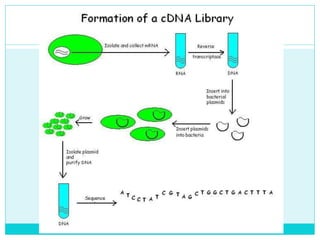
cDNA Library
 No cDNA library was made from prokaryotic
mRNA…..???
 cDNA libraries are very useful for eukaryotic gene
analysis.
mRNA isolation, purification
Check the RNA integrity
Synthesis of cDNA
Treatment of cDNA ends
Ligation to vector
mRNA isolation
 Most eukaryotic mRNAs are polyadenylated
at their 3’ ends
• oligo (dT) can be bound to the poly(A) tail and
used to recover the mRNA.
AAAAAAAAAAn5’ cap
Check the mRNA integrity
 Make sure that the mRNA is not degraded.
•Translating the mRNA
•Analysis the mRNAs by gel
elctrophoresis
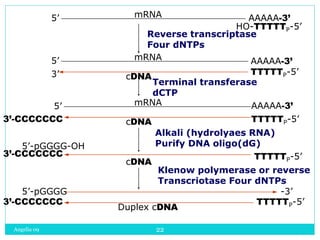
Synthesis of cDNA
First stand synthesis:
Reverse transcriptase ,primer( oligo(dT) or
hexanucleotides) and dNTPs.
Second strand synthesis:
Best way of making full-length cdna is to ‘tail’ the
3’-end of the first strand and then use a
complementary primer to make the second.
5’ mRNA AAAAA-3’
HO-TTTTTP-5’
5’
Reverse transcriptase
Four dNTPs
AAAAA-3’
TTTTTP-5’
mRNA
mRNA
cDNA
cDNA
cDNA
Duplex cDNA
AAAAA-3’
TTTTTP-5’
TTTTTP-5’
3’
3’-CCCCCCC
Terminal transferase
dCTP
Alkali (hydrolyaes RNA)
Purify DNA oligo(dG)
Klenow polymerase or reverse
Transcriotase Four dNTPs
5’-pGGGG-OH
5’
3’-CCCCCCC
5’-pGGGG
3’-CCCCCCC TTTTTP-5’
-3’
Angelia 09 22
5’-pGGGG
3’-CCCCCCC
HO-CCGAATTCGGGGGG
3’-GGCTTAAGCCCCCC
5’-pAATTCGGGGGG
TTTTTGGCTTAAGCC-OH
CCGAATTCGG-3’
3’-CCCC
3’-CCCCCCC
3’-CCC
5’-pGGGG
5’-pGGGG
TTTTTp-5’
-3’
TTTTTp-5’
TTTTTp-5’
-3’
-3’
TTTTTGGCTTAAp-5’
HO-CCG/AATTCGG-3’
3’-GGCTTAA/GCC-OH
CCG-3’
Duplex cDNA
Single strand-specific nuclease
Klenow polymerase
treat with E.coRI methylase
Add E.colRI linkers
using T4 DNA ligase
E.colRI digestion
Ligate to vector and transfom
Fig2.1 Second strand synthesis23
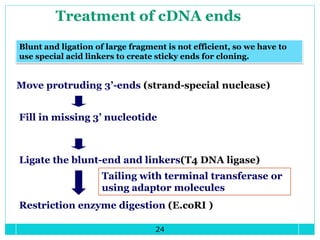
Treatment of cDNA ends
Blunt and ligation of large fragment is not efficient, so we have to
use special acid linkers to create sticky ends for cloning.
Move protruding 3’-ends (strand-special nuclease)
Fill in missing 3’ nucleotide
Ligate the blunt-end and linkers(T4 DNA ligase)
Restriction enzyme digestion (E.coRI )
Tailing with terminal transferase or
using adaptor molecules
24
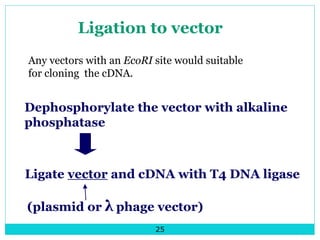
Ligation to vector
Any vectors with an EcoRI site would suitable
for cloning the cDNA.
Dephosphorylate the vector with alkaline
phosphatase
Ligate vector and cDNA with T4 DNA ligase
(plasmid or λ phage vector)
25
Uses of cDNA library
 Used when reproducing eukaryotic genomes as
the amount of information is reduced to remove the
large number of non-coding regions from the library.
 To express eukaryotic genes in prokaryotes.
 Useful for subsequently isolating the gene that codes
for that mRNA.
DNA library

DNA library

  • 1.
  • 2.
    DNA LIBRARY  Theterm "library" can refer to a population of organisms, each of which carries a DNA molecule inserted into a cloning vector, or alternatively to the collection of all of the cloned vector molecules.  Collection of DNA fragments that have been cloned into vectors so that researchers can identify and isolate the DNA fragments that interest them for further study.
  • 3.
    Genomic libraries cDNA libraries Gene library (madefrom genomic DNA) (made from cDNA- copy of mRNA)
  • 4.
    For the constructionof DNA library  Size of the gene  Capacity of the vector  Molecular tools  Vectors
  • 5.
    Vector type Max.Insert size cloned DNA (kb) Approx.no: of cloned DNA required in a library Plasmid 20 >10^5 Lambda phage 20 5 x10^5 Cosmid 45 2 x 10^5 BAC >500 5 x 10^4 YAC 1Mb 1o^5
  • 6.
     Genomic DNAlibrary: Contains the whole genome of an organism  Genome size is expressed in terms of number of base pairs.  Smallest genomic size is…………..????  For human the genomic size is………….????
  • 7.
    STEPS 1) Purification ofgenomic DNA PROKARYOTES EUKARYOTES •Genomic libraries of prokaryotes are easier to make and contain all the genome sequences.
  • 8.
    2) Cleaving thegenome into smaller fragments by restriction endonucleases. • Parial digestion is used to getting longer DNA sequences.
  • 9.
    3) In cooperationof these fragments into a suitable vector.
  • 10.
    4) Introduction ofvector into a suitable host like bacterium(Transformation)
  • 11.
  • 12.
     Screening: The processof identifying one particular clone containing the gene of interest from among the very large number of others in the gene library .  Expression screening  Hybridisation technique  PCR
  • 13.
    Expression screening Eg:  Findingthe gene for alanine production  Grow in alanine deficit medium  Then they are labelled in the petri plate indicates that gene for alanine production is stored in bacteria.
  • 14.
  • 16.
    cDNA Library  NocDNA library was made from prokaryotic mRNA…..???  cDNA libraries are very useful for eukaryotic gene analysis.
  • 18.
    mRNA isolation, purification Checkthe RNA integrity Synthesis of cDNA Treatment of cDNA ends Ligation to vector
  • 19.
    mRNA isolation  Mosteukaryotic mRNAs are polyadenylated at their 3’ ends • oligo (dT) can be bound to the poly(A) tail and used to recover the mRNA. AAAAAAAAAAn5’ cap
  • 20.
    Check the mRNAintegrity  Make sure that the mRNA is not degraded. •Translating the mRNA •Analysis the mRNAs by gel elctrophoresis
  • 21.
    Synthesis of cDNA Firststand synthesis: Reverse transcriptase ,primer( oligo(dT) or hexanucleotides) and dNTPs. Second strand synthesis: Best way of making full-length cdna is to ‘tail’ the 3’-end of the first strand and then use a complementary primer to make the second.
  • 22.
    5’ mRNA AAAAA-3’ HO-TTTTTP-5’ 5’ Reversetranscriptase Four dNTPs AAAAA-3’ TTTTTP-5’ mRNA mRNA cDNA cDNA cDNA Duplex cDNA AAAAA-3’ TTTTTP-5’ TTTTTP-5’ 3’ 3’-CCCCCCC Terminal transferase dCTP Alkali (hydrolyaes RNA) Purify DNA oligo(dG) Klenow polymerase or reverse Transcriotase Four dNTPs 5’-pGGGG-OH 5’ 3’-CCCCCCC 5’-pGGGG 3’-CCCCCCC TTTTTP-5’ -3’ Angelia 09 22
  • 23.
  • 24.
    Treatment of cDNAends Blunt and ligation of large fragment is not efficient, so we have to use special acid linkers to create sticky ends for cloning. Move protruding 3’-ends (strand-special nuclease) Fill in missing 3’ nucleotide Ligate the blunt-end and linkers(T4 DNA ligase) Restriction enzyme digestion (E.coRI ) Tailing with terminal transferase or using adaptor molecules 24
  • 25.
    Ligation to vector Anyvectors with an EcoRI site would suitable for cloning the cDNA. Dephosphorylate the vector with alkaline phosphatase Ligate vector and cDNA with T4 DNA ligase (plasmid or λ phage vector) 25
  • 26.
    Uses of cDNAlibrary  Used when reproducing eukaryotic genomes as the amount of information is reduced to remove the large number of non-coding regions from the library.  To express eukaryotic genes in prokaryotes.  Useful for subsequently isolating the gene that codes for that mRNA.