“GENOMIC DNA LIBRARY CONSTRUCTION”
SUBMITTED BY:
SAMIM KHAN
M.Sc.(BT) 3rd
sem.
A7100216002
Introduction
Gene sequence are arrangedingenome inarandon fashionandselectingorisolatingagene is a big
task especiallywhenthe genomicsequencesare notknown.A small portionof genome is
transcribedtogive mRNA where asa major portionremaineduntranscribed.Hence,there are two
waysto representagenomicsequence informationintothe multiple smallfragmentsinthe formof
a library:(1) Genomiclibrary(2) cDNA library.
Preparationof Genomic Library-A genomiclibraryrepresentscomplete genome inmultiple
clonescontainingsmall DNA fragments.Dependinguponorganismandsize of genome,this libraryis
either prepared in a bacterial vector (discussed later in future lectures) or in yeast artificial
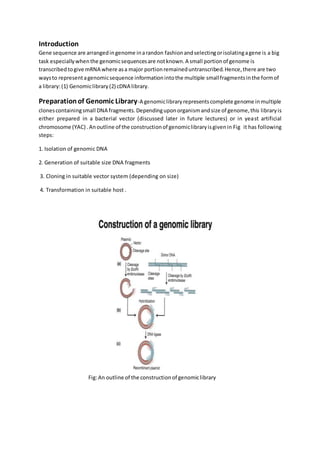
chromosome (YAC) .Anoutline of the constructionof genomiclibraryisgivenin Fig it has following
steps:
1. Isolation of genomic DNA
2. Generation of suitable size DNA fragments
3. Cloning in suitable vector system (depending on size)
4. Transformation in suitable host .
Fig:An outline of the constructionof genomiclibrary
1.Isolation of genomic DNA-
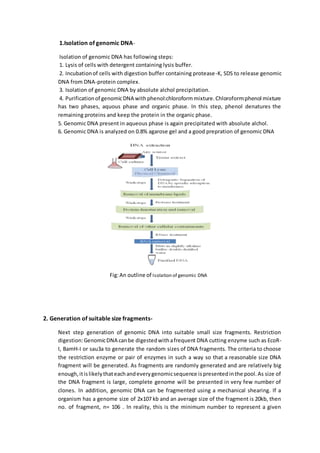
Isolation of genomic DNA has following steps:
1. Lysis of cells with detergent containing lysis buffer.
2. Incubationof cells with digestion buffer containing protease-K, SDS to release genomic
DNA from DNA-protein complex.
3. Isolation of genomic DNA by absolute alchol precipitation.
4. Purificationof genomicDNA withphenol:chloroformmixture.Chloroform:phenol mixture
has two phases, aquous phase and organic phase. In this step, phenol denatures the
remaining proteins and keep the protein in the organic phase.
5. Genomic DNA present in aqueous phase is again precipitated with absolute alchol.
6. Genomic DNA is analyzed on 0.8% agarose gel and a good prepration of genomic DNA
Fig:An outline of Isolation of genomic DNA
2. Generation of suitable size fragments-
Next step generation of genomic DNA into suitable small size fragments. Restriction
digestion:GenomicDNA canbe digestedwithafrequent DNA cutting enzyme such as EcoR-
I, BamH-I or sau3a to generate the random sizes of DNA fragments. The criteria to choose
the restriction enzyme or pair of enzymes in such a way so that a reasonable size DNA
fragment will be generated. As fragments are randomly generated and are relatively big
enough,itislikelythateachandeverygenomicsequence ispresentedinthe pool.As size of
the DNA fragment is large, complete genome will be presented in very few number of
clones. In addition, genomic DNA can be fragmented using a mechanical shearing. If a
organism has a genome size of 2x10⁷ kb and an average size of the fragment is 20kb, then
no. of fragment, n= 106 . In reality, this is the minimum number to represent a given
fragment in the library where as the actual number is much larger. The probability (P) of
finding a particular genomic sequence in a random library of N independent clone is as
follows:N=ln(1-P)/ln(1-1/n) Where,N=numberof clones, P=probability, n= size of average
fragment size
3. Cloning into the suitable vector-
The suitable vector to prepare the genomic library can be selected based on size of the
fragmentof genomicDNA andcarrying capacityof the vector . Size of average fragment can
be calculated from the and accordingly a suitable vector can be choosen. In the case of
fragment generated by restriction enzyme, vector can be digested with the same enzyme
and put for ligation to get clone. In the case of mechanical shearing mediated fragment
generation, putting these fragment needs additional effort. In one of the approachs, a
adoptermolecule canbe usedtogenerate sticky ends, alternatively a endonuclease can be
used to generate sticky ends.
4. Transformation to get colonies- Post ligation, clones are transformed in a suitable host
to get colonies. A suitable host can be a bacterial strain or yeast.
Table 10.1: Carrying capacity of different vectors
S.No Vector Insert Size (MB)
1 Plasmids 15
2 Phage lambda 25
3 Cosmids 45
4 Bacteriophage 70-100
5 Bacterial artificial chromosome (BAC) 120-300
6 Yeast artificial chromosome (YAC) 250-2000
Application
 Researcherscanexplore the genome of anorganismtolearnmore aboutgenomicstructure
and function
 Theycan map the genome,identifyingthe locationsof specificgenes.
 Helpsto developtestswhichcanbe usedto locate geneticvariationsincludingmutations
 Useful inRecombinantDNA Technology,helpstogeneticallymodifyorganismsandproduce
clonesof desiredtypes.
 Genomiclibraryconstructionisthe firststepinanyDNA sequencingprojects.
 Genomiclibraryhelpsinidentificationof the novelpharmaceuticallyimportantgenes.
Samim

Samim

  • 1.
    “GENOMIC DNA LIBRARYCONSTRUCTION” SUBMITTED BY: SAMIM KHAN M.Sc.(BT) 3rd sem. A7100216002
  • 2.
    Introduction Gene sequence arearrangedingenome inarandon fashionandselectingorisolatingagene is a big task especiallywhenthe genomicsequencesare notknown.A small portionof genome is transcribedtogive mRNA where asa major portionremaineduntranscribed.Hence,there are two waysto representagenomicsequence informationintothe multiple smallfragmentsinthe formof a library:(1) Genomiclibrary(2) cDNA library. Preparationof Genomic Library-A genomiclibraryrepresentscomplete genome inmultiple clonescontainingsmall DNA fragments.Dependinguponorganismandsize of genome,this libraryis either prepared in a bacterial vector (discussed later in future lectures) or in yeast artificial chromosome (YAC) .Anoutline of the constructionof genomiclibraryisgivenin Fig it has following steps: 1. Isolation of genomic DNA 2. Generation of suitable size DNA fragments 3. Cloning in suitable vector system (depending on size) 4. Transformation in suitable host . Fig:An outline of the constructionof genomiclibrary
  • 3.
    1.Isolation of genomicDNA- Isolation of genomic DNA has following steps: 1. Lysis of cells with detergent containing lysis buffer. 2. Incubationof cells with digestion buffer containing protease-K, SDS to release genomic DNA from DNA-protein complex. 3. Isolation of genomic DNA by absolute alchol precipitation. 4. Purificationof genomicDNA withphenol:chloroformmixture.Chloroform:phenol mixture has two phases, aquous phase and organic phase. In this step, phenol denatures the remaining proteins and keep the protein in the organic phase. 5. Genomic DNA present in aqueous phase is again precipitated with absolute alchol. 6. Genomic DNA is analyzed on 0.8% agarose gel and a good prepration of genomic DNA Fig:An outline of Isolation of genomic DNA 2. Generation of suitable size fragments- Next step generation of genomic DNA into suitable small size fragments. Restriction digestion:GenomicDNA canbe digestedwithafrequent DNA cutting enzyme such as EcoR- I, BamH-I or sau3a to generate the random sizes of DNA fragments. The criteria to choose the restriction enzyme or pair of enzymes in such a way so that a reasonable size DNA fragment will be generated. As fragments are randomly generated and are relatively big enough,itislikelythateachandeverygenomicsequence ispresentedinthe pool.As size of the DNA fragment is large, complete genome will be presented in very few number of clones. In addition, genomic DNA can be fragmented using a mechanical shearing. If a organism has a genome size of 2x10⁷ kb and an average size of the fragment is 20kb, then no. of fragment, n= 106 . In reality, this is the minimum number to represent a given
  • 4.
    fragment in thelibrary where as the actual number is much larger. The probability (P) of finding a particular genomic sequence in a random library of N independent clone is as follows:N=ln(1-P)/ln(1-1/n) Where,N=numberof clones, P=probability, n= size of average fragment size 3. Cloning into the suitable vector- The suitable vector to prepare the genomic library can be selected based on size of the fragmentof genomicDNA andcarrying capacityof the vector . Size of average fragment can be calculated from the and accordingly a suitable vector can be choosen. In the case of fragment generated by restriction enzyme, vector can be digested with the same enzyme and put for ligation to get clone. In the case of mechanical shearing mediated fragment generation, putting these fragment needs additional effort. In one of the approachs, a adoptermolecule canbe usedtogenerate sticky ends, alternatively a endonuclease can be used to generate sticky ends. 4. Transformation to get colonies- Post ligation, clones are transformed in a suitable host to get colonies. A suitable host can be a bacterial strain or yeast. Table 10.1: Carrying capacity of different vectors S.No Vector Insert Size (MB) 1 Plasmids 15 2 Phage lambda 25 3 Cosmids 45 4 Bacteriophage 70-100 5 Bacterial artificial chromosome (BAC) 120-300 6 Yeast artificial chromosome (YAC) 250-2000 Application  Researcherscanexplore the genome of anorganismtolearnmore aboutgenomicstructure and function  Theycan map the genome,identifyingthe locationsof specificgenes.  Helpsto developtestswhichcanbe usedto locate geneticvariationsincludingmutations  Useful inRecombinantDNA Technology,helpstogeneticallymodifyorganismsandproduce clonesof desiredtypes.  Genomiclibraryconstructionisthe firststepinanyDNA sequencingprojects.  Genomiclibraryhelpsinidentificationof the novelpharmaceuticallyimportantgenes.