




























Social Digital Networking Publishing
Calvin Yu @      CCL / 2010.05.08
Publishing industry
is no longer the same
Changing Landscape
Changing Landscape

•        Content Delivery


    •           New Possibilities


•        Mode of Communication


    •   Interaction


    •   Speed
Changing Landscape

•   Triggering Point


•         Product Life Cycle


•     User Expectation
Puzzled?
Social Networking?
Myths of Social Networking
Myth #1
It is for the Youth only!
Fact #1

•                                    2009.11
    Research by The Nielsen Company
    in the US (Nov. 2009)

     •                During the past 5 years


         •                                  ^ 55%
             seniors actively using the
             Internet ^ 55%

         •                       ^ 11%
             time spent online by the
             seniors ^ 11%


               Source: http://blog.nielsen.com/nielsenwire/online_mobile/six-million-more-seniors-using-the-web-than-five-years-ago/
Fact #1

•                                   2009.11
    Research by The Nielsen Company
    in the US (2009.11)

     •               During the past 2 years


         •                      ^ 53%
             social networking seniors ^
             53%


              Source: http://blog.nielsen.com/nielsenwire/online_mobile/six-million-more-seniors-using-the-web-than-five-years-ago/
Fact #1

•         Facebook            2009.2.2
    US Facebook Statistics (2009.2.2)

     •
         Growing in all age/gender
         demographic

     •                     55
                 120            175.3%
         Fastest growing segment:
         Women over 55
         up 175.3% in the last 120 days


                 Source: http://www.insidefacebook.com/2009/02/02/fastest-growing-demographic-on-facebook-women-over-55/
Fact #1

•         Facebook            2009.2.2
    US Facebook Statistics (2009.2.2)

     •


         Facebook growing faster with
         women than men in almost every
         age group

     • 45%                    26
         45% users > 26 years


                 Source: http://www.insidefacebook.com/2009/02/02/fastest-growing-demographic-on-facebook-women-over-55/
Tip #1
The audience spectrum is much
wider than your guess!
Myth #2
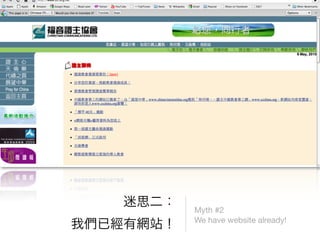
We have website already!
Fact #2

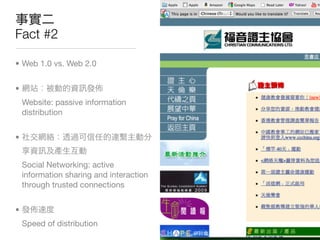
• Web 1.0 vs. Web 2.0


•
    Website: passive information
    distribution


•


    Social Networking: active
    information sharing and interaction
    through trusted connections


•
    Speed of distribution
Fact #2

•
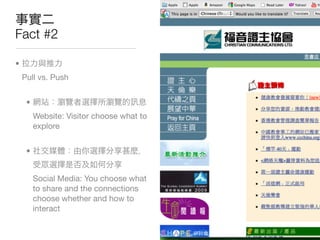
    Pull vs. Push


     •
         Website: Visitor choose what to
         explore


     •


         Social Media: You choose what
         to share and the connections
         choose whether and how to
         interact
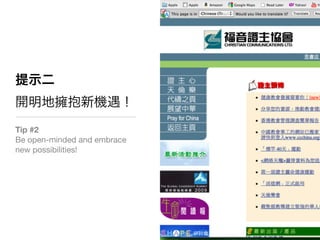
Tip #2
Be open-minded and embrace
new possibilities!
Myth #3
We have no resources!
Fact #3

•
    That is exactly why you need Social
    Networking!


•
    Trusted connections are your assets


•
    Viral effect


•
    Explore the hidden potentials of
    your work
Tip #3
With Social Networking
platforms, you become much
more resourceful than you used
to be!
Myth #4
We have no IT people!
Fact #4

•
    Social Networking is designed for
    everyone!


•
    They have already done the
    technical hard work for you!


•                                       !
    You know better about your
    organization’s vision than any IT
    experts!
Tip #4
You need relevant Social
Networking strategy rather than
competent IT people!
Myth #5
           Facebook = Social Networking
Facebook
Fact #5

•          Yes and No


•       Facebook


    Yes: Facebook is a popular Social
    Networking service


•


    Twitter Delicious   Digg   YouTube
      SlideShare Scribd
    No: Social Networking takes many
    different forms and perspectives >
Tip #5
Do your research to explore the
possibilities!
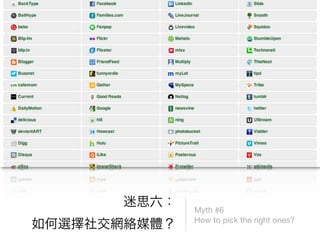
Myth #6
How to pick the right ones?
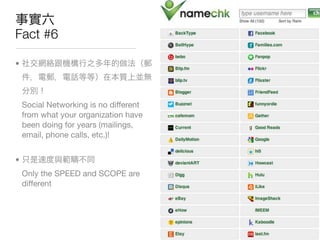
Fact #6

•


    Social Networking is no different
    from what your organization have
    been doing for years (mailings,
    email, phone calls, etc.)!


•
    Only the SPEED and SCOPE are
    different
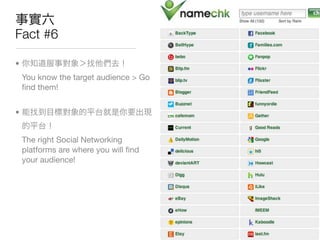
Fact #6

•
    You know the target audience > Go
    find them!


•


    The right Social Networking
    platforms are where you will find
    your audience!
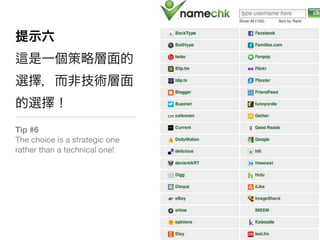
Tip #6
The choice is a strategic one
rather than a technical one!
Myth #7
Just put everything on it!
Fact #7

•
    Highly competitive in attention
    seeking


•
    What to share and how to share are
    critical
Fact #7

•             Editorial Principles


    •
        Concise & Accurate: get to the
        point instantly


    •
        Creative & Photographic: catch
        the attention

    •


        Active & Interactive: update
        frequently and make room for
        interaction
Tip #7
Customize and Differentiate!
Social Networking in Plain English
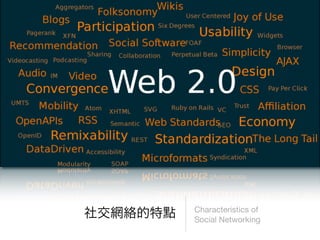
Characteristics of
Social Networking
Connections of Connections
Trusted Connections
Sharing and Interaction
Participation
What is the Relevance?
Social Networking Strategy
Focused
Focused

•


    Solidify, deepen and extend Trusted
    Connections, including supporters
    and partners


•


    Select Social Networking platforms
    by evaluating its appropriateness in
    reaching and bridging target
    communities
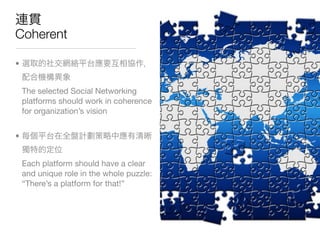
Coherent
Coherent

•


    The selected Social Networking
    platforms should work in coherence
    for organization’s vision


•


    Each platform should have a clear
    and unique role in the whole puzzle:
    “There’s a platform for that!”
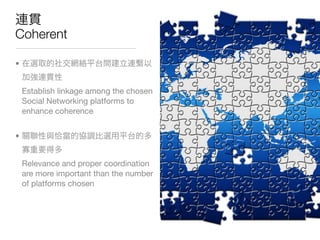
Coherent

•


    Establish linkage among the chosen
    Social Networking platforms to
    enhance coherence


•


    Relevance and proper coordination
    are more important than the number
    of platforms chosen
Sustainable
Sustainable

•


    Empower, educate and mobilize the
    Connections for Sharing, Interaction
    and Participation


•
    Share Together, Interact Together
    and Grow Together
Sustainable

•             Doable


    • 20/80        20/80 Rule


•                    Simplicity is key


    • “Simplicity is the ultimate
      sophistication.” ~ Da Vinci


    •


        Ease of use for all (staff,
        supporters, partners, etc.)
Facing the Social Networking Revolution, you need to...
Think Different
Publishers’ Challenges
Too much to read for readers
Too much to read

•         Communication


    •


        Email, SMS, Instant Messages,
        Letters, etc.


•         Information


    •
        News, Advertisement, Lifestyle
        Information, etc.
Too many media choices
Too many media

•             Traditional media


    •


        Press, Magazine, Book, TV,
        Movie, Radio etc.


•           New media


    •                Facebook     Twitter,
        Podcast,
        Web, Blog, Facebook, Twitter,
        Podcast, etc.
Too many media

•            Information overload


•            Too much noise


•
    Less time for reading


•
    Bite-sized content consumption


•
    Changing expectation of readers
Too many new possibilities
Too many possibilities

•
    Strike of tablet computer


•
    Changing reading experience


•


    Changing reading expectation
    (content, timing, format, etc.)


•               vs.
    Digitized Book vs. Digital Publishing
Way Out
Way Out

•
    Content is king!


•
    Diversified mode of content delivery


•
    Digital Publishing is not simply
    digitizing books
Way Out

•


    Embrace social networking to make
    a difference for both digital
    publishing and traditional publishing


     •
         Changing triggering point:
         Cross-Media Marketing


     •
         The Power of Experience, Word
         of Mouth and Share
Way Out

•
    Emphasis on both content and user
    experience


     •


         Customize appropriate user
         experience based on content:
         Don’t put the cart before the
         horse


     •
         Intuitive user experience
Q&A
In search of excellence for HIM

Social Networking x Digital Publishing 社交網絡 x 數碼出版 (2010.05.08 @ CCL 福音證主協會)

  • 1.
    Social Digital NetworkingPublishing Calvin Yu @ CCL / 2010.05.08
  • 2.
  • 3.
  • 4.
    Changing Landscape • Content Delivery • New Possibilities • Mode of Communication • Interaction • Speed
  • 5.
    Changing Landscape • Triggering Point • Product Life Cycle • User Expectation
  • 6.
  • 7.
  • 8.
    Myths of SocialNetworking
  • 9.
    Myth #1 It isfor the Youth only!
  • 10.
    Fact #1 • 2009.11 Research by The Nielsen Company in the US (Nov. 2009) • During the past 5 years • ^ 55% seniors actively using the Internet ^ 55% • ^ 11% time spent online by the seniors ^ 11% Source: http://blog.nielsen.com/nielsenwire/online_mobile/six-million-more-seniors-using-the-web-than-five-years-ago/
  • 11.
    Fact #1 • 2009.11 Research by The Nielsen Company in the US (2009.11) • During the past 2 years • ^ 53% social networking seniors ^ 53% Source: http://blog.nielsen.com/nielsenwire/online_mobile/six-million-more-seniors-using-the-web-than-five-years-ago/
  • 12.
    Fact #1 • Facebook 2009.2.2 US Facebook Statistics (2009.2.2) • Growing in all age/gender demographic • 55 120 175.3% Fastest growing segment: Women over 55 up 175.3% in the last 120 days Source: http://www.insidefacebook.com/2009/02/02/fastest-growing-demographic-on-facebook-women-over-55/
  • 13.
    Fact #1 • Facebook 2009.2.2 US Facebook Statistics (2009.2.2) • Facebook growing faster with women than men in almost every age group • 45% 26 45% users > 26 years Source: http://www.insidefacebook.com/2009/02/02/fastest-growing-demographic-on-facebook-women-over-55/
  • 14.
    Tip #1 The audiencespectrum is much wider than your guess!
  • 15.
    Myth #2 We havewebsite already!
  • 16.
    Fact #2 • Web1.0 vs. Web 2.0 • Website: passive information distribution • Social Networking: active information sharing and interaction through trusted connections • Speed of distribution
  • 17.
    Fact #2 • Pull vs. Push • Website: Visitor choose what to explore • Social Media: You choose what to share and the connections choose whether and how to interact
  • 18.
    Tip #2 Be open-mindedand embrace new possibilities!
  • 19.
    Myth #3 We haveno resources!
  • 20.
    Fact #3 • That is exactly why you need Social Networking! • Trusted connections are your assets • Viral effect • Explore the hidden potentials of your work
  • 21.
    Tip #3 With SocialNetworking platforms, you become much more resourceful than you used to be!
  • 22.
    Myth #4 We haveno IT people!
  • 23.
    Fact #4 • Social Networking is designed for everyone! • They have already done the technical hard work for you! • ! You know better about your organization’s vision than any IT experts!
  • 24.
    Tip #4 You needrelevant Social Networking strategy rather than competent IT people!
  • 25.
    Myth #5 Facebook = Social Networking Facebook
  • 26.
    Fact #5 • Yes and No • Facebook Yes: Facebook is a popular Social Networking service • Twitter Delicious Digg YouTube SlideShare Scribd No: Social Networking takes many different forms and perspectives >
  • 27.
    Tip #5 Do yourresearch to explore the possibilities!
  • 28.
    Myth #6 How topick the right ones?
  • 29.
    Fact #6 • Social Networking is no different from what your organization have been doing for years (mailings, email, phone calls, etc.)! • Only the SPEED and SCOPE are different
  • 30.
    Fact #6 • You know the target audience > Go find them! • The right Social Networking platforms are where you will find your audience!
  • 31.
    Tip #6 The choiceis a strategic one rather than a technical one!
  • 32.
    Myth #7 Just puteverything on it!
  • 33.
    Fact #7 • Highly competitive in attention seeking • What to share and how to share are critical
  • 34.
    Fact #7 • Editorial Principles • Concise & Accurate: get to the point instantly • Creative & Photographic: catch the attention • Active & Interactive: update frequently and make room for interaction
  • 35.
    Tip #7 Customize andDifferentiate!
  • 36.
    Social Networking inPlain English
  • 37.
  • 38.
  • 39.
  • 40.
  • 41.
  • 42.
    What is theRelevance?
  • 43.
  • 44.
  • 45.
    Focused • Solidify, deepen and extend Trusted Connections, including supporters and partners • Select Social Networking platforms by evaluating its appropriateness in reaching and bridging target communities
  • 46.
  • 47.
    Coherent • The selected Social Networking platforms should work in coherence for organization’s vision • Each platform should have a clear and unique role in the whole puzzle: “There’s a platform for that!”
  • 48.
    Coherent • Establish linkage among the chosen Social Networking platforms to enhance coherence • Relevance and proper coordination are more important than the number of platforms chosen
  • 49.
  • 50.
    Sustainable • Empower, educate and mobilize the Connections for Sharing, Interaction and Participation • Share Together, Interact Together and Grow Together
  • 51.
    Sustainable • Doable • 20/80 20/80 Rule • Simplicity is key • “Simplicity is the ultimate sophistication.” ~ Da Vinci • Ease of use for all (staff, supporters, partners, etc.)
  • 52.
    Facing the SocialNetworking Revolution, you need to...
  • 53.
  • 54.
  • 55.
    Too much toread for readers
  • 56.
    Too much toread • Communication • Email, SMS, Instant Messages, Letters, etc. • Information • News, Advertisement, Lifestyle Information, etc.
  • 57.
  • 58.
    Too many media • Traditional media • Press, Magazine, Book, TV, Movie, Radio etc. • New media • Facebook Twitter, Podcast, Web, Blog, Facebook, Twitter, Podcast, etc.
  • 59.
    Too many media • Information overload • Too much noise • Less time for reading • Bite-sized content consumption • Changing expectation of readers
  • 60.
    Too many newpossibilities
  • 61.
    Too many possibilities • Strike of tablet computer • Changing reading experience • Changing reading expectation (content, timing, format, etc.) • vs. Digitized Book vs. Digital Publishing
  • 62.
  • 63.
    Way Out • Content is king! • Diversified mode of content delivery • Digital Publishing is not simply digitizing books
  • 64.
    Way Out • Embrace social networking to make a difference for both digital publishing and traditional publishing • Changing triggering point: Cross-Media Marketing • The Power of Experience, Word of Mouth and Share
  • 65.
    Way Out • Emphasis on both content and user experience • Customize appropriate user experience based on content: Don’t put the cart before the horse • Intuitive user experience
  • 66.
  • 67.
    In search ofexcellence for HIM