Services provided by the internet
1. What is the internet?
2. Brief history of the internet.
3. Services provided by the internet.
                     What is the internet?
  The Internet is a global system of interconnected computer networks that use the
  standard Internet protocol suite (TCP/IP) to serve billions of users worldwide. It is a
  network of networks that consists of millions of private, public, academic, business,
  and government networks, of local to global scope, that are linked by a broad array
  of electronic, wireless and optical networking technologies. The Internet carries an
  extensive range of information resources and services, such as the inter-linked
  hypertext documents of the World Wide Web (WWW) and the infrastructure to
  support email.

  Most traditional communications media including telephone, music, film, and
  television are reshaped or redefined by the Internet, giving birth to new services
  such as Voice over Internet Protocol (VoIP) and Internet Protocol Television (IPTV).
  Newspaper, book and other print publishing are adapting to Web site technology, or
  are reshaped into blogging and web feeds. The Internet has enabled or accelerated
  new forms of human interactions through instant messaging, Internet forums, and
  social networking. Online shopping has boomed both for major retail outlets and
  small artisans and traders. Business-to-business and financial services on the
  Internet affect supply chains across entire industries.

  The origins of the Internet reach back to research of the 1960s, commissioned by
  the United States government in collaboration with private commercial interests to
  build robust, fault-tolerant, and distributed computer networks. The funding of a
  new U.S. backbone by the National Science Foundation in the 1980s, as well as
  private funding for other commercial backbones, led to worldwide participation in
  the development of new networking technologies, and the merger of many
  networks. The commercialization of what was by the 1990s an international
  network resulted in its popularization and incorporation into virtually every aspect
  of modern human life. As of 2011, more than 2.1 billion people — nearly a third of
  Earth's population — use the services of the Internet.

  The largest network of the networks is called the internet.
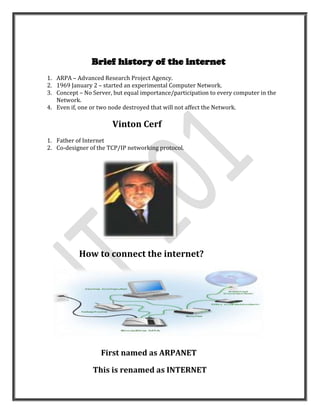
Brief history of the internet
1. ARPA – Advanced Research Project Agency.
2. 1969 January 2 – started an experimental Computer Network.
3. Concept – No Server, but equal importance/participation to every computer in the
   Network.
4. Even if, one or two node destroyed that will not affect the Network.

                       Vinton Cerf
1. Father of Internet
2. Co-designer of the TCP/IP networking protocol.


           How to connect the internet?


                   First named as ARPANET

                This is renamed as INTERNET
Services provided by the internet
   1.   Electronic Mail (e-mail)
   2.   World Wide Web
   3.   File Transfer Protocol (FTP)
   4.   Chat Rooms
   5.   Mailing list
   6.   Instant Messaging
   7.   Chat
   8.   News Groups


                               Electronic Mail
Electronic mail, commonly known as email or e-mail, is a method of exchanging digital
messages from an author to one or more recipients. Modern email operates across the Internet or
other computer networks. Some early email systems required that the author and the recipient
both be online at the same time, in common with instant messaging. Today's email systems are
based on a store-and-forward model. Email servers accept, forward, deliver and store messages.
Neither the users nor their computers are required to be online simultaneously; they need connect
only briefly, typically to an email server, for as long as it takes to send or receive messages.

An email message consists of three components, the message envelope, the message header, and
the message body. The message header contains control information, including, minimally, an
originator's email address and one or more recipient addresses. Usually descriptive information is
also added, such as a subject header field and a message submission date/time stamp.Distributes
e-mail messages and attached files to one or more electronic mailboxes. Message can consist of
attachment, graphic or video/audio clips.

   Eg :- e-mail addresses

   1. thomas@mes.edu.in
   2. murugan@mesmarampally.org

                          Different E-mail services provider

   1.   Gmail
   2.   Hotmail
   3.   Yahoo
   4.   MSN
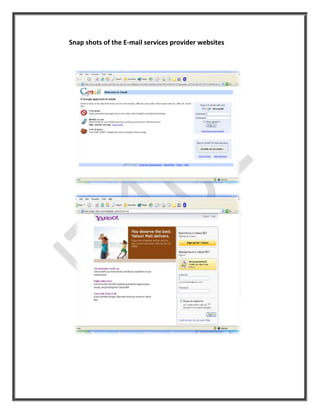
Snap shots of the E-mail services provider websites
World Wide Web (WWW)
1. Most important service provided by Internet.
2. An internet-based hypermedia initiative for global information sharing.
3. Developed in 1989 by Tim Berners-Lee of the European Particle Physics Lab (CERN) in
   Switzerland.

                              Tim Berners-Lee
1. Father of WWW.
2. Invented WWW while working at CERN, the European Particle Physics Laboratory.


                              Search engines
     For searching information on the Internet.

1.   Google
2.   Yahoo
3.   Altavista
4.   Wikipedia
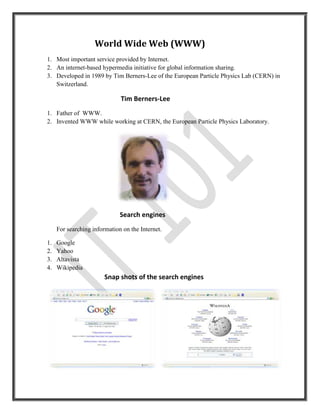
                        Snap shots of the search engines
File Transfer Protocole (FTP)
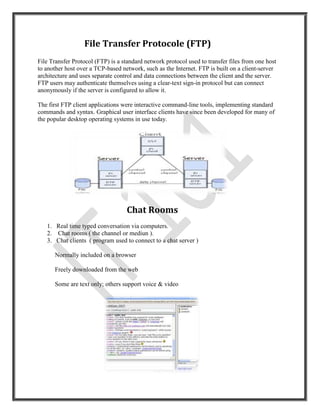
File Transfer Protocol (FTP) is a standard network protocol used to transfer files from one host
to another host over a TCP-based network, such as the Internet. FTP is built on a client-server
architecture and uses separate control and data connections between the client and the server.
FTP users may authenticate themselves using a clear-text sign-in protocol but can connect
anonymously if the server is configured to allow it.

The first FTP client applications were interactive command-line tools, implementing standard
commands and syntax. Graphical user interface clients have since been developed for many of
the popular desktop operating systems in use today.


                                   Chat Rooms
   1. Real time typed conversation via computers.
   2. Chat rooms ( the channel or mediun ).
   3. Chat clients ( program used to connect to a chat server )

      Normally included on a browser

      Freely downloaded from the web

      Some are text only; others support voice & video
Mailing list
1. Group of e-mail address given a single name.
2. When a message is sent to the mailing list everyone on the list receive the message.
3. To add your name to a mailing list you must subscribe to it; to remove your name you
   must unsubscribe.

                       Instant Messaging
1. Notifies you when one or more people are online allows exchange of messages and files.
2. It allows you to join a private chat rooms.


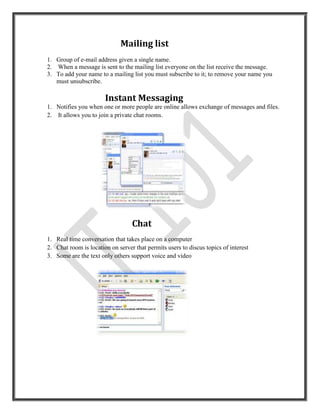
                                  Chat
1. Real time conversation that takes place on a computer
2. Chat room is location on server that permits users to discus topics of interest
3. Some are the text only others support voice and video
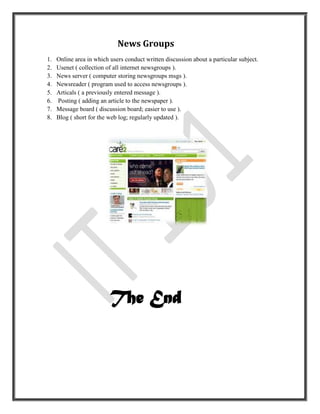
News Groups
1.   Online area in which users conduct written discussion about a particular subject.
2.   Usenet ( collection of all internet newsgroups ).
3.   News server ( computer storing newsgroups msgs ).
4.   Newsreader ( program used to access newsgroups ).
5.   Articals ( a previously entered message ).
6.   Posting ( adding an article to the newspaper ).
7.   Message board ( discussion board; easier to use ).
8.   Blog ( short for the web log; regularly updated ).


                          The End

Services provided by the internet

  • 1.
    Services provided bythe internet 1. What is the internet? 2. Brief history of the internet. 3. Services provided by the internet. What is the internet? The Internet is a global system of interconnected computer networks that use the standard Internet protocol suite (TCP/IP) to serve billions of users worldwide. It is a network of networks that consists of millions of private, public, academic, business, and government networks, of local to global scope, that are linked by a broad array of electronic, wireless and optical networking technologies. The Internet carries an extensive range of information resources and services, such as the inter-linked hypertext documents of the World Wide Web (WWW) and the infrastructure to support email. Most traditional communications media including telephone, music, film, and television are reshaped or redefined by the Internet, giving birth to new services such as Voice over Internet Protocol (VoIP) and Internet Protocol Television (IPTV). Newspaper, book and other print publishing are adapting to Web site technology, or are reshaped into blogging and web feeds. The Internet has enabled or accelerated new forms of human interactions through instant messaging, Internet forums, and social networking. Online shopping has boomed both for major retail outlets and small artisans and traders. Business-to-business and financial services on the Internet affect supply chains across entire industries. The origins of the Internet reach back to research of the 1960s, commissioned by the United States government in collaboration with private commercial interests to build robust, fault-tolerant, and distributed computer networks. The funding of a new U.S. backbone by the National Science Foundation in the 1980s, as well as private funding for other commercial backbones, led to worldwide participation in the development of new networking technologies, and the merger of many networks. The commercialization of what was by the 1990s an international network resulted in its popularization and incorporation into virtually every aspect of modern human life. As of 2011, more than 2.1 billion people — nearly a third of Earth's population — use the services of the Internet. The largest network of the networks is called the internet.
  • 2.
    Brief history ofthe internet 1. ARPA – Advanced Research Project Agency. 2. 1969 January 2 – started an experimental Computer Network. 3. Concept – No Server, but equal importance/participation to every computer in the Network. 4. Even if, one or two node destroyed that will not affect the Network. Vinton Cerf 1. Father of Internet 2. Co-designer of the TCP/IP networking protocol. How to connect the internet? First named as ARPANET This is renamed as INTERNET
  • 3.
    Services provided bythe internet 1. Electronic Mail (e-mail) 2. World Wide Web 3. File Transfer Protocol (FTP) 4. Chat Rooms 5. Mailing list 6. Instant Messaging 7. Chat 8. News Groups Electronic Mail Electronic mail, commonly known as email or e-mail, is a method of exchanging digital messages from an author to one or more recipients. Modern email operates across the Internet or other computer networks. Some early email systems required that the author and the recipient both be online at the same time, in common with instant messaging. Today's email systems are based on a store-and-forward model. Email servers accept, forward, deliver and store messages. Neither the users nor their computers are required to be online simultaneously; they need connect only briefly, typically to an email server, for as long as it takes to send or receive messages. An email message consists of three components, the message envelope, the message header, and the message body. The message header contains control information, including, minimally, an originator's email address and one or more recipient addresses. Usually descriptive information is also added, such as a subject header field and a message submission date/time stamp.Distributes e-mail messages and attached files to one or more electronic mailboxes. Message can consist of attachment, graphic or video/audio clips. Eg :- e-mail addresses 1. thomas@mes.edu.in 2. murugan@mesmarampally.org Different E-mail services provider 1. Gmail 2. Hotmail 3. Yahoo 4. MSN
  • 4.
    Snap shots ofthe E-mail services provider websites
  • 5.
    World Wide Web(WWW) 1. Most important service provided by Internet. 2. An internet-based hypermedia initiative for global information sharing. 3. Developed in 1989 by Tim Berners-Lee of the European Particle Physics Lab (CERN) in Switzerland. Tim Berners-Lee 1. Father of WWW. 2. Invented WWW while working at CERN, the European Particle Physics Laboratory. Search engines For searching information on the Internet. 1. Google 2. Yahoo 3. Altavista 4. Wikipedia Snap shots of the search engines
  • 6.
    File Transfer Protocole(FTP) File Transfer Protocol (FTP) is a standard network protocol used to transfer files from one host to another host over a TCP-based network, such as the Internet. FTP is built on a client-server architecture and uses separate control and data connections between the client and the server. FTP users may authenticate themselves using a clear-text sign-in protocol but can connect anonymously if the server is configured to allow it. The first FTP client applications were interactive command-line tools, implementing standard commands and syntax. Graphical user interface clients have since been developed for many of the popular desktop operating systems in use today. Chat Rooms 1. Real time typed conversation via computers. 2. Chat rooms ( the channel or mediun ). 3. Chat clients ( program used to connect to a chat server ) Normally included on a browser Freely downloaded from the web Some are text only; others support voice & video
  • 7.
    Mailing list 1. Groupof e-mail address given a single name. 2. When a message is sent to the mailing list everyone on the list receive the message. 3. To add your name to a mailing list you must subscribe to it; to remove your name you must unsubscribe. Instant Messaging 1. Notifies you when one or more people are online allows exchange of messages and files. 2. It allows you to join a private chat rooms. Chat 1. Real time conversation that takes place on a computer 2. Chat room is location on server that permits users to discus topics of interest 3. Some are the text only others support voice and video
  • 8.
    News Groups 1. Online area in which users conduct written discussion about a particular subject. 2. Usenet ( collection of all internet newsgroups ). 3. News server ( computer storing newsgroups msgs ). 4. Newsreader ( program used to access newsgroups ). 5. Articals ( a previously entered message ). 6. Posting ( adding an article to the newspaper ). 7. Message board ( discussion board; easier to use ). 8. Blog ( short for the web log; regularly updated ). The End