Analytic Hierarchy
    Process
    Zheng-Wen Shen
      2006/04/11
Outline
1.   Introduction of AHP
2.   How the AHP works
3.   Example
1. Introduction of AHP
 Is job                                   Salary is
1 best ?                                 important
                                             ..
 Is Job                                    Location
2 best ?                                      is
                                          important..

 Is Job                                       Long term
3 best ?                                     prospect is
                                             important..

 Is Job
4 best ?                                     Interest is
                                            important..

           Crystal is looking for job…
AHP Features
 AHPis a powerful tool that may be used to
 make decisions when
    multiple and conflicting objectives/criteria are
     present,
    and both qualitative and quantitative aspects
     of a decision need to be considered.
 AHP reduces complex decisions to a
 series of pairwise comparisons.
2. How the AHP works
1.   Computing the vector of objective
     weights
2.   Computing the matrix of scenario scores
3.   Ranking the scenarios
4.   Checking the consistency

consider m evaluation criteria and n scenarios.
AHP Steps
1.   Computing the vector of objective
     weights
2.   Computing the matrix of scenario scores
3.   Ranking the scenarios
4.   Checking the consistency
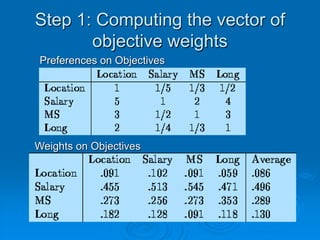
Step 1: Computing the vector of
         objective weights
 Pairwisecomparison matrix A [m × m].
 Each entry ajk of A represents the
  importance of criterion j relative to criterion
  k:
     If ajk > 1, j is more important than k
     if ajk < 1, j is less important than k
     if ajk = 1, same importance
 ajk   and akj must satisfy ajkakj = 1.
Step 1: Computing the vector of
           objective weights
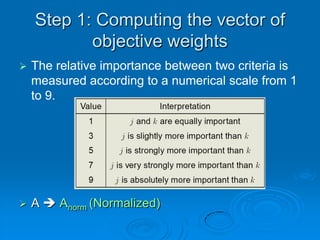
   The relative importance between two criteria is
    measured according to a numerical scale from 1
    to 9.


   A  Anorm (Normalized)
Step 1: Computing the vector of
       objective weights
Preferences on Objectives


Weights on Objectives
AHP Steps
1.   Computing the vector of objective
     weights
2.   Computing the matrix of scenario scores
3.   Ranking the scenarios
4.   Checking the consistency
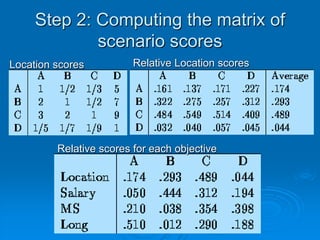
Step 2: Computing the matrix of
            scenario scores
 The matrix of scenario scores S [n × m]
 Each entry sij of S represents the score of the
  scenario i with respect to the criterion j
 The score matrix S is obtained by the columns sj
  calculated as follows:
       A pairwise comparison matrix Bj is built for each
        criterion j.
       Each entry bjih represents the evaluation of the
        scenario i compared to the scenario h with respect to
        the criterion j according to the DM’s evaluations.
       From each matrix Bj a score vectors sj is obtained (as
        in Step 1).
Step 2: Computing the matrix of
             scenario scores
Location scores          Relative Location scores


         Relative scores for each objective
AHP Steps
1.   Computing the vector of objective
     weights
2.   Computing the matrix of scenario scores
3.   Ranking the scenarios
4.   Checking the consistency
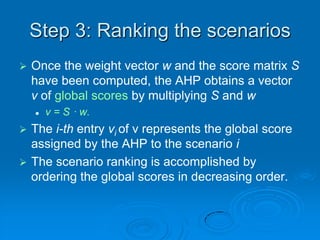
Step 3: Ranking the scenarios
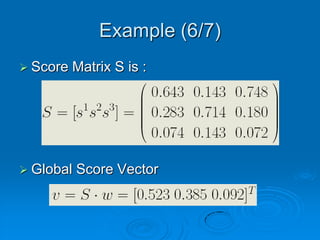
   Once the weight vector w and the score matrix S
    have been computed, the AHP obtains a vector
    v of global scores by multiplying S and w
       v = S · w.
 The i-th entry vi of v represents the global score
  assigned by the AHP to the scenario i
 The scenario ranking is accomplished by
  ordering the global scores in decreasing order.
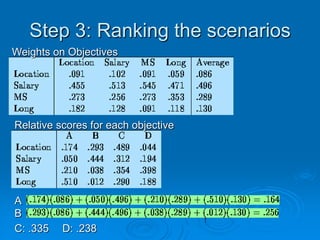
Step 3: Ranking the scenarios
Weights on Objectives


Relative scores for each objective


A
B
C: .335   D: .238
AHP Steps
1.   Computing the vector of objective
     weights
2.   Computing the matrix of scenario scores
3.   Ranking the scenarios
4.   Checking the consistency
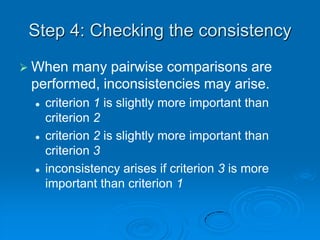
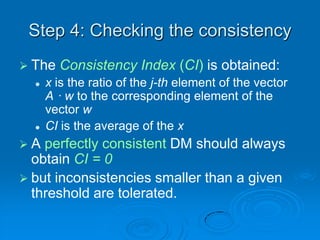
Step 4: Checking the consistency
 When many pairwise comparisons are
 performed, inconsistencies may arise.
    criterion 1 is slightly more important than
     criterion 2
    criterion 2 is slightly more important than
     criterion 3
    inconsistency arises if criterion 3 is more
     important than criterion 1
Step 4: Checking the consistency
 The   Consistency Index (CI) is obtained:
     x is the ratio of the j-th element of the vector
      A · w to the corresponding element of the
      vector w
     CI is the average of the x
A  perfectly consistent DM should always
  obtain CI = 0
 but inconsistencies smaller than a given
  threshold are tolerated.
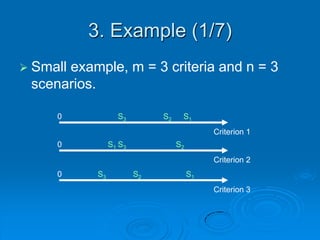
3. Example (1/7)
 Small
      example, m = 3 criteria and n = 3
 scenarios.

     0            S3         S2    S1
                                            Criterion 1
     0          S1 S3             S2
                                            Criterion 2
     0     S3           S2             S1
                                            Criterion 3
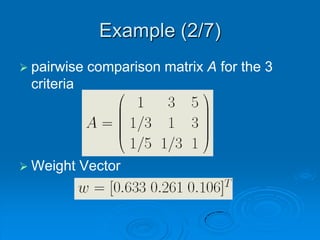
Example (2/7)
 pairwise   comparison matrix A for the 3
 criteria


 Weight    Vector
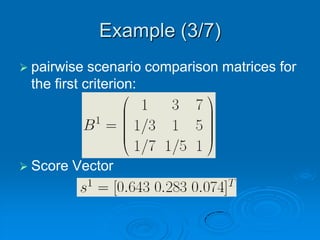
Example (3/7)
 pairwise  scenario comparison matrices for
 the first criterion:


 Score   Vector
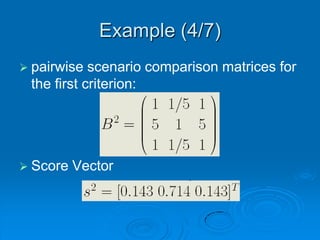
Example (4/7)
 pairwise  scenario comparison matrices for
 the first criterion:


 Score   Vector
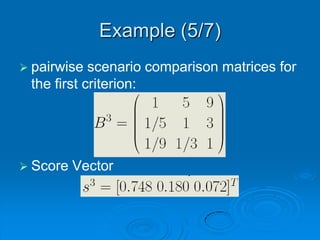
Example (5/7)
 pairwise  scenario comparison matrices for
 the first criterion:


 Score   Vector
Example (6/7)
 Score   Matrix S is :


 Global   Score Vector
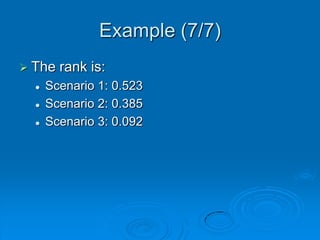
Example (7/7)
 The   rank is:
     Scenario 1: 0.523
     Scenario 2: 0.385
     Scenario 3: 0.092

20060411 Analytic Hierarchy Process (AHP)

  • 1.
    Analytic Hierarchy Process Zheng-Wen Shen 2006/04/11
  • 2.
    Outline 1. Introduction of AHP 2. How the AHP works 3. Example
  • 3.
    1. Introduction ofAHP Is job Salary is 1 best ? important .. Is Job Location 2 best ? is important.. Is Job Long term 3 best ? prospect is important.. Is Job 4 best ? Interest is important.. Crystal is looking for job…
  • 4.
    AHP Features  AHPisa powerful tool that may be used to make decisions when  multiple and conflicting objectives/criteria are present,  and both qualitative and quantitative aspects of a decision need to be considered.  AHP reduces complex decisions to a series of pairwise comparisons.
  • 5.
    2. How theAHP works 1. Computing the vector of objective weights 2. Computing the matrix of scenario scores 3. Ranking the scenarios 4. Checking the consistency consider m evaluation criteria and n scenarios.
  • 6.
    AHP Steps 1. Computing the vector of objective weights 2. Computing the matrix of scenario scores 3. Ranking the scenarios 4. Checking the consistency
  • 7.
    Step 1: Computingthe vector of objective weights  Pairwisecomparison matrix A [m × m].  Each entry ajk of A represents the importance of criterion j relative to criterion k:  If ajk > 1, j is more important than k  if ajk < 1, j is less important than k  if ajk = 1, same importance  ajk and akj must satisfy ajkakj = 1.
  • 8.
    Step 1: Computingthe vector of objective weights  The relative importance between two criteria is measured according to a numerical scale from 1 to 9.  A  Anorm (Normalized)
  • 9.
    Step 1: Computingthe vector of objective weights Preferences on Objectives Weights on Objectives
  • 10.
    AHP Steps 1. Computing the vector of objective weights 2. Computing the matrix of scenario scores 3. Ranking the scenarios 4. Checking the consistency
  • 11.
    Step 2: Computingthe matrix of scenario scores  The matrix of scenario scores S [n × m]  Each entry sij of S represents the score of the scenario i with respect to the criterion j  The score matrix S is obtained by the columns sj calculated as follows:  A pairwise comparison matrix Bj is built for each criterion j.  Each entry bjih represents the evaluation of the scenario i compared to the scenario h with respect to the criterion j according to the DM’s evaluations.  From each matrix Bj a score vectors sj is obtained (as in Step 1).
  • 12.
    Step 2: Computingthe matrix of scenario scores Location scores Relative Location scores Relative scores for each objective
  • 13.
    AHP Steps 1. Computing the vector of objective weights 2. Computing the matrix of scenario scores 3. Ranking the scenarios 4. Checking the consistency
  • 14.
    Step 3: Rankingthe scenarios  Once the weight vector w and the score matrix S have been computed, the AHP obtains a vector v of global scores by multiplying S and w  v = S · w.  The i-th entry vi of v represents the global score assigned by the AHP to the scenario i  The scenario ranking is accomplished by ordering the global scores in decreasing order.
  • 15.
    Step 3: Rankingthe scenarios Weights on Objectives Relative scores for each objective A B C: .335 D: .238
  • 16.
    AHP Steps 1. Computing the vector of objective weights 2. Computing the matrix of scenario scores 3. Ranking the scenarios 4. Checking the consistency
  • 17.
    Step 4: Checkingthe consistency  When many pairwise comparisons are performed, inconsistencies may arise.  criterion 1 is slightly more important than criterion 2  criterion 2 is slightly more important than criterion 3  inconsistency arises if criterion 3 is more important than criterion 1
  • 18.
    Step 4: Checkingthe consistency  The Consistency Index (CI) is obtained:  x is the ratio of the j-th element of the vector A · w to the corresponding element of the vector w  CI is the average of the x A perfectly consistent DM should always obtain CI = 0  but inconsistencies smaller than a given threshold are tolerated.
  • 19.
    3. Example (1/7) Small example, m = 3 criteria and n = 3 scenarios. 0 S3 S2 S1 Criterion 1 0 S1 S3 S2 Criterion 2 0 S3 S2 S1 Criterion 3
  • 20.
    Example (2/7)  pairwise comparison matrix A for the 3 criteria  Weight Vector
  • 21.
    Example (3/7)  pairwise scenario comparison matrices for the first criterion:  Score Vector
  • 22.
    Example (4/7)  pairwise scenario comparison matrices for the first criterion:  Score Vector
  • 23.
    Example (5/7)  pairwise scenario comparison matrices for the first criterion:  Score Vector
  • 24.
    Example (6/7)  Score Matrix S is :  Global Score Vector
  • 25.
    Example (7/7)  The rank is:  Scenario 1: 0.523  Scenario 2: 0.385  Scenario 3: 0.092