DECISION MAKING USING ANALYTIC
HIERARCHY PROCESS (AHP)
1. Mr. Vaibhav S. Gaikwad (B.E. MECH)
2. Mr. Hansraj O. Patil (B.E. MECH)
3. Mr. Pankaj S. Patil (B.E. MECH)
4. Mr. Aniket S. Thakur (B.E. MECH)
DEPARTMENT OF MECHANICAL ENGINEERING,
K.G.C.E , KARJAT.
► Is a multicriteria decision-making system.
► Was developed by Thomas L. Saaty.
►Used to solve complex decision-making problems.
►Has been applied in variety of decisions and planning projects
in nearly 20 countries.
►Is implemented in the software of Expert Choice©
Analytic Hierarchy Process (AHP)
►Resource allocation
►Hiring, evaluating and promoting employees
►TQM
►Strategic planning
►Relocation decisions
►Vendor selection
►Evaluating mergers and acquisitions
Applicable in the areas
A few of the Universities using AHP.
Harvard University Colorado State University
Yale University University of Cambridge
MIT American University
IBM NASA
Goodyear IRS
Ford Motor Co. FBI
Citibank Department of Defense
Xerox World Bank
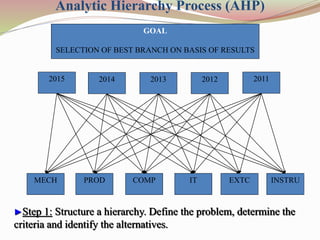
►Goal: To select the best branch (Resultwise).
►Criteria: 2015,2014,2013,2012,2011(Yearwise)
►Alternatives: MECH, PROD, COMP, IT, EXTC, INSTRU.(Branchwise)
GOAL
SELECTION OF BEST BRANCH ON BASIS OF RESULTS
2015 2014 2013 2012 2011
MECH PROD COMP IT EXTC INSTRU
Analytic Hierarchy Process (AHP)
►Step 1: Structure a hierarchy. Define the problem, determine the
criteria and identify the alternatives.
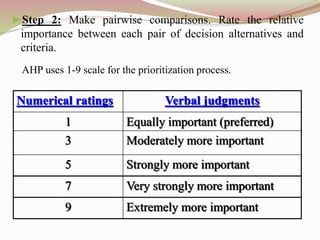
►Step 2: Make pairwise comparisons. Rate the relative
importance between each pair of decision alternatives and
criteria.
AHP uses 1-9 scale for the prioritization process.
Numerical ratings Verbal judgments
1 Equally important (preferred)
3 Moderately more important
5 Strongly more important
7 Very strongly more important
9 Extremely more important
►Step 2 (cont’d):
Intermediate numerical ratings of 2, 4, 6, and 8 can be assigned.
If someone could not decide whether one criterion (alternative) is
moderately more important than the other one or strongly more
important than the other one, 4 (moderately to strongly more
important) can be assigned.
►Step 3:
Synthesize the results to determine the best alternative. Obtain the final
results.
The output of AHP is the set of priorities of the alternatives.
Best Branch SelectionPairwise compasrison:
2015 MECH PROD COMP IT EXTC INSTRU
MECH 1 1/7 3 1/3 1/5 1/9
PROD 7 1 7 5 3 1/3
COMP 1/3 1/7 1 1/3 1/5 1/7
IT 3 1/5 3 1 1/3 1/5
EXTC 5 1/3 5 3 1 1/3
INSTRU 9 3 7 5 3 1
2014 MECH PROD COMP IT EXTC INSTRU
MECH 1 9 1/3 7 5 3
PROD 1/9 1 1/9 1/3 1/5 1/7
COMP 3 9 1 7 5 3
IT 1/7 3 1/7 1 1/3 1/5
EXTC 1/5 5 1/5 3 1 1/3
INSTRU 1/3 7 1/3 5 3 1
2013 MECH PROD COMP IT EXTC INSTRU
MECH 1 1/5 1/3 5 1/7 3
PROD 5 1 3 7 1/3 5
COMP 3 1/3 1 5 1/3 3
IT 1/5 1/7 1/5 1 1/5 1/3
EXTC 7 3 3 5 1 3
INSTRU 1/3 1/5 1/3 3 1/3 1
2012 MECH PROD COMP IT EXTC INSTRU
MECH 1 1/5 1/3 3 1/9 1/7
PROD 5 1 3 5 1/5 1/3
COMP 3 1/3 1 3 1/5 1/3
IT 1/3 1/5 1/3 1 1/5 1/3
EXTC 9 5 5 5 1 3
INSTRU 7 3 3 3 1/3 1
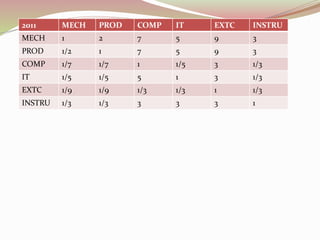
2011 MECH PROD COMP IT EXTC INSTRU
MECH 1 2 7 5 9 3
PROD 1/2 1 7 5 9 3
COMP 1/7 1/7 1 1/5 3 1/3
IT 1/5 1/5 5 1 3 1/3
EXTC 1/9 1/9 1/3 1/3 1 1/3
INSTRU 1/3 1/3 3 3 3 1
Synthesizing Procedure – 1
Solving for year 2015
Step 1: Sum the values in each column:
2015 MECH PROD COMP IT EXTC INSTRU
MECH 1 1/7 3 1/3 1/5 1/9
PROD 7 1 7 5 3 1/3
COMP 1/3 1/7 1 1/3 1/5 1/7
IT 3 1/5 3 1 1/3 1/5
EXTC 5 1/3 5 3 1 1/3
INSTRU 9 3 7 5 3 1
COLUMN
TOTAL
76/3 506/105 26 44/3 116/15 668/315
Synthesizing Procedure - 2
Step 2: Divide each element of the matrix by its column total.
All columns in the normalized Form.
2015 MECH PROD COMP IT EXTC INSTRU
MECH 3/76 15/506 3/26 1/44 3/116 35/668
PROD 21/76 105/506 7/26 15/44 45/116 105/668
COMP 1/76 15/506 1/26 1/44 3/116 45/668
IT 9/76 21/506 3/26 3/44 5/116 63/668
EXTC 15/76 35/506 5/26 9/44 15/116 105/668
INSTRU 27/76 315/506 7/26 15/44 45/116 315/668
Synthesizing Procedure - 3
Step 3: Average the elements in each row.
1. The values in the normalized pairwise comparison matrix have been
converted to decimal form.
2. The result is usually represented as the (relative) priority vector.
2015 Row Avg.
MECH 0.04758
PROD 0.27318
COMP 0.03286
IT 0.08015
EXTC 0.15831
INSTRU 0.4079
TOTAL 1.0000
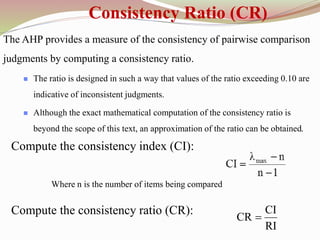
Consistency Ratio (CR)
The AHP provides a measure of the consistency of pairwise comparison
judgments by computing a consistency ratio.
 The ratio is designed in such a way that values of the ratio exceeding 0.10 are
indicative of inconsistent judgments.
 Although the exact mathematical computation of the consistency ratio is
beyond the scope of this text, an approximation of the ratio can be obtained.
Compute the consistency index (CI):
Where n is the number of items being compared
Compute the consistency ratio (CR):
RI
CI
CR 
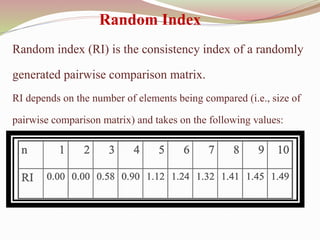
Random Index
Random index (RI) is the consistency index of a randomly
generated pairwise comparison matrix.
RI depends on the number of elements being compared (i.e., size of
pairwise comparison matrix) and takes on the following values:
MECH PROD COMP IT EXTC INSTR
U
1 1/7 3 1/3 1/5 1/9
7 1 7 5 3 1/3
1/3 1/7 1 1/3 1/5 1/7
3 1/5 3 1 1/3 1/5
5 1/3 5 3 1 1/3
9 3 7 5 3 1
Row Avg
0.04758
0.27318
0.03286
0.08015
0.15831
0.40790
Weighted
Sum
0.2888
1.8478
0.2043
0.5104
1.0279
2.761
Divide the elements of the vector of weighted sums by the
corresponding priority value.
MECH - 0.288/0.04758 = 6.0697
PROD - 1.8478/0.27318 =6.7640
COMP - 0.2043/0.03286 =6.2203
IT - 0.5104/0.08015 =6.3680
EXTC - 1.0279/0.1583 =6.4933
INSTRU - 2.761/0.4079 = 6.7688
Compute the average of the values computed in step 2 (lmax).
lmax =
6.0697+6.7640+6.2203+6.3680+6.4933+6.7688
6
= 6.4474
Compute the consistency index (CI).
CI =
l max −𝑛
𝑛−1
=
6.4474−6
6−1
=0.08947
Compute the consistency ratio (CR).
CR =
0.08947
1.24
= 0.07215 ≤ 0.10 (for Year 2015)
2011 2012 2013 2014 2015 Priority
vector
2011 1 5 3 7 9 0.5160
2012 1/5 1 1/3 3 5 0.1424
2013 1/3 3 1 3 5 0.2266
2014 1/7 1/3 1/3 1 3 0.0761
2015 1/9 1/5 1/5 1/3 1 0.0381
Calculate Judgement matrix:
Decision Matrix
2011 2012 2013 2014 2015 Final priority
0.5160 0.1424 0.2266 0.0761 0.0381
MECH 0.3842 0.0530 0.0987 0.2776 0.0475 0.2510
PROD 0.3038 0.1582 0.2710 0.0252 0.2731 0.2530
COMP 0.0509 0.0907 0.1511 0.3998 0.0328 0.1050
IT 0.0953 0.0454 0.0354 0.0461 0.0801 0.07022
EXTC 0.0320 0.4310 0.3725 0.0871 0.1583 0.1749
INSTRU 0.1334 0.2214 0.07015 0.1640 0.4079 0.1445
T O T A L 1.0000
Conclusions
1. Number of failing percentage in IT BRANCH is less as compared
to all other branches.
2. Result of IT BRANCH in last five years is better in terms of result.
3. Calculated value of C.R. is also less than 10%.
4. However this paper demonstrate the live example of our college
result (Branchwise).
Future Findings
We will compare our results found in AHP with other methods such as :
TOPSIS
FUZZY
REFERENCES
[1] Saaty, T.L., 1980. “The Analytic Hierarchy Process.” McGraw-Hill, New York
[2] Wikipedia for problem definition of AHP.
[3] Saaty@katz.pitt.edu
[4] T. L. Saaty, Inconsistency and rank preservation. J. math. Psychol. 28(2),
2055214 (1984).
[5] R. Venkatarao phd (Decision Making in the Manufacturing Environment)
[6] Expert Choice, software package. Decision Support Software, McLean, Va.
[7] Exam cell of KGCE from where we collected the result statistics for matrix
evaluation
Thanks

Decision Making Using The Analytic Hierarchy Process

  • 1.
    DECISION MAKING USINGANALYTIC HIERARCHY PROCESS (AHP) 1. Mr. Vaibhav S. Gaikwad (B.E. MECH) 2. Mr. Hansraj O. Patil (B.E. MECH) 3. Mr. Pankaj S. Patil (B.E. MECH) 4. Mr. Aniket S. Thakur (B.E. MECH) DEPARTMENT OF MECHANICAL ENGINEERING, K.G.C.E , KARJAT.
  • 2.
    ► Is amulticriteria decision-making system. ► Was developed by Thomas L. Saaty. ►Used to solve complex decision-making problems. ►Has been applied in variety of decisions and planning projects in nearly 20 countries. ►Is implemented in the software of Expert Choice© Analytic Hierarchy Process (AHP)
  • 3.
    ►Resource allocation ►Hiring, evaluatingand promoting employees ►TQM ►Strategic planning ►Relocation decisions ►Vendor selection ►Evaluating mergers and acquisitions Applicable in the areas
  • 4.
    A few ofthe Universities using AHP. Harvard University Colorado State University Yale University University of Cambridge MIT American University IBM NASA Goodyear IRS Ford Motor Co. FBI Citibank Department of Defense Xerox World Bank ►Goal: To select the best branch (Resultwise). ►Criteria: 2015,2014,2013,2012,2011(Yearwise) ►Alternatives: MECH, PROD, COMP, IT, EXTC, INSTRU.(Branchwise)
  • 5.
    GOAL SELECTION OF BESTBRANCH ON BASIS OF RESULTS 2015 2014 2013 2012 2011 MECH PROD COMP IT EXTC INSTRU Analytic Hierarchy Process (AHP) ►Step 1: Structure a hierarchy. Define the problem, determine the criteria and identify the alternatives.
  • 6.
    ►Step 2: Makepairwise comparisons. Rate the relative importance between each pair of decision alternatives and criteria. AHP uses 1-9 scale for the prioritization process. Numerical ratings Verbal judgments 1 Equally important (preferred) 3 Moderately more important 5 Strongly more important 7 Very strongly more important 9 Extremely more important
  • 7.
    ►Step 2 (cont’d): Intermediatenumerical ratings of 2, 4, 6, and 8 can be assigned. If someone could not decide whether one criterion (alternative) is moderately more important than the other one or strongly more important than the other one, 4 (moderately to strongly more important) can be assigned. ►Step 3: Synthesize the results to determine the best alternative. Obtain the final results. The output of AHP is the set of priorities of the alternatives.
  • 8.
    Best Branch SelectionPairwisecompasrison: 2015 MECH PROD COMP IT EXTC INSTRU MECH 1 1/7 3 1/3 1/5 1/9 PROD 7 1 7 5 3 1/3 COMP 1/3 1/7 1 1/3 1/5 1/7 IT 3 1/5 3 1 1/3 1/5 EXTC 5 1/3 5 3 1 1/3 INSTRU 9 3 7 5 3 1 2014 MECH PROD COMP IT EXTC INSTRU MECH 1 9 1/3 7 5 3 PROD 1/9 1 1/9 1/3 1/5 1/7 COMP 3 9 1 7 5 3 IT 1/7 3 1/7 1 1/3 1/5 EXTC 1/5 5 1/5 3 1 1/3 INSTRU 1/3 7 1/3 5 3 1
  • 9.
    2013 MECH PRODCOMP IT EXTC INSTRU MECH 1 1/5 1/3 5 1/7 3 PROD 5 1 3 7 1/3 5 COMP 3 1/3 1 5 1/3 3 IT 1/5 1/7 1/5 1 1/5 1/3 EXTC 7 3 3 5 1 3 INSTRU 1/3 1/5 1/3 3 1/3 1 2012 MECH PROD COMP IT EXTC INSTRU MECH 1 1/5 1/3 3 1/9 1/7 PROD 5 1 3 5 1/5 1/3 COMP 3 1/3 1 3 1/5 1/3 IT 1/3 1/5 1/3 1 1/5 1/3 EXTC 9 5 5 5 1 3 INSTRU 7 3 3 3 1/3 1
  • 10.
    2011 MECH PRODCOMP IT EXTC INSTRU MECH 1 2 7 5 9 3 PROD 1/2 1 7 5 9 3 COMP 1/7 1/7 1 1/5 3 1/3 IT 1/5 1/5 5 1 3 1/3 EXTC 1/9 1/9 1/3 1/3 1 1/3 INSTRU 1/3 1/3 3 3 3 1
  • 11.
    Synthesizing Procedure –1 Solving for year 2015 Step 1: Sum the values in each column: 2015 MECH PROD COMP IT EXTC INSTRU MECH 1 1/7 3 1/3 1/5 1/9 PROD 7 1 7 5 3 1/3 COMP 1/3 1/7 1 1/3 1/5 1/7 IT 3 1/5 3 1 1/3 1/5 EXTC 5 1/3 5 3 1 1/3 INSTRU 9 3 7 5 3 1 COLUMN TOTAL 76/3 506/105 26 44/3 116/15 668/315
  • 12.
    Synthesizing Procedure -2 Step 2: Divide each element of the matrix by its column total. All columns in the normalized Form. 2015 MECH PROD COMP IT EXTC INSTRU MECH 3/76 15/506 3/26 1/44 3/116 35/668 PROD 21/76 105/506 7/26 15/44 45/116 105/668 COMP 1/76 15/506 1/26 1/44 3/116 45/668 IT 9/76 21/506 3/26 3/44 5/116 63/668 EXTC 15/76 35/506 5/26 9/44 15/116 105/668 INSTRU 27/76 315/506 7/26 15/44 45/116 315/668
  • 13.
    Synthesizing Procedure -3 Step 3: Average the elements in each row. 1. The values in the normalized pairwise comparison matrix have been converted to decimal form. 2. The result is usually represented as the (relative) priority vector. 2015 Row Avg. MECH 0.04758 PROD 0.27318 COMP 0.03286 IT 0.08015 EXTC 0.15831 INSTRU 0.4079 TOTAL 1.0000
  • 14.
    Consistency Ratio (CR) TheAHP provides a measure of the consistency of pairwise comparison judgments by computing a consistency ratio.  The ratio is designed in such a way that values of the ratio exceeding 0.10 are indicative of inconsistent judgments.  Although the exact mathematical computation of the consistency ratio is beyond the scope of this text, an approximation of the ratio can be obtained. Compute the consistency index (CI): Where n is the number of items being compared Compute the consistency ratio (CR): RI CI CR 
  • 15.
    Random Index Random index(RI) is the consistency index of a randomly generated pairwise comparison matrix. RI depends on the number of elements being compared (i.e., size of pairwise comparison matrix) and takes on the following values:
  • 16.
    MECH PROD COMPIT EXTC INSTR U 1 1/7 3 1/3 1/5 1/9 7 1 7 5 3 1/3 1/3 1/7 1 1/3 1/5 1/7 3 1/5 3 1 1/3 1/5 5 1/3 5 3 1 1/3 9 3 7 5 3 1 Row Avg 0.04758 0.27318 0.03286 0.08015 0.15831 0.40790 Weighted Sum 0.2888 1.8478 0.2043 0.5104 1.0279 2.761 Divide the elements of the vector of weighted sums by the corresponding priority value. MECH - 0.288/0.04758 = 6.0697 PROD - 1.8478/0.27318 =6.7640 COMP - 0.2043/0.03286 =6.2203 IT - 0.5104/0.08015 =6.3680 EXTC - 1.0279/0.1583 =6.4933 INSTRU - 2.761/0.4079 = 6.7688 Compute the average of the values computed in step 2 (lmax). lmax = 6.0697+6.7640+6.2203+6.3680+6.4933+6.7688 6 = 6.4474
  • 17.
    Compute the consistencyindex (CI). CI = l max −𝑛 𝑛−1 = 6.4474−6 6−1 =0.08947 Compute the consistency ratio (CR). CR = 0.08947 1.24 = 0.07215 ≤ 0.10 (for Year 2015) 2011 2012 2013 2014 2015 Priority vector 2011 1 5 3 7 9 0.5160 2012 1/5 1 1/3 3 5 0.1424 2013 1/3 3 1 3 5 0.2266 2014 1/7 1/3 1/3 1 3 0.0761 2015 1/9 1/5 1/5 1/3 1 0.0381 Calculate Judgement matrix:
  • 18.
    Decision Matrix 2011 20122013 2014 2015 Final priority 0.5160 0.1424 0.2266 0.0761 0.0381 MECH 0.3842 0.0530 0.0987 0.2776 0.0475 0.2510 PROD 0.3038 0.1582 0.2710 0.0252 0.2731 0.2530 COMP 0.0509 0.0907 0.1511 0.3998 0.0328 0.1050 IT 0.0953 0.0454 0.0354 0.0461 0.0801 0.07022 EXTC 0.0320 0.4310 0.3725 0.0871 0.1583 0.1749 INSTRU 0.1334 0.2214 0.07015 0.1640 0.4079 0.1445 T O T A L 1.0000 Conclusions 1. Number of failing percentage in IT BRANCH is less as compared to all other branches. 2. Result of IT BRANCH in last five years is better in terms of result. 3. Calculated value of C.R. is also less than 10%. 4. However this paper demonstrate the live example of our college result (Branchwise).
  • 19.
    Future Findings We willcompare our results found in AHP with other methods such as : TOPSIS FUZZY REFERENCES [1] Saaty, T.L., 1980. “The Analytic Hierarchy Process.” McGraw-Hill, New York [2] Wikipedia for problem definition of AHP. [3] Saaty@katz.pitt.edu [4] T. L. Saaty, Inconsistency and rank preservation. J. math. Psychol. 28(2), 2055214 (1984). [5] R. Venkatarao phd (Decision Making in the Manufacturing Environment) [6] Expert Choice, software package. Decision Support Software, McLean, Va. [7] Exam cell of KGCE from where we collected the result statistics for matrix evaluation
  • 20.