Analytic Hierarchy Process

By: Aman Kumar Gupta
(2012MB31)

1
Table of Content
•
•
•
•
•

What is AHP
General Idea
Example: Car Selection
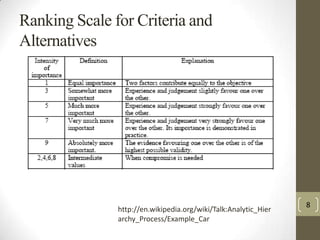
Ranking Scale for Criteria and Alternatives
Pros and Cons of AHP

2
Analytic Hierarchy Process(AHP)
• The Analytic Hierarchy Process (AHP) is a structured
technique for organizing and analyzing complex
decisions.
• It was developed by Thomas L. Saaty in the 1970s.

• Application in group decision making.

3
Analytic Hierarchy Process (Cont.)
Wide range of applications exists:
•
Selecting a car for purchasing
•
Deciding upon a place to visit for vacation
•
Deciding upon an MBA program after graduation.

4
General Idea
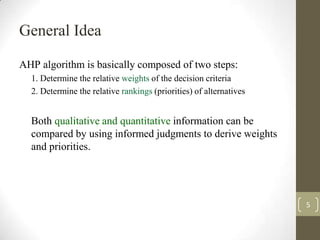
AHP algorithm is basically composed of two steps:
1. Determine the relative weights of the decision criteria
2. Determine the relative rankings (priorities) of alternatives

Both qualitative and quantitative information can be
compared by using informed judgments to derive weights
and priorities.

5
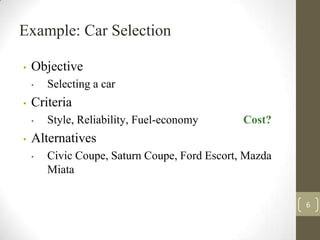
Example: Car Selection
•

Objective
•

•

Criteria
•

•

Selecting a car
Style, Reliability, Fuel-economy

Cost?

Alternatives
•

Civic Coupe, Saturn Coupe, Ford Escort, Mazda
Miata
6
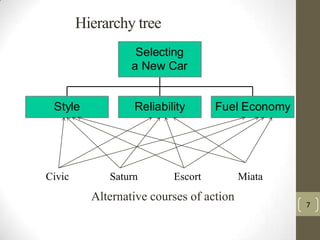
Hierarchy tree
Selecting
a New Car

Style

Civic

Reliability

Saturn

Fuel Economy

Escort

Alternative courses of action

Miata
7
Ranking Scale for Criteria and
Alternatives

http://en.wikipedia.org/wiki/Talk:Analytic_Hier
archy_Process/Example_Car

8
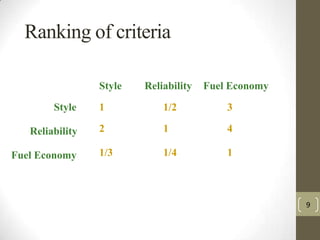
Ranking of criteria
Style

Reliability

Fuel Economy

Style

1

1/2

3

Reliability

2

1

4

1/3

1/4

1

Fuel Economy

9
Ranking of priorities
• Consider [Ax = maxx] where
• A is the comparison matrix of size n n, for n criteria, also called the priority matrix.
• x is the Eigenvector of size n 1, also called the priority vector.
• max is the Eigenvalue.
• To find the ranking of priorities, namely the Eigen Vector X:
1) Normalize the column entries by dividing each entry by the sum of the column.
2) Take the overall row averages.

A=

1
0.5 3
2
1
4
0.33 0.25 1.0

Column sums 3.33 1.75

8.00

Normalized
Column Sums

0.30
0.60
0.10

0.28
0.57
0.15

0.37
0.51
0.12

1.00

1.00

1.00

Row
averages

X=

0.32
0.56
0.12

Priority vector

10
Criteria weights
• Style
.32
• Reliability
.56
• Fuel Economy .12

Selecting a New Car
1.00

Style
0.32

Reliability
0.56

Fuel Economy
0.12
11
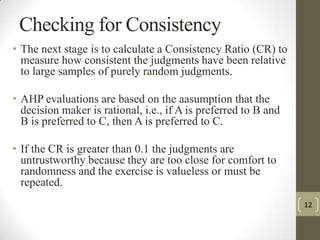
Checking for Consistency
• The next stage is to calculate a Consistency Ratio (CR) to
measure how consistent the judgments have been relative
to large samples of purely random judgments.
• AHP evaluations are based on the aasumption that the
decision maker is rational, i.e., if A is preferred to B and
B is preferred to C, then A is preferred to C.
• If the CR is greater than 0.1 the judgments are
untrustworthy because they are too close for comfort to
randomness and the exercise is valueless or must be
repeated.
12
Calculation of Consistency Ratio
• The next stage is to calculate max so as to lead to the
Consistency Index and the Consistency Ratio.
• Consider [Ax = max x] where x is the Eigenvector.
A

1
0.5
2
1
0.333 0.25

x

3
4
1.0

Ax

x

0.32
0.56
0.12

0.98
1.68
0.36

0.32
0.56
0.12

=

=

max

λmax=average{0.98/0.32, 1.68/0.56, 0.36/0.12}=3.04
Consistency index , CI is found by
CI=(λmax-n)/(n-1)=(3.04-3)/(3-1)= 0.02

13
C.R. = C.I./R.I. where R.I. is the random index
n 1
2
3
4
5
6
R.I.
0
0
.52
.88
1.11 1.25

7
1.35

C.I. = 0.02
n=3
R.I. = 0.50(from table)
So, C.R. = C.I./R.I. = 0.02/0.52 = 0.04
C.R. ≤ 0.1 indicates sufficient consistency for decision.

14
Ranking alternatives
Style
Civic

Civic
1

Saturn

4

1

4

1/4

Escort
Miata

1/4
6

1/4
4

1
5

1/5
1

Reliability Civic

Saturn
1/4

Saturn
2

Escort Miata
4
1/6

Escort Miata
5
1

Civic

1

Saturn
Escort

1/2
1/5

1
1/3

3
1

2
1/4

Miata

1

1/2

4

1

Priority vector

0.13
0.24
0.07
0.56

0.38
0.29
0.07
0.26

15
Ranking alternatives
Miles/gallon

Priority Vector

Civic

34

.30

Saturn
Escort
Miata

Fuel Economy

27
24
28
113

.24
.21
.25
1.0

Since fuel economy is a quantitative measure, fuel
consumption ratios can be used to determine the
relative ranking of alternatives.
16
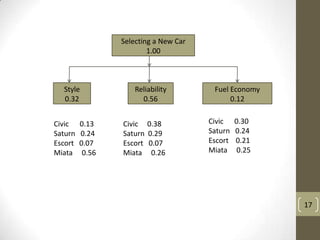
Selecting a New Car
1.00

Style
0.32
Civic
Saturn
Escort
Miata

0.13
0.24
0.07
0.56

Reliability
0.56
Civic
Saturn
Escort
Miata

0.38
0.29
0.07
0.26

Fuel Economy
0.12
Civic
Saturn
Escort
Miata

0.30
0.24
0.21
0.25

17
Fuel
Economy

Reliability

Style

Ranking of alternatives

Civic

.13 .38 .30

Saturn
Escort

.24 .29 .24

Miata

.56 .26 .25

.07 .07 .21

Priority matrix

.32
x

.56
.12

.28
.25
=
.07
.34

Criteria Weights
18
Including Cost as a Decision Criteria
Adding “cost” as a a new criterion is very difficult in AHP. A new column and a
new row will be added in the evaluation matrix. However, whole evaluation
should be repeated since addition of a new criterion might affect the relative
importance of other criteria as well!
Instead one may think of normalizing the costs directly and calculate the
cost/benefit ratio for comparing alternatives!

Cost

•
•
•
•

CIVIC
SATURN
ESCORT
MIATA

Normalized
Cost

Benefits

Cost/Benefits
Ratio

$ 12k
$15K
$9K
$18K

.22
.28
.17
.33

.28
.25
.07
.34

0.78
1.12
2.42
0.97

19
• The “ESCORT” Is the winner with the highest benefit to
COST RATIO and we rank it 1st ,
• Then at 2nd position Saturn,
• At 3rd Miata,
• At 4th Civic.

20
More about AHP: Pros and Cons
Pros

• It allows multi criteria decision making.
• It is applicable when it is difficult to formulate criteria
evaluations, i.e., it allows qualitative evaluation as well as
quantitative evaluation.
• It is applicable for group decision making environments

Cons

•There are hidden assumptions like consistency.
Repeating evaluations is cumbersome.
•Difficult to use when the number of criteria or
alternatives is high, i.e., more than 7.
•Difficult to add a new criterion or alternative

•Difficult to take out an existing criterion or alternative,
since the best alternative might differ if the worst one is
excluded.

21
22

Analytic hierarchy process

  • 1.
    Analytic Hierarchy Process By:Aman Kumar Gupta (2012MB31) 1
  • 2.
    Table of Content • • • • • Whatis AHP General Idea Example: Car Selection Ranking Scale for Criteria and Alternatives Pros and Cons of AHP 2
  • 3.
    Analytic Hierarchy Process(AHP) •The Analytic Hierarchy Process (AHP) is a structured technique for organizing and analyzing complex decisions. • It was developed by Thomas L. Saaty in the 1970s. • Application in group decision making. 3
  • 4.
    Analytic Hierarchy Process(Cont.) Wide range of applications exists: • Selecting a car for purchasing • Deciding upon a place to visit for vacation • Deciding upon an MBA program after graduation. 4
  • 5.
    General Idea AHP algorithmis basically composed of two steps: 1. Determine the relative weights of the decision criteria 2. Determine the relative rankings (priorities) of alternatives Both qualitative and quantitative information can be compared by using informed judgments to derive weights and priorities. 5
  • 6.
    Example: Car Selection • Objective • • Criteria • • Selectinga car Style, Reliability, Fuel-economy Cost? Alternatives • Civic Coupe, Saturn Coupe, Ford Escort, Mazda Miata 6
  • 7.
    Hierarchy tree Selecting a NewCar Style Civic Reliability Saturn Fuel Economy Escort Alternative courses of action Miata 7
  • 8.
    Ranking Scale forCriteria and Alternatives http://en.wikipedia.org/wiki/Talk:Analytic_Hier archy_Process/Example_Car 8
  • 9.
    Ranking of criteria Style Reliability FuelEconomy Style 1 1/2 3 Reliability 2 1 4 1/3 1/4 1 Fuel Economy 9
  • 10.
    Ranking of priorities •Consider [Ax = maxx] where • A is the comparison matrix of size n n, for n criteria, also called the priority matrix. • x is the Eigenvector of size n 1, also called the priority vector. • max is the Eigenvalue. • To find the ranking of priorities, namely the Eigen Vector X: 1) Normalize the column entries by dividing each entry by the sum of the column. 2) Take the overall row averages. A= 1 0.5 3 2 1 4 0.33 0.25 1.0 Column sums 3.33 1.75 8.00 Normalized Column Sums 0.30 0.60 0.10 0.28 0.57 0.15 0.37 0.51 0.12 1.00 1.00 1.00 Row averages X= 0.32 0.56 0.12 Priority vector 10
  • 11.
    Criteria weights • Style .32 •Reliability .56 • Fuel Economy .12 Selecting a New Car 1.00 Style 0.32 Reliability 0.56 Fuel Economy 0.12 11
  • 12.
    Checking for Consistency •The next stage is to calculate a Consistency Ratio (CR) to measure how consistent the judgments have been relative to large samples of purely random judgments. • AHP evaluations are based on the aasumption that the decision maker is rational, i.e., if A is preferred to B and B is preferred to C, then A is preferred to C. • If the CR is greater than 0.1 the judgments are untrustworthy because they are too close for comfort to randomness and the exercise is valueless or must be repeated. 12
  • 13.
    Calculation of ConsistencyRatio • The next stage is to calculate max so as to lead to the Consistency Index and the Consistency Ratio. • Consider [Ax = max x] where x is the Eigenvector. A 1 0.5 2 1 0.333 0.25 x 3 4 1.0 Ax x 0.32 0.56 0.12 0.98 1.68 0.36 0.32 0.56 0.12 = = max λmax=average{0.98/0.32, 1.68/0.56, 0.36/0.12}=3.04 Consistency index , CI is found by CI=(λmax-n)/(n-1)=(3.04-3)/(3-1)= 0.02 13
  • 14.
    C.R. = C.I./R.I.where R.I. is the random index n 1 2 3 4 5 6 R.I. 0 0 .52 .88 1.11 1.25 7 1.35 C.I. = 0.02 n=3 R.I. = 0.50(from table) So, C.R. = C.I./R.I. = 0.02/0.52 = 0.04 C.R. ≤ 0.1 indicates sufficient consistency for decision. 14
  • 15.
    Ranking alternatives Style Civic Civic 1 Saturn 4 1 4 1/4 Escort Miata 1/4 6 1/4 4 1 5 1/5 1 Reliability Civic Saturn 1/4 Saturn 2 EscortMiata 4 1/6 Escort Miata 5 1 Civic 1 Saturn Escort 1/2 1/5 1 1/3 3 1 2 1/4 Miata 1 1/2 4 1 Priority vector 0.13 0.24 0.07 0.56 0.38 0.29 0.07 0.26 15
  • 16.
    Ranking alternatives Miles/gallon Priority Vector Civic 34 .30 Saturn Escort Miata FuelEconomy 27 24 28 113 .24 .21 .25 1.0 Since fuel economy is a quantitative measure, fuel consumption ratios can be used to determine the relative ranking of alternatives. 16
  • 17.
    Selecting a NewCar 1.00 Style 0.32 Civic Saturn Escort Miata 0.13 0.24 0.07 0.56 Reliability 0.56 Civic Saturn Escort Miata 0.38 0.29 0.07 0.26 Fuel Economy 0.12 Civic Saturn Escort Miata 0.30 0.24 0.21 0.25 17
  • 18.
    Fuel Economy Reliability Style Ranking of alternatives Civic .13.38 .30 Saturn Escort .24 .29 .24 Miata .56 .26 .25 .07 .07 .21 Priority matrix .32 x .56 .12 .28 .25 = .07 .34 Criteria Weights 18
  • 19.
    Including Cost asa Decision Criteria Adding “cost” as a a new criterion is very difficult in AHP. A new column and a new row will be added in the evaluation matrix. However, whole evaluation should be repeated since addition of a new criterion might affect the relative importance of other criteria as well! Instead one may think of normalizing the costs directly and calculate the cost/benefit ratio for comparing alternatives! Cost • • • • CIVIC SATURN ESCORT MIATA Normalized Cost Benefits Cost/Benefits Ratio $ 12k $15K $9K $18K .22 .28 .17 .33 .28 .25 .07 .34 0.78 1.12 2.42 0.97 19
  • 20.
    • The “ESCORT”Is the winner with the highest benefit to COST RATIO and we rank it 1st , • Then at 2nd position Saturn, • At 3rd Miata, • At 4th Civic. 20
  • 21.
    More about AHP:Pros and Cons Pros • It allows multi criteria decision making. • It is applicable when it is difficult to formulate criteria evaluations, i.e., it allows qualitative evaluation as well as quantitative evaluation. • It is applicable for group decision making environments Cons •There are hidden assumptions like consistency. Repeating evaluations is cumbersome. •Difficult to use when the number of criteria or alternatives is high, i.e., more than 7. •Difficult to add a new criterion or alternative •Difficult to take out an existing criterion or alternative, since the best alternative might differ if the worst one is excluded. 21
  • 22.