Project Design

Expert assessment methods
First… homework results
The Title:
The assumption
  restaurant.


          Kinga Klimkiewicz
               Gr.Z.4.3
Product
• The main service of my project it:
- cooking and serving regional Polish food.

CUSTOMERS
Potential clients in my restaurant:
•   Official:
-   Gender: male
-   Age: 40 years old
-   Geography: Lublin, Poland
-   Income level: 7000zł
-   His opinion: „Finally, I can eat a good lunch break.”
Customers
•   Student:
-   Gender: female
-   Age: 22 years old
-   Geography: Lublin, Poland
-   Income level: 600zł
-   His opinion: „Eating like at grandma's house. Finally, something other than fast
    foods.”
•   Tourist:
-   Gender: female
-   Age: 33 years old
-   Geography: Paris, France
-   Income level: 3000 EUR
-   Her opinion: „Cuisine differs from the French but very good.”
Customers
•   Pensioner:
-   Gender: male
-   Age:70 years old
-   Geography: Zamość, Poland
-   income level: 2500zł
-   His opinion:”It was nice to go back to the old tastes.”
•   Schoolboy:
-   Gender: male
-   Age:13 years old
-   Geography: Wrocław, Poland
-   Income level: 0zł
-   His opinion: „Here is boring. Missing fast foods and cola”
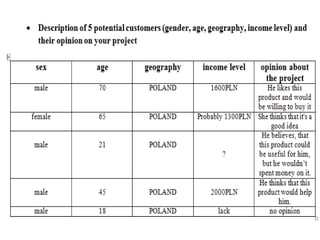
Home work for Monday
• Finish your research!!!
• Find 5 opinions
• Describe people and their opinions
Evaluation & choice of
     alternatives
Decision Making Techniques:
         Choosing Between Options
•   Ranking
•   Pairwise Comparisons
•   Grid Analysis
•   The Analytic Hierarchy Process (AHP)
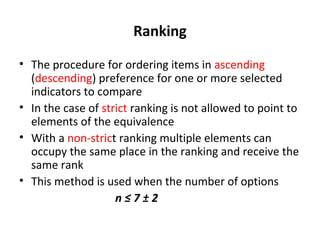
Ranking
• The procedure for ordering items in ascending
  (descending) preference for one or more selected
  indicators to compare
• In the case of strict ranking is not allowed to point to
  elements of the equivalence
• With a non-strict ranking multiple elements can
  occupy the same place in the ranking and receive the
  same rank
• This method is used when the number of options
                    n≤7±2
Choose the trip of your dream

By ranking
By pairwise comparisons
By grid analysis
Is there any difference?
You conclusions….
Pairwise Comparisons
• The procedure of determination of the preferences
  by comparing all possible pairs of objects (options)
• Results of the comparison of pairs of objects
  represented as a matrix
• Rank is calculating by summation of numerical
  representations for paired comparisons for each
  option
• If the comparison is made on various parameters or
  group of experts, for each indicator or expert the
  matrix of pairwise comparisons is preparing
Some possible types of numerical presentation


         1, if ai  a j , ai ≈ a j
   xij = 
               0 , if ai  a j


      1, if ai  a j ,            2 , if ai  a j ,
                                  
xij =  0.5, if ai ≈ a j     xij =  1, if ai ≈ a j
       0 , if ai  a j             0 , if ai  a j
                                  
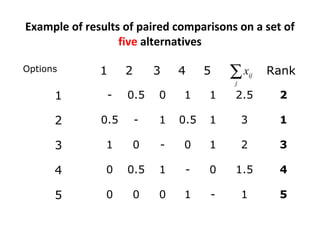
Example of results of paired comparisons on a set of
                  five alternatives

Options       1     2       3   4     5   ∑x
                                          j
                                                  ij   Rank

      1        -    0.5     0   1     1   2.5           2

      2       0.5       -   1   0.5   1       3         1

      3        1    0       -   0     1       2         3

      4        0    0.5     1    -    0   1.5           4

      5        0    0       0   1     -       1         5
Median comparison
• Any two elements of the set of alternatives
  are selected and ordered
• The third element is compared with the best
  of the first two, and if it is worse, with the
  worst, and so one find its place
• The fourth element is compared first to the
  median to determine left or right semi-set to
  further refine the location of the fourth
  element, etc.
Grid Analysis
• a number of good alternatives to choose from
• many different factors to take into account
                          ?????
• list your options as rows on a table, and the factors
  you need consider as columns
• score each option/factor combination, weight this
  score by the relative importance of the factor,
• add these scores up to give an overall score for each
  option
Grid Analysis: example
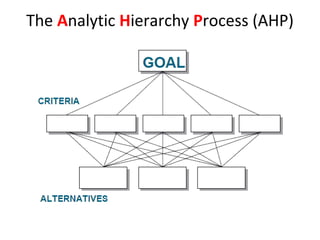
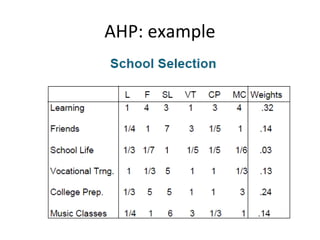
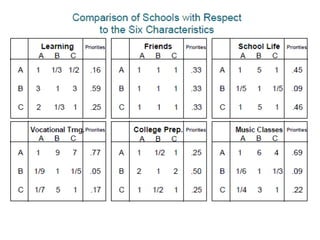
The Analytic Hierarchy Process (AHP)
AHP: example
Effects of the project
•   Commercial
•   Social
•   Ecological
•   Budgetary/economical
•   ………..
How we can estimate the effect?
• measurement is the assignment of numbers
  to objects
• direct and indirect measurements
• what to measure, how to measure
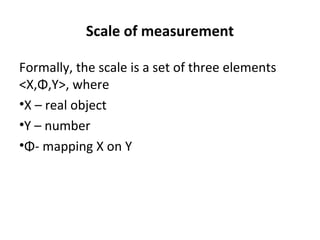
Scale of measurement

Formally, the scale is a set of three elements
<X,Φ,Y>, where
•X – real object
•Y – number
•Φ- mapping X on Y
Nominal Scale
• Simply labels objects
• Categorical data are measured on
  nominal scales which merely assign
  labels to distinguish categories
Ordinal Scale
• Numbers are used to place objects in order
• But, there is no information regarding the
  differences (intervals) between points on the
  scale
Interval Scale
• An interval scale is a scale on which equal
  intervals between objects, represent equal
  differences
• The interval differences are meaningful
• But, we can’t defend ratio relationships

• For example, the difference between 10 and 20
  degrees is the same as between 80 and 90 degrees.
  But, we can’t say that 80 degrees is twice as hot as
  40 degrees. There is no ‘true’ zero, only an ‘arbitrary’
  zero
Ratio Scale
• Have a true zero point
• Ratios are meaningful
• Physical scales of time, length and
  volume are ratio scales
Group work

Define the main effects of your projects
 (15 min)

Propose a method and a scale to evaluate
  the effects (15 min)

Discuss your results (5 min)

Project Design

  • 1.
  • 2.
  • 4.
    The Title: The assumption restaurant. Kinga Klimkiewicz Gr.Z.4.3
  • 5.
    Product • The mainservice of my project it: - cooking and serving regional Polish food. CUSTOMERS Potential clients in my restaurant: • Official: - Gender: male - Age: 40 years old - Geography: Lublin, Poland - Income level: 7000zł - His opinion: „Finally, I can eat a good lunch break.”
  • 6.
    Customers • Student: - Gender: female - Age: 22 years old - Geography: Lublin, Poland - Income level: 600zł - His opinion: „Eating like at grandma's house. Finally, something other than fast foods.” • Tourist: - Gender: female - Age: 33 years old - Geography: Paris, France - Income level: 3000 EUR - Her opinion: „Cuisine differs from the French but very good.”
  • 7.
    Customers • Pensioner: - Gender: male - Age:70 years old - Geography: Zamość, Poland - income level: 2500zł - His opinion:”It was nice to go back to the old tastes.” • Schoolboy: - Gender: male - Age:13 years old - Geography: Wrocław, Poland - Income level: 0zł - His opinion: „Here is boring. Missing fast foods and cola”
  • 8.
    Home work forMonday • Finish your research!!! • Find 5 opinions • Describe people and their opinions
  • 9.
    Evaluation & choiceof alternatives
  • 10.
    Decision Making Techniques: Choosing Between Options • Ranking • Pairwise Comparisons • Grid Analysis • The Analytic Hierarchy Process (AHP)
  • 11.
    Ranking • The procedurefor ordering items in ascending (descending) preference for one or more selected indicators to compare • In the case of strict ranking is not allowed to point to elements of the equivalence • With a non-strict ranking multiple elements can occupy the same place in the ranking and receive the same rank • This method is used when the number of options n≤7±2
  • 12.
    Choose the tripof your dream By ranking By pairwise comparisons By grid analysis Is there any difference? You conclusions….
  • 13.
    Pairwise Comparisons • Theprocedure of determination of the preferences by comparing all possible pairs of objects (options) • Results of the comparison of pairs of objects represented as a matrix • Rank is calculating by summation of numerical representations for paired comparisons for each option • If the comparison is made on various parameters or group of experts, for each indicator or expert the matrix of pairwise comparisons is preparing
  • 14.
    Some possible typesof numerical presentation 1, if ai  a j , ai ≈ a j xij =   0 , if ai  a j 1, if ai  a j , 2 , if ai  a j ,   xij =  0.5, if ai ≈ a j xij =  1, if ai ≈ a j  0 , if ai  a j  0 , if ai  a j  
  • 15.
    Example of resultsof paired comparisons on a set of five alternatives Options 1 2 3 4 5 ∑x j ij Rank 1 - 0.5 0 1 1 2.5 2 2 0.5 - 1 0.5 1 3 1 3 1 0 - 0 1 2 3 4 0 0.5 1 - 0 1.5 4 5 0 0 0 1 - 1 5
  • 16.
    Median comparison • Anytwo elements of the set of alternatives are selected and ordered • The third element is compared with the best of the first two, and if it is worse, with the worst, and so one find its place • The fourth element is compared first to the median to determine left or right semi-set to further refine the location of the fourth element, etc.
  • 17.
    Grid Analysis • anumber of good alternatives to choose from • many different factors to take into account ????? • list your options as rows on a table, and the factors you need consider as columns • score each option/factor combination, weight this score by the relative importance of the factor, • add these scores up to give an overall score for each option
  • 18.
  • 19.
  • 20.
  • 22.
  • 26.
    Effects of theproject • Commercial • Social • Ecological • Budgetary/economical • ………..
  • 27.
    How we canestimate the effect? • measurement is the assignment of numbers to objects • direct and indirect measurements • what to measure, how to measure
  • 28.
    Scale of measurement Formally,the scale is a set of three elements <X,Φ,Y>, where •X – real object •Y – number •Φ- mapping X on Y
  • 29.
    Nominal Scale • Simplylabels objects • Categorical data are measured on nominal scales which merely assign labels to distinguish categories
  • 30.
    Ordinal Scale • Numbersare used to place objects in order • But, there is no information regarding the differences (intervals) between points on the scale
  • 31.
    Interval Scale • Aninterval scale is a scale on which equal intervals between objects, represent equal differences • The interval differences are meaningful • But, we can’t defend ratio relationships • For example, the difference between 10 and 20 degrees is the same as between 80 and 90 degrees. But, we can’t say that 80 degrees is twice as hot as 40 degrees. There is no ‘true’ zero, only an ‘arbitrary’ zero
  • 32.
    Ratio Scale • Havea true zero point • Ratios are meaningful • Physical scales of time, length and volume are ratio scales
  • 34.
    Group work Define themain effects of your projects (15 min) Propose a method and a scale to evaluate the effects (15 min) Discuss your results (5 min)