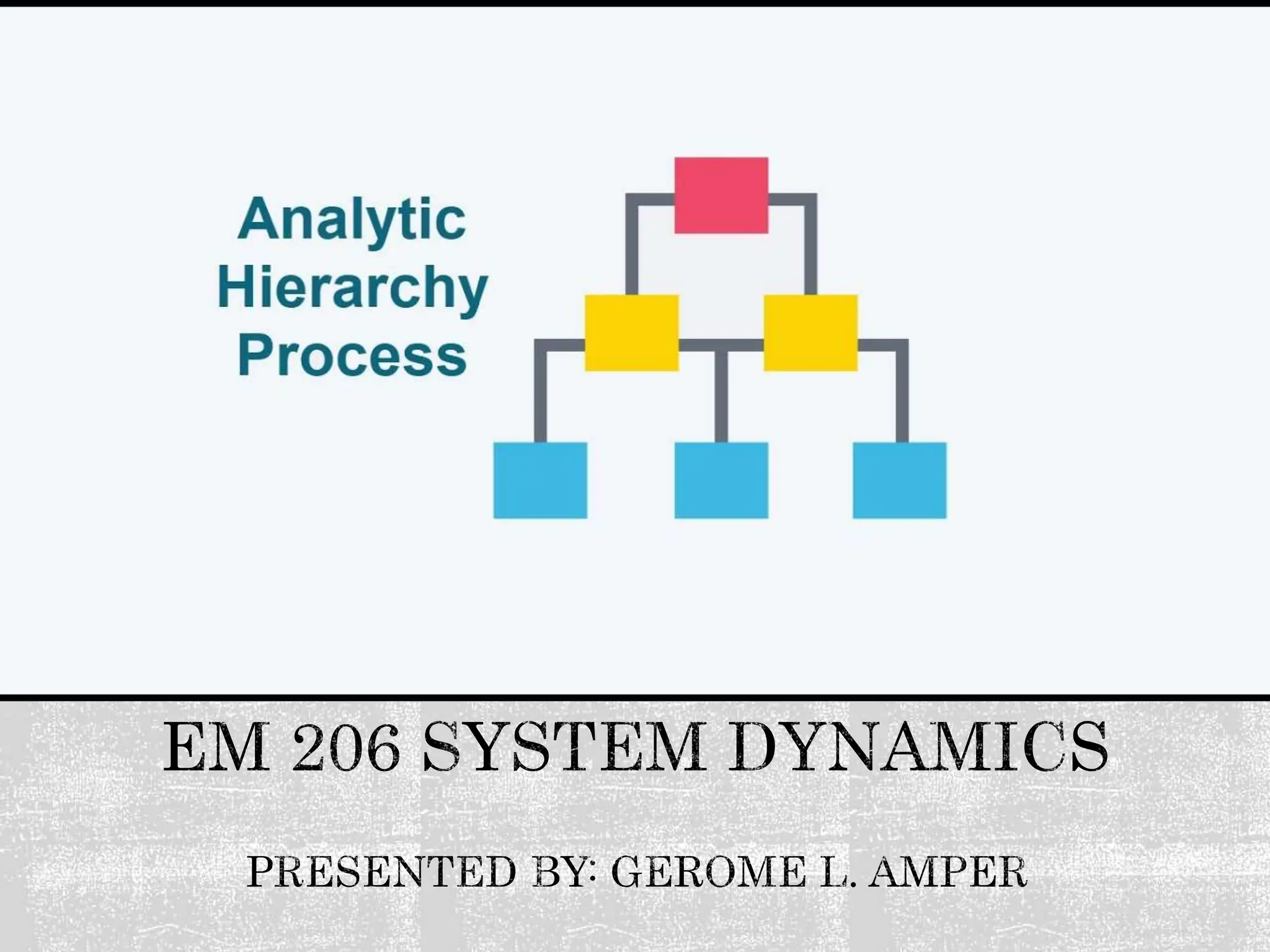
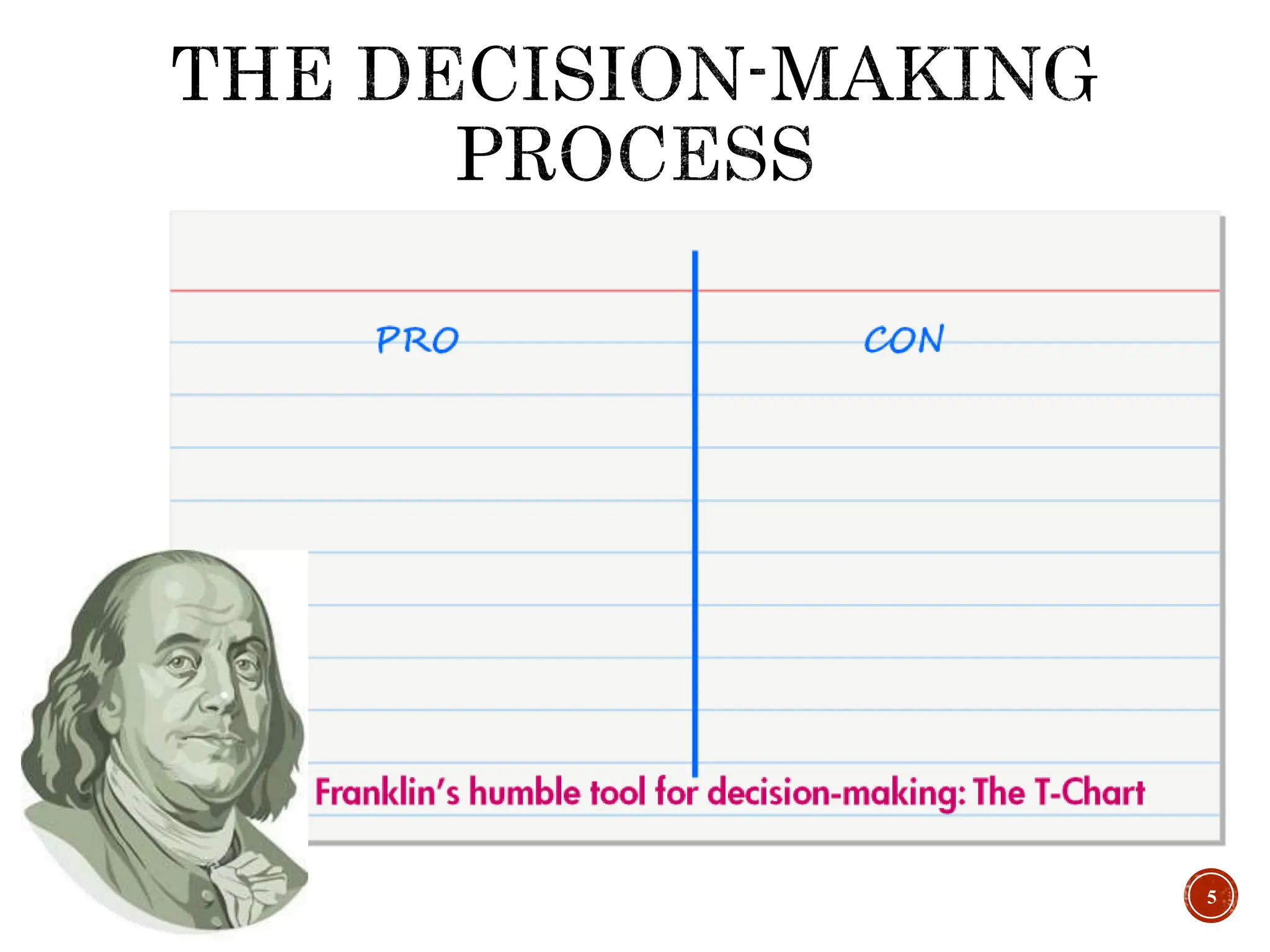
Analytic Hierarchy Process
1
2
set of activities that lead to the
resolution of a decision-making
problem that involves at least
two meaningful alternatives, of
which the selected one offers the
best result with respect to the
set goal, as well as the possibility
of its implementation
3
The content side
of decision-
making - this reflects
the differences in
individual decision-
making processes.
The formal-logical
(procedural) side of
decision-making -
expresses that individual
decision-making
processes
have certain common
features, regardless of
their content.
4
A precondition for claiming that there is a framework
procedure for resolving a decision-making situation
with different content.
The formal-logical (procedural) side of decision-
making
It is the basis for decision-making theory, which aims
to create appropriate procedures (methods) for
solving decision-making situations with the highest
degree of universality.
Multiple-Criteria Decision-Making (“MCDM”)
5
6
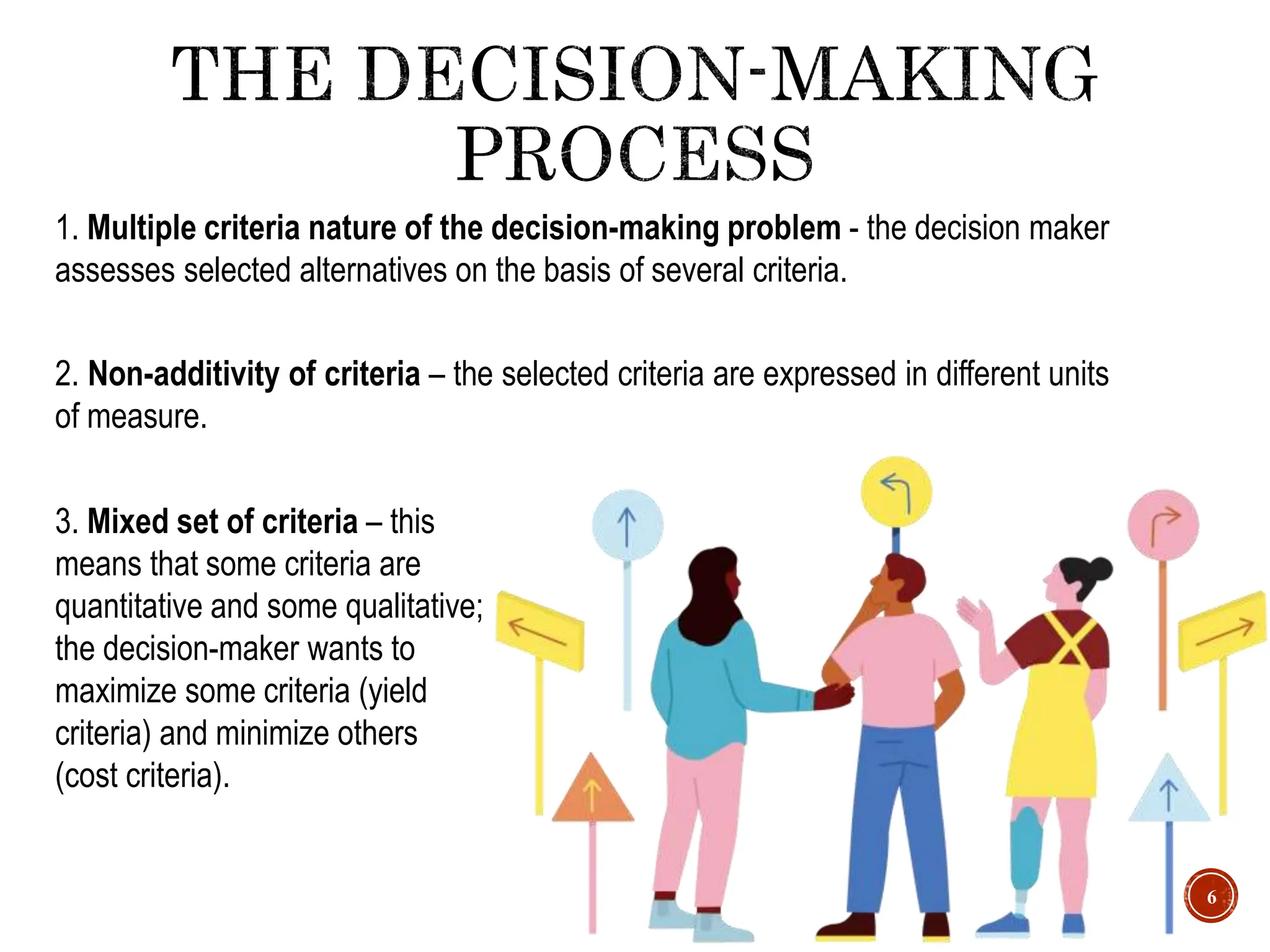
3. Mixed set of criteria – this
means that some criteria are
quantitative and some qualitative;
the decision-maker wants to
maximize some criteria (yield
criteria) and minimize others
(cost criteria).
1. Multiple criteria nature of the decision-making problem - the decision maker
assesses selected alternatives on the basis of several criteria.
2. Non-additivity of criteria – the selected criteria are expressed in different units
of measure.
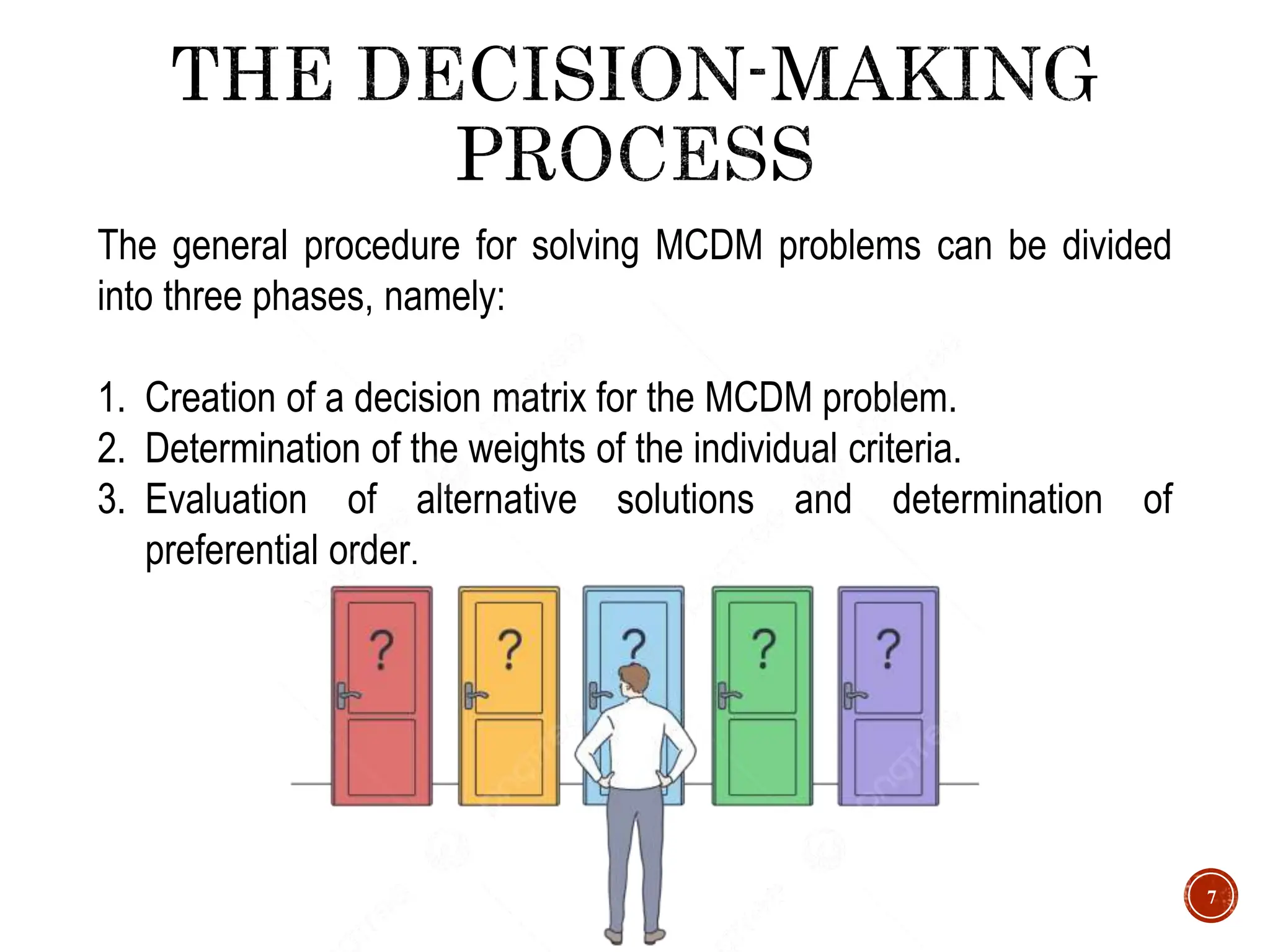
7
The general procedure for solving MCDM problems can be divided
into three phases, namely:
1. Creation of a decision matrix for the MCDM problem.
2. Determination of the weights of the individual criteria.
3. Evaluation of alternative solutions and determination of
preferential order.
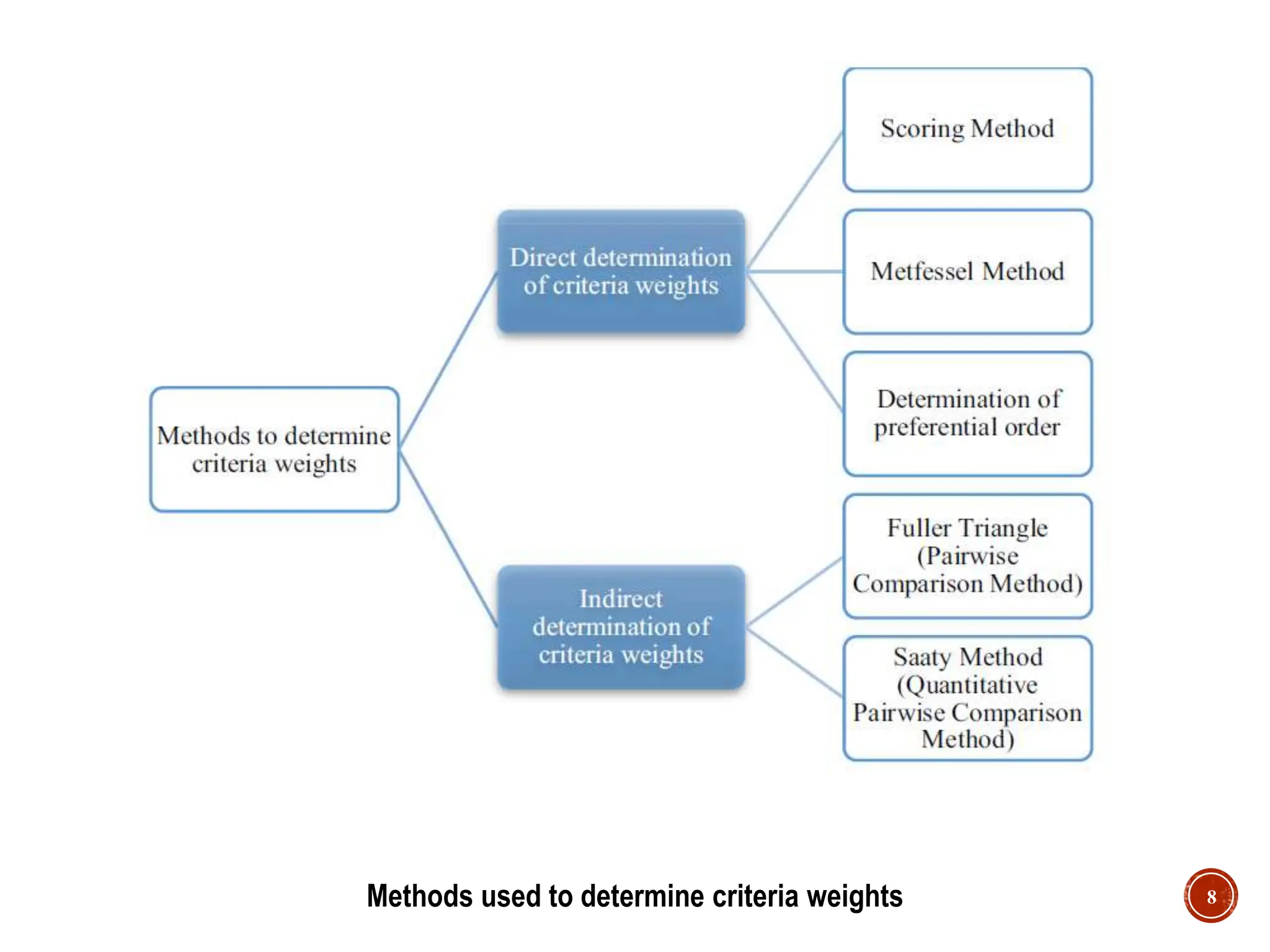
8
Methods used to determine criteria weights
9
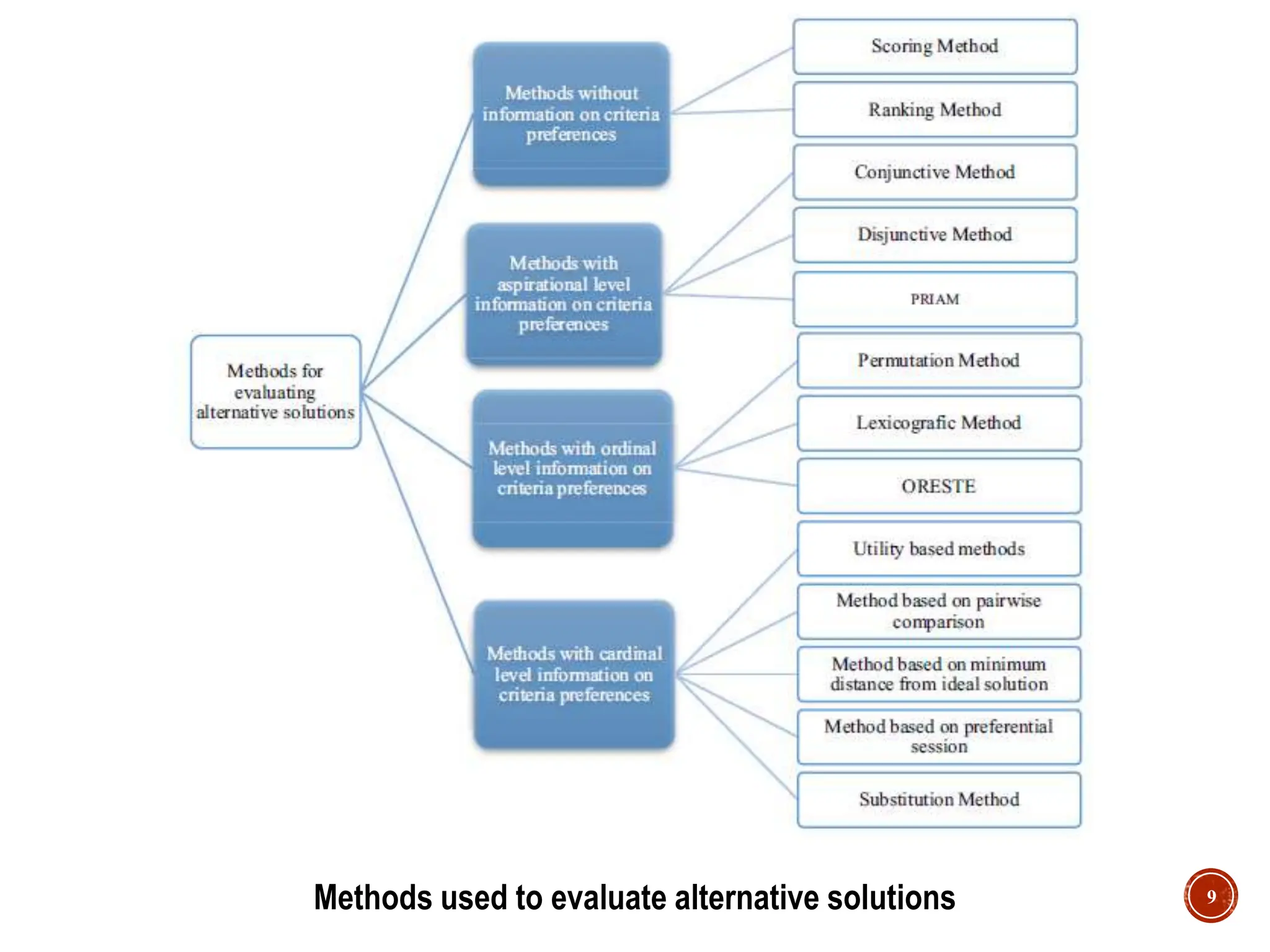
Methods used to evaluate alternative solutions
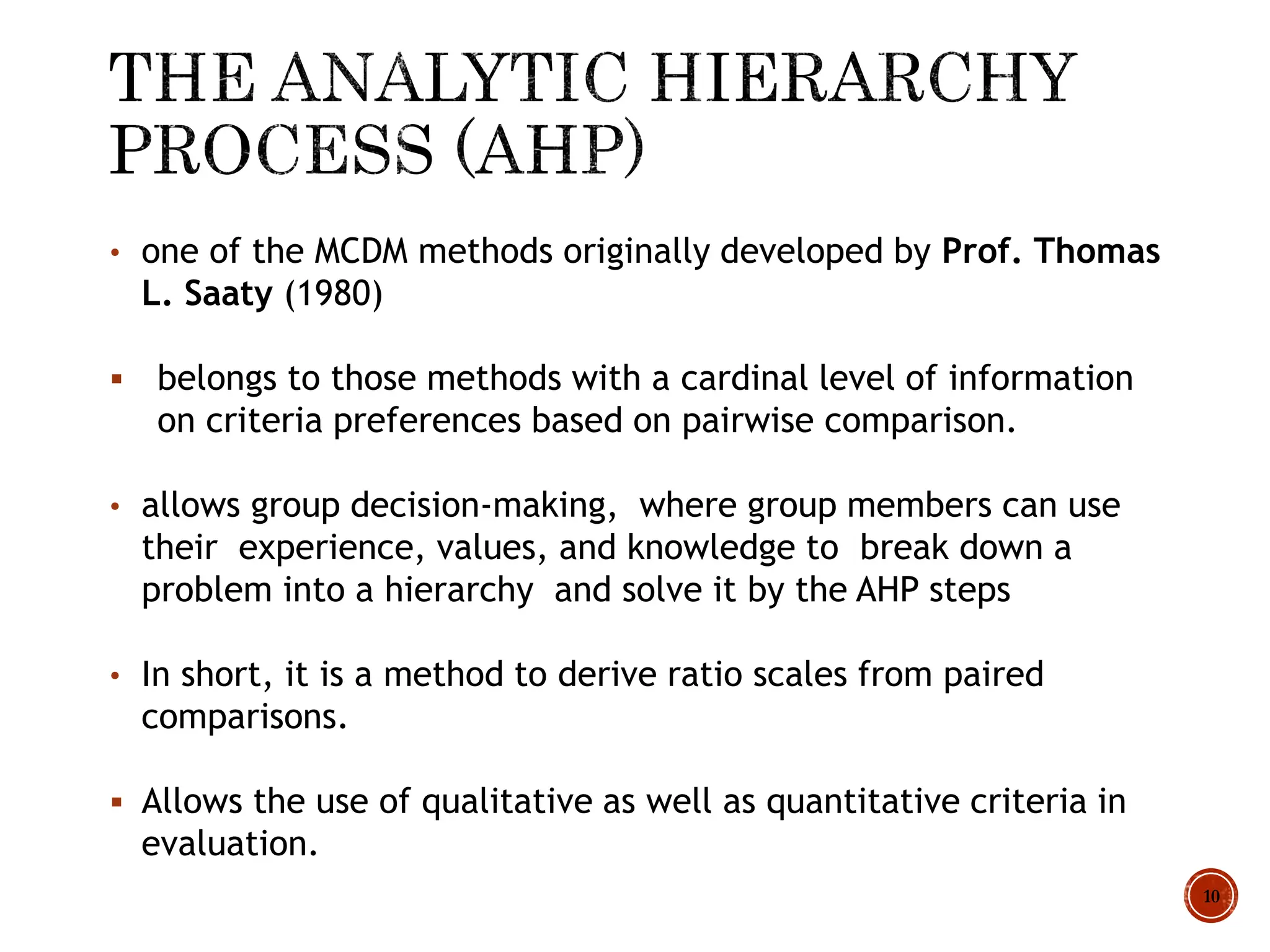
• one of the MCDM methods originally developed by Prof. Thomas
L. Saaty (1980)
 belongs to those methods with a cardinal level of information
on criteria preferences based on pairwise comparison.
• allows group decision-making, where group members can use
their experience, values, and knowledge to break down a
problem into a hierarchy and solve it by the AHP steps
• In short, it is a method to derive ratio scales from paired
comparisons.
 Allows the use of qualitative as well as quantitative criteria in
evaluation.
10
 Wide range of applications exists:
 Selecting a car for purchasing
 Deciding upon a place to visit for vacation
 Deciding upon an MBA program after graduation
11
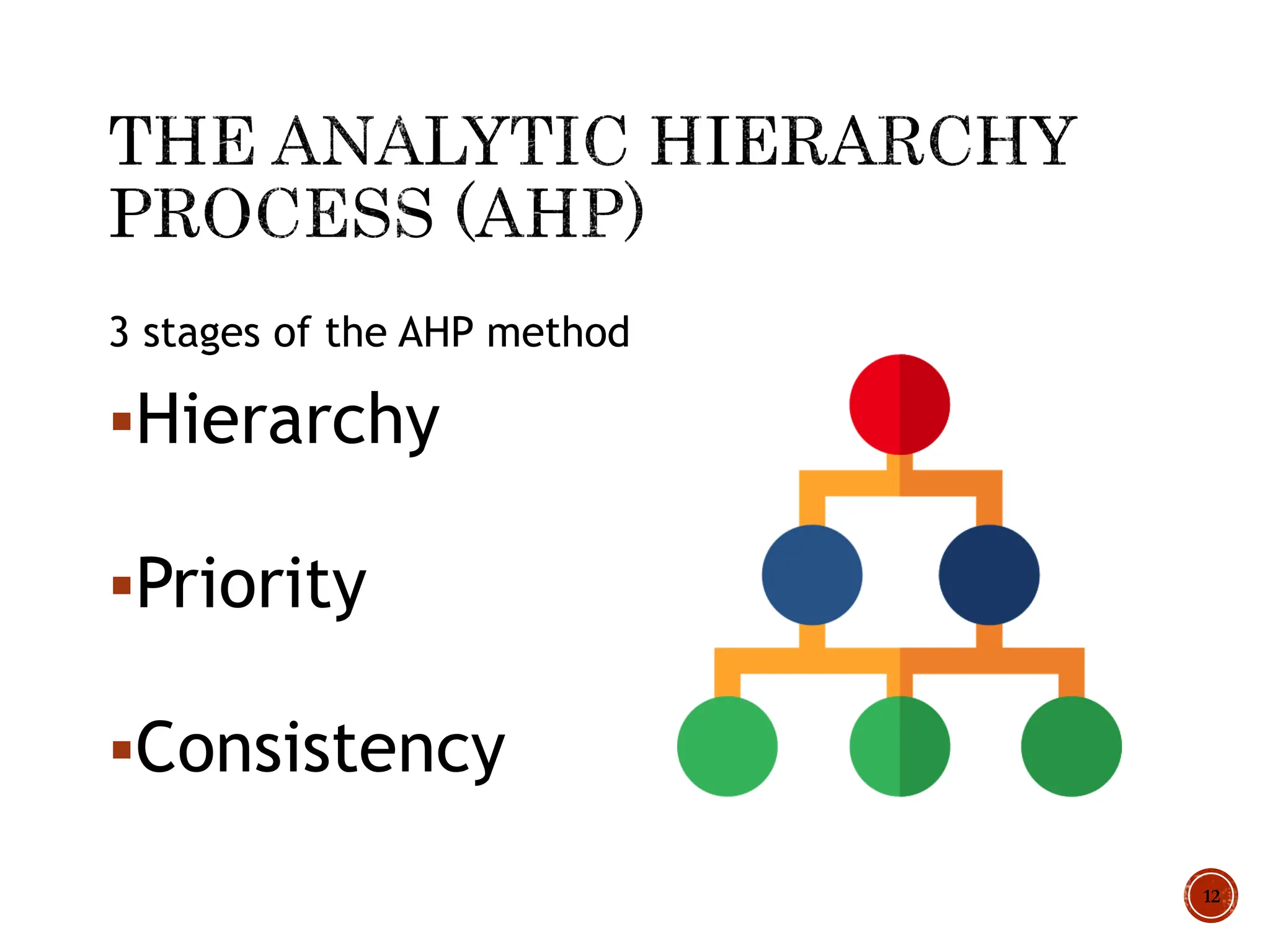
3 stages of the AHP method
Hierarchy
Priority
Consistency
12
13
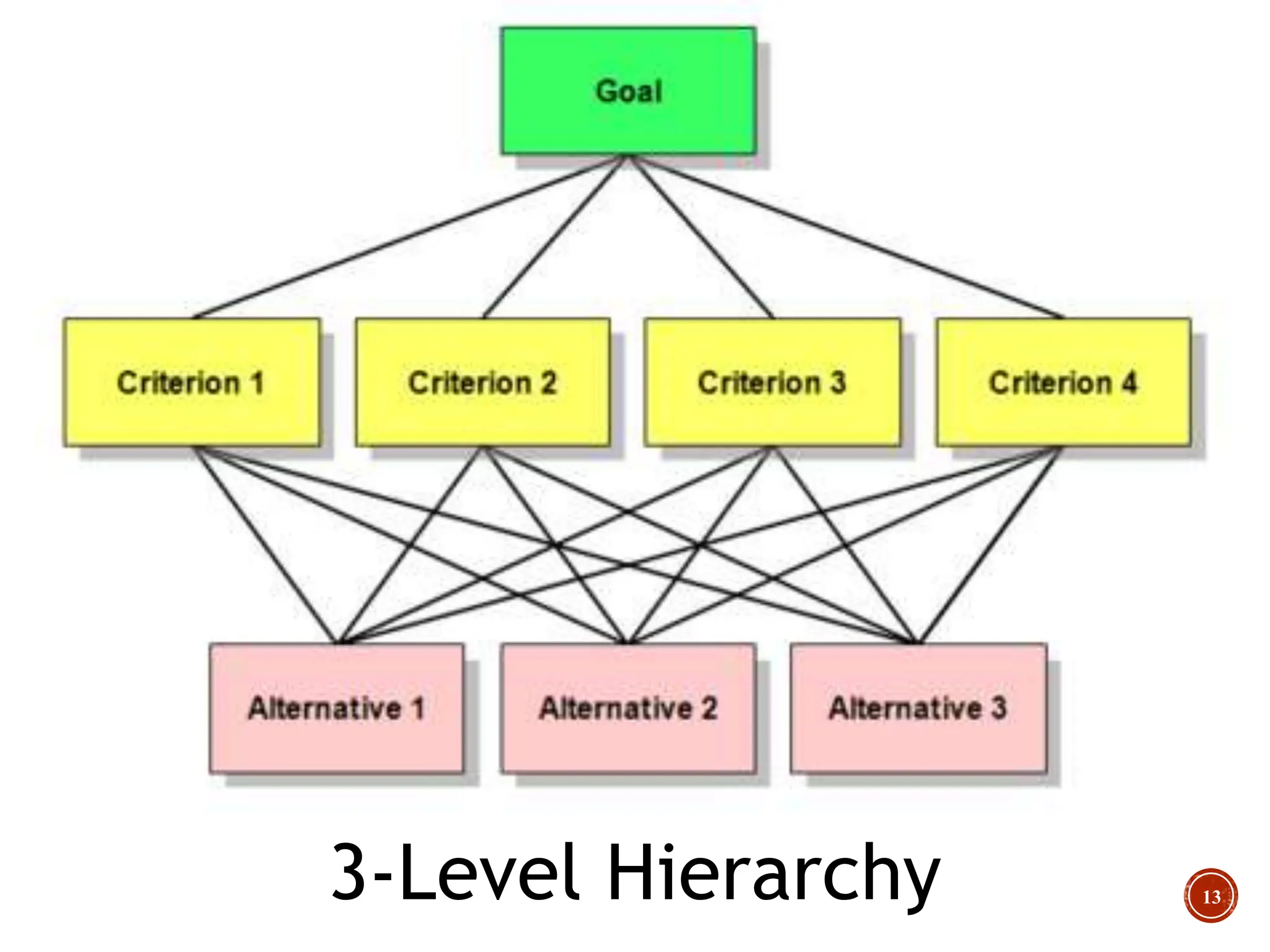
3-Level Hierarchy
 Develop an hierarchy of decision criteria and define
the alternative courses of actions.
 AHP algorithm is basically composed of two steps:
1. Determine the relative weights of the decision criteria
2. Determine the relative rankings (priorities) of alternatives
! Both qualitative and quantitative information can
be compared by using informed judgments to derive
weights and priorities.
14
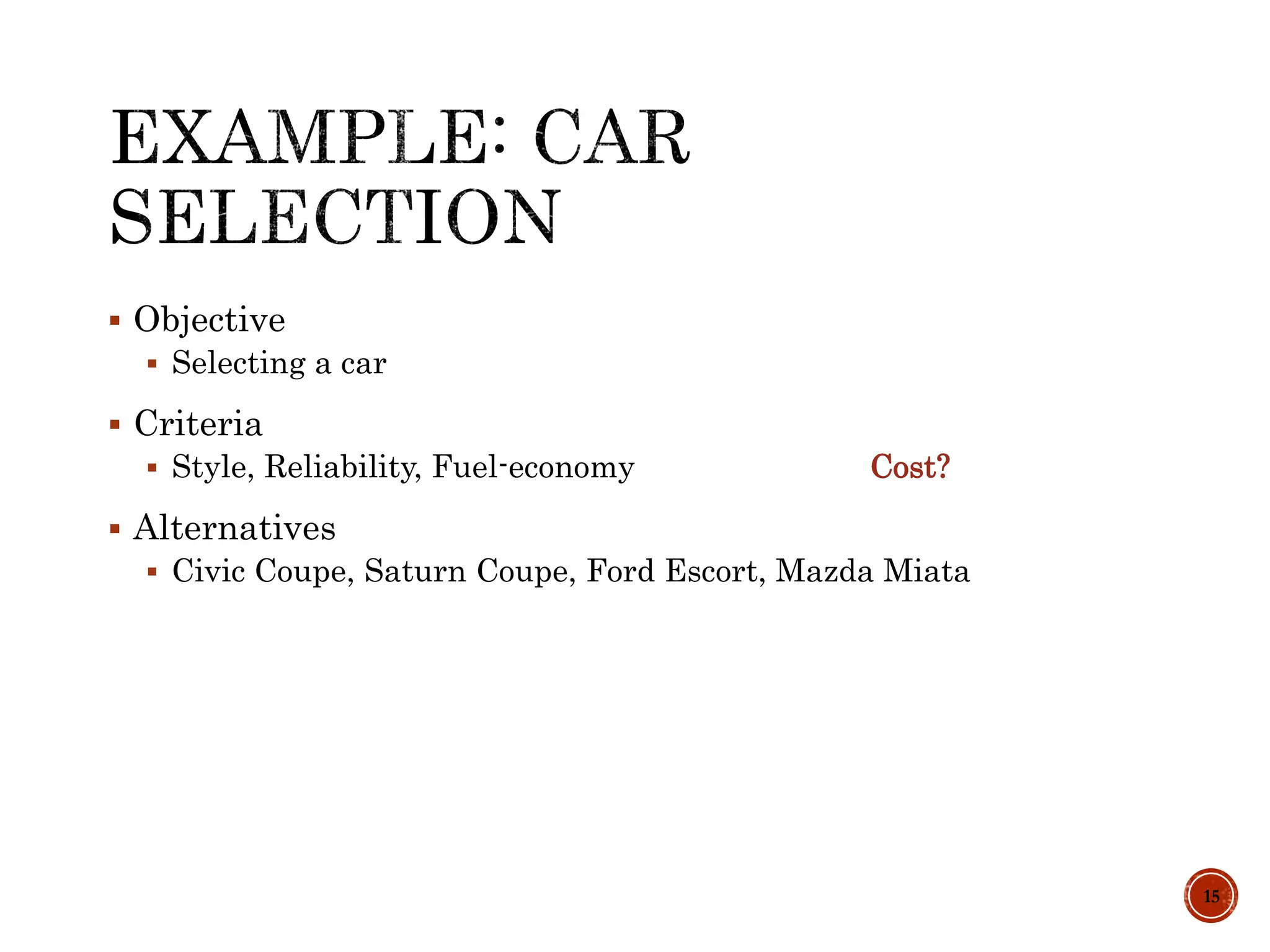
 Objective
 Selecting a car
 Criteria
 Style, Reliability, Fuel-economy Cost?
 Alternatives
 Civic Coupe, Saturn Coupe, Ford Escort, Mazda Miata
15
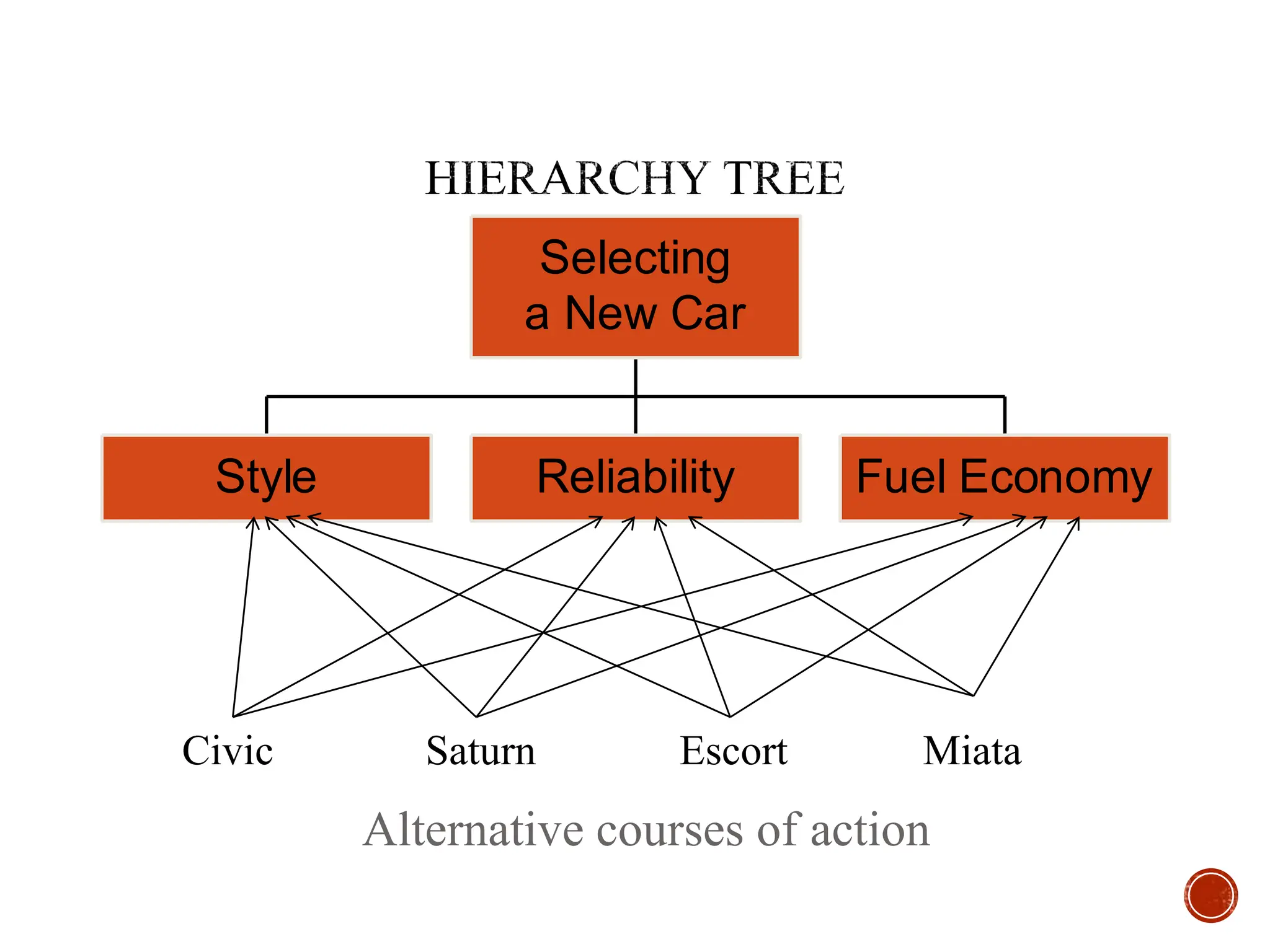
Style Reliability Fuel Economy
Selecting
a New Car
Civic Saturn Escort Miata
Alternative courses of action
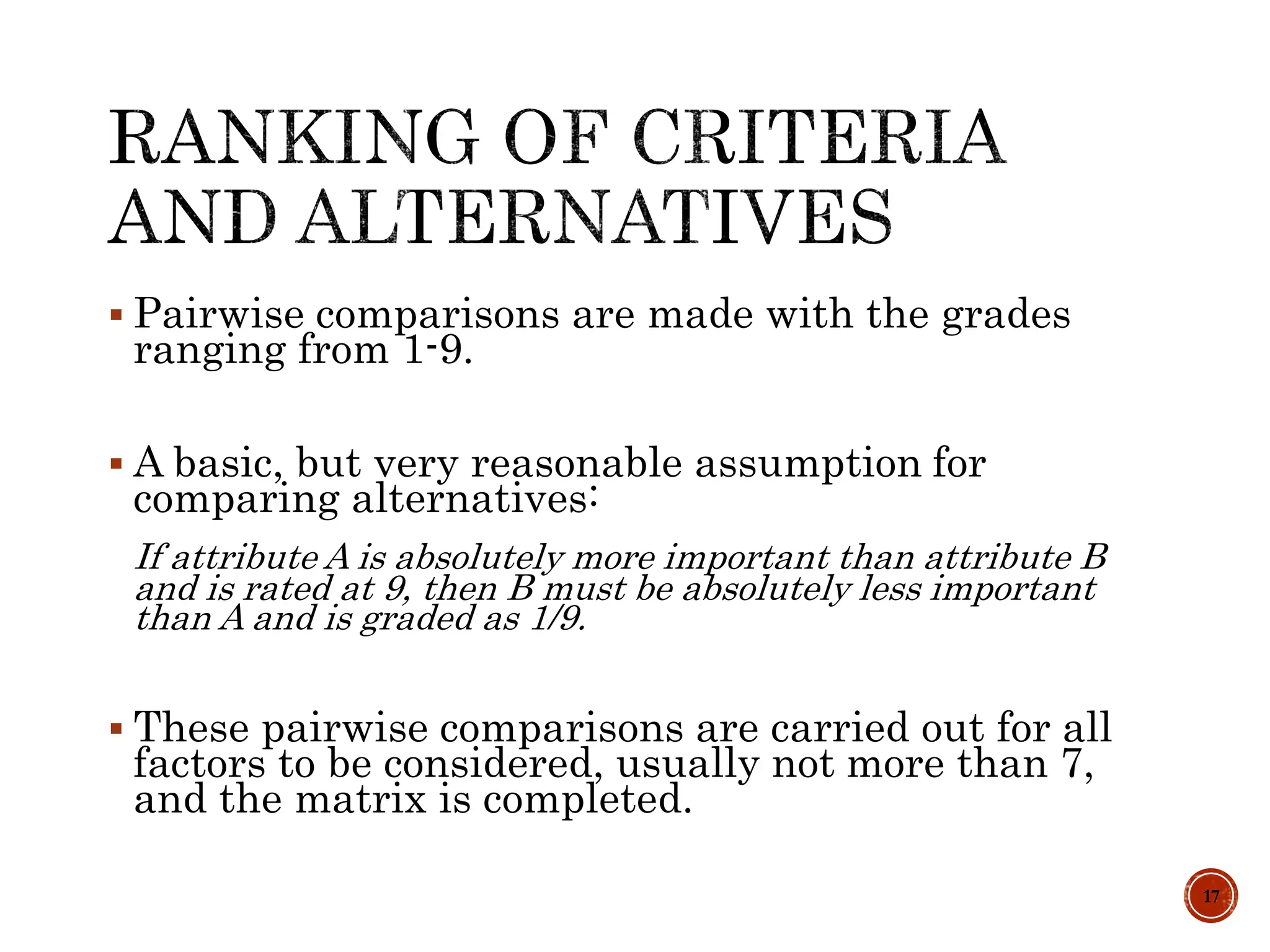
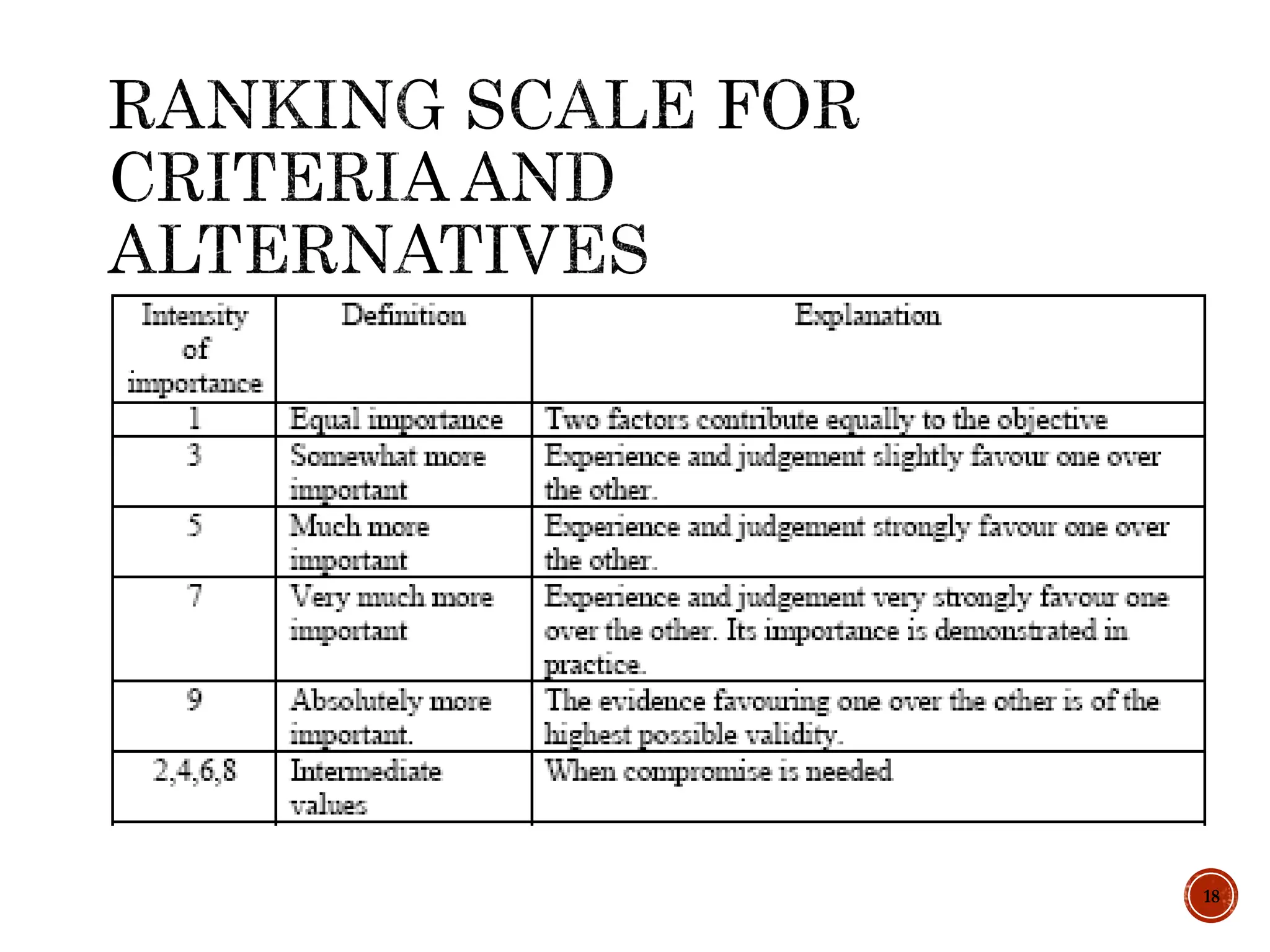
 Pairwise comparisons are made with the grades
ranging from 1-9.
 A basic, but very reasonable assumption for
comparing alternatives:
If attribute A is absolutely more important than attribute B
and is rated at 9, then B must be absolutely less important
than A and is graded as 1/9.
 These pairwise comparisons are carried out for all
factors to be considered, usually not more than 7,
and the matrix is completed.
17
18
19
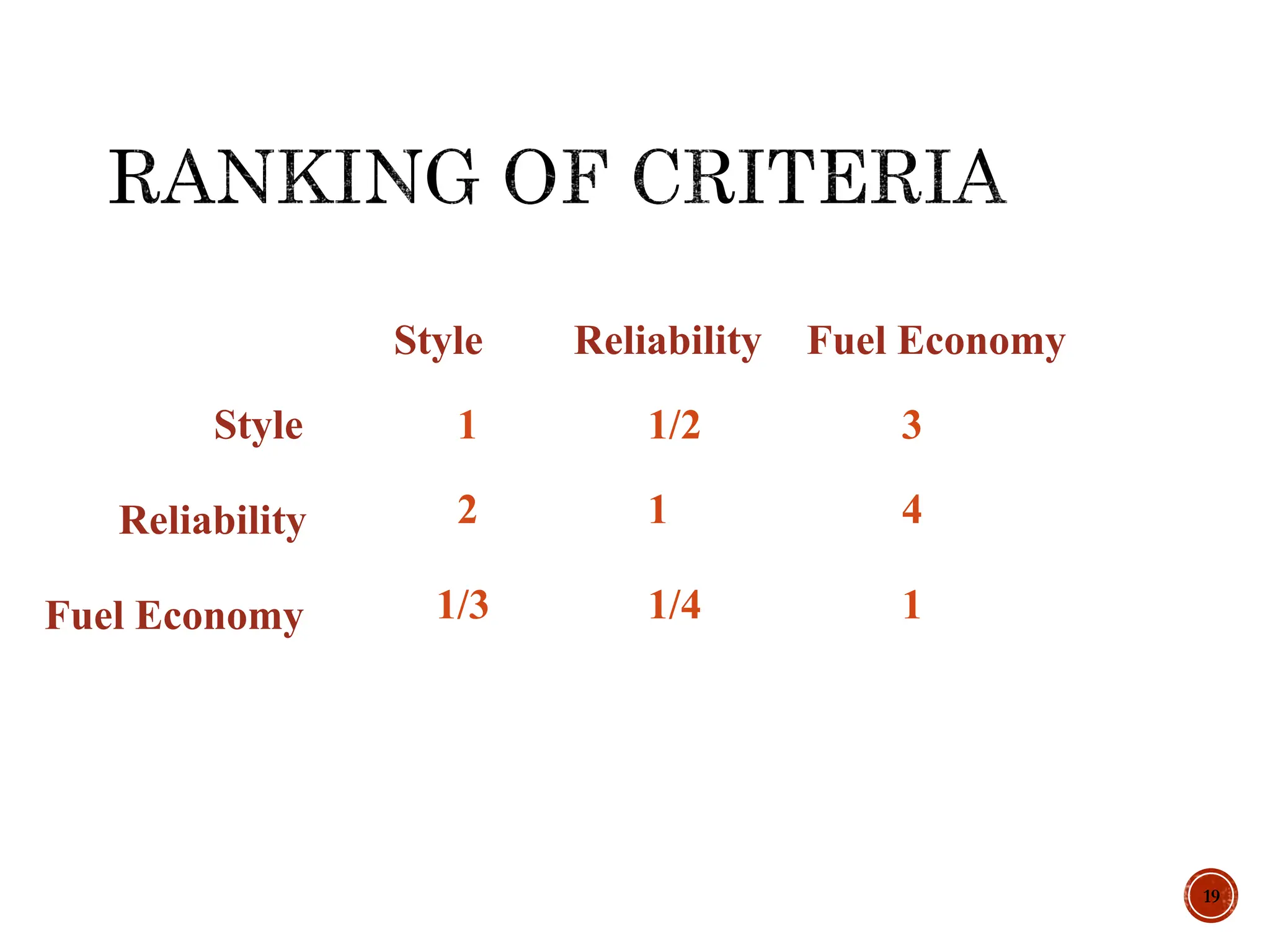
Style Reliability Fuel Economy
Style
Reliability
Fuel Economy
1 1/2 3
2 1 4
1/3 1/4 1
 Consider [Ax = maxx] where
 A is the comparison matrix of size n×n, for n criteria, also called the
priority matrix.
 x is the Eigenvector of size n×1, also called the priority vector.
 max is the Eigenvalue, max  > n.
 To find the ranking of priorities, namely the Eigen Vector X:
1) Normalize the column entries by dividing each entry by the sum of the
column.
2) Take the overall row averages.
20
0.30 0.29 0.38
0.60 0.57 0.50
0.10 0.14 0.13
Column sums 3.33 1.75 8.00 1.00 1.00 1.00
A=
1 0.5 3
2 1 4
0.33 0.25 1
Normalized
Column Sums
Row
averages 0.30
0.60
0.10
Priority vector
X=
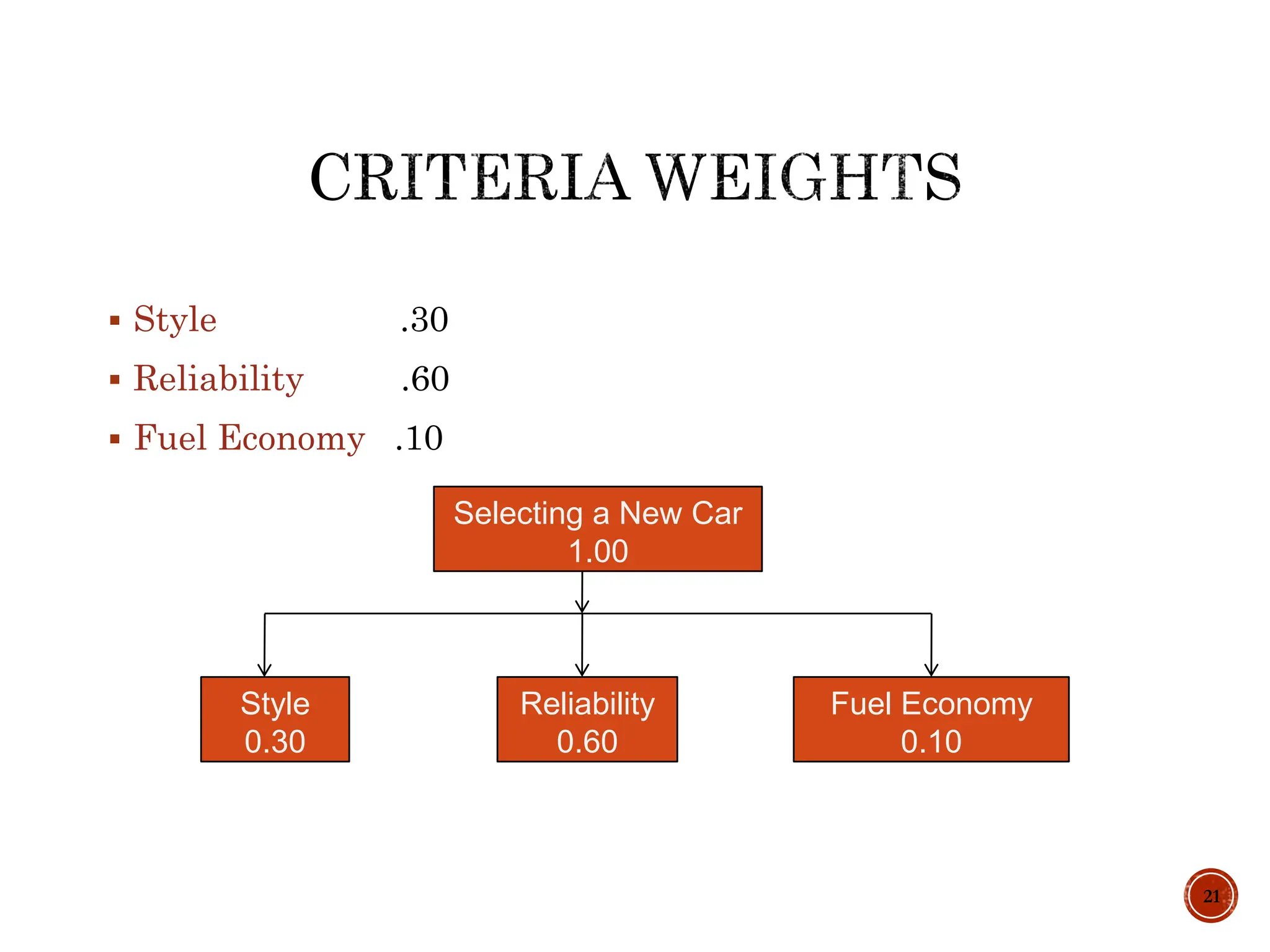
 Style .30
 Reliability .60
 Fuel Economy .10
21
Style
0.30
Reliability
0.60
Fuel Economy
0.10
Selecting a New Car
1.00
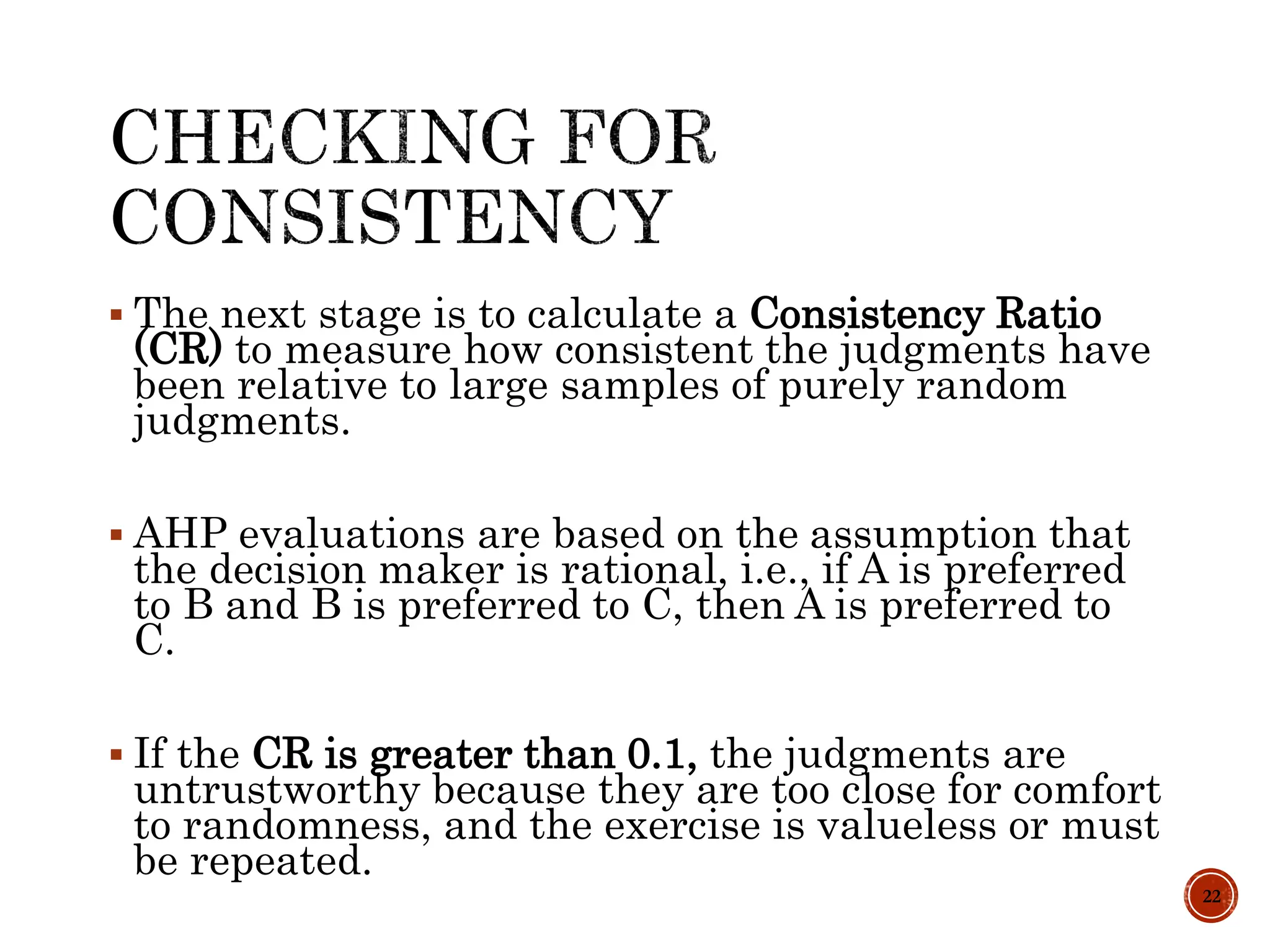
 The next stage is to calculate a Consistency Ratio
(CR) to measure how consistent the judgments have
been relative to large samples of purely random
judgments.
 AHP evaluations are based on the assumption that
the decision maker is rational, i.e., if A is preferred
to B and B is preferred to C, then A is preferred to
C.
 If the CR is greater than 0.1, the judgments are
untrustworthy because they are too close for comfort
to randomness, and the exercise is valueless or must
be repeated.
22
 The next stage is to calculate max so as to lead
to the Consistency Index and the Consistency
Ratio.
 Consider [Ax = max x] where x is the
Eigenvector.
0.30
0.60
0.10
1 0.5 3
2 1 4
0.33 0.25 1
0.90
1.60
0.35
= = max
λmax=average{0.90/0.30, 1.60/0.6, 0.35/0.10}=3.06
0.30
0.60
0.10
A x Ax x
Consistency index, CI is found by
CI=(λmax-n)/(n-1)=(3.06-3)/(3-1)= 0.03
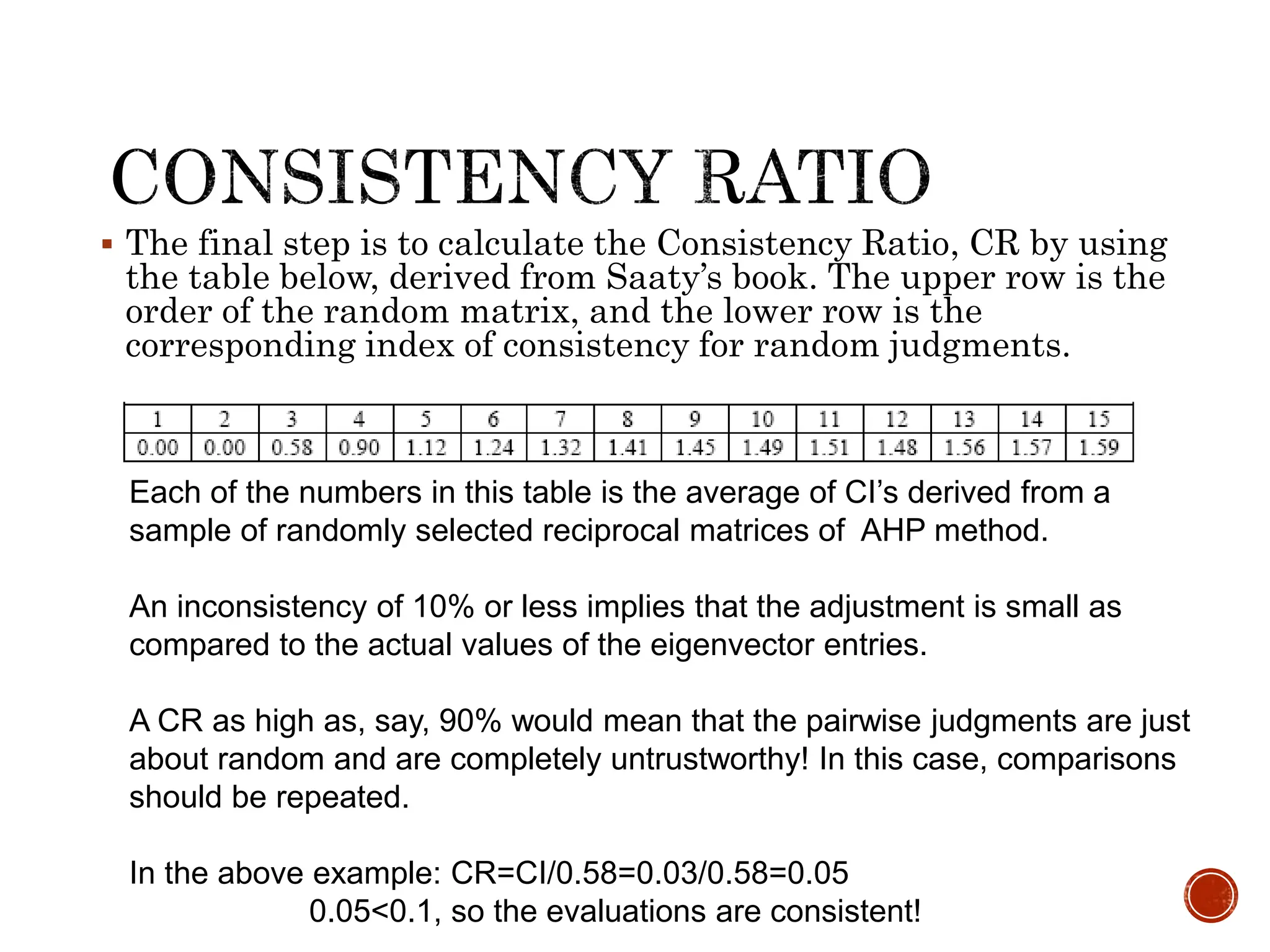
 The final step is to calculate the Consistency Ratio, CR by using
the table below, derived from Saaty’s book. The upper row is the
order of the random matrix, and the lower row is the
corresponding index of consistency for random judgments.
Each of the numbers in this table is the average of CI’s derived from a
sample of randomly selected reciprocal matrices of AHP method.
An inconsistency of 10% or less implies that the adjustment is small as
compared to the actual values of the eigenvector entries.
A CR as high as, say, 90% would mean that the pairwise judgments are just
about random and are completely untrustworthy! In this case, comparisons
should be repeated.
In the above example: CR=CI/0.58=0.03/0.58=0.05
0.05<0.1, so the evaluations are consistent!
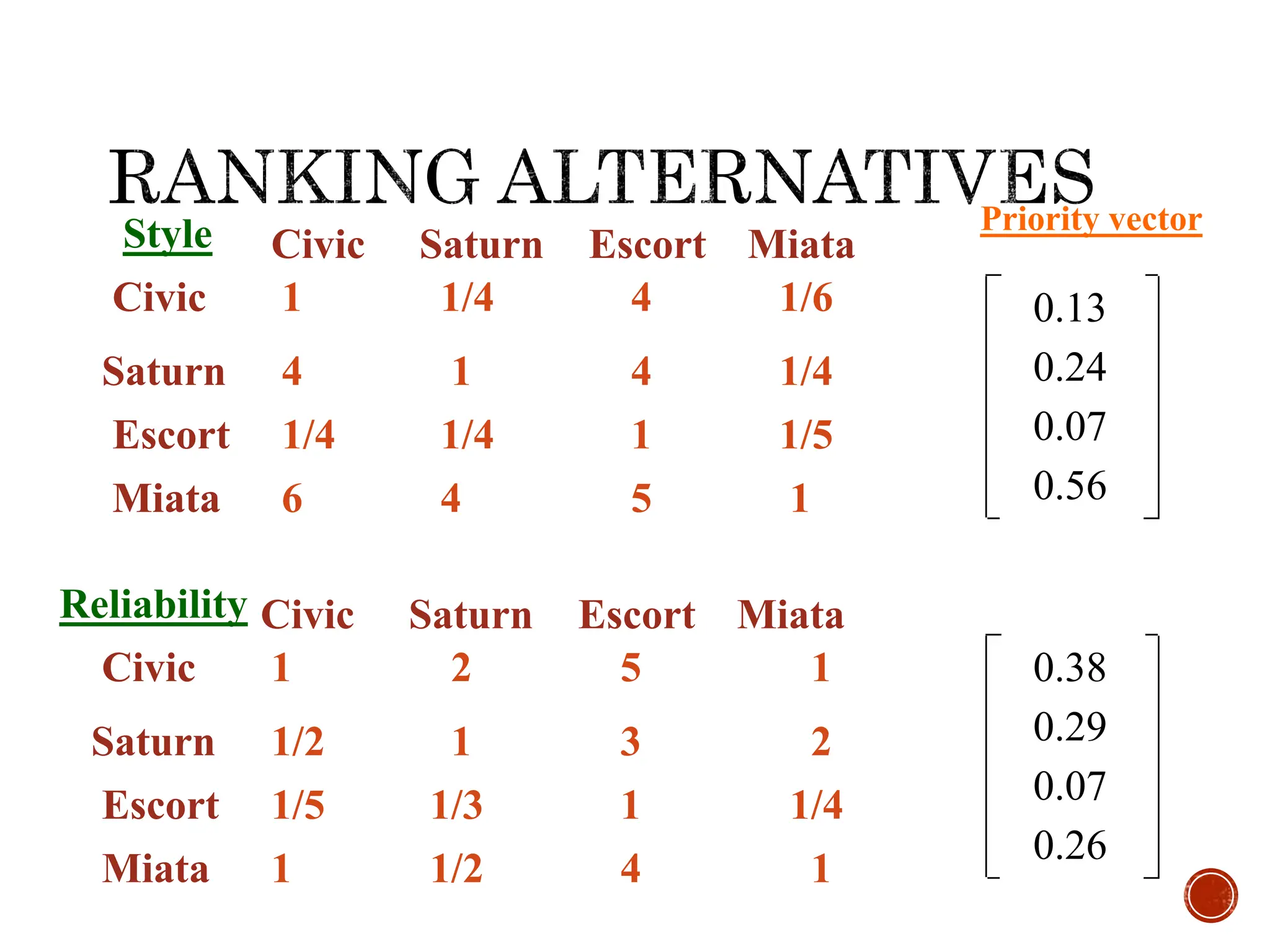
Style
Civic
Saturn
Escort
1 1/4 4 1/6
4 1 4 1/4
1/4 1/4 1 1/5
Miata 6 4 5 1
Civic Saturn Escort Miata
Miata
Reliability
Civic
Saturn
Escort
1 2 5 1
1/2 1 3 2
1/5 1/3 1 1/4
Miata 1 1/2 4 1
Civic Saturn Escort Miata
0.13
0.24
0.07
0.56
Priority vector
0.38
0.29
0.07
0.26
26
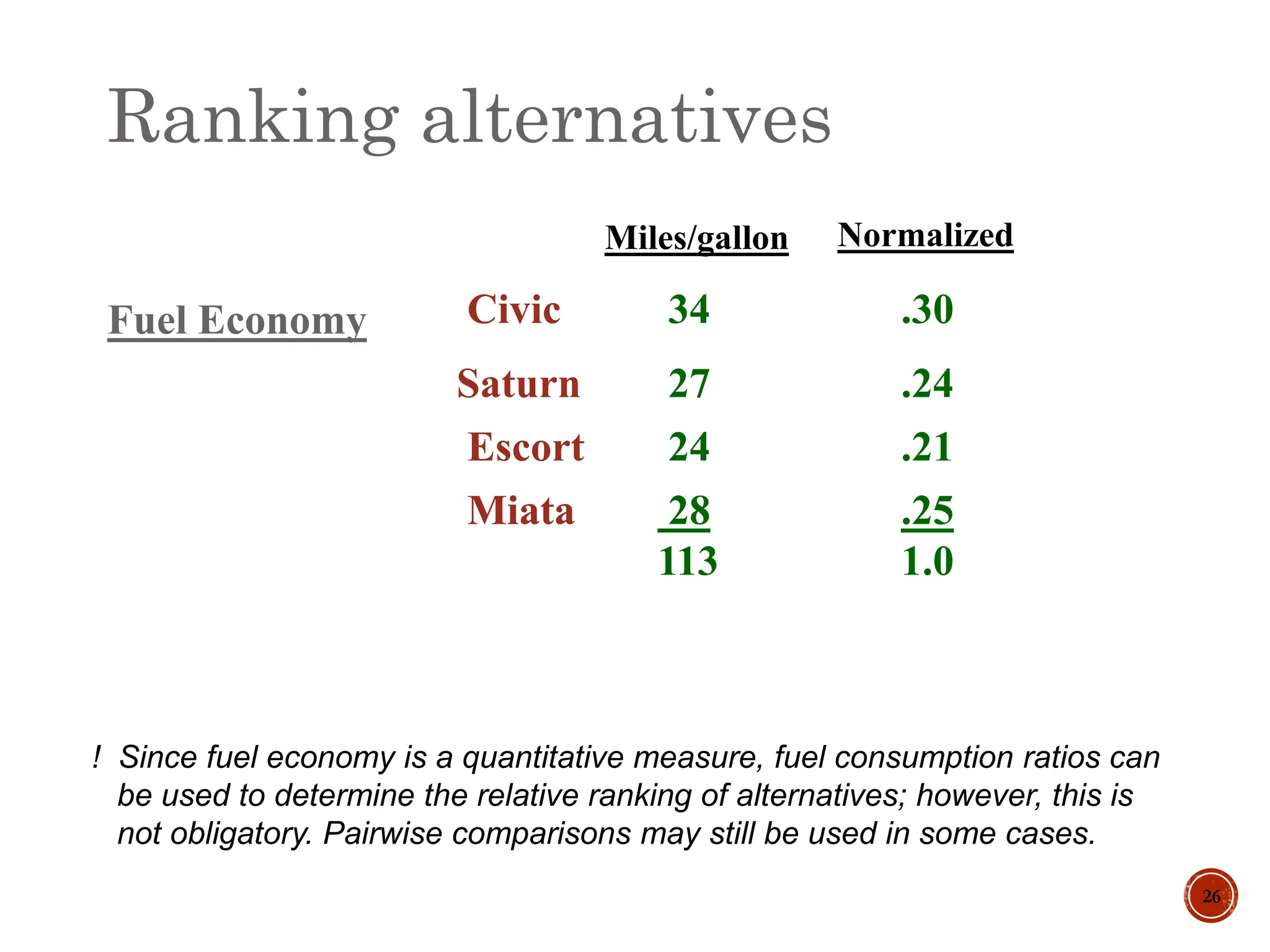
Fuel Economy Civic
Saturn
Escort
Miata
Miata
34
27
24
28
113
Miles/gallon Normalized
.30
.24
.21
.25
1.0
Ranking alternatives
! Since fuel economy is a quantitative measure, fuel consumption ratios can
be used to determine the relative ranking of alternatives; however, this is
not obligatory. Pairwise comparisons may still be used in some cases.
27
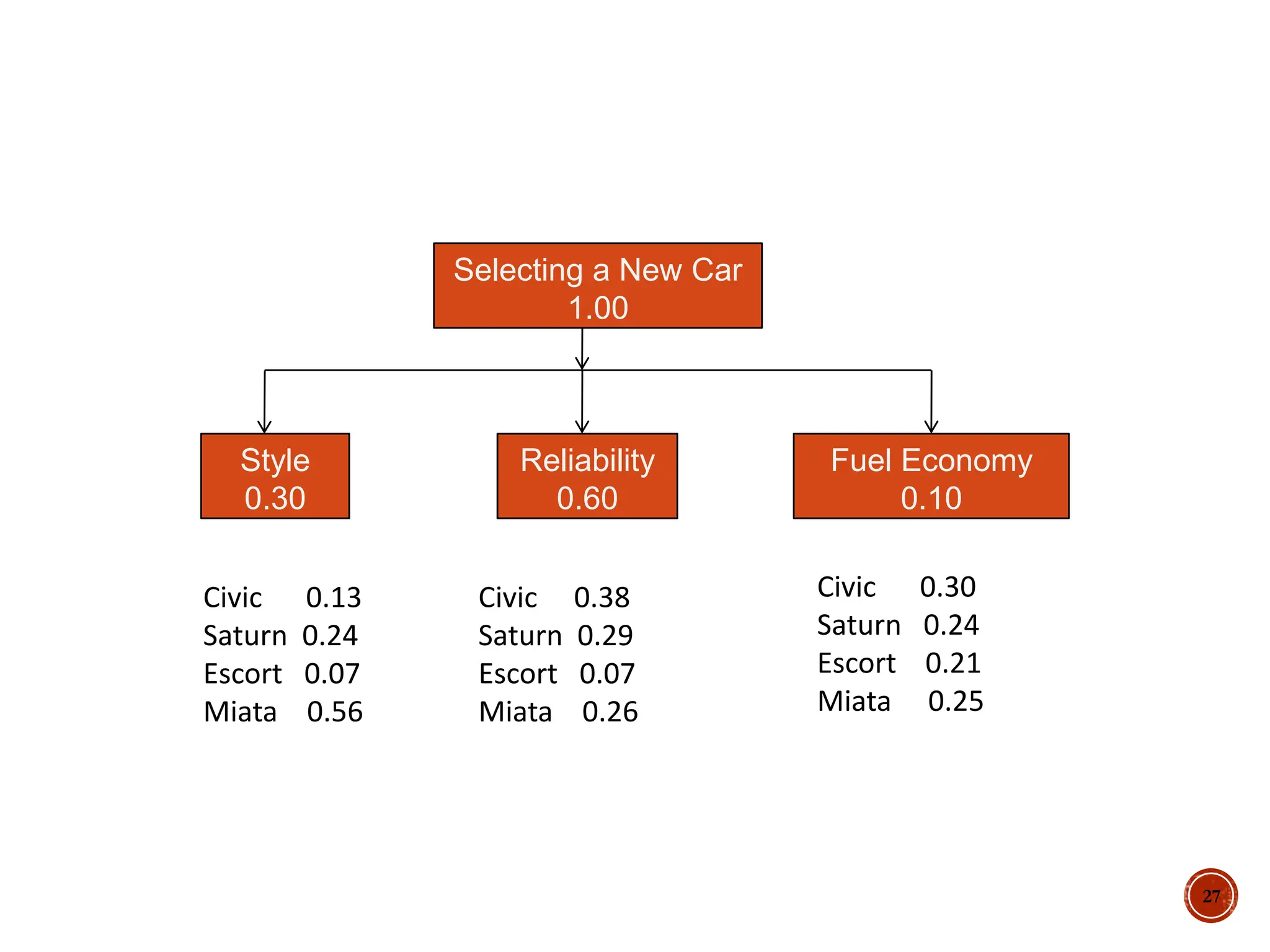
Civic 0.13
Saturn 0.24
Escort 0.07
Miata 0.56
Civic 0.38
Saturn 0.29
Escort 0.07
Miata 0.26
Civic 0.30
Saturn 0.24
Escort 0.21
Miata 0.25
Style
0.30
Reliability
0.60
Fuel Economy
0.10
Selecting a New Car
1.00
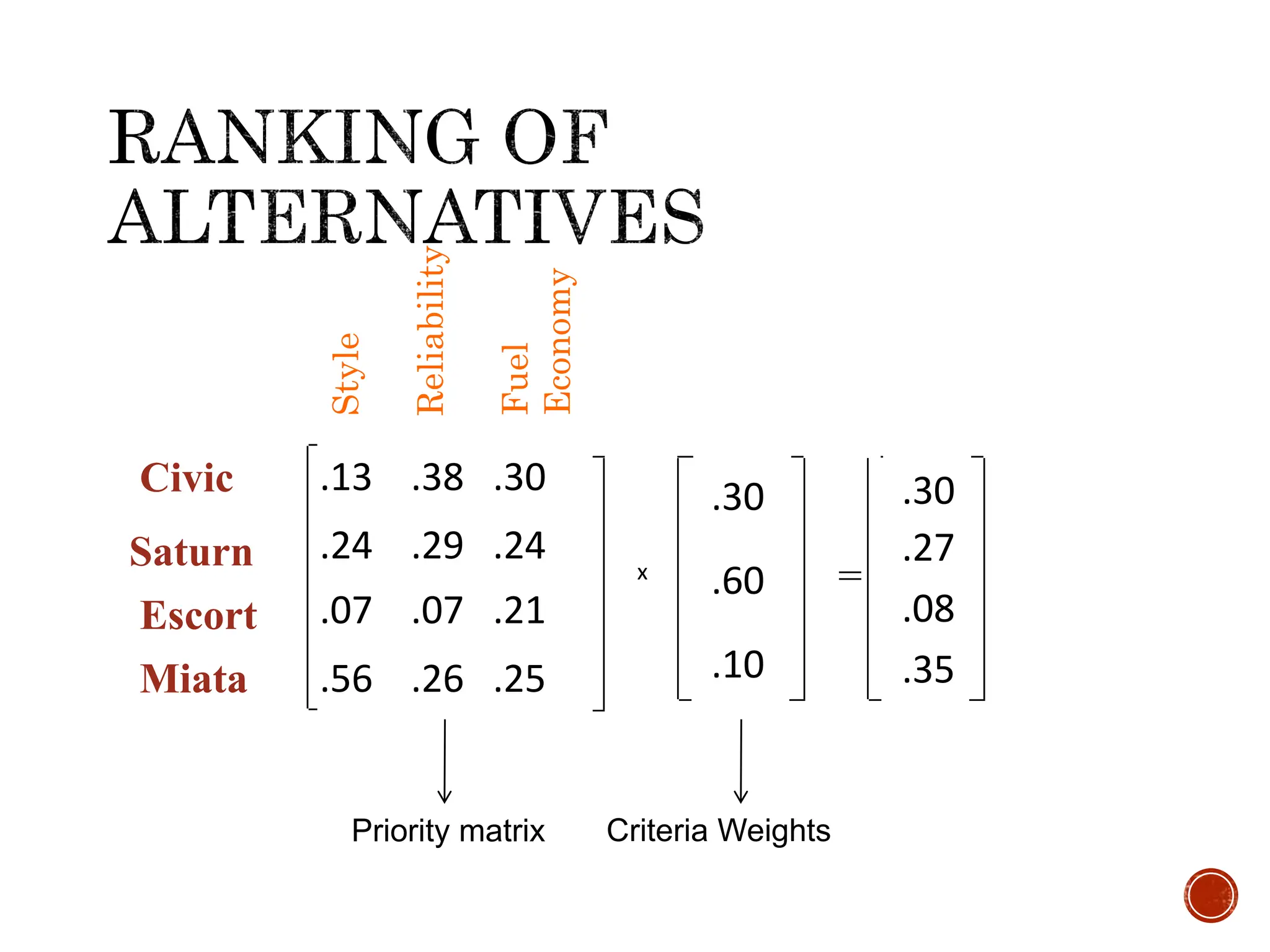
Style
Reliability
Fuel
Economy
Civic
Escort
Miata
Miata
Saturn
.13 .38 .30
.24 .29 .24
.07 .07 .21
.56 .26 .25
x
.30
.60
.10
=
.30
.27
.08
.35
Criteria Weights
Priority matrix
 CIVIC $12K .22 .30
0.73
 SATURN $15K .28 .27 1.03
 ESCORT $9K .17 .08 2.13
 MIATA $18K .33 .35 0.92
Cost
Normalized
Cost
Cost/Benefits
Ratio
Adding “cost” as a a new criterion is very difficult in AHP. A new column
and a new row will be added in the evaluation matrix. However, whole
evaluation should be repeated since addition of a new criterion might
affect the relative importance of other criteria as well!
Instead one may think of normalizing the costs directly and calculate the
cost/benefit ratio for comparing alternatives!
Benefits
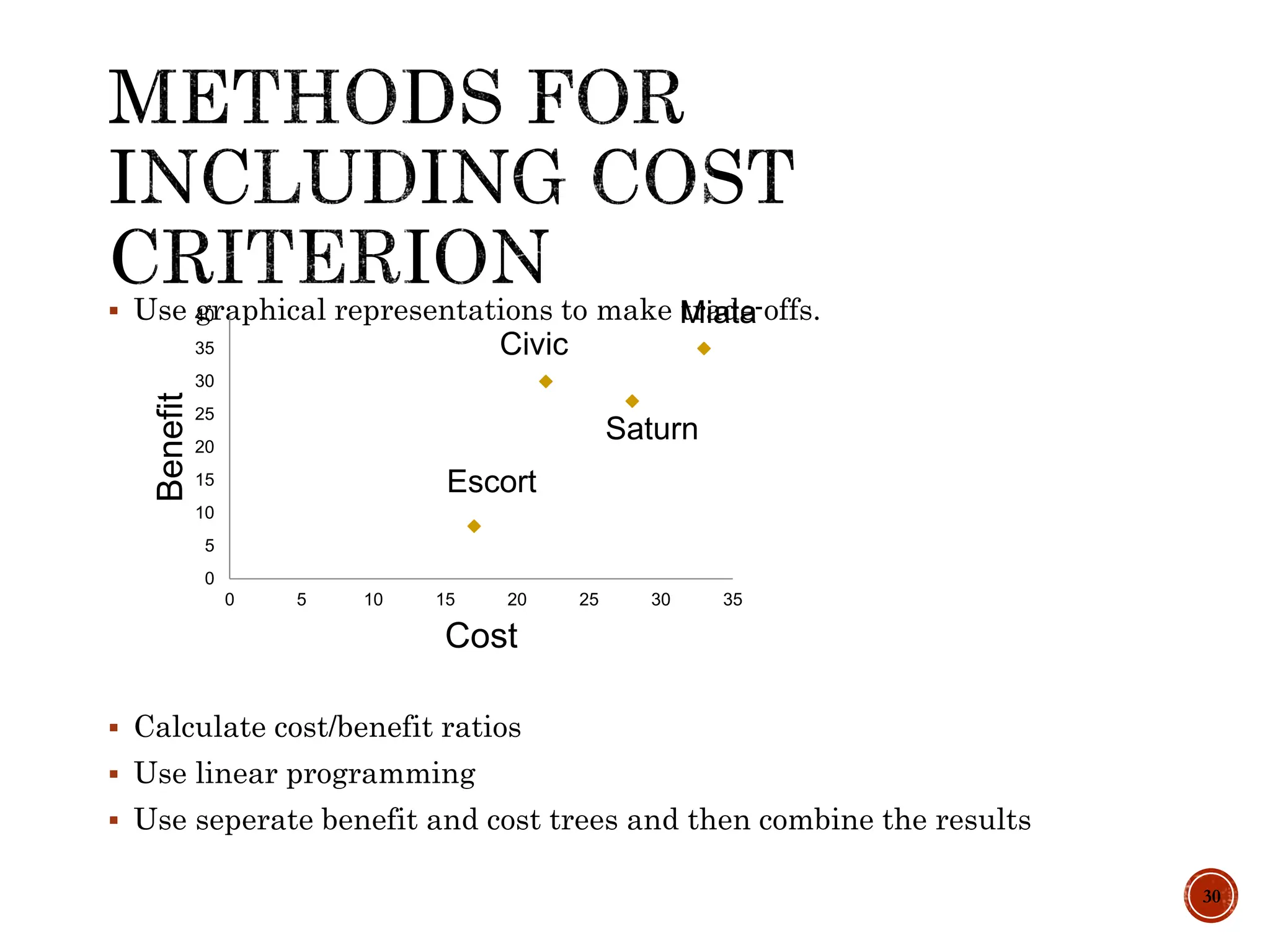
 Use graphical representations to make trade-offs.
 Calculate cost/benefit ratios
 Use linear programming
 Use seperate benefit and cost trees and then combine the results
30
0
5
10
15
20
25
30
35
40
0 5 10 15 20 25 30 35
Benefit
Cost
Civic
Escort
Saturn
Miata
31
F. C. Zola, J. C. Colmenero, F. V. Aragao, T. Rodrigues, A. Braghini, Multicriterial
model for selecting a charcoal kiln. Energy. 190(1), 1–14 (2020)
Al Harbi K.M.A.S. (1999), Application of AHP in Project Management, International
Journal of Project Management, 19, 19-27.
Haas R., Meixner, O., (2009) An Illustrated Guide to the Analytic Hierarchy Process,
Lecture Notes, Institute of Marketing & Innovation, University of Natural Resources,
retrieved from http://www.boku.ac.at/mi/ on October 2009.
Saaty, T.L., Vargas, L.G., (2001), Models, Methods, Concepts & Applications of the
Analytic Hierarchy Process, Kluwer’s Academic Publishers, Boston, USA.
Brans, J.P., Mareschal, B., (2010) “How to Decide with Promethee, retrieved from
http://www.visualdecision.com on October 2010.
32
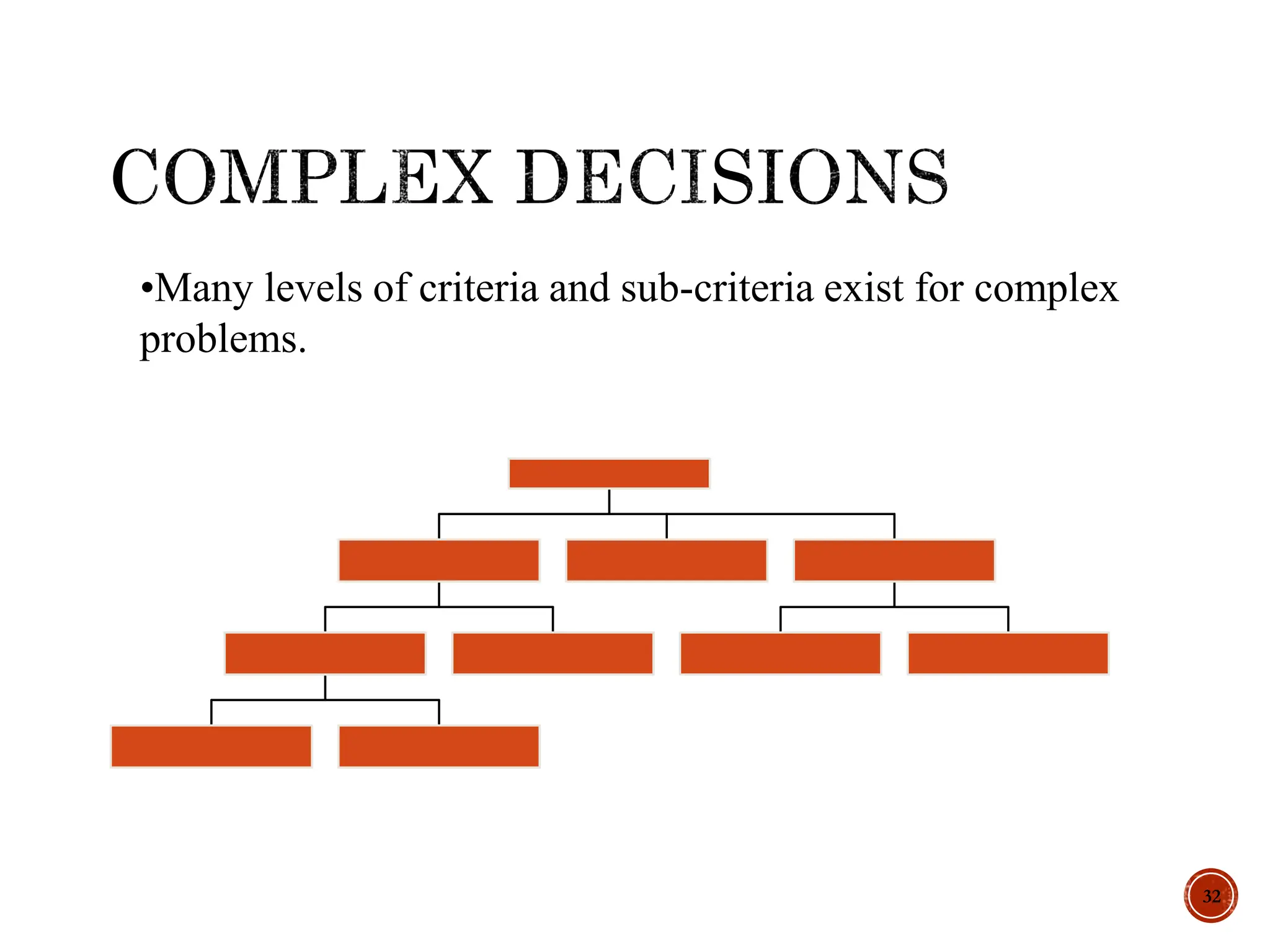
•Many levels of criteria and sub-criteria exist for complex
problems.
Professional commercial software Expert Choice
developed by Expert Choice Inc. is available which
simplifies the implementation of the AHP’s steps
and automates many of its computations
 computations
 sensitivity analysis
 graphs, tables
33
34
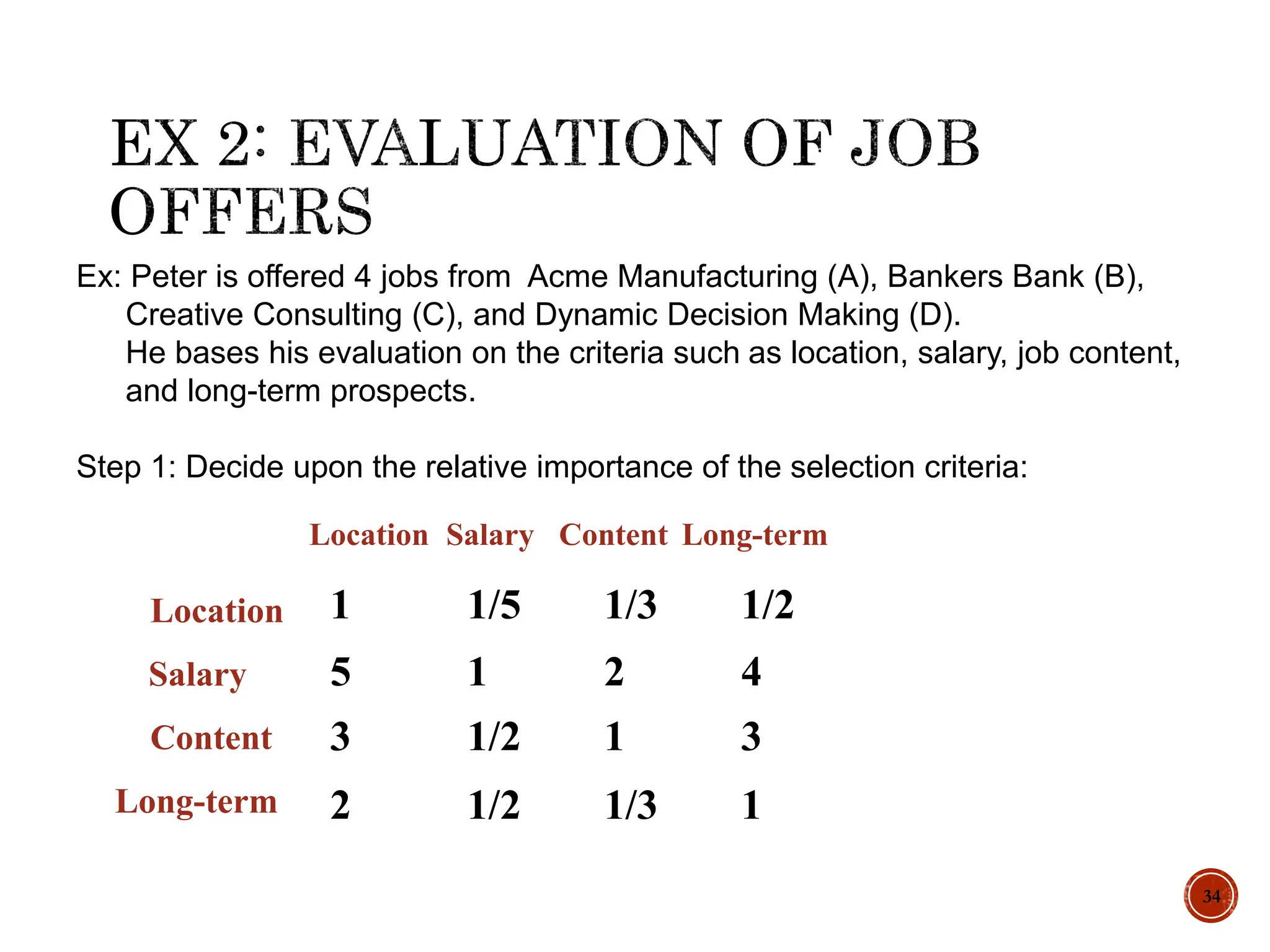
Ex: Peter is offered 4 jobs from Acme Manufacturing (A), Bankers Bank (B),
Creative Consulting (C), and Dynamic Decision Making (D).
He bases his evaluation on the criteria such as location, salary, job content,
and long-term prospects.
Step 1: Decide upon the relative importance of the selection criteria:
Location
Content
Long-term
Salary
1 1/5 1/3 1/2
5 1 2 4
3 1/2 1 3
2 1/2 1/3 1
Location Salary Content Long-term
35
1) Normalize the column entries by dividing each entry by the sum of the column.
2) Take the overall row averages
Location
Content
Long-term
Salary
0.091 0.102 0.091 0.059
0.455 0.513 0.545 0.471
0.273 0.256 0.273 0.353
0.182 0.128 0.091 0.118
Location Salary Content Long-term Average
0.086
0.496
0.289
0.130
+ +
1 1 1 1 1
36
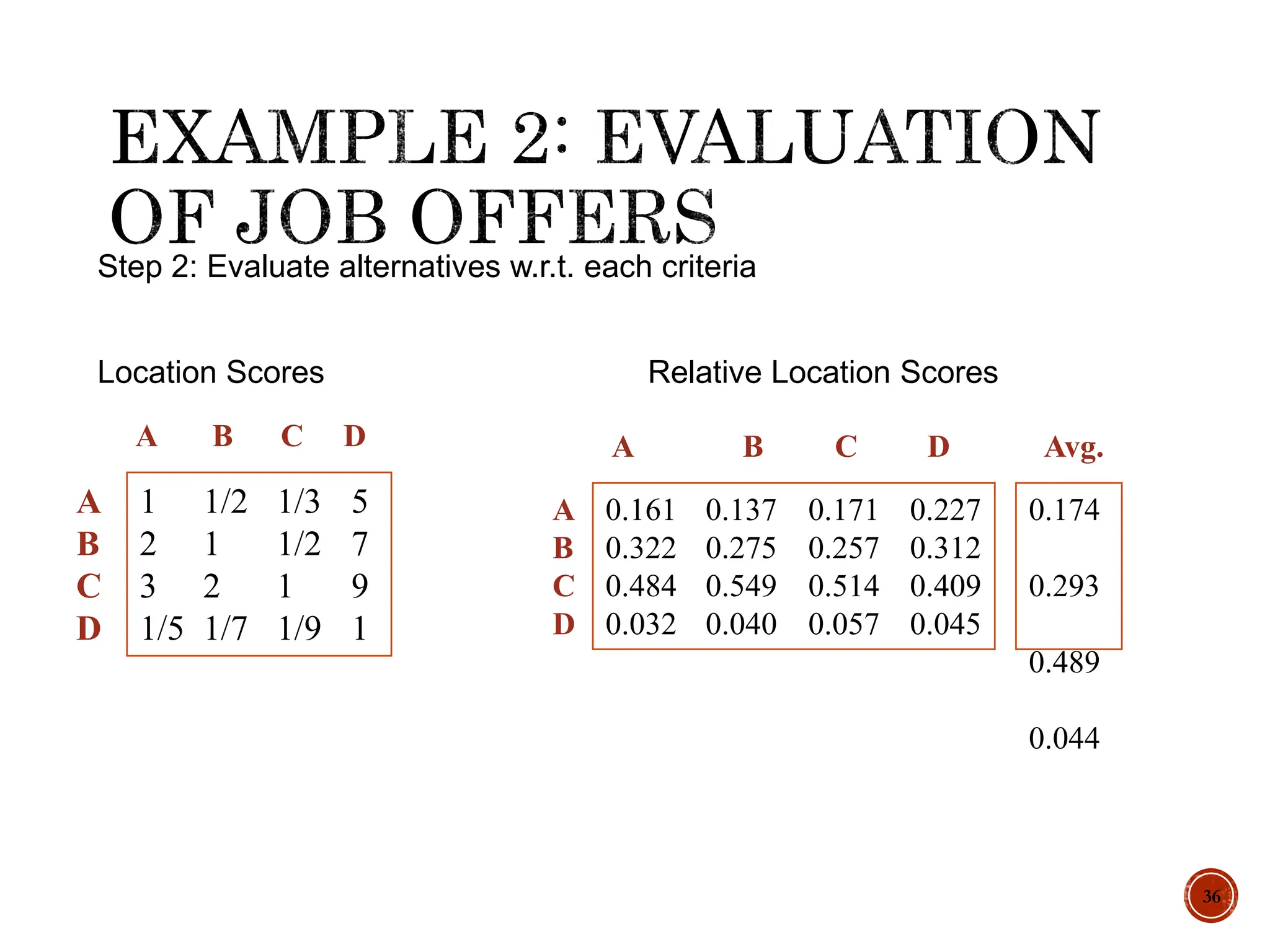
Step 2: Evaluate alternatives w.r.t. each criteria
A
B
C
D
1 1/2 1/3 5
2 1 1/2 7
3 2 1 9
1/5 1/7 1/9 1
A B C D
Relative Location Scores
Location Scores
A
B
C
D
0.161 0.137 0.171 0.227
0.322 0.275 0.257 0.312
0.484 0.549 0.514 0.409
0.032 0.040 0.057 0.045
A B C D Avg.
0.174
0.293
0.489
0.044
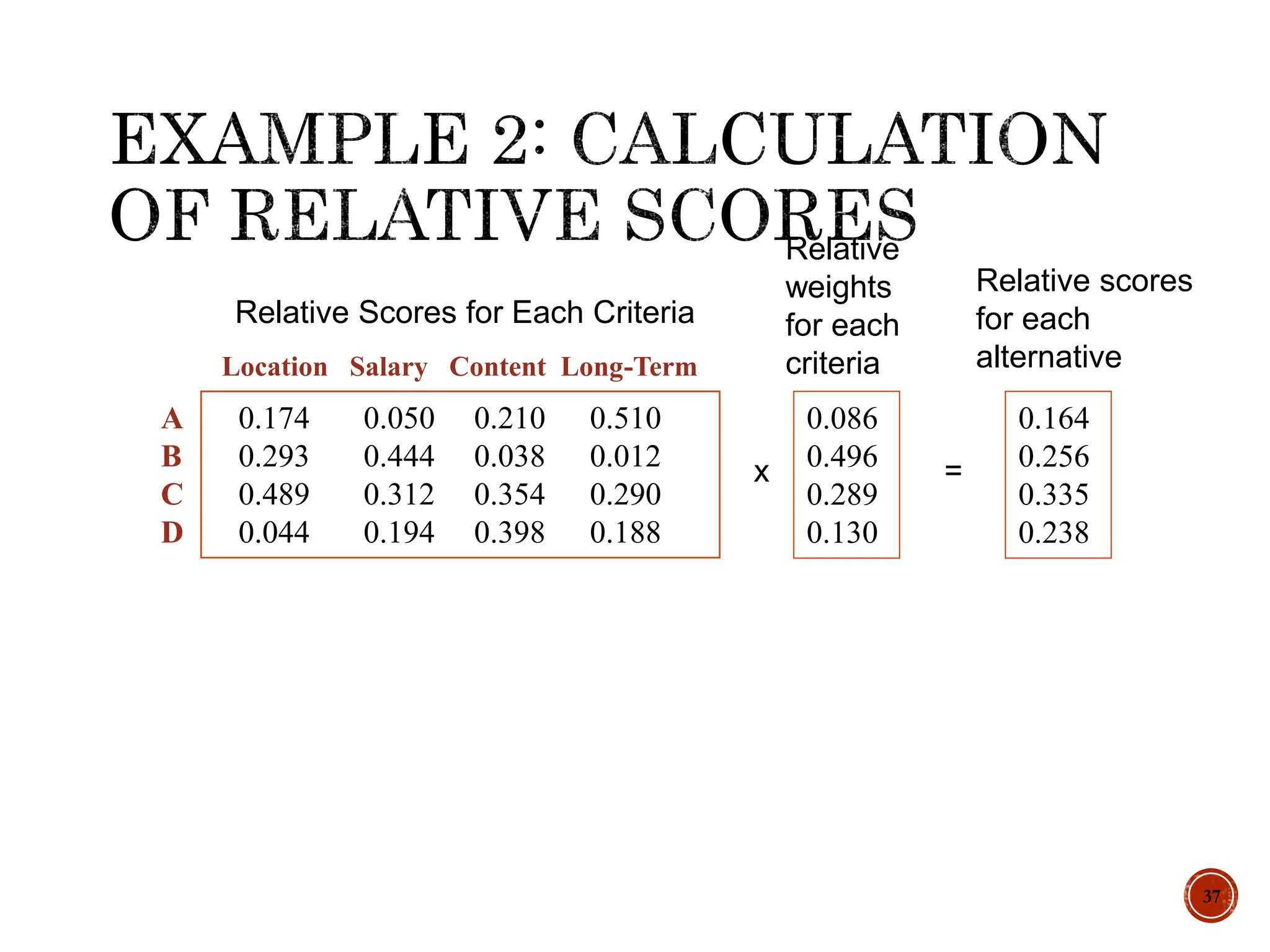
37
Relative Scores for Each Criteria
A
B
C
D
0.174 0.050 0.210 0.510
0.293 0.444 0.038 0.012
0.489 0.312 0.354 0.290
0.044 0.194 0.398 0.188
Location Salary Content Long-Term
0.086
0.496
0.289
0.130
Relative
weights
for each
criteria
x =
Relative scores
for each
alternative
0.164
0.256
0.335
0.238
38
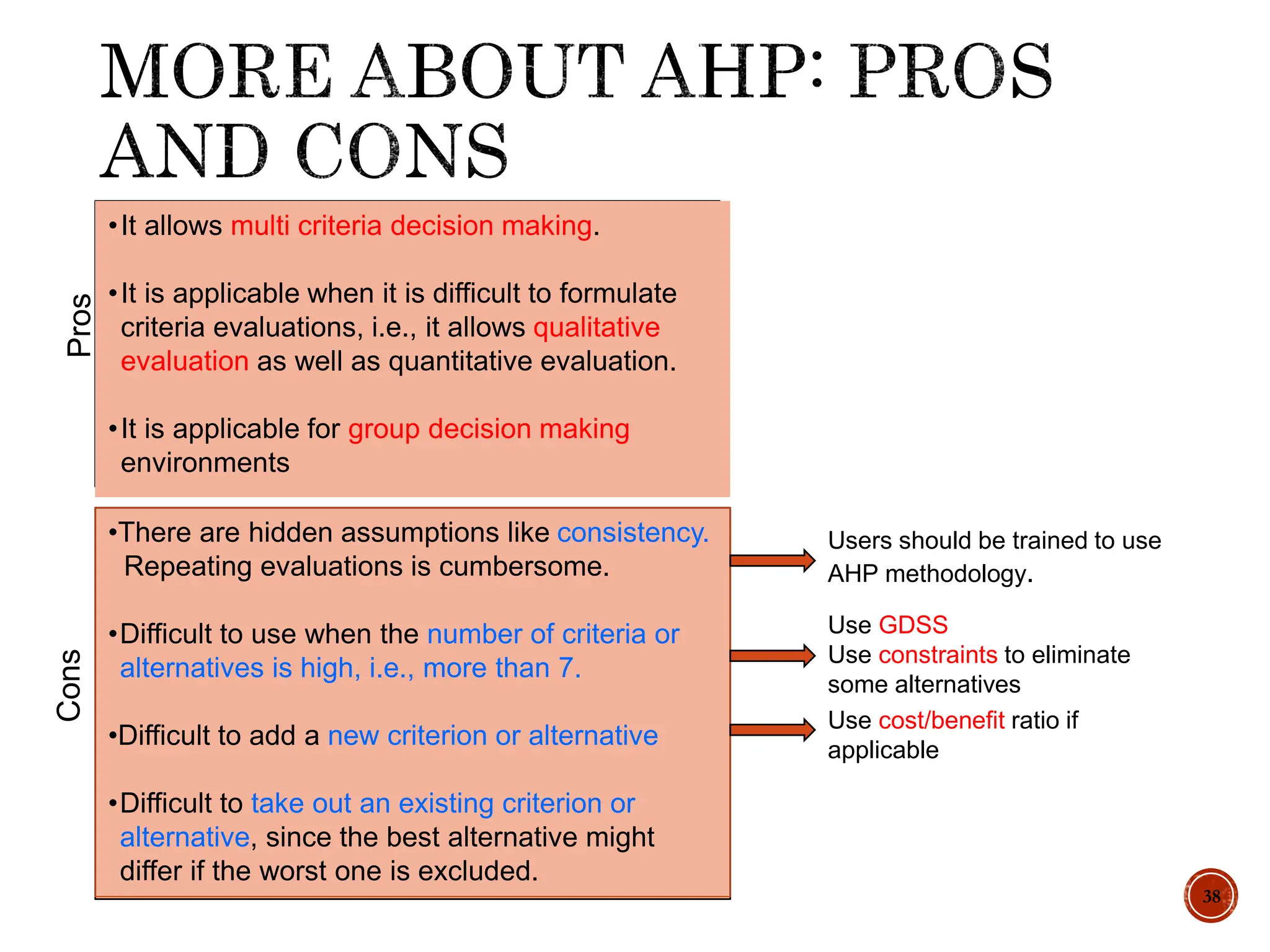
•There are hidden assumptions like consistency.
Repeating evaluations is cumbersome.
•Difficult to use when the number of criteria or
alternatives is high, i.e., more than 7.
•Difficult to add a new criterion or alternative
•Difficult to take out an existing criterion or
alternative, since the best alternative might
differ if the worst one is excluded.
Users should be trained to use
AHP methodology.
Use GDSS
Use constraints to eliminate
some alternatives
Use cost/benefit ratio if
applicable
Pros
Cons
•It allows multi criteria decision making.
•It is applicable when it is difficult to formulate
criteria evaluations, i.e., it allows qualitative
evaluation as well as quantitative evaluation.
•It is applicable for group decision making
environments
39
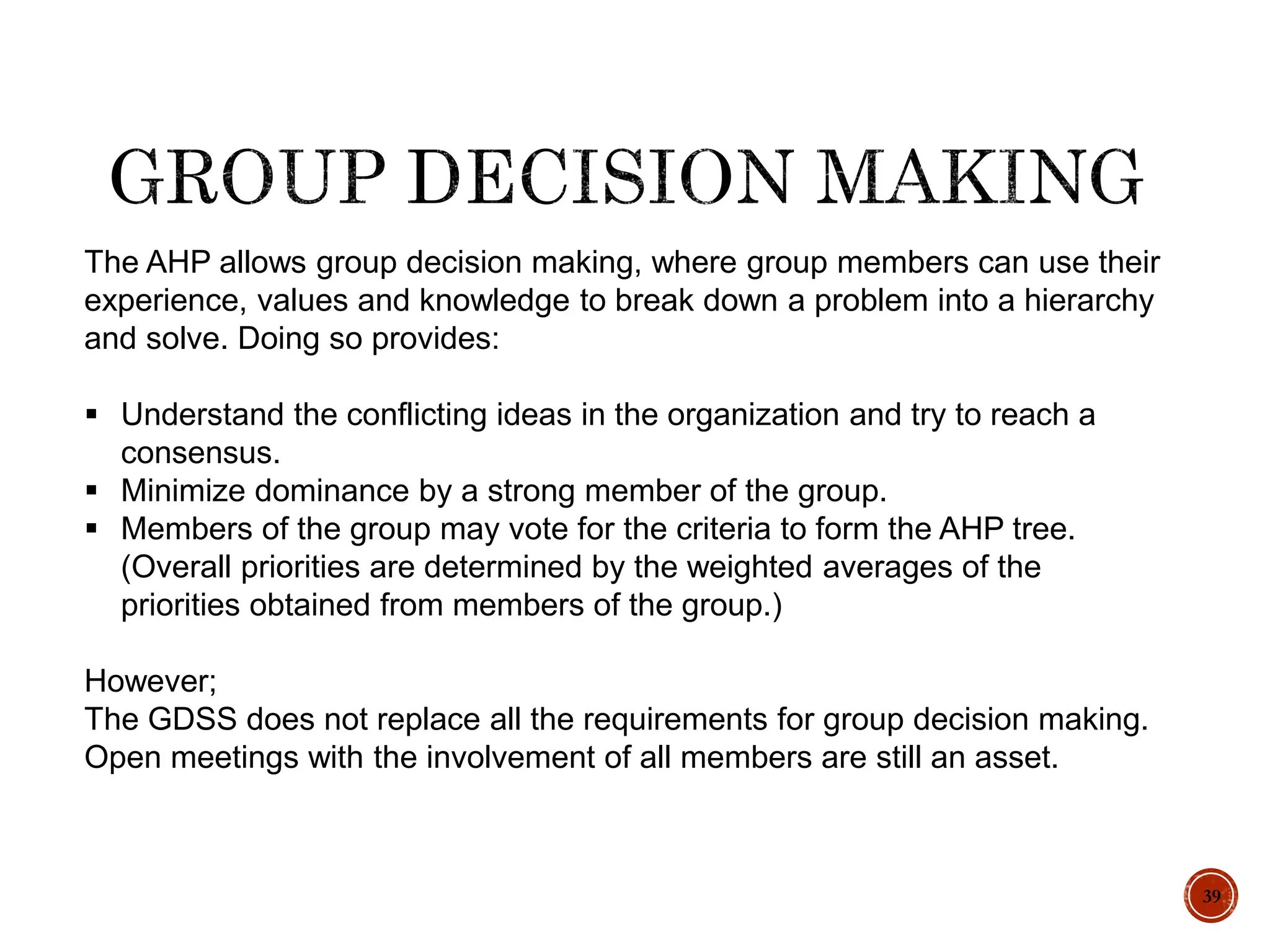
The AHP allows group decision making, where group members can use their
experience, values and knowledge to break down a problem into a hierarchy
and solve. Doing so provides:
 Understand the conflicting ideas in the organization and try to reach a
consensus.
 Minimize dominance by a strong member of the group.
 Members of the group may vote for the criteria to form the AHP tree.
(Overall priorities are determined by the weighted averages of the
priorities obtained from members of the group.)
However;
The GDSS does not replace all the requirements for group decision making.
Open meetings with the involvement of all members are still an asset.
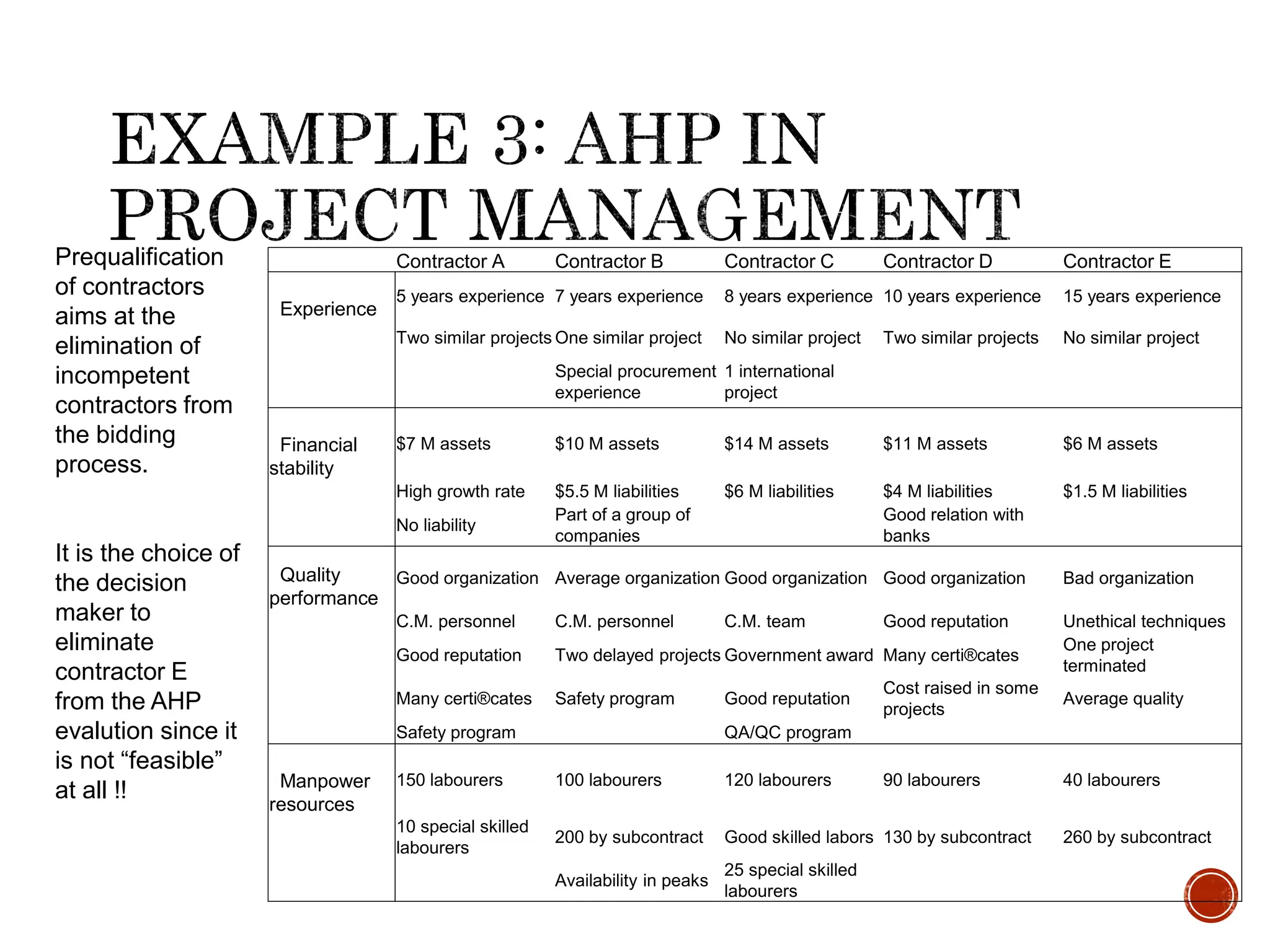
Prequalification
of contractors
aims at the
elimination of
incompetent
contractors from
the bidding
process.
It is the choice of
the decision
maker to
eliminate
contractor E
from the AHP
evalution since it
is not “feasible”
at all !!
Contractor A Contractor B Contractor C Contractor D Contractor E
Experience
5 years experience 7 years experience 8 years experience 10 years experience 15 years experience
Two similar projects One similar project No similar project Two similar projects No similar project
Special procurement
experience
1 international
project
Financial
stability
$7 M assets $10 M assets $14 M assets $11 M assets $6 M assets
High growth rate $5.5 M liabilities $6 M liabilities $4 M liabilities $1.5 M liabilities
No liability
Part of a group of
companies
Good relation with
banks
Quality
performance
Good organization Average organization Good organization Good organization Bad organization
C.M. personnel C.M. personnel C.M. team Good reputation Unethical techniques
Good reputation Two delayed projects Government award Many certi®cates
One project
terminated
Many certi®cates Safety program Good reputation
Cost raised in some
projects
Average quality
Safety program QA/QC program
Manpower
resources
150 labourers 100 labourers 120 labourers 90 labourers 40 labourers
10 special skilled
labourers
200 by subcontract Good skilled labors 130 by subcontract 260 by subcontract
Availability in peaks
25 special skilled
labourers
41
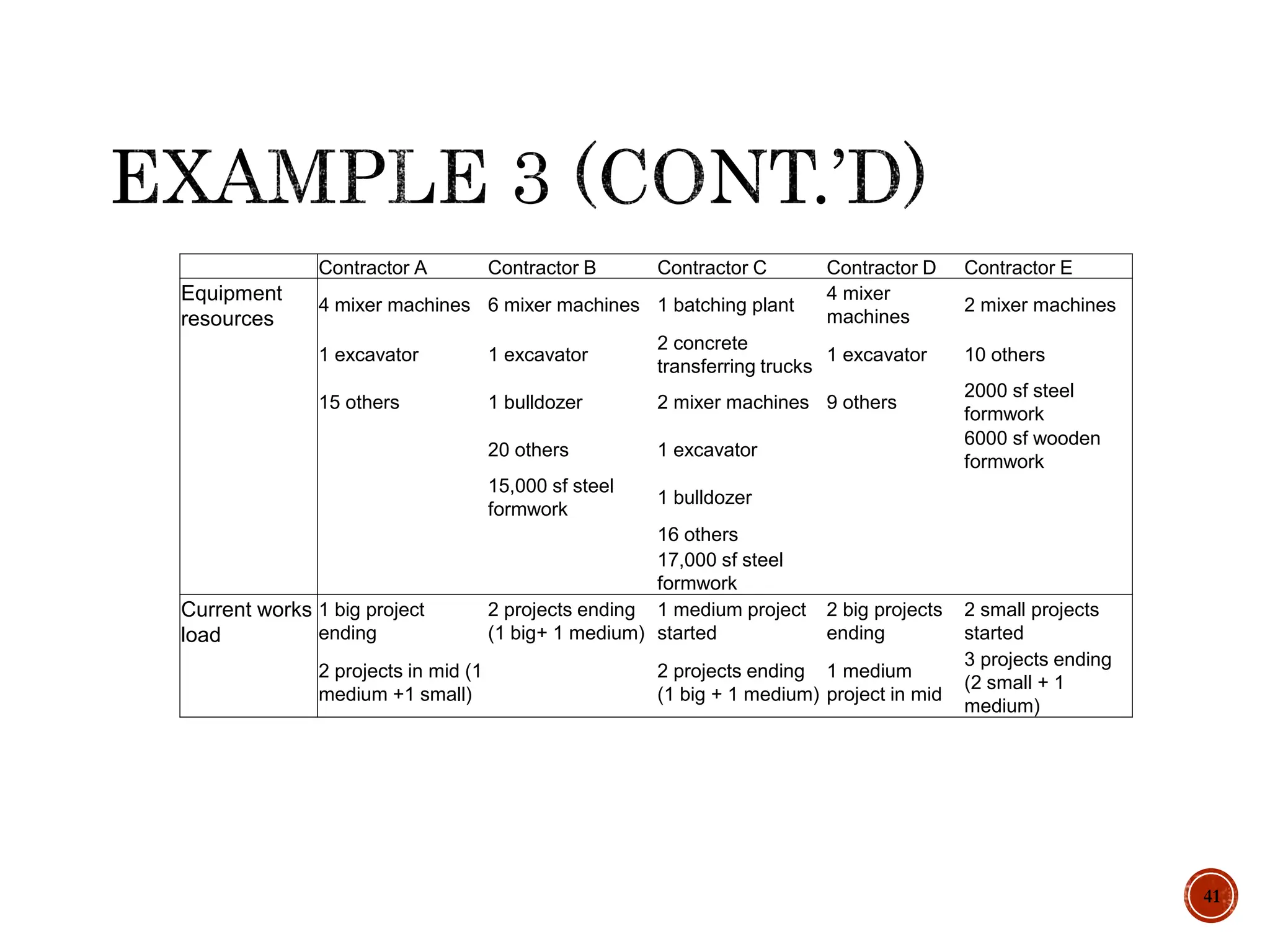
Contractor A Contractor B Contractor C Contractor D Contractor E
Equipment
resources
4 mixer machines 6 mixer machines 1 batching plant
4 mixer
machines
2 mixer machines
1 excavator 1 excavator
2 concrete
transferring trucks
1 excavator 10 others
15 others 1 bulldozer 2 mixer machines 9 others
2000 sf steel
formwork
20 others 1 excavator
6000 sf wooden
formwork
15,000 sf steel
formwork
1 bulldozer
16 others
17,000 sf steel
formwork
Current works
load
1 big project
ending
2 projects ending
(1 big+ 1 medium)
1 medium project
started
2 big projects
ending
2 small projects
started
2 projects in mid (1
medium +1 small)
2 projects ending
(1 big + 1 medium)
1 medium
project in mid
3 projects ending
(2 small + 1
medium)
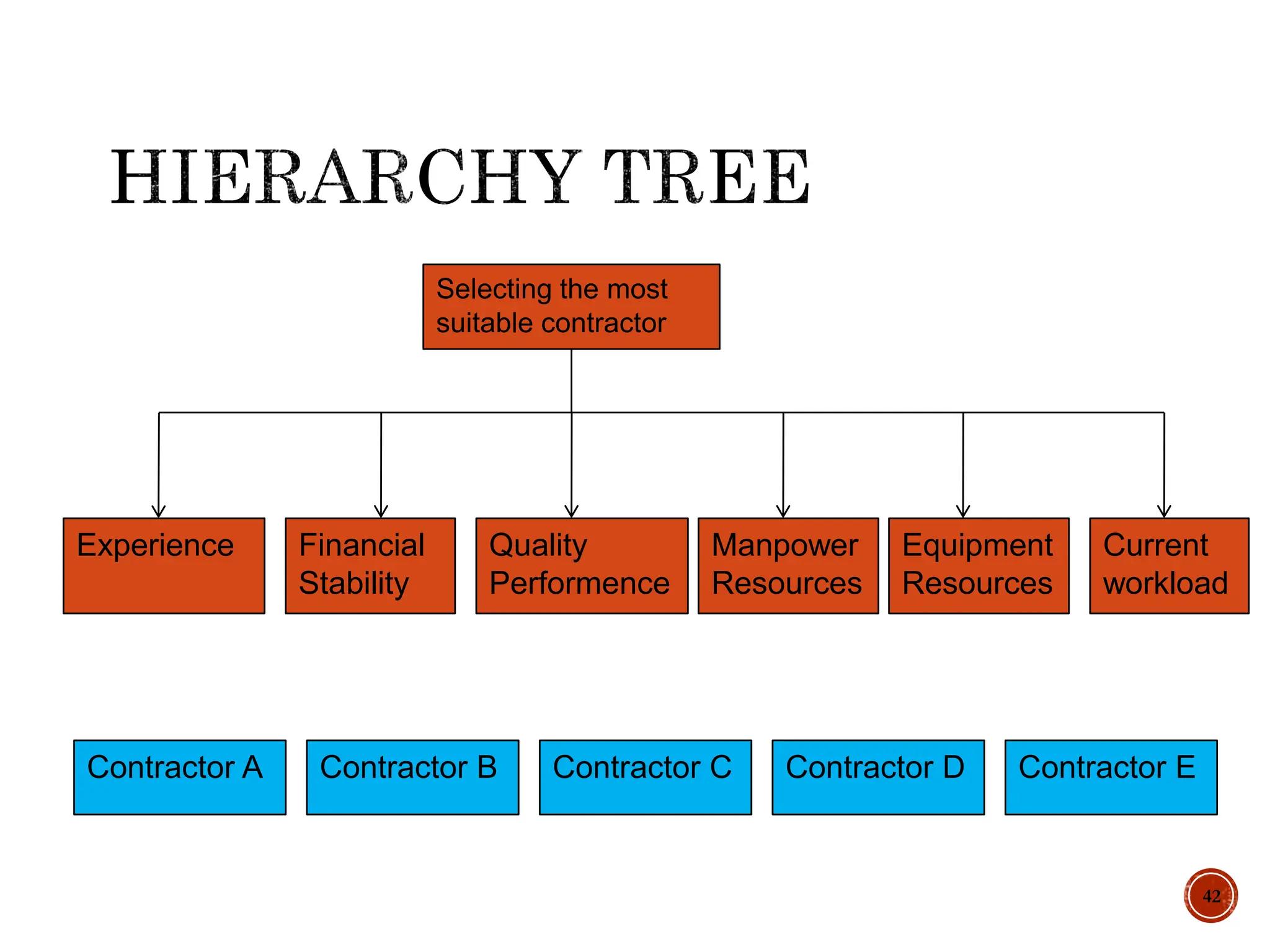
42
Selecting the most
suitable contractor
Financial
Stability
Experience Quality
Performence
Manpower
Resources
Equipment
Resources
Current
workload
Contractor A Contractor B Contractor C Contractor D Contractor E
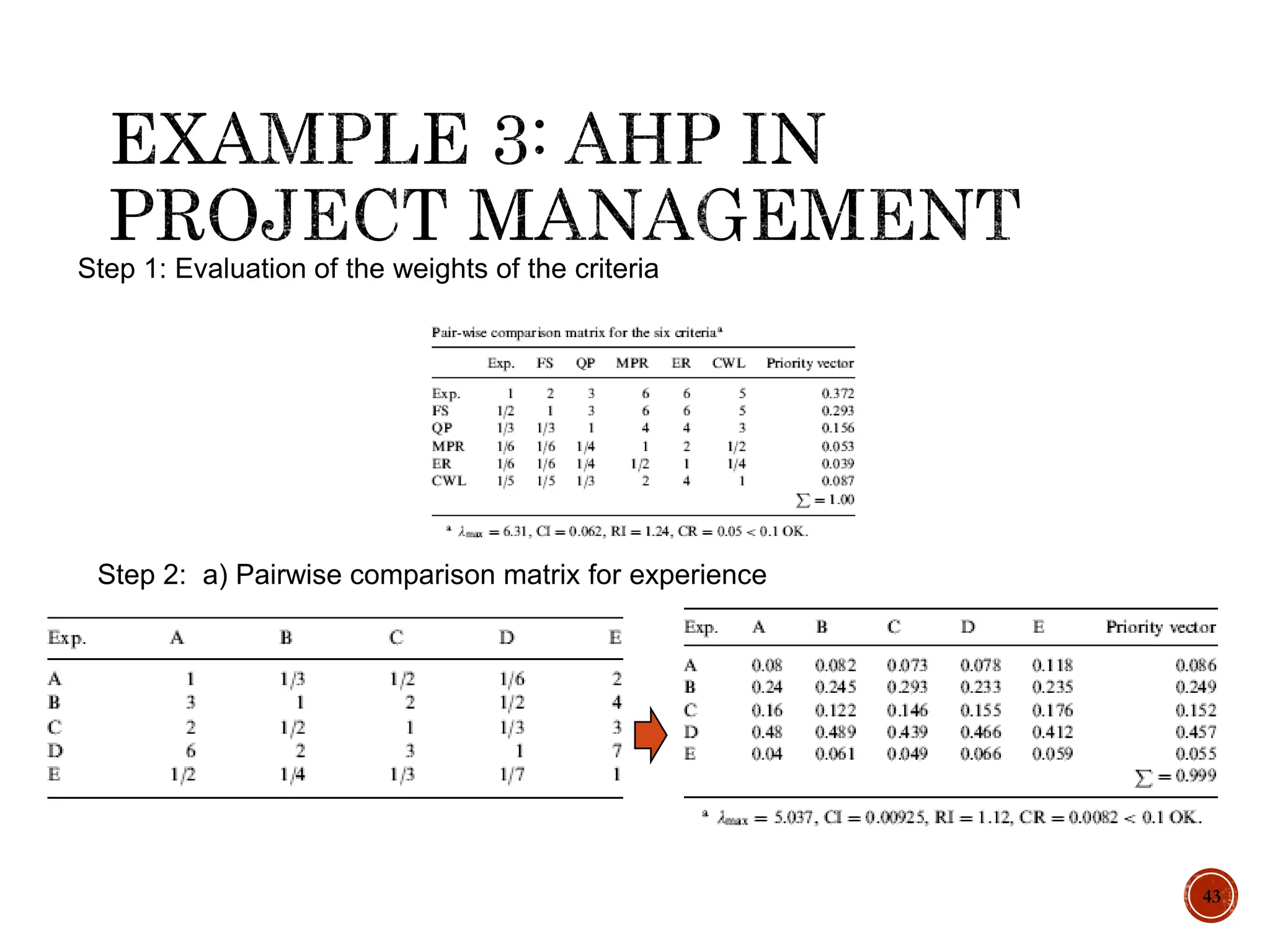
43
Step 1: Evaluation of the weights of the criteria
Step 2: a) Pairwise comparison matrix for experience
44
Calculation of priority vector:
x =
Note that a DSS supports the decision maker, it can not replace him/her. Thus,
an AHP Based DSS should allow the decision maker to make sensitivity analysis of
his judgements on the overall priorities !
Probably Contractor-E should have been eliminated. It appears to be the worst.
45
 One of the most efficient and easiest MCDM methodologies.
 Developed by Jean-Pierre Brans and Bertrand
Mareschal at the ULB and VUB universities since 1982
 Considers a set of criteria and alternatives. Criteria weights
are determined that indicate the relative importance
 Utilizes a function reflecting the degree of advantage of one
alternative over the other, along with the degree of
disadvantage that the same alternative has with respect to
the other alternative.
 In scaling, there are six options allowing the user to express
meaningful differences by minimum gaps between
observations. When type I is used, only relative advantage
matters; type 6 is based on standardization with respect to
normal distribution.
46
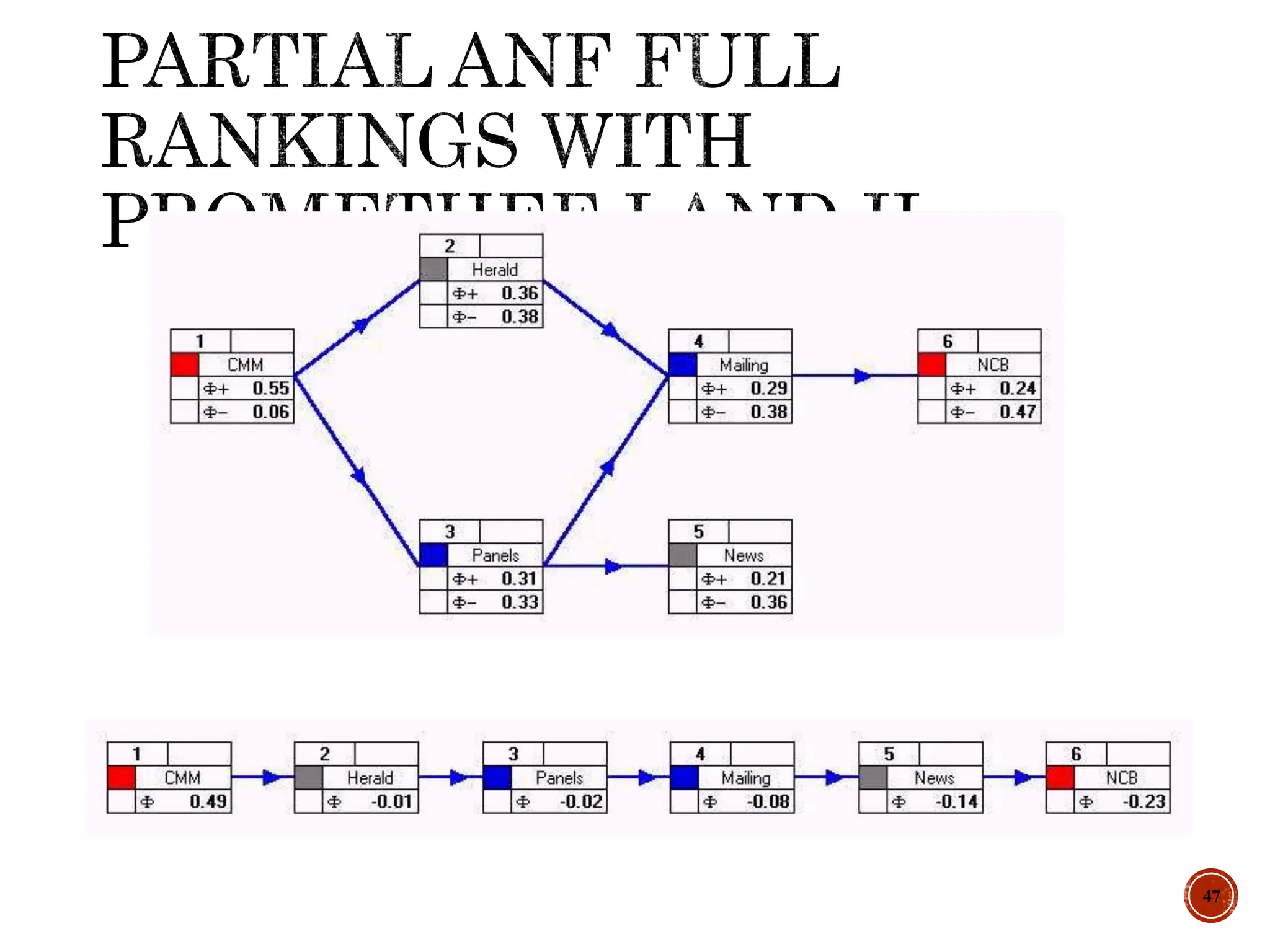
A bicycle manufacturing company is intending to advertise its products.
Six marketing actions are considered: Advertising in the international
newspaper, News; in the newspaper Herald; by mean of advertising boards in
large cities; of a personal mailing; by TV spots on channels CMM or NCB.
Units: Cost ($ 1,000), Target (10,000 people), Duration (days), Efficiency (0-100)
Manpower (# people involved in the company)
47
48
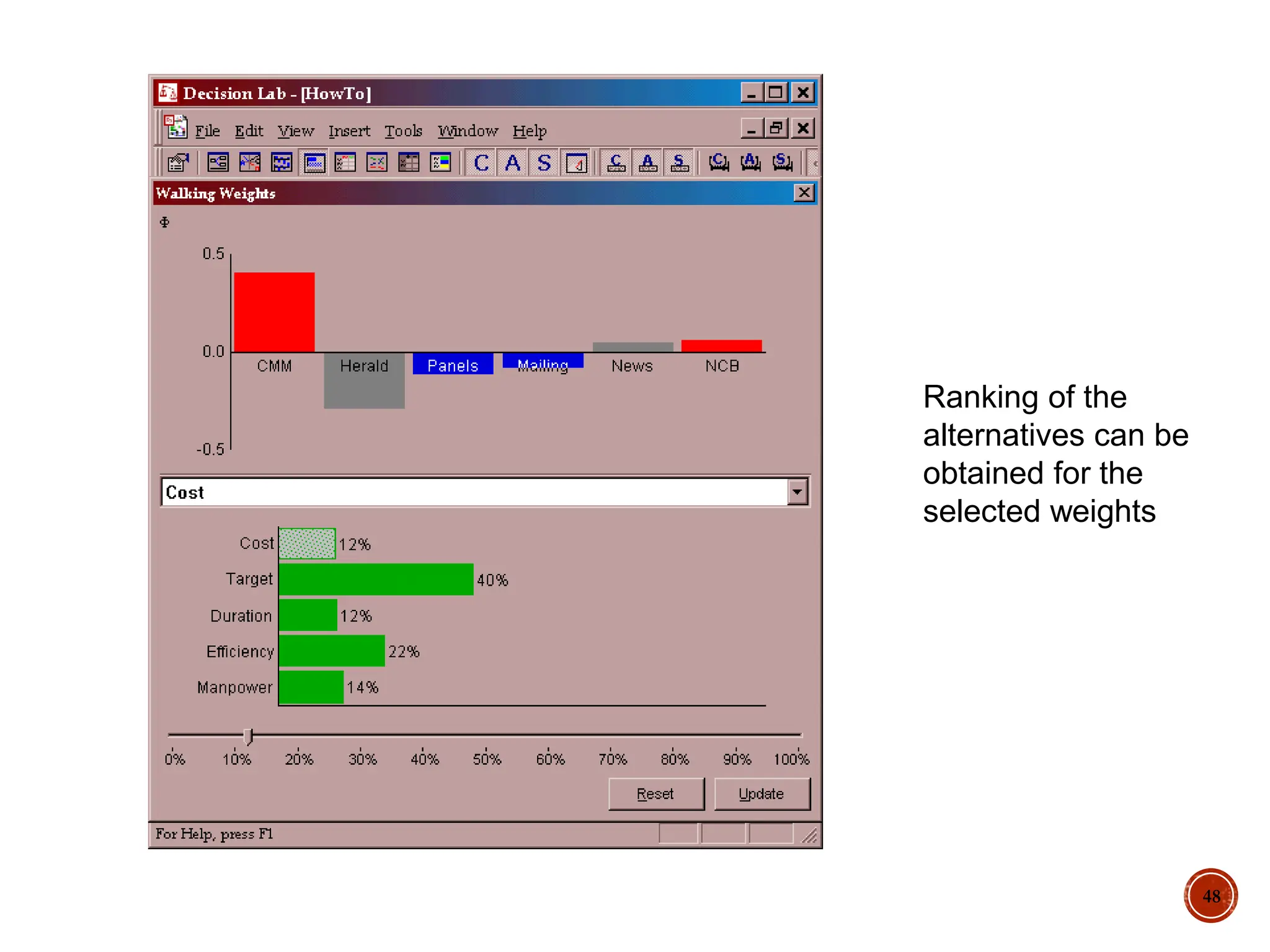
Ranking of the
alternatives can be
obtained for the
selected weights
49
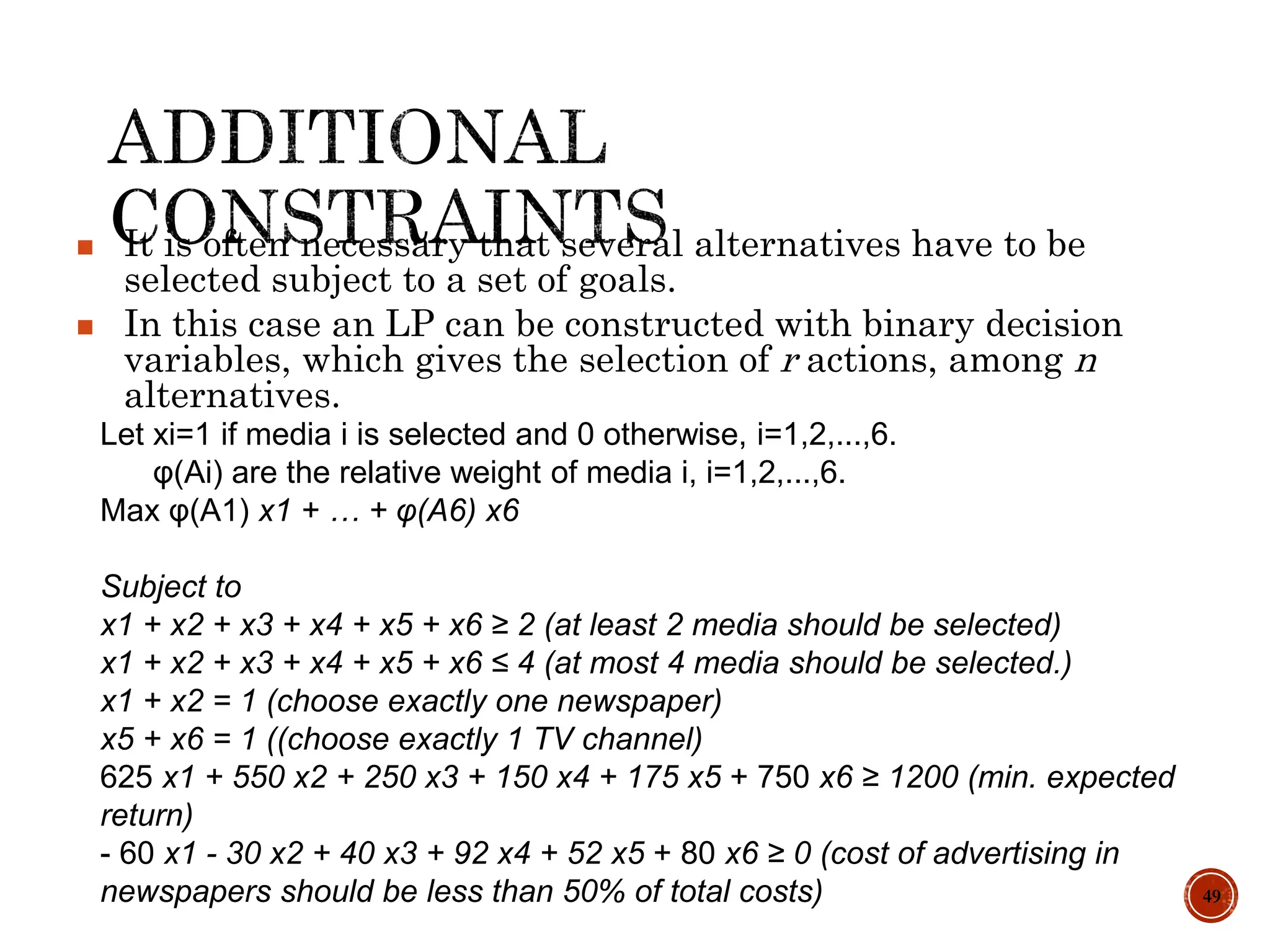
 It is often necessary that several alternatives have to be
selected subject to a set of goals.
 In this case an LP can be constructed with binary decision
variables, which gives the selection of r actions, among n
alternatives.
Let xi=1 if media i is selected and 0 otherwise, i=1,2,...,6.
φ(Ai) are the relative weight of media i, i=1,2,...,6.
Max φ(A1) x1 + … + φ(A6) x6
Subject to
x1 + x2 + x3 + x4 + x5 + x6 ≥ 2 (at least 2 media should be selected)
x1 + x2 + x3 + x4 + x5 + x6 ≤ 4 (at most 4 media should be selected.)
x1 + x2 = 1 (choose exactly one newspaper)
x5 + x6 = 1 ((choose exactly 1 TV channel)
625 x1 + 550 x2 + 250 x3 + 150 x4 + 175 x5 + 750 x6 ≥ 1200 (min. expected
return)
- 60 x1 - 30 x2 + 40 x3 + 92 x4 + 52 x5 + 80 x6 ≥ 0 (cost of advertising in
newspapers should be less than 50% of total costs)

AHP_Report_EM-206.ppt

  • 1.
  • 2.
    2 set of activitiesthat lead to the resolution of a decision-making problem that involves at least two meaningful alternatives, of which the selected one offers the best result with respect to the set goal, as well as the possibility of its implementation
  • 3.
    3 The content side ofdecision- making - this reflects the differences in individual decision- making processes. The formal-logical (procedural) side of decision-making - expresses that individual decision-making processes have certain common features, regardless of their content.
  • 4.
    4 A precondition forclaiming that there is a framework procedure for resolving a decision-making situation with different content. The formal-logical (procedural) side of decision- making It is the basis for decision-making theory, which aims to create appropriate procedures (methods) for solving decision-making situations with the highest degree of universality. Multiple-Criteria Decision-Making (“MCDM”)
  • 5.
  • 6.
    6 3. Mixed setof criteria – this means that some criteria are quantitative and some qualitative; the decision-maker wants to maximize some criteria (yield criteria) and minimize others (cost criteria). 1. Multiple criteria nature of the decision-making problem - the decision maker assesses selected alternatives on the basis of several criteria. 2. Non-additivity of criteria – the selected criteria are expressed in different units of measure.
  • 7.
    7 The general procedurefor solving MCDM problems can be divided into three phases, namely: 1. Creation of a decision matrix for the MCDM problem. 2. Determination of the weights of the individual criteria. 3. Evaluation of alternative solutions and determination of preferential order.
  • 8.
    8 Methods used todetermine criteria weights
  • 9.
    9 Methods used toevaluate alternative solutions
  • 10.
    • one ofthe MCDM methods originally developed by Prof. Thomas L. Saaty (1980)  belongs to those methods with a cardinal level of information on criteria preferences based on pairwise comparison. • allows group decision-making, where group members can use their experience, values, and knowledge to break down a problem into a hierarchy and solve it by the AHP steps • In short, it is a method to derive ratio scales from paired comparisons.  Allows the use of qualitative as well as quantitative criteria in evaluation. 10
  • 11.
     Wide rangeof applications exists:  Selecting a car for purchasing  Deciding upon a place to visit for vacation  Deciding upon an MBA program after graduation 11
  • 12.
    3 stages ofthe AHP method Hierarchy Priority Consistency 12
  • 13.
  • 14.
     Develop anhierarchy of decision criteria and define the alternative courses of actions.  AHP algorithm is basically composed of two steps: 1. Determine the relative weights of the decision criteria 2. Determine the relative rankings (priorities) of alternatives ! Both qualitative and quantitative information can be compared by using informed judgments to derive weights and priorities. 14
  • 15.
     Objective  Selectinga car  Criteria  Style, Reliability, Fuel-economy Cost?  Alternatives  Civic Coupe, Saturn Coupe, Ford Escort, Mazda Miata 15
  • 16.
    Style Reliability FuelEconomy Selecting a New Car Civic Saturn Escort Miata Alternative courses of action
  • 17.
     Pairwise comparisonsare made with the grades ranging from 1-9.  A basic, but very reasonable assumption for comparing alternatives: If attribute A is absolutely more important than attribute B and is rated at 9, then B must be absolutely less important than A and is graded as 1/9.  These pairwise comparisons are carried out for all factors to be considered, usually not more than 7, and the matrix is completed. 17
  • 18.
  • 19.
    19 Style Reliability FuelEconomy Style Reliability Fuel Economy 1 1/2 3 2 1 4 1/3 1/4 1
  • 20.
     Consider [Ax= maxx] where  A is the comparison matrix of size n×n, for n criteria, also called the priority matrix.  x is the Eigenvector of size n×1, also called the priority vector.  max is the Eigenvalue, max  > n.  To find the ranking of priorities, namely the Eigen Vector X: 1) Normalize the column entries by dividing each entry by the sum of the column. 2) Take the overall row averages. 20 0.30 0.29 0.38 0.60 0.57 0.50 0.10 0.14 0.13 Column sums 3.33 1.75 8.00 1.00 1.00 1.00 A= 1 0.5 3 2 1 4 0.33 0.25 1 Normalized Column Sums Row averages 0.30 0.60 0.10 Priority vector X=
  • 21.
     Style .30 Reliability .60  Fuel Economy .10 21 Style 0.30 Reliability 0.60 Fuel Economy 0.10 Selecting a New Car 1.00
  • 22.
     The nextstage is to calculate a Consistency Ratio (CR) to measure how consistent the judgments have been relative to large samples of purely random judgments.  AHP evaluations are based on the assumption that the decision maker is rational, i.e., if A is preferred to B and B is preferred to C, then A is preferred to C.  If the CR is greater than 0.1, the judgments are untrustworthy because they are too close for comfort to randomness, and the exercise is valueless or must be repeated. 22
  • 23.
     The nextstage is to calculate max so as to lead to the Consistency Index and the Consistency Ratio.  Consider [Ax = max x] where x is the Eigenvector. 0.30 0.60 0.10 1 0.5 3 2 1 4 0.33 0.25 1 0.90 1.60 0.35 = = max λmax=average{0.90/0.30, 1.60/0.6, 0.35/0.10}=3.06 0.30 0.60 0.10 A x Ax x Consistency index, CI is found by CI=(λmax-n)/(n-1)=(3.06-3)/(3-1)= 0.03
  • 24.
     The finalstep is to calculate the Consistency Ratio, CR by using the table below, derived from Saaty’s book. The upper row is the order of the random matrix, and the lower row is the corresponding index of consistency for random judgments. Each of the numbers in this table is the average of CI’s derived from a sample of randomly selected reciprocal matrices of AHP method. An inconsistency of 10% or less implies that the adjustment is small as compared to the actual values of the eigenvector entries. A CR as high as, say, 90% would mean that the pairwise judgments are just about random and are completely untrustworthy! In this case, comparisons should be repeated. In the above example: CR=CI/0.58=0.03/0.58=0.05 0.05<0.1, so the evaluations are consistent!
  • 25.
    Style Civic Saturn Escort 1 1/4 41/6 4 1 4 1/4 1/4 1/4 1 1/5 Miata 6 4 5 1 Civic Saturn Escort Miata Miata Reliability Civic Saturn Escort 1 2 5 1 1/2 1 3 2 1/5 1/3 1 1/4 Miata 1 1/2 4 1 Civic Saturn Escort Miata 0.13 0.24 0.07 0.56 Priority vector 0.38 0.29 0.07 0.26
  • 26.
    26 Fuel Economy Civic Saturn Escort Miata Miata 34 27 24 28 113 Miles/gallonNormalized .30 .24 .21 .25 1.0 Ranking alternatives ! Since fuel economy is a quantitative measure, fuel consumption ratios can be used to determine the relative ranking of alternatives; however, this is not obligatory. Pairwise comparisons may still be used in some cases.
  • 27.
    27 Civic 0.13 Saturn 0.24 Escort0.07 Miata 0.56 Civic 0.38 Saturn 0.29 Escort 0.07 Miata 0.26 Civic 0.30 Saturn 0.24 Escort 0.21 Miata 0.25 Style 0.30 Reliability 0.60 Fuel Economy 0.10 Selecting a New Car 1.00
  • 28.
    Style Reliability Fuel Economy Civic Escort Miata Miata Saturn .13 .38 .30 .24.29 .24 .07 .07 .21 .56 .26 .25 x .30 .60 .10 = .30 .27 .08 .35 Criteria Weights Priority matrix
  • 29.
     CIVIC $12K.22 .30 0.73  SATURN $15K .28 .27 1.03  ESCORT $9K .17 .08 2.13  MIATA $18K .33 .35 0.92 Cost Normalized Cost Cost/Benefits Ratio Adding “cost” as a a new criterion is very difficult in AHP. A new column and a new row will be added in the evaluation matrix. However, whole evaluation should be repeated since addition of a new criterion might affect the relative importance of other criteria as well! Instead one may think of normalizing the costs directly and calculate the cost/benefit ratio for comparing alternatives! Benefits
  • 30.
     Use graphicalrepresentations to make trade-offs.  Calculate cost/benefit ratios  Use linear programming  Use seperate benefit and cost trees and then combine the results 30 0 5 10 15 20 25 30 35 40 0 5 10 15 20 25 30 35 Benefit Cost Civic Escort Saturn Miata
  • 31.
    31 F. C. Zola,J. C. Colmenero, F. V. Aragao, T. Rodrigues, A. Braghini, Multicriterial model for selecting a charcoal kiln. Energy. 190(1), 1–14 (2020) Al Harbi K.M.A.S. (1999), Application of AHP in Project Management, International Journal of Project Management, 19, 19-27. Haas R., Meixner, O., (2009) An Illustrated Guide to the Analytic Hierarchy Process, Lecture Notes, Institute of Marketing & Innovation, University of Natural Resources, retrieved from http://www.boku.ac.at/mi/ on October 2009. Saaty, T.L., Vargas, L.G., (2001), Models, Methods, Concepts & Applications of the Analytic Hierarchy Process, Kluwer’s Academic Publishers, Boston, USA. Brans, J.P., Mareschal, B., (2010) “How to Decide with Promethee, retrieved from http://www.visualdecision.com on October 2010.
  • 32.
    32 •Many levels ofcriteria and sub-criteria exist for complex problems.
  • 33.
    Professional commercial softwareExpert Choice developed by Expert Choice Inc. is available which simplifies the implementation of the AHP’s steps and automates many of its computations  computations  sensitivity analysis  graphs, tables 33
  • 34.
    34 Ex: Peter isoffered 4 jobs from Acme Manufacturing (A), Bankers Bank (B), Creative Consulting (C), and Dynamic Decision Making (D). He bases his evaluation on the criteria such as location, salary, job content, and long-term prospects. Step 1: Decide upon the relative importance of the selection criteria: Location Content Long-term Salary 1 1/5 1/3 1/2 5 1 2 4 3 1/2 1 3 2 1/2 1/3 1 Location Salary Content Long-term
  • 35.
    35 1) Normalize thecolumn entries by dividing each entry by the sum of the column. 2) Take the overall row averages Location Content Long-term Salary 0.091 0.102 0.091 0.059 0.455 0.513 0.545 0.471 0.273 0.256 0.273 0.353 0.182 0.128 0.091 0.118 Location Salary Content Long-term Average 0.086 0.496 0.289 0.130 + + 1 1 1 1 1
  • 36.
    36 Step 2: Evaluatealternatives w.r.t. each criteria A B C D 1 1/2 1/3 5 2 1 1/2 7 3 2 1 9 1/5 1/7 1/9 1 A B C D Relative Location Scores Location Scores A B C D 0.161 0.137 0.171 0.227 0.322 0.275 0.257 0.312 0.484 0.549 0.514 0.409 0.032 0.040 0.057 0.045 A B C D Avg. 0.174 0.293 0.489 0.044
  • 37.
    37 Relative Scores forEach Criteria A B C D 0.174 0.050 0.210 0.510 0.293 0.444 0.038 0.012 0.489 0.312 0.354 0.290 0.044 0.194 0.398 0.188 Location Salary Content Long-Term 0.086 0.496 0.289 0.130 Relative weights for each criteria x = Relative scores for each alternative 0.164 0.256 0.335 0.238
  • 38.
    38 •There are hiddenassumptions like consistency. Repeating evaluations is cumbersome. •Difficult to use when the number of criteria or alternatives is high, i.e., more than 7. •Difficult to add a new criterion or alternative •Difficult to take out an existing criterion or alternative, since the best alternative might differ if the worst one is excluded. Users should be trained to use AHP methodology. Use GDSS Use constraints to eliminate some alternatives Use cost/benefit ratio if applicable Pros Cons •It allows multi criteria decision making. •It is applicable when it is difficult to formulate criteria evaluations, i.e., it allows qualitative evaluation as well as quantitative evaluation. •It is applicable for group decision making environments
  • 39.
    39 The AHP allowsgroup decision making, where group members can use their experience, values and knowledge to break down a problem into a hierarchy and solve. Doing so provides:  Understand the conflicting ideas in the organization and try to reach a consensus.  Minimize dominance by a strong member of the group.  Members of the group may vote for the criteria to form the AHP tree. (Overall priorities are determined by the weighted averages of the priorities obtained from members of the group.) However; The GDSS does not replace all the requirements for group decision making. Open meetings with the involvement of all members are still an asset.
  • 40.
    Prequalification of contractors aims atthe elimination of incompetent contractors from the bidding process. It is the choice of the decision maker to eliminate contractor E from the AHP evalution since it is not “feasible” at all !! Contractor A Contractor B Contractor C Contractor D Contractor E Experience 5 years experience 7 years experience 8 years experience 10 years experience 15 years experience Two similar projects One similar project No similar project Two similar projects No similar project Special procurement experience 1 international project Financial stability $7 M assets $10 M assets $14 M assets $11 M assets $6 M assets High growth rate $5.5 M liabilities $6 M liabilities $4 M liabilities $1.5 M liabilities No liability Part of a group of companies Good relation with banks Quality performance Good organization Average organization Good organization Good organization Bad organization C.M. personnel C.M. personnel C.M. team Good reputation Unethical techniques Good reputation Two delayed projects Government award Many certi®cates One project terminated Many certi®cates Safety program Good reputation Cost raised in some projects Average quality Safety program QA/QC program Manpower resources 150 labourers 100 labourers 120 labourers 90 labourers 40 labourers 10 special skilled labourers 200 by subcontract Good skilled labors 130 by subcontract 260 by subcontract Availability in peaks 25 special skilled labourers
  • 41.
    41 Contractor A ContractorB Contractor C Contractor D Contractor E Equipment resources 4 mixer machines 6 mixer machines 1 batching plant 4 mixer machines 2 mixer machines 1 excavator 1 excavator 2 concrete transferring trucks 1 excavator 10 others 15 others 1 bulldozer 2 mixer machines 9 others 2000 sf steel formwork 20 others 1 excavator 6000 sf wooden formwork 15,000 sf steel formwork 1 bulldozer 16 others 17,000 sf steel formwork Current works load 1 big project ending 2 projects ending (1 big+ 1 medium) 1 medium project started 2 big projects ending 2 small projects started 2 projects in mid (1 medium +1 small) 2 projects ending (1 big + 1 medium) 1 medium project in mid 3 projects ending (2 small + 1 medium)
  • 42.
    42 Selecting the most suitablecontractor Financial Stability Experience Quality Performence Manpower Resources Equipment Resources Current workload Contractor A Contractor B Contractor C Contractor D Contractor E
  • 43.
    43 Step 1: Evaluationof the weights of the criteria Step 2: a) Pairwise comparison matrix for experience
  • 44.
    44 Calculation of priorityvector: x = Note that a DSS supports the decision maker, it can not replace him/her. Thus, an AHP Based DSS should allow the decision maker to make sensitivity analysis of his judgements on the overall priorities ! Probably Contractor-E should have been eliminated. It appears to be the worst.
  • 45.
    45  One ofthe most efficient and easiest MCDM methodologies.  Developed by Jean-Pierre Brans and Bertrand Mareschal at the ULB and VUB universities since 1982  Considers a set of criteria and alternatives. Criteria weights are determined that indicate the relative importance  Utilizes a function reflecting the degree of advantage of one alternative over the other, along with the degree of disadvantage that the same alternative has with respect to the other alternative.  In scaling, there are six options allowing the user to express meaningful differences by minimum gaps between observations. When type I is used, only relative advantage matters; type 6 is based on standardization with respect to normal distribution.
  • 46.
    46 A bicycle manufacturingcompany is intending to advertise its products. Six marketing actions are considered: Advertising in the international newspaper, News; in the newspaper Herald; by mean of advertising boards in large cities; of a personal mailing; by TV spots on channels CMM or NCB. Units: Cost ($ 1,000), Target (10,000 people), Duration (days), Efficiency (0-100) Manpower (# people involved in the company)
  • 47.
  • 48.
    48 Ranking of the alternativescan be obtained for the selected weights
  • 49.
    49  It isoften necessary that several alternatives have to be selected subject to a set of goals.  In this case an LP can be constructed with binary decision variables, which gives the selection of r actions, among n alternatives. Let xi=1 if media i is selected and 0 otherwise, i=1,2,...,6. φ(Ai) are the relative weight of media i, i=1,2,...,6. Max φ(A1) x1 + … + φ(A6) x6 Subject to x1 + x2 + x3 + x4 + x5 + x6 ≥ 2 (at least 2 media should be selected) x1 + x2 + x3 + x4 + x5 + x6 ≤ 4 (at most 4 media should be selected.) x1 + x2 = 1 (choose exactly one newspaper) x5 + x6 = 1 ((choose exactly 1 TV channel) 625 x1 + 550 x2 + 250 x3 + 150 x4 + 175 x5 + 750 x6 ≥ 1200 (min. expected return) - 60 x1 - 30 x2 + 40 x3 + 92 x4 + 52 x5 + 80 x6 ≥ 0 (cost of advertising in newspapers should be less than 50% of total costs)