Analytic Hierarchy Process 
(AHP) 
1 
The Analytic Hierarchy Process (AHP) is a structured 
technique for organizing and analyzing complex 
decisions, based on mathematics and psychology. It 
was developed by Thomas L. Saaty in the 1970s and 
has been extensively studied and refined since then.
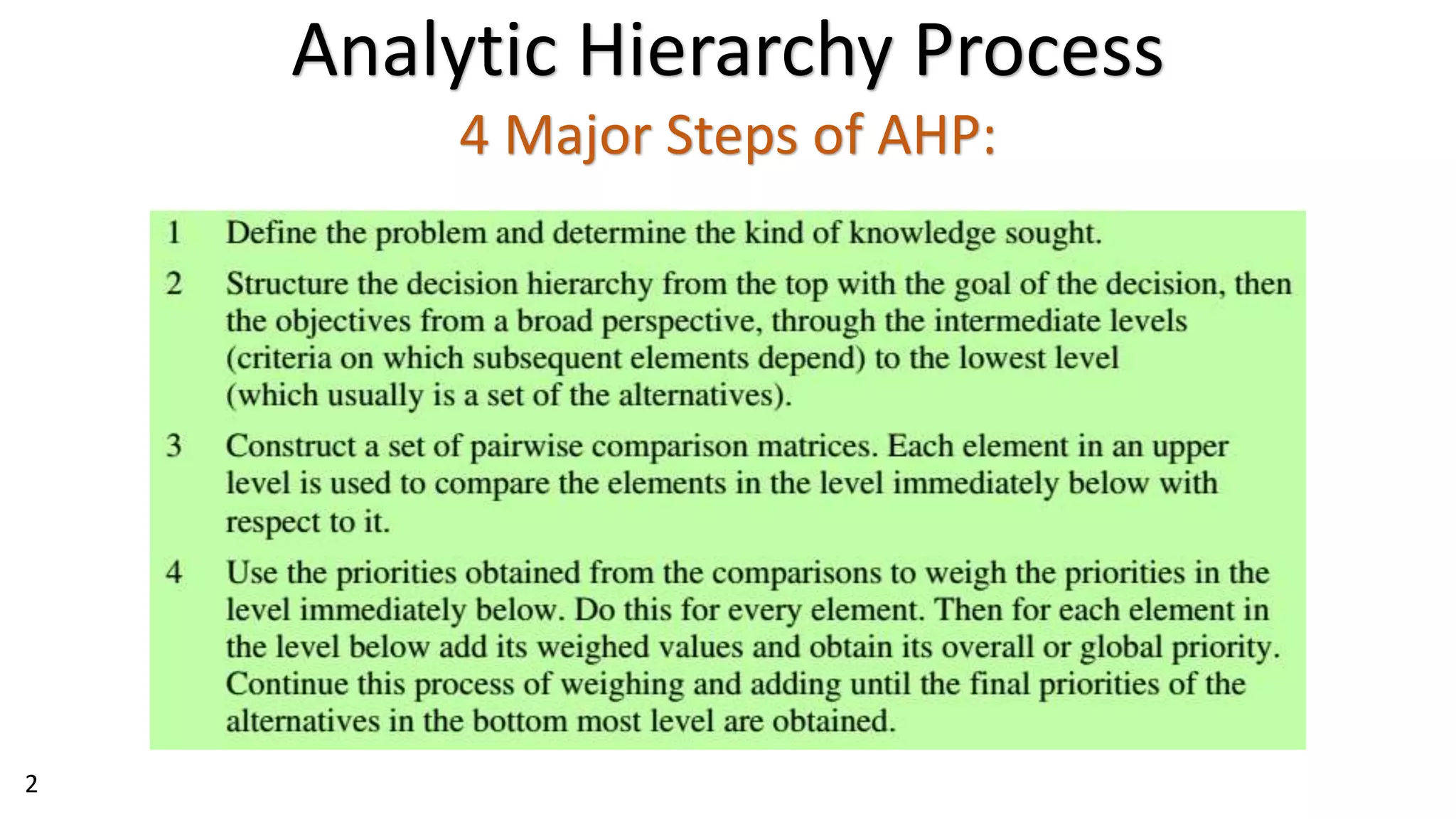
Analytic Hierarchy Process 
4 Major Steps of AHP: 
2
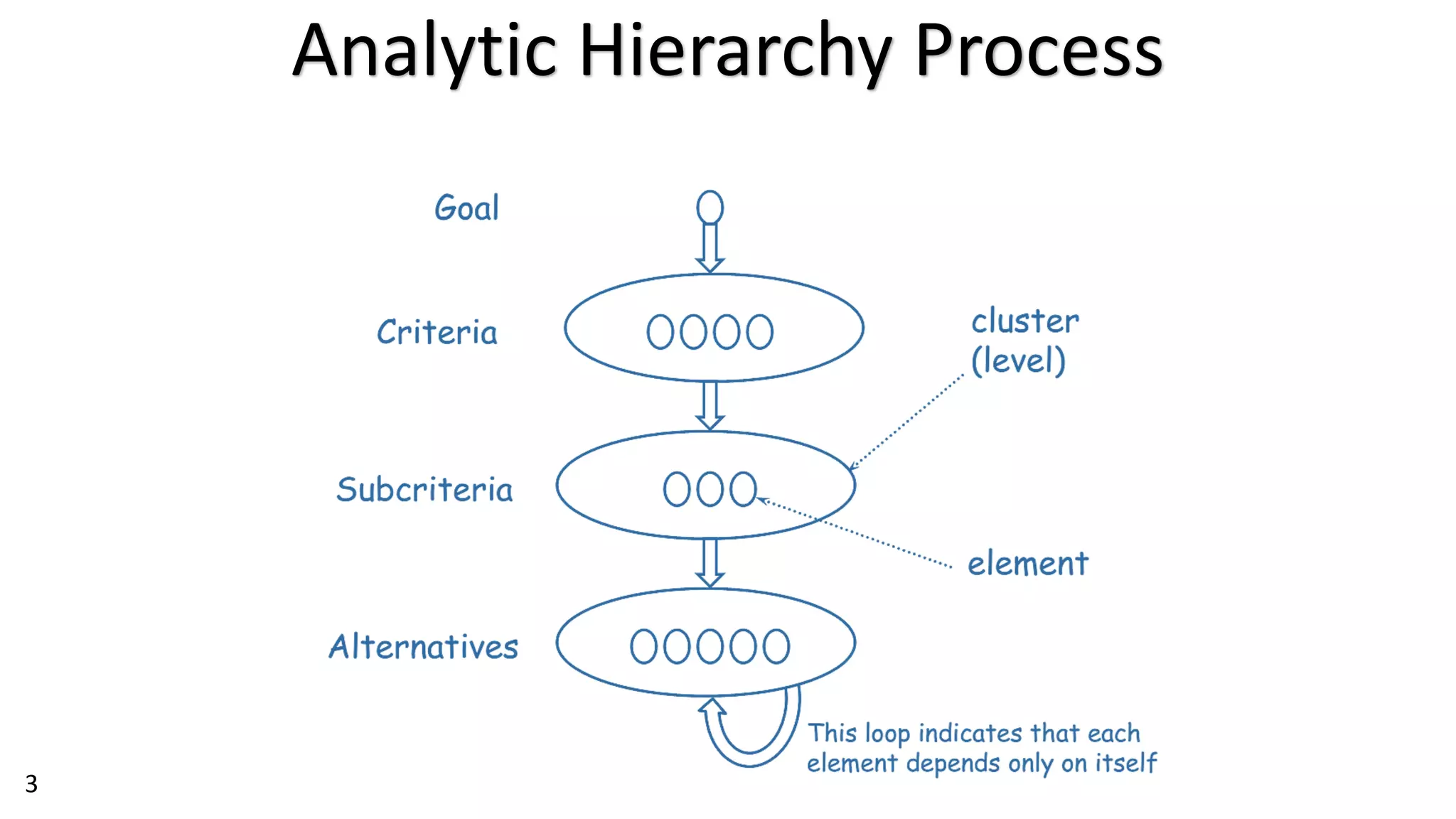
Analytic Hierarchy Process 
3
Saati Scale 
4
Analytic Network Process 
(ANP) 
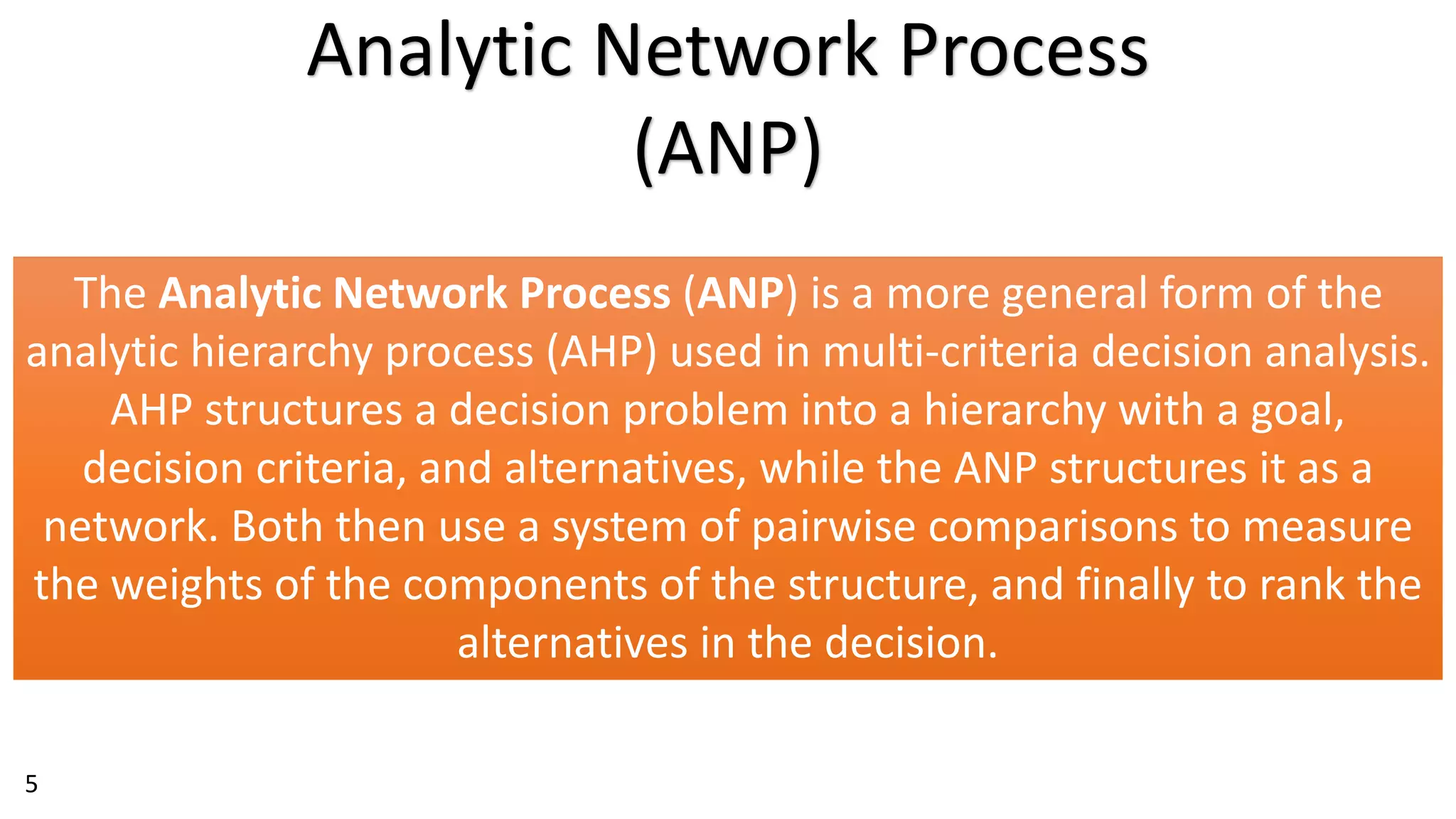
The Analytic Network Process (ANP) is a more general form of the 
analytic hierarchy process (AHP) used in multi-criteria decision analysis. 
AHP structures a decision problem into a hierarchy with a goal, 
decision criteria, and alternatives, while the ANP structures it as a 
network. Both then use a system of pairwise comparisons to measure 
the weights of the components of the structure, and finally to rank the 
5 
alternatives in the decision.
Analytic Network Process 
6 
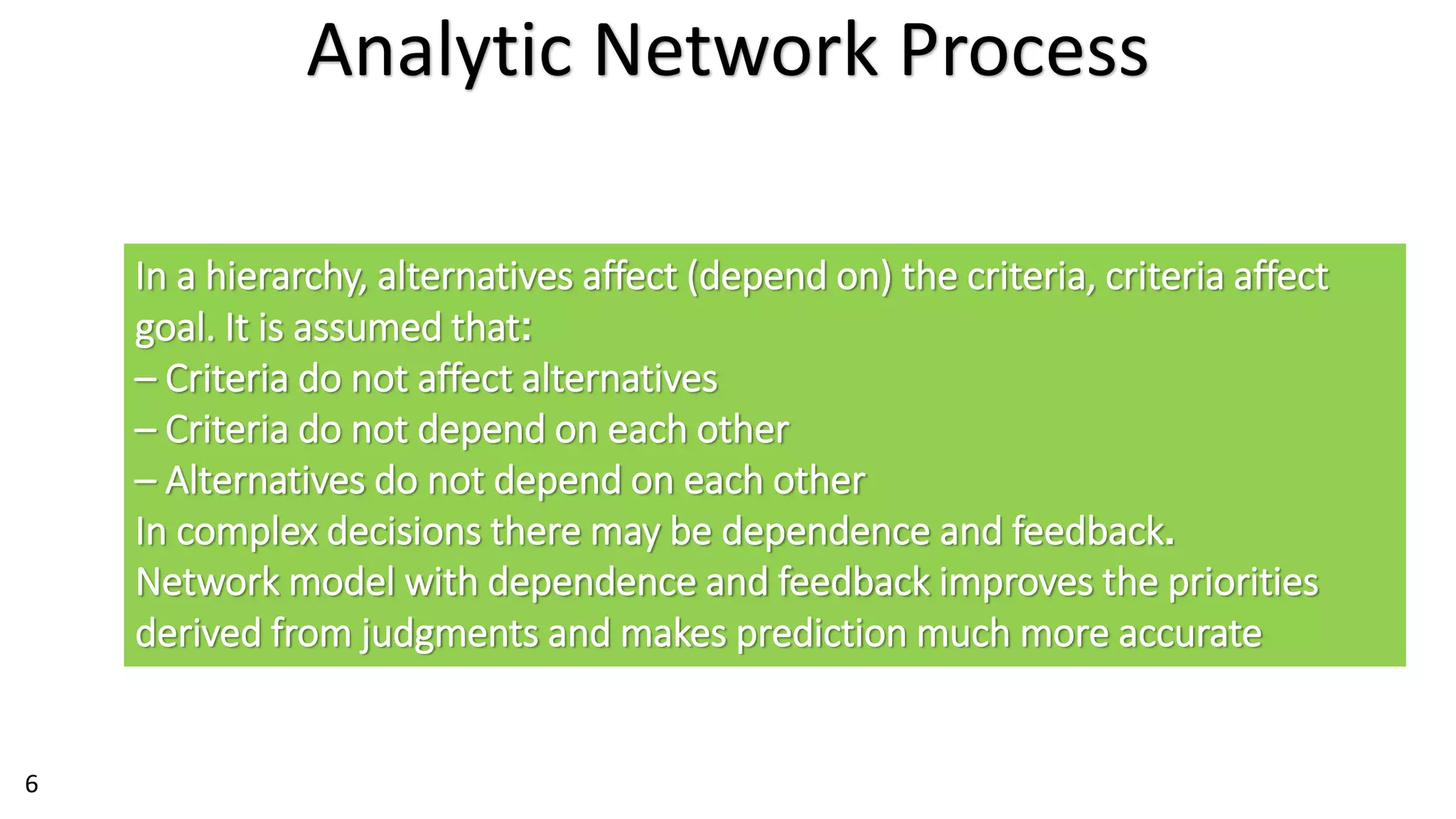
In a hierarchy, alternatives affect (depend on) the criteria, criteria affect 
goal. It is assumed that: 
– Criteria do not affect alternatives 
– Criteria do not depend on each other 
– Alternatives do not depend on each other 
In complex decisions there may be dependence and feedback. 
Network model with dependence and feedback improves the priorities 
derived from judgments and makes prediction much more accurate
Analytic Network Process 
4 Major Steps of ANP: 
7 
Step1: Model Construction and Problem Structuring 
Step2: Pairwise Comparison Matrices and Priority Vectors 
Step3: Supermatrix Formation 
Step4: Selection of The Best Alternatives
Analytic Network Process 
8 
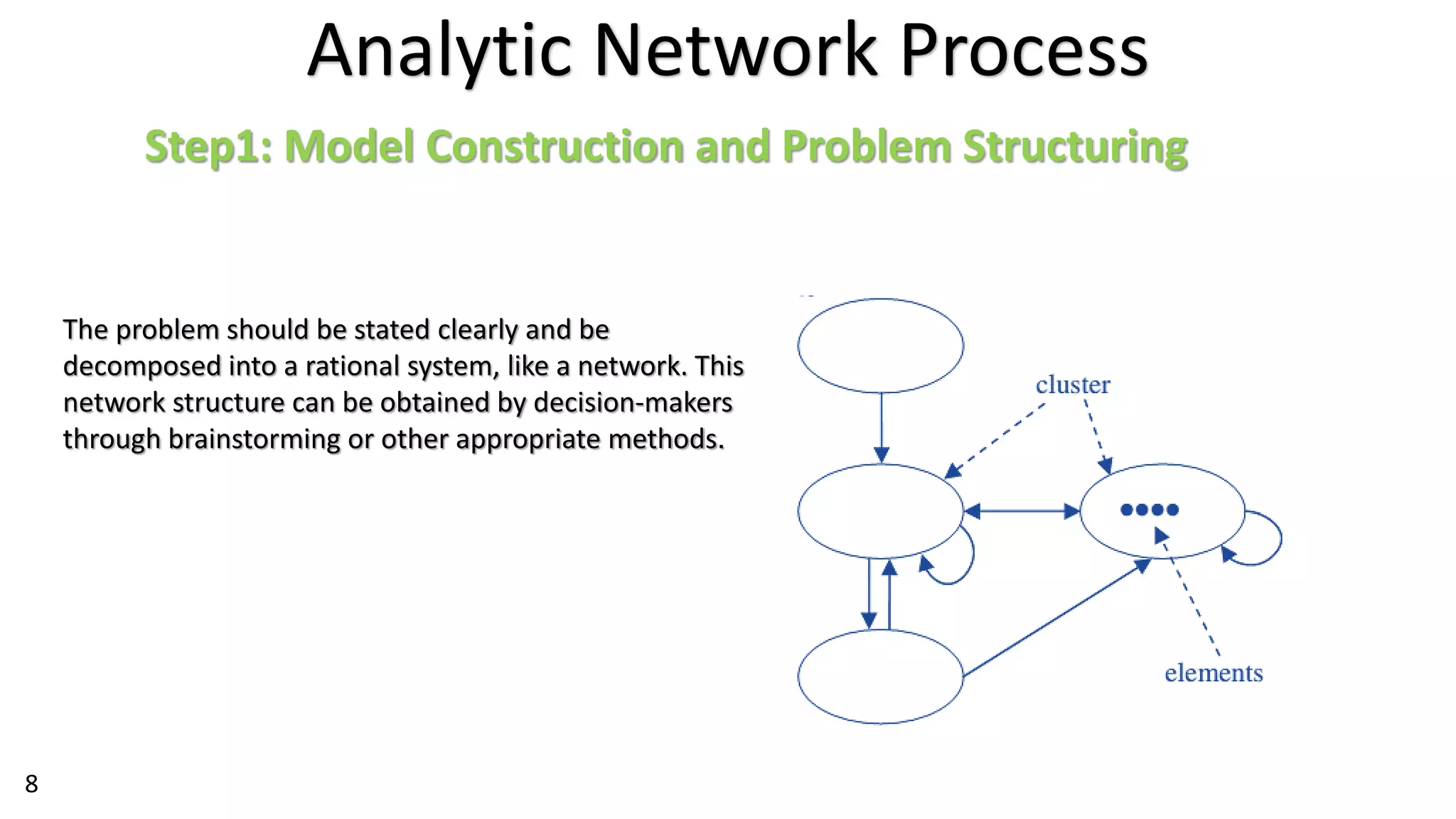
Step1: Model Construction and Problem Structuring 
The problem should be stated clearly and be 
decomposed into a rational system, like a network. This 
network structure can be obtained by decision-makers 
through brainstorming or other appropriate methods.
Analytic Network Process 
9 
Step2: Pairwise Comparison Matrices and Priority Vectors 
Similar to the comparisons performed in AHP, pairs 
of decision elements at each cluster are compared with 
respect to their importance towards their control 
criteria. The clusters themselves are also compared 
pairwise with respect to their contribution to the 
objective. Decision-makers are asked to respond to a 
series of pairwise comparisons of two elements 
or two clusters to be evaluated in terms of their 
contribution to their particular upper level criteria.
Analytic Network Process 
10 
Step2: Pairwise Comparison Matrices and Priority Vectors 
In addition, interdependencies among elements of a 
cluster must also be examined pairwise; 
the influence of each element on other elements can be 
represented by an eigenvector. The relative 
importance values are determined with Saaty’s 1–9 scale 
,where a score of 1 represents equal 
importance between the two elements and a score of 9 
indicates the extreme importance of one element 
(row cluster in the matrix) compared to the other one 
(column cluster in the matrix).
Analytic Network Process 
11 
Step2: Pairwise Comparison Matrices and Priority Vectors 
A reciprocal like with AHP, pairwise comparison in ANP is 
performed in the framework of a matrix, and a local 
priority vector can be derived as an estimate of the relative 
importance associated with the elements (or clusters) 
being compared by solving the following equation: 
Where A is the matrix of pairwise comparison, w is the eigenvector, 
and λ max is the largest eigenvalue of A. 
Saaty proposes several algorithms to approximate w. In this paper, 
Expert Choice is used to compute the eigenvectors from the pairwise 
comparison matrices and to determine the consistency ratios.
Analytic Network Process 
12 
Step3: Supermatrix Formation 
The Supermatrix concept is similar to the Markov chain 
process.To obtain global priorities in a system with 
interdependent influences, the local priority vectors are 
entered in the appropriate columns of a matrix. As a result, 
a supermatrix is actually a partitioned matrix, where each 
matrix segment represents a relationship between two 
clusters in a system.The local priority vectors obtained in 
Step 2 are grouped and placed in the appropriate positions 
in a supermatrix based on the flow of influence from one 
cluster to another, or from a cluster to itself, as in the loop.
Analytic Network Process 
13 
Step4: Selection of The Best Alternatives 
If the supermatrix formed in Step 3 covers the whole network, the 
priority weights of the alternatives can be found in the column of 
alternatives in the normalized supermatrix. On the other hand, if a 
supermatrix only comprises clusters that are interrelated, 
additional calculations must be made to obtain the overall 
priorities of the alternatives. The alternative with the largest 
overall priority should be selected, as it is the best alternative as 
determined by the calculations made using matrix operations.
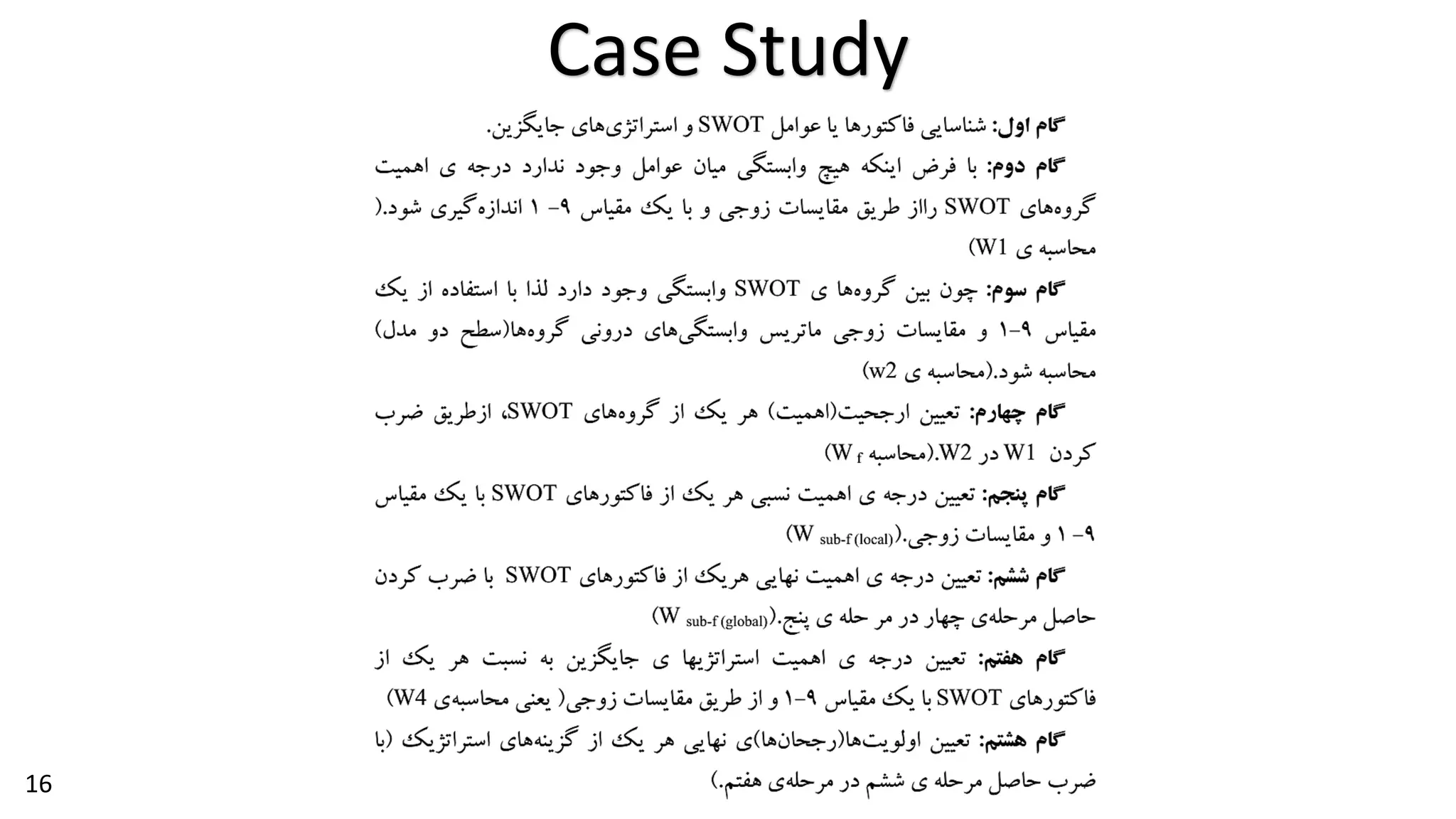
Case Study 
14 
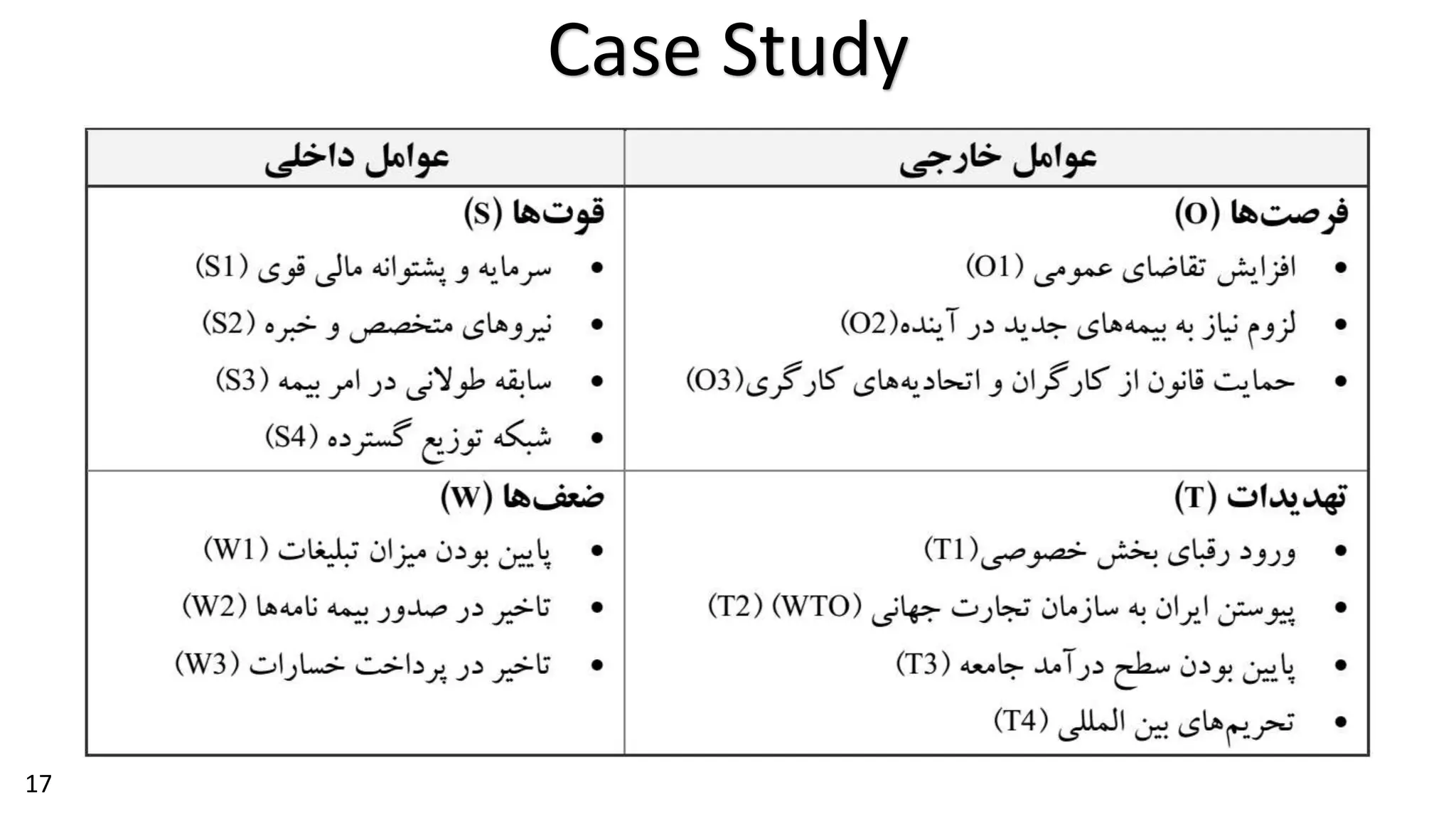
به کارگیری تکنیک فرآیند تحلیل شبکه ای در تحلیل 
نقاط قوت، ضعف، فرصت و تهدید 
)مطالعه موردی شرکت سهامی بیمه ایران(
Case Study 
15 
AHP ANP
Case Study 
16
Case Study 
17
Case Study 
18
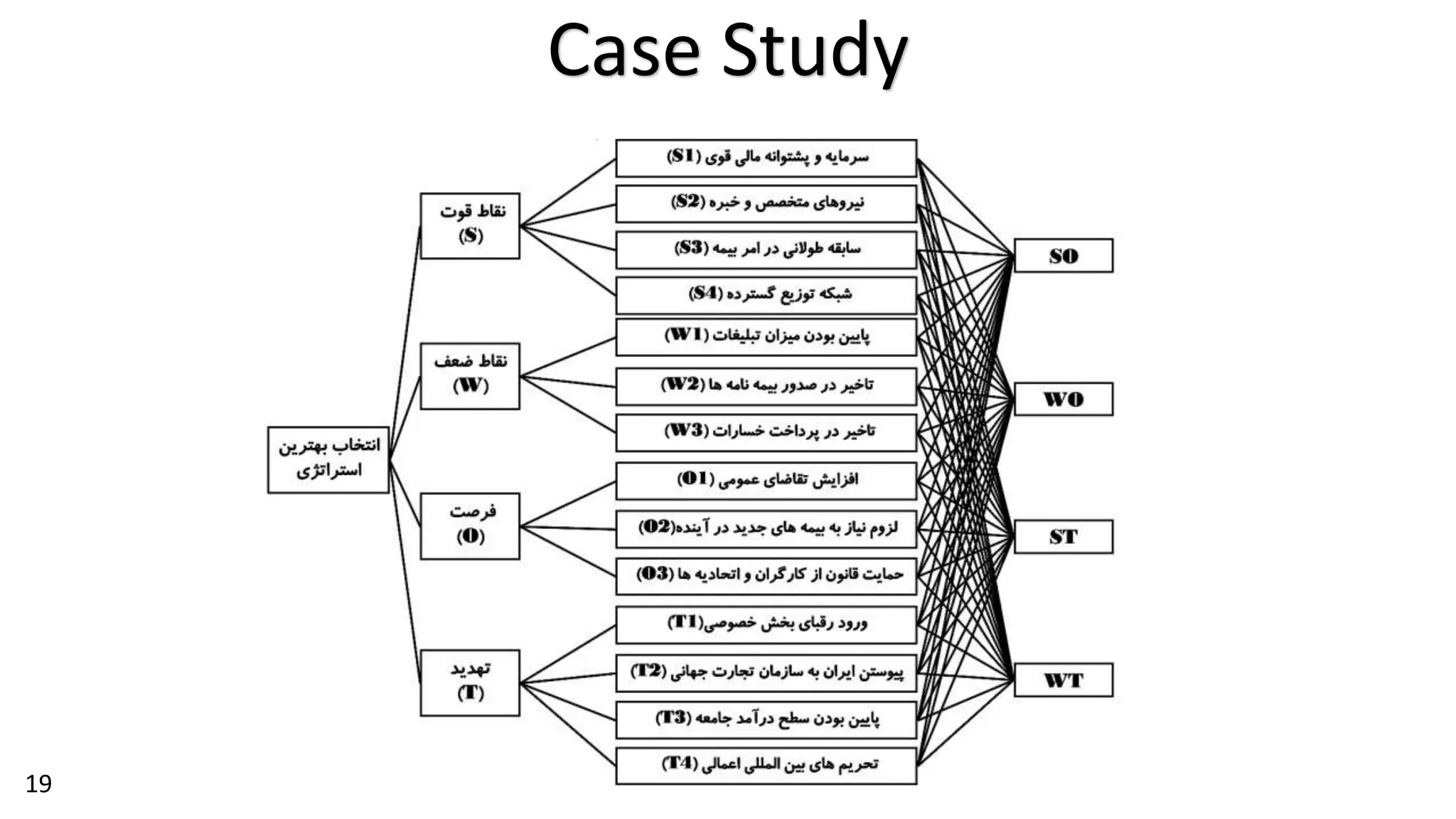
Case Study 
19
Case Study 
20 
ماتریس مقایسه زوجی گروه 
SWOT های
Case Study 
21 
وابستگی های درونی گروه 
SWOT های
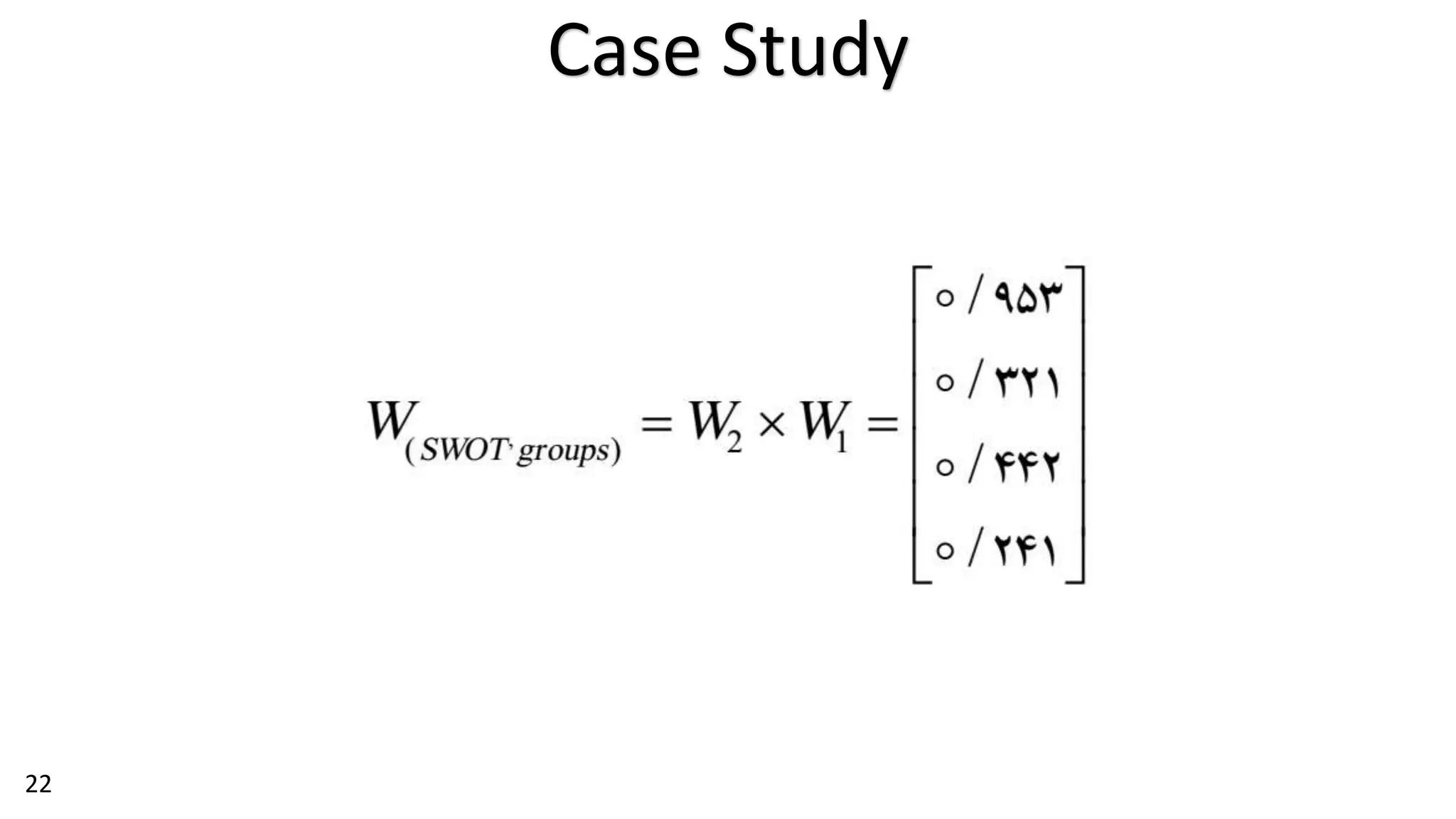
Case Study 
22
Case Study 
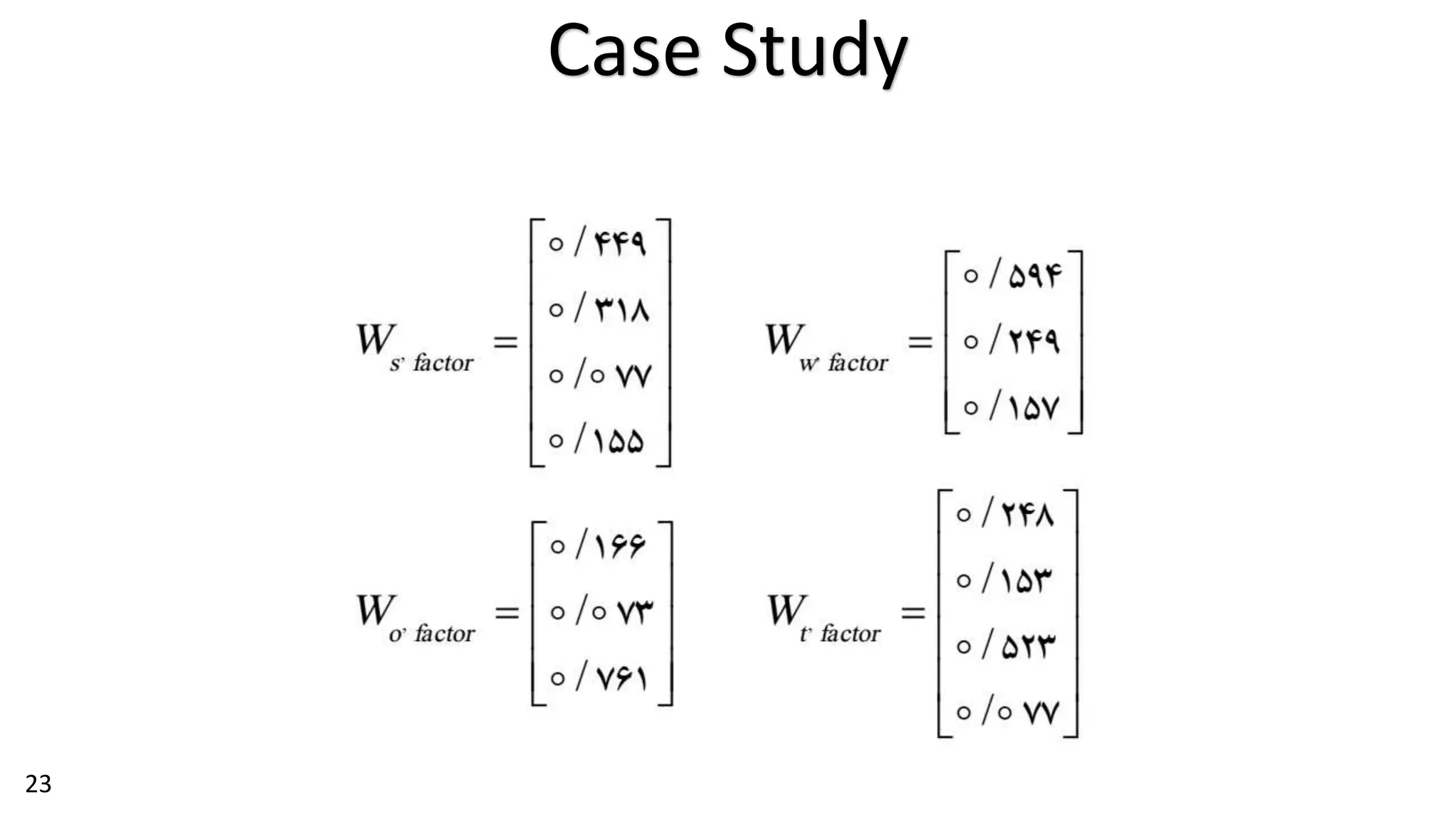
23
Case Study 
24 
. 
. 
.
Case Study 
25 
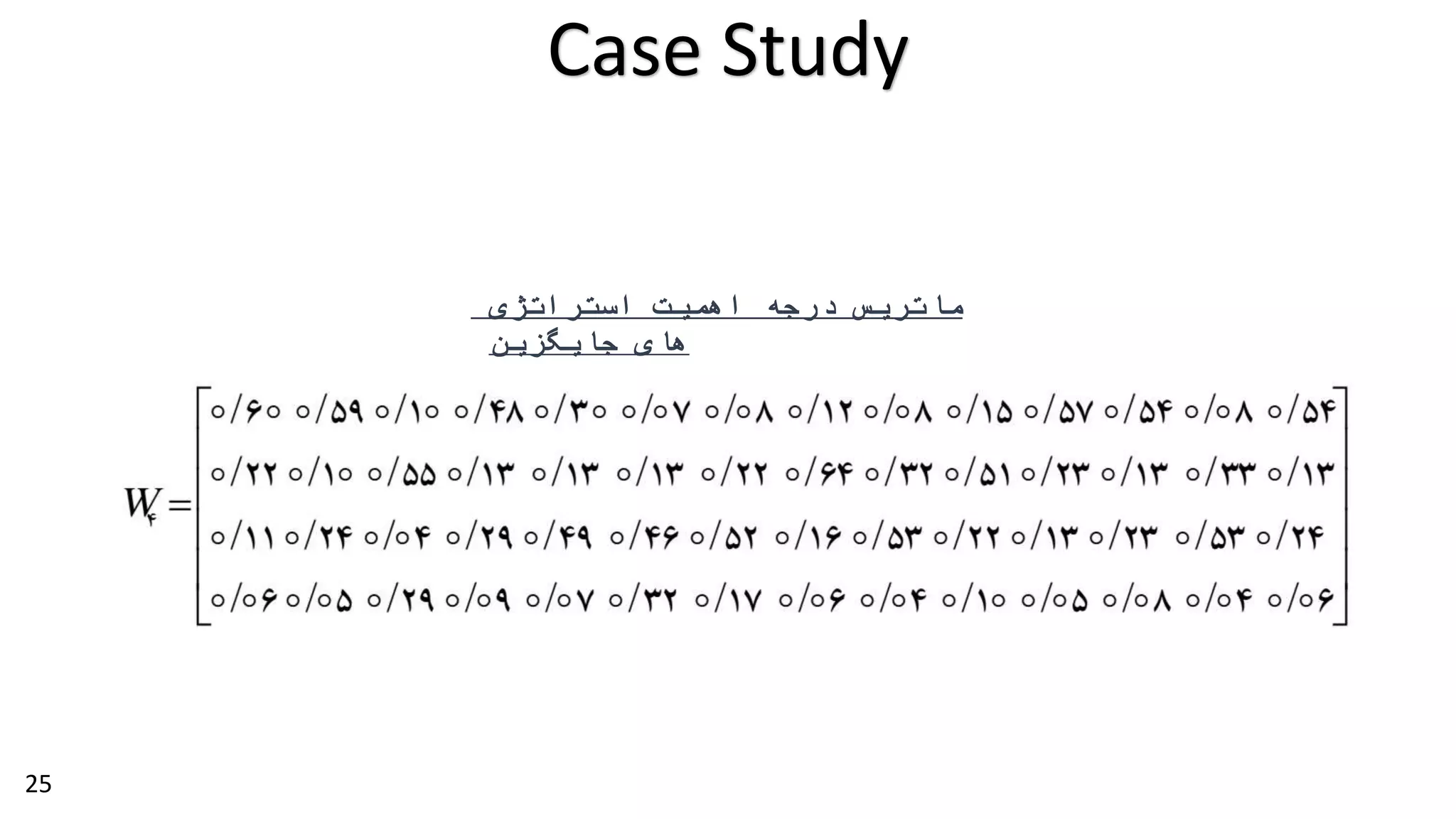
ماتریس درجه اهمیت استراتژی 
های جایگزین
Case Study 
26 
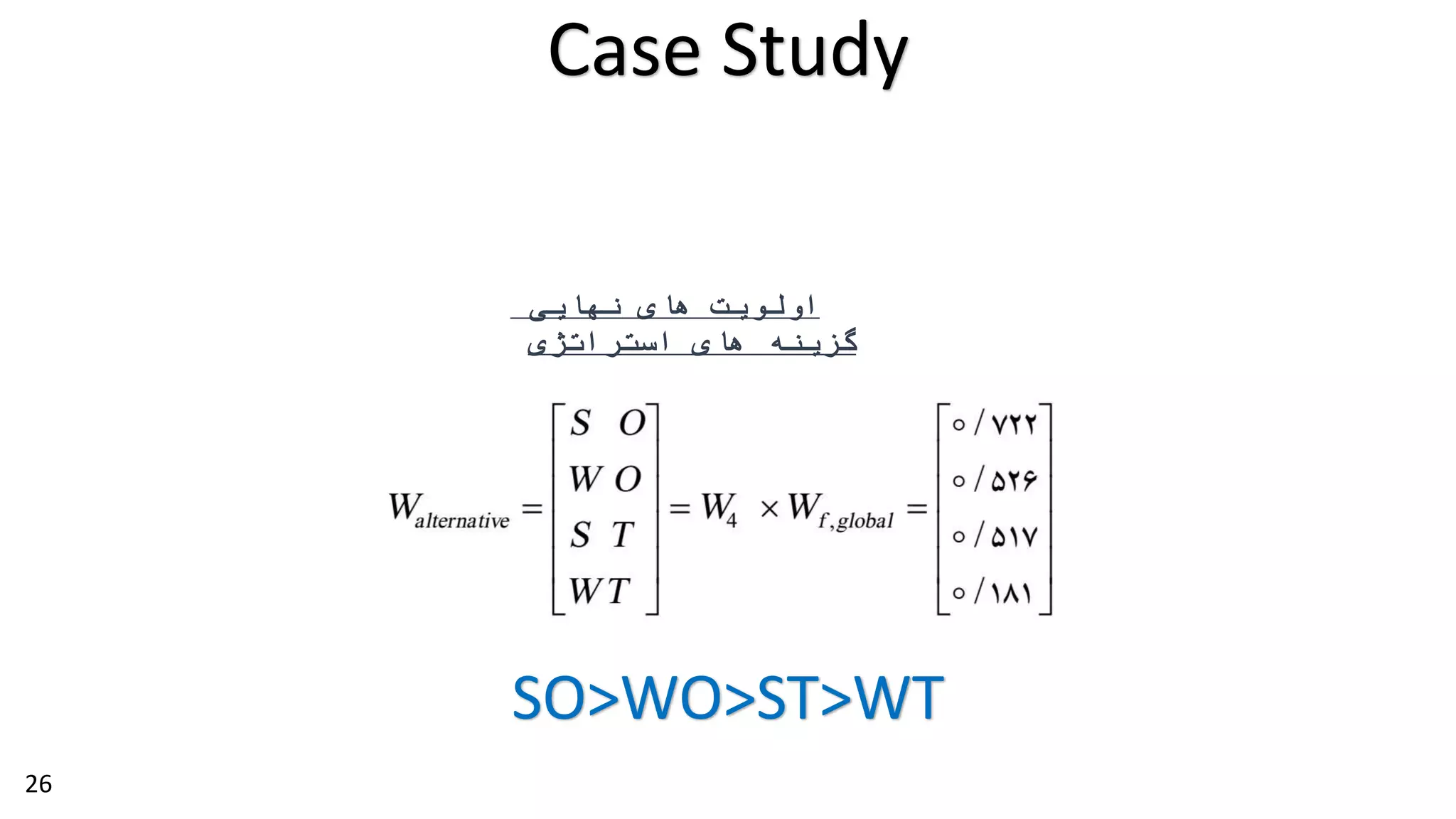
اولویت های نهایی 
گزینه های استراتژی 
SO>WO>ST>WT
Analytic Network Process

Analytic Network Process

  • 2.
    Analytic Hierarchy Process (AHP) 1 The Analytic Hierarchy Process (AHP) is a structured technique for organizing and analyzing complex decisions, based on mathematics and psychology. It was developed by Thomas L. Saaty in the 1970s and has been extensively studied and refined since then.
  • 3.
    Analytic Hierarchy Process 4 Major Steps of AHP: 2
  • 4.
  • 5.
  • 6.
    Analytic Network Process (ANP) The Analytic Network Process (ANP) is a more general form of the analytic hierarchy process (AHP) used in multi-criteria decision analysis. AHP structures a decision problem into a hierarchy with a goal, decision criteria, and alternatives, while the ANP structures it as a network. Both then use a system of pairwise comparisons to measure the weights of the components of the structure, and finally to rank the 5 alternatives in the decision.
  • 7.
    Analytic Network Process 6 In a hierarchy, alternatives affect (depend on) the criteria, criteria affect goal. It is assumed that: – Criteria do not affect alternatives – Criteria do not depend on each other – Alternatives do not depend on each other In complex decisions there may be dependence and feedback. Network model with dependence and feedback improves the priorities derived from judgments and makes prediction much more accurate
  • 8.
    Analytic Network Process 4 Major Steps of ANP: 7 Step1: Model Construction and Problem Structuring Step2: Pairwise Comparison Matrices and Priority Vectors Step3: Supermatrix Formation Step4: Selection of The Best Alternatives
  • 9.
    Analytic Network Process 8 Step1: Model Construction and Problem Structuring The problem should be stated clearly and be decomposed into a rational system, like a network. This network structure can be obtained by decision-makers through brainstorming or other appropriate methods.
  • 10.
    Analytic Network Process 9 Step2: Pairwise Comparison Matrices and Priority Vectors Similar to the comparisons performed in AHP, pairs of decision elements at each cluster are compared with respect to their importance towards their control criteria. The clusters themselves are also compared pairwise with respect to their contribution to the objective. Decision-makers are asked to respond to a series of pairwise comparisons of two elements or two clusters to be evaluated in terms of their contribution to their particular upper level criteria.
  • 11.
    Analytic Network Process 10 Step2: Pairwise Comparison Matrices and Priority Vectors In addition, interdependencies among elements of a cluster must also be examined pairwise; the influence of each element on other elements can be represented by an eigenvector. The relative importance values are determined with Saaty’s 1–9 scale ,where a score of 1 represents equal importance between the two elements and a score of 9 indicates the extreme importance of one element (row cluster in the matrix) compared to the other one (column cluster in the matrix).
  • 12.
    Analytic Network Process 11 Step2: Pairwise Comparison Matrices and Priority Vectors A reciprocal like with AHP, pairwise comparison in ANP is performed in the framework of a matrix, and a local priority vector can be derived as an estimate of the relative importance associated with the elements (or clusters) being compared by solving the following equation: Where A is the matrix of pairwise comparison, w is the eigenvector, and λ max is the largest eigenvalue of A. Saaty proposes several algorithms to approximate w. In this paper, Expert Choice is used to compute the eigenvectors from the pairwise comparison matrices and to determine the consistency ratios.
  • 13.
    Analytic Network Process 12 Step3: Supermatrix Formation The Supermatrix concept is similar to the Markov chain process.To obtain global priorities in a system with interdependent influences, the local priority vectors are entered in the appropriate columns of a matrix. As a result, a supermatrix is actually a partitioned matrix, where each matrix segment represents a relationship between two clusters in a system.The local priority vectors obtained in Step 2 are grouped and placed in the appropriate positions in a supermatrix based on the flow of influence from one cluster to another, or from a cluster to itself, as in the loop.
  • 14.
    Analytic Network Process 13 Step4: Selection of The Best Alternatives If the supermatrix formed in Step 3 covers the whole network, the priority weights of the alternatives can be found in the column of alternatives in the normalized supermatrix. On the other hand, if a supermatrix only comprises clusters that are interrelated, additional calculations must be made to obtain the overall priorities of the alternatives. The alternative with the largest overall priority should be selected, as it is the best alternative as determined by the calculations made using matrix operations.
  • 15.
    Case Study 14 به کارگیری تکنیک فرآیند تحلیل شبکه ای در تحلیل نقاط قوت، ضعف، فرصت و تهدید )مطالعه موردی شرکت سهامی بیمه ایران(
  • 16.
    Case Study 15 AHP ANP
  • 17.
  • 18.
  • 19.
  • 20.
  • 21.
    Case Study 20 ماتریس مقایسه زوجی گروه SWOT های
  • 22.
    Case Study 21 وابستگی های درونی گروه SWOT های
  • 23.
  • 24.
  • 25.
  • 26.
    Case Study 25 ماتریس درجه اهمیت استراتژی های جایگزین
  • 27.
    Case Study 26 اولویت های نهایی گزینه های استراتژی SO>WO>ST>WT