SHANKHA SHUBHRA GOSWAMI
DEPARTMENT OF MECHANICAL ENGINEERING
M.TECH IN PRODUCTION TECHNOLOGY & MANAGEMENT
ROLL NO. – 17101203011
JALPAIGURI GOVERNMENT ENGINEERING COLLEGE
GUIDED BY
Dr. SOUPAYAN MITRA
ASSOCIATE PROFESSOR
DEPARTMENT OF MECHANICAL ENGINEERING
JALPAIGURI GOVERNMENT ENGINEERING COLLEGE
AN INTEGRATED APPROCH OF AHPAND TOPSIS
FOR OPTIMUM SELECTION OF PRODUCT & PROCESS
OBJECTIVES
•To study and selection of most suitable product, process, strategy or service option
under several alternatives having varying degree of choices or preferences with a
number of sub-criteria is done by multi-criteria decision making (MCDM) system
tool.
•An integrated AHP and TOPSIS can be used to obtain more probabilistic model
analysis on various problems like selection of Machines such as Lathe, selection of
manufacturing process, selection of welding technique, selection of cutting tool,
selection of products like mobiles, domestic appliances such as refrigerator, air
conditioner, washing machine and many more.
•Initially, to apply an AHP to find out the optimum domestic refrigerator to illustrate
the calculation procedure of AHP.
•To compare merits, demerits and application suitability among various MCDM.
INTRODUCTION
MCDM
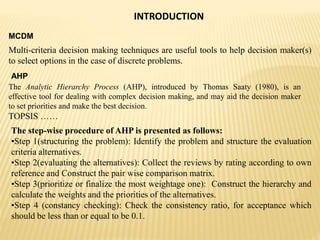
Multi-criteria decision making techniques are useful tools to help decision maker(s)
to select options in the case of discrete problems.
AHP
The Analytic Hierarchy Process (AHP), introduced by Thomas Saaty (1980), is an
effective tool for dealing with complex decision making, and may aid the decision maker
to set priorities and make the best decision.
TOPSIS ……
The step-wise procedure of AHP is presented as follows:
•Step 1(structuring the problem): Identify the problem and structure the evaluation
criteria alternatives.
•Step 2(evaluating the alternatives): Collect the reviews by rating according to own
reference and Construct the pair wise comparison matrix.
•Step 3(prioritize or finalize the most weightage one): Construct the hierarchy and
calculate the weights and the priorities of the alternatives.
•Step 4 (constancy checking): Check the consistency ratio, for acceptance which
should be less than or equal to be 0.1.
APPLICATIONS
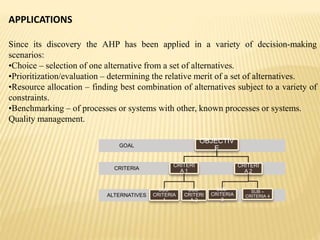
Since its discovery the AHP has been applied in a variety of decision-making
scenarios:
•Choice – selection of one alternative from a set of alternatives.
•Prioritization/evaluation – determining the relative merit of a set of alternatives.
•Resource allocation – finding best combination of alternatives subject to a variety of
constraints.
•Benchmarking – of processes or systems with other, known processes or systems.
Quality management.
ALTERNATIVES
CRITERIA
GOAL
OBJECTIV
E
CRITERI
A 1
SUB-
CRITERIA
1
SUB-
CRITERI
A 2
CRITERI
A 2
SUB-
CRITERIA
3
SUB –
CRITERIA 4
THEORETICAL ANALYSIS
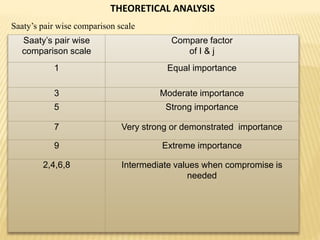
Saaty’s pair wise comparison scale
Saaty’s pair wise
comparison scale
Compare factor
of I & j
1 Equal importance
3 Moderate importance
5 Strong importance
7 Very strong or demonstrated importance
9 Extreme importance
2,4,6,8 Intermediate values when compromise is
needed
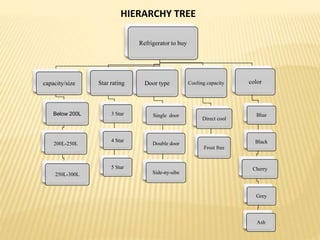
HIERARCHY TREE
Refrigerator to buy
capacity/size
Below 200L
200L-250L
250L-300L
Star rating
3 Star
4 Star
5 Star
Door type
Single door
Double door
Side-ny-sibe
Cooling capacity
Direct cool
Frost free
color
Blue
Black
Cherry
Grey
Ash
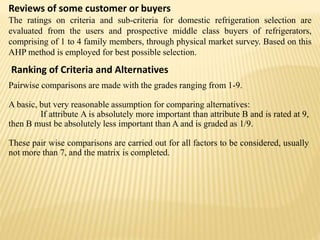
Reviews of some customer or buyers
The ratings on criteria and sub-criteria for domestic refrigeration selection are
evaluated from the users and prospective middle class buyers of refrigerators,
comprising of 1 to 4 family members, through physical market survey. Based on this
AHP method is employed for best possible selection.
Ranking of Criteria and Alternatives
Pairwise comparisons are made with the grades ranging from 1-9.
A basic, but very reasonable assumption for comparing alternatives:
If attribute A is absolutely more important than attribute B and is rated at 9,
then B must be absolutely less important than A and is graded as 1/9.
These pair wise comparisons are carried out for all factors to be considered, usually
not more than 7, and the matrix is completed.
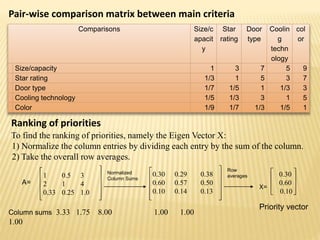
Pair-wise comparison matrix between main criteria
Comparisons Size/c
apacit
y
Star
rating
Door
type
Coolin
g
techn
ology
col
or
Size/capacity 1 3 7 5 9
Star rating 1/3 1 5 3 7
Door type 1/7 1/5 1 1/3 3
Cooling technology 1/5 1/3 3 1 5
Color 1/9 1/7 1/3 1/5 1
Ranking of priorities
To find the ranking of priorities, namely the Eigen Vector X:
1) Normalize the column entries by dividing each entry by the sum of the column.
2) Take the overall row averages.
0.30 0.29 0.38
0.60 0.57 0.50
0.10 0.14 0.13
A=
1 0.5 3
2 1 4
0.33 0.25 1.0
Normalized
Column Sums
Row
averages 0.30
0.60
0.10
X=
Column sums 3.33 1.75 8.00 1.00 1.00
1.00
Priority vector
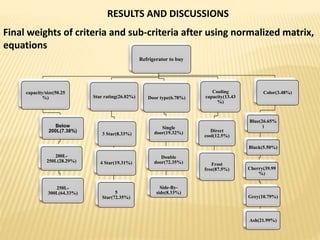
RESULTS AND DISCUSSIONS
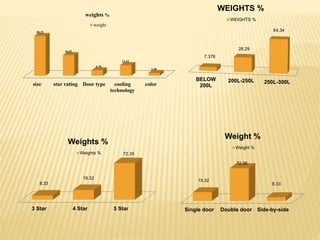
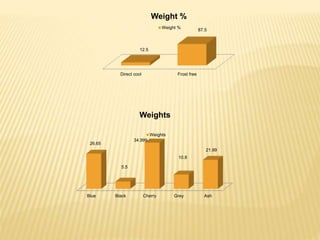
Final weights of criteria and sub-criteria after using normalized matrix,
equations
Refrigerator to buy
capacity/size(50.25
%)
Below
200L(7.38%)
200L-
250L(28.29%)
250L-
300L(64.33%)
Star rating(26.02%)
3 Star(8.33%)
4 Star(19.31%)
5
Star(72.35%)
Door type(6.78%)
Single
door(19.32%)
Double
door(72.35%)
Side-By-
side(8.33%)
Cooling
capacity(13.43
%)
Direct
cool(12.5%)
Frost
free(87.5%)
Color(3.48%)
Blue(26.65%
)
Black(5.50%)
Cherry(39.99
%)
Grey(10.79%)
Ash(21.99%)
Checking for Consistency
The next stage is to calculate a Consistency Ratio (CR) to measure how consistent
the judgments have been relative to large samples of purely random judgments.
AHP evaluations are based on the aasumption that the decision maker is rational, i.e.,
if A is preferred to B and B is preferred to C, then A is preferred to C.
If the CR is greater than 0.1 the judgments are untrustworthy because they are too
close for comfort to randomness and the exercise is valueless or must be repeated.
Calculation of Consistency Ratio
The next stage is to calculate λ max so as to lead to the Consistency Index and the
Consistency Ratio.
Consider [Ax = λmax x] where x is the Eigenvector.
0.30
0.60
0.10
1 0.5 3
2 1 4
0.333 0.25 1.0
0.90
1.60
0.35
= = max
0.30
0.60
0.10
A x Ax x
λmax=average{0.90/0.30, 1.60/0.6, 0.35/0.10}=3.06
Consistency index , CI is found by
CI=(λ max -n)/(n-1)=(3.06-3)/(3-1)= 0.03
Consistency Ratio
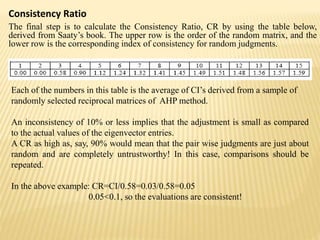
The final step is to calculate the Consistency Ratio, CR by using the table below,
derived from Saaty’s book. The upper row is the order of the random matrix, and the
lower row is the corresponding index of consistency for random judgments.
Each of the numbers in this table is the average of CI’s derived from a sample of
randomly selected reciprocal matrices of AHP method.
An inconsistency of 10% or less implies that the adjustment is small as compared
to the actual values of the eigenvector entries.
A CR as high as, say, 90% would mean that the pair wise judgments are just about
random and are completely untrustworthy! In this case, comparisons should be
repeated.
In the above example: CR=CI/0.58=0.03/0.58=0.05
0.05<0.1, so the evaluations are consistent!
size star rating Door type cooling
technology
color
50.25
26.02
6.78
13.43
3.48
weights %
weight
3 Star 4 Star 5 Star
8.33
19.32
72.35
Weights %
Weights %
Single door Double door Side-by-side
19.32
72.35
8.33
Weight %
Weight %
BELOW
200L
200L-250L 250L-300L
7.378
28.29
64.34
WEIGHTS %
WEIGHTS %
Direct cool Frost free
12.5
87.5
Weight %
Weight %
Blue Black Cherry Grey Ash
26.65
5.5
34.999
10.8
21.99
Weights
Weights
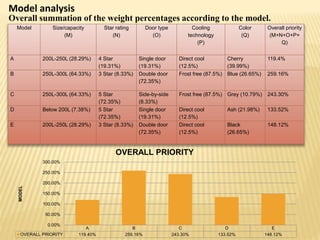
Model analysis
Overall summation of the weight percentages according to the model.
Model Size/capacity
(M)
Star rating
(N)
Door type
(O)
Cooling
technology
(P)
Color
(Q)
Overall priority
(M+N+O+P+
Q)
A 200L-250L (28.29%) 4 Star
(19.31%)
Single door
(19.31%)
Direct cool
(12.5%)
Cherry
(39.99%)
119.4%
B 250L-300L (64.33%) 3 Star (8.33%) Double door
(72.35%)
Frost free (87.5%) Blue (26.65%) 259.16%
C 250L-300L (64.33%) 5 Star
(72.35%)
Side-by-side
(8.33%)
Frost free (87.5%) Grey (10.79%) 243.30%
D Below 200L (7.38%) 5 Star
(72.35%)
Single door
(19.31%)
Direct cool
(12.5%)
Ash (21.98%) 133.52%
E 200L-250L (28.29%) 3 Star (8.33%) Double door
(72.35%)
Direct cool
(12.5%)
Black
(26.65%)
148.12%
A B C D E
OVERALL PRIORITY 119.40% 259.16% 243.30% 133.52% 148.12%
0.00%
50.00%
100.00%
150.00%
200.00%
250.00%
300.00%
MODEL
OVERALL PRIORITY
CONCLUSION
So far an AHP technique has been followed for selection of best possible refrigerator
for a middle class family. Preferences of customers for five most useful refrigerator
selection criteria and sub-criteria and their relative weightages are evaluated from
market survey. The detail AHP analysis is presented and consistencies are also
checked. Finally the best possible refrigerator model is selected and priorities of
other alternatives are ranked. The same procedure may be extended to consider more
other criteria and sub-criteria for best possible selection.
Scope for future work
Here in this work we have considered few important criteria’s which influence the
selection of domestic refrigerator. The scope of work can be extended by applying
AHP on some more problems and applications of other MCDM tool like TOPSIS,
MAXMIN, MAXMAX after AHP for getting more probabilistic results considering
real-life industrial and domestic problems.
multi criteria decision making

multi criteria decision making

  • 1.
    SHANKHA SHUBHRA GOSWAMI DEPARTMENTOF MECHANICAL ENGINEERING M.TECH IN PRODUCTION TECHNOLOGY & MANAGEMENT ROLL NO. – 17101203011 JALPAIGURI GOVERNMENT ENGINEERING COLLEGE GUIDED BY Dr. SOUPAYAN MITRA ASSOCIATE PROFESSOR DEPARTMENT OF MECHANICAL ENGINEERING JALPAIGURI GOVERNMENT ENGINEERING COLLEGE AN INTEGRATED APPROCH OF AHPAND TOPSIS FOR OPTIMUM SELECTION OF PRODUCT & PROCESS
  • 2.
    OBJECTIVES •To study andselection of most suitable product, process, strategy or service option under several alternatives having varying degree of choices or preferences with a number of sub-criteria is done by multi-criteria decision making (MCDM) system tool. •An integrated AHP and TOPSIS can be used to obtain more probabilistic model analysis on various problems like selection of Machines such as Lathe, selection of manufacturing process, selection of welding technique, selection of cutting tool, selection of products like mobiles, domestic appliances such as refrigerator, air conditioner, washing machine and many more. •Initially, to apply an AHP to find out the optimum domestic refrigerator to illustrate the calculation procedure of AHP. •To compare merits, demerits and application suitability among various MCDM.
  • 3.
    INTRODUCTION MCDM Multi-criteria decision makingtechniques are useful tools to help decision maker(s) to select options in the case of discrete problems. AHP The Analytic Hierarchy Process (AHP), introduced by Thomas Saaty (1980), is an effective tool for dealing with complex decision making, and may aid the decision maker to set priorities and make the best decision. TOPSIS …… The step-wise procedure of AHP is presented as follows: •Step 1(structuring the problem): Identify the problem and structure the evaluation criteria alternatives. •Step 2(evaluating the alternatives): Collect the reviews by rating according to own reference and Construct the pair wise comparison matrix. •Step 3(prioritize or finalize the most weightage one): Construct the hierarchy and calculate the weights and the priorities of the alternatives. •Step 4 (constancy checking): Check the consistency ratio, for acceptance which should be less than or equal to be 0.1.
  • 4.
    APPLICATIONS Since its discoverythe AHP has been applied in a variety of decision-making scenarios: •Choice – selection of one alternative from a set of alternatives. •Prioritization/evaluation – determining the relative merit of a set of alternatives. •Resource allocation – finding best combination of alternatives subject to a variety of constraints. •Benchmarking – of processes or systems with other, known processes or systems. Quality management. ALTERNATIVES CRITERIA GOAL OBJECTIV E CRITERI A 1 SUB- CRITERIA 1 SUB- CRITERI A 2 CRITERI A 2 SUB- CRITERIA 3 SUB – CRITERIA 4
  • 5.
    THEORETICAL ANALYSIS Saaty’s pairwise comparison scale Saaty’s pair wise comparison scale Compare factor of I & j 1 Equal importance 3 Moderate importance 5 Strong importance 7 Very strong or demonstrated importance 9 Extreme importance 2,4,6,8 Intermediate values when compromise is needed
  • 6.
    HIERARCHY TREE Refrigerator tobuy capacity/size Below 200L 200L-250L 250L-300L Star rating 3 Star 4 Star 5 Star Door type Single door Double door Side-ny-sibe Cooling capacity Direct cool Frost free color Blue Black Cherry Grey Ash
  • 7.
    Reviews of somecustomer or buyers The ratings on criteria and sub-criteria for domestic refrigeration selection are evaluated from the users and prospective middle class buyers of refrigerators, comprising of 1 to 4 family members, through physical market survey. Based on this AHP method is employed for best possible selection. Ranking of Criteria and Alternatives Pairwise comparisons are made with the grades ranging from 1-9. A basic, but very reasonable assumption for comparing alternatives: If attribute A is absolutely more important than attribute B and is rated at 9, then B must be absolutely less important than A and is graded as 1/9. These pair wise comparisons are carried out for all factors to be considered, usually not more than 7, and the matrix is completed.
  • 8.
    Pair-wise comparison matrixbetween main criteria Comparisons Size/c apacit y Star rating Door type Coolin g techn ology col or Size/capacity 1 3 7 5 9 Star rating 1/3 1 5 3 7 Door type 1/7 1/5 1 1/3 3 Cooling technology 1/5 1/3 3 1 5 Color 1/9 1/7 1/3 1/5 1 Ranking of priorities To find the ranking of priorities, namely the Eigen Vector X: 1) Normalize the column entries by dividing each entry by the sum of the column. 2) Take the overall row averages. 0.30 0.29 0.38 0.60 0.57 0.50 0.10 0.14 0.13 A= 1 0.5 3 2 1 4 0.33 0.25 1.0 Normalized Column Sums Row averages 0.30 0.60 0.10 X= Column sums 3.33 1.75 8.00 1.00 1.00 1.00 Priority vector
  • 9.
    RESULTS AND DISCUSSIONS Finalweights of criteria and sub-criteria after using normalized matrix, equations Refrigerator to buy capacity/size(50.25 %) Below 200L(7.38%) 200L- 250L(28.29%) 250L- 300L(64.33%) Star rating(26.02%) 3 Star(8.33%) 4 Star(19.31%) 5 Star(72.35%) Door type(6.78%) Single door(19.32%) Double door(72.35%) Side-By- side(8.33%) Cooling capacity(13.43 %) Direct cool(12.5%) Frost free(87.5%) Color(3.48%) Blue(26.65% ) Black(5.50%) Cherry(39.99 %) Grey(10.79%) Ash(21.99%)
  • 10.
    Checking for Consistency Thenext stage is to calculate a Consistency Ratio (CR) to measure how consistent the judgments have been relative to large samples of purely random judgments. AHP evaluations are based on the aasumption that the decision maker is rational, i.e., if A is preferred to B and B is preferred to C, then A is preferred to C. If the CR is greater than 0.1 the judgments are untrustworthy because they are too close for comfort to randomness and the exercise is valueless or must be repeated. Calculation of Consistency Ratio The next stage is to calculate λ max so as to lead to the Consistency Index and the Consistency Ratio. Consider [Ax = λmax x] where x is the Eigenvector. 0.30 0.60 0.10 1 0.5 3 2 1 4 0.333 0.25 1.0 0.90 1.60 0.35 = = max 0.30 0.60 0.10 A x Ax x λmax=average{0.90/0.30, 1.60/0.6, 0.35/0.10}=3.06 Consistency index , CI is found by CI=(λ max -n)/(n-1)=(3.06-3)/(3-1)= 0.03
  • 11.
    Consistency Ratio The finalstep is to calculate the Consistency Ratio, CR by using the table below, derived from Saaty’s book. The upper row is the order of the random matrix, and the lower row is the corresponding index of consistency for random judgments. Each of the numbers in this table is the average of CI’s derived from a sample of randomly selected reciprocal matrices of AHP method. An inconsistency of 10% or less implies that the adjustment is small as compared to the actual values of the eigenvector entries. A CR as high as, say, 90% would mean that the pair wise judgments are just about random and are completely untrustworthy! In this case, comparisons should be repeated. In the above example: CR=CI/0.58=0.03/0.58=0.05 0.05<0.1, so the evaluations are consistent!
  • 12.
    size star ratingDoor type cooling technology color 50.25 26.02 6.78 13.43 3.48 weights % weight 3 Star 4 Star 5 Star 8.33 19.32 72.35 Weights % Weights % Single door Double door Side-by-side 19.32 72.35 8.33 Weight % Weight % BELOW 200L 200L-250L 250L-300L 7.378 28.29 64.34 WEIGHTS % WEIGHTS %
  • 13.
    Direct cool Frostfree 12.5 87.5 Weight % Weight % Blue Black Cherry Grey Ash 26.65 5.5 34.999 10.8 21.99 Weights Weights
  • 14.
    Model analysis Overall summationof the weight percentages according to the model. Model Size/capacity (M) Star rating (N) Door type (O) Cooling technology (P) Color (Q) Overall priority (M+N+O+P+ Q) A 200L-250L (28.29%) 4 Star (19.31%) Single door (19.31%) Direct cool (12.5%) Cherry (39.99%) 119.4% B 250L-300L (64.33%) 3 Star (8.33%) Double door (72.35%) Frost free (87.5%) Blue (26.65%) 259.16% C 250L-300L (64.33%) 5 Star (72.35%) Side-by-side (8.33%) Frost free (87.5%) Grey (10.79%) 243.30% D Below 200L (7.38%) 5 Star (72.35%) Single door (19.31%) Direct cool (12.5%) Ash (21.98%) 133.52% E 200L-250L (28.29%) 3 Star (8.33%) Double door (72.35%) Direct cool (12.5%) Black (26.65%) 148.12% A B C D E OVERALL PRIORITY 119.40% 259.16% 243.30% 133.52% 148.12% 0.00% 50.00% 100.00% 150.00% 200.00% 250.00% 300.00% MODEL OVERALL PRIORITY
  • 15.
    CONCLUSION So far anAHP technique has been followed for selection of best possible refrigerator for a middle class family. Preferences of customers for five most useful refrigerator selection criteria and sub-criteria and their relative weightages are evaluated from market survey. The detail AHP analysis is presented and consistencies are also checked. Finally the best possible refrigerator model is selected and priorities of other alternatives are ranked. The same procedure may be extended to consider more other criteria and sub-criteria for best possible selection. Scope for future work Here in this work we have considered few important criteria’s which influence the selection of domestic refrigerator. The scope of work can be extended by applying AHP on some more problems and applications of other MCDM tool like TOPSIS, MAXMIN, MAXMAX after AHP for getting more probabilistic results considering real-life industrial and domestic problems.