Analytical Hierarchy Process (AHP) - by Saaty •  Another way to structure decision problem •  Used to prioritize alternatives •  Used to build an additive value function •  Attempts to mirror human decision process •  Easy to use •  Well accepted by decision makers –  Used often - familiarity –  Intuitive •  Can be used for multiple decision makers •  Very controversial!
What do we want to accomplish? •  Learn how to conduct an AHP analysis •  Understand the how it works •  Deal with controversy –  Rank reversal –  Arbitrary ratings •  Show what can be done to make it useable Bottom Line: AHP can be a useful tool. . . but it can’t be used indiscriminately!
AHP Procedure – Build the Hierarchy •  Very similar to hierarchical value structure –  Goal on top (Fundamental Objective) –  Decompose into sub-goals (Means objectives) –  Further decomposition as necessary –  Identify criteria (attributes) to measure achievement of goals (attributes and objectives) •  Alternatives added to bottom –  Different from decision tree –  Alternatives show up in decision nodes –  Alternatives affected by uncertain events –  Alternatives connected to all criteria
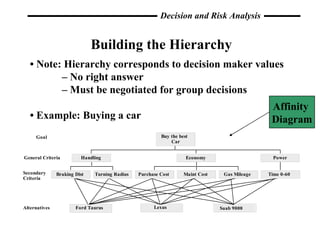
Building the Hierarchy •  Note: Hierarchy corresponds to decision maker values –  No right answer –  Must be negotiated for group decisions •  Example: Buying a car Affinity  Diagram
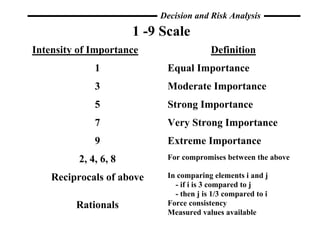
AHP Procedure – Judgments and Comparisons •  Numerical Representation •  Relationship between two elements that share a common parent in the hierarchy •  Comparisons ask 2 questions: –  Which is more important with respect to the criterion? –  How strongly? •  Matrix shows results of all such comparisons •  Typically uses a 1-9 scale •  Requires n(n-1)/2 judgments •  Inconsistency may arise
1 -9 Scale
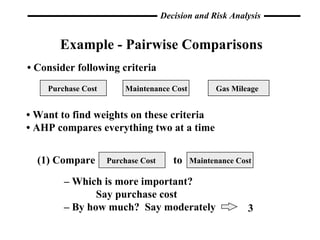
Example - Pairwise Comparisons •  Consider following criteria •  Want to find weights on these criteria •  AHP compares everything two at a time (1) Compare to –  Which is more important? Say purchase cost –  By how much?  Say moderately  3 Purchase Cost Maintenance Cost Gas Mileage Purchase Cost Maintenance Cost
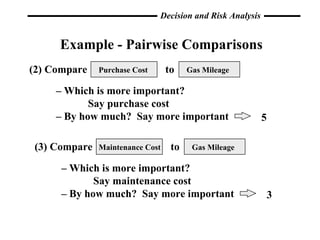
Example - Pairwise Comparisons (2) Compare to –  Which is more important? Say purchase cost –  By how much?  Say more important  5 (3) Compare to –  Which is more important? Say maintenance cost –  By how much?  Say more important  3 Purchase Cost Gas Mileage Gas Mileage Maintenance Cost
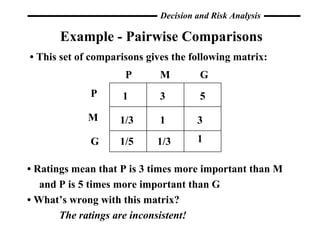
Example - Pairwise Comparisons •  This set of comparisons gives the following matrix: •  Ratings mean that P is 3 times more important than M and P is 5 times more important than G •  What’s wrong with this matrix? The ratings are inconsistent! P M G P M G 1 1 1 3 5 1/3 1/5 3 1/3
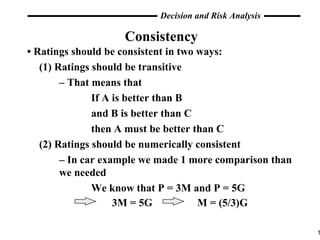
Consistency •  Ratings should be consistent in two ways: (1) Ratings should be transitive –  That means that  If A is better than B and B is better than C then A must be better than C (2) Ratings should be numerically consistent –  In car example we made 1 more comparison than  we needed We know that P = 3M and P = 5G  3M = 5G  M = (5/3)G
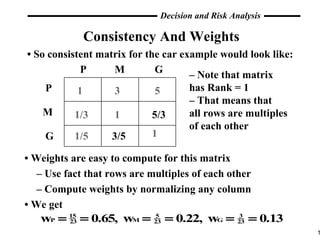
Consistency And Weights •  So consistent matrix for the car example would look like: –  Note that matrix has Rank = 1 –  That means that  all rows are multiples of each other •  Weights are easy to compute for this matrix –  Use fact that rows are multiples of each other –  Compute weights by normalizing any column •  We get  P M G P M G 1 1 1 3 5 1/3 1/5 5/3 3/5
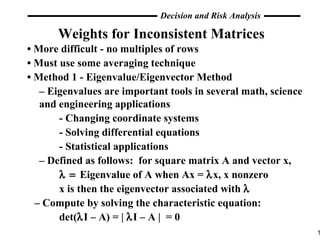
Weights for Inconsistent Matrices •  More difficult - no multiples of rows •  Must use some averaging technique •  Method 1 - Eigenvalue/Eigenvector Method –  Eigenvalues are important tools in several math, science and engineering applications - Changing coordinate systems - Solving differential equations - Statistical applications –  Defined as follows:  for square matrix A and vector x,   Eigenvalue of A when Ax =   x, x nonzero x is then the eigenvector associated with    –  Compute by solving the characteristic equation: det(  I – A) = |   I – A |  = 0
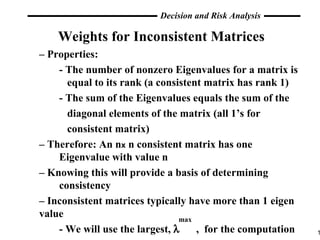
Weights for Inconsistent Matrices –  Properties: - The number of nonzero Eigenvalues for a matrix is    equal to its rank (a consistent matrix has rank 1) - The sum of the Eigenvalues equals the sum of the    diagonal elements of the matrix (all 1’s for    consistent matrix) –  Therefore: An n x  n consistent matrix has one    Eigenvalue with value n –  Knowing this will provide a basis of determining  consistency –  Inconsistent matrices typically have more than 1 eigen value - We will use the largest,     ,  for the computation max
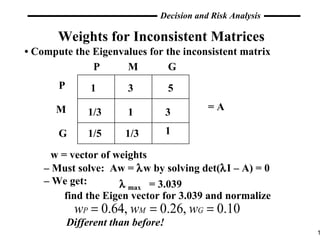
Weights for Inconsistent Matrices •  Compute the Eigenvalues for the inconsistent matrix = A w = vector of weights –  Must solve:  Aw =   w by solving det(  I – A) = 0 –  We get: Different than before! find the Eigen vector for 3.039 and normalize P M G P M G 1 1 1 3 5 1/3 1/5 3 1/3  max = 3.039
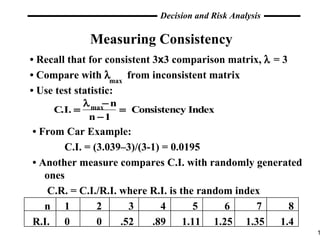
Measuring Consistency •  Recall that for consistent 3 x 3 comparison matrix,    = 3 •  Compare with     from inconsistent matrix •  Use test statistic: max max •  From Car Example: C.I. = (3.039–3)/(3-1) = 0.0195  •  Another measure compares C.I. with randomly generated ones   C.R. = C.I./R.I. where R.I. is the random index n 1 2 3 4 5 6 7 8 R.I. 0 0  .52  .89  1.11  1.25  1.35  1.4
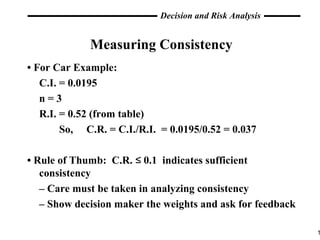
Measuring Consistency •  For Car Example: C.I. = 0.0195 n = 3 R.I. = 0.52 (from table) So,  C.R. = C.I./R.I.  = 0.0195/0.52 = 0.037 •  Rule of Thumb:  C.R. ≤ 0.1  indicates sufficient consistency –  Care must be taken in analyzing consistency –  Show decision maker the weights and ask for feedback
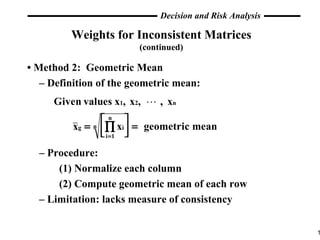
Weights for Inconsistent Matrices (continued) •  Method 2:  Geometric Mean –  Definition of the geometric mean: –  Procedure: (1) Normalize each column (2) Compute geometric mean of each row –  Limitation: lacks measure of consistency
Weights for Inconsistent Matrices (continued) •  Car example with geometric means w w w p M G = 0.63 = 0.26 = 0.05 0.67 0.28 0.05 P M G P M G 1 1 1 3 5 1/3 1/5 3 1/3 Normalized P M G P M G .65 .23 .11 .69 .56 .22 .13 .33 .08 = [(.65)(.69)(.56)] 1/3 = [(.22)(.23)(.33)] 1/3 = [(.13)(.08)(.11)] 1/3 Normalized

Ahp

  • 1.
    Analytical Hierarchy Process(AHP) - by Saaty • Another way to structure decision problem • Used to prioritize alternatives • Used to build an additive value function • Attempts to mirror human decision process • Easy to use • Well accepted by decision makers – Used often - familiarity – Intuitive • Can be used for multiple decision makers • Very controversial!
  • 2.
    What do wewant to accomplish? • Learn how to conduct an AHP analysis • Understand the how it works • Deal with controversy – Rank reversal – Arbitrary ratings • Show what can be done to make it useable Bottom Line: AHP can be a useful tool. . . but it can’t be used indiscriminately!
  • 3.
    AHP Procedure –Build the Hierarchy • Very similar to hierarchical value structure – Goal on top (Fundamental Objective) – Decompose into sub-goals (Means objectives) – Further decomposition as necessary – Identify criteria (attributes) to measure achievement of goals (attributes and objectives) • Alternatives added to bottom – Different from decision tree – Alternatives show up in decision nodes – Alternatives affected by uncertain events – Alternatives connected to all criteria
  • 4.
    Building the Hierarchy• Note: Hierarchy corresponds to decision maker values – No right answer – Must be negotiated for group decisions • Example: Buying a car Affinity Diagram
  • 5.
    AHP Procedure –Judgments and Comparisons • Numerical Representation • Relationship between two elements that share a common parent in the hierarchy • Comparisons ask 2 questions: – Which is more important with respect to the criterion? – How strongly? • Matrix shows results of all such comparisons • Typically uses a 1-9 scale • Requires n(n-1)/2 judgments • Inconsistency may arise
  • 6.
  • 7.
    Example - PairwiseComparisons • Consider following criteria • Want to find weights on these criteria • AHP compares everything two at a time (1) Compare to – Which is more important? Say purchase cost – By how much? Say moderately 3 Purchase Cost Maintenance Cost Gas Mileage Purchase Cost Maintenance Cost
  • 8.
    Example - PairwiseComparisons (2) Compare to – Which is more important? Say purchase cost – By how much? Say more important 5 (3) Compare to – Which is more important? Say maintenance cost – By how much? Say more important 3 Purchase Cost Gas Mileage Gas Mileage Maintenance Cost
  • 9.
    Example - PairwiseComparisons • This set of comparisons gives the following matrix: • Ratings mean that P is 3 times more important than M and P is 5 times more important than G • What’s wrong with this matrix? The ratings are inconsistent! P M G P M G 1 1 1 3 5 1/3 1/5 3 1/3
  • 10.
    Consistency • Ratings should be consistent in two ways: (1) Ratings should be transitive – That means that If A is better than B and B is better than C then A must be better than C (2) Ratings should be numerically consistent – In car example we made 1 more comparison than we needed We know that P = 3M and P = 5G 3M = 5G M = (5/3)G
  • 11.
    Consistency And Weights• So consistent matrix for the car example would look like: – Note that matrix has Rank = 1 – That means that all rows are multiples of each other • Weights are easy to compute for this matrix – Use fact that rows are multiples of each other – Compute weights by normalizing any column • We get P M G P M G 1 1 1 3 5 1/3 1/5 5/3 3/5
  • 12.
    Weights for InconsistentMatrices • More difficult - no multiples of rows • Must use some averaging technique • Method 1 - Eigenvalue/Eigenvector Method – Eigenvalues are important tools in several math, science and engineering applications - Changing coordinate systems - Solving differential equations - Statistical applications – Defined as follows: for square matrix A and vector x,  Eigenvalue of A when Ax =  x, x nonzero x is then the eigenvector associated with   – Compute by solving the characteristic equation: det(  I – A) = |  I – A | = 0
  • 13.
    Weights for InconsistentMatrices – Properties: - The number of nonzero Eigenvalues for a matrix is equal to its rank (a consistent matrix has rank 1) - The sum of the Eigenvalues equals the sum of the diagonal elements of the matrix (all 1’s for consistent matrix) – Therefore: An n x n consistent matrix has one Eigenvalue with value n – Knowing this will provide a basis of determining consistency – Inconsistent matrices typically have more than 1 eigen value - We will use the largest,  , for the computation max
  • 14.
    Weights for InconsistentMatrices • Compute the Eigenvalues for the inconsistent matrix = A w = vector of weights – Must solve: Aw =  w by solving det(  I – A) = 0 – We get: Different than before! find the Eigen vector for 3.039 and normalize P M G P M G 1 1 1 3 5 1/3 1/5 3 1/3  max = 3.039
  • 15.
    Measuring Consistency • Recall that for consistent 3 x 3 comparison matrix,  = 3 • Compare with  from inconsistent matrix • Use test statistic: max max • From Car Example: C.I. = (3.039–3)/(3-1) = 0.0195 • Another measure compares C.I. with randomly generated ones C.R. = C.I./R.I. where R.I. is the random index n 1 2 3 4 5 6 7 8 R.I. 0 0 .52 .89 1.11 1.25 1.35 1.4
  • 16.
    Measuring Consistency • For Car Example: C.I. = 0.0195 n = 3 R.I. = 0.52 (from table) So, C.R. = C.I./R.I. = 0.0195/0.52 = 0.037 • Rule of Thumb: C.R. ≤ 0.1 indicates sufficient consistency – Care must be taken in analyzing consistency – Show decision maker the weights and ask for feedback
  • 17.
    Weights for InconsistentMatrices (continued) • Method 2: Geometric Mean – Definition of the geometric mean: – Procedure: (1) Normalize each column (2) Compute geometric mean of each row – Limitation: lacks measure of consistency
  • 18.
    Weights for InconsistentMatrices (continued) • Car example with geometric means w w w p M G = 0.63 = 0.26 = 0.05 0.67 0.28 0.05 P M G P M G 1 1 1 3 5 1/3 1/5 3 1/3 Normalized P M G P M G .65 .23 .11 .69 .56 .22 .13 .33 .08 = [(.65)(.69)(.56)] 1/3 = [(.22)(.23)(.33)] 1/3 = [(.13)(.08)(.11)] 1/3 Normalized