Specification-based
regression test selection
   with risk analysis
       Zheng-Wen Shen
         2005/03/14
Reference
   Specification-based regression test selection with
    risk analysis
     Yanping Chen, Robert L. Probert, D. Paul Sims
     Source IBM Centre for Advanced Studies
      Conference archive
     Proceedings of the 2002 conference of the Centre
      for Advanced Studies on Collaborative research
      table of contents
Outline
1.   Introduction
2.   Background
3.   Specification-based test case selection
4.   Risk-based test case selection
5.   Evaluation
6.   Conclusions
1. Introduction
   Regression testing is essential to ensure software
    quality.
   Regression test selection attempts to select a
    cost-minimized subset of test cases.
White-box (code-based) V.S. Black-
    box (specification-based)
   Code-based regression test selection is good for
    unit testing, but it has a scalability problem.
   Code-based regression techniques are not
    suitable for testing larger components at more
    abstract level.
   Code-based regression techniques require testers
    to access and understand the code.
   Code-based regression techniques are language-
    dependent.
Two kinds of regression tests
   Targeted Tests, which ensure that important
    current customer features are still supported
    adequately in the new release.
   Safety Tests, which are risk-directed, and ensure
    the potential problem areas are properly handled.
2. Background
   2.1 Regression testing
   2.2 Controlled Regression Testing Assumption
    (CRTA)
   2.3 Risk Analysis
   2.4 Requirement traceability
2.1 Regression testing
   Given a program P, a modified version P’, and a
    set T of test cases used previously to test P,
    regression analysis and testing techniques
    attempt to make use of a subset of T to gain
    sufficient confidence in the correctness of P’
    with respect to behaviors from P retained in P’.
   With selective re-test techniques, we only return
    those test cases that test the affected entities of
    the modified program.
2.2 Controlled Regression Testing
          Assumption (CRTA)
   When P’ is tested with T, we hold all factors that
    might influence the output of P’, except for the
    code in P’, constant with respect to their states
    when we tested P with T.
   Ideally, regression tests should be run while
    CRTA holds.
   Testers must identify and document
    uncontrollable factors and the test cases that are
    potentially affected by them.
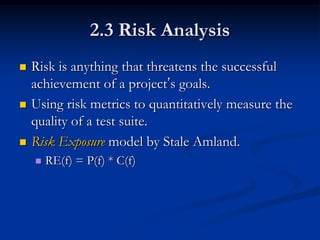
2.3 Risk Analysis
   Risk is anything that threatens the successful
    achievement of a project’s goals.
   Using risk metrics to quantitatively measure the
    quality of a test suite.
   Risk Exposure model by Stale Amland.
       RE(f) = P(f) * C(f)
1.   P(f), the probability of a fault being present.
2.   C(f), the cost (consequence or impact) of a
     fault in the corresponding function if it occurs
     in operation.
2.4 Requirement traceability
   Traceability is a simple, common-sense book-
    keeping property that can prevent a wide range
    of problem.
       Know which test case verifies a given requirements
        attribute.
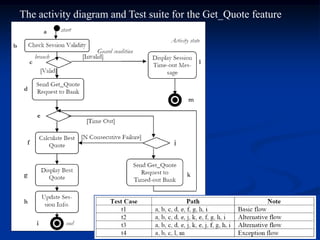
   We use the activity diagram to represent the
    desired system behavior.
The activity diagram and Test suite for the Get_Quote feature
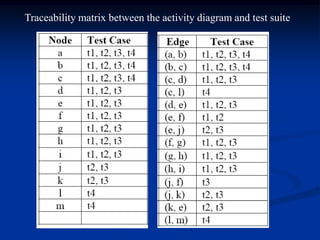
Traceability matrix between the activity diagram and test suite
3. Specification-based test case
                  selection
   3.1 Changes in code
   3.2 Changes in specification
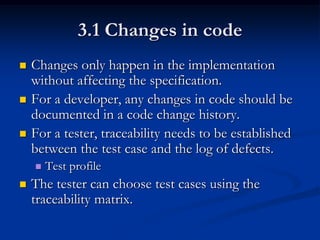
3.1 Changes in code
   Changes only happen in the implementation
    without affecting the specification.
   For a developer, any changes in code should be
    documented in a code change history.
   For a tester, traceability needs to be established
    between the test case and the log of defects.
       Test profile
   The tester can choose test cases using the
    traceability matrix.
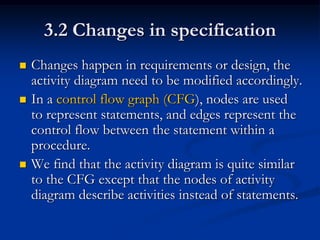
3.2 Changes in specification
   Changes happen in requirements or design, the
    activity diagram need to be modified accordingly.
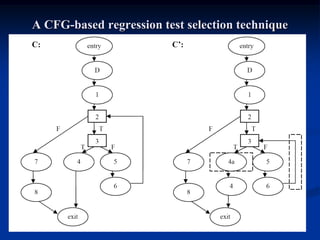
   In a control flow graph (CFG), nodes are used
    to represent statements, and edges represent the
    control flow between the statement within a
    procedure.
   We find that the activity diagram is quite similar
    to the CFG except that the nodes of activity
    diagram describe activities instead of statements.
A CFG-based regression test selection technique
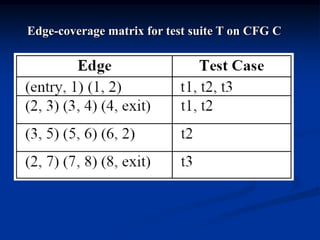
Edge-coverage matrix for test suite T on CFG C
Regression analysis with the activity
              diagram
1.   We traverse the activity diagram to identify
     affected edges.
2.   Then we select test cases that execute the
     affected edges based on the traceability matrix
     to create our Targeted Tests.
4. Risk-based test case selection
   4.1 Motivation for risk-based selection.
   4.2 Model-based selection of Safety Tests.
   4.3 Risk-based end-to-end test scenario selection.
4.1 Motivation for risk-based
                 selection
   If the developer changes code that cannot be
    identified by a test profile, and he does not
    update the code change history, the tester might
    miss some defects.
   To achieve enough confidence, we would like to
    include some test cases in addition to the
    Targeted Tests for our regression test suite.
Useful in two situations
1.   After running the Targeted Tests, if time and
     resources are available, testers may want to
     return some test cases to gain more confidence
     in the modified system.
2.   The time to delivery may be extremely short,
     Safety Tests provide some assurance that the
     remaining defects in the release will not bring
     about serious failures.
4.2 Model-based selection of Safety
                  Tests
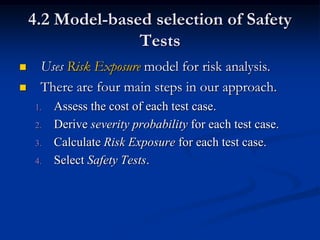
    Uses Risk Exposure model for risk analysis.
    There are four main steps in our approach.
    1.   Assess the cost of each test case.
    2.   Derive severity probability for each test case.
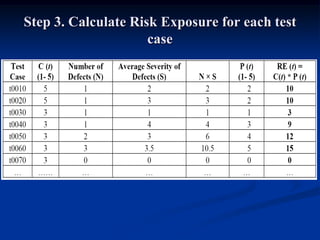
    3.   Calculate Risk Exposure for each test case.
    4.   Select Safety Tests.
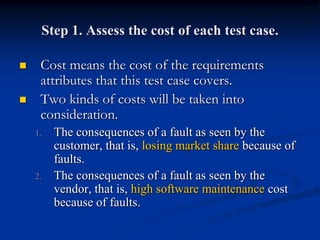
Step 1. Assess the cost of each test case.

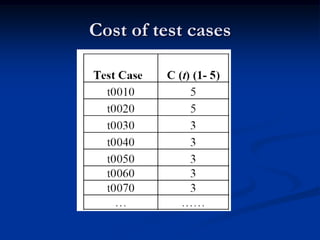
    Cost means the cost of the requirements
     attributes that this test case covers.
    Two kinds of costs will be taken into
     consideration.
    1.   The consequences of a fault as seen by the
         customer, that is, losing market share because of
         faults.
    2.   The consequences of a fault as seen by the
         vendor, that is, high software maintenance cost
         because of faults.
Cost of test cases
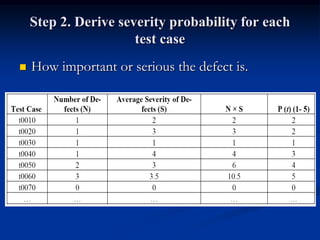
Step 2. Derive severity probability for each
                      test case
   How important or serious the defect is.
Step 3. Calculate Risk Exposure for each test
                     case
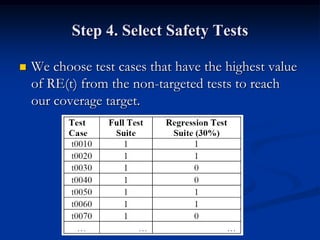
Step 4. Select Safety Tests

   We choose test cases that have the highest value
    of RE(t) from the non-targeted tests to reach
    our coverage target.
4.3 Risk-based end-to-end test
               scenario selection
   End-to-end scenarios simulate common user
    profiles of system uses. Some are equivalent to
    use cases.
     More customer-directed.
     Highly effective at finding regression faults.
    One end-to-end consists of several test cases.
     Every test case tests one or more requirements
     attributes.
     Selection strategy obeys two rules
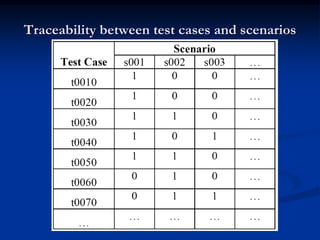
    1.   Select scenarios that cover the most critical test
         cases.
    2.   Have the suite of scenarios cover as many test
         case as possible.
Traceability between test cases and scenarios
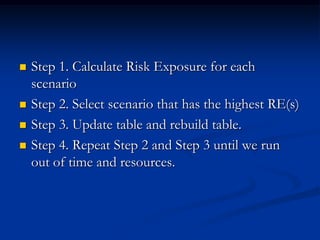
   Step 1. Calculate Risk Exposure for each
    scenario
   Step 2. Select scenario that has the highest RE(s)
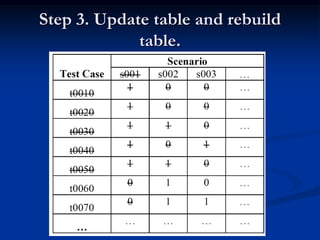
   Step 3. Update table and rebuild table.
   Step 4. Repeat Step 2 and Step 3 until we run
    out of time and resources.
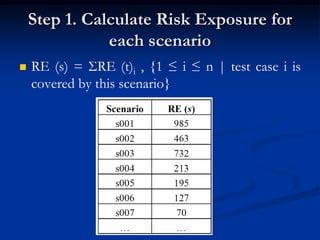
Step 1. Calculate Risk Exposure for
               each scenario
   RE (s) = ΣRE (t)i , {1 ≤ i ≤ n | test case i is
    covered by this scenario}
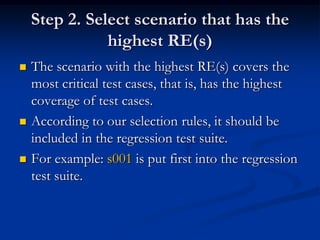
Step 2. Select scenario that has the
               highest RE(s)
   The scenario with the highest RE(s) covers the
    most critical test cases, that is, has the highest
    coverage of test cases.
   According to our selection rules, it should be
    included in the regression test suite.
   For example: s001 is put first into the regression
    test suite.
Step 3. Update table and rebuild
             table.
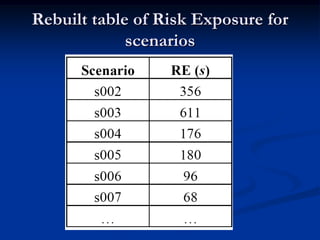
Rebuilt table of Risk Exposure for
             scenarios
Step 4. Repeat Step 2 and Step 3 until
  we run out of time and resources
   The size of our test suite of scenarios is
    dependent on the time and resources available.
   Regression testing is terminated whenever we
    run out of time and resources.
   The final selected regression test suite is the
    union of the Targeted Tests and the Safety Tests.
5. Evaluation
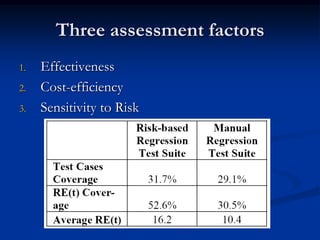
   We applied our approach to three components
    of IBM WebSphere Commerce 5.4. Each
    component was owned by one experienced
    tester. (306 test cases)
   65 defects were opened in the first pass.
   There were 9 defects found, which failed 28
    test cases in the second pass.
Three assessment factors
1.   Effectiveness
2.   Cost-efficiency
3.   Sensitivity to Risk
6. Conclusions
   This technique is Customer-oriented and also Risk-
    based.
   It provides methods to obtain both Targted Tests
    and Safety Tests.
   Future work
     To decide when to stop regression testing.
     Implementing our approach in a production test
      environment.

20050314 specification based regression test selection with risk analysis

  • 1.
    Specification-based regression test selection with risk analysis Zheng-Wen Shen 2005/03/14
  • 2.
    Reference  Specification-based regression test selection with risk analysis  Yanping Chen, Robert L. Probert, D. Paul Sims  Source IBM Centre for Advanced Studies Conference archive  Proceedings of the 2002 conference of the Centre for Advanced Studies on Collaborative research table of contents
  • 3.
    Outline 1. Introduction 2. Background 3. Specification-based test case selection 4. Risk-based test case selection 5. Evaluation 6. Conclusions
  • 4.
    1. Introduction  Regression testing is essential to ensure software quality.  Regression test selection attempts to select a cost-minimized subset of test cases.
  • 5.
    White-box (code-based) V.S.Black- box (specification-based)  Code-based regression test selection is good for unit testing, but it has a scalability problem.  Code-based regression techniques are not suitable for testing larger components at more abstract level.  Code-based regression techniques require testers to access and understand the code.  Code-based regression techniques are language- dependent.
  • 6.
    Two kinds ofregression tests  Targeted Tests, which ensure that important current customer features are still supported adequately in the new release.  Safety Tests, which are risk-directed, and ensure the potential problem areas are properly handled.
  • 7.
    2. Background  2.1 Regression testing  2.2 Controlled Regression Testing Assumption (CRTA)  2.3 Risk Analysis  2.4 Requirement traceability
  • 8.
    2.1 Regression testing  Given a program P, a modified version P’, and a set T of test cases used previously to test P, regression analysis and testing techniques attempt to make use of a subset of T to gain sufficient confidence in the correctness of P’ with respect to behaviors from P retained in P’.  With selective re-test techniques, we only return those test cases that test the affected entities of the modified program.
  • 9.
    2.2 Controlled RegressionTesting Assumption (CRTA)  When P’ is tested with T, we hold all factors that might influence the output of P’, except for the code in P’, constant with respect to their states when we tested P with T.  Ideally, regression tests should be run while CRTA holds.  Testers must identify and document uncontrollable factors and the test cases that are potentially affected by them.
  • 10.
    2.3 Risk Analysis  Risk is anything that threatens the successful achievement of a project’s goals.  Using risk metrics to quantitatively measure the quality of a test suite.  Risk Exposure model by Stale Amland.  RE(f) = P(f) * C(f)
  • 11.
    1. P(f), the probability of a fault being present. 2. C(f), the cost (consequence or impact) of a fault in the corresponding function if it occurs in operation.
  • 12.
    2.4 Requirement traceability  Traceability is a simple, common-sense book- keeping property that can prevent a wide range of problem.  Know which test case verifies a given requirements attribute.  We use the activity diagram to represent the desired system behavior.
  • 13.
    The activity diagramand Test suite for the Get_Quote feature
  • 14.
    Traceability matrix betweenthe activity diagram and test suite
  • 15.
    3. Specification-based testcase selection  3.1 Changes in code  3.2 Changes in specification
  • 16.
    3.1 Changes incode  Changes only happen in the implementation without affecting the specification.  For a developer, any changes in code should be documented in a code change history.  For a tester, traceability needs to be established between the test case and the log of defects.  Test profile  The tester can choose test cases using the traceability matrix.
  • 17.
    3.2 Changes inspecification  Changes happen in requirements or design, the activity diagram need to be modified accordingly.  In a control flow graph (CFG), nodes are used to represent statements, and edges represent the control flow between the statement within a procedure.  We find that the activity diagram is quite similar to the CFG except that the nodes of activity diagram describe activities instead of statements.
  • 18.
    A CFG-based regressiontest selection technique
  • 19.
    Edge-coverage matrix fortest suite T on CFG C
  • 20.
    Regression analysis withthe activity diagram 1. We traverse the activity diagram to identify affected edges. 2. Then we select test cases that execute the affected edges based on the traceability matrix to create our Targeted Tests.
  • 21.
    4. Risk-based testcase selection  4.1 Motivation for risk-based selection.  4.2 Model-based selection of Safety Tests.  4.3 Risk-based end-to-end test scenario selection.
  • 22.
    4.1 Motivation forrisk-based selection  If the developer changes code that cannot be identified by a test profile, and he does not update the code change history, the tester might miss some defects.  To achieve enough confidence, we would like to include some test cases in addition to the Targeted Tests for our regression test suite.
  • 23.
    Useful in twosituations 1. After running the Targeted Tests, if time and resources are available, testers may want to return some test cases to gain more confidence in the modified system. 2. The time to delivery may be extremely short, Safety Tests provide some assurance that the remaining defects in the release will not bring about serious failures.
  • 24.
    4.2 Model-based selectionof Safety Tests  Uses Risk Exposure model for risk analysis.  There are four main steps in our approach. 1. Assess the cost of each test case. 2. Derive severity probability for each test case. 3. Calculate Risk Exposure for each test case. 4. Select Safety Tests.
  • 25.
    Step 1. Assessthe cost of each test case.  Cost means the cost of the requirements attributes that this test case covers.  Two kinds of costs will be taken into consideration. 1. The consequences of a fault as seen by the customer, that is, losing market share because of faults. 2. The consequences of a fault as seen by the vendor, that is, high software maintenance cost because of faults.
  • 26.
  • 27.
    Step 2. Deriveseverity probability for each test case  How important or serious the defect is.
  • 28.
    Step 3. CalculateRisk Exposure for each test case
  • 29.
    Step 4. SelectSafety Tests  We choose test cases that have the highest value of RE(t) from the non-targeted tests to reach our coverage target.
  • 30.
    4.3 Risk-based end-to-endtest scenario selection  End-to-end scenarios simulate common user profiles of system uses. Some are equivalent to use cases.  More customer-directed.  Highly effective at finding regression faults.
  • 31.
    One end-to-end consists of several test cases. Every test case tests one or more requirements attributes.  Selection strategy obeys two rules 1. Select scenarios that cover the most critical test cases. 2. Have the suite of scenarios cover as many test case as possible.
  • 32.
    Traceability between testcases and scenarios
  • 33.
    Step 1. Calculate Risk Exposure for each scenario  Step 2. Select scenario that has the highest RE(s)  Step 3. Update table and rebuild table.  Step 4. Repeat Step 2 and Step 3 until we run out of time and resources.
  • 34.
    Step 1. CalculateRisk Exposure for each scenario  RE (s) = ΣRE (t)i , {1 ≤ i ≤ n | test case i is covered by this scenario}
  • 35.
    Step 2. Selectscenario that has the highest RE(s)  The scenario with the highest RE(s) covers the most critical test cases, that is, has the highest coverage of test cases.  According to our selection rules, it should be included in the regression test suite.  For example: s001 is put first into the regression test suite.
  • 36.
    Step 3. Updatetable and rebuild table.
  • 37.
    Rebuilt table ofRisk Exposure for scenarios
  • 38.
    Step 4. RepeatStep 2 and Step 3 until we run out of time and resources  The size of our test suite of scenarios is dependent on the time and resources available.  Regression testing is terminated whenever we run out of time and resources.  The final selected regression test suite is the union of the Targeted Tests and the Safety Tests.
  • 39.
    5. Evaluation  We applied our approach to three components of IBM WebSphere Commerce 5.4. Each component was owned by one experienced tester. (306 test cases)  65 defects were opened in the first pass.  There were 9 defects found, which failed 28 test cases in the second pass.
  • 40.
    Three assessment factors 1. Effectiveness 2. Cost-efficiency 3. Sensitivity to Risk
  • 41.
    6. Conclusions  This technique is Customer-oriented and also Risk- based.  It provides methods to obtain both Targted Tests and Safety Tests.  Future work  To decide when to stop regression testing.  Implementing our approach in a production test environment.