1Slide© 2005 Thomson/South-Western
Chapter 13
Decision Analysis
 Problem Formulation
 Decision Making without
Probabilities
 Decision Making with Probabilities
 Risk Analysis and Sensitivity
Analysis
 Decision Analysis with Sample
Information
 Computing Branch Probabilities
2Slide© 2005 Thomson/South-Western
Problem Formulation
 A decision problem is characterized by
decision alternatives, states of nature, and
resulting payoffs.
 The decision alternatives are the different
possible strategies the decision maker can
employ.
 The states of nature refer to future events,
not under the control of the decision maker,
which may occur. States of nature should
be defined so that they are mutually
exclusive and collectively exhaustive.
3Slide© 2005 Thomson/South-Western
Influence Diagrams
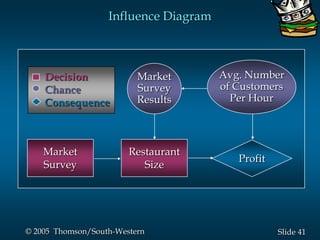
 An influence diagram is a graphical device
showing the relationships among the
decisions, the chance events, and the
consequences.
 Squares or rectangles depict decision nodes.
 Circles or ovals depict chance nodes.
 Diamonds depict consequence nodes.
 Lines or arcs connecting the nodes show the
direction of influence.
4Slide© 2005 Thomson/South-Western
Payoff Tables
 The consequence resulting from a specific
combination of a decision alternative and a
state of nature is a payoff.
 A table showing payoffs for all combinations
of decision alternatives and states of nature is
a payoff table.
 Payoffs can be expressed in terms of profit,
cost, time, distance or any other appropriate
measure.
5Slide© 2005 Thomson/South-Western
Decision Trees
 A decision tree is a chronological
representation of the decision problem.
 Each decision tree has two types of
nodes; round nodes correspond to the
states of nature while square nodes
correspond to the decision alternatives.
6Slide© 2005 Thomson/South-Western
The branches leaving each round node
represent the different states of nature
while the branches leaving each
square node represent the different
decision alternatives.
At the end of each limb of a tree are the
payoffs attained from the series of
branches making up that limb.
7Slide© 2005 Thomson/South-Western
Decision Making without Probabilities
 Three commonly used criteria for
decision making when probability
information regarding the likelihood
of the states of nature is unavailable
are:
•the optimistic approach
•the conservative approach
•the minimax regret approach.
8Slide© 2005 Thomson/South-Western
Optimistic Approach
 The optimistic approach would be used
by an optimistic decision maker.
 The decision with the largest possible
payoff is chosen.
 If the payoff table was in terms of costs,
the decision with the lowest cost would
be chosen.
9Slide© 2005 Thomson/South-Western
Conservative Approach
 The conservative approach would be used by a
conservative decision maker.
 For each decision the minimum payoff is listed and
then the decision corresponding to the maximum
of these minimum payoffs is selected. (Hence, the
minimum possible payoff is maximized.)
 If the payoff was in terms of costs, the maximum
costs would be determined for each decision and
then the decision corresponding to the minimum
of these maximum costs is selected. (Hence, the
maximum possible cost is minimized.)
10Slide© 2005 Thomson/South-Western
Minimax Regret Approach
 The minimax regret approach requires the
construction of a regret table or an opportunity
loss table.
 This is done by calculating for each state of nature
the difference between each payoff and the largest
payoff for that state of nature.
 Then, using this regret table, the maximum regret
for each possible decision is listed.
 The decision chosen is the one corresponding to
the minimum of the maximum regrets.
11Slide© 2005 Thomson/South-Western
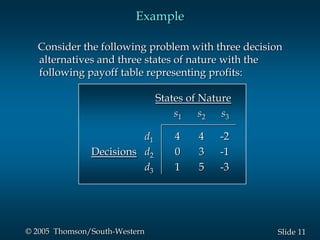
Example
Consider the following problem with three decision
alternatives and three states of nature with the
following payoff table representing profits:
States of Nature
s1 s2 s3
d1 4 4 -2
Decisions d2 0 3 -1
d3 1 5 -3
12Slide© 2005 Thomson/South-Western
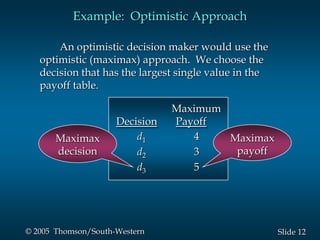
Example: Optimistic Approach
An optimistic decision maker would use the
optimistic (maximax) approach. We choose the
decision that has the largest single value in the
payoff table.
Maximum
Decision Payoff
d1 4
d2 3
d3 5
Maximax
payoff
Maximax
decision
13Slide© 2005 Thomson/South-Western
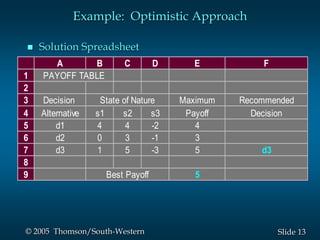
Example: Optimistic Approach
 Solution Spreadsheet
A B C D E F
1
2
3 Decision Maximum Recommended
4 Alternative s1 s2 s3 Payoff Decision
5 d1 4 4 -2 4
6 d2 0 3 -1 3
7 d3 1 5 -3 5 d3
8
9 5
State of Nature
Best Payoff
PAYOFF TABLE
14Slide© 2005 Thomson/South-Western
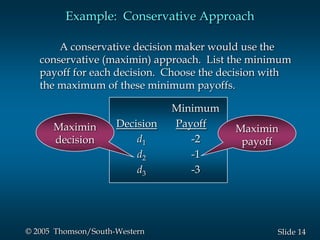
Example: Conservative Approach
A conservative decision maker would use the
conservative (maximin) approach. List the minimum
payoff for each decision. Choose the decision with
the maximum of these minimum payoffs.
Minimum
Decision Payoff
d1 -2
d2 -1
d3 -3
Maximin
decision
Maximin
payoff
15Slide© 2005 Thomson/South-Western
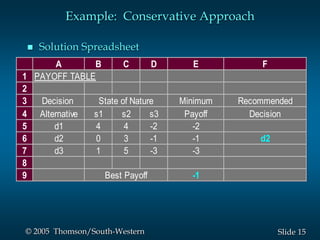
Example: Conservative Approach
 Solution Spreadsheet
A B C D E F
1
2
3 Decision Minimum Recommended
4 Alternative s1 s2 s3 Payoff Decision
5 d1 4 4 -2 -2
6 d2 0 3 -1 -1 d2
7 d3 1 5 -3 -3
8
9 -1
State of Nature
Best Payoff
PAYOFF TABLE
16Slide© 2005 Thomson/South-Western
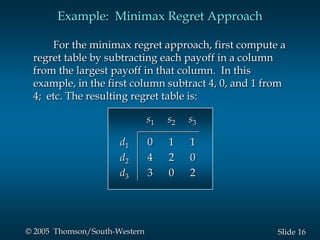
For the minimax regret approach, first compute a
regret table by subtracting each payoff in a column
from the largest payoff in that column. In this
example, in the first column subtract 4, 0, and 1 from
4; etc. The resulting regret table is:
s1 s2 s3
d1 0 1 1
d2 4 2 0
d3 3 0 2
Example: Minimax Regret Approach
17Slide© 2005 Thomson/South-Western
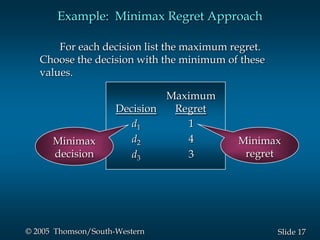
For each decision list the maximum regret.
Choose the decision with the minimum of these
values.
Maximum
Decision Regret
d1 1
d2 4
d3 3
Example: Minimax Regret Approach
Minimax
decision
Minimax
regret
18Slide© 2005 Thomson/South-Western
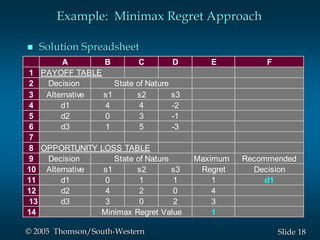
 Solution Spreadsheet
A B C D E F
1
2 Decision
3 Alternative s1 s2 s3
4 d1 4 4 -2
5 d2 0 3 -1
6 d3 1 5 -3
7
8
9 Decision Maximum Recommended
10 Alternative s1 s2 s3 Regret Decision
11 d1 0 1 1 1 d1
12 d2 4 2 0 4
13 d3 3 0 2 3
14 1Minimax Regret Value
State of Nature
PAYOFF TABLE
State of Nature
OPPORTUNITY LOSS TABLE
Example: Minimax Regret Approach
19Slide© 2005 Thomson/South-Western
Decision Making with Probabilities
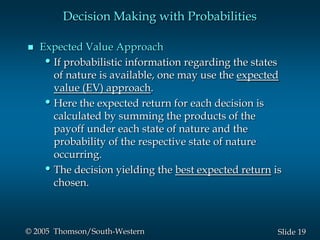
 Expected Value Approach
•If probabilistic information regarding the states
of nature is available, one may use the expected
value (EV) approach.
•Here the expected return for each decision is
calculated by summing the products of the
payoff under each state of nature and the
probability of the respective state of nature
occurring.
•The decision yielding the best expected return is
chosen.
20Slide© 2005 Thomson/South-Western
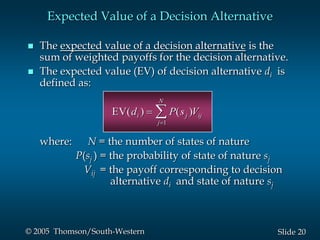
 The expected value of a decision alternative is the
sum of weighted payoffs for the decision alternative.
 The expected value (EV) of decision alternative di is
defined as:
where: N = the number of states of nature
P(sj ) = the probability of state of nature sj
Vij = the payoff corresponding to decision
alternative di and state of nature sj
Expected Value of a Decision Alternative
EV( ) ( )d P s Vi j ij
j
N
1
EV( ) ( )d P s Vi j ij
j
N
1
21Slide© 2005 Thomson/South-Western
Example: Burger Prince
Burger Prince Restaurant is considering opening
a new restaurant on Main Street. It has three
different models, each with a different
seating capacity. Burger Prince
estimates that the average number of
customers per hour will be 80, 100, or
120. The payoff table for the three
models is on the next slide.
22Slide© 2005 Thomson/South-Western
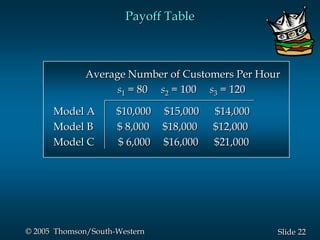
Payoff Table
Average Number of Customers Per Hour
s1 = 80 s2 = 100 s3 = 120
Model A $10,000 $15,000 $14,000
Model B $ 8,000 $18,000 $12,000
Model C $ 6,000 $16,000 $21,000
23Slide© 2005 Thomson/South-Western
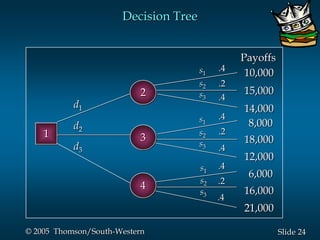
Expected Value Approach
Calculate the expected value for each decision.
The decision tree on the next slide can assist in this
calculation. Here d1, d2, d3 represent the decision
alternatives of models A, B, C, and s1, s2, s3 represent
the states of nature of 80, 100, and 120.
24Slide© 2005 Thomson/South-Western
Decision Tree
1
.2
.4
.4
.4
.2
.4
.4
.2
.4
d1
d2
d3
s1
s1
s1
s2
s3
s2
s2
s3
s3
Payoffs
10,000
15,000
14,000
8,000
18,000
12,000
6,000
16,000
21,000
2
3
4
25Slide© 2005 Thomson/South-Western
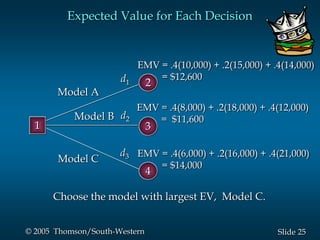
Expected Value for Each Decision
Choose the model with largest EV, Model C.
3
d1
d2
d3
EMV = .4(10,000) + .2(15,000) + .4(14,000)
= $12,600
EMV = .4(8,000) + .2(18,000) + .4(12,000)
= $11,600
EMV = .4(6,000) + .2(16,000) + .4(21,000)
= $14,000
Model A
Model B
Model C
2
1
4
26Slide© 2005 Thomson/South-Western
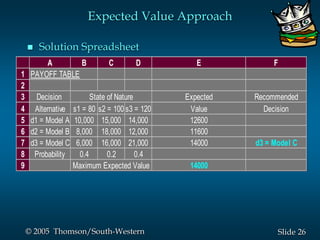
 Solution Spreadsheet
A B C D E F
1
2
3 Decision Expected Recommended
4 Alternative s1 = 80 s2 = 100 s3 = 120 Value Decision
5 d1 = Model A 10,000 15,000 14,000 12600
6 d2 = Model B 8,000 18,000 12,000 11600
7 d3 = Model C 6,000 16,000 21,000 14000 d3 = Model C
8 Probability 0.4 0.2 0.4
9 14000
State of Nature
Maximum Expected Value
PAYOFF TABLE
Expected Value Approach
27Slide© 2005 Thomson/South-Western
Expected Value of Perfect Information
 Frequently information is available which can
improve the probability estimates for the states of
nature.
 The expected value of perfect information (EVPI) is
the increase in the expected profit that would
result if one knew with certainty which state of
nature would occur.
 The EVPI provides an upper bound on the
expected value of any sample or survey
information.
28Slide© 2005 Thomson/South-Western
Expected Value of Perfect Information
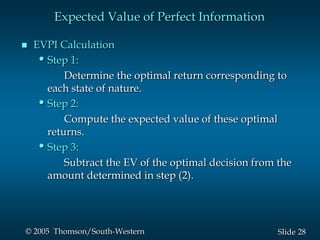
 EVPI Calculation
•Step 1:
Determine the optimal return corresponding to
each state of nature.
•Step 2:
Compute the expected value of these optimal
returns.
•Step 3:
Subtract the EV of the optimal decision from the
amount determined in step (2).
29Slide© 2005 Thomson/South-Western
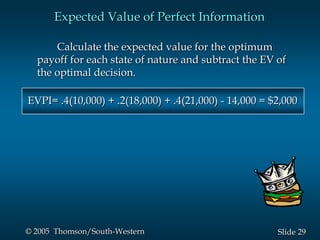
Calculate the expected value for the optimum
payoff for each state of nature and subtract the EV of
the optimal decision.
EVPI= .4(10,000) + .2(18,000) + .4(21,000) - 14,000 = $2,000
Expected Value of Perfect Information
30Slide© 2005 Thomson/South-Western
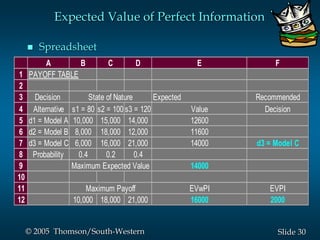
 Spreadsheet
A B C D E F
1
2
3 Decision Expected Recommended
4 Alternative s1 = 80 s2 = 100 s3 = 120 Value Decision
5 d1 = Model A 10,000 15,000 14,000 12600
6 d2 = Model B 8,000 18,000 12,000 11600
7 d3 = Model C 6,000 16,000 21,000 14000 d3 = Model C
8 Probability 0.4 0.2 0.4
9 14000
10
11 EVwPI EVPI
12 10,000 18,000 21,000 16000 2000
State of Nature
Maximum Expected Value
PAYOFF TABLE
Maximum Payoff
Expected Value of Perfect Information
31Slide© 2005 Thomson/South-Western
Risk Analysis
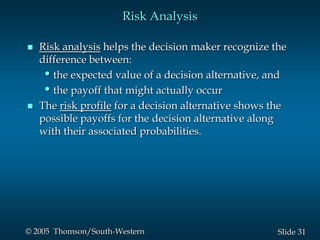
 Risk analysis helps the decision maker recognize the
difference between:
•the expected value of a decision alternative, and
•the payoff that might actually occur
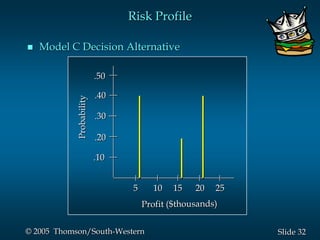
 The risk profile for a decision alternative shows the
possible payoffs for the decision alternative along
with their associated probabilities.
32Slide© 2005 Thomson/South-Western
Risk Profile
 Model C Decision Alternative
.10
.20
.30
.40
.50
5 10 15 20 25
Probability
33Slide© 2005 Thomson/South-Western
Sensitivity Analysis
 Sensitivity analysis can be used to determine how
changes to the following inputs affect the
recommended decision alternative:
•probabilities for the states of nature
•values of the payoffs
 If a small change in the value of one of the inputs
causes a change in the recommended decision
alternative, extra effort and care should be taken in
estimating the input value.
34Slide© 2005 Thomson/South-Western
Bayes’ Theorem and Posterior Probabilities
 Knowledge of sample (survey) information can be used
to revise the probability estimates for the states of nature.
 Prior to obtaining this information, the probability
estimates for the states of nature are called prior
probabilities.
 With knowledge of conditional probabilities for the
outcomes or indicators of the sample or survey
information, these prior probabilities can be revised by
employing Bayes' Theorem.
 The outcomes of this analysis are called posterior
probabilities or branch probabilities for decision trees.
35Slide© 2005 Thomson/South-Western
Computing Branch Probabilities
 Branch (Posterior) Probabilities Calculation
•Step 1:
For each state of nature, multiply the prior
probability by its conditional probability for the
indicator -- this gives the joint probabilities for the
states and indicator.
36Slide© 2005 Thomson/South-Western
Computing Branch Probabilities
 Branch (Posterior) Probabilities Calculation
•Step 2:
Sum these joint probabilities over all states -- this
gives the marginal probability for the indicator.
•Step 3:
For each state, divide its joint probability by the
marginal probability for the indicator -- this gives
the posterior probability distribution.
37Slide© 2005 Thomson/South-Western
Expected Value of Sample Information
 The expected value of sample information (EVSI) is
the additional expected profit possible through
knowledge of the sample or survey information.
38Slide© 2005 Thomson/South-Western
Expected Value of Sample Information
 EVSI Calculation
•Step 1:
Determine the optimal decision and its expected
return for the possible outcomes of the sample using
the posterior probabilities for the states of nature.
•Step 2:
Compute the expected value of these optimal
returns.
•Step 3:
Subtract the EV of the optimal decision obtained
without using the sample information from the
amount determined in step (2).
39Slide© 2005 Thomson/South-Western
Efficiency of Sample Information
 Efficiency of sample information is the ratio of EVSI
to EVPI.
 As the EVPI provides an upper bound for the EVSI,
efficiency is always a number between 0 and 1.
40Slide© 2005 Thomson/South-Western
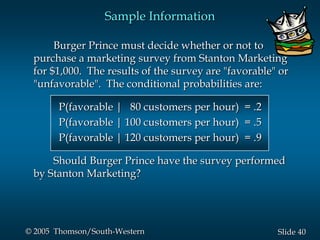
Burger Prince must decide whether or not to
purchase a marketing survey from Stanton Marketing
for $1,000. The results of the survey are "favorable" or
"unfavorable". The conditional probabilities are:
P(favorable | 80 customers per hour) = .2
P(favorable | 100 customers per hour) = .5
P(favorable | 120 customers per hour) = .9
Should Burger Prince have the survey performed
by Stanton Marketing?
Sample Information
41Slide© 2005 Thomson/South-Western
Influence Diagram
Restaurant
Size
Profit
Avg. Number
of Customers
Per Hour
Market
Survey
Results
Market
Survey
Decision
Chance
Consequence
42Slide© 2005 Thomson/South-Western
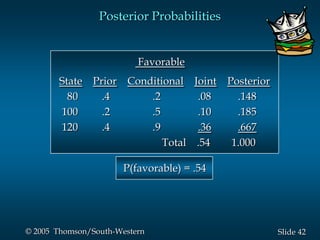
Favorable
State Prior Conditional Joint Posterior
80 .4 .2 .08 .148
100 .2 .5 .10 .185
120 .4 .9 .36 .667
Total .54 1.000
P(favorable) = .54
Posterior Probabilities
43Slide© 2005 Thomson/South-Western
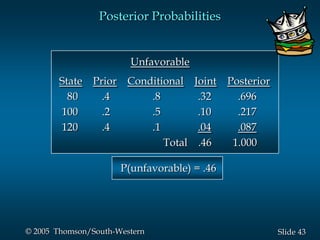
Unfavorable
State Prior Conditional Joint Posterior
80 .4 .8 .32 .696
100 .2 .5 .10 .217
120 .4 .1 .04 .087
Total .46 1.000
P(unfavorable) = .46
Posterior Probabilities
44Slide© 2005 Thomson/South-Western
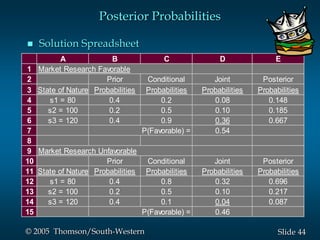
 Solution Spreadsheet
A B C D E
1
2 Prior Conditional Joint Posterior
3 State of Nature Probabilities Probabilities Probabilities Probabilities
4 s1 = 80 0.4 0.2 0.08 0.148
5 s2 = 100 0.2 0.5 0.10 0.185
6 s3 = 120 0.4 0.9 0.36 0.667
7 0.54
8
9
10 Prior Conditional Joint Posterior
11 State of Nature Probabilities Probabilities Probabilities Probabilities
12 s1 = 80 0.4 0.8 0.32 0.696
13 s2 = 100 0.2 0.5 0.10 0.217
14 s3 = 120 0.4 0.1 0.04 0.087
15 0.46
Market Research Favorable
P(Favorable) =
Market Research Unfavorable
P(Favorable) =
Posterior Probabilities
45Slide© 2005 Thomson/South-Western
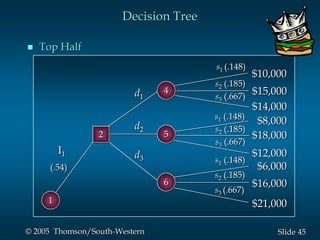
Decision Tree
 Top Half
s1 (.148)
s1 (.148)
s1 (.148)
s2 (.185)
s2 (.185)
s2 (.185)
s3 (.667)
s3 (.667)
s3 (.667)
$10,000
$15,000
$14,000
$8,000
$18,000
$12,000
$6,000
$16,000
$21,000
I1
(.54)
d1
d2
d3
2
4
5
6
1
46Slide© 2005 Thomson/South-Western
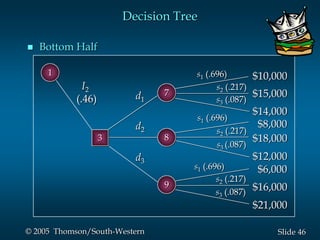
 Bottom Half
s1 (.696)
s1 (.696)
s1 (.696)
s2 (.217)
s2 (.217)
s2 (.217)
s3 (.087)
s3 (.087)
s3 (.087)
$10,000
$15,000
$18,000
$14,000
$8,000
$12,000
$6,000
$16,000
$21,000
I2
(.46) d1
d2
d3
7
9
83
1
Decision Tree
47Slide© 2005 Thomson/South-Western
I2
(.46)
d1
d2
d3
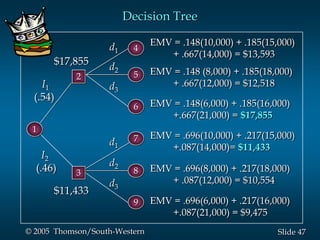
EMV = .696(10,000) + .217(15,000)
+.087(14,000)= $11,433
EMV = .696(8,000) + .217(18,000)
+ .087(12,000) = $10,554
EMV = .696(6,000) + .217(16,000)
+.087(21,000) = $9,475
I1
(.54)
d1
d2
d3
EMV = .148(10,000) + .185(15,000)
+ .667(14,000) = $13,593
EMV = .148 (8,000) + .185(18,000)
+ .667(12,000) = $12,518
EMV = .148(6,000) + .185(16,000)
+.667(21,000) = $17,855
4
5
6
7
8
9
2
3
1
$17,855
$11,433
Decision Tree
48Slide© 2005 Thomson/South-Western
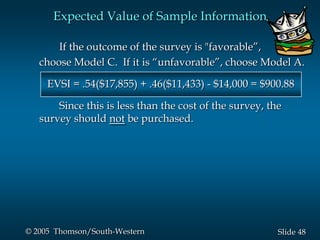
If the outcome of the survey is "favorable”,
choose Model C. If it is “unfavorable”, choose Model A.
EVSI = .54($17,855) + .46($11,433) - $14,000 = $900.88
Since this is less than the cost of the survey, the
survey should not be purchased.
Expected Value of Sample Information
49Slide© 2005 Thomson/South-Western
Efficiency of Sample Information
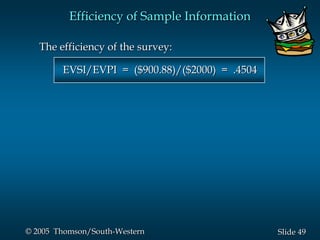
The efficiency of the survey:
EVSI/EVPI = ($900.88)/($2000) = .4504
50Slide© 2005 Thomson/South-Western
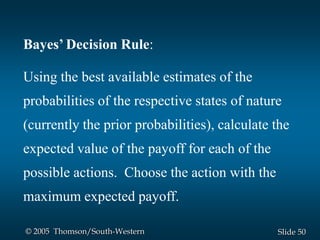
Bayes’ Decision Rule:
Using the best available estimates of the
probabilities of the respective states of nature
(currently the prior probabilities), calculate the
expected value of the payoff for each of the
possible actions. Choose the action with the
maximum expected payoff.
51Slide© 2005 Thomson/South-Western
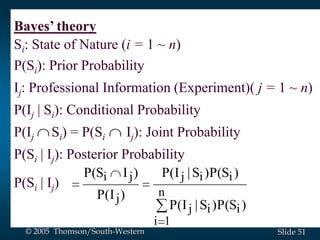
Bayes’ theory
Si: State of Nature (i = 1 ~ n)
P(Si): Prior Probability
Ij: Professional Information (Experiment)( j = 1 ~ n)
P(Ij | Si): Conditional Probability
P(Ij Si) = P(Si Ij): Joint Probability
P(Si | Ij): Posterior Probability
P(Si | Ij)
n
1i
iij
iij
j
ji
)S(P)S|I(P
)S(P)S|I(P
)I(P
)IS(P
52Slide© 2005 Thomson/South-Western
Home Work
 Problem 13-10
 Problem 13-21
 Due Date: Nov 11, 2008

Decision analysis

  • 1.
    1Slide© 2005 Thomson/South-Western Chapter13 Decision Analysis  Problem Formulation  Decision Making without Probabilities  Decision Making with Probabilities  Risk Analysis and Sensitivity Analysis  Decision Analysis with Sample Information  Computing Branch Probabilities
  • 2.
    2Slide© 2005 Thomson/South-Western ProblemFormulation  A decision problem is characterized by decision alternatives, states of nature, and resulting payoffs.  The decision alternatives are the different possible strategies the decision maker can employ.  The states of nature refer to future events, not under the control of the decision maker, which may occur. States of nature should be defined so that they are mutually exclusive and collectively exhaustive.
  • 3.
    3Slide© 2005 Thomson/South-Western InfluenceDiagrams  An influence diagram is a graphical device showing the relationships among the decisions, the chance events, and the consequences.  Squares or rectangles depict decision nodes.  Circles or ovals depict chance nodes.  Diamonds depict consequence nodes.  Lines or arcs connecting the nodes show the direction of influence.
  • 4.
    4Slide© 2005 Thomson/South-Western PayoffTables  The consequence resulting from a specific combination of a decision alternative and a state of nature is a payoff.  A table showing payoffs for all combinations of decision alternatives and states of nature is a payoff table.  Payoffs can be expressed in terms of profit, cost, time, distance or any other appropriate measure.
  • 5.
    5Slide© 2005 Thomson/South-Western DecisionTrees  A decision tree is a chronological representation of the decision problem.  Each decision tree has two types of nodes; round nodes correspond to the states of nature while square nodes correspond to the decision alternatives.
  • 6.
    6Slide© 2005 Thomson/South-Western Thebranches leaving each round node represent the different states of nature while the branches leaving each square node represent the different decision alternatives. At the end of each limb of a tree are the payoffs attained from the series of branches making up that limb.
  • 7.
    7Slide© 2005 Thomson/South-Western DecisionMaking without Probabilities  Three commonly used criteria for decision making when probability information regarding the likelihood of the states of nature is unavailable are: •the optimistic approach •the conservative approach •the minimax regret approach.
  • 8.
    8Slide© 2005 Thomson/South-Western OptimisticApproach  The optimistic approach would be used by an optimistic decision maker.  The decision with the largest possible payoff is chosen.  If the payoff table was in terms of costs, the decision with the lowest cost would be chosen.
  • 9.
    9Slide© 2005 Thomson/South-Western ConservativeApproach  The conservative approach would be used by a conservative decision maker.  For each decision the minimum payoff is listed and then the decision corresponding to the maximum of these minimum payoffs is selected. (Hence, the minimum possible payoff is maximized.)  If the payoff was in terms of costs, the maximum costs would be determined for each decision and then the decision corresponding to the minimum of these maximum costs is selected. (Hence, the maximum possible cost is minimized.)
  • 10.
    10Slide© 2005 Thomson/South-Western MinimaxRegret Approach  The minimax regret approach requires the construction of a regret table or an opportunity loss table.  This is done by calculating for each state of nature the difference between each payoff and the largest payoff for that state of nature.  Then, using this regret table, the maximum regret for each possible decision is listed.  The decision chosen is the one corresponding to the minimum of the maximum regrets.
  • 11.
    11Slide© 2005 Thomson/South-Western Example Considerthe following problem with three decision alternatives and three states of nature with the following payoff table representing profits: States of Nature s1 s2 s3 d1 4 4 -2 Decisions d2 0 3 -1 d3 1 5 -3
  • 12.
    12Slide© 2005 Thomson/South-Western Example:Optimistic Approach An optimistic decision maker would use the optimistic (maximax) approach. We choose the decision that has the largest single value in the payoff table. Maximum Decision Payoff d1 4 d2 3 d3 5 Maximax payoff Maximax decision
  • 13.
    13Slide© 2005 Thomson/South-Western Example:Optimistic Approach  Solution Spreadsheet A B C D E F 1 2 3 Decision Maximum Recommended 4 Alternative s1 s2 s3 Payoff Decision 5 d1 4 4 -2 4 6 d2 0 3 -1 3 7 d3 1 5 -3 5 d3 8 9 5 State of Nature Best Payoff PAYOFF TABLE
  • 14.
    14Slide© 2005 Thomson/South-Western Example:Conservative Approach A conservative decision maker would use the conservative (maximin) approach. List the minimum payoff for each decision. Choose the decision with the maximum of these minimum payoffs. Minimum Decision Payoff d1 -2 d2 -1 d3 -3 Maximin decision Maximin payoff
  • 15.
    15Slide© 2005 Thomson/South-Western Example:Conservative Approach  Solution Spreadsheet A B C D E F 1 2 3 Decision Minimum Recommended 4 Alternative s1 s2 s3 Payoff Decision 5 d1 4 4 -2 -2 6 d2 0 3 -1 -1 d2 7 d3 1 5 -3 -3 8 9 -1 State of Nature Best Payoff PAYOFF TABLE
  • 16.
    16Slide© 2005 Thomson/South-Western Forthe minimax regret approach, first compute a regret table by subtracting each payoff in a column from the largest payoff in that column. In this example, in the first column subtract 4, 0, and 1 from 4; etc. The resulting regret table is: s1 s2 s3 d1 0 1 1 d2 4 2 0 d3 3 0 2 Example: Minimax Regret Approach
  • 17.
    17Slide© 2005 Thomson/South-Western Foreach decision list the maximum regret. Choose the decision with the minimum of these values. Maximum Decision Regret d1 1 d2 4 d3 3 Example: Minimax Regret Approach Minimax decision Minimax regret
  • 18.
    18Slide© 2005 Thomson/South-Western Solution Spreadsheet A B C D E F 1 2 Decision 3 Alternative s1 s2 s3 4 d1 4 4 -2 5 d2 0 3 -1 6 d3 1 5 -3 7 8 9 Decision Maximum Recommended 10 Alternative s1 s2 s3 Regret Decision 11 d1 0 1 1 1 d1 12 d2 4 2 0 4 13 d3 3 0 2 3 14 1Minimax Regret Value State of Nature PAYOFF TABLE State of Nature OPPORTUNITY LOSS TABLE Example: Minimax Regret Approach
  • 19.
    19Slide© 2005 Thomson/South-Western DecisionMaking with Probabilities  Expected Value Approach •If probabilistic information regarding the states of nature is available, one may use the expected value (EV) approach. •Here the expected return for each decision is calculated by summing the products of the payoff under each state of nature and the probability of the respective state of nature occurring. •The decision yielding the best expected return is chosen.
  • 20.
    20Slide© 2005 Thomson/South-Western The expected value of a decision alternative is the sum of weighted payoffs for the decision alternative.  The expected value (EV) of decision alternative di is defined as: where: N = the number of states of nature P(sj ) = the probability of state of nature sj Vij = the payoff corresponding to decision alternative di and state of nature sj Expected Value of a Decision Alternative EV( ) ( )d P s Vi j ij j N 1 EV( ) ( )d P s Vi j ij j N 1
  • 21.
    21Slide© 2005 Thomson/South-Western Example:Burger Prince Burger Prince Restaurant is considering opening a new restaurant on Main Street. It has three different models, each with a different seating capacity. Burger Prince estimates that the average number of customers per hour will be 80, 100, or 120. The payoff table for the three models is on the next slide.
  • 22.
    22Slide© 2005 Thomson/South-Western PayoffTable Average Number of Customers Per Hour s1 = 80 s2 = 100 s3 = 120 Model A $10,000 $15,000 $14,000 Model B $ 8,000 $18,000 $12,000 Model C $ 6,000 $16,000 $21,000
  • 23.
    23Slide© 2005 Thomson/South-Western ExpectedValue Approach Calculate the expected value for each decision. The decision tree on the next slide can assist in this calculation. Here d1, d2, d3 represent the decision alternatives of models A, B, C, and s1, s2, s3 represent the states of nature of 80, 100, and 120.
  • 24.
    24Slide© 2005 Thomson/South-Western DecisionTree 1 .2 .4 .4 .4 .2 .4 .4 .2 .4 d1 d2 d3 s1 s1 s1 s2 s3 s2 s2 s3 s3 Payoffs 10,000 15,000 14,000 8,000 18,000 12,000 6,000 16,000 21,000 2 3 4
  • 25.
    25Slide© 2005 Thomson/South-Western ExpectedValue for Each Decision Choose the model with largest EV, Model C. 3 d1 d2 d3 EMV = .4(10,000) + .2(15,000) + .4(14,000) = $12,600 EMV = .4(8,000) + .2(18,000) + .4(12,000) = $11,600 EMV = .4(6,000) + .2(16,000) + .4(21,000) = $14,000 Model A Model B Model C 2 1 4
  • 26.
    26Slide© 2005 Thomson/South-Western Solution Spreadsheet A B C D E F 1 2 3 Decision Expected Recommended 4 Alternative s1 = 80 s2 = 100 s3 = 120 Value Decision 5 d1 = Model A 10,000 15,000 14,000 12600 6 d2 = Model B 8,000 18,000 12,000 11600 7 d3 = Model C 6,000 16,000 21,000 14000 d3 = Model C 8 Probability 0.4 0.2 0.4 9 14000 State of Nature Maximum Expected Value PAYOFF TABLE Expected Value Approach
  • 27.
    27Slide© 2005 Thomson/South-Western ExpectedValue of Perfect Information  Frequently information is available which can improve the probability estimates for the states of nature.  The expected value of perfect information (EVPI) is the increase in the expected profit that would result if one knew with certainty which state of nature would occur.  The EVPI provides an upper bound on the expected value of any sample or survey information.
  • 28.
    28Slide© 2005 Thomson/South-Western ExpectedValue of Perfect Information  EVPI Calculation •Step 1: Determine the optimal return corresponding to each state of nature. •Step 2: Compute the expected value of these optimal returns. •Step 3: Subtract the EV of the optimal decision from the amount determined in step (2).
  • 29.
    29Slide© 2005 Thomson/South-Western Calculatethe expected value for the optimum payoff for each state of nature and subtract the EV of the optimal decision. EVPI= .4(10,000) + .2(18,000) + .4(21,000) - 14,000 = $2,000 Expected Value of Perfect Information
  • 30.
    30Slide© 2005 Thomson/South-Western Spreadsheet A B C D E F 1 2 3 Decision Expected Recommended 4 Alternative s1 = 80 s2 = 100 s3 = 120 Value Decision 5 d1 = Model A 10,000 15,000 14,000 12600 6 d2 = Model B 8,000 18,000 12,000 11600 7 d3 = Model C 6,000 16,000 21,000 14000 d3 = Model C 8 Probability 0.4 0.2 0.4 9 14000 10 11 EVwPI EVPI 12 10,000 18,000 21,000 16000 2000 State of Nature Maximum Expected Value PAYOFF TABLE Maximum Payoff Expected Value of Perfect Information
  • 31.
    31Slide© 2005 Thomson/South-Western RiskAnalysis  Risk analysis helps the decision maker recognize the difference between: •the expected value of a decision alternative, and •the payoff that might actually occur  The risk profile for a decision alternative shows the possible payoffs for the decision alternative along with their associated probabilities.
  • 32.
    32Slide© 2005 Thomson/South-Western RiskProfile  Model C Decision Alternative .10 .20 .30 .40 .50 5 10 15 20 25 Probability
  • 33.
    33Slide© 2005 Thomson/South-Western SensitivityAnalysis  Sensitivity analysis can be used to determine how changes to the following inputs affect the recommended decision alternative: •probabilities for the states of nature •values of the payoffs  If a small change in the value of one of the inputs causes a change in the recommended decision alternative, extra effort and care should be taken in estimating the input value.
  • 34.
    34Slide© 2005 Thomson/South-Western Bayes’Theorem and Posterior Probabilities  Knowledge of sample (survey) information can be used to revise the probability estimates for the states of nature.  Prior to obtaining this information, the probability estimates for the states of nature are called prior probabilities.  With knowledge of conditional probabilities for the outcomes or indicators of the sample or survey information, these prior probabilities can be revised by employing Bayes' Theorem.  The outcomes of this analysis are called posterior probabilities or branch probabilities for decision trees.
  • 35.
    35Slide© 2005 Thomson/South-Western ComputingBranch Probabilities  Branch (Posterior) Probabilities Calculation •Step 1: For each state of nature, multiply the prior probability by its conditional probability for the indicator -- this gives the joint probabilities for the states and indicator.
  • 36.
    36Slide© 2005 Thomson/South-Western ComputingBranch Probabilities  Branch (Posterior) Probabilities Calculation •Step 2: Sum these joint probabilities over all states -- this gives the marginal probability for the indicator. •Step 3: For each state, divide its joint probability by the marginal probability for the indicator -- this gives the posterior probability distribution.
  • 37.
    37Slide© 2005 Thomson/South-Western ExpectedValue of Sample Information  The expected value of sample information (EVSI) is the additional expected profit possible through knowledge of the sample or survey information.
  • 38.
    38Slide© 2005 Thomson/South-Western ExpectedValue of Sample Information  EVSI Calculation •Step 1: Determine the optimal decision and its expected return for the possible outcomes of the sample using the posterior probabilities for the states of nature. •Step 2: Compute the expected value of these optimal returns. •Step 3: Subtract the EV of the optimal decision obtained without using the sample information from the amount determined in step (2).
  • 39.
    39Slide© 2005 Thomson/South-Western Efficiencyof Sample Information  Efficiency of sample information is the ratio of EVSI to EVPI.  As the EVPI provides an upper bound for the EVSI, efficiency is always a number between 0 and 1.
  • 40.
    40Slide© 2005 Thomson/South-Western BurgerPrince must decide whether or not to purchase a marketing survey from Stanton Marketing for $1,000. The results of the survey are "favorable" or "unfavorable". The conditional probabilities are: P(favorable | 80 customers per hour) = .2 P(favorable | 100 customers per hour) = .5 P(favorable | 120 customers per hour) = .9 Should Burger Prince have the survey performed by Stanton Marketing? Sample Information
  • 41.
    41Slide© 2005 Thomson/South-Western InfluenceDiagram Restaurant Size Profit Avg. Number of Customers Per Hour Market Survey Results Market Survey Decision Chance Consequence
  • 42.
    42Slide© 2005 Thomson/South-Western Favorable StatePrior Conditional Joint Posterior 80 .4 .2 .08 .148 100 .2 .5 .10 .185 120 .4 .9 .36 .667 Total .54 1.000 P(favorable) = .54 Posterior Probabilities
  • 43.
    43Slide© 2005 Thomson/South-Western Unfavorable StatePrior Conditional Joint Posterior 80 .4 .8 .32 .696 100 .2 .5 .10 .217 120 .4 .1 .04 .087 Total .46 1.000 P(unfavorable) = .46 Posterior Probabilities
  • 44.
    44Slide© 2005 Thomson/South-Western Solution Spreadsheet A B C D E 1 2 Prior Conditional Joint Posterior 3 State of Nature Probabilities Probabilities Probabilities Probabilities 4 s1 = 80 0.4 0.2 0.08 0.148 5 s2 = 100 0.2 0.5 0.10 0.185 6 s3 = 120 0.4 0.9 0.36 0.667 7 0.54 8 9 10 Prior Conditional Joint Posterior 11 State of Nature Probabilities Probabilities Probabilities Probabilities 12 s1 = 80 0.4 0.8 0.32 0.696 13 s2 = 100 0.2 0.5 0.10 0.217 14 s3 = 120 0.4 0.1 0.04 0.087 15 0.46 Market Research Favorable P(Favorable) = Market Research Unfavorable P(Favorable) = Posterior Probabilities
  • 45.
    45Slide© 2005 Thomson/South-Western DecisionTree  Top Half s1 (.148) s1 (.148) s1 (.148) s2 (.185) s2 (.185) s2 (.185) s3 (.667) s3 (.667) s3 (.667) $10,000 $15,000 $14,000 $8,000 $18,000 $12,000 $6,000 $16,000 $21,000 I1 (.54) d1 d2 d3 2 4 5 6 1
  • 46.
    46Slide© 2005 Thomson/South-Western Bottom Half s1 (.696) s1 (.696) s1 (.696) s2 (.217) s2 (.217) s2 (.217) s3 (.087) s3 (.087) s3 (.087) $10,000 $15,000 $18,000 $14,000 $8,000 $12,000 $6,000 $16,000 $21,000 I2 (.46) d1 d2 d3 7 9 83 1 Decision Tree
  • 47.
    47Slide© 2005 Thomson/South-Western I2 (.46) d1 d2 d3 EMV= .696(10,000) + .217(15,000) +.087(14,000)= $11,433 EMV = .696(8,000) + .217(18,000) + .087(12,000) = $10,554 EMV = .696(6,000) + .217(16,000) +.087(21,000) = $9,475 I1 (.54) d1 d2 d3 EMV = .148(10,000) + .185(15,000) + .667(14,000) = $13,593 EMV = .148 (8,000) + .185(18,000) + .667(12,000) = $12,518 EMV = .148(6,000) + .185(16,000) +.667(21,000) = $17,855 4 5 6 7 8 9 2 3 1 $17,855 $11,433 Decision Tree
  • 48.
    48Slide© 2005 Thomson/South-Western Ifthe outcome of the survey is "favorable”, choose Model C. If it is “unfavorable”, choose Model A. EVSI = .54($17,855) + .46($11,433) - $14,000 = $900.88 Since this is less than the cost of the survey, the survey should not be purchased. Expected Value of Sample Information
  • 49.
    49Slide© 2005 Thomson/South-Western Efficiencyof Sample Information The efficiency of the survey: EVSI/EVPI = ($900.88)/($2000) = .4504
  • 50.
    50Slide© 2005 Thomson/South-Western Bayes’Decision Rule: Using the best available estimates of the probabilities of the respective states of nature (currently the prior probabilities), calculate the expected value of the payoff for each of the possible actions. Choose the action with the maximum expected payoff.
  • 51.
    51Slide© 2005 Thomson/South-Western Bayes’theory Si: State of Nature (i = 1 ~ n) P(Si): Prior Probability Ij: Professional Information (Experiment)( j = 1 ~ n) P(Ij | Si): Conditional Probability P(Ij Si) = P(Si Ij): Joint Probability P(Si | Ij): Posterior Probability P(Si | Ij) n 1i iij iij j ji )S(P)S|I(P )S(P)S|I(P )I(P )IS(P
  • 52.
    52Slide© 2005 Thomson/South-Western HomeWork  Problem 13-10  Problem 13-21  Due Date: Nov 11, 2008