Multicriteria Decision Analysis
MCDA
Pablo Aragonés Beltrán
and
Mónica García Melón
ANALYTIC HIERARCHY
PROCESS
AHP
MEASURING DM´S PREFERENCES
(Saaty y Peniwati, 2008)
 There are two ways to measure something about a property (or criteria).
 One is to apply an existing scale (distance in meters, weight in kg, price or costs in
Euros, etc.)
 Another is to compare the measuring object with another that is comparable to it
with respect to the property that is being measured. In this case an object serves
as a measuring unit and the other is estimated as a multiple of that unit using the
expert judgment of the DM.
 If you assign a number to something when there is no measurement scale, this
number is arbitrary and a meaningless measure.
 According to the decision process described above, first we have to measure the
importance of the criteria and in a second step measure how each alternative
satisfies the criteria.
 Finally we should combine those measures to obtain an aggregated measure
which ranks alternatives from highest to lowest preference (or priority).
INTRODUCTION
 AHP is a well known Multicriteria Decision Technique
 It allows to make decisions considering different points of view and criteria.
 It was proposed by Professor Thomas Saaty, University of Pittsburgh, in the late
70s.
 It is based on the idea that the complexity inherent in a decision making problem
with multiple criteria can be solved by the hierarchy of the problems.
 At each level of the hierarchy, pairwise comparisons are made between the
elements of the same level, based on the importance or contribution of each of them
to the element of the upper level to which they are linked.
 This comparison process leads to a measurement scale of priorities or weights on
the elements.
 Pairwise comparisons were performed using ratios of preference (in comparison
alternatives), and ratios of importance (when compared criteria), which are
evaluated on a numerical scale by the method proposed.
INTRODUCTION
 The method allows to analyze the degree of inconsistency of the judgments of the
decision maker.
 According Th Saaty, AHP is a theory of relative measurement of intangible criteria.
 AHP provides a method for measuring Decisor judgments or preferences, which in
turn are always subjective.
 Although criteria can be measured on a physical scale (full scale: kg, m, Euros,
etc.), the meaning that measure has to the decision maker is always subjective.
E.g. we can not tell if an object weighting 50 kg is very heavy or very light without
knowing in what context is this measure, for what purpose and with what other
objects you are comparing.
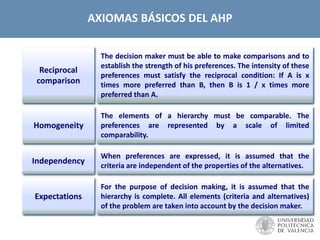
AXIOMAS BÁSICOS DEL AHP
The decision maker must be able to make comparisons and to
establish the strength of his preferences. The intensity of these
preferences must satisfy the reciprocal condition: If A is x
times more preferred than B, then B is 1 / x times more
preferred than A.
Reciprocal
comparison
The elements of a hierarchy must be comparable. The
preferences are represented by a scale of limited
comparability.
Homogeneity
When preferences are expressed, it is assumed that the
criteria are independent of the properties of the alternatives.
Independency
For the purpose of decision making, it is assumed that the
hierarchy is complete. All elements (criteria and alternatives)
of the problem are taken into account by the decision maker.
Expectations
2. STEPS OF THE METHOD
AHP FUNDAMENTS
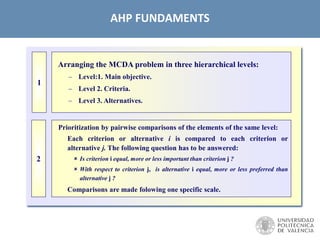
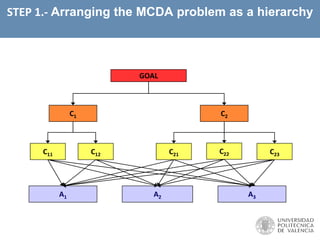
Arranging the MCDA problem in three hierarchical levels:
– Level:1. Main objective.
– Level 2. Criteria.
– Level 3. Alternatives.
Prioritization by pairwise comparisons of the elements of the same level:
Each criterion or alternative i is compared to each criterion or
alternative j. The following question has to be answered:
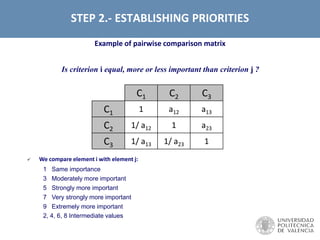
 Is criterion i equal, more or less important than criterion j ?
 With respect to criterion j, is alternative i equal, more or less preferred than
alternative j ?
Comparisons are made folowing one specific scale.
1
2
AHP FUNDAMENTS
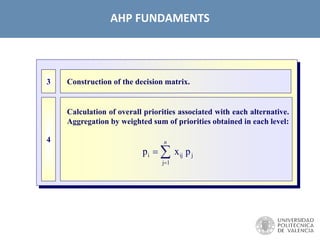
Construction of the decision matrix.
Calculation of overall priorities associated with each alternative.
Aggregation by weighted sum of priorities obtained in each level:
3
4
p x pi ij
j
j

1
n
GOAL
C1
C11
C2
C12 C21 C22 C23
A1 A2 A3
STEP 1.- Arranging the MCDA problem as a hierarchy
STEP 2.- ESTABLISHING PRIORITIES
Prioritization by pairwise comparisons of the elements of the same level:
Each criterion or alternative i is compared to each criterion or
alternative j. The following question has to be answered:
 Is criterion i equal, more or less important than criterion j ?
 With respect to criterion j, is alternative i equal, more or less preferred than
alternative j ?
Comparisons are made folowing one specific scale.
2
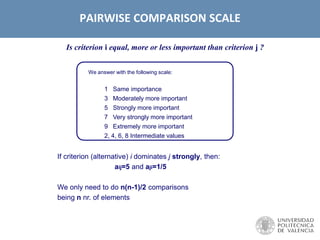
PAIRWISE COMPARISON SCALE
Is criterion i equal, more or less important than criterion j ?
We answer with the following scale:
1 Same importance
3 Moderately more important
5 Strongly more important
7 Very strongly more important
9 Extremely more important
2, 4, 6, 8 Intermediate values
If criterion (alternative) i dominates j strongly, then:
aij=5 and aji=1/5
We only need to do n(n-1)/2 comparisons
being n nr. of elements
STEP 2.- ESTABLISHING PRIORITIES
C1 C2 C3
C1 1 a12 a13
C2 1/ a12 1 a23
C3 1/ a13 1/ a23 1
 We compare element i with element j:
1 Same importance
3 Moderately more important
5 Strongly more important
7 Very strongly more important
9 Extremely more important
2, 4, 6, 8 Intermediate values
Is criterion i equal, more or less important than criterion j ?
Example of pairwise comparison matrix
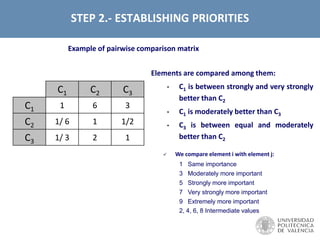
C1 C2 C3
C1 1 6 3
C2 1/ 6 1 1/2
C3 1/ 3 2 1
Elements are compared among them:
• C1 is between strongly and very strongly
better than C2
• C1 is moderately better than C3
• C3 is between equal and moderately
better than C2
 We compare element i with element j:
1 Same importance
3 Moderately more important
5 Strongly more important
7 Very strongly more important
9 Extremely more important
2, 4, 6, 8 Intermediate values
STEP 2.- ESTABLISHING PRIORITIES
Example of pairwise comparison matrix
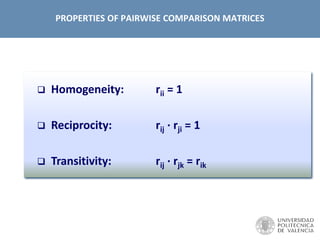
 Homogeneity: rii = 1
 Reciprocity: rij · rji = 1
 Transitivity: rij · rjk = rik
PROPERTIES OF PAIRWISE COMPARISON MATRICES
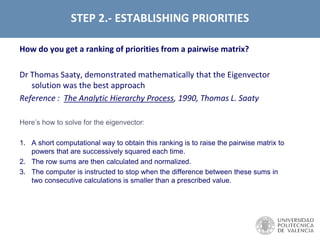
How do you get a ranking of priorities from a pairwise matrix?
Dr Thomas Saaty, demonstrated mathematically that the Eigenvector
solution was the best approach
Reference : The Analytic Hierarchy Process, 1990, Thomas L. Saaty
Here’s how to solve for the eigenvector:
1. A short computational way to obtain this ranking is to raise the pairwise matrix to
powers that are successively squared each time.
2. The row sums are then calculated and normalized.
3. The computer is instructed to stop when the difference between these sums in
two consecutive calculations is smaller than a prescribed value.
STEP 2.- ESTABLISHING PRIORITIES
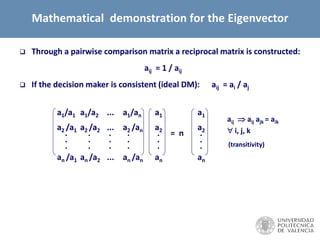
Mathematical demonstration for the Eigenvector
 Through a pairwise comparison matrix a reciprocal matrix is constructed:
aij = 1 / aij
 If the decision maker is consistent (ideal DM): aij = ai / aj
a1/a1
a2 /a1
an /a1
.
.
.
a1/a2
a2 /a2
an /a2
.
.
.
...
...
...
.
.
.
a1/an
a2 /an
an /an
.
.
.
a1
a2
an
.
.
.
= n
a1
a2
an
.
.
.
aij  aij ajk = aik
 i, j, k
(transitivity)
 Let A be a nxn matrix of judgements. We call Eigenvalues of A (λ1, λ2, …, λn) the
solutions to the equation: det (A-λI) = 0
 The principal Eigenvalue (λmax) is the maximum of the Eigenvalues.
 n is the dominant Eigenvaluees of [A] and [a] is the asociated Eigenvector (ideal
case)
 If there is no consistency, the matrix of judgements becomes [R] a perturbation of
[A] and fulfills: [R] · [a] = max · [a]
( max dominant Eigenvalue  + and [a] its Eigenvector)
THE EIGENVECTOR ASSOCIATED TO THE DOMINANT EIGENVALUE
IS THE WEIGHTS VECTOR
Mathematical demonstration for the Eigenvector
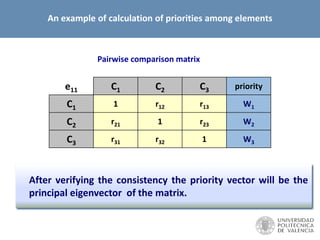
e11 C1 C2 C3 priority
C1 1 r12 r13 W1
C2 r21 1 r23 W2
C3 r31 r32 1 W3
Pairwise comparison matrix
After verifying the consistency the priority vector will be the
principal eigenvector of the matrix.
An example of calculation of priorities among elements
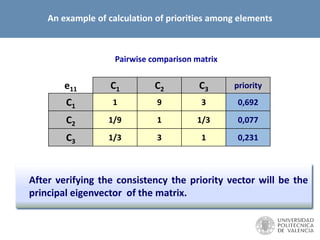
e11 C1 C2 C3 priority
C1 1 9 3 0,692
C2 1/9 1 1/3 0,077
C3 1/3 3 1 0,231
Pairwise comparison matrix
An example of calculation of priorities among elements
After verifying the consistency the priority vector will be the
principal eigenvector of the matrix.
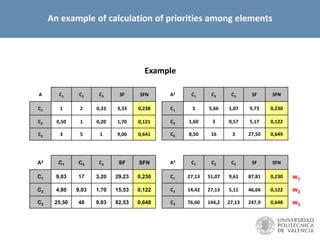
A C1 C2 C3 SF SFN
C1 1 2 0,33 3,33 0,238
C2 0,50 1 0,20 1,70 0,121
C3 3 5 1 9,00 0,641
Example
A2 C1 C2 C3 SF SFN
C1 3 5,66 1,07 9,73 0,230
C2 1,60 3 0,57 5,17 0,122
C3 8,50 16 3 27,50 0,649
A3 C1 C2 C3 SF SFN
C1 9,03 17 3,20 29,23 0,230
C2 4,80 9,03 1,70 15,53 0,122
C3 25,50 48 9,03 82,53 0,648
A4 C1 C2 C3 SF SFN
C1 27,13 51,07 9,61 87,81 0,230
C2 14,42 27,13 5,11 46,66 0,122
C3 76,60 144,2 27,13 247,9 0,648
w1
w2
w3
An example of calculation of priorities among elements
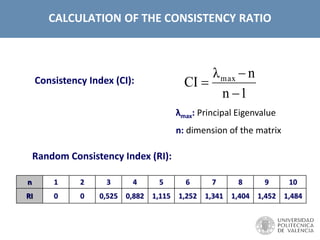
CALCULATION OF THE CONSISTENCY RATIO
Consistency Index (CI):
1n
nλ
CI max



n 1 2 3 4 5 6 7 8 9 10
RI 0 0 0,525 0,882 1,115 1,252 1,341 1,404 1,452 1,484
λmax: Principal Eigenvalue
n: dimension of the matrix
Random Consistency Index (RI):
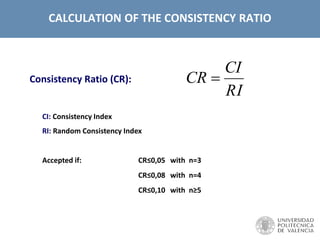
CALCULATION OF THE CONSISTENCY RATIO
Consistency Ratio (CR):
RI
CI
CR 
CI: Consistency Index
RI: Random Consistency Index
Accepted if: CR≤0,05 with n=3
CR≤0,08 with n=4
CR≤0,10 with n≥5
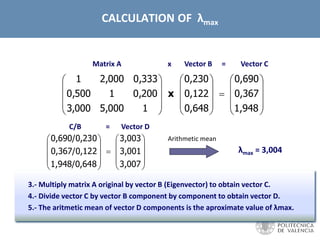
CALCULATION OF λmax
Vector B Vector CMatrix A x =
C/B Vector D=
Arithmetic mean
λmax = 3,004































1,948
0,367
0,690
0,648
0,122
0,230
1000,5000,3
200,01500,0
333,0000,21
x





















3,007
3,001
3,003
81,948/0,64
20,367/0,12
00,690/0,23
3.- Multiply matrix A original by vector B (Eigenvector) to obtain vector C.
4.- Divide vector C by vector B component by component to obtain vector D.
5.- The aritmetic mean of vector D components is the aproximate value of λmax.
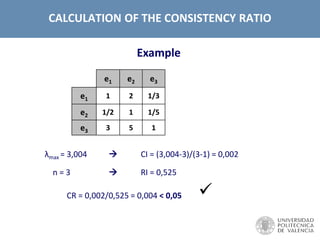
e1 e2 e3
e1 1 2 1/3
e2 1/2 1 1/5
e3 3 5 1
λmax = 3,004  CI = (3,004-3)/(3-1) = 0,002
n = 3  RI = 0,525
CR = 0,002/0,525 = 0,004 < 0,05 
Example
CALCULATION OF THE CONSISTENCY RATIO
Step 3. Construction of the decision matrix
Construction of the decision matrix.
3.1 Weighting of criteria.
3.2 Assessment of alternatives.
3
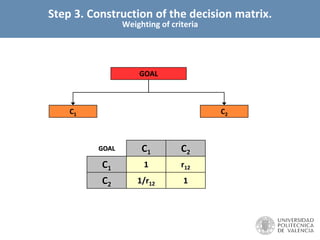
GOAL
C1 C2
GOAL C1 C2
C1 1 r12
C2 1/r12 1
Step 3. Construction of the decision matrix.
Weighting of criteria
GOAL
C1 C2
GOAL C1 C2
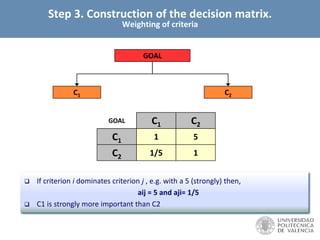
C1 1 5
C2 1/5 1
 If criterion i dominates criterion j , e.g. with a 5 (strongly) then,
aij = 5 and aji= 1/5
 C1 is strongly more important than C2
Step 3. Construction of the decision matrix.
Weighting of criteria
GOAL
C1 C2
Goal C1 C2
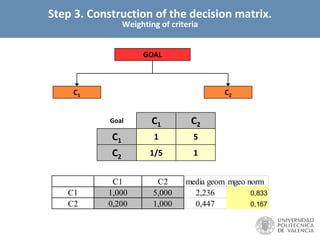
C1 1 5
C2 1/5 1
C1 C2 media geom mgeo norm
C1 1,000 5,000 2,236 0,833
C2 0,200 1,000 0,447 0,167
Step 3. Construction of the decision matrix.
Weighting of criteria
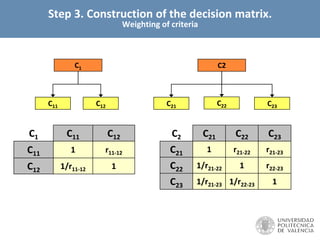
C1
C11 C12
C1 C11 C12
C11 1 r11-12
C12 1/r11-12 1
C2
C21 C22 C23
C2 C21 C22 C23
C21 1 r21-22 r21-23
C22 1/r21-22 1 r22-23
C23 1/r21-23 1/r22-23 1
Step 3. Construction of the decision matrix.
Weighting of criteria
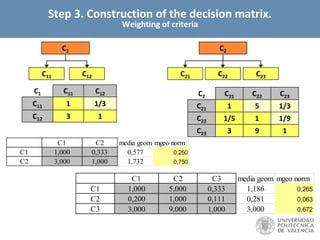
C1
C11 C12
C1 C11 C12
C11 1 1/3
C12 3 1
C2
C21 C22 C23
C2 C21 C22 C23
C21 1 5 1/3
C22 1/5 1 1/9
C23 3 9 1
C1 C2 media geom mgeo norm
C1 1,000 0,333 0,577 0,250
C2 3,000 1,000 1,732 0,750
C1 C2 C3 media geom mgeo norm
C1 1,000 5,000 0,333 1,186 0,265
C2 0,200 1,000 0,111 0,281 0,063
C3 3,000 9,000 1,000 3,000 0,672
Step 3. Construction of the decision matrix.
Weighting of criteria
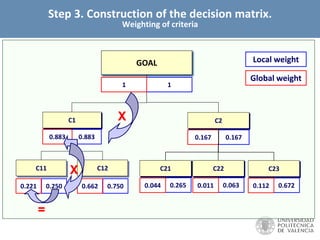
GOAL
C1 C2
C11 C12
0.883 0.167
0.250 0.750
1
Local weight
0.883 0.167
0.221 0.662
1
Global weight
=
X
X C21
0.2650.044
C22
0.0630.011
C23
0.6720.112
Step 3. Construction of the decision matrix.
Weighting of criteria
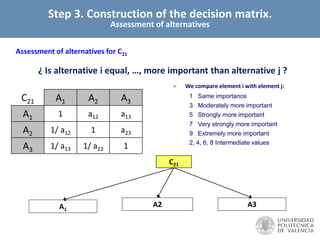
C21 A1 A2 A3
A1 1 a12 a13
A2 1/ a12 1 a23
A3 1/ a13 1/ a23 1
C21
A1
A2 A3
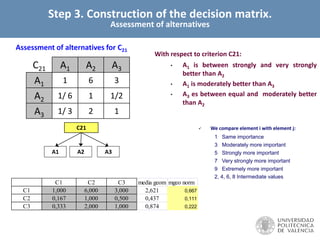
Assessment of alternatives for C21
¿ Is alternative i equal, …, more important than alternative j ?
Step 3. Construction of the decision matrix.
Assessment of alternatives
 We compare element i with element j:
1 Same importance
3 Moderately more important
5 Strongly more important
7 Very strongly more important
9 Extremely more important
2, 4, 6, 8 Intermediate values
Assessment of alternatives for C21
C21 A1 A2 A3
A1 1 6 3
A2 1/ 6 1 1/2
A3 1/ 3 2 1
C21
A1 A2 A3
With respect to criterion C21:
• A1 is between strongly and very strongly
better than A2
• A1 is moderately better than A3
• A3 es between equal and moderately better
than A2
C1 C2 C3 media geom mgeo norm
C1 1,000 6,000 3,000 2,621 0,667
C2 0,167 1,000 0,500 0,437 0,111
C3 0,333 2,000 1,000 0,874 0,222
 We compare element i with element j:
1 Same importance
3 Moderately more important
5 Strongly more important
7 Very strongly more important
9 Extremely more important
2, 4, 6, 8 Intermediate values
Step 3. Construction of the decision matrix.
Assessment of alternatives
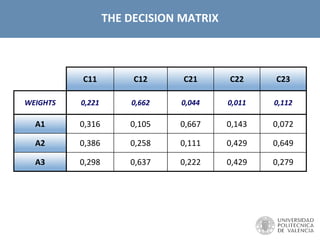
THE DECISION MATRIX
C11 C12 C21 C22 C23
WEIGHTS 0,221 0,662 0,044 0,011 0,112
A1 0,316 0,105 0,667 0,143 0,072
A2 0,386 0,258 0,111 0,429 0,649
A3 0,298 0,637 0,222 0,429 0,279
STEP 4. CALCULATION OF OVERALL PRIORITIES
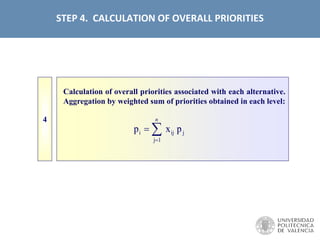
Calculation of overall priorities associated with each alternative.
Aggregation by weighted sum of priorities obtained in each level:
4
p x pi ij
j
j

1
n
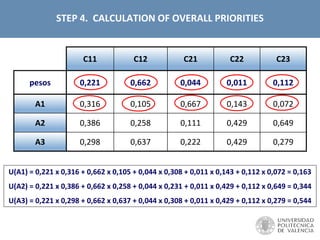
C11 C12 C21 C22 C23
pesos 0,221 0,662 0,044 0,011 0,112
A1 0,316 0,105 0,667 0,143 0,072
A2 0,386 0,258 0,111 0,429 0,649
A3 0,298 0,637 0,222 0,429 0,279
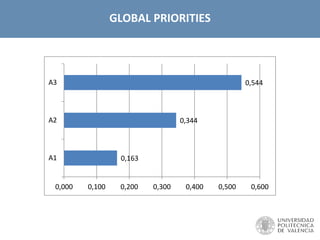
U(A1) = 0,221 x 0,316 + 0,662 x 0,105 + 0,044 x 0,308 + 0,011 x 0,143 + 0,112 x 0,072 = 0,163
U(A2) = 0,221 x 0,386 + 0,662 x 0,258 + 0,044 x 0,231 + 0,011 x 0,429 + 0,112 x 0,649 = 0,344
U(A3) = 0,221 x 0,298 + 0,662 x 0,637 + 0,044 x 0,308 + 0,011 x 0,429 + 0,112 x 0,279 = 0,544
STEP 4. CALCULATION OF OVERALL PRIORITIES
GLOBAL PRIORITIES
0,163
0,344
0,544
0,000 0,100 0,200 0,300 0,400 0,500 0,600
A1
A2
A3

AHP fundamentals

  • 1.
    Multicriteria Decision Analysis MCDA PabloAragonés Beltrán and Mónica García Melón
  • 2.
  • 3.
    MEASURING DM´S PREFERENCES (Saatyy Peniwati, 2008)  There are two ways to measure something about a property (or criteria).  One is to apply an existing scale (distance in meters, weight in kg, price or costs in Euros, etc.)  Another is to compare the measuring object with another that is comparable to it with respect to the property that is being measured. In this case an object serves as a measuring unit and the other is estimated as a multiple of that unit using the expert judgment of the DM.  If you assign a number to something when there is no measurement scale, this number is arbitrary and a meaningless measure.  According to the decision process described above, first we have to measure the importance of the criteria and in a second step measure how each alternative satisfies the criteria.  Finally we should combine those measures to obtain an aggregated measure which ranks alternatives from highest to lowest preference (or priority).
  • 4.
    INTRODUCTION  AHP isa well known Multicriteria Decision Technique  It allows to make decisions considering different points of view and criteria.  It was proposed by Professor Thomas Saaty, University of Pittsburgh, in the late 70s.  It is based on the idea that the complexity inherent in a decision making problem with multiple criteria can be solved by the hierarchy of the problems.  At each level of the hierarchy, pairwise comparisons are made between the elements of the same level, based on the importance or contribution of each of them to the element of the upper level to which they are linked.  This comparison process leads to a measurement scale of priorities or weights on the elements.  Pairwise comparisons were performed using ratios of preference (in comparison alternatives), and ratios of importance (when compared criteria), which are evaluated on a numerical scale by the method proposed.
  • 5.
    INTRODUCTION  The methodallows to analyze the degree of inconsistency of the judgments of the decision maker.  According Th Saaty, AHP is a theory of relative measurement of intangible criteria.  AHP provides a method for measuring Decisor judgments or preferences, which in turn are always subjective.  Although criteria can be measured on a physical scale (full scale: kg, m, Euros, etc.), the meaning that measure has to the decision maker is always subjective. E.g. we can not tell if an object weighting 50 kg is very heavy or very light without knowing in what context is this measure, for what purpose and with what other objects you are comparing.
  • 6.
    AXIOMAS BÁSICOS DELAHP The decision maker must be able to make comparisons and to establish the strength of his preferences. The intensity of these preferences must satisfy the reciprocal condition: If A is x times more preferred than B, then B is 1 / x times more preferred than A. Reciprocal comparison The elements of a hierarchy must be comparable. The preferences are represented by a scale of limited comparability. Homogeneity When preferences are expressed, it is assumed that the criteria are independent of the properties of the alternatives. Independency For the purpose of decision making, it is assumed that the hierarchy is complete. All elements (criteria and alternatives) of the problem are taken into account by the decision maker. Expectations
  • 7.
    2. STEPS OFTHE METHOD
  • 8.
    AHP FUNDAMENTS Arranging theMCDA problem in three hierarchical levels: – Level:1. Main objective. – Level 2. Criteria. – Level 3. Alternatives. Prioritization by pairwise comparisons of the elements of the same level: Each criterion or alternative i is compared to each criterion or alternative j. The following question has to be answered:  Is criterion i equal, more or less important than criterion j ?  With respect to criterion j, is alternative i equal, more or less preferred than alternative j ? Comparisons are made folowing one specific scale. 1 2
  • 9.
    AHP FUNDAMENTS Construction ofthe decision matrix. Calculation of overall priorities associated with each alternative. Aggregation by weighted sum of priorities obtained in each level: 3 4 p x pi ij j j  1 n
  • 10.
    GOAL C1 C11 C2 C12 C21 C22C23 A1 A2 A3 STEP 1.- Arranging the MCDA problem as a hierarchy
  • 11.
    STEP 2.- ESTABLISHINGPRIORITIES Prioritization by pairwise comparisons of the elements of the same level: Each criterion or alternative i is compared to each criterion or alternative j. The following question has to be answered:  Is criterion i equal, more or less important than criterion j ?  With respect to criterion j, is alternative i equal, more or less preferred than alternative j ? Comparisons are made folowing one specific scale. 2
  • 12.
    PAIRWISE COMPARISON SCALE Iscriterion i equal, more or less important than criterion j ? We answer with the following scale: 1 Same importance 3 Moderately more important 5 Strongly more important 7 Very strongly more important 9 Extremely more important 2, 4, 6, 8 Intermediate values If criterion (alternative) i dominates j strongly, then: aij=5 and aji=1/5 We only need to do n(n-1)/2 comparisons being n nr. of elements
  • 13.
    STEP 2.- ESTABLISHINGPRIORITIES C1 C2 C3 C1 1 a12 a13 C2 1/ a12 1 a23 C3 1/ a13 1/ a23 1  We compare element i with element j: 1 Same importance 3 Moderately more important 5 Strongly more important 7 Very strongly more important 9 Extremely more important 2, 4, 6, 8 Intermediate values Is criterion i equal, more or less important than criterion j ? Example of pairwise comparison matrix
  • 14.
    C1 C2 C3 C11 6 3 C2 1/ 6 1 1/2 C3 1/ 3 2 1 Elements are compared among them: • C1 is between strongly and very strongly better than C2 • C1 is moderately better than C3 • C3 is between equal and moderately better than C2  We compare element i with element j: 1 Same importance 3 Moderately more important 5 Strongly more important 7 Very strongly more important 9 Extremely more important 2, 4, 6, 8 Intermediate values STEP 2.- ESTABLISHING PRIORITIES Example of pairwise comparison matrix
  • 15.
     Homogeneity: rii= 1  Reciprocity: rij · rji = 1  Transitivity: rij · rjk = rik PROPERTIES OF PAIRWISE COMPARISON MATRICES
  • 16.
    How do youget a ranking of priorities from a pairwise matrix? Dr Thomas Saaty, demonstrated mathematically that the Eigenvector solution was the best approach Reference : The Analytic Hierarchy Process, 1990, Thomas L. Saaty Here’s how to solve for the eigenvector: 1. A short computational way to obtain this ranking is to raise the pairwise matrix to powers that are successively squared each time. 2. The row sums are then calculated and normalized. 3. The computer is instructed to stop when the difference between these sums in two consecutive calculations is smaller than a prescribed value. STEP 2.- ESTABLISHING PRIORITIES
  • 17.
    Mathematical demonstration forthe Eigenvector  Through a pairwise comparison matrix a reciprocal matrix is constructed: aij = 1 / aij  If the decision maker is consistent (ideal DM): aij = ai / aj a1/a1 a2 /a1 an /a1 . . . a1/a2 a2 /a2 an /a2 . . . ... ... ... . . . a1/an a2 /an an /an . . . a1 a2 an . . . = n a1 a2 an . . . aij  aij ajk = aik  i, j, k (transitivity)
  • 18.
     Let Abe a nxn matrix of judgements. We call Eigenvalues of A (λ1, λ2, …, λn) the solutions to the equation: det (A-λI) = 0  The principal Eigenvalue (λmax) is the maximum of the Eigenvalues.  n is the dominant Eigenvaluees of [A] and [a] is the asociated Eigenvector (ideal case)  If there is no consistency, the matrix of judgements becomes [R] a perturbation of [A] and fulfills: [R] · [a] = max · [a] ( max dominant Eigenvalue  + and [a] its Eigenvector) THE EIGENVECTOR ASSOCIATED TO THE DOMINANT EIGENVALUE IS THE WEIGHTS VECTOR Mathematical demonstration for the Eigenvector
  • 19.
    e11 C1 C2C3 priority C1 1 r12 r13 W1 C2 r21 1 r23 W2 C3 r31 r32 1 W3 Pairwise comparison matrix After verifying the consistency the priority vector will be the principal eigenvector of the matrix. An example of calculation of priorities among elements
  • 20.
    e11 C1 C2C3 priority C1 1 9 3 0,692 C2 1/9 1 1/3 0,077 C3 1/3 3 1 0,231 Pairwise comparison matrix An example of calculation of priorities among elements After verifying the consistency the priority vector will be the principal eigenvector of the matrix.
  • 21.
    A C1 C2C3 SF SFN C1 1 2 0,33 3,33 0,238 C2 0,50 1 0,20 1,70 0,121 C3 3 5 1 9,00 0,641 Example A2 C1 C2 C3 SF SFN C1 3 5,66 1,07 9,73 0,230 C2 1,60 3 0,57 5,17 0,122 C3 8,50 16 3 27,50 0,649 A3 C1 C2 C3 SF SFN C1 9,03 17 3,20 29,23 0,230 C2 4,80 9,03 1,70 15,53 0,122 C3 25,50 48 9,03 82,53 0,648 A4 C1 C2 C3 SF SFN C1 27,13 51,07 9,61 87,81 0,230 C2 14,42 27,13 5,11 46,66 0,122 C3 76,60 144,2 27,13 247,9 0,648 w1 w2 w3 An example of calculation of priorities among elements
  • 22.
    CALCULATION OF THECONSISTENCY RATIO Consistency Index (CI): 1n nλ CI max    n 1 2 3 4 5 6 7 8 9 10 RI 0 0 0,525 0,882 1,115 1,252 1,341 1,404 1,452 1,484 λmax: Principal Eigenvalue n: dimension of the matrix Random Consistency Index (RI):
  • 23.
    CALCULATION OF THECONSISTENCY RATIO Consistency Ratio (CR): RI CI CR  CI: Consistency Index RI: Random Consistency Index Accepted if: CR≤0,05 with n=3 CR≤0,08 with n=4 CR≤0,10 with n≥5
  • 24.
    CALCULATION OF λmax VectorB Vector CMatrix A x = C/B Vector D= Arithmetic mean λmax = 3,004                                1,948 0,367 0,690 0,648 0,122 0,230 1000,5000,3 200,01500,0 333,0000,21 x                      3,007 3,001 3,003 81,948/0,64 20,367/0,12 00,690/0,23 3.- Multiply matrix A original by vector B (Eigenvector) to obtain vector C. 4.- Divide vector C by vector B component by component to obtain vector D. 5.- The aritmetic mean of vector D components is the aproximate value of λmax.
  • 25.
    e1 e2 e3 e11 2 1/3 e2 1/2 1 1/5 e3 3 5 1 λmax = 3,004  CI = (3,004-3)/(3-1) = 0,002 n = 3  RI = 0,525 CR = 0,002/0,525 = 0,004 < 0,05  Example CALCULATION OF THE CONSISTENCY RATIO
  • 26.
    Step 3. Constructionof the decision matrix Construction of the decision matrix. 3.1 Weighting of criteria. 3.2 Assessment of alternatives. 3
  • 27.
    GOAL C1 C2 GOAL C1C2 C1 1 r12 C2 1/r12 1 Step 3. Construction of the decision matrix. Weighting of criteria
  • 28.
    GOAL C1 C2 GOAL C1C2 C1 1 5 C2 1/5 1  If criterion i dominates criterion j , e.g. with a 5 (strongly) then, aij = 5 and aji= 1/5  C1 is strongly more important than C2 Step 3. Construction of the decision matrix. Weighting of criteria
  • 29.
    GOAL C1 C2 Goal C1C2 C1 1 5 C2 1/5 1 C1 C2 media geom mgeo norm C1 1,000 5,000 2,236 0,833 C2 0,200 1,000 0,447 0,167 Step 3. Construction of the decision matrix. Weighting of criteria
  • 30.
    C1 C11 C12 C1 C11C12 C11 1 r11-12 C12 1/r11-12 1 C2 C21 C22 C23 C2 C21 C22 C23 C21 1 r21-22 r21-23 C22 1/r21-22 1 r22-23 C23 1/r21-23 1/r22-23 1 Step 3. Construction of the decision matrix. Weighting of criteria
  • 31.
    C1 C11 C12 C1 C11C12 C11 1 1/3 C12 3 1 C2 C21 C22 C23 C2 C21 C22 C23 C21 1 5 1/3 C22 1/5 1 1/9 C23 3 9 1 C1 C2 media geom mgeo norm C1 1,000 0,333 0,577 0,250 C2 3,000 1,000 1,732 0,750 C1 C2 C3 media geom mgeo norm C1 1,000 5,000 0,333 1,186 0,265 C2 0,200 1,000 0,111 0,281 0,063 C3 3,000 9,000 1,000 3,000 0,672 Step 3. Construction of the decision matrix. Weighting of criteria
  • 32.
    GOAL C1 C2 C11 C12 0.8830.167 0.250 0.750 1 Local weight 0.883 0.167 0.221 0.662 1 Global weight = X X C21 0.2650.044 C22 0.0630.011 C23 0.6720.112 Step 3. Construction of the decision matrix. Weighting of criteria
  • 33.
    C21 A1 A2A3 A1 1 a12 a13 A2 1/ a12 1 a23 A3 1/ a13 1/ a23 1 C21 A1 A2 A3 Assessment of alternatives for C21 ¿ Is alternative i equal, …, more important than alternative j ? Step 3. Construction of the decision matrix. Assessment of alternatives  We compare element i with element j: 1 Same importance 3 Moderately more important 5 Strongly more important 7 Very strongly more important 9 Extremely more important 2, 4, 6, 8 Intermediate values
  • 34.
    Assessment of alternativesfor C21 C21 A1 A2 A3 A1 1 6 3 A2 1/ 6 1 1/2 A3 1/ 3 2 1 C21 A1 A2 A3 With respect to criterion C21: • A1 is between strongly and very strongly better than A2 • A1 is moderately better than A3 • A3 es between equal and moderately better than A2 C1 C2 C3 media geom mgeo norm C1 1,000 6,000 3,000 2,621 0,667 C2 0,167 1,000 0,500 0,437 0,111 C3 0,333 2,000 1,000 0,874 0,222  We compare element i with element j: 1 Same importance 3 Moderately more important 5 Strongly more important 7 Very strongly more important 9 Extremely more important 2, 4, 6, 8 Intermediate values Step 3. Construction of the decision matrix. Assessment of alternatives
  • 35.
    THE DECISION MATRIX C11C12 C21 C22 C23 WEIGHTS 0,221 0,662 0,044 0,011 0,112 A1 0,316 0,105 0,667 0,143 0,072 A2 0,386 0,258 0,111 0,429 0,649 A3 0,298 0,637 0,222 0,429 0,279
  • 36.
    STEP 4. CALCULATIONOF OVERALL PRIORITIES Calculation of overall priorities associated with each alternative. Aggregation by weighted sum of priorities obtained in each level: 4 p x pi ij j j  1 n
  • 37.
    C11 C12 C21C22 C23 pesos 0,221 0,662 0,044 0,011 0,112 A1 0,316 0,105 0,667 0,143 0,072 A2 0,386 0,258 0,111 0,429 0,649 A3 0,298 0,637 0,222 0,429 0,279 U(A1) = 0,221 x 0,316 + 0,662 x 0,105 + 0,044 x 0,308 + 0,011 x 0,143 + 0,112 x 0,072 = 0,163 U(A2) = 0,221 x 0,386 + 0,662 x 0,258 + 0,044 x 0,231 + 0,011 x 0,429 + 0,112 x 0,649 = 0,344 U(A3) = 0,221 x 0,298 + 0,662 x 0,637 + 0,044 x 0,308 + 0,011 x 0,429 + 0,112 x 0,279 = 0,544 STEP 4. CALCULATION OF OVERALL PRIORITIES
  • 38.
    GLOBAL PRIORITIES 0,163 0,344 0,544 0,000 0,1000,200 0,300 0,400 0,500 0,600 A1 A2 A3