Kirchoff’s Rules

Purpose: solve complex circuits
Some terminology
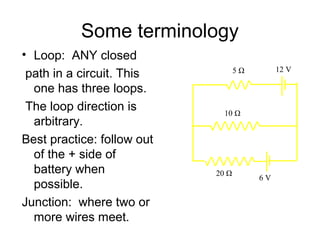
• Loop: ANY closed
                                   5Ω        12 V
 path in a circuit. This
  one has three loops.
 The loop direction is        10 Ω
  arbitrary.
Best practice: follow out
  of the + side of
  battery when              20 Ω
                                        6V
  possible.
Junction: where two or
  more wires meet.
Purpose of Rules:
• Since some circuits are too complex they
  must be solved using Kirchoff’s Rules.

 These rules follow the principle and ideals
 of conservation of charge and
 conservation of energy.
 The rules help keep track of +/- for
 potentials.
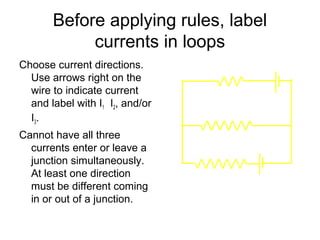
Before applying rules, label
            currents in loops
Choose current directions.              5Ω        12 V
  Use arrows right on the
  wire to indicate current
  and label with I1 I2, and/or
                                   10 Ω
  I3.
Cannot have all three
  currents enter or leave a
  junction simultaneously.
  At least one direction         20 Ω
                                             6V
  must be different coming
  in or out of a junction.
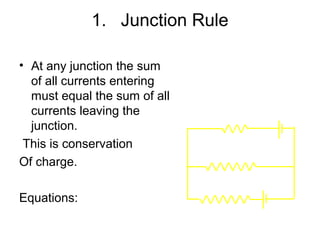
1. Junction Rule

• At any junction the sum
  of all currents entering
  must equal the sum of all
  currents leaving the               5Ω        12 V
  junction.
 This is conservation
                                10 Ω
Of charge.

Equations:
                              20 Ω
                                          6V
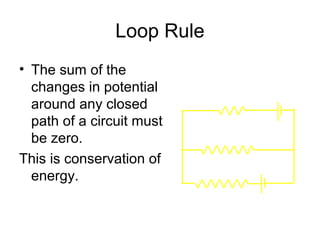
Loop Rule
• The sum of the
  changes in potential                       12 V
                                   5Ω
  around any closed
  path of a circuit must
  be zero.                    10 Ω

This is conservation of
  energy.
                            20 Ω
                                        6V
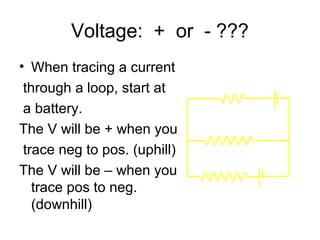
Voltage: + or - ???
• When tracing a current
                                     5Ω        12 V
 through a loop, start at
 a battery.
The V will be + when you        10 Ω


 trace neg to pos. (uphill)
The V will be – when you
   trace pos to neg.          20 Ω
                                          6V
   (downhill)
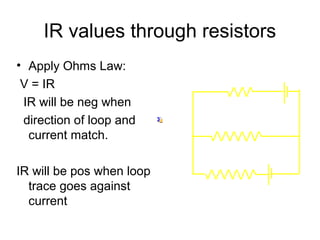
IR values through resistors
• Apply Ohms Law:
                                  5Ω        12 V
 V = IR
 IR will be neg when
 direction of loop and       10 Ω
  current match.

IR will be pos when loop
  trace goes against       20 Ω
                                       6V
  current
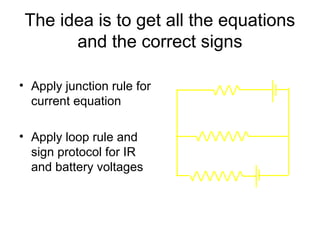
The idea is to get all the equations
       and the correct signs
                                   5Ω        12 V
• Apply junction rule for
  current equation
                              10 Ω

• Apply loop rule and
  sign protocol for IR
  and battery voltages
                            20 Ω
                                        6V
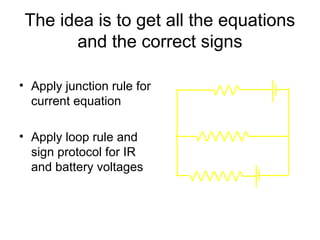
The idea is to get all the equations
       and the correct signs
                                   5Ω        12 V
• Apply junction rule for
  current equation
                              10 Ω

• Apply loop rule and
  sign protocol for IR
  and battery voltages
                            20 Ω
                                        6V

Ch 11 - kirchoff's laws ppt

  • 1.
  • 2.
    Some terminology • Loop:ANY closed 5Ω 12 V path in a circuit. This one has three loops. The loop direction is 10 Ω arbitrary. Best practice: follow out of the + side of battery when 20 Ω 6V possible. Junction: where two or more wires meet.
  • 3.
    Purpose of Rules: •Since some circuits are too complex they must be solved using Kirchoff’s Rules. These rules follow the principle and ideals of conservation of charge and conservation of energy. The rules help keep track of +/- for potentials.
  • 4.
    Before applying rules,label currents in loops Choose current directions. 5Ω 12 V Use arrows right on the wire to indicate current and label with I1 I2, and/or 10 Ω I3. Cannot have all three currents enter or leave a junction simultaneously. At least one direction 20 Ω 6V must be different coming in or out of a junction.
  • 5.
    1. Junction Rule •At any junction the sum of all currents entering must equal the sum of all currents leaving the 5Ω 12 V junction. This is conservation 10 Ω Of charge. Equations: 20 Ω 6V
  • 6.
    Loop Rule • Thesum of the changes in potential 12 V 5Ω around any closed path of a circuit must be zero. 10 Ω This is conservation of energy. 20 Ω 6V
  • 7.
    Voltage: + or- ??? • When tracing a current 5Ω 12 V through a loop, start at a battery. The V will be + when you 10 Ω trace neg to pos. (uphill) The V will be – when you trace pos to neg. 20 Ω 6V (downhill)
  • 8.
    IR values throughresistors • Apply Ohms Law: 5Ω 12 V V = IR IR will be neg when direction of loop and 10 Ω current match. IR will be pos when loop trace goes against 20 Ω 6V current
  • 9.
    The idea isto get all the equations and the correct signs 5Ω 12 V • Apply junction rule for current equation 10 Ω • Apply loop rule and sign protocol for IR and battery voltages 20 Ω 6V
  • 10.
    The idea isto get all the equations and the correct signs 5Ω 12 V • Apply junction rule for current equation 10 Ω • Apply loop rule and sign protocol for IR and battery voltages 20 Ω 6V

Editor's Notes

  • #3 Show on white board instead of screen and loops can be drawn in with class. Class will have multiple circuits so they can take notes.
  • #5 Use diagram projected on white board to label currents with students.
  • #6 Use white board to get equations with students based on their chosen current labels.
  • #8 Show students on white board how the possibilities are. Recommend to go out of positive.
  • #9 Show students on white board how to obtain equations.
  • #10 Show students on white board how to obtain all the equations.