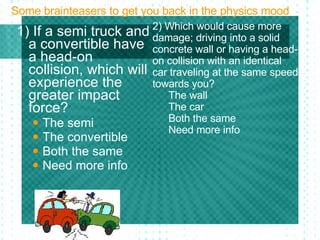
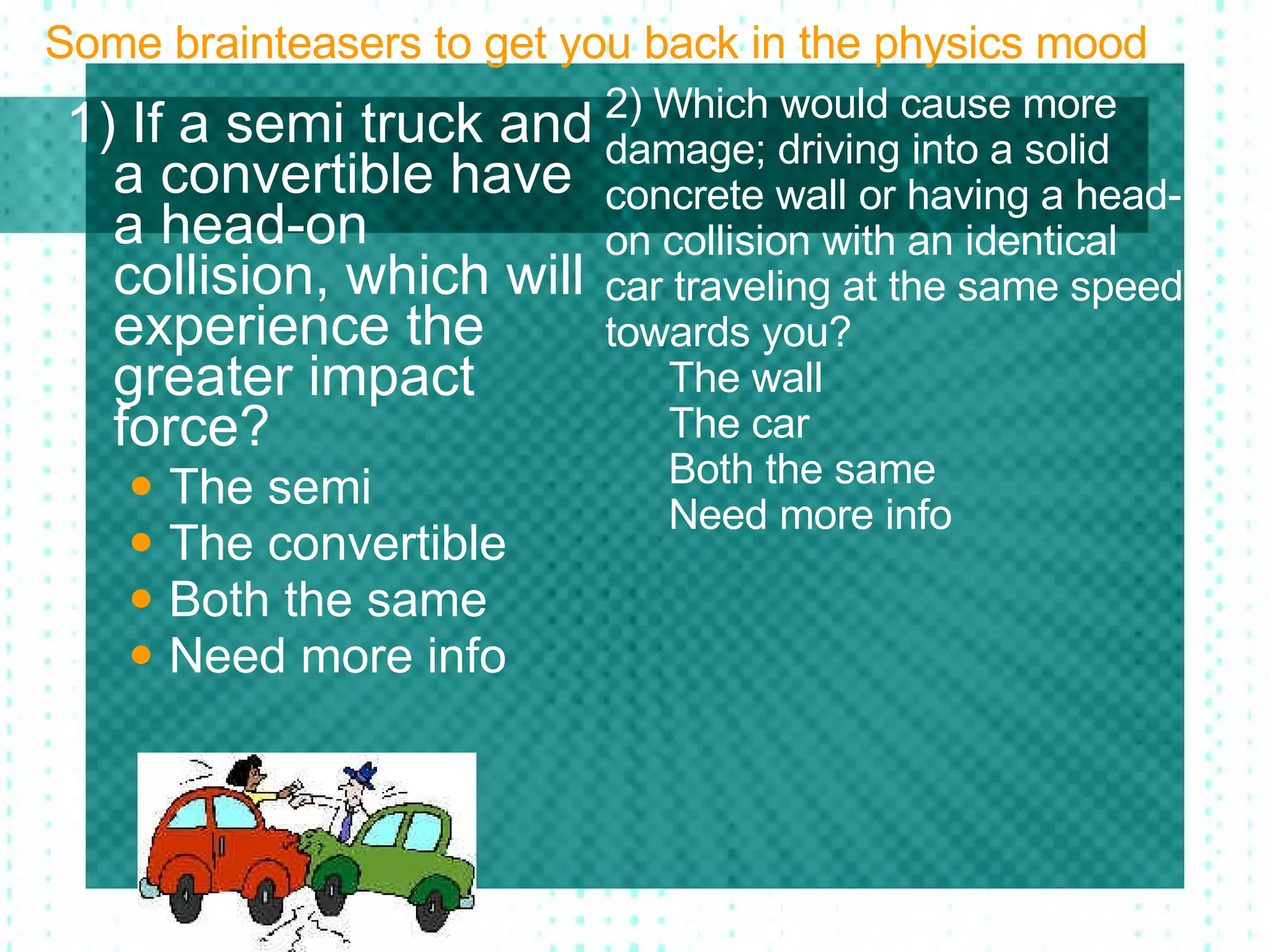

Some brainteasers to get you back in the physics mood 1) If a semi truck and a convertible have a head-on collision, which will experience the greater impact force? The semi The convertible Both the same Need more info 2) Which would cause more damage; driving into a solid concrete wall or having a head-on collision with an identical car traveling at the same speed towards you? The wall The car Both the same Need more info
Let’s start with the semi and the car…. Both will have the SAME impact force Newton’s 3rd Law! For every action there is an equal and opposite reaction So what’s different? The acceleration (deceleration) F=m*a So same force, but a smaller mass on the car means the deceleration is more….and hurts more!
And now for car vs. the wall… Both will cause the SAME amount of damage because in both cases the car is coming to a complete stop in the same amount of time  This has to do with momentum, our next unit What if the car you hit was moving slower? You’d keep going after the collision so you would have a smaller change in momentum and get hurt less What if the car you hit was moving faster? You’d immediately change directions (go backwards) causing a much greater change in momentum and much greater damage to yourself
Impulse & Momentum Welcome back!! Wednesday January 7th, 2009
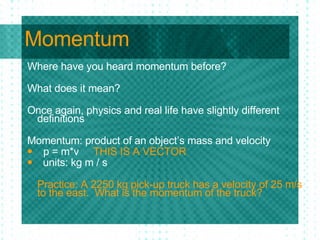
Momentum Where have you heard momentum before? What does it mean? Once again, physics and real life have slightly different definitions Momentum: product of an object’s mass and velocity  p = m*v  THIS IS A VECTOR units: kg m / s Practice: A 2250 kg pick-up truck has a velocity of 25 m/s to the east.  What is the momentum of the truck?
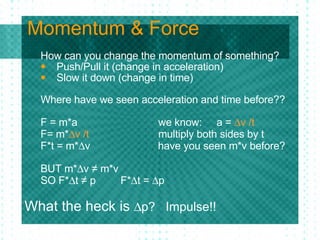
Momentum & Force How can you change the momentum of something? Push/Pull it (change in acceleration) Slow it down (change in time) Where have we seen acceleration and time before?? F = m*a    we know: a =   v /t F= m*  v /t   multiply both sides by t F*t = m*  v   have you seen m*v before? BUT m*  v ≠ m*v SO F*  t ≠ p  F*  t =   p  What the heck is   p?  Impulse!!
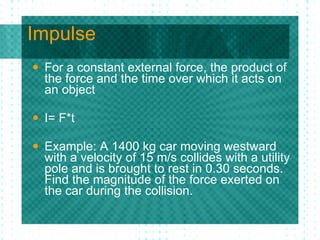
Impulse For a constant external force, the product of the force and the time over which it acts on an object I= F*t Example: A 1400 kg car moving westward with a velocity of 15 m/s collides with a utility pole and is brought to rest in 0.30 seconds.  Find the magnitude of the force exerted on the car during the collision.
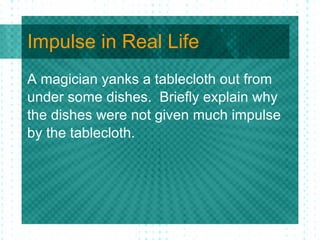
Impulse in Real Life A magician yanks a tablecloth out from under some dishes.  Briefly explain why the dishes were not given much impulse by the tablecloth.
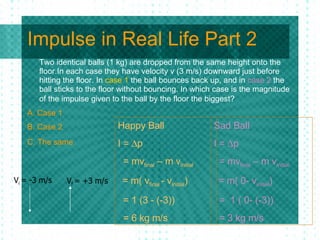
Impulse in Real Life Part 2 Two identical balls (1 kg) are dropped from the same height onto the floor.In each case they have velocity v (3 m/s) downward just before hitting the floor. In  case 1  the ball bounces back up, and in  case 2  the ball sticks to the floor without bouncing. In which case is the magnitude of the impulse given to the ball by the floor the biggest?   A. Case 1  B. Case 2  C. The same   Happy Ball I =   p = mv final  – m v initial = m( v final  - v initial ) = 1 (3 - (-3)) = 6 kg m/s Sad Ball I =   p = mv final  – m v initial = m( 0- v initial ) =  1 ( 0- (-3)) = 3 kg m/s V i  = -3 m/s V f  = +3 m/s
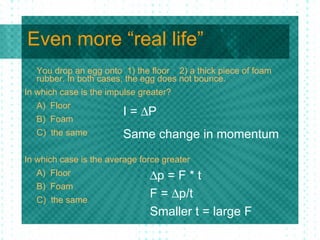
Even more “real life” You drop an egg onto  1) the floor  2) a thick piece of foam rubber. In both cases, the egg does not bounce. In which case is the impulse greater? A)  Floor B)  Foam C)  the same In which case is the average force greater A)  Floor  B)  Foam C)  the same I =   P Same change in momentum  p = F * t F =   p/t Smaller t = large F
Stopping times & distances depend on the Impulse-Momentum Theorem
Momentum is conserved Momentum is “Conserved” meaning it can not be created nor destroyed  Can be transferred   Total Momentum does not change with time. This is a BIG deal!
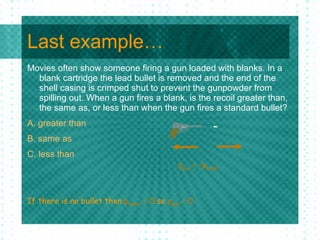
Last example… Movies often show someone firing a gun loaded with blanks. In a blank cartridge the lead bullet is removed and the end of the shell casing is crimped shut to prevent the gunpowder from spilling out. When a gun fires a blank, is the recoil greater than, the same as, or less than when the gun fires a standard bullet?  A. greater than  B. same as  C. less than If there is no bullet then  p bullet  = 0  so  p gun  = 0 p gun  = -p bullet

Impulse & Momentum

  • 1.
    Some brainteasers toget you back in the physics mood 1) If a semi truck and a convertible have a head-on collision, which will experience the greater impact force? The semi The convertible Both the same Need more info 2) Which would cause more damage; driving into a solid concrete wall or having a head-on collision with an identical car traveling at the same speed towards you? The wall The car Both the same Need more info
  • 2.
    Let’s start withthe semi and the car…. Both will have the SAME impact force Newton’s 3rd Law! For every action there is an equal and opposite reaction So what’s different? The acceleration (deceleration) F=m*a So same force, but a smaller mass on the car means the deceleration is more….and hurts more!
  • 3.
    And now forcar vs. the wall… Both will cause the SAME amount of damage because in both cases the car is coming to a complete stop in the same amount of time This has to do with momentum, our next unit What if the car you hit was moving slower? You’d keep going after the collision so you would have a smaller change in momentum and get hurt less What if the car you hit was moving faster? You’d immediately change directions (go backwards) causing a much greater change in momentum and much greater damage to yourself
  • 4.
    Impulse & MomentumWelcome back!! Wednesday January 7th, 2009
  • 5.
    Momentum Where haveyou heard momentum before? What does it mean? Once again, physics and real life have slightly different definitions Momentum: product of an object’s mass and velocity p = m*v THIS IS A VECTOR units: kg m / s Practice: A 2250 kg pick-up truck has a velocity of 25 m/s to the east. What is the momentum of the truck?
  • 6.
    Momentum & ForceHow can you change the momentum of something? Push/Pull it (change in acceleration) Slow it down (change in time) Where have we seen acceleration and time before?? F = m*a we know: a =  v /t F= m*  v /t multiply both sides by t F*t = m*  v have you seen m*v before? BUT m*  v ≠ m*v SO F*  t ≠ p F*  t =  p What the heck is  p? Impulse!!
  • 7.
    Impulse For aconstant external force, the product of the force and the time over which it acts on an object I= F*t Example: A 1400 kg car moving westward with a velocity of 15 m/s collides with a utility pole and is brought to rest in 0.30 seconds. Find the magnitude of the force exerted on the car during the collision.
  • 8.
    Impulse in RealLife A magician yanks a tablecloth out from under some dishes. Briefly explain why the dishes were not given much impulse by the tablecloth.
  • 9.
    Impulse in RealLife Part 2 Two identical balls (1 kg) are dropped from the same height onto the floor.In each case they have velocity v (3 m/s) downward just before hitting the floor. In case 1 the ball bounces back up, and in case 2 the ball sticks to the floor without bouncing. In which case is the magnitude of the impulse given to the ball by the floor the biggest? A. Case 1 B. Case 2 C. The same Happy Ball I =  p = mv final – m v initial = m( v final - v initial ) = 1 (3 - (-3)) = 6 kg m/s Sad Ball I =  p = mv final – m v initial = m( 0- v initial ) = 1 ( 0- (-3)) = 3 kg m/s V i = -3 m/s V f = +3 m/s
  • 10.
    Even more “reallife” You drop an egg onto 1) the floor 2) a thick piece of foam rubber. In both cases, the egg does not bounce. In which case is the impulse greater? A) Floor B) Foam C) the same In which case is the average force greater A) Floor B) Foam C) the same I =  P Same change in momentum  p = F * t F =  p/t Smaller t = large F
  • 11.
    Stopping times &distances depend on the Impulse-Momentum Theorem
  • 12.
    Momentum is conservedMomentum is “Conserved” meaning it can not be created nor destroyed Can be transferred Total Momentum does not change with time. This is a BIG deal!
  • 13.
    Last example… Moviesoften show someone firing a gun loaded with blanks. In a blank cartridge the lead bullet is removed and the end of the shell casing is crimped shut to prevent the gunpowder from spilling out. When a gun fires a blank, is the recoil greater than, the same as, or less than when the gun fires a standard bullet? A. greater than B. same as C. less than If there is no bullet then p bullet = 0 so p gun = 0 p gun = -p bullet