6. MOMENTUM
1.The Impulse-momentum
theorem
2.The principle of
conservation of linear
momentum
3. Collisions: elastic and
inelastic collisions
4. Collisions in one dimension
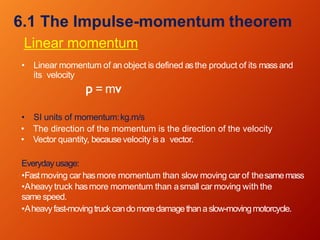
6.1 The Impulse-momentum theorem
Linear momentum
• Linear momentum of an object is defined asthe product of its mass and
its velocity
p = mv
• SI units of momentum:kg.m/s
• The direction of the momentum is the direction of the velocity
• Vector quantity, becausevelocity is a vector.
Everydayusage:
•Fastmoving car hasmore momentum than slow moving car of thesamemass
•Aheavy truck hasmore momentum than asmall car moving with the
same speed.
•Aheavyfast-movingtruckcandomoredamagethanaslow-movingmotorcycle.
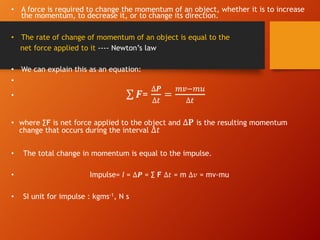
• A force is required to change the momentum of an object, whether it is to increase
the momentum, to decrease it, or to change its direction.
• The rate of change of momentum of an object is equal to the
net force applied to it ---- Newton’s law
• We can explain this as an equation:
•
• ∑ 𝑭=
∆𝑷
∆#
=
$%&$'
∆#
• where ∑F is net force applied to the object and ∆𝐏 is the resulting momentum
change that occurs during the interval ∆𝑡
• The total change in momentum is equal to the impulse.
• Impulse= I = ∆𝑷 = ∑ F ∆𝑡 = m ∆𝑣 = mv-mu
• SI unit for impulse : kgms-1, N s
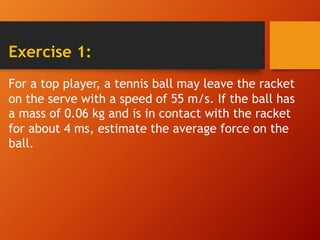
Exercise 1:
For a top player, a tennis ball may leave the racket
on the serve with a speed of 55 m/s. If the ball has
a mass of 0.06 kg and is in contact with the racket
for about 4 ms, estimate the average force on the
ball.
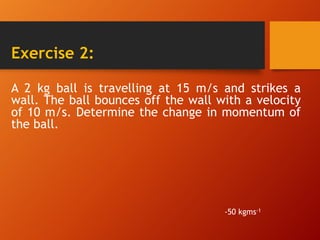
Exercise 2:
A 2 kg ball is travelling at 15 m/s and strikes a
wall. The ball bounces off the wall with a velocity
of 10 m/s. Determine the change in momentum of
the ball.
-50 kgms-1
6.2 The principle of conservation of linear momentum
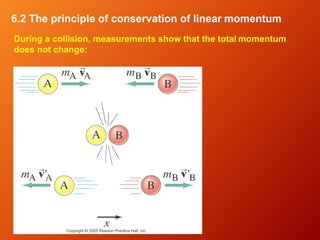
During a collision, measurements show that the total momentum
does not change:
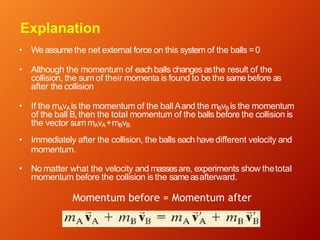
Explanation
• Weassume the net external force on this system of the balls =0
• Although the momentum of eachballs changesasthe result of the
collision, the sum of their momenta is found to be the same before as
after the collision
• If the mAvAis the momentum of the ballAand the mBvB is the momentum
of the ball B,then the total momentum of the balls before the collision is
the vector sum mAvA+mBvB.
• Immediately after the collision, the balls each have different velocity and
momentum.
• No matter what the velocity and massesare, experiments show thetotal
momentum before the collision is the sameasafterward.
Momentum before = Momentum after
Thus the general statement of the law of conservation of
momentum is:
The total momentum of an isolated system of objects
remains constant.
Momentum conservation related to Newton’s Law
• Conservation of momentum is closely connected to
Newton’s law of motion
• Newton’s third law of motion states that for every action,
there is an equal and opposite direction; action and
reaction force act on different objects.
• When two objects A and B are touching each other, if
object A exerts a force F on object B, then object B will
exerts a force –F on object A, i.e. F are equal but in
different direction.
𝐹()= −𝐹)(
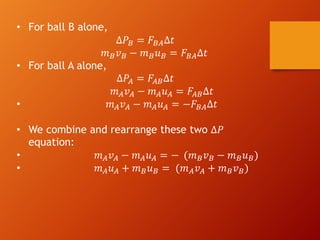
• For ball B alone,
∆𝑃) = 𝐹)(∆𝑡
𝑚)𝑣) − 𝑚)𝑢) = 𝐹)(∆𝑡
• For ball A alone,
∆𝑃( = 𝐹()∆𝑡
𝑚(𝑣( − 𝑚(𝑢( = 𝐹()∆𝑡
• 𝑚(𝑣( − 𝑚(𝑢( = −𝐹)(∆𝑡
• We combine and rearrange these two ∆𝑃
equation:
• 𝑚(𝑣( − 𝑚(𝑢( = − (𝑚)𝑣) − 𝑚)𝑢))
• 𝑚(𝑢( + 𝑚)𝑢) = (𝑚(𝑣( + 𝑚)𝑣))
CONSERV
A
TIONOFLINEAR MOMENTUM
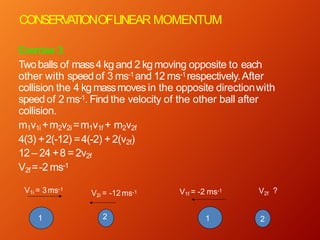
Exercise 3:
Twoballs of mass4 kgand 2 kgmoving opposite to each
other with speed of 3 ms-1and 12 ms-1respectively.After
collision the 4 kgmassmoves in the opposite directionwith
speed of 2 ms-1. Find the velocity of the other ball after
collision.
m1v1i +m2v2i =m1v1f + m2v2f
4(3) +2(-12) =4(-2) +2(v2f)
12 – 24 +8 = 2v2f
V2f =-2 ms-1
V1i = 3ms-1
V2i = -12ms-1 V2f ?
V1f = -2 ms-1
1 2 1 2
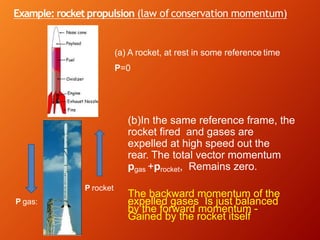
Example: rocket propulsion (law of conservation momentum)
P rocket
P gas:
(a) A rocket, at rest in some reference time
P=0
(b)In the same reference frame, the
rocket fired and gases are
expelled at high speed out the
rear. The total vector momentum
pgas +procket, Remains zero.
The backward momentum of the
expelled gases Is just balanced
by the forward momentum -
Gained by the rocket itself
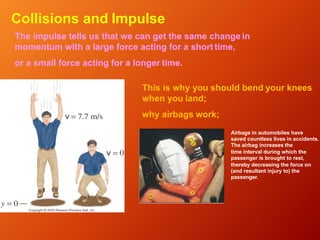
Collisions and Impulse
The impulse tells us that we can get the same change in
momentum with a large force acting for a short time,
or a small force acting for a longer time.
This is why you should bend your knees
when you land;
why airbags work;
Airbags in automobiles have
saved countless lives in accidents.
The airbag increases the
time interval during which the
passenger is brought to rest,
thereby decreasing the force on
(and resultant injury to) the
passenger.
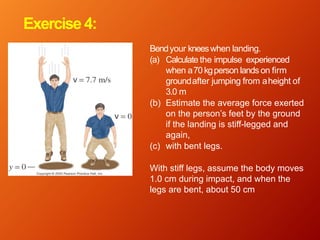
Exercise4:
Bendyour kneeswhen landing.
(a) Calculate the impulse experienced
when a70 kgperson lands on firm
groundafter jumping from aheight of
3.0 m
(b) Estimate the average force exerted
on the person’s feet by the ground
if the landing is stiff-legged and
again,
(c) with bent legs.
With stiff legs, assume the body moves
1.0 cm during impact, and when the
legs are bent, about 50 cm
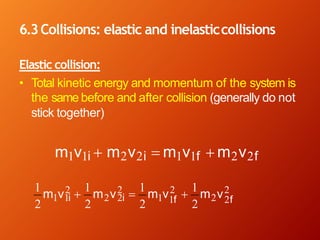
6.3Collisions: elastic and inelasticcollisions
Elastic collision:
• Total kinetic energy and momentum of the system is
the same before and after collision (generally do not
stick together)
m1v1i + m2v2i = m1v1f + m2v2f
2
2 2 2 2
1 1f 2f
1 1i 2 2i
1
m v2 +
1
m v2 =
1
m v2 +
1
m v2
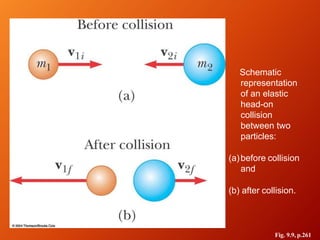
Fig. 9.9, p.261
Schematic
representation
of an elastic
head-on
collision
between two
particles:
(a)before collision
and
(b) after collision.
INELASTICCOLLISION
• Inelastic collision:
• Total momentum is conserve but the total
kinetic energy of the system is not the same
before and after thecollision.
• If object stick together after collision, then its
perfectly inelastic.
• If object do not stick but some kinetic energy
lost then collision calledinelastic.
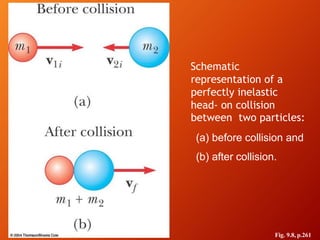
Fig. 9.8, p.261
Schematic
representation of a
perfectly inelastic
head- on collision
between two particles:
(a) before collision and
(b) after collision.
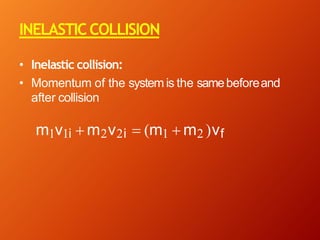
INELASTICCOLLISION
• Inelastic collision:
• Momentum of the system is the samebeforeand
after collision
m1v1i + m2v2i = (m1 + m2 )vf
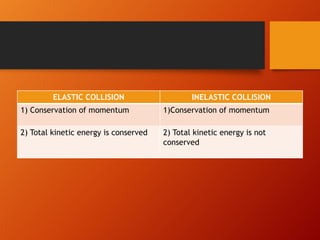
ELASTIC COLLISION INELASTIC COLLISION
1) Conservation of momentum 1)Conservation of momentum
2) Total kinetic energy is conserved 2) Total kinetic energy is not
conserved
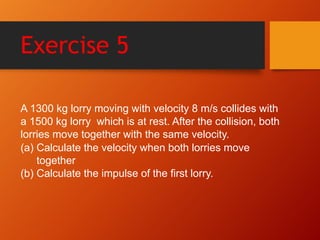
Exercise 5
A 1300 kg lorry moving with velocity 8 m/s collides with
a 1500 kg lorry which is at rest. After the collision, both
lorries move together with the same velocity.
(a) Calculate the velocity when both lorries move
together
(b) Calculate the impulse of the first lorry.
6.4 Collisions in one dimension
• In this section we use the law of conservation of linear
momentum to describe what happens when two particles
collide.
• We use the term collision to represent an event
during which two particles come close to each other
and interact by means of forces.
• The time interval during which the velocities of the
particles change from initial to final values is assumed to
be short.
• The interaction forces are assumed to be much greater
than any external forces present.
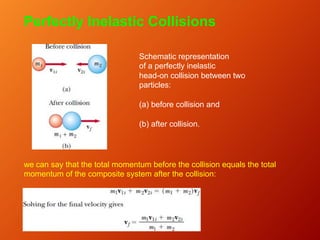
Schematic representation
of a perfectly inelastic
head-on collision between two
particles:
(a) before collision and
(b) after collision.
Perfectly Inelastic Collisions
we can say that the total momentum before the collision equals the total
momentum of the composite system after the collision:
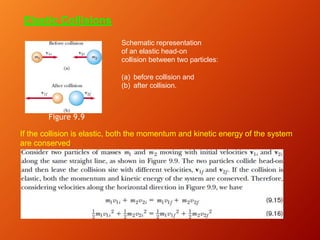
Elastic Collisions
Schematic representation
of an elastic head-on
collision between two particles:
(a) before collision and
(b) after collision.
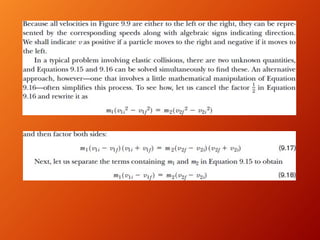
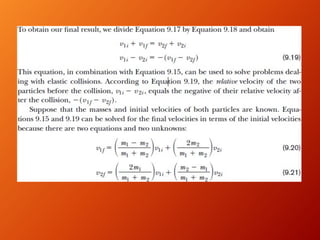
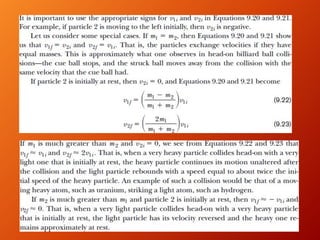
If the collision is elastic, both the momentum and kinetic energy of the system
are conserved.
Figure 9.9
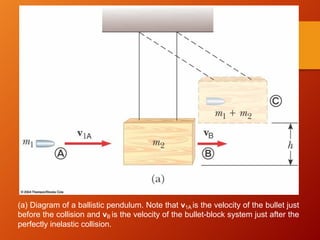
(a) Diagram of a ballistic pendulum. Note that v1A is the velocity of the bullet just
before the collision and vB is the velocity of the bullet-block system just after the
perfectly inelastic collision.
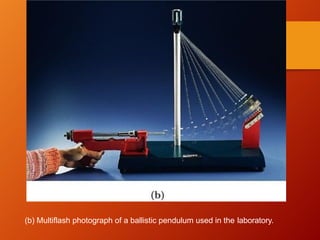
(b) Multiflash photograph of a ballistic pendulum used in the laboratory.
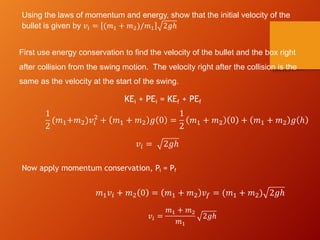
Using the laws of momentum and energy, show that the initial velocity of the
bullet is given by 𝑣! = (𝑚" + 𝑚#)/𝑚" 2𝑔ℎ
First use energy conservation to find the velocity of the bullet and the box right
after collision from the swing motion. The velocity right after the collision is the
same as the velocity at the start of the swing.
1
2
(𝑚!+𝑚")𝑣#
"
+ 𝑚! + 𝑚" 𝑔 0 =
1
2
𝑚! + 𝑚" 0 + 𝑚! + 𝑚" 𝑔 ℎ
𝑣# = 2𝑔ℎ
Now apply momentum conservation, Pi = Pf
𝑚!𝑣# + 𝑚" 0 = 𝑚! + 𝑚" 𝑣$ = (𝑚! + 𝑚") 2𝑔ℎ
𝑣! =
𝑚" + 𝑚#
𝑚"
2𝑔ℎ
KEi + PEi = KEf + PEf
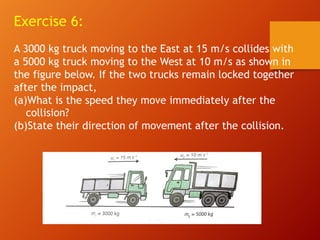
Exercise 6:
A 3000 kg truck moving to the East at 15 m/s collides with
a 5000 kg truck moving to the West at 10 m/s as shown in
the figure below. If the two trucks remain locked together
after the impact,
(a)What is the speed they move immediately after the
collision?
(b)State their direction of movement after the collision.
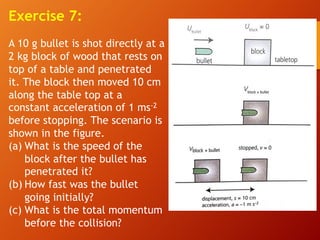
Exercise 7:
A 10 g bullet is shot directly at a
2 kg block of wood that rests on
top of a table and penetrated
it. The block then moved 10 cm
along the table top at a
constant acceleration of 1 ms-2
before stopping. The scenario is
shown in the figure.
(a) What is the speed of the
block after the bullet has
penetrated it?
(b) How fast was the bullet
going initially?
(c) What is the total momentum
before the collision?
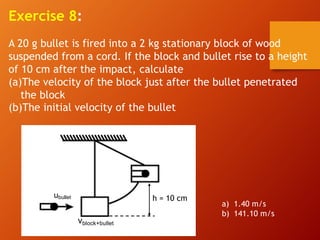
Exercise 8:
A 20 g bullet is fired into a 2 kg stationary block of wood
suspended from a cord. If the block and bullet rise to a height
of 10 cm after the impact, calculate
(a)The velocity of the block just after the bullet penetrated
the block
(b)The initial velocity of the bullet
ubullet
vblock+bullet
h = 10 cm
a) 1.40 m/s
b) 141.10 m/s
Exercise 9:
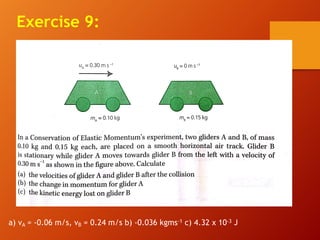
a) vA = -0.06 m/s, vB = 0.24 m/s b) -0.036 kgms-1 c) 4.32 x 10⁻³ J
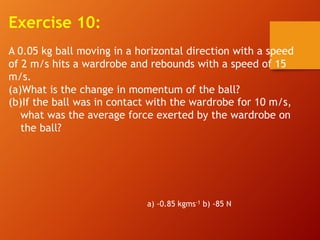
Exercise 10:
A 0.05 kg ball moving in a horizontal direction with a speed
of 2 m/s hits a wardrobe and rebounds with a speed of 15
m/s.
(a)What is the change in momentum of the ball?
(b)If the ball was in contact with the wardrobe for 10 m/s,
what was the average force exerted by the wardrobe on
the ball?
a) -0.85 kgms-1 b) -85 N
END OF CHAPTER 6

Chapter 6 PHI406 Momentum notes.pdf physic

  • 1.
    6. MOMENTUM 1.The Impulse-momentum theorem 2.Theprinciple of conservation of linear momentum 3. Collisions: elastic and inelastic collisions 4. Collisions in one dimension
  • 2.
    6.1 The Impulse-momentumtheorem Linear momentum • Linear momentum of an object is defined asthe product of its mass and its velocity p = mv • SI units of momentum:kg.m/s • The direction of the momentum is the direction of the velocity • Vector quantity, becausevelocity is a vector. Everydayusage: •Fastmoving car hasmore momentum than slow moving car of thesamemass •Aheavy truck hasmore momentum than asmall car moving with the same speed. •Aheavyfast-movingtruckcandomoredamagethanaslow-movingmotorcycle.
  • 3.
    • A forceis required to change the momentum of an object, whether it is to increase the momentum, to decrease it, or to change its direction. • The rate of change of momentum of an object is equal to the net force applied to it ---- Newton’s law • We can explain this as an equation: • • ∑ 𝑭= ∆𝑷 ∆# = $%&$' ∆# • where ∑F is net force applied to the object and ∆𝐏 is the resulting momentum change that occurs during the interval ∆𝑡 • The total change in momentum is equal to the impulse. • Impulse= I = ∆𝑷 = ∑ F ∆𝑡 = m ∆𝑣 = mv-mu • SI unit for impulse : kgms-1, N s
  • 4.
    Exercise 1: For atop player, a tennis ball may leave the racket on the serve with a speed of 55 m/s. If the ball has a mass of 0.06 kg and is in contact with the racket for about 4 ms, estimate the average force on the ball.
  • 5.
    Exercise 2: A 2kg ball is travelling at 15 m/s and strikes a wall. The ball bounces off the wall with a velocity of 10 m/s. Determine the change in momentum of the ball. -50 kgms-1
  • 6.
    6.2 The principleof conservation of linear momentum During a collision, measurements show that the total momentum does not change:
  • 7.
    Explanation • Weassume thenet external force on this system of the balls =0 • Although the momentum of eachballs changesasthe result of the collision, the sum of their momenta is found to be the same before as after the collision • If the mAvAis the momentum of the ballAand the mBvB is the momentum of the ball B,then the total momentum of the balls before the collision is the vector sum mAvA+mBvB. • Immediately after the collision, the balls each have different velocity and momentum. • No matter what the velocity and massesare, experiments show thetotal momentum before the collision is the sameasafterward. Momentum before = Momentum after
  • 8.
    Thus the generalstatement of the law of conservation of momentum is: The total momentum of an isolated system of objects remains constant.
  • 9.
    Momentum conservation relatedto Newton’s Law • Conservation of momentum is closely connected to Newton’s law of motion • Newton’s third law of motion states that for every action, there is an equal and opposite direction; action and reaction force act on different objects. • When two objects A and B are touching each other, if object A exerts a force F on object B, then object B will exerts a force –F on object A, i.e. F are equal but in different direction. 𝐹()= −𝐹)(
  • 10.
    • For ballB alone, ∆𝑃) = 𝐹)(∆𝑡 𝑚)𝑣) − 𝑚)𝑢) = 𝐹)(∆𝑡 • For ball A alone, ∆𝑃( = 𝐹()∆𝑡 𝑚(𝑣( − 𝑚(𝑢( = 𝐹()∆𝑡 • 𝑚(𝑣( − 𝑚(𝑢( = −𝐹)(∆𝑡 • We combine and rearrange these two ∆𝑃 equation: • 𝑚(𝑣( − 𝑚(𝑢( = − (𝑚)𝑣) − 𝑚)𝑢)) • 𝑚(𝑢( + 𝑚)𝑢) = (𝑚(𝑣( + 𝑚)𝑣))
  • 11.
    CONSERV A TIONOFLINEAR MOMENTUM Exercise 3: Twoballsof mass4 kgand 2 kgmoving opposite to each other with speed of 3 ms-1and 12 ms-1respectively.After collision the 4 kgmassmoves in the opposite directionwith speed of 2 ms-1. Find the velocity of the other ball after collision. m1v1i +m2v2i =m1v1f + m2v2f 4(3) +2(-12) =4(-2) +2(v2f) 12 – 24 +8 = 2v2f V2f =-2 ms-1 V1i = 3ms-1 V2i = -12ms-1 V2f ? V1f = -2 ms-1 1 2 1 2
  • 12.
    Example: rocket propulsion(law of conservation momentum) P rocket P gas: (a) A rocket, at rest in some reference time P=0 (b)In the same reference frame, the rocket fired and gases are expelled at high speed out the rear. The total vector momentum pgas +procket, Remains zero. The backward momentum of the expelled gases Is just balanced by the forward momentum - Gained by the rocket itself
  • 13.
    Collisions and Impulse Theimpulse tells us that we can get the same change in momentum with a large force acting for a short time, or a small force acting for a longer time. This is why you should bend your knees when you land; why airbags work; Airbags in automobiles have saved countless lives in accidents. The airbag increases the time interval during which the passenger is brought to rest, thereby decreasing the force on (and resultant injury to) the passenger.
  • 14.
    Exercise4: Bendyour kneeswhen landing. (a)Calculate the impulse experienced when a70 kgperson lands on firm groundafter jumping from aheight of 3.0 m (b) Estimate the average force exerted on the person’s feet by the ground if the landing is stiff-legged and again, (c) with bent legs. With stiff legs, assume the body moves 1.0 cm during impact, and when the legs are bent, about 50 cm
  • 15.
    6.3Collisions: elastic andinelasticcollisions Elastic collision: • Total kinetic energy and momentum of the system is the same before and after collision (generally do not stick together) m1v1i + m2v2i = m1v1f + m2v2f 2 2 2 2 2 1 1f 2f 1 1i 2 2i 1 m v2 + 1 m v2 = 1 m v2 + 1 m v2
  • 16.
    Fig. 9.9, p.261 Schematic representation ofan elastic head-on collision between two particles: (a)before collision and (b) after collision.
  • 17.
    INELASTICCOLLISION • Inelastic collision: •Total momentum is conserve but the total kinetic energy of the system is not the same before and after thecollision. • If object stick together after collision, then its perfectly inelastic. • If object do not stick but some kinetic energy lost then collision calledinelastic.
  • 18.
    Fig. 9.8, p.261 Schematic representationof a perfectly inelastic head- on collision between two particles: (a) before collision and (b) after collision.
  • 19.
    INELASTICCOLLISION • Inelastic collision: •Momentum of the system is the samebeforeand after collision m1v1i + m2v2i = (m1 + m2 )vf
  • 20.
    ELASTIC COLLISION INELASTICCOLLISION 1) Conservation of momentum 1)Conservation of momentum 2) Total kinetic energy is conserved 2) Total kinetic energy is not conserved
  • 21.
    Exercise 5 A 1300kg lorry moving with velocity 8 m/s collides with a 1500 kg lorry which is at rest. After the collision, both lorries move together with the same velocity. (a) Calculate the velocity when both lorries move together (b) Calculate the impulse of the first lorry.
  • 22.
    6.4 Collisions inone dimension • In this section we use the law of conservation of linear momentum to describe what happens when two particles collide. • We use the term collision to represent an event during which two particles come close to each other and interact by means of forces. • The time interval during which the velocities of the particles change from initial to final values is assumed to be short. • The interaction forces are assumed to be much greater than any external forces present.
  • 23.
    Schematic representation of aperfectly inelastic head-on collision between two particles: (a) before collision and (b) after collision. Perfectly Inelastic Collisions we can say that the total momentum before the collision equals the total momentum of the composite system after the collision:
  • 24.
    Elastic Collisions Schematic representation ofan elastic head-on collision between two particles: (a) before collision and (b) after collision. If the collision is elastic, both the momentum and kinetic energy of the system are conserved. Figure 9.9
  • 28.
    (a) Diagram ofa ballistic pendulum. Note that v1A is the velocity of the bullet just before the collision and vB is the velocity of the bullet-block system just after the perfectly inelastic collision.
  • 29.
    (b) Multiflash photographof a ballistic pendulum used in the laboratory.
  • 30.
    Using the lawsof momentum and energy, show that the initial velocity of the bullet is given by 𝑣! = (𝑚" + 𝑚#)/𝑚" 2𝑔ℎ First use energy conservation to find the velocity of the bullet and the box right after collision from the swing motion. The velocity right after the collision is the same as the velocity at the start of the swing. 1 2 (𝑚!+𝑚")𝑣# " + 𝑚! + 𝑚" 𝑔 0 = 1 2 𝑚! + 𝑚" 0 + 𝑚! + 𝑚" 𝑔 ℎ 𝑣# = 2𝑔ℎ Now apply momentum conservation, Pi = Pf 𝑚!𝑣# + 𝑚" 0 = 𝑚! + 𝑚" 𝑣$ = (𝑚! + 𝑚") 2𝑔ℎ 𝑣! = 𝑚" + 𝑚# 𝑚" 2𝑔ℎ KEi + PEi = KEf + PEf
  • 31.
    Exercise 6: A 3000kg truck moving to the East at 15 m/s collides with a 5000 kg truck moving to the West at 10 m/s as shown in the figure below. If the two trucks remain locked together after the impact, (a)What is the speed they move immediately after the collision? (b)State their direction of movement after the collision.
  • 32.
    Exercise 7: A 10g bullet is shot directly at a 2 kg block of wood that rests on top of a table and penetrated it. The block then moved 10 cm along the table top at a constant acceleration of 1 ms-2 before stopping. The scenario is shown in the figure. (a) What is the speed of the block after the bullet has penetrated it? (b) How fast was the bullet going initially? (c) What is the total momentum before the collision?
  • 33.
    Exercise 8: A 20g bullet is fired into a 2 kg stationary block of wood suspended from a cord. If the block and bullet rise to a height of 10 cm after the impact, calculate (a)The velocity of the block just after the bullet penetrated the block (b)The initial velocity of the bullet ubullet vblock+bullet h = 10 cm a) 1.40 m/s b) 141.10 m/s
  • 34.
    Exercise 9: a) vA= -0.06 m/s, vB = 0.24 m/s b) -0.036 kgms-1 c) 4.32 x 10⁻³ J
  • 35.
    Exercise 10: A 0.05kg ball moving in a horizontal direction with a speed of 2 m/s hits a wardrobe and rebounds with a speed of 15 m/s. (a)What is the change in momentum of the ball? (b)If the ball was in contact with the wardrobe for 10 m/s, what was the average force exerted by the wardrobe on the ball? a) -0.85 kgms-1 b) -85 N
  • 36.