Engineering Mechanics
Linear Momentum
and
Collisions / Impact
Prof. Samirsinh P. Parmar
samirddu@gmail.com, spp.cl@ddu.ac.in
Asst. Prof. Dept. of Civil Engineering
Dharmasinh Desai University, Nadiad, Gujarat, India
Linear Momentum and Collisions
• Momentum
• Impulse
• Conservation of Momentum
• 1-D Collisions
• 2-D Collisions
• The Center of Mass
Conservation of Energy
• D E = D K + D U = 0 if conservative forces are the only forces that
do work on the system.
• The total amount of energy in the system is constant.
• D E = D K + D U = -fkd if friction forces are doing work on the
system.
• The total amount of energy in the system is still constant, but the
change in mechanical energy goes into “internal energy” or heat.
2
2
2
2
2
1
2
1
2
1
2
1
i
i
i
f
f
f kx
mgy
mv
kx
mgy
mv 






















 2
2
2
2
2
1
2
1
2
1
2
1
i
i
i
f
f
f
k kx
mgy
mv
kx
mgy
mv
d
f
Linear Momentum
• This is a new fundamental quantity, like force, energy. It is a vector
quantity (points in same direction as velocity).
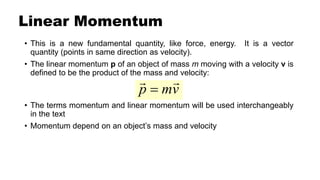
• The linear momentum p of an object of mass m moving with a velocity v is
defined to be the product of the mass and velocity:
• The terms momentum and linear momentum will be used interchangeably
in the text
• Momentum depend on an object’s mass and velocity
v
m
p



Momentum and Energy
• Two objects with masses m1 and m2 have
equal kinetic energy. How do the
magnitudes of their momenta compare?
(A) p1 < p2
(B) p1 = p2
(C) p1 > p2
(D) Not enough information is given
Linear Momentum, cont’d
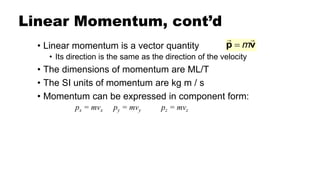
• Linear momentum is a vector quantity
• Its direction is the same as the direction of the velocity
• The dimensions of momentum are ML/T
• The SI units of momentum are kg m / s
• Momentum can be expressed in component form:
px = mvx py = mvy pz = mvz
m

p v
Newton’s Law and Momentum
• Newton’s Second Law can be used to relate the
momentum of an object to the resultant force
acting on it
• The change in an object’s momentum divided by
the elapsed time equals the constant net force
acting on the object
t
v
m
t
v
m
a
m
Fnet
D
D

D
D


)
(




net
F
t
p 



D
D
interval
time
momentum
in
change
Impulse
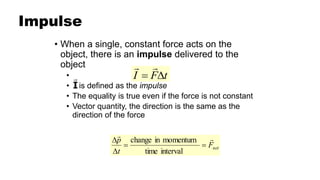
• When a single, constant force acts on the
object, there is an impulse delivered to the
object
•
• is defined as the impulse
• The equality is true even if the force is not constant
• Vector quantity, the direction is the same as the
direction of the force
I
t
F
I D



net
F
t
p 



D
D
interval
time
momentum
in
change
Impulse-Momentum Theorem
• The theorem states
that the impulse acting
on a system is equal
to the change in
momentum of the
system
i
f v
m
v
m
p
I






D

I
t
F
p net




D

D
Calculating the Change of Momentum
 
0 ( )
p m v mv
D    
( )
after before
after before
after before
p p p
mv mv
m v v
D  
 
 
For the teddy bear
For the bouncing ball
 
( ) 2
p m v v mv
D    
How Good Are the Bumpers?
 In a crash test, a car of mass 1.5103 kg collides with a wall and
rebounds as in figure. The initial and final velocities of the car are vi=-15
m/s and vf = 2.6 m/s, respectively. If the collision lasts for 0.15 s, find
(a) the impulse delivered to the car due to the collision
(b) the size and direction of the average force exerted on the car
How Good Are the Bumpers?
 In a crash test, a car of mass 1.5103 kg collides with a wall and
rebounds as in figure. The initial and final velocities of the car are vi=-15
m/s and vf = 2.6 m/s, respectively. If the collision lasts for 0.15 s, find
(a) the impulse delivered to the car due to the collision
(b) the size and direction of the average force exerted on the car
s
m
kg
s
m
kg
mv
p i
i /
10
25
.
2
)
/
15
)(
10
5
.
1
( 4
3








N
s
s
m
kg
t
I
t
p
Fav
5
4
10
76
.
1
15
.
0
/
10
64
.
2





D

D
D

s
m
kg
s
m
kg
mv
p f
f /
10
39
.
0
)
/
6
.
2
)(
10
5
.
1
( 4
3








s
m
kg
s
m
kg
s
m
kg
mv
mv
p
p
I i
f
i
f
/
10
64
.
2
)
/
10
25
.
2
(
)
/
10
39
.
0
(
4
4
4














Impulse-Momentum Theorem
• A child bounces a 100 g superball on the
sidewalk. The velocity of the superball
changes from 10 m/s downward to 10 m/s
upward. If the contact time with the sidewalk
is 0.1s, what is the magnitude of the
impulse imparted to the superball?
(A) 0
(B) 2 kg-m/s
(C) 20 kg-m/s
(D) 200 kg-m/s
(E) 2000 kg-m/s
i
f v
m
v
m
p
I






D

Impulse-Momentum Theorem 2
• A child bounces a 100 g superball on the
sidewalk. The velocity of the superball
changes from 10 m/s downward to 10 m/s
upward. If the contact time with the sidewalk
is 0.1s, what is the magnitude of the force
between the sidewalk and the superball?
(A) 0
(B) 2 N
(C) 20 N
(D) 200 N
(E) 2000 N
t
v
m
v
m
t
p
t
I
F
i
f
D


D
D

D






Conservation of Momentum
• In an isolated and closed system,
the total momentum of the
system remains constant in time.
• Isolated system: no external forces
• Closed system: no mass enters or
leaves
• The linear momentum of each
colliding body may change
• The total momentum P of the
system cannot change.
Conservation of Momentum
• Start from impulse-momentum
theorem
• Since
• Then
• So
i
f v
m
v
m
t
F 2
2
2
2
12





D
i
f v
m
v
m
t
F 1
1
1
1
21





D
t
F
t
F D


D 12
21


)
( 2
2
2
2
1
1
1
1 i
f
i
f v
m
v
m
v
m
v
m








f
f
i
i v
m
v
m
v
m
v
m 2
2
1
1
2
2
1
1







Conservation of Momentum
• When no external forces act on a system consisting of two
objects that collide with each other, the total momentum of
the system remains constant in time
• When then
• For an isolated system
• Specifically, the total momentum before the collision will
equal the total momentum after the collision
i
f
net p
p
p
t
F






D

D
0

Dp

0

net
F

i
f p
p



f
f
i
i v
m
v
m
v
m
v
m 2
2
1
1
2
2
1
1







The Archer
 An archer stands at rest on frictionless ice and fires a 0.5-kg arrow
horizontally at 50.0 m/s. The combined mass of the archer and bow is
60.0 kg. With what velocity does the archer move across the ice after
firing the arrow?
f
f
i
i v
m
v
m
v
m
v
m 2
2
1
1
2
2
1
1 


f
i p
p 
?
,
/
50
,
0
,
5
.
0
,
0
.
60 1
2
2
1
2
1 




 f
f
i
i v
s
m
v
v
v
kg
m
kg
m
f
f v
m
v
m 2
2
1
1
0 

s
m
s
m
kg
kg
v
m
m
v f
f /
417
.
0
)
/
0
.
50
(
0
.
60
5
.
0
2
1
2
1 





Conservation of Momentum
• A 100 kg man and 50 kg woman on ice
skates stand facing each other. If the woman
pushes the man backwards so that his final
speed is 1 m/s, at what speed does she
recoil?
(A) 0
(B) 0.5 m/s
(C) 1 m/s
(D) 1.414 m/s
(E) 2 m/s
Types of Collisions
• Momentum is conserved in any collision
• Inelastic collisions: rubber ball and hard ball
• Kinetic energy is not conserved
• Perfectly inelastic collisions occur when the objects
stick together
• Elastic collisions: billiard ball
• both momentum and kinetic energy are conserved
• Actual collisions
• Most collisions fall between elastic and perfectly
inelastic collisions
Collisions Summary
• In an elastic collision, both momentum and kinetic energy are conserved
• In a non-perfect inelastic collision, momentum is conserved but kinetic
energy is not. Moreover, the objects do not stick together
• In a perfectly inelastic collision, momentum is conserved, kinetic energy
is not, and the two objects stick together after the collision, so their final
velocities are the same
• Elastic and perfectly inelastic collisions are limiting cases, most actual
collisions fall in between these two types
• Momentum is conserved in all collisions
More about Perfectly Inelastic Collisions
• When two objects stick together
after the collision, they have
undergone a perfectly inelastic
collision
• Conservation of momentum
• Kinetic energy is NOT conserved
f
i
i v
m
m
v
m
v
m )
( 2
1
2
2
1
1 


2
1
2
2
1
1
m
m
v
m
v
m
v i
i
f



An SUV Versus a Compact
 An SUV with mass 1.80103 kg is travelling eastbound at
+15.0 m/s, while a compact car with mass 9.00102 kg
is travelling westbound at -15.0 m/s. The cars collide
head-on, becoming entangled.
(a) Find the speed of the entangled
cars after the collision.
(b) Find the change in the velocity
of each car.
(c) Find the change in the kinetic
energy of the system consisting
of both cars.
(a) Find the speed of the entangled
cars after the collision.
f
i
i v
m
m
v
m
v
m )
( 2
1
2
2
1
1 


f
i p
p 
s
m
v
kg
m
s
m
v
kg
m
i
i
/
15
,
10
00
.
9
/
15
,
10
80
.
1
2
2
2
1
3
1








2
1
2
2
1
1
m
m
v
m
v
m
v i
i
f



s
m
vf /
00
.
5


An SUV Versus a Compact
(b) Find the change in the velocity
of each car.
s
m
v
v
v i
f /
0
.
10
1
1 



D
s
m
v
kg
m
s
m
v
kg
m
i
i
/
15
,
10
00
.
9
/
15
,
10
80
.
1
2
2
2
1
3
1








s
m
vf /
00
.
5


An SUV Versus a Compact
s
m
v
v
v i
f /
0
.
20
2
2 



D
s
m
kg
v
v
m
v
m i
f /
10
8
.
1
)
( 4
1
1
1
1 





D
0
2
2
1
1 
D

D v
m
v
m
s
m
kg
v
v
m
v
m i
f /
10
8
.
1
)
( 4
2
2
2
2 





D
(c) Find the change in the kinetic
energy of the system consisting
of both cars.
J
v
m
v
m
KE i
i
i
5
2
2
2
2
1
1 10
04
.
3
2
1
2
1




s
m
v
kg
m
s
m
v
kg
m
i
i
/
15
,
10
00
.
9
/
15
,
10
80
.
1
2
2
2
1
3
1








s
m
vf /
00
.
5


An SUV Versus a Compact
J
KE
KE
KE i
f
5
10
70
.
2 




D
J
v
m
v
m
KE f
f
f
4
2
2
2
2
1
1 10
38
.
3
2
1
2
1




More About Elastic Collisions
• Both momentum and kinetic energy
are conserved
• Typically have two unknowns
• Momentum is a vector quantity
• Direction is important
• Be sure to have the correct signs
• Solve the equations simultaneously
2
2
2
2
1
1
2
2
2
2
1
1
2
2
1
1
2
2
1
1
2
1
2
1
2
1
2
1
f
f
i
i
f
f
i
i
v
m
v
m
v
m
v
m
v
m
v
m
v
m
v
m






Elastic Collisions
• A simpler equation can be used in place of the KE
equation
i
f
f
i v
v
v
v 2
2
1
1 


)
v
v
(
v
v f
2
f
1
i
2
i
1 



2
2
2
2
1
1
2
2
2
2
1
1
2
1
2
1
2
1
2
1
f
f
i
i v
m
v
m
v
m
v
m 


)
)(
(
)
)(
( 2
2
2
2
2
1
1
1
1
1 i
f
i
f
f
i
f
i v
v
v
v
m
v
v
v
v
m 




)
(
)
( 2
2
2
1
1
1 i
f
f
i v
v
m
v
v
m 


)
(
)
( 2
2
2
2
2
2
1
2
1
1 i
f
f
i v
v
m
v
v
m 


f
f
i
i v
m
v
m
v
m
v
m 2
2
1
1
2
2
1
1 


f
f
i
i v
m
v
m
v
m
v
m 2
2
1
1
2
2
1
1 


Summary of Types of Collisions
• In an elastic collision, both momentum and kinetic energy
are conserved
• In an inelastic collision, momentum is conserved but
kinetic energy is not
• In a perfectly inelastic collision, momentum is conserved,
kinetic energy is not, and the two objects stick together
after the collision, so their final velocities are the same
i
f
f
i v
v
v
v 2
2
1
1 

 f
f
i
i v
m
v
m
v
m
v
m 2
2
1
1
2
2
1
1 


f
f
i
i v
m
v
m
v
m
v
m 2
2
1
1
2
2
1
1 


f
i
i v
m
m
v
m
v
m )
( 2
1
2
2
1
1 


Conservation of Momentum
• An object of mass m moves to the right with a speed
v. It collides head-on with an object of mass 3m
moving with speed v/3 in the opposite direction. If the
two objects stick together, what is the speed of the
combined object, of mass 4m, after the collision?
(A) 0
(B) v/2
(C) v
(D) 2v
(E) 4v
Problem Solving for 1D Collisions, 1
• Coordinates: Set up a
coordinate axis and define
the velocities with respect to
this axis
• It is convenient to make your
axis coincide with one of the
initial velocities
• Diagram: In your sketch,
draw all the velocity vectors
and label the velocities and
the masses
Problem Solving for 1D Collisions, 2
• Conservation of
Momentum: Write a
general expression for the
total momentum of the
system before and after the
collision
• Equate the two total
momentum expressions
• Fill in the known values
f
f
i
i v
m
v
m
v
m
v
m 2
2
1
1
2
2
1
1 


Problem Solving for 1D Collisions, 3
• Conservation of Energy:
If the collision is elastic,
write a second equation for
conservation of KE, or the
alternative equation
• This only applies to perfectly
elastic collisions
• Solve: the resulting
equations simultaneously
i
f
f
i v
v
v
v 2
2
1
1 


One-Dimension vs Two-Dimension
Two-Dimensional Collisions
• For a general collision of two objects in two-
dimensional space, the conservation of momentum
principle implies that the total momentum of the
system in each direction is conserved
fy
fy
iy
iy
fx
fx
ix
ix
v
m
v
m
v
m
v
m
v
m
v
m
v
m
v
m
2
2
1
1
2
2
1
1
2
2
1
1
2
2
1
1






Two-Dimensional Collisions
• The momentum is conserved in all directions
• Use subscripts for
• Identifying the object
• Indicating initial or final values
• The velocity components
• If the collision is elastic, use conservation of
kinetic energy as a second equation
• Remember, the simpler equation can only be used
for one-dimensional situations
fy
fy
iy
iy
fx
fx
ix
ix
v
m
v
m
v
m
v
m
v
m
v
m
v
m
v
m
2
2
1
1
2
2
1
1
2
2
1
1
2
2
1
1






i
f
f
i v
v
v
v 2
2
1
1 


Glancing Collisions
• The “after” velocities have x and y components
• Momentum is conserved in the x direction and in the y
direction
• Apply conservation of momentum separately to each
direction
fy
fy
iy
iy
fx
fx
ix
ix
v
m
v
m
v
m
v
m
v
m
v
m
v
m
v
m
2
2
1
1
2
2
1
1
2
2
1
1
2
2
1
1






2-D Collision, example
• Particle 1 is moving at
velocity and particle
2 is at rest
• In the x-direction, the
initial momentum is
m1v1i
• In the y-direction, the
initial momentum is 0
1i
v
2-D Collision, example cont
• After the collision, the momentum
in the x-direction is m1v1f cos q 
m2v2f cos f
• After the collision, the momentum
in the y-direction is m1v1f sin q 
m2v2f sin f
• If the collision is elastic, apply the
kinetic energy equation
f
q
f
q
sin
sin
0
0
cos
cos
0
2
2
1
1
2
2
1
1
1
1
f
f
f
f
i
v
m
v
m
v
m
v
m
v
m






2
2
2
2
1
1
2
1
1
2
1
2
1
2
1
f
f
i v
m
v
m
v
m 

Collision at an Intersection
 A car with mass 1.5×10³ kg traveling
east at a speed of 25 m/s collides at
an intersection with a 2.5×10³ kg van
traveling north at a speed of 20 m/s.
Find the magnitude and direction of
the velocity of the wreckage after the
collision, assuming that the vehicles
undergo a perfectly inelastic collision
and assuming that friction between the
vehicles and the road can be
neglected.
?
?
,
/
20
,
/
25
10
5
.
2
,
10
5
.
1 3
3








q
f
viy
cix
v
c
v
s
m
v
s
m
v
kg
m
kg
m
Collision at an Intersection
?
?
,
m/s
20
,
m/s
25
kg
10
5
.
2
,
kg
10
5
.
1 3
3








q
f
viy
cix
v
c
v
v
v
m
m
 




 m/s
kg
10
75
.
3 4
cix
c
vix
v
cix
c
xi v
m
v
m
v
m
p
 


 q
cos
)
( f
v
c
vfx
v
cfx
c
xf v
m
m
v
m
v
m
p
q
cos
)
kg
10
00
.
4
(
m/s
kg
10
75
.
3 3
4
f
v




 




 m/s
kg
10
00
.
5 4
viy
v
viy
v
ciy
c
yi v
m
v
m
v
m
p
 


 q
sin
)
( f
v
c
vfy
v
cfy
c
yf v
m
m
v
m
v
m
p
q
sin
)
kg
10
00
.
4
(
m/s
kg
10
00
.
5 3
4
f
v




Collision at an Intersection
?
?
,
/
20
,
/
25
10
5
.
2
,
10
5
.
1 3
3








q
f
viy
cix
v
c
v
s
m
v
s
m
v
kg
m
kg
m
33
.
1
/
10
75
.
3
/
10
00
.
5
tan 4
4






s
m
kg
s
m
kg
q

1
.
53
)
33
.
1
(
tan 1

 
q
m/s
6
.
15
1
.
53
sin
)
kg
10
00
.
4
(
m/s
kg
10
00
.
5
3
4




 
f
v
q
cos
)
kg
10
00
.
4
(
m/s
kg
10
75
.
3 3
4
f
v




q
sin
)
kg
10
00
.
4
(
m/s
kg
10
00
.
5 3
4
f
v




The Center of Mass
• How should we define the
position of the moving
body ?
• What is y for Ug = mgy ?
• Take the average position
of mass. Call “Center of
Mass” (COM or CM)
The Center of Mass
• There is a special point in a system or object, called the center
of mass, that moves as if all of the mass of the system is
concentrated at that point
• The CM of an object or a system is the point, where the object
or the system can be balanced in the uniform gravitational field
The Center of Mass
• The center of mass of any symmetric object lies on an
axis of symmetry and on any plane of symmetry
• If the object has uniform density
• The CM may reside inside the body, or outside the body
Where is the Center of Mass ?
• The center of mass of particles
• Two bodies in 1 dimension
2
1
2
2
1
1
m
m
x
m
x
m
xCM



Center of Mass for many
particles in 3D?
Where is the Center of Mass ?
• Assume m1 = 1 kg, m2 = 3 kg, and x1 = 1 m, x2
= 5 m, where is the center of mass of these two
objects?
A) xCM = 1 m
B) xCM = 2 m
C) xCM = 3 m
D) xCM = 4 m
E) xCM = 5 m
2
1
2
2
1
1
m
m
x
m
x
m
xCM



Center of Mass for a System of Particles
• Two bodies and one dimension
• General case: n bodies and three dimension
• where M = m1 + m2 + m3 +…
Sample Problem : Three particles of masses m1 = 1.2 kg,
m2 = 2.5 kg, and m3 = 3.4 kg form an equilateral triangle of
edge length a = 140 cm. Where is the center of mass of this
system? (Hint: m1 is at (0,0), m2 is at (140 cm,0), and m3 is
at (70 cm, 120 cm), as shown in the figure below.)
3
2
1
3
3
2
2
1
1
1
1
m
m
m
x
m
x
m
x
m
x
m
M
x
n
i
i
i
CM





 

3
2
1
3
3
2
2
1
1
1
1
m
m
m
y
m
y
m
y
m
y
m
M
y
n
i
i
i
CM





 

cm
5
.
57
and
cm
82.8 
 CM
CM y
x
Motion of a System of Particles
• Assume the total mass, M, of the system remains constant
• We can describe the motion of the system in terms of the
velocity and acceleration of the center of mass of the system
• We can also describe the momentum of the system and
Newton’s Second Law for the system
Velocity and Momentum of a System of Particles
• The velocity of the center of mass of a system of particles is
• The momentum can be expressed as
• The total linear momentum of the system equals the total
mass multiplied by the velocity of the center of mass
CM
CM
1
i i
i
d
m
dt M
  
r
v v
CM tot
i i i
i i
M m
  
 
v v p p
Acceleration and Force of the Center of Mass
• The acceleration of the center of mass can be found by
differentiating the velocity with respect to time
• The acceleration can be related to a force
• If we sum over all the internal forces, they cancel in pairs and
the net force on the system is caused only by the external
forces
CM
CM
1
i i
i
d
m
dt M
  
v
a a
CM i
i
M  
a F
Newton’s Second Law for a System of
Particles
• Since the only forces are external, the net external force equals
the total mass of the system multiplied by the acceleration of the
center of mass:
• The center of mass of a system of particles of combined mass M
moves like an equivalent particle of mass M would move under
the influence of the net external force on the system
ext CM
M

F a
Linear Momentum and Collision_spp.pptx

Linear Momentum and Collision_spp.pptx

  • 1.
    Engineering Mechanics Linear Momentum and Collisions/ Impact Prof. Samirsinh P. Parmar samirddu@gmail.com, spp.cl@ddu.ac.in Asst. Prof. Dept. of Civil Engineering Dharmasinh Desai University, Nadiad, Gujarat, India
  • 2.
    Linear Momentum andCollisions • Momentum • Impulse • Conservation of Momentum • 1-D Collisions • 2-D Collisions • The Center of Mass
  • 3.
    Conservation of Energy •D E = D K + D U = 0 if conservative forces are the only forces that do work on the system. • The total amount of energy in the system is constant. • D E = D K + D U = -fkd if friction forces are doing work on the system. • The total amount of energy in the system is still constant, but the change in mechanical energy goes into “internal energy” or heat. 2 2 2 2 2 1 2 1 2 1 2 1 i i i f f f kx mgy mv kx mgy mv                         2 2 2 2 2 1 2 1 2 1 2 1 i i i f f f k kx mgy mv kx mgy mv d f
  • 4.
    Linear Momentum • Thisis a new fundamental quantity, like force, energy. It is a vector quantity (points in same direction as velocity). • The linear momentum p of an object of mass m moving with a velocity v is defined to be the product of the mass and velocity: • The terms momentum and linear momentum will be used interchangeably in the text • Momentum depend on an object’s mass and velocity v m p   
  • 5.
    Momentum and Energy •Two objects with masses m1 and m2 have equal kinetic energy. How do the magnitudes of their momenta compare? (A) p1 < p2 (B) p1 = p2 (C) p1 > p2 (D) Not enough information is given
  • 6.
    Linear Momentum, cont’d •Linear momentum is a vector quantity • Its direction is the same as the direction of the velocity • The dimensions of momentum are ML/T • The SI units of momentum are kg m / s • Momentum can be expressed in component form: px = mvx py = mvy pz = mvz m  p v
  • 7.
    Newton’s Law andMomentum • Newton’s Second Law can be used to relate the momentum of an object to the resultant force acting on it • The change in an object’s momentum divided by the elapsed time equals the constant net force acting on the object t v m t v m a m Fnet D D  D D   ) (     net F t p     D D interval time momentum in change
  • 8.
    Impulse • When asingle, constant force acts on the object, there is an impulse delivered to the object • • is defined as the impulse • The equality is true even if the force is not constant • Vector quantity, the direction is the same as the direction of the force I t F I D    net F t p     D D interval time momentum in change
  • 9.
    Impulse-Momentum Theorem • Thetheorem states that the impulse acting on a system is equal to the change in momentum of the system i f v m v m p I       D  I t F p net     D  D
  • 10.
    Calculating the Changeof Momentum   0 ( ) p m v mv D     ( ) after before after before after before p p p mv mv m v v D       For the teddy bear For the bouncing ball   ( ) 2 p m v v mv D    
  • 11.
    How Good Arethe Bumpers?  In a crash test, a car of mass 1.5103 kg collides with a wall and rebounds as in figure. The initial and final velocities of the car are vi=-15 m/s and vf = 2.6 m/s, respectively. If the collision lasts for 0.15 s, find (a) the impulse delivered to the car due to the collision (b) the size and direction of the average force exerted on the car
  • 12.
    How Good Arethe Bumpers?  In a crash test, a car of mass 1.5103 kg collides with a wall and rebounds as in figure. The initial and final velocities of the car are vi=-15 m/s and vf = 2.6 m/s, respectively. If the collision lasts for 0.15 s, find (a) the impulse delivered to the car due to the collision (b) the size and direction of the average force exerted on the car s m kg s m kg mv p i i / 10 25 . 2 ) / 15 )( 10 5 . 1 ( 4 3         N s s m kg t I t p Fav 5 4 10 76 . 1 15 . 0 / 10 64 . 2      D  D D  s m kg s m kg mv p f f / 10 39 . 0 ) / 6 . 2 )( 10 5 . 1 ( 4 3         s m kg s m kg s m kg mv mv p p I i f i f / 10 64 . 2 ) / 10 25 . 2 ( ) / 10 39 . 0 ( 4 4 4              
  • 13.
    Impulse-Momentum Theorem • Achild bounces a 100 g superball on the sidewalk. The velocity of the superball changes from 10 m/s downward to 10 m/s upward. If the contact time with the sidewalk is 0.1s, what is the magnitude of the impulse imparted to the superball? (A) 0 (B) 2 kg-m/s (C) 20 kg-m/s (D) 200 kg-m/s (E) 2000 kg-m/s i f v m v m p I       D 
  • 14.
    Impulse-Momentum Theorem 2 •A child bounces a 100 g superball on the sidewalk. The velocity of the superball changes from 10 m/s downward to 10 m/s upward. If the contact time with the sidewalk is 0.1s, what is the magnitude of the force between the sidewalk and the superball? (A) 0 (B) 2 N (C) 20 N (D) 200 N (E) 2000 N t v m v m t p t I F i f D   D D  D      
  • 15.
    Conservation of Momentum •In an isolated and closed system, the total momentum of the system remains constant in time. • Isolated system: no external forces • Closed system: no mass enters or leaves • The linear momentum of each colliding body may change • The total momentum P of the system cannot change.
  • 16.
    Conservation of Momentum •Start from impulse-momentum theorem • Since • Then • So i f v m v m t F 2 2 2 2 12      D i f v m v m t F 1 1 1 1 21      D t F t F D   D 12 21   ) ( 2 2 2 2 1 1 1 1 i f i f v m v m v m v m         f f i i v m v m v m v m 2 2 1 1 2 2 1 1       
  • 17.
    Conservation of Momentum •When no external forces act on a system consisting of two objects that collide with each other, the total momentum of the system remains constant in time • When then • For an isolated system • Specifically, the total momentum before the collision will equal the total momentum after the collision i f net p p p t F       D  D 0  Dp  0  net F  i f p p    f f i i v m v m v m v m 2 2 1 1 2 2 1 1       
  • 18.
    The Archer  Anarcher stands at rest on frictionless ice and fires a 0.5-kg arrow horizontally at 50.0 m/s. The combined mass of the archer and bow is 60.0 kg. With what velocity does the archer move across the ice after firing the arrow? f f i i v m v m v m v m 2 2 1 1 2 2 1 1    f i p p  ? , / 50 , 0 , 5 . 0 , 0 . 60 1 2 2 1 2 1       f f i i v s m v v v kg m kg m f f v m v m 2 2 1 1 0   s m s m kg kg v m m v f f / 417 . 0 ) / 0 . 50 ( 0 . 60 5 . 0 2 1 2 1      
  • 19.
    Conservation of Momentum •A 100 kg man and 50 kg woman on ice skates stand facing each other. If the woman pushes the man backwards so that his final speed is 1 m/s, at what speed does she recoil? (A) 0 (B) 0.5 m/s (C) 1 m/s (D) 1.414 m/s (E) 2 m/s
  • 20.
    Types of Collisions •Momentum is conserved in any collision • Inelastic collisions: rubber ball and hard ball • Kinetic energy is not conserved • Perfectly inelastic collisions occur when the objects stick together • Elastic collisions: billiard ball • both momentum and kinetic energy are conserved • Actual collisions • Most collisions fall between elastic and perfectly inelastic collisions
  • 21.
    Collisions Summary • Inan elastic collision, both momentum and kinetic energy are conserved • In a non-perfect inelastic collision, momentum is conserved but kinetic energy is not. Moreover, the objects do not stick together • In a perfectly inelastic collision, momentum is conserved, kinetic energy is not, and the two objects stick together after the collision, so their final velocities are the same • Elastic and perfectly inelastic collisions are limiting cases, most actual collisions fall in between these two types • Momentum is conserved in all collisions
  • 22.
    More about PerfectlyInelastic Collisions • When two objects stick together after the collision, they have undergone a perfectly inelastic collision • Conservation of momentum • Kinetic energy is NOT conserved f i i v m m v m v m ) ( 2 1 2 2 1 1    2 1 2 2 1 1 m m v m v m v i i f   
  • 23.
    An SUV Versusa Compact  An SUV with mass 1.80103 kg is travelling eastbound at +15.0 m/s, while a compact car with mass 9.00102 kg is travelling westbound at -15.0 m/s. The cars collide head-on, becoming entangled. (a) Find the speed of the entangled cars after the collision. (b) Find the change in the velocity of each car. (c) Find the change in the kinetic energy of the system consisting of both cars.
  • 24.
    (a) Find thespeed of the entangled cars after the collision. f i i v m m v m v m ) ( 2 1 2 2 1 1    f i p p  s m v kg m s m v kg m i i / 15 , 10 00 . 9 / 15 , 10 80 . 1 2 2 2 1 3 1         2 1 2 2 1 1 m m v m v m v i i f    s m vf / 00 . 5   An SUV Versus a Compact
  • 25.
    (b) Find thechange in the velocity of each car. s m v v v i f / 0 . 10 1 1     D s m v kg m s m v kg m i i / 15 , 10 00 . 9 / 15 , 10 80 . 1 2 2 2 1 3 1         s m vf / 00 . 5   An SUV Versus a Compact s m v v v i f / 0 . 20 2 2     D s m kg v v m v m i f / 10 8 . 1 ) ( 4 1 1 1 1       D 0 2 2 1 1  D  D v m v m s m kg v v m v m i f / 10 8 . 1 ) ( 4 2 2 2 2       D
  • 26.
    (c) Find thechange in the kinetic energy of the system consisting of both cars. J v m v m KE i i i 5 2 2 2 2 1 1 10 04 . 3 2 1 2 1     s m v kg m s m v kg m i i / 15 , 10 00 . 9 / 15 , 10 80 . 1 2 2 2 1 3 1         s m vf / 00 . 5   An SUV Versus a Compact J KE KE KE i f 5 10 70 . 2      D J v m v m KE f f f 4 2 2 2 2 1 1 10 38 . 3 2 1 2 1    
  • 27.
    More About ElasticCollisions • Both momentum and kinetic energy are conserved • Typically have two unknowns • Momentum is a vector quantity • Direction is important • Be sure to have the correct signs • Solve the equations simultaneously 2 2 2 2 1 1 2 2 2 2 1 1 2 2 1 1 2 2 1 1 2 1 2 1 2 1 2 1 f f i i f f i i v m v m v m v m v m v m v m v m      
  • 28.
    Elastic Collisions • Asimpler equation can be used in place of the KE equation i f f i v v v v 2 2 1 1    ) v v ( v v f 2 f 1 i 2 i 1     2 2 2 2 1 1 2 2 2 2 1 1 2 1 2 1 2 1 2 1 f f i i v m v m v m v m    ) )( ( ) )( ( 2 2 2 2 2 1 1 1 1 1 i f i f f i f i v v v v m v v v v m      ) ( ) ( 2 2 2 1 1 1 i f f i v v m v v m    ) ( ) ( 2 2 2 2 2 2 1 2 1 1 i f f i v v m v v m    f f i i v m v m v m v m 2 2 1 1 2 2 1 1    f f i i v m v m v m v m 2 2 1 1 2 2 1 1   
  • 29.
    Summary of Typesof Collisions • In an elastic collision, both momentum and kinetic energy are conserved • In an inelastic collision, momentum is conserved but kinetic energy is not • In a perfectly inelastic collision, momentum is conserved, kinetic energy is not, and the two objects stick together after the collision, so their final velocities are the same i f f i v v v v 2 2 1 1    f f i i v m v m v m v m 2 2 1 1 2 2 1 1    f f i i v m v m v m v m 2 2 1 1 2 2 1 1    f i i v m m v m v m ) ( 2 1 2 2 1 1   
  • 30.
    Conservation of Momentum •An object of mass m moves to the right with a speed v. It collides head-on with an object of mass 3m moving with speed v/3 in the opposite direction. If the two objects stick together, what is the speed of the combined object, of mass 4m, after the collision? (A) 0 (B) v/2 (C) v (D) 2v (E) 4v
  • 31.
    Problem Solving for1D Collisions, 1 • Coordinates: Set up a coordinate axis and define the velocities with respect to this axis • It is convenient to make your axis coincide with one of the initial velocities • Diagram: In your sketch, draw all the velocity vectors and label the velocities and the masses
  • 32.
    Problem Solving for1D Collisions, 2 • Conservation of Momentum: Write a general expression for the total momentum of the system before and after the collision • Equate the two total momentum expressions • Fill in the known values f f i i v m v m v m v m 2 2 1 1 2 2 1 1   
  • 33.
    Problem Solving for1D Collisions, 3 • Conservation of Energy: If the collision is elastic, write a second equation for conservation of KE, or the alternative equation • This only applies to perfectly elastic collisions • Solve: the resulting equations simultaneously i f f i v v v v 2 2 1 1   
  • 34.
  • 35.
    Two-Dimensional Collisions • Fora general collision of two objects in two- dimensional space, the conservation of momentum principle implies that the total momentum of the system in each direction is conserved fy fy iy iy fx fx ix ix v m v m v m v m v m v m v m v m 2 2 1 1 2 2 1 1 2 2 1 1 2 2 1 1      
  • 36.
    Two-Dimensional Collisions • Themomentum is conserved in all directions • Use subscripts for • Identifying the object • Indicating initial or final values • The velocity components • If the collision is elastic, use conservation of kinetic energy as a second equation • Remember, the simpler equation can only be used for one-dimensional situations fy fy iy iy fx fx ix ix v m v m v m v m v m v m v m v m 2 2 1 1 2 2 1 1 2 2 1 1 2 2 1 1       i f f i v v v v 2 2 1 1   
  • 37.
    Glancing Collisions • The“after” velocities have x and y components • Momentum is conserved in the x direction and in the y direction • Apply conservation of momentum separately to each direction fy fy iy iy fx fx ix ix v m v m v m v m v m v m v m v m 2 2 1 1 2 2 1 1 2 2 1 1 2 2 1 1      
  • 38.
    2-D Collision, example •Particle 1 is moving at velocity and particle 2 is at rest • In the x-direction, the initial momentum is m1v1i • In the y-direction, the initial momentum is 0 1i v
  • 39.
    2-D Collision, examplecont • After the collision, the momentum in the x-direction is m1v1f cos q  m2v2f cos f • After the collision, the momentum in the y-direction is m1v1f sin q  m2v2f sin f • If the collision is elastic, apply the kinetic energy equation f q f q sin sin 0 0 cos cos 0 2 2 1 1 2 2 1 1 1 1 f f f f i v m v m v m v m v m       2 2 2 2 1 1 2 1 1 2 1 2 1 2 1 f f i v m v m v m  
  • 40.
    Collision at anIntersection  A car with mass 1.5×10³ kg traveling east at a speed of 25 m/s collides at an intersection with a 2.5×10³ kg van traveling north at a speed of 20 m/s. Find the magnitude and direction of the velocity of the wreckage after the collision, assuming that the vehicles undergo a perfectly inelastic collision and assuming that friction between the vehicles and the road can be neglected. ? ? , / 20 , / 25 10 5 . 2 , 10 5 . 1 3 3         q f viy cix v c v s m v s m v kg m kg m
  • 41.
    Collision at anIntersection ? ? , m/s 20 , m/s 25 kg 10 5 . 2 , kg 10 5 . 1 3 3         q f viy cix v c v v v m m        m/s kg 10 75 . 3 4 cix c vix v cix c xi v m v m v m p      q cos ) ( f v c vfx v cfx c xf v m m v m v m p q cos ) kg 10 00 . 4 ( m/s kg 10 75 . 3 3 4 f v            m/s kg 10 00 . 5 4 viy v viy v ciy c yi v m v m v m p      q sin ) ( f v c vfy v cfy c yf v m m v m v m p q sin ) kg 10 00 . 4 ( m/s kg 10 00 . 5 3 4 f v    
  • 42.
    Collision at anIntersection ? ? , / 20 , / 25 10 5 . 2 , 10 5 . 1 3 3         q f viy cix v c v s m v s m v kg m kg m 33 . 1 / 10 75 . 3 / 10 00 . 5 tan 4 4       s m kg s m kg q  1 . 53 ) 33 . 1 ( tan 1    q m/s 6 . 15 1 . 53 sin ) kg 10 00 . 4 ( m/s kg 10 00 . 5 3 4       f v q cos ) kg 10 00 . 4 ( m/s kg 10 75 . 3 3 4 f v     q sin ) kg 10 00 . 4 ( m/s kg 10 00 . 5 3 4 f v    
  • 43.
    The Center ofMass • How should we define the position of the moving body ? • What is y for Ug = mgy ? • Take the average position of mass. Call “Center of Mass” (COM or CM)
  • 44.
    The Center ofMass • There is a special point in a system or object, called the center of mass, that moves as if all of the mass of the system is concentrated at that point • The CM of an object or a system is the point, where the object or the system can be balanced in the uniform gravitational field
  • 45.
    The Center ofMass • The center of mass of any symmetric object lies on an axis of symmetry and on any plane of symmetry • If the object has uniform density • The CM may reside inside the body, or outside the body
  • 46.
    Where is theCenter of Mass ? • The center of mass of particles • Two bodies in 1 dimension 2 1 2 2 1 1 m m x m x m xCM   
  • 47.
    Center of Massfor many particles in 3D?
  • 48.
    Where is theCenter of Mass ? • Assume m1 = 1 kg, m2 = 3 kg, and x1 = 1 m, x2 = 5 m, where is the center of mass of these two objects? A) xCM = 1 m B) xCM = 2 m C) xCM = 3 m D) xCM = 4 m E) xCM = 5 m 2 1 2 2 1 1 m m x m x m xCM   
  • 49.
    Center of Massfor a System of Particles • Two bodies and one dimension • General case: n bodies and three dimension • where M = m1 + m2 + m3 +…
  • 50.
    Sample Problem :Three particles of masses m1 = 1.2 kg, m2 = 2.5 kg, and m3 = 3.4 kg form an equilateral triangle of edge length a = 140 cm. Where is the center of mass of this system? (Hint: m1 is at (0,0), m2 is at (140 cm,0), and m3 is at (70 cm, 120 cm), as shown in the figure below.) 3 2 1 3 3 2 2 1 1 1 1 m m m x m x m x m x m M x n i i i CM         3 2 1 3 3 2 2 1 1 1 1 m m m y m y m y m y m M y n i i i CM         cm 5 . 57 and cm 82.8   CM CM y x
  • 51.
    Motion of aSystem of Particles • Assume the total mass, M, of the system remains constant • We can describe the motion of the system in terms of the velocity and acceleration of the center of mass of the system • We can also describe the momentum of the system and Newton’s Second Law for the system
  • 52.
    Velocity and Momentumof a System of Particles • The velocity of the center of mass of a system of particles is • The momentum can be expressed as • The total linear momentum of the system equals the total mass multiplied by the velocity of the center of mass CM CM 1 i i i d m dt M    r v v CM tot i i i i i M m      v v p p
  • 53.
    Acceleration and Forceof the Center of Mass • The acceleration of the center of mass can be found by differentiating the velocity with respect to time • The acceleration can be related to a force • If we sum over all the internal forces, they cancel in pairs and the net force on the system is caused only by the external forces CM CM 1 i i i d m dt M    v a a CM i i M   a F
  • 54.
    Newton’s Second Lawfor a System of Particles • Since the only forces are external, the net external force equals the total mass of the system multiplied by the acceleration of the center of mass: • The center of mass of a system of particles of combined mass M moves like an equivalent particle of mass M would move under the influence of the net external force on the system ext CM M  F a