SUBTERRANEAN ORGANS
By
Dr. Mostafa Mahmoud Hegazy ( PH.D.)
GINGER ‫الزنجبيل‬ ‫ريزومة‬
•Synonyms:Rhizoma Zingiberis, Ingwer, Zingiber,
Zanjabeel.
•Origin: Carefully dried rhizomes of Zingiber
officinale (Fam. Zingiberaceae), deprived of the
dark outer tissues and known as unbleached
Jamaica ginger. (Monocot.)
•Ginger yields not less than 1% of volatile oil.
•Geographical origin : native to South-East Asia.
Morphological Description:
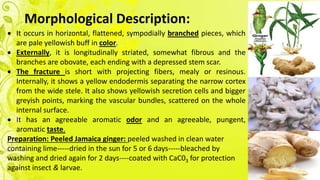
 It occurs in horizontal, flattened, sympodially branched pieces, which
are pale yellowish buff in color.
 Externally, it is longitudinally striated, somewhat fibrous and the
branches are obovate, each ending with a depressed stem scar.
 The fracture is short with projecting fibers, mealy or resinous.
Internally, it shows a yellow endodermis separating the narrow cortex
from the wide stele. It also shows yellowish secretion cells and bigger
greyish points, marking the vascular bundles, scattered on the whole
internal surface.
 It has an agreeable aromatic odor and an agreeable, pungent,
aromatic taste.
Preparation: Peeled Jamaica ginger: peeled washed in clean water
containing lime-----dried in the sun for 5 or 6 days-----bleached by
washing and dried again for 2 days----coated with CaC03 for protection
against insect & larvae.
Histological Description
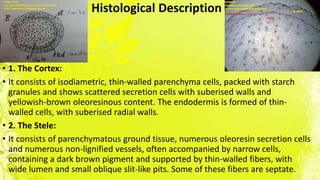
• 1. The Cortex:
• It consists of isodiametric, thin-walled parenchyma cells, packed with starch
granules and shows scattered secretion cells with suberised walls and
yellowish-brown oleoresinous content. The endodermis is formed of thin-
walled cells, with suberised radial walls.
• 2. The Stele:
• It consists of parenchymatous ground tissue, numerous oleoresin secretion cells
and numerous non-lignified vessels, often accompanied by narrow cells,
containing a dark brown pigment and supported by thin-walled fibers, with
wide lumen and small oblique slit-like pits. Some of these fibers are septate.
Microscopical Identification:
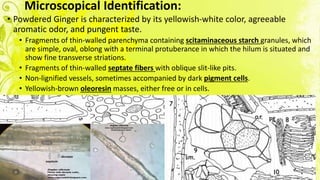
• Powdered Ginger is characterized by its yellowish-white color, agreeable
aromatic odor, and pungent taste.
• Fragments of thin-walled parenchyma containing scitaminaceous starch granules, which
are simple, oval, oblong with a terminal protuberance in which the hilum is situated and
show fine transverse striations.
• Fragments of thin-walled septate fibers with oblique slit-like pits.
• Non-lignified vessels, sometimes accompanied by dark pigment cells.
• Yellowish-brown oleoresin masses, either free or in cells.
Active Constituents:
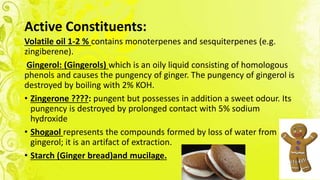
Volatile oil 1-2 % contains monoterpenes and sesquiterpenes (e.g.
zingiberene).
Gingerol: (Gingerols) which is an oily liquid consisting of homologous
phenols and causes the pungency of ginger. The pungency of gingerol is
destroyed by boiling with 2% KOH.
• Zingerone ????: pungent but possesses in addition a sweet odour. Its
pungency is destroyed by prolonged contact with 5% sodium
hydroxide
• Shogaol represents the compounds formed by loss of water from
gingerol; it is an artifact of extraction.
• Starch (Ginger bread)and mucilage.
Actions & Uses
• 1) Antiemetic:
• - The prophylaxis of nausea and vomiting associated with motion sickness,
postoperative nausea and seasickness.
• - A US study indicated that powdered ginger "act locally" may be a more effective
anti-emetic than dimenhydrinate (Dramamine) "act centrally".
• - The authors suggested that it may ameliorate the effects of motion sickness in
the GIT itself, in contrast to anthistamines, which act centrally
• Ginger acts locally on the GIT.
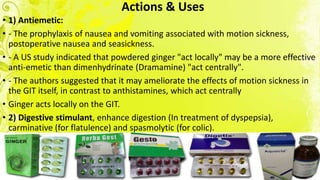
• 2) Digestive stimulant, enhance digestion (In treatment of dyspepsia),
carminative (for flatulence) and spasmolytic (for colic).
3) Anti-inflammatory agent in treatment of rheumatic & muscular
disorders. ex. profile cream, cerolav cream.
• 4) Diffusive stimulant, metabolic (heating) and circulatory enhancing agent for weight
control and sexual tonic.
• In treatment of → colds & flu (specially the fresh rhizomes).
• 5) antioxidant activity : ex. antioxidant 4 sach.
• Chemical tests
• 1) (+) with Sudan III → Red stain "due to volatile oil"
• 2) (+) with Iodine (t.s) → Brown stain "due to resin" & Blue stain [due to starch].
• 3)Test for Pungency:
• -The pungency of gingerol is destroyed by boiling with 2% potassium hydroxide
Side effects & Contraindications
1-ginger may have adverse effects on bleeding time because it is such a powerful
thromboxane synthase inhibitor. (in a dose 2-5 gm dried ginger), Thromboxane is a
vasoconstrictor “a potent hypertensive agent” and it facilitates platelet
aggregation.
• SO Patients taking anti-coagulant drugs should consult their physician prior to
self-medication with ginger. ( Asprine-like action)
• 2- ginger should not be used for vomiting in pregnancy as a medication.
• 3- Renal Patients with gallstones should consult their physician before using
ginger preparations. There have been claims in the older literature that that
ginger might promote glomerulonephritis (Bright’s disease) in renal patients but
this effect is not supported by any recent report or study.
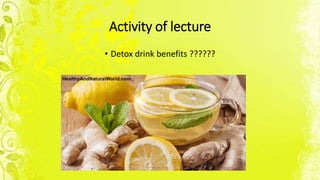
Activity of lecture
• Detox drink benefits ??????
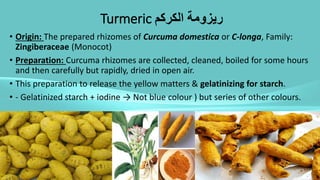
Turmeric ‫الكركم‬ ‫ريزومة‬
• Origin: The prepared rhizomes of Curcuma domestica or C-longa, Family:
Zingiberaceae (Monocot)
• Preparation: Curcuma rhizomes are collected, cleaned, boiled for some hours
and then carefully but rapidly, dried in open air.
• This preparation to release the yellow matters & gelatinizing for starch.
• - Gelatinized starch + iodine → Not blue colour ) but series of other colours.
Morphological Description
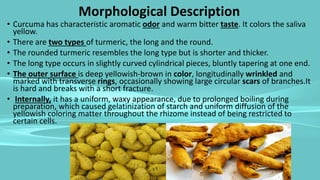
• Curcuma has characteristic aromatic odor and warm bitter taste. It colors the saliva
yellow.
• There are two types of turmeric, the long and the round.
• The rounded turmeric resembles the long type but is shorter and thicker.
• The long type occurs in slightly curved cylindrical pieces, bluntly tapering at one end.
• The outer surface is deep yellowish-brown in color, longitudinally wrinkled and
marked with transverse rings, occasionally showing large circular scars of branches.It
is hard and breaks with a short fracture.
• Internally, it has a uniform, waxy appearance, due to prolonged boiling during
preparation, which caused gelatinization of starch and uniform diffusion of the
yellowish coloring matter throughout the rhizome instead of being restricted to
certain cells.
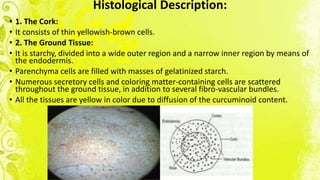
Histological Description:
• 1. The Cork:
• It consists of thin yellowish-brown cells.
• 2. The Ground Tissue:
• It is starchy, divided into a wide outer region and a narrow inner region by means of
the endodermis.
• Parenchyma cells are filled with masses of gelatinized starch.
• Numerous secretory cells and coloring matter-containing cells are scattered
throughout the ground tissue, in addition to several fibro-vascular bundles.
• All the tissues are yellow in color due to diffusion of the curcuminoid content.
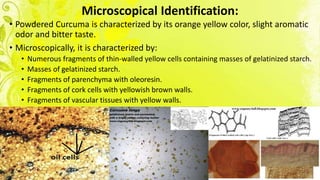
Microscopical Identification:
• Powdered Curcuma is characterized by its orange yellow color, slight aromatic
odor and bitter taste.
• Microscopically, it is characterized by:
• Numerous fragments of thin-walled yellow cells containing masses of gelatinized starch.
• Masses of gelatinized starch.
• Fragments of parenchyma with oleoresin.
• Fragments of cork cells with yellowish brown walls.
• Fragments of vascular tissues with yellow walls.
Active Constituents
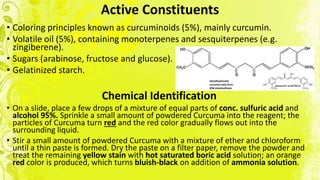
• Coloring principles known as curcuminoids (5%), mainly curcumin.
• Volatile oil (5%), containing monoterpenes and sesquiterpenes (e.g.
zingiberene).
• Sugars (arabinose, fructose and glucose).
• Gelatinized starch.
Chemical Identification
• On a slide, place a few drops of a mixture of equal parts of conc. sulfuric acid and
alcohol 95%. Sprinkle a small amount of powdered Curcuma into the reagent; the
particles of Curcuma turn red and the red color gradually flows out into the
surrounding liquid.
• Stir a small amount of powdered Curcuma with a mixture of ether and chloroform
until a thin paste is formed. Dry the paste on a filter paper, remove the powder and
treat the remaining yellow stain with hot saturated boric acid solution; an orange
red color is produced, which turns bluish-black on addition of ammonia solution.
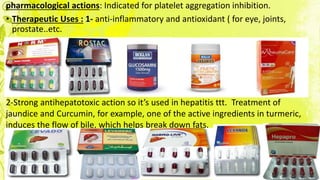
pharmacological actions: Indicated for platelet aggregation inhibition.
• Therapeutic Uses : 1- anti-inflammatory and antioxidant ( for eye, joints,
prostate..etc.
2-Strong antihepatotoxic action so it’s used in hepatitis ttt. Treatment of
jaundice and Curcumin, for example, one of the active ingredients in turmeric,
induces the flow of bile, which helps break down fats.
Therapeutic Uses
3-As a stomachic, Treatment of digestive disorders (stomach upset, gas, and
abdominal cramps). curry powders and other condiments.
4-natural Coloring agents: It is used as a colouring agent for drugs, foodstuffs,
and cosmetics.
• the safety of turmeric oleoresin on the thyroid
• There has been some concern about the safety of turmeric oleoresin, an
extract of turmeric, after reports of adverse thyroid changes in pigs.
Differences bet. ginger and turmeric
• externally
• Ginger more branching than Curcuma.
• Ginger have longitudinally striations comes from V.B fibers but
Curcuma has wrinkles due to cork fissures.
• internally
• Ginger without cork (c.f curcuma).
• Ginger have wider steel and lesser cortex (c.f curcuma).
• - Non lignified elements.
Liquorice (licorice) ‫سوس‬ ‫عرق‬
• origin: Dried unpeeled or peeled roots and stolons of Glycyrrhiza glabra (Fam. Leguminosae).
• Morphological Description: (Dicot.)
• Liquorice has a faint characteristic odor and a very sweet taste.
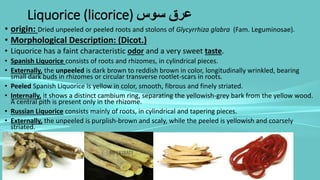
• Spanish Liquorice consists of roots and rhizomes, in cylindrical pieces.
• Externally, the unpeeled is dark brown to reddish brown in color, longitudinally wrinkled, bearing
small dark buds in rhizomes or circular transverse rootlet-scars in roots.
• Peeled Spanish Liquorice is yellow in color, smooth, fibrous and finely striated.
• Internally, it shows a distinct cambium ring, separating the yellowish-grey bark from the yellow wood.
A central pith is present only in the rhizome.
• Russian Liquorice consists mainly of roots, in cylindrical and tapering pieces.
• Externally, the unpeeled is purplish-brown and scaly, while the peeled is yellowish and coarsely
striated.
• Those of G. glabra var. typica are known in commerce as Spanish Liquorice, those of G.
glabra var. glandulifera as Russian Liquorice, and those of G. glabra var. β-violacea as
Persian Liquorice.
• Ph. Eur. 6.2 (Liquorice Root; Liquorice BP 2008). The dried unpeeled or peeled, whole
or cut root and stolons of Glycyrrhiza glabra and/or G. inflata and/or G. uralensis. It
contains not less than 4% of glycyrrhizic acid.
• USP 31 (Licorice). The roots, rhizomes, and stolons of Glycyrrhiza glabra or G.
uralensis. It contains not less than 2.5% of glycyrrhizic acid, calculated on the dried
basis. Store in a cool, dry
• place.
• BP 2008 (Liquorice Root for use in THM). It is the dried unpeeled root and rhizome of
Glycyrrhiza uralensis, G. inflata, or G. glabra. For use in traditional Chinese medicines.
It contains not less than 2.0% of glycyrrhizic acid calculated with reference to the dried
material. Protect from moisture.
Histological Description
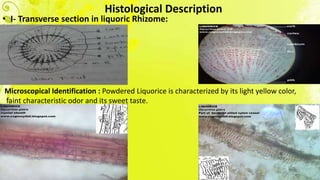
• I- Transverse section in liquoric Rhizome:
Microscopical Identification : Powdered Liquorice is characterized by its light yellow color,
faint characteristic odor and its sweet taste.
Active Constituents
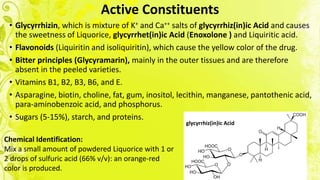
• Glycyrrhizin, which is mixture of K+ and Ca++ salts of glycyrrhiz(in)ic Acid and causes
the sweetness of Liquorice, glycyrrhet(in)ic Acid (Enoxolone ) and Liquiritic acid.
• Flavonoids (Liquiritin and isoliquiritin), which cause the yellow color of the drug.
• Bitter principles (Glycyramarin), mainly in the outer tissues and are therefore
absent in the peeled varieties.
• Vitamins B1, B2, B3, B6, and E.
• Asparagine, biotin, choline, fat, gum, inositol, lecithin, manganese, pantothenic acid,
para-aminobenzoic acid, and phosphorus.
• Sugars (5-15%), starch, and proteins.
glycyrrhiz(in)ic Acid
Chemical Identification:
Mix a small amount of powdered Liquorice with 1 or
2 drops of sulfuric acid (66% v/v): an orange-red
color is produced.
Therapeutic actions
1-Demulcents act as indirect peripherally acting cough suppressants by providing a
protective coating over sensory receptors in the pharynx. Demulcents include
glycerol, honey, liquorice, and sucrose syrups.
2-Mucosal protectants
• Cytoprotective drugs (mucosal protectants) play a role in the management of peptic
ulcer disease.
• It has ulcer-healing properties that may result from stimulation of mucus synthesis.
3-Cortisone like action: ( anti-inflammatory and anti-allergy )
• It contains constituents that produce mineralocorticoid effects
4- Antispasmodic and laxative properties.
5-Antiviral activity: It stimulates the production of interferon.
6- As a Skin-Lightening Agents: Skin whitening
7-The liquid extract is used to mask the taste of nauseous medicines.
Therapeutic Uses
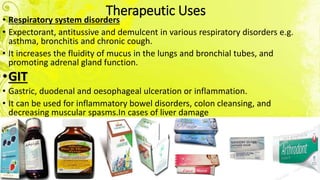
• Respiratory system disorders
• Expectorant, antitussive and demulcent in various respiratory disorders e.g.
asthma, bronchitis and chronic cough.
• It increases the fluidity of mucus in the lungs and bronchial tubes, and
promoting adrenal gland function.
•GIT
• Gastric, duodenal and oesophageal ulceration or inflammation.
• It can be used for inflammatory bowel disorders, colon cleansing, and
decreasing muscular spasms.In cases of liver damage
Therapeutic Uses
•Joints
• As a mild anti-inflammatory in arthritis and rheumatism, due to the
corticosteroid effect of its glycyrrhizin content.
•Topically
• Topically, for inflammatory skin disorders, mouth ulcers and viral
lesions, especially herpes simplex and herpes zoster.
• It possesses estrogen- and progesterone-like effects; may change the
pitch of the voice.
• Enoxolone is used locally in preparations for the treatment of non-infective
inflammatory disorders of the skin, mouth, throat, and rectum.
• Enoxolone is a potent inhibitor of the enzyme 11β-hydroxysteroid
dehydrogenase, which inactivates cortisol
• Derivatives of enoxolone, including its aluminium salt and carbenoxolone
have been used in the treatment of benign peptic ulcer disease and other
gastrointestinal disorders.
• Carbenoxolone sodium is a synthetic derivative of enoxolone that was
formerly used as a mucosal protectant in peptic ulcer disease and has been
given with antacids and alginic acid in gastro-oesophageal reflux disease.
Carbenoxolone sodium is one of many topical treatments for the symptomatic
management of mouth ulceration . It is usually used as a 2% gel; a 1%
mouthwash has been used.
Adverse Effects and Precautions
• Liquorice has mineralocorticoid-like actions manifesting as sodium
and water retention and hypokalaemia. Deglycyrrhizinised liquorice is
not usually associated with such adverse effects.
• Pregnancy. Studies in Finnish women indicated that heavy
consumption of liquorice (equivalent to ≥ 500 mg/week of glycyrrhizic
acid) during pregnancy was associated with an increased risk of
preterm delivery.1,2 Consumption of large amounts of liquorice was a
social habit noted to occur in some northern European countries.
Mineralocorticoid effects.
• Mineralocorticoid effects have been reported after excessive or prolonged
ingestion of liquorice. The liquorice may be ingested in confectionery (including
liquorice- flavoured chewing gum), tea, soft drinks, herbal medicines, cough
mixtures, or by chewing tobacco. The enzyme 11-β-hydroxysteroid
dehydrogenase (cortisol oxidase) converts cortisol to cortisone, preventing
cortisol gaining access to non-specific mineralocorticoid receptors. This enzyme is
inhibited by glycyrrhetinic acid (produced by the hydrolysis of glycyrrhizic acid, a
natural constituent of liquorice), resulting in increased concentrations of cortisol
in the body, enhancing its physiological effects.
• it has reportedly caused gynaecomastia.

2 ginger, turmeric and liquorice

  • 1.
    SUBTERRANEAN ORGANS By Dr. MostafaMahmoud Hegazy ( PH.D.)
  • 2.
    GINGER ‫الزنجبيل‬ ‫ريزومة‬ •Synonyms:RhizomaZingiberis, Ingwer, Zingiber, Zanjabeel. •Origin: Carefully dried rhizomes of Zingiber officinale (Fam. Zingiberaceae), deprived of the dark outer tissues and known as unbleached Jamaica ginger. (Monocot.) •Ginger yields not less than 1% of volatile oil. •Geographical origin : native to South-East Asia.
  • 3.
    Morphological Description:  Itoccurs in horizontal, flattened, sympodially branched pieces, which are pale yellowish buff in color.  Externally, it is longitudinally striated, somewhat fibrous and the branches are obovate, each ending with a depressed stem scar.  The fracture is short with projecting fibers, mealy or resinous. Internally, it shows a yellow endodermis separating the narrow cortex from the wide stele. It also shows yellowish secretion cells and bigger greyish points, marking the vascular bundles, scattered on the whole internal surface.  It has an agreeable aromatic odor and an agreeable, pungent, aromatic taste. Preparation: Peeled Jamaica ginger: peeled washed in clean water containing lime-----dried in the sun for 5 or 6 days-----bleached by washing and dried again for 2 days----coated with CaC03 for protection against insect & larvae.
  • 4.
    Histological Description • 1.The Cortex: • It consists of isodiametric, thin-walled parenchyma cells, packed with starch granules and shows scattered secretion cells with suberised walls and yellowish-brown oleoresinous content. The endodermis is formed of thin- walled cells, with suberised radial walls. • 2. The Stele: • It consists of parenchymatous ground tissue, numerous oleoresin secretion cells and numerous non-lignified vessels, often accompanied by narrow cells, containing a dark brown pigment and supported by thin-walled fibers, with wide lumen and small oblique slit-like pits. Some of these fibers are septate.
  • 5.
    Microscopical Identification: • PowderedGinger is characterized by its yellowish-white color, agreeable aromatic odor, and pungent taste. • Fragments of thin-walled parenchyma containing scitaminaceous starch granules, which are simple, oval, oblong with a terminal protuberance in which the hilum is situated and show fine transverse striations. • Fragments of thin-walled septate fibers with oblique slit-like pits. • Non-lignified vessels, sometimes accompanied by dark pigment cells. • Yellowish-brown oleoresin masses, either free or in cells.
  • 6.
    Active Constituents: Volatile oil1-2 % contains monoterpenes and sesquiterpenes (e.g. zingiberene). Gingerol: (Gingerols) which is an oily liquid consisting of homologous phenols and causes the pungency of ginger. The pungency of gingerol is destroyed by boiling with 2% KOH. • Zingerone ????: pungent but possesses in addition a sweet odour. Its pungency is destroyed by prolonged contact with 5% sodium hydroxide • Shogaol represents the compounds formed by loss of water from gingerol; it is an artifact of extraction. • Starch (Ginger bread)and mucilage.
  • 7.
    Actions & Uses •1) Antiemetic: • - The prophylaxis of nausea and vomiting associated with motion sickness, postoperative nausea and seasickness. • - A US study indicated that powdered ginger "act locally" may be a more effective anti-emetic than dimenhydrinate (Dramamine) "act centrally". • - The authors suggested that it may ameliorate the effects of motion sickness in the GIT itself, in contrast to anthistamines, which act centrally • Ginger acts locally on the GIT. • 2) Digestive stimulant, enhance digestion (In treatment of dyspepsia), carminative (for flatulence) and spasmolytic (for colic).
  • 8.
    3) Anti-inflammatory agentin treatment of rheumatic & muscular disorders. ex. profile cream, cerolav cream. • 4) Diffusive stimulant, metabolic (heating) and circulatory enhancing agent for weight control and sexual tonic. • In treatment of → colds & flu (specially the fresh rhizomes). • 5) antioxidant activity : ex. antioxidant 4 sach. • Chemical tests • 1) (+) with Sudan III → Red stain "due to volatile oil" • 2) (+) with Iodine (t.s) → Brown stain "due to resin" & Blue stain [due to starch]. • 3)Test for Pungency: • -The pungency of gingerol is destroyed by boiling with 2% potassium hydroxide
  • 9.
    Side effects &Contraindications 1-ginger may have adverse effects on bleeding time because it is such a powerful thromboxane synthase inhibitor. (in a dose 2-5 gm dried ginger), Thromboxane is a vasoconstrictor “a potent hypertensive agent” and it facilitates platelet aggregation. • SO Patients taking anti-coagulant drugs should consult their physician prior to self-medication with ginger. ( Asprine-like action) • 2- ginger should not be used for vomiting in pregnancy as a medication. • 3- Renal Patients with gallstones should consult their physician before using ginger preparations. There have been claims in the older literature that that ginger might promote glomerulonephritis (Bright’s disease) in renal patients but this effect is not supported by any recent report or study.
  • 10.
    Activity of lecture •Detox drink benefits ??????
  • 11.
    Turmeric ‫الكركم‬ ‫ريزومة‬ •Origin: The prepared rhizomes of Curcuma domestica or C-longa, Family: Zingiberaceae (Monocot) • Preparation: Curcuma rhizomes are collected, cleaned, boiled for some hours and then carefully but rapidly, dried in open air. • This preparation to release the yellow matters & gelatinizing for starch. • - Gelatinized starch + iodine → Not blue colour ) but series of other colours.
  • 12.
    Morphological Description • Curcumahas characteristic aromatic odor and warm bitter taste. It colors the saliva yellow. • There are two types of turmeric, the long and the round. • The rounded turmeric resembles the long type but is shorter and thicker. • The long type occurs in slightly curved cylindrical pieces, bluntly tapering at one end. • The outer surface is deep yellowish-brown in color, longitudinally wrinkled and marked with transverse rings, occasionally showing large circular scars of branches.It is hard and breaks with a short fracture. • Internally, it has a uniform, waxy appearance, due to prolonged boiling during preparation, which caused gelatinization of starch and uniform diffusion of the yellowish coloring matter throughout the rhizome instead of being restricted to certain cells.
  • 13.
    Histological Description: • 1.The Cork: • It consists of thin yellowish-brown cells. • 2. The Ground Tissue: • It is starchy, divided into a wide outer region and a narrow inner region by means of the endodermis. • Parenchyma cells are filled with masses of gelatinized starch. • Numerous secretory cells and coloring matter-containing cells are scattered throughout the ground tissue, in addition to several fibro-vascular bundles. • All the tissues are yellow in color due to diffusion of the curcuminoid content.
  • 14.
    Microscopical Identification: • PowderedCurcuma is characterized by its orange yellow color, slight aromatic odor and bitter taste. • Microscopically, it is characterized by: • Numerous fragments of thin-walled yellow cells containing masses of gelatinized starch. • Masses of gelatinized starch. • Fragments of parenchyma with oleoresin. • Fragments of cork cells with yellowish brown walls. • Fragments of vascular tissues with yellow walls.
  • 15.
    Active Constituents • Coloringprinciples known as curcuminoids (5%), mainly curcumin. • Volatile oil (5%), containing monoterpenes and sesquiterpenes (e.g. zingiberene). • Sugars (arabinose, fructose and glucose). • Gelatinized starch. Chemical Identification • On a slide, place a few drops of a mixture of equal parts of conc. sulfuric acid and alcohol 95%. Sprinkle a small amount of powdered Curcuma into the reagent; the particles of Curcuma turn red and the red color gradually flows out into the surrounding liquid. • Stir a small amount of powdered Curcuma with a mixture of ether and chloroform until a thin paste is formed. Dry the paste on a filter paper, remove the powder and treat the remaining yellow stain with hot saturated boric acid solution; an orange red color is produced, which turns bluish-black on addition of ammonia solution.
  • 16.
    pharmacological actions: Indicatedfor platelet aggregation inhibition. • Therapeutic Uses : 1- anti-inflammatory and antioxidant ( for eye, joints, prostate..etc. 2-Strong antihepatotoxic action so it’s used in hepatitis ttt. Treatment of jaundice and Curcumin, for example, one of the active ingredients in turmeric, induces the flow of bile, which helps break down fats.
  • 17.
    Therapeutic Uses 3-As astomachic, Treatment of digestive disorders (stomach upset, gas, and abdominal cramps). curry powders and other condiments. 4-natural Coloring agents: It is used as a colouring agent for drugs, foodstuffs, and cosmetics. • the safety of turmeric oleoresin on the thyroid • There has been some concern about the safety of turmeric oleoresin, an extract of turmeric, after reports of adverse thyroid changes in pigs.
  • 18.
    Differences bet. gingerand turmeric • externally • Ginger more branching than Curcuma. • Ginger have longitudinally striations comes from V.B fibers but Curcuma has wrinkles due to cork fissures. • internally • Ginger without cork (c.f curcuma). • Ginger have wider steel and lesser cortex (c.f curcuma). • - Non lignified elements.
  • 19.
    Liquorice (licorice) ‫سوس‬‫عرق‬ • origin: Dried unpeeled or peeled roots and stolons of Glycyrrhiza glabra (Fam. Leguminosae). • Morphological Description: (Dicot.) • Liquorice has a faint characteristic odor and a very sweet taste. • Spanish Liquorice consists of roots and rhizomes, in cylindrical pieces. • Externally, the unpeeled is dark brown to reddish brown in color, longitudinally wrinkled, bearing small dark buds in rhizomes or circular transverse rootlet-scars in roots. • Peeled Spanish Liquorice is yellow in color, smooth, fibrous and finely striated. • Internally, it shows a distinct cambium ring, separating the yellowish-grey bark from the yellow wood. A central pith is present only in the rhizome. • Russian Liquorice consists mainly of roots, in cylindrical and tapering pieces. • Externally, the unpeeled is purplish-brown and scaly, while the peeled is yellowish and coarsely striated.
  • 20.
    • Those ofG. glabra var. typica are known in commerce as Spanish Liquorice, those of G. glabra var. glandulifera as Russian Liquorice, and those of G. glabra var. β-violacea as Persian Liquorice. • Ph. Eur. 6.2 (Liquorice Root; Liquorice BP 2008). The dried unpeeled or peeled, whole or cut root and stolons of Glycyrrhiza glabra and/or G. inflata and/or G. uralensis. It contains not less than 4% of glycyrrhizic acid. • USP 31 (Licorice). The roots, rhizomes, and stolons of Glycyrrhiza glabra or G. uralensis. It contains not less than 2.5% of glycyrrhizic acid, calculated on the dried basis. Store in a cool, dry • place. • BP 2008 (Liquorice Root for use in THM). It is the dried unpeeled root and rhizome of Glycyrrhiza uralensis, G. inflata, or G. glabra. For use in traditional Chinese medicines. It contains not less than 2.0% of glycyrrhizic acid calculated with reference to the dried material. Protect from moisture.
  • 21.
    Histological Description • I-Transverse section in liquoric Rhizome: Microscopical Identification : Powdered Liquorice is characterized by its light yellow color, faint characteristic odor and its sweet taste.
  • 22.
    Active Constituents • Glycyrrhizin,which is mixture of K+ and Ca++ salts of glycyrrhiz(in)ic Acid and causes the sweetness of Liquorice, glycyrrhet(in)ic Acid (Enoxolone ) and Liquiritic acid. • Flavonoids (Liquiritin and isoliquiritin), which cause the yellow color of the drug. • Bitter principles (Glycyramarin), mainly in the outer tissues and are therefore absent in the peeled varieties. • Vitamins B1, B2, B3, B6, and E. • Asparagine, biotin, choline, fat, gum, inositol, lecithin, manganese, pantothenic acid, para-aminobenzoic acid, and phosphorus. • Sugars (5-15%), starch, and proteins. glycyrrhiz(in)ic Acid Chemical Identification: Mix a small amount of powdered Liquorice with 1 or 2 drops of sulfuric acid (66% v/v): an orange-red color is produced.
  • 23.
    Therapeutic actions 1-Demulcents actas indirect peripherally acting cough suppressants by providing a protective coating over sensory receptors in the pharynx. Demulcents include glycerol, honey, liquorice, and sucrose syrups. 2-Mucosal protectants • Cytoprotective drugs (mucosal protectants) play a role in the management of peptic ulcer disease. • It has ulcer-healing properties that may result from stimulation of mucus synthesis. 3-Cortisone like action: ( anti-inflammatory and anti-allergy ) • It contains constituents that produce mineralocorticoid effects 4- Antispasmodic and laxative properties. 5-Antiviral activity: It stimulates the production of interferon. 6- As a Skin-Lightening Agents: Skin whitening 7-The liquid extract is used to mask the taste of nauseous medicines.
  • 24.
    Therapeutic Uses • Respiratorysystem disorders • Expectorant, antitussive and demulcent in various respiratory disorders e.g. asthma, bronchitis and chronic cough. • It increases the fluidity of mucus in the lungs and bronchial tubes, and promoting adrenal gland function. •GIT • Gastric, duodenal and oesophageal ulceration or inflammation. • It can be used for inflammatory bowel disorders, colon cleansing, and decreasing muscular spasms.In cases of liver damage
  • 25.
    Therapeutic Uses •Joints • Asa mild anti-inflammatory in arthritis and rheumatism, due to the corticosteroid effect of its glycyrrhizin content. •Topically • Topically, for inflammatory skin disorders, mouth ulcers and viral lesions, especially herpes simplex and herpes zoster. • It possesses estrogen- and progesterone-like effects; may change the pitch of the voice.
  • 26.
    • Enoxolone isused locally in preparations for the treatment of non-infective inflammatory disorders of the skin, mouth, throat, and rectum. • Enoxolone is a potent inhibitor of the enzyme 11β-hydroxysteroid dehydrogenase, which inactivates cortisol • Derivatives of enoxolone, including its aluminium salt and carbenoxolone have been used in the treatment of benign peptic ulcer disease and other gastrointestinal disorders. • Carbenoxolone sodium is a synthetic derivative of enoxolone that was formerly used as a mucosal protectant in peptic ulcer disease and has been given with antacids and alginic acid in gastro-oesophageal reflux disease. Carbenoxolone sodium is one of many topical treatments for the symptomatic management of mouth ulceration . It is usually used as a 2% gel; a 1% mouthwash has been used.
  • 27.
    Adverse Effects andPrecautions • Liquorice has mineralocorticoid-like actions manifesting as sodium and water retention and hypokalaemia. Deglycyrrhizinised liquorice is not usually associated with such adverse effects. • Pregnancy. Studies in Finnish women indicated that heavy consumption of liquorice (equivalent to ≥ 500 mg/week of glycyrrhizic acid) during pregnancy was associated with an increased risk of preterm delivery.1,2 Consumption of large amounts of liquorice was a social habit noted to occur in some northern European countries.
  • 28.
    Mineralocorticoid effects. • Mineralocorticoideffects have been reported after excessive or prolonged ingestion of liquorice. The liquorice may be ingested in confectionery (including liquorice- flavoured chewing gum), tea, soft drinks, herbal medicines, cough mixtures, or by chewing tobacco. The enzyme 11-β-hydroxysteroid dehydrogenase (cortisol oxidase) converts cortisol to cortisone, preventing cortisol gaining access to non-specific mineralocorticoid receptors. This enzyme is inhibited by glycyrrhetinic acid (produced by the hydrolysis of glycyrrhizic acid, a natural constituent of liquorice), resulting in increased concentrations of cortisol in the body, enhancing its physiological effects. • it has reportedly caused gynaecomastia.