Semecarpus anacardium (Linn. F.)
(Bhilawa Seed)
DRUG CLASS:- Glycoside & Sterol
USES:- In heart, blood pressure, respiration, cancer and
neurological disorders.
Its seed is eaten by Indians in winter and was commonly used
as a method of birth control for women.
PRESENTED BY : HARSHANI JADAV [12] & RINKAL JARIWALA [14]
GUIDED BY : DR. AARTI GUPTA
B-PHARM SEM-7
MALIBA PHARMACY COLLEGE
1
Semecarpus anacardium (Linn. F.)
-Biological Name : Semecarpus anacardium
-Synonym : Bhallataka
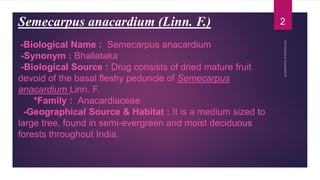
-Biological Source : Drug consists of dried mature fruit
devoid of the basal fleshy peduncle of Semecarpus
anacardium Linn. F.
*Family : Anacardiaceae
-Geographical Source & Habitat : It is a medium sized to
large tree, found in semi-evergreen and moist deciduous
forests throughout India.
2
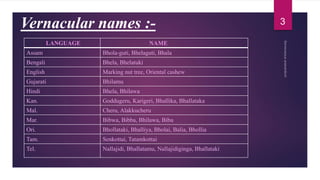
Vernacular names :- 3
LANGUAGE NAME
Assam Bhola-guti, Bhelaguti, Bhala
Bengali Bhela, Bhelatuki
English Marking nut tree, Oriental cashew
Gujarati Bhilamu
Hindi Bhela, Bhilawa
Kan. Goddugeru, Karigeri, Bhallika, Bhallataka
Mal. Cheru, Alakkucheru
Mar. Bibwa, Bibba, Bhilawa, Bibu
Ori. Bhollataki, Bhalliya, Bholai, Balia, Bhollia
Tam. Senkottai, Tatamkottai
Tel. Nallajidi, Bhallatamu, Nallajidiginga, Bhallataki
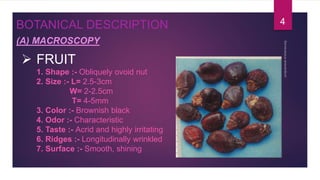
 FRUIT
1. Shape :- Obliquely ovoid nut
2. Size :- L= 2.5-3cm
W= 2-2.5cm
T= 4-5mm
3. Color :- Brownish black
4. Odor :- Characteristic
5. Taste :- Acrid and highly irritating
6. Ridges :- Longitudinally wrinkled
7. Surface :- Smooth, shining
BOTANICAL DESCRIPTION
(A) MACROSCOPY
4
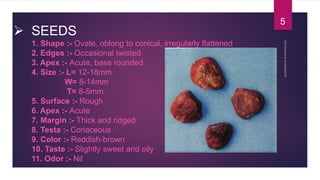
 SEEDS
1. Shape :- Ovate, oblong to conical, irregularly flattened
2. Edges :- Occasional twisted
3. Apex :- Acute, base rounded
4. Size :- L= 12-18mm
W= 8-14mm
T= 8-5mm
5. Surface :- Rough
6. Apex :- Acute
7. Margin :- Thick and ridged
8. Testa :- Coriaceous
9. Color :- Reddish-brown
10. Taste :- Slightly sweet and oily
11. Odor :- Nil
5
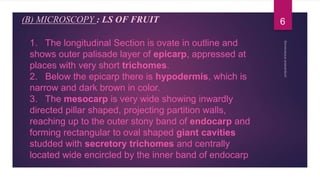
1. The longitudinal Section is ovate in outline and
shows outer palisade layer of epicarp, appressed at
places with very short trichomes.
2. Below the epicarp there is hypodermis, which is
narrow and dark brown in color.
3. The mesocarp is very wide showing inwardly
directed pillar shaped, projecting partition walls,
reaching up to the outer stony band of endocarp and
forming rectangular to oval shaped giant cavities
studded with secretory trichomes and centrally
located wide encircled by the inner band of endocarp
(B) MICROSCOPY : LS OF FRUIT 6
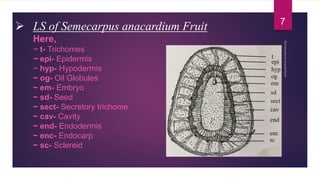
 LS of Semecarpus anacardium Fruit
Here,
~ t- Trichomes
~ epi- Epidermis
~ hyp- Hypodermis
~ og- Oil Globules
~ em- Embryo
~ sd- Seed
~ sect- Secretory trichome
~ cav- Cavity
~ end- Endodermis
~ enc- Endocarp
~ sc- Sclereid
7
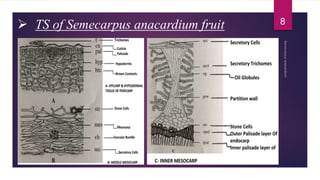
 TS of Semecarpus anacardium fruit 8
 TS of Semecarpus anacardium (Continued)
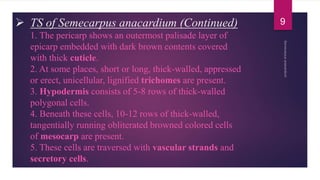
1. The pericarp shows an outermost palisade layer of
epicarp embedded with dark brown contents covered
with thick cuticle.
2. At some places, short or long, thick-walled, appressed
or erect, unicellular, lignified trichomes are present.
3. Hypodermis consists of 5-8 rows of thick-walled
polygonal cells.
4. Beneath these cells, 10-12 rows of thick-walled,
tangentially running obliterated browned colored cells
of mesocarp are present.
5. These cells are traversed with vascular strands and
secretory cells.
9
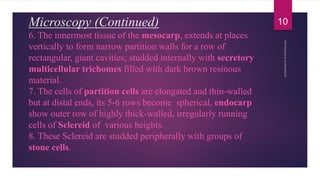
Microscopy (Continued)
6. The innermost tissue of the mesocarp, extends at places
vertically to form narrow partition walls for a row of
rectangular, giant cavities; studded internally with secretory
multicellular trichomes filled with dark brown resinous
material.
7. The cells of partition cells are elongated and thin-walled
but at distal ends, its 5-6 rows become spherical, endocarp
show outer row of highly thick-walled, irregularly running
cells of Sclereid of various heights.
8. These Sclereid are studded peripherally with groups of
stone cells.
10
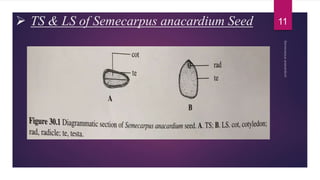
 TS & LS of Semecarpus anacardium Seed 11
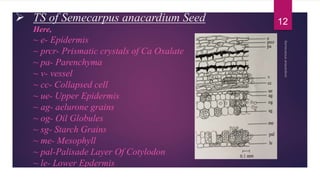
 TS of Semecarpus anacardium Seed
Here,
~ e- Epidermis
~ prcr- Prismatic crystals of Ca Oxalate
~ pa- Parenchyma
~ v- vessel
~ cc- Collapsed cell
~ ue- Upper Epidermis
~ ag- aelurone grains
~ og- Oil Globules
~ sg- Starch Grains
~ me- Mesophyll
~ pal-Palisade Layer Of Cotylodon
~ le- Lower Epdermis
12
13
TS of Semecarpus anacardium Seed
1.TS shows a layer of tubular cells of epidermis covered
with cuticle, underneath this lies loosely arranged thin-
walled 3to4 rows of parenchymatous cells of testa.
2.Followed by primastic cystals of calcium oxalate, and
squarish bigger side cells, embedded with brownish
matter or content.
3.A wider zone of endosperm transversed with obliquely
cut annular vessels of vascular strad and fixed oil
globules lies underneath.
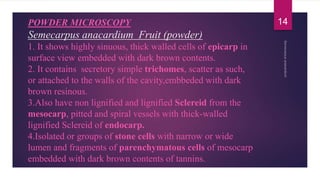
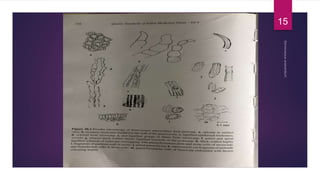
POWDER MICROSCOPY
Semecarpus anacardium Fruit (powder)
1. It shows highly sinuous, thick walled cells of epicarp in
surface view embedded with dark brown contents.
2. It contains secretory simple trichomes, scatter as such,
or attached to the walls of the cavity,embbeded with dark
brown resinous.
3.Also have non lignified and lignified Sclereid from the
mesocarp, pitted and spiral vessels with thick-walled
lignified Sclereid of endocarp.
4.Isolated or groups of stone cells with narrow or wide
lumen and fragments of parenchymatous cells of mesocarp
embedded with dark brown contents of tannins.
14
15
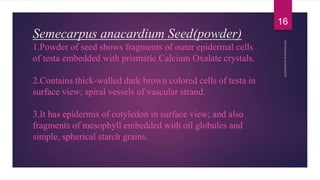
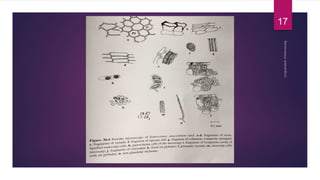
Semecarpus anacardium Seed(powder)
1.Powder of seed shows fragments of outer epidermal cells
of testa embedded with prismatic Calcium Oxalate crystals.
2.Contains thick-walled dark brown colored cells of testa in
surface view; spiral vessels of vascular strand.
3.It has epidermis of cotyledon in surface view; and also
fragments of mesophyll embedded with oil globules and
simple, spherical starch grains.
16
17
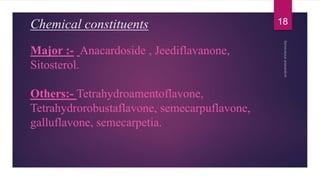
Chemical constituents
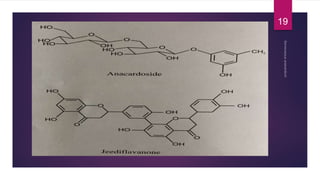
Major :- Anacardoside , Jeediflavanone,
Sitosterol.
Others:- Tetrahydroamentoflavone,
Tetrahydrorobustaflavone, semecarpuflavone,
galluflavone, semecarpetia.
18
19
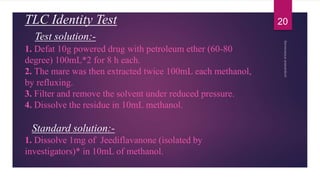
TLC Identity Test
Test solution:-
1. Defat 10g powered drug with petroleum ether (60-80
degree) 100mL*2 for 8 h each.
2. The mare was then extracted twice 100mL each methanol,
by refluxing.
3. Filter and remove the solvent under reduced pressure.
4. Dissolve the residue in 10mL methanol.
Standard solution:-
1. Dissolve 1mg of Jeediflavanone (isolated by
investigators)* in 10mL of methanol.
20
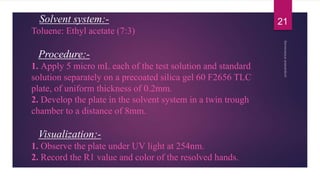
Solvent system:-
Toluene: Ethyl acetate (7:3)
Procedure:-
1. Apply 5 micro mL each of the test solution and standard
solution separately on a precoated silica gel 60 F2656 TLC
plate, of uniform thickness of 0.2mm.
2. Develop the plate in the solvent system in a twin trough
chamber to a distance of 8mm.
Visualization:-
1. Observe the plate under UV light at 254nm.
2. Record the R1 value and color of the resolved hands.
21
Evaluation:-
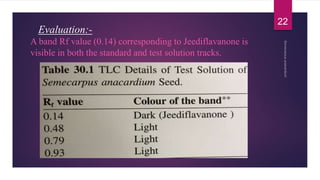
A band Rf value (0.14) corresponding to Jeediflavanone is
visible in both the standard and test solution tracks.
22
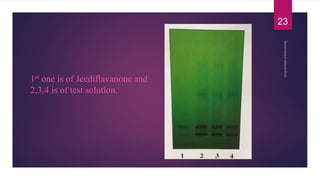
1st one is of Jeediflavanone and
2,3,4 is of test solution.
23
Assay/Analytical methods:-
HPLC estimation of Jeediflavanone.
Test solution:-
1. Extract about 10g accurately weighed, defatted powdered
drug by refluxing consecutively twice with 50mL each of
methanol for a duration of 8 h each.
2. Filter the combined extract and remove the solvent under
reduced pressure yielding the crude residue(930 mg).
3. Dissolve about 10mg, accurately weighed, of the residue
in methanol in a 10mL volumetric flask and make up the
volume.
4. Filter through 0.45 micro gm membrane and use for
HPLC analysis.
24
Standard Solution:-
Dissolve 1mg accurately weighed Jeediflavanone in
methanol in a 10mL volumetric flask and make up the
volume.
Chromatographic conditions:-
~ Instrument- shimadzu HPLC system with LC-10-
ATVPpump
~ Column- C18-ODS (octadecylsilane)
~ Detection- SPD M10AVP PDA(photodiode array detector)
~ Mobile phase- A=0.5% acetic acid in water, B= Methanol
~ Mode- Gradient 0-5minutes 10% A in B, 5-10 minutes
50% A in B, 10-20 minutes 90% A in B.
25
Chromatographic Conditions (Continued)
~ Flow rate- 1mL/min
~ Run time- 20minutes
~ Injection volume- 20 micro mL.
26
Estimation of Jeediflavanone in the drug:-
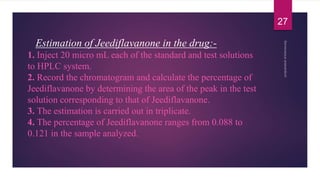
1. Inject 20 micro mL each of the standard and test solutions
to HPLC system.
2. Record the chromatogram and calculate the percentage of
Jeediflavanone by determining the area of the peak in the test
solution corresponding to that of Jeediflavanone.
3. The estimation is carried out in triplicate.
4. The percentage of Jeediflavanone ranges from 0.088 to
0.121 in the sample analyzed.
27
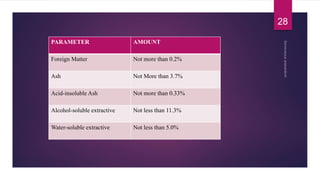
PARAMETER AMOUNT
Foreign Matter Not more than 0.2%
Ash Not More than 3.7%
Acid-insoluble Ash Not more than 0.33%
Alcohol-soluble extractive Not less than 11.3%
Water-soluble extractive Not less than 5.0%
28
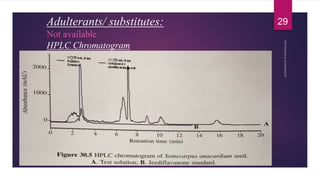
Adulterants/ substitutes:
Not available
HPLC Chromatogram
29
Clinical study:-
Milk extract was found to be effective in patients of
sciatica.
Major Therapeutic Claims-
Hemorrhoids, helminthiasis and dermatipathies.
Safety Aspects-
The drug used after traditional way of purification used in
classical formulations in the dose prescribed is considered
safe.
Dose-
1.2 gm of the drug in ‘Ksirpaka form’.
30
1. Antiatherogenic effect
2. Anti-inflammatory activity
3. Anti-oxidant activity
4. CNS activity
5.Anti-microbial activity
6. Hypoglycemic activity
7. Anti-carcinogenic activity
8. Reproductive function (Anti-spermatogenic effect)
9. Nephrotoxicity
10. Toxicity
11. Traditional uses
PHARMACOLOGY 31
~ Shuddh Bhallataka
~ Shuddh Vatsnabh
~ Vidanga
~ Ginger root
~ Pippali
~ Haritaki
~ Amlaki
~ Vacha
~ Guduchi herb
MARKETED PRODUCTS :-
SANJIVANI VATI
INGREDIENTS :-
32
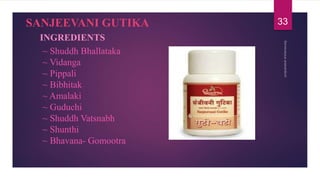
~ Shuddh Bhallataka
~ Vidanga
~ Pippali
~ Bibhitak
~ Amalaki
~ Guduchi
~ Shuddh Vatsnabh
~ Shunthi
~ Bhavana- Gomootra
SANJEEVANI GUTIKA
INGREDIENTS
33
References-
1.“Quality Standards of Indian, New Delhi, 2003, Pg. no. 311-323.
Medicinal Plants”, Volume-1, Indian Council of Medical Research
2. http://www.alwaysayurveda.com/semecarpus-anacardium/
3. http://sdlindia.com/sanjeevani-gutika.html
4. https://www.ncbi.nlm.nih.gov/pmc/articles/PMC3249908/#sec1-
6title
34
THANKYOU
35

Semecarpus anacardium (bhilawa)

  • 1.
    Semecarpus anacardium (Linn.F.) (Bhilawa Seed) DRUG CLASS:- Glycoside & Sterol USES:- In heart, blood pressure, respiration, cancer and neurological disorders. Its seed is eaten by Indians in winter and was commonly used as a method of birth control for women. PRESENTED BY : HARSHANI JADAV [12] & RINKAL JARIWALA [14] GUIDED BY : DR. AARTI GUPTA B-PHARM SEM-7 MALIBA PHARMACY COLLEGE 1
  • 2.
    Semecarpus anacardium (Linn.F.) -Biological Name : Semecarpus anacardium -Synonym : Bhallataka -Biological Source : Drug consists of dried mature fruit devoid of the basal fleshy peduncle of Semecarpus anacardium Linn. F. *Family : Anacardiaceae -Geographical Source & Habitat : It is a medium sized to large tree, found in semi-evergreen and moist deciduous forests throughout India. 2
  • 3.
    Vernacular names :-3 LANGUAGE NAME Assam Bhola-guti, Bhelaguti, Bhala Bengali Bhela, Bhelatuki English Marking nut tree, Oriental cashew Gujarati Bhilamu Hindi Bhela, Bhilawa Kan. Goddugeru, Karigeri, Bhallika, Bhallataka Mal. Cheru, Alakkucheru Mar. Bibwa, Bibba, Bhilawa, Bibu Ori. Bhollataki, Bhalliya, Bholai, Balia, Bhollia Tam. Senkottai, Tatamkottai Tel. Nallajidi, Bhallatamu, Nallajidiginga, Bhallataki
  • 4.
     FRUIT 1. Shape:- Obliquely ovoid nut 2. Size :- L= 2.5-3cm W= 2-2.5cm T= 4-5mm 3. Color :- Brownish black 4. Odor :- Characteristic 5. Taste :- Acrid and highly irritating 6. Ridges :- Longitudinally wrinkled 7. Surface :- Smooth, shining BOTANICAL DESCRIPTION (A) MACROSCOPY 4
  • 5.
     SEEDS 1. Shape:- Ovate, oblong to conical, irregularly flattened 2. Edges :- Occasional twisted 3. Apex :- Acute, base rounded 4. Size :- L= 12-18mm W= 8-14mm T= 8-5mm 5. Surface :- Rough 6. Apex :- Acute 7. Margin :- Thick and ridged 8. Testa :- Coriaceous 9. Color :- Reddish-brown 10. Taste :- Slightly sweet and oily 11. Odor :- Nil 5
  • 6.
    1. The longitudinalSection is ovate in outline and shows outer palisade layer of epicarp, appressed at places with very short trichomes. 2. Below the epicarp there is hypodermis, which is narrow and dark brown in color. 3. The mesocarp is very wide showing inwardly directed pillar shaped, projecting partition walls, reaching up to the outer stony band of endocarp and forming rectangular to oval shaped giant cavities studded with secretory trichomes and centrally located wide encircled by the inner band of endocarp (B) MICROSCOPY : LS OF FRUIT 6
  • 7.
     LS ofSemecarpus anacardium Fruit Here, ~ t- Trichomes ~ epi- Epidermis ~ hyp- Hypodermis ~ og- Oil Globules ~ em- Embryo ~ sd- Seed ~ sect- Secretory trichome ~ cav- Cavity ~ end- Endodermis ~ enc- Endocarp ~ sc- Sclereid 7
  • 8.
     TS ofSemecarpus anacardium fruit 8
  • 9.
     TS ofSemecarpus anacardium (Continued) 1. The pericarp shows an outermost palisade layer of epicarp embedded with dark brown contents covered with thick cuticle. 2. At some places, short or long, thick-walled, appressed or erect, unicellular, lignified trichomes are present. 3. Hypodermis consists of 5-8 rows of thick-walled polygonal cells. 4. Beneath these cells, 10-12 rows of thick-walled, tangentially running obliterated browned colored cells of mesocarp are present. 5. These cells are traversed with vascular strands and secretory cells. 9
  • 10.
    Microscopy (Continued) 6. Theinnermost tissue of the mesocarp, extends at places vertically to form narrow partition walls for a row of rectangular, giant cavities; studded internally with secretory multicellular trichomes filled with dark brown resinous material. 7. The cells of partition cells are elongated and thin-walled but at distal ends, its 5-6 rows become spherical, endocarp show outer row of highly thick-walled, irregularly running cells of Sclereid of various heights. 8. These Sclereid are studded peripherally with groups of stone cells. 10
  • 11.
     TS &LS of Semecarpus anacardium Seed 11
  • 12.
     TS ofSemecarpus anacardium Seed Here, ~ e- Epidermis ~ prcr- Prismatic crystals of Ca Oxalate ~ pa- Parenchyma ~ v- vessel ~ cc- Collapsed cell ~ ue- Upper Epidermis ~ ag- aelurone grains ~ og- Oil Globules ~ sg- Starch Grains ~ me- Mesophyll ~ pal-Palisade Layer Of Cotylodon ~ le- Lower Epdermis 12
  • 13.
    13 TS of Semecarpusanacardium Seed 1.TS shows a layer of tubular cells of epidermis covered with cuticle, underneath this lies loosely arranged thin- walled 3to4 rows of parenchymatous cells of testa. 2.Followed by primastic cystals of calcium oxalate, and squarish bigger side cells, embedded with brownish matter or content. 3.A wider zone of endosperm transversed with obliquely cut annular vessels of vascular strad and fixed oil globules lies underneath.
  • 14.
    POWDER MICROSCOPY Semecarpus anacardiumFruit (powder) 1. It shows highly sinuous, thick walled cells of epicarp in surface view embedded with dark brown contents. 2. It contains secretory simple trichomes, scatter as such, or attached to the walls of the cavity,embbeded with dark brown resinous. 3.Also have non lignified and lignified Sclereid from the mesocarp, pitted and spiral vessels with thick-walled lignified Sclereid of endocarp. 4.Isolated or groups of stone cells with narrow or wide lumen and fragments of parenchymatous cells of mesocarp embedded with dark brown contents of tannins. 14
  • 15.
  • 16.
    Semecarpus anacardium Seed(powder) 1.Powderof seed shows fragments of outer epidermal cells of testa embedded with prismatic Calcium Oxalate crystals. 2.Contains thick-walled dark brown colored cells of testa in surface view; spiral vessels of vascular strand. 3.It has epidermis of cotyledon in surface view; and also fragments of mesophyll embedded with oil globules and simple, spherical starch grains. 16
  • 17.
  • 18.
    Chemical constituents Major :-Anacardoside , Jeediflavanone, Sitosterol. Others:- Tetrahydroamentoflavone, Tetrahydrorobustaflavone, semecarpuflavone, galluflavone, semecarpetia. 18
  • 19.
  • 20.
    TLC Identity Test Testsolution:- 1. Defat 10g powered drug with petroleum ether (60-80 degree) 100mL*2 for 8 h each. 2. The mare was then extracted twice 100mL each methanol, by refluxing. 3. Filter and remove the solvent under reduced pressure. 4. Dissolve the residue in 10mL methanol. Standard solution:- 1. Dissolve 1mg of Jeediflavanone (isolated by investigators)* in 10mL of methanol. 20
  • 21.
    Solvent system:- Toluene: Ethylacetate (7:3) Procedure:- 1. Apply 5 micro mL each of the test solution and standard solution separately on a precoated silica gel 60 F2656 TLC plate, of uniform thickness of 0.2mm. 2. Develop the plate in the solvent system in a twin trough chamber to a distance of 8mm. Visualization:- 1. Observe the plate under UV light at 254nm. 2. Record the R1 value and color of the resolved hands. 21
  • 22.
    Evaluation:- A band Rfvalue (0.14) corresponding to Jeediflavanone is visible in both the standard and test solution tracks. 22
  • 23.
    1st one isof Jeediflavanone and 2,3,4 is of test solution. 23
  • 24.
    Assay/Analytical methods:- HPLC estimationof Jeediflavanone. Test solution:- 1. Extract about 10g accurately weighed, defatted powdered drug by refluxing consecutively twice with 50mL each of methanol for a duration of 8 h each. 2. Filter the combined extract and remove the solvent under reduced pressure yielding the crude residue(930 mg). 3. Dissolve about 10mg, accurately weighed, of the residue in methanol in a 10mL volumetric flask and make up the volume. 4. Filter through 0.45 micro gm membrane and use for HPLC analysis. 24
  • 25.
    Standard Solution:- Dissolve 1mgaccurately weighed Jeediflavanone in methanol in a 10mL volumetric flask and make up the volume. Chromatographic conditions:- ~ Instrument- shimadzu HPLC system with LC-10- ATVPpump ~ Column- C18-ODS (octadecylsilane) ~ Detection- SPD M10AVP PDA(photodiode array detector) ~ Mobile phase- A=0.5% acetic acid in water, B= Methanol ~ Mode- Gradient 0-5minutes 10% A in B, 5-10 minutes 50% A in B, 10-20 minutes 90% A in B. 25
  • 26.
    Chromatographic Conditions (Continued) ~Flow rate- 1mL/min ~ Run time- 20minutes ~ Injection volume- 20 micro mL. 26
  • 27.
    Estimation of Jeediflavanonein the drug:- 1. Inject 20 micro mL each of the standard and test solutions to HPLC system. 2. Record the chromatogram and calculate the percentage of Jeediflavanone by determining the area of the peak in the test solution corresponding to that of Jeediflavanone. 3. The estimation is carried out in triplicate. 4. The percentage of Jeediflavanone ranges from 0.088 to 0.121 in the sample analyzed. 27
  • 28.
    PARAMETER AMOUNT Foreign MatterNot more than 0.2% Ash Not More than 3.7% Acid-insoluble Ash Not more than 0.33% Alcohol-soluble extractive Not less than 11.3% Water-soluble extractive Not less than 5.0% 28
  • 29.
  • 30.
    Clinical study:- Milk extractwas found to be effective in patients of sciatica. Major Therapeutic Claims- Hemorrhoids, helminthiasis and dermatipathies. Safety Aspects- The drug used after traditional way of purification used in classical formulations in the dose prescribed is considered safe. Dose- 1.2 gm of the drug in ‘Ksirpaka form’. 30
  • 31.
    1. Antiatherogenic effect 2.Anti-inflammatory activity 3. Anti-oxidant activity 4. CNS activity 5.Anti-microbial activity 6. Hypoglycemic activity 7. Anti-carcinogenic activity 8. Reproductive function (Anti-spermatogenic effect) 9. Nephrotoxicity 10. Toxicity 11. Traditional uses PHARMACOLOGY 31
  • 32.
    ~ Shuddh Bhallataka ~Shuddh Vatsnabh ~ Vidanga ~ Ginger root ~ Pippali ~ Haritaki ~ Amlaki ~ Vacha ~ Guduchi herb MARKETED PRODUCTS :- SANJIVANI VATI INGREDIENTS :- 32
  • 33.
    ~ Shuddh Bhallataka ~Vidanga ~ Pippali ~ Bibhitak ~ Amalaki ~ Guduchi ~ Shuddh Vatsnabh ~ Shunthi ~ Bhavana- Gomootra SANJEEVANI GUTIKA INGREDIENTS 33
  • 34.
    References- 1.“Quality Standards ofIndian, New Delhi, 2003, Pg. no. 311-323. Medicinal Plants”, Volume-1, Indian Council of Medical Research 2. http://www.alwaysayurveda.com/semecarpus-anacardium/ 3. http://sdlindia.com/sanjeevani-gutika.html 4. https://www.ncbi.nlm.nih.gov/pmc/articles/PMC3249908/#sec1- 6title 34
  • 35.