
TROPANE ALKALOIDS
Assoc. Prof. Dr. Mostafa Mahmoud Hegazy
 content
 Solanaceous alkaloids
(Atropine, Hyoscyamine and Hyoscine).
 Coca alkaloids
(Cocaine, Cinnamyl cocaine and α- and β-truxillines).
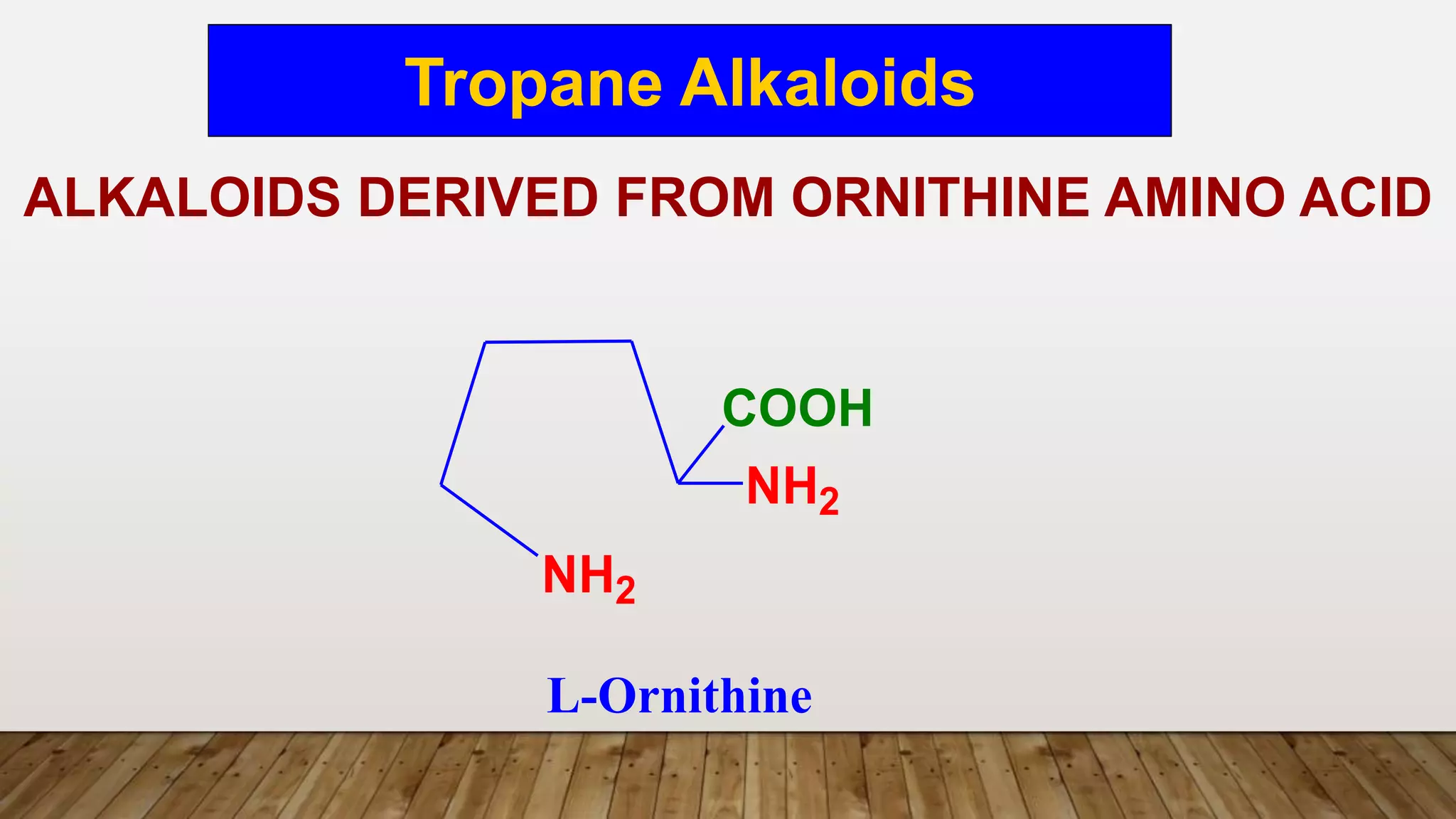
ALKALOIDS DERIVED FROM ORNITHINE AMINO ACID
L-Ornithine
NH2
NH2
COOH
Tropane Alkaloids
Tropane Alkaloids
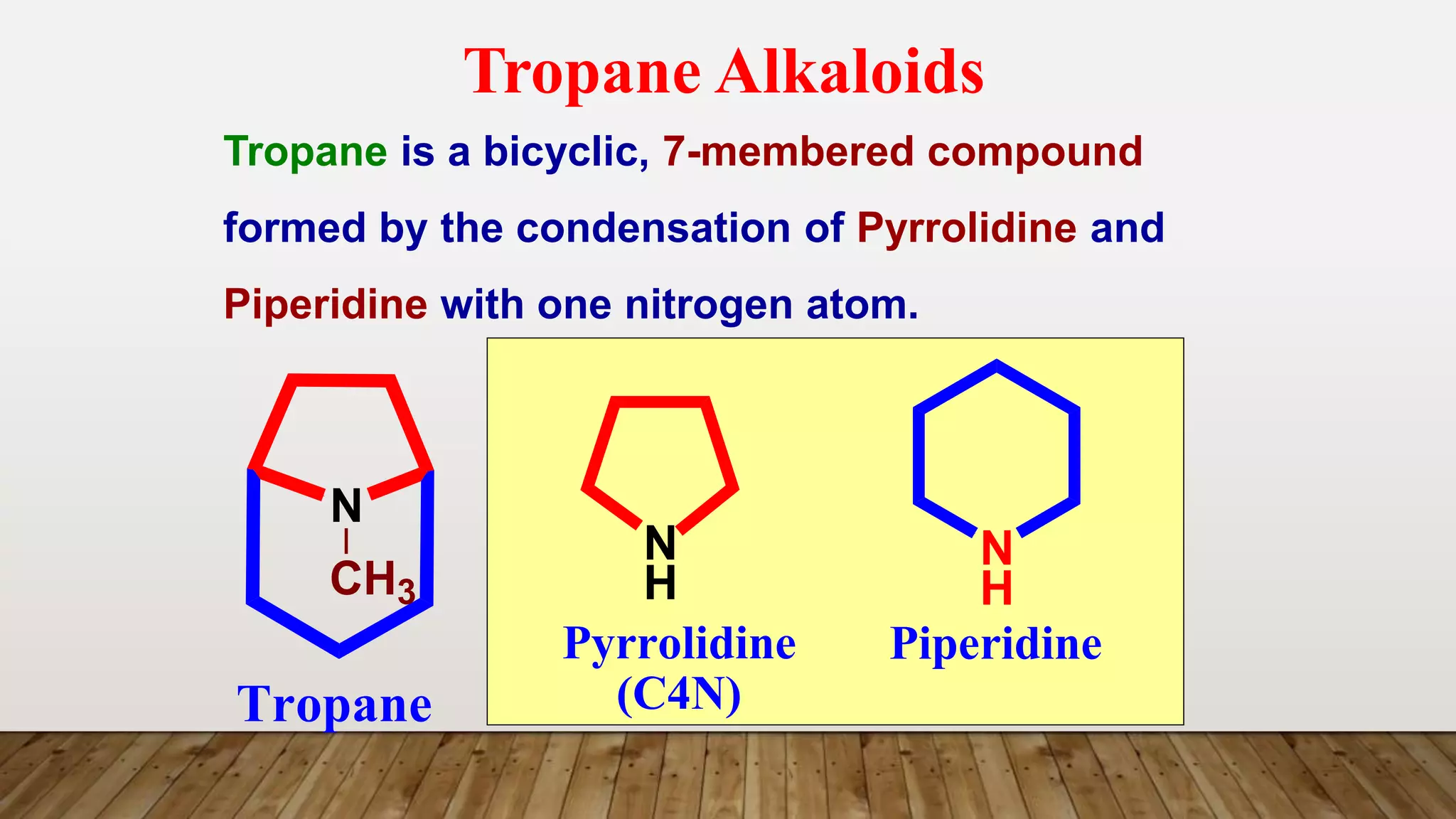
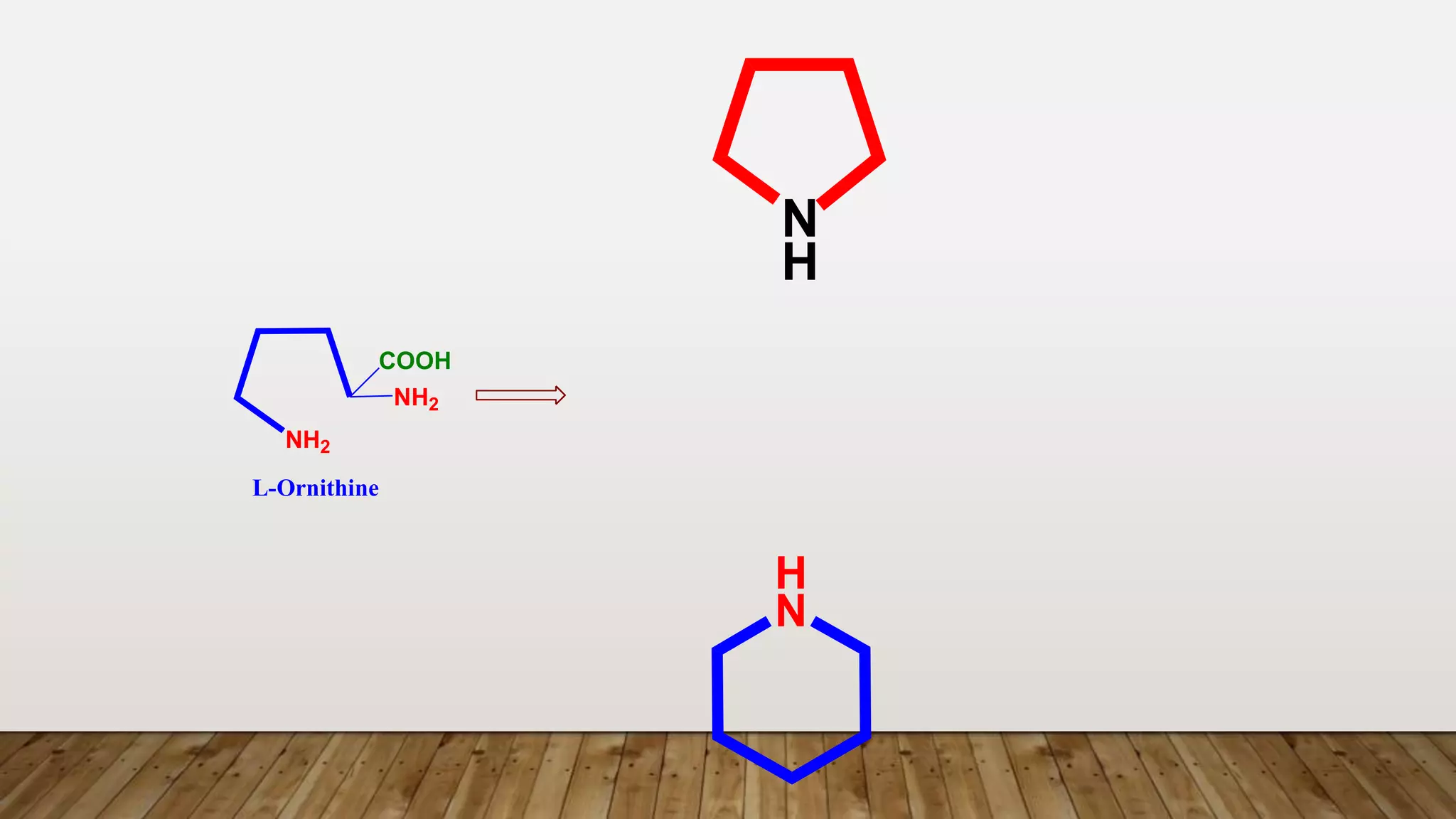
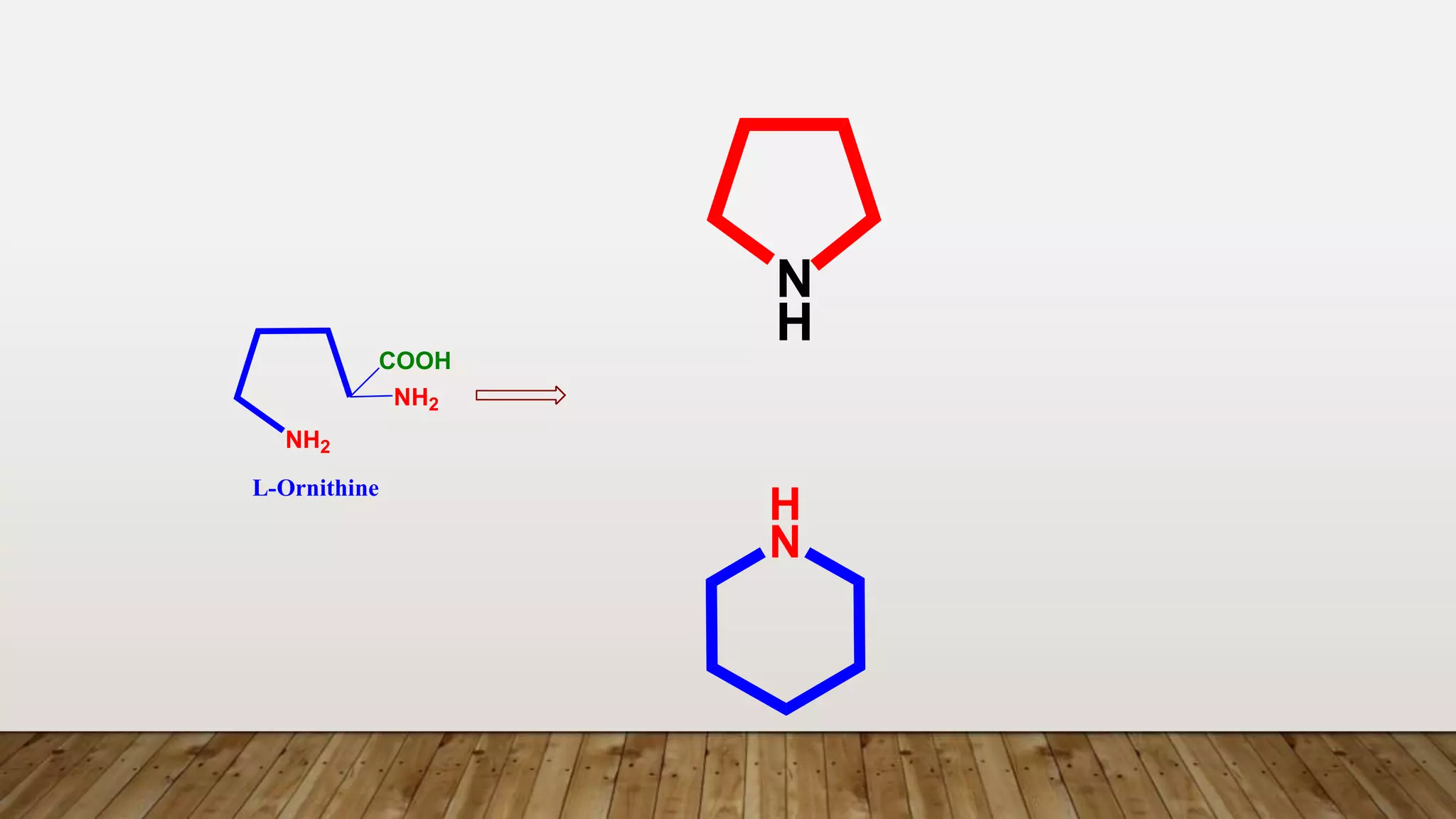
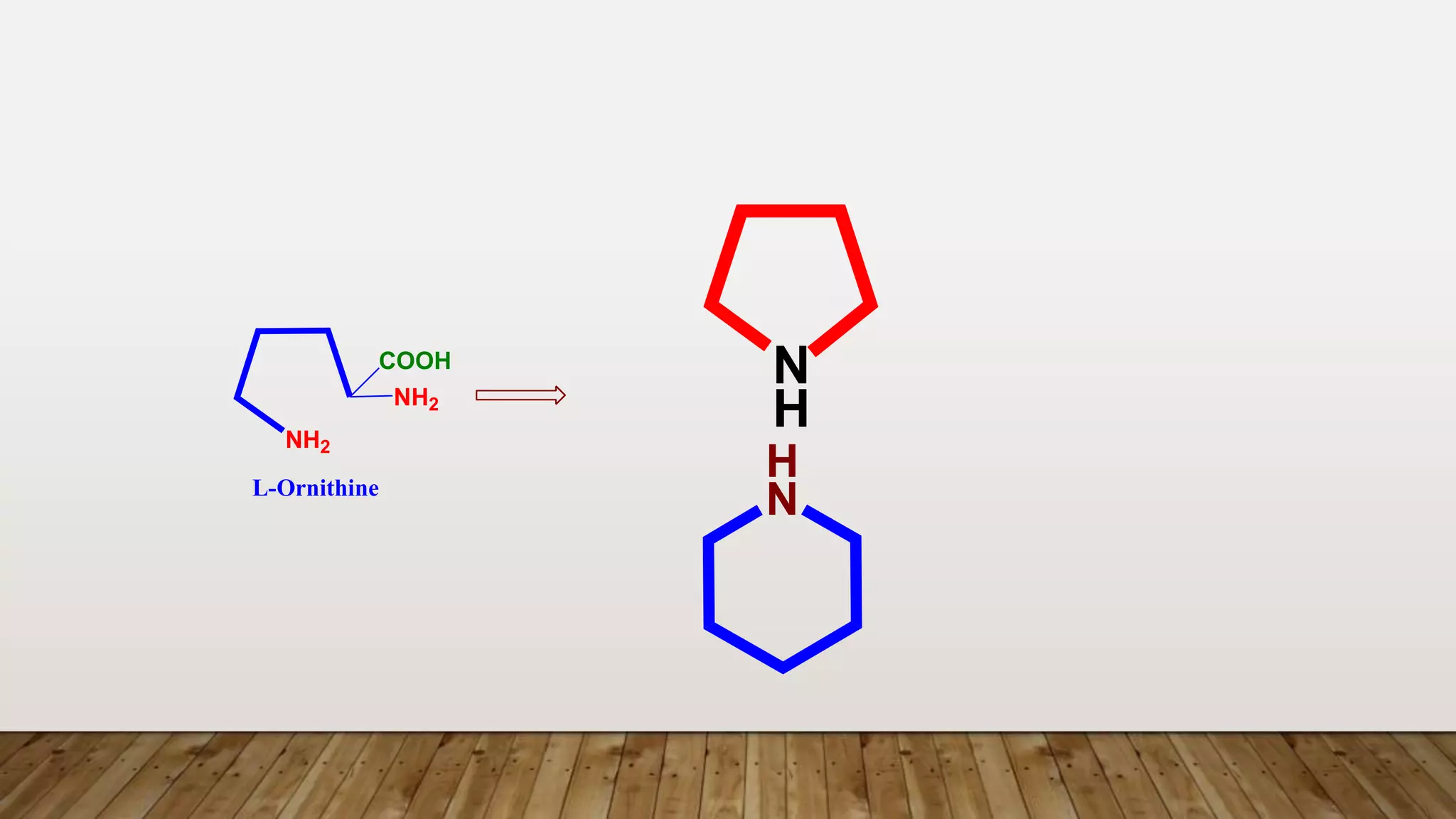
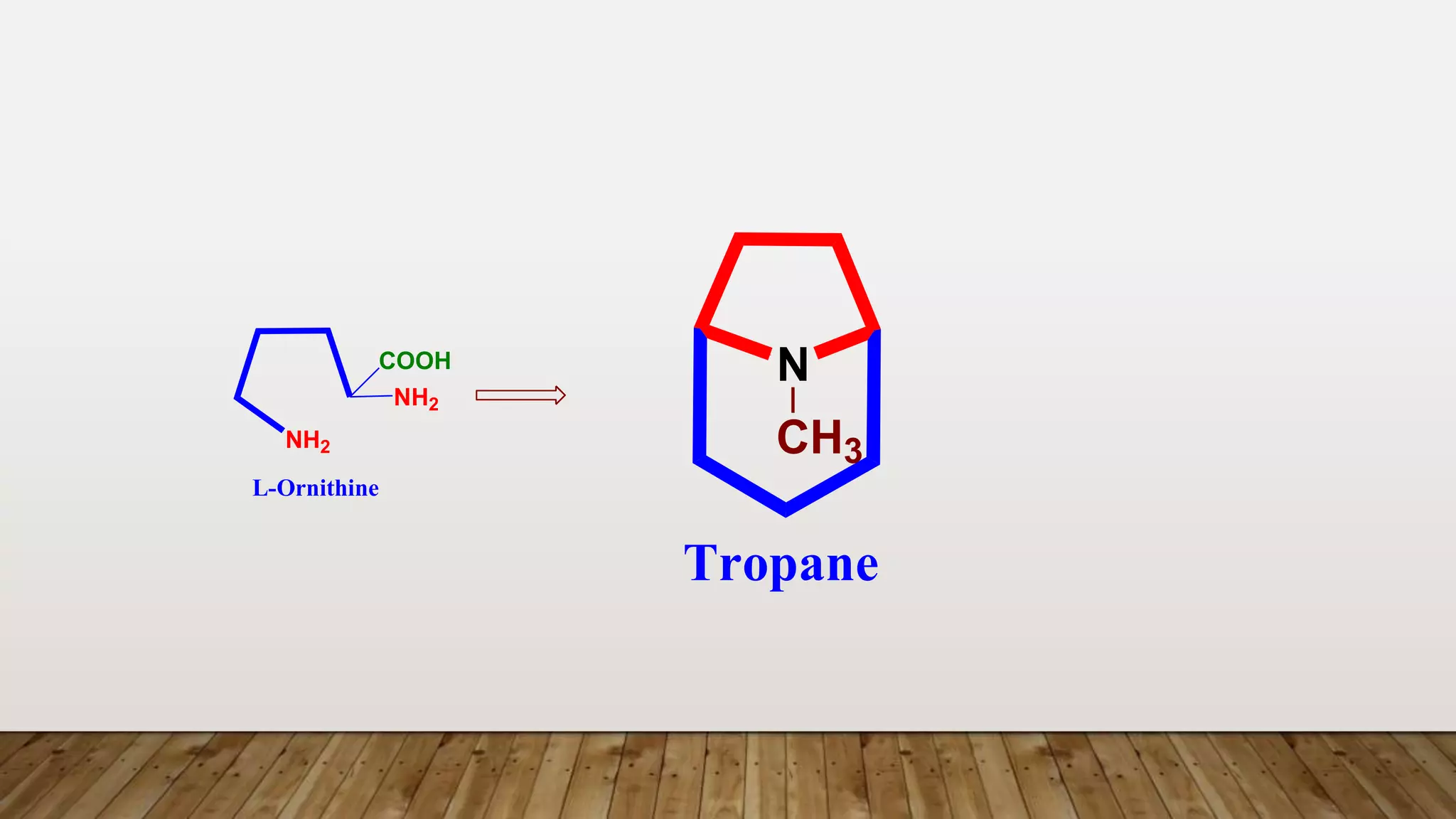
Tropane is a bicyclic, 7-membered compound
formed by the condensation of Pyrrolidine and
Piperidine with one nitrogen atom.
Piperidine
N
H
Pyrrolidine
(C4N)
N
H
Tropane
N
CH3
H
N
L-Ornithine
NH2
NH2
COOH
N
H
H
N
N
H
L-Ornithine
NH2
NH2
COOH
N
H
H
N
L-Ornithine
NH2
NH2
COOH
Tropane
N
CH3
L-Ornithine
NH2
NH2
COOH
L-Ornithine
NH2
NH2
COOH
Tropane
N
N
H3C
1
2
3
4
5
6
7
CH3
=
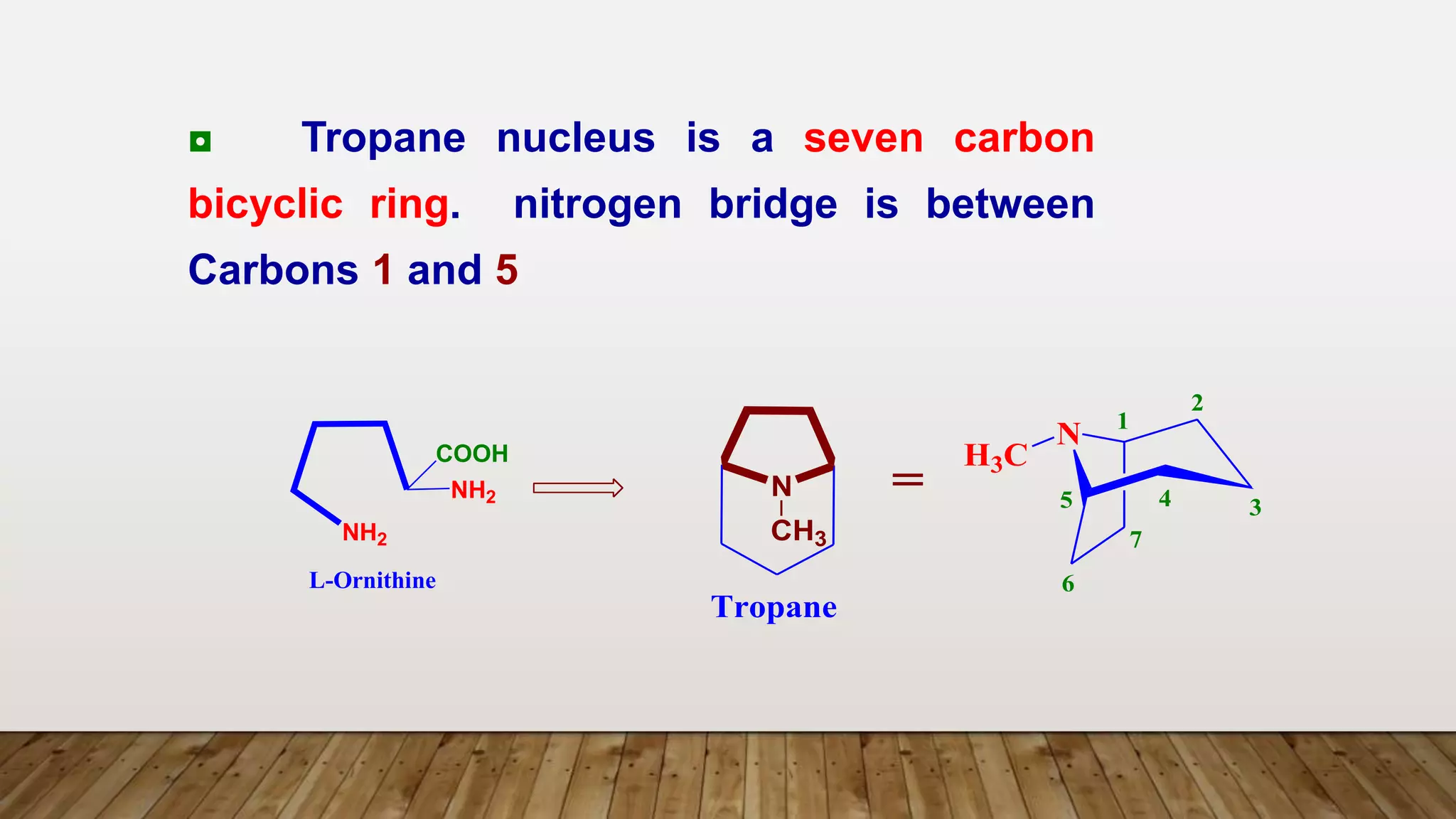
◘ Tropane nucleus is a seven carbon
bicyclic ring. nitrogen bridge is between
Carbons 1 and 5
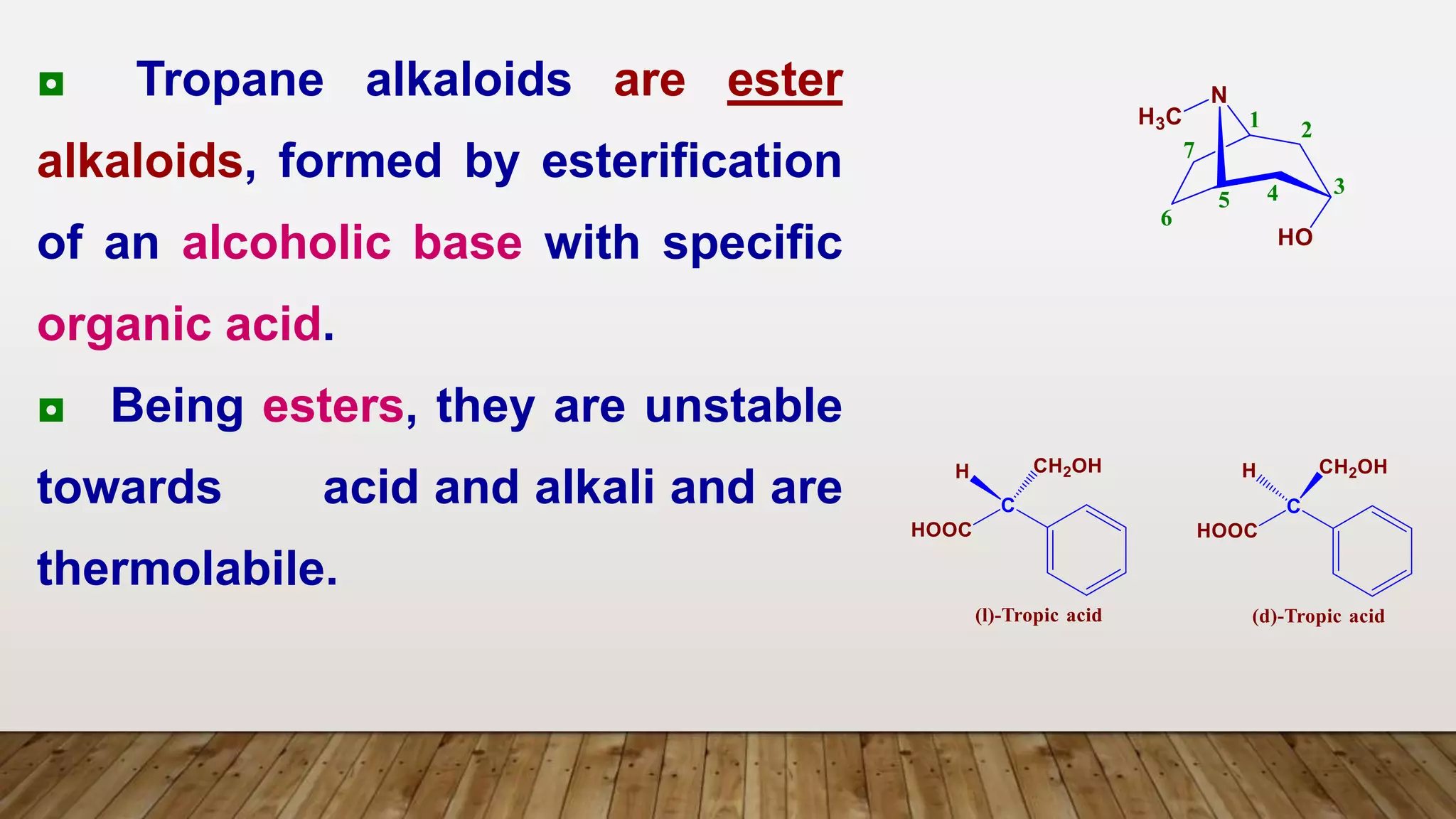
◘ Tropane alkaloids are ester
alkaloids, formed by esterification
of an alcoholic base with specific
organic acid.
◘ Being esters, they are unstable
towards acid and alkali and are
thermolabile.
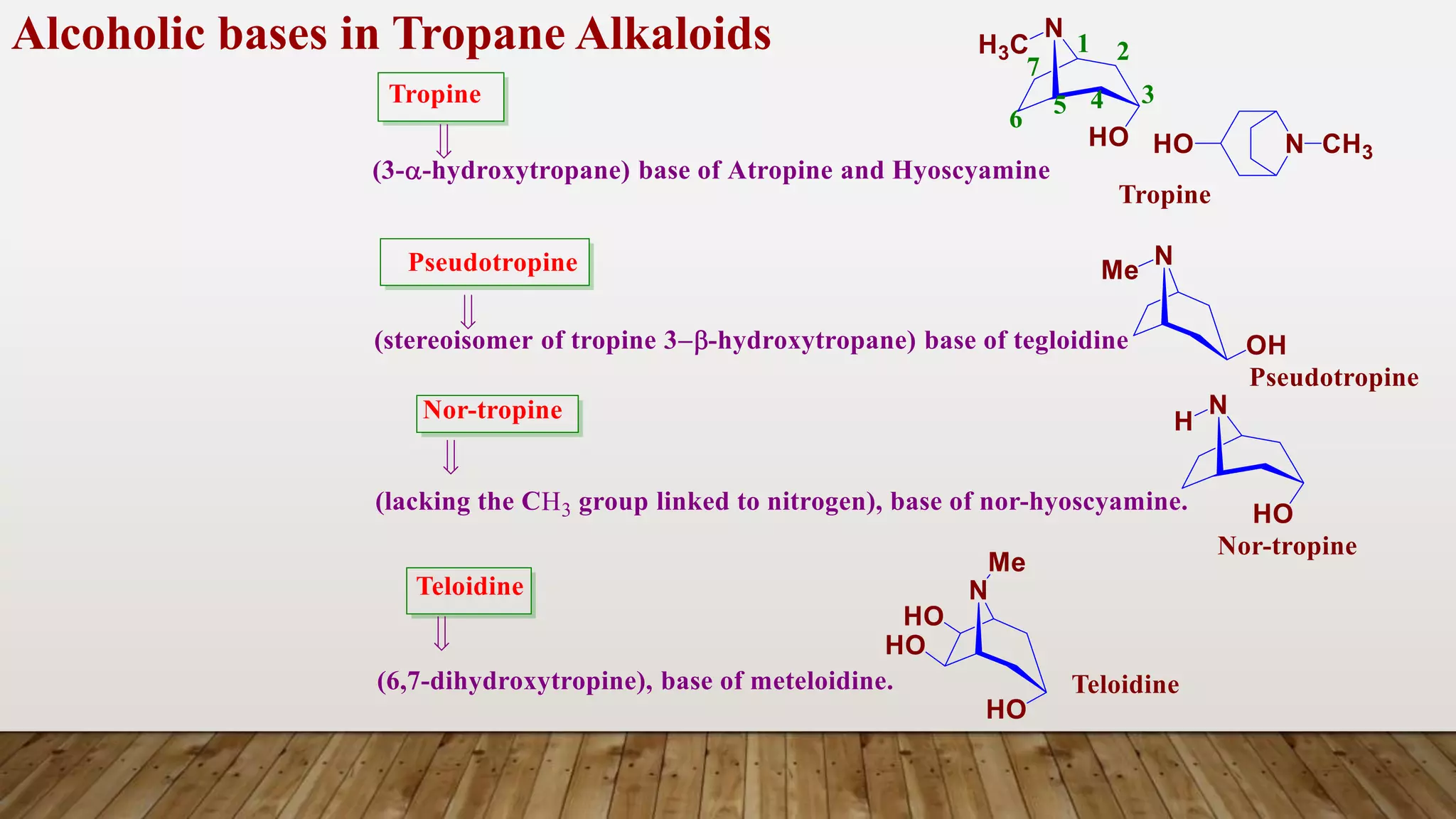
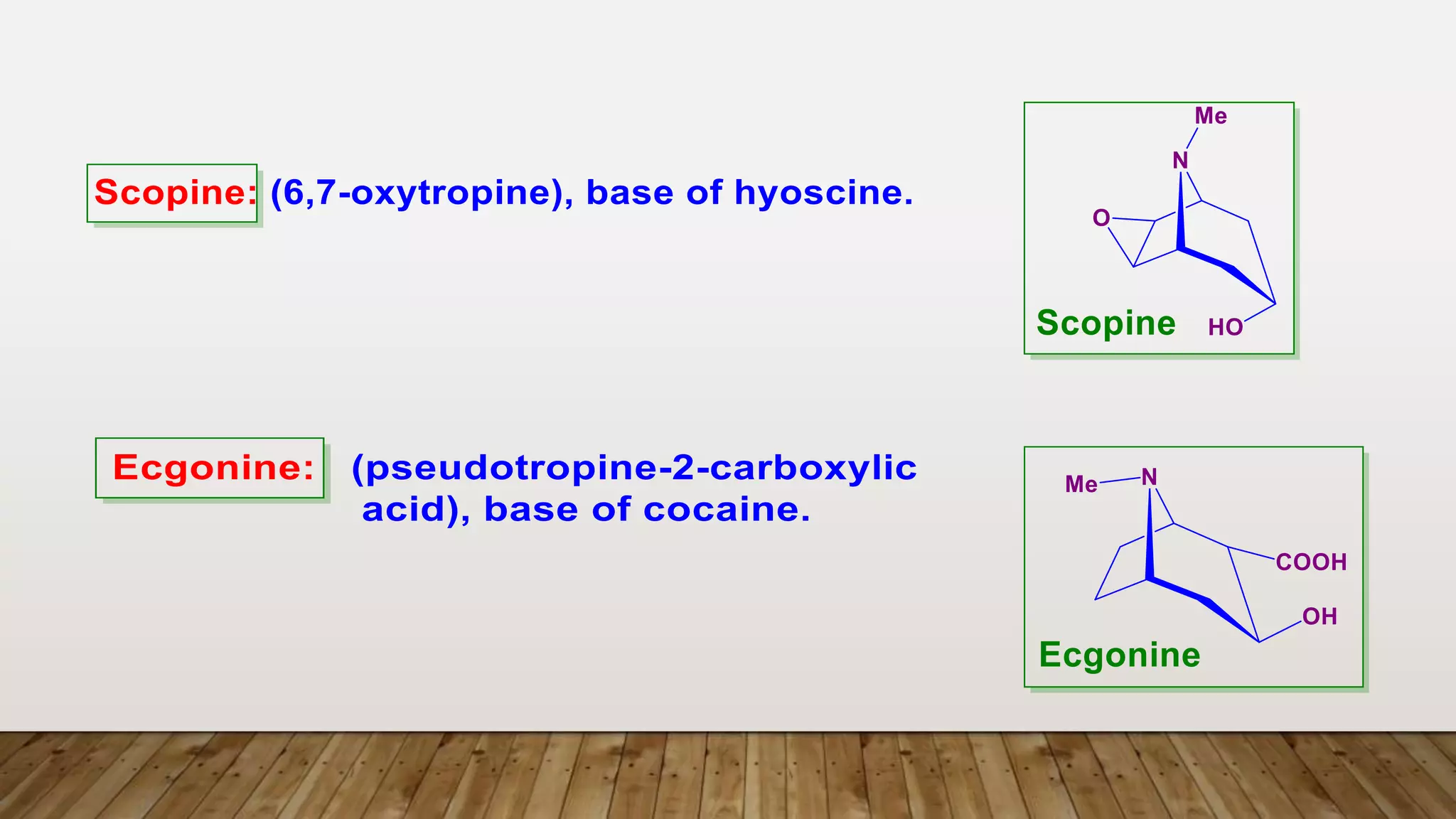
Alcoholic bases in Tropane Alkaloids
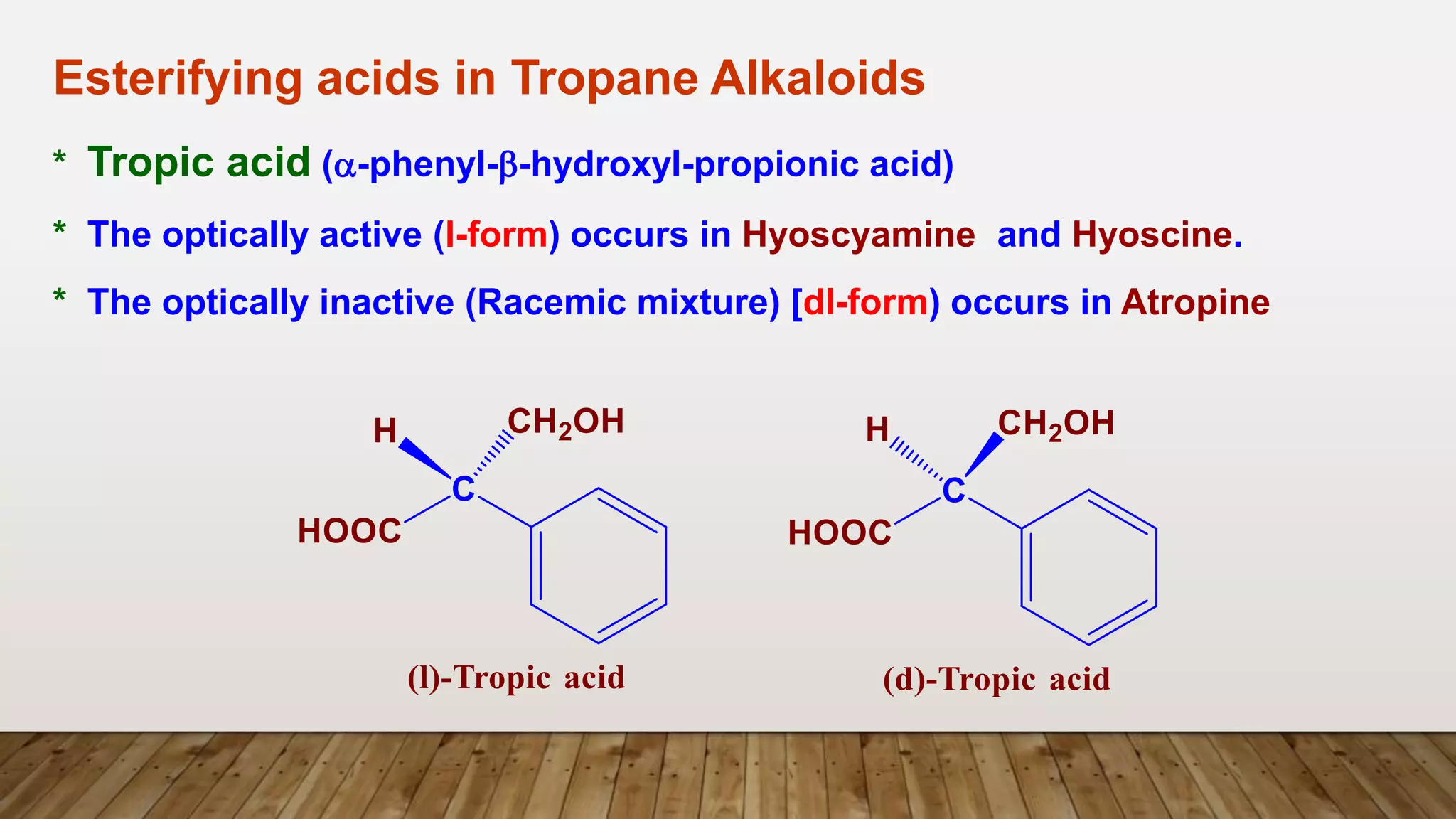
Esterifying acids in Tropane Alkaloids
* Tropic acid (a-phenyl-b-hydroxyl-propionic acid)
* The optically active (l-form) occurs in Hyoscyamine and Hyoscine.
* The optically inactive (Racemic mixture) [dl-form) occurs in Atropine
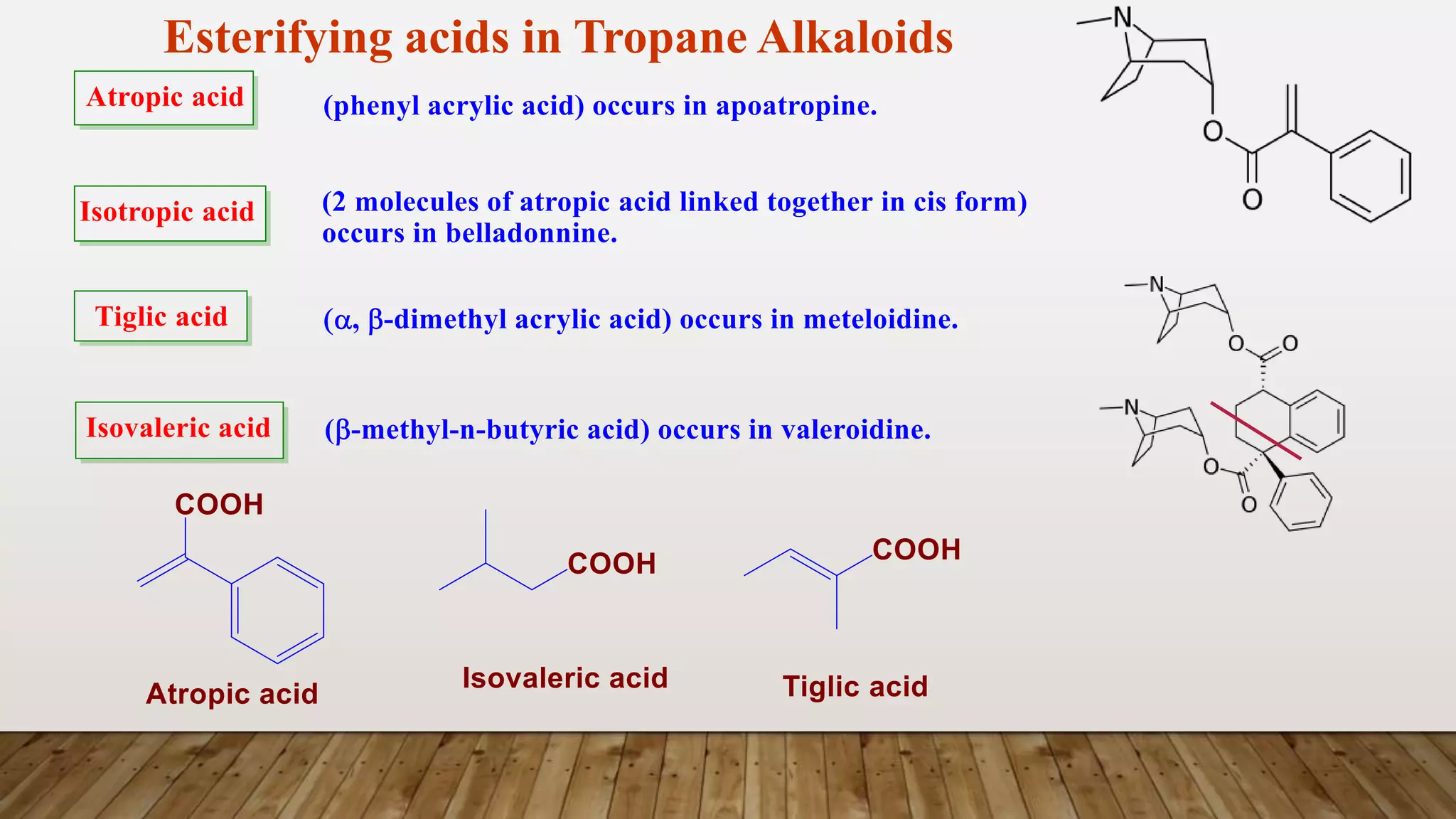
Esterifying acids in Tropane Alkaloids
Examples of Tropane alakloids
1) Solanaceous alkaloids e.g. Atropine,
Hyoscyamine and Hyoscine.
2) Coca alkaloids e.g. Cocaine, Cinnamyl cocaine
and α- and β-truxillines.
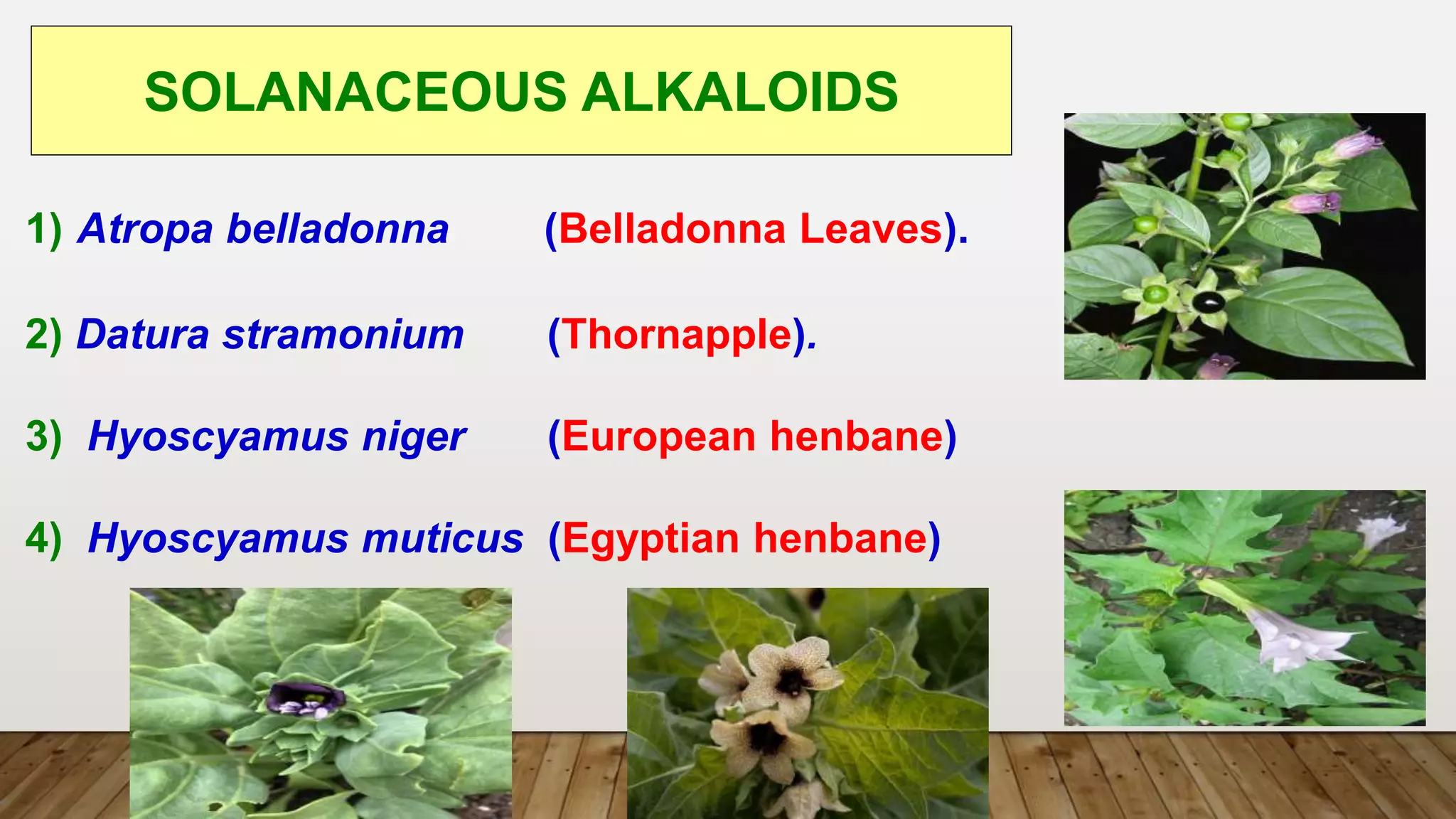
1) Atropa belladonna (Belladonna Leaves).
2) Datura stramonium (Thornapple).
3) Hyoscyamus niger (European henbane)
4) Hyoscyamus muticus (Egyptian henbane)
SOLANACEOUS ALKALOIDS
Solanaceous Alkaloids
N
O
Me
O
H CH2OH
(-)-Hyoscyamine
N
O
O
CH2OH
Me
Atropine
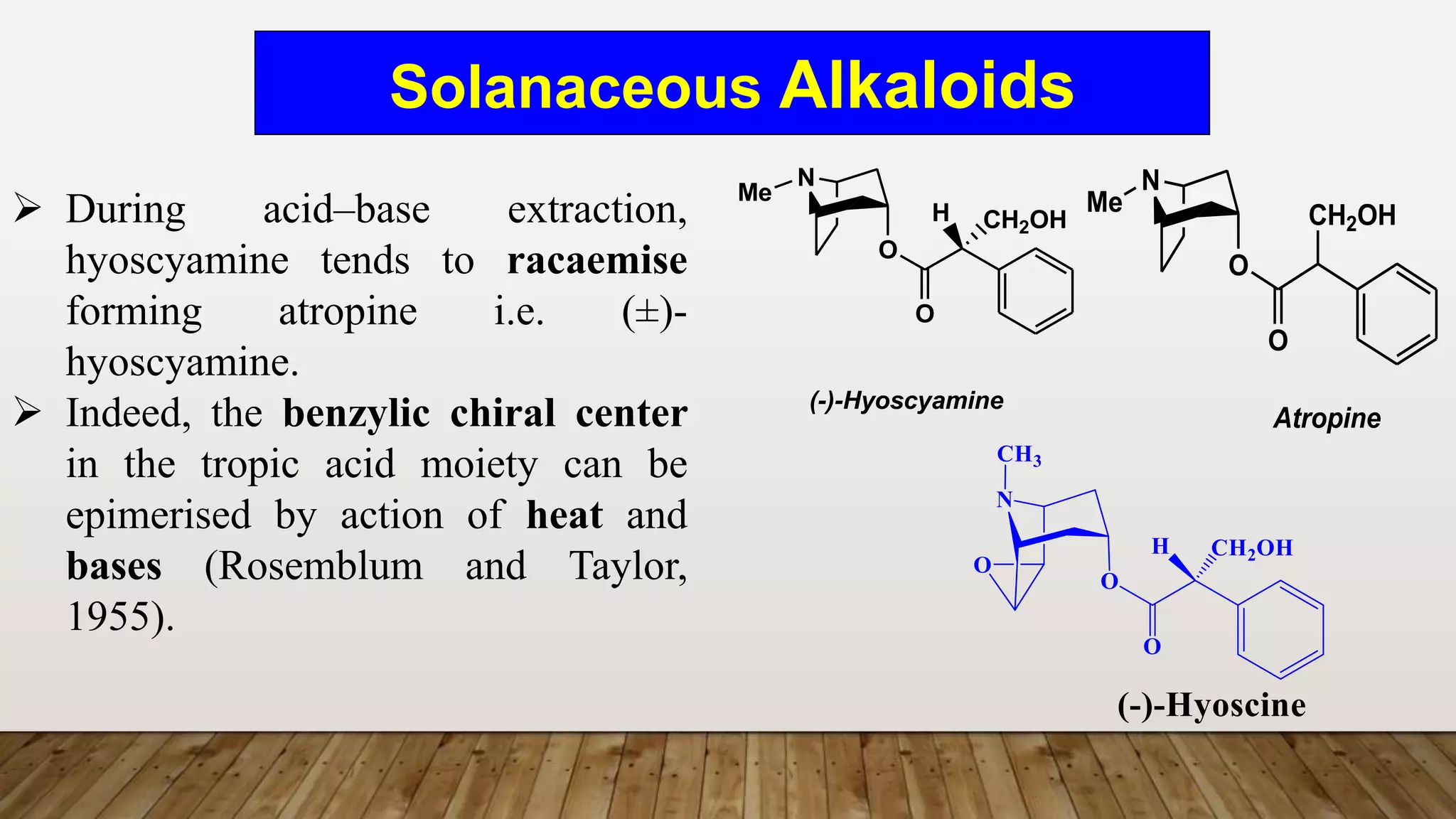
 During acid–base extraction,
hyoscyamine tends to racaemise
forming atropine i.e. (±)-
hyoscyamine.
 Indeed, the benzylic chiral center
in the tropic acid moiety can be
epimerised by action of heat and
bases (Rosemblum and Taylor,
1955).
Number of atropine chiral center(s)?
N
O
O
CH2OH
Me
Atropine
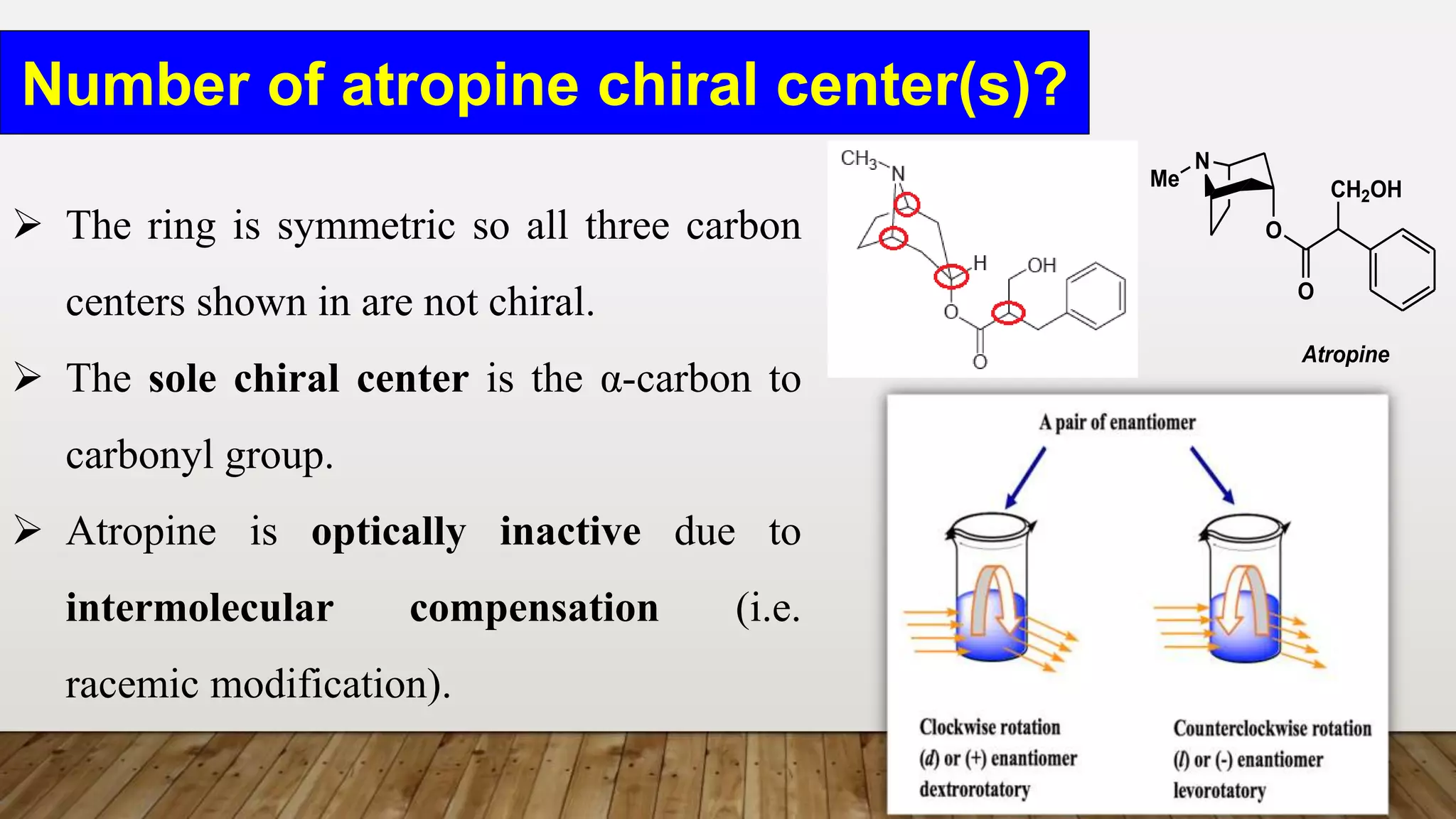
 The ring is symmetric so all three carbon
centers shown in are not chiral.
 The sole chiral center is the α-carbon to
carbonyl group.
 Atropine is optically inactive due to
intermolecular compensation (i.e.
racemic modification).
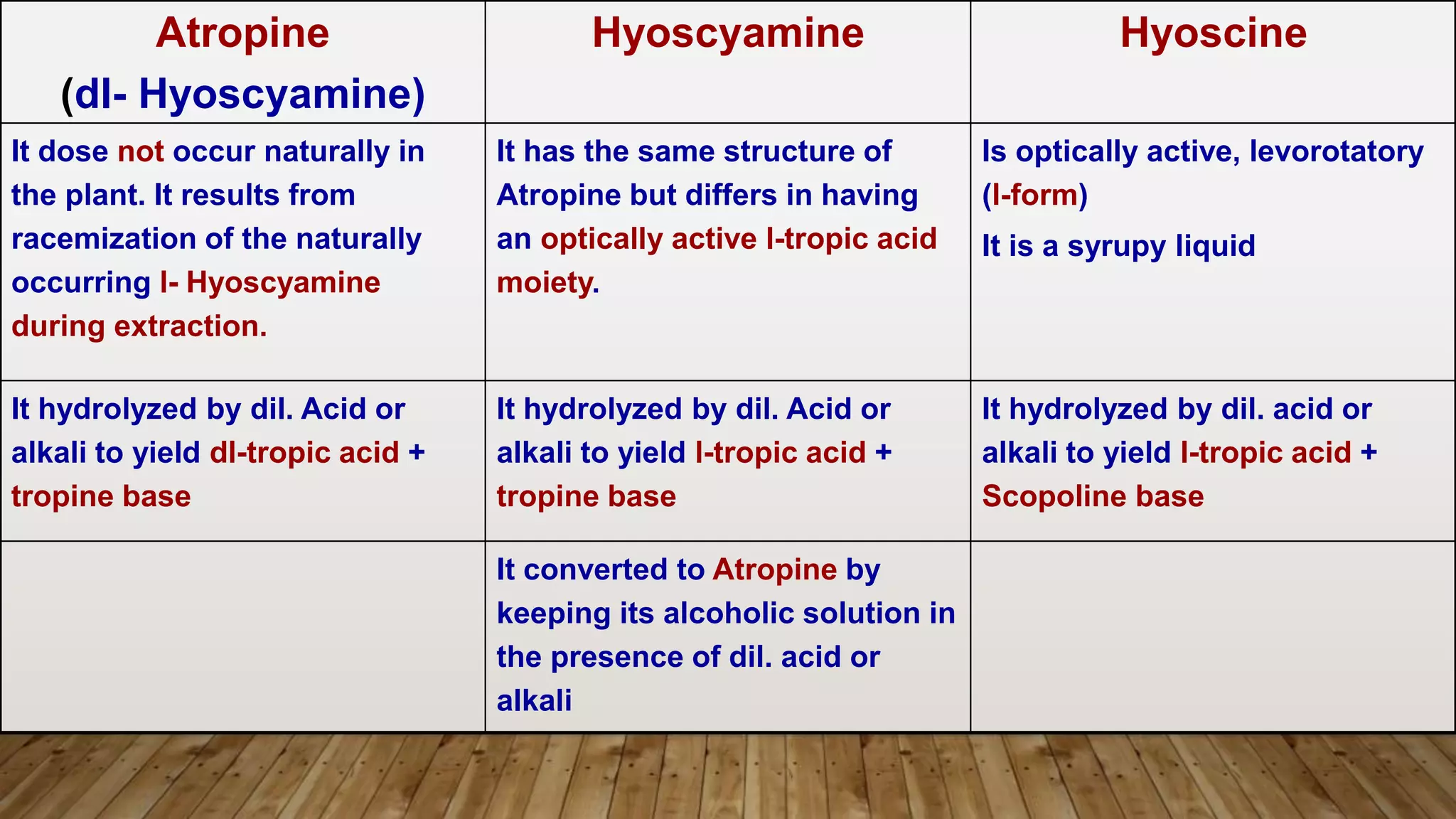
Hyoscine
Hyoscyamine
Atropine
(dl- Hyoscyamine)
Is optically active, levorotatory
(l-form)
It is a syrupy liquid
It has the same structure of
Atropine but differs in having
an optically active l-tropic acid
moiety.
It dose not occur naturally in
the plant. It results from
racemization of the naturally
occurring l- Hyoscyamine
during extraction.
It hydrolyzed by dil. acid or
alkali to yield l-tropic acid +
Scopoline base
It hydrolyzed by dil. Acid or
alkali to yield l-tropic acid +
tropine base
It hydrolyzed by dil. Acid or
alkali to yield dl-tropic acid +
tropine base
It converted to Atropine by
keeping its alcoholic solution in
the presence of dil. acid or
alkali
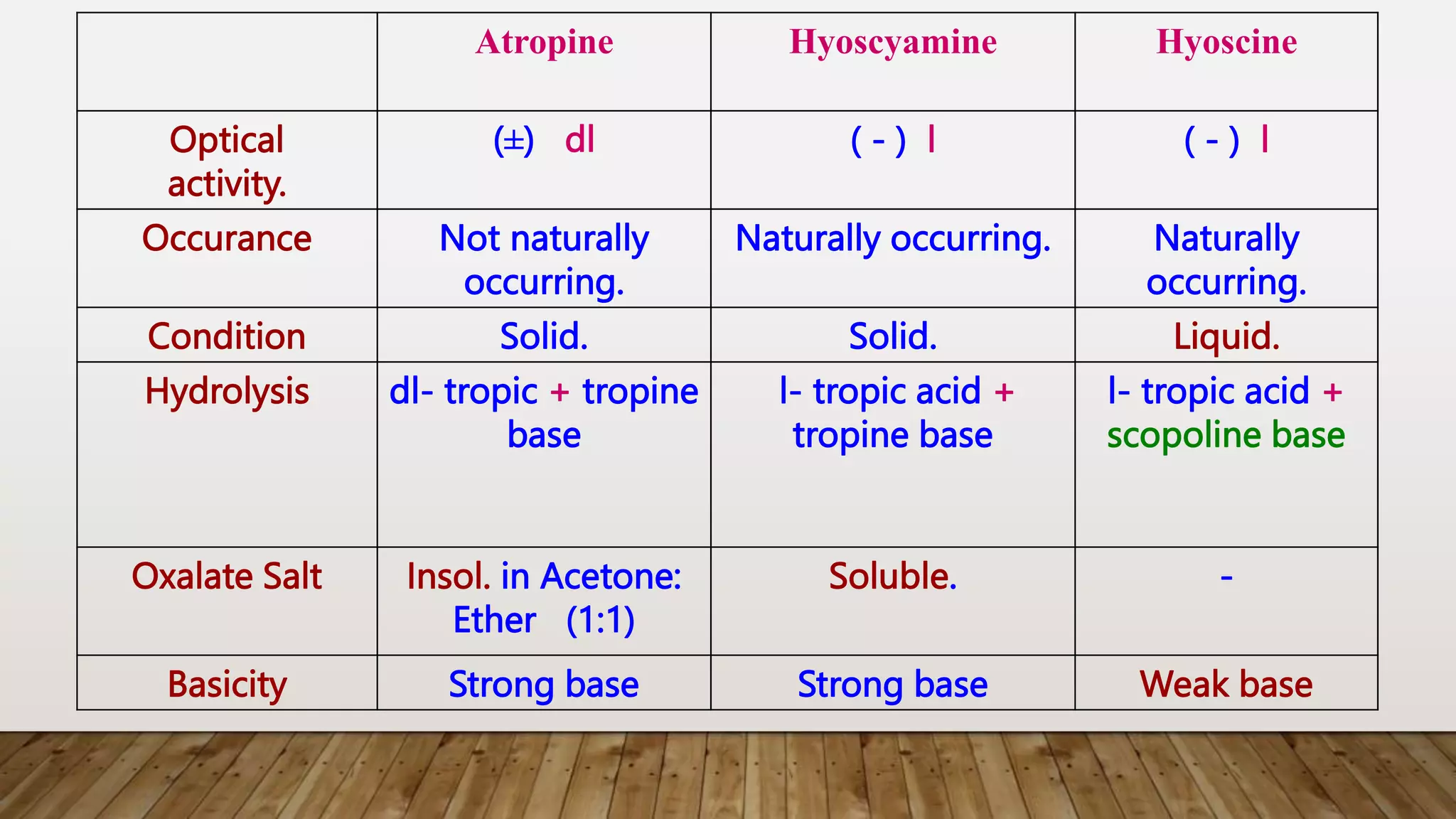
Hyoscine
Hyoscyamine
Atropine
( - ) l
( - ) l
(±) dl
Optical
activity.
Naturally
occurring.
Naturally occurring.
Not naturally
occurring.
Occurance
Liquid.
Solid.
Solid.
Condition
l- tropic acid +
scopoline base
l- tropic acid +
tropine base
dl- tropic + tropine
base
Hydrolysis
-
Soluble.
Insol. in Acetone:
Ether (1:1)
Oxalate Salt
Weak base
Strong base
Strong base
Basicity
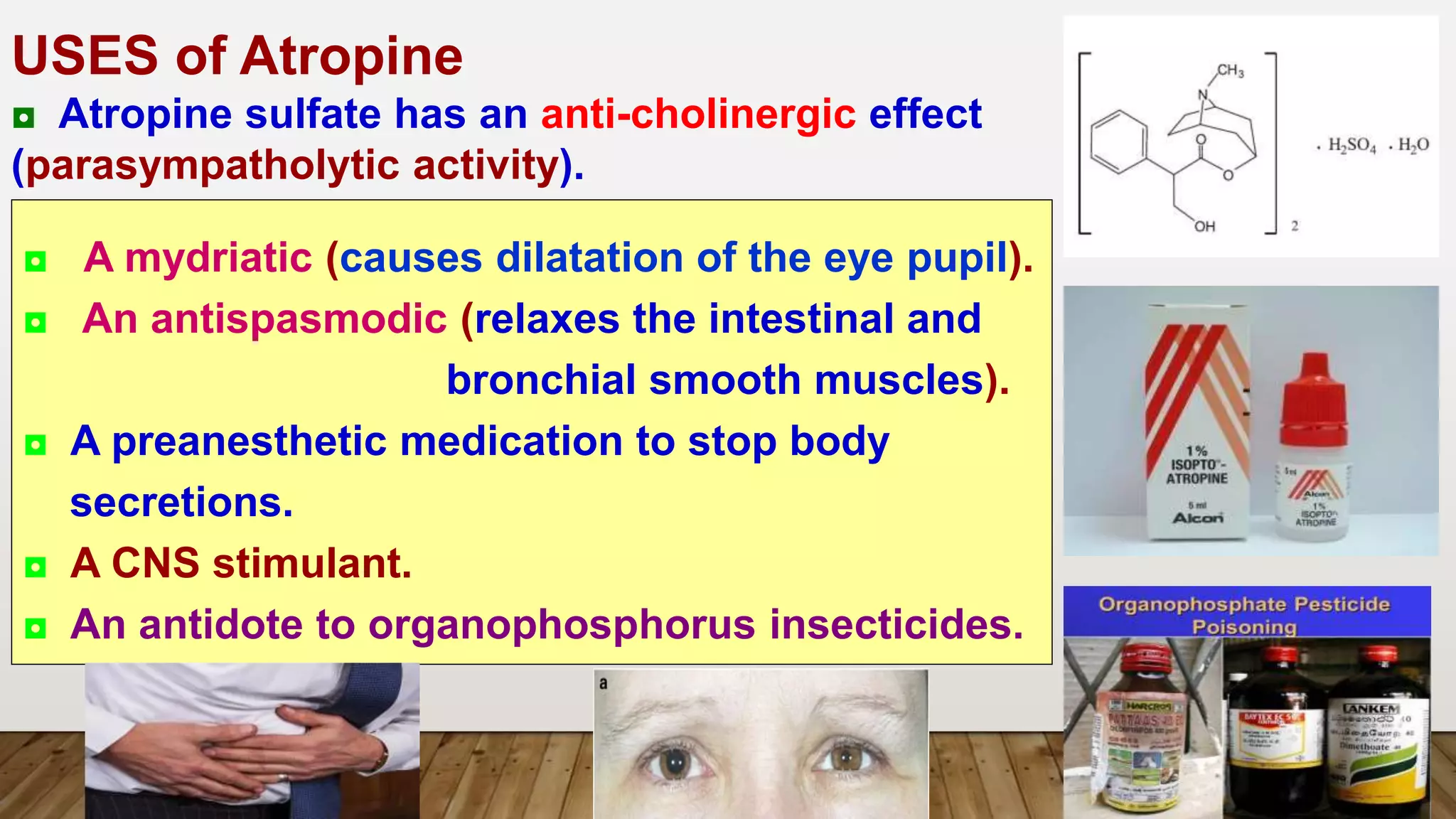
USES of Atropine
◘ Atropine sulfate has an anti-cholinergic effect
(parasympatholytic activity).
◘ A mydriatic (causes dilatation of the eye pupil).
◘ An antispasmodic (relaxes the intestinal and
bronchial smooth muscles).
◘ A preanesthetic medication to stop body
secretions.
◘ A CNS stimulant.
◘ An antidote to organophosphorus insecticides.
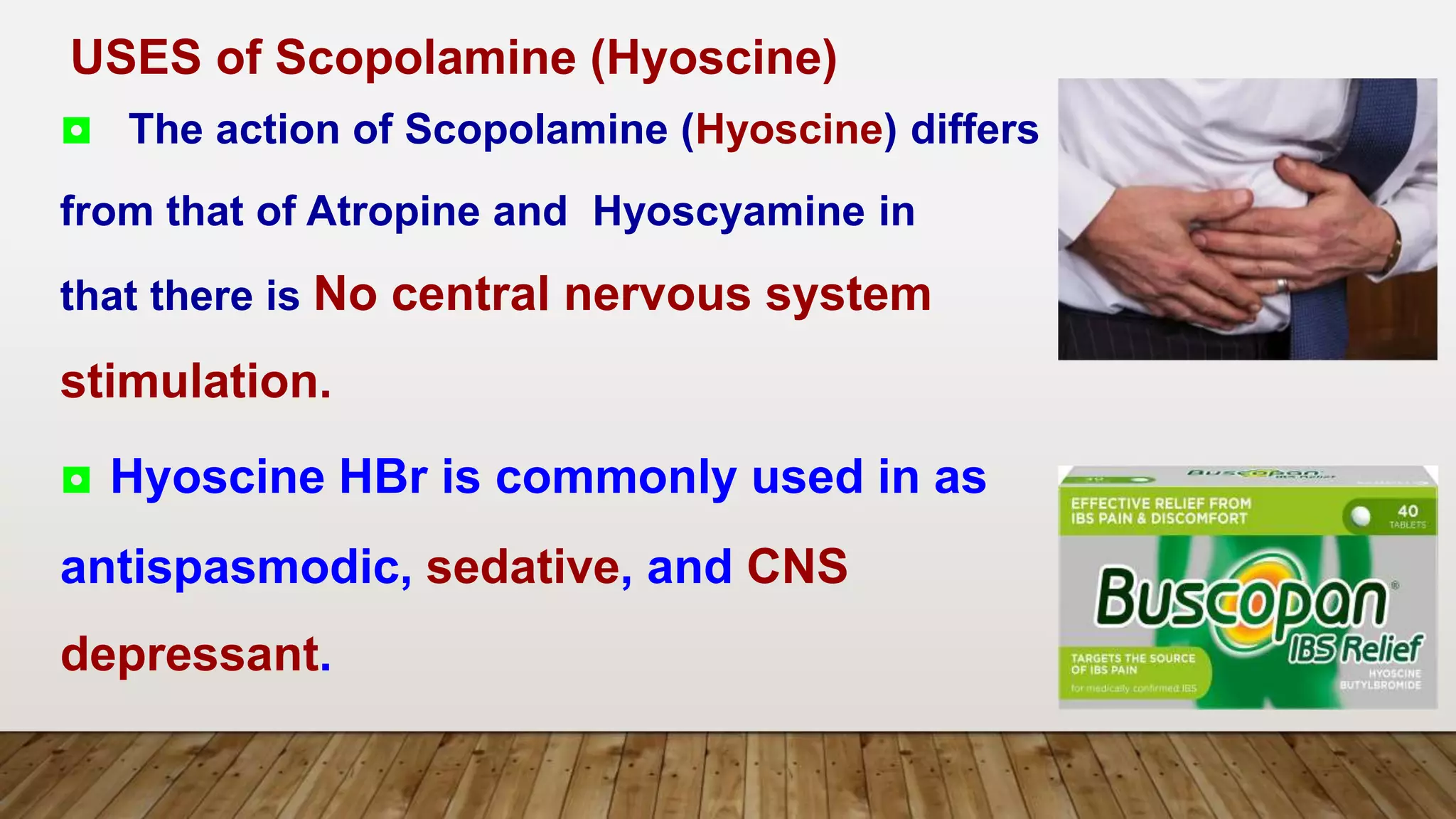
◘ The action of Scopolamine (Hyoscine) differs
from that of Atropine and Hyoscyamine in
that there is No central nervous system
stimulation.
◘ Hyoscine HBr is commonly used in as
antispasmodic, sedative, and CNS
depressant.
USES of Scopolamine (Hyoscine)
CNS effect of the plant vs major isolated Alkaloid(s)?!!!
Belladonna, Datura and Hyoscyamus vs Atropine and Hyoscyamine
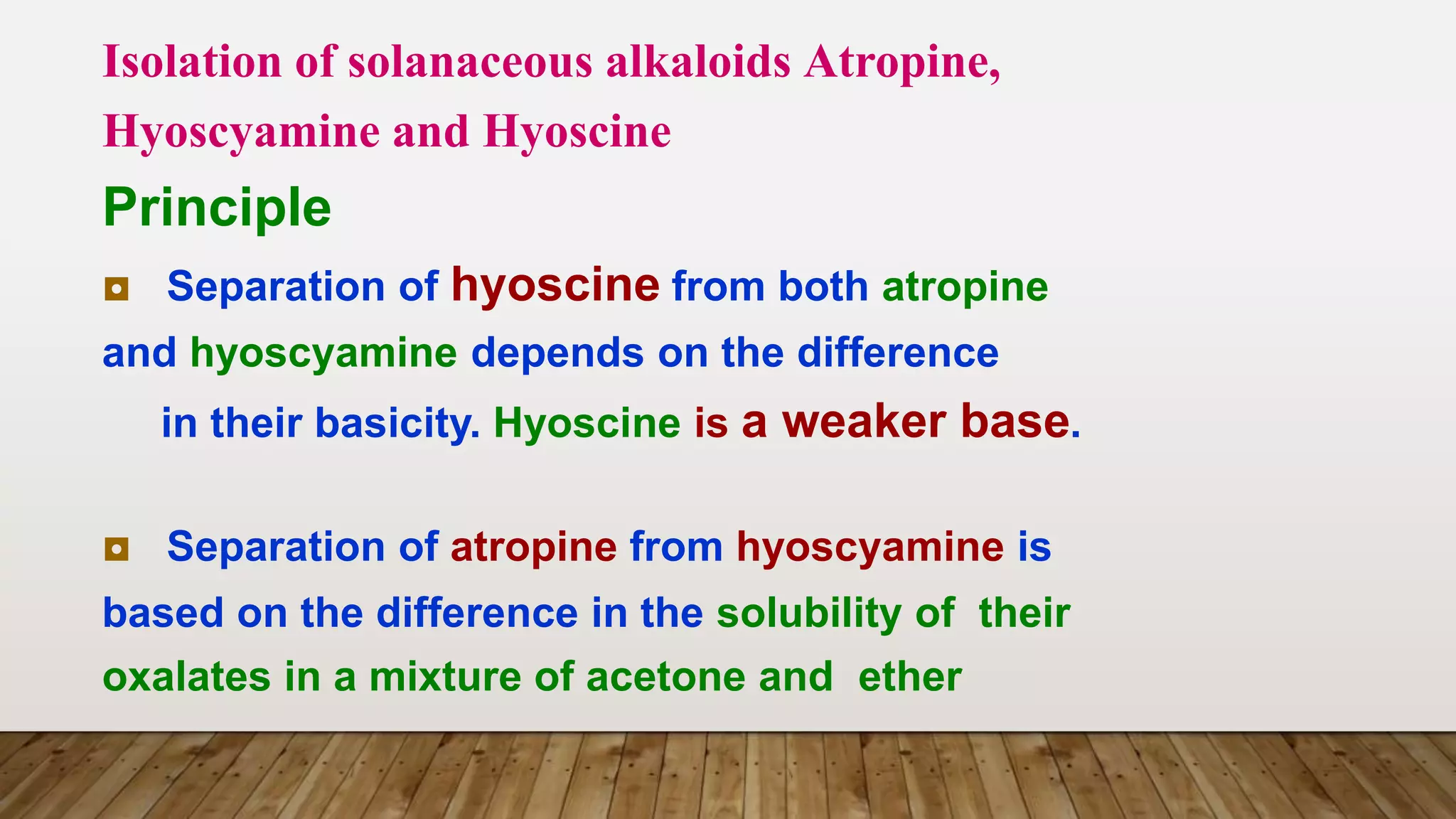
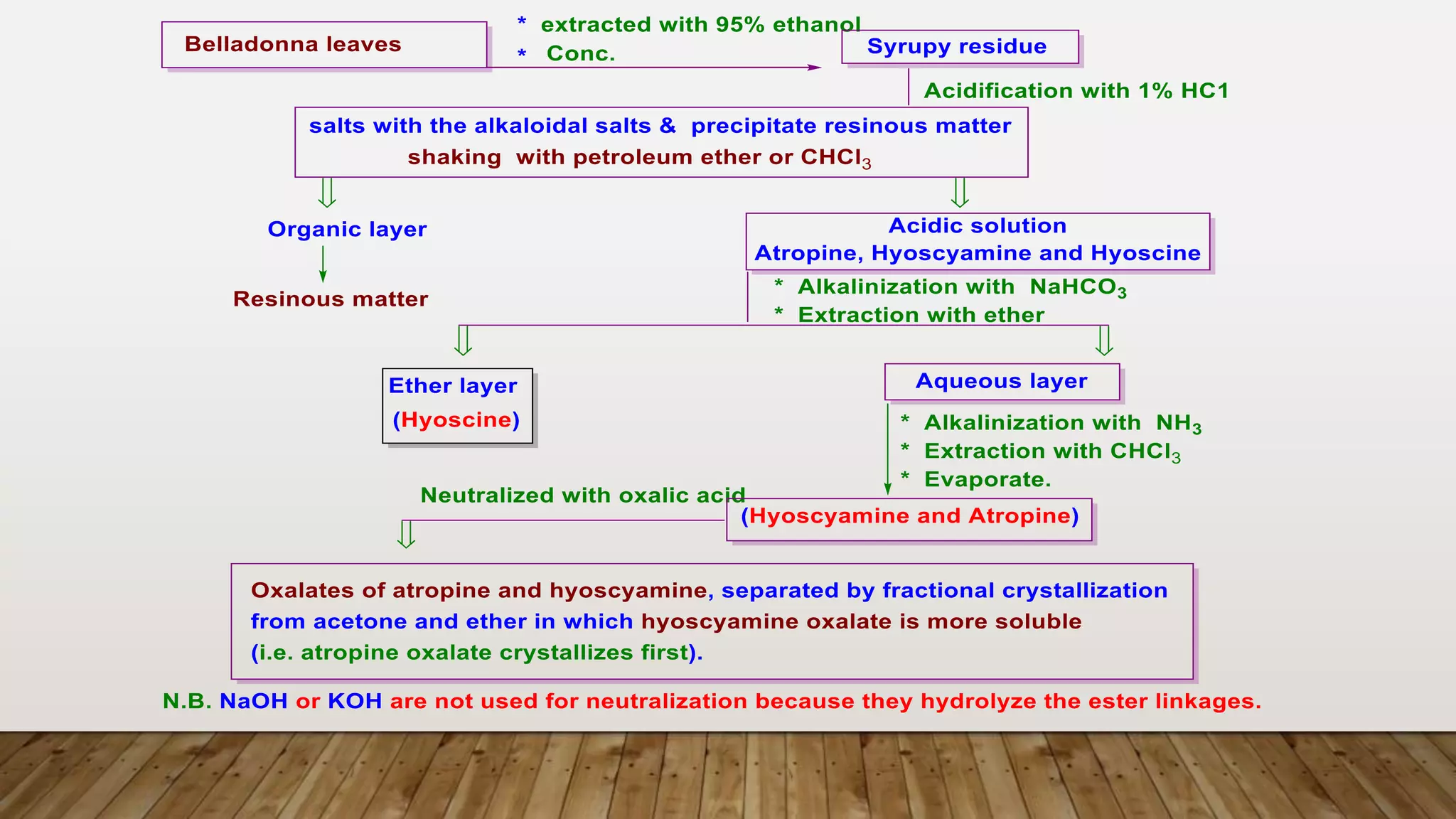
Isolation of solanaceous alkaloids Atropine,
Hyoscyamine and Hyoscine
Principle
◘ Separation of hyoscine from both atropine
and hyoscyamine depends on the difference
in their basicity. Hyoscine is a weaker base.
◘ Separation of atropine from hyoscyamine is
based on the difference in the solubility of their
oxalates in a mixture of acetone and ether
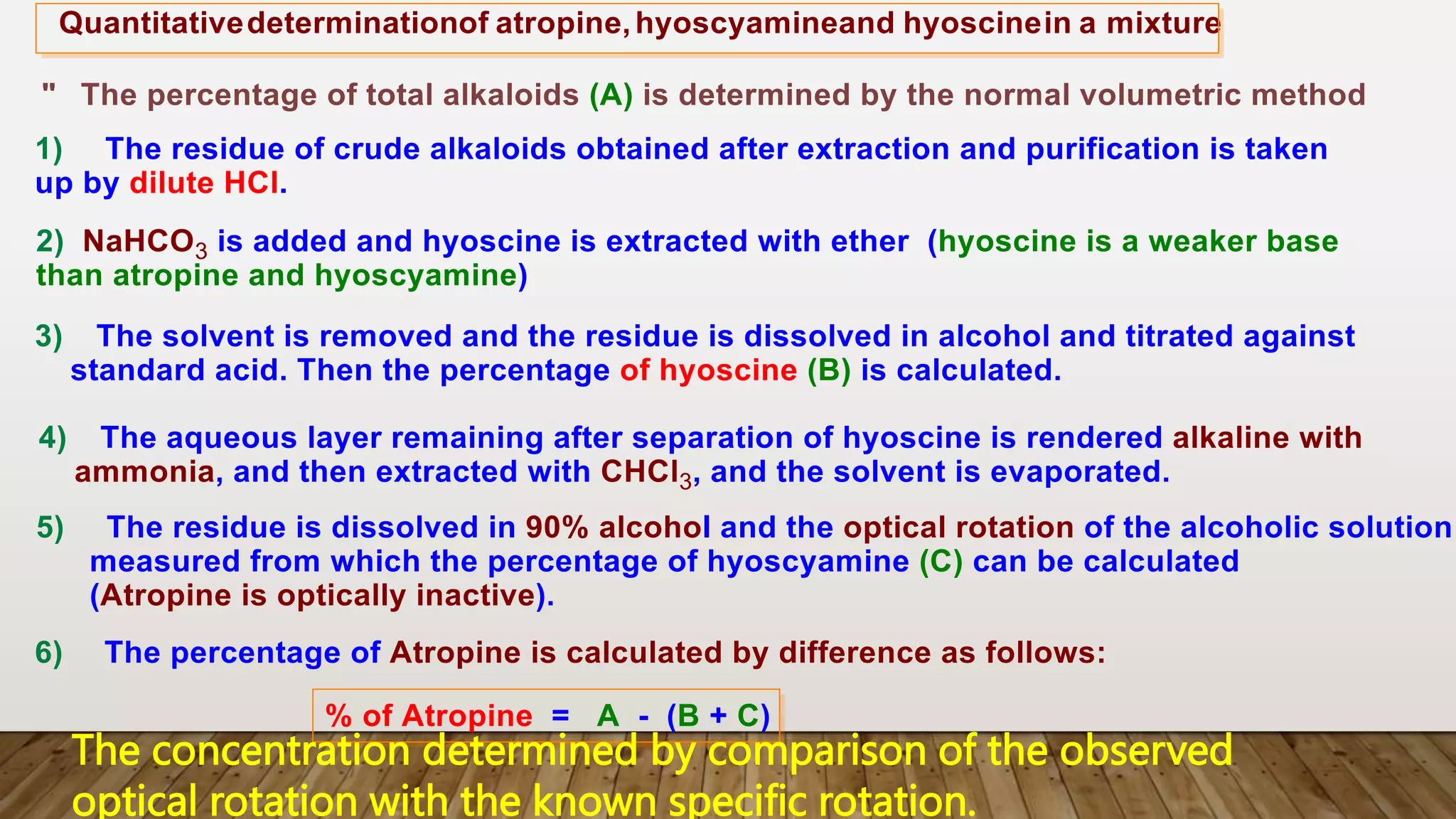
The concentration determined by comparison of the observed
optical rotation with the known specific rotation.
Chemical tests of Tropane Alkaloids
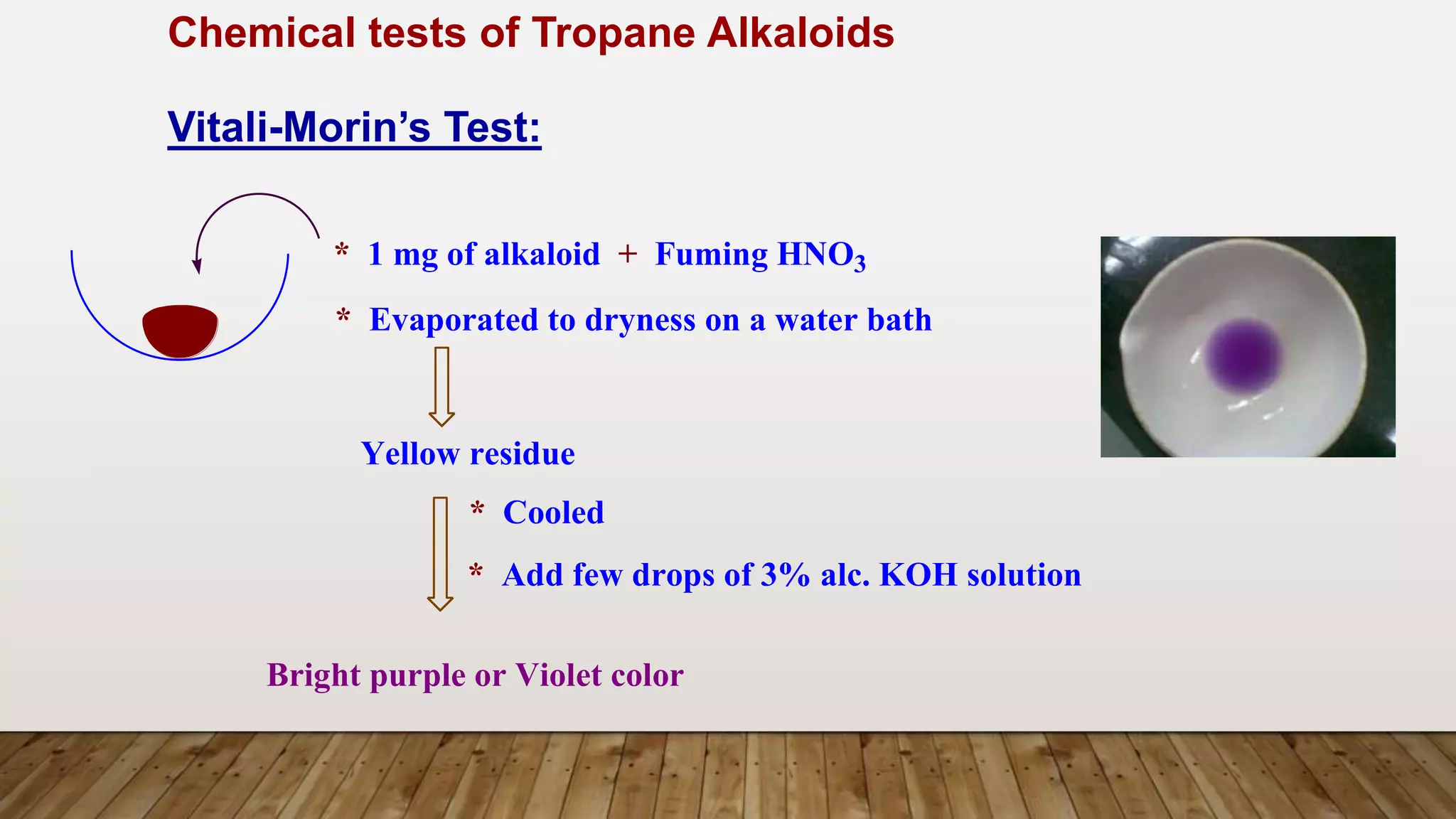
Vitali-Morin’s Test:
* 1 mg of alkaloid + Fuming HNO3
* Evaporated to dryness on a water bath
Yellow residue
* Cooled
* Add few drops of 3% alc. KOH solution
Bright purple or Violet color
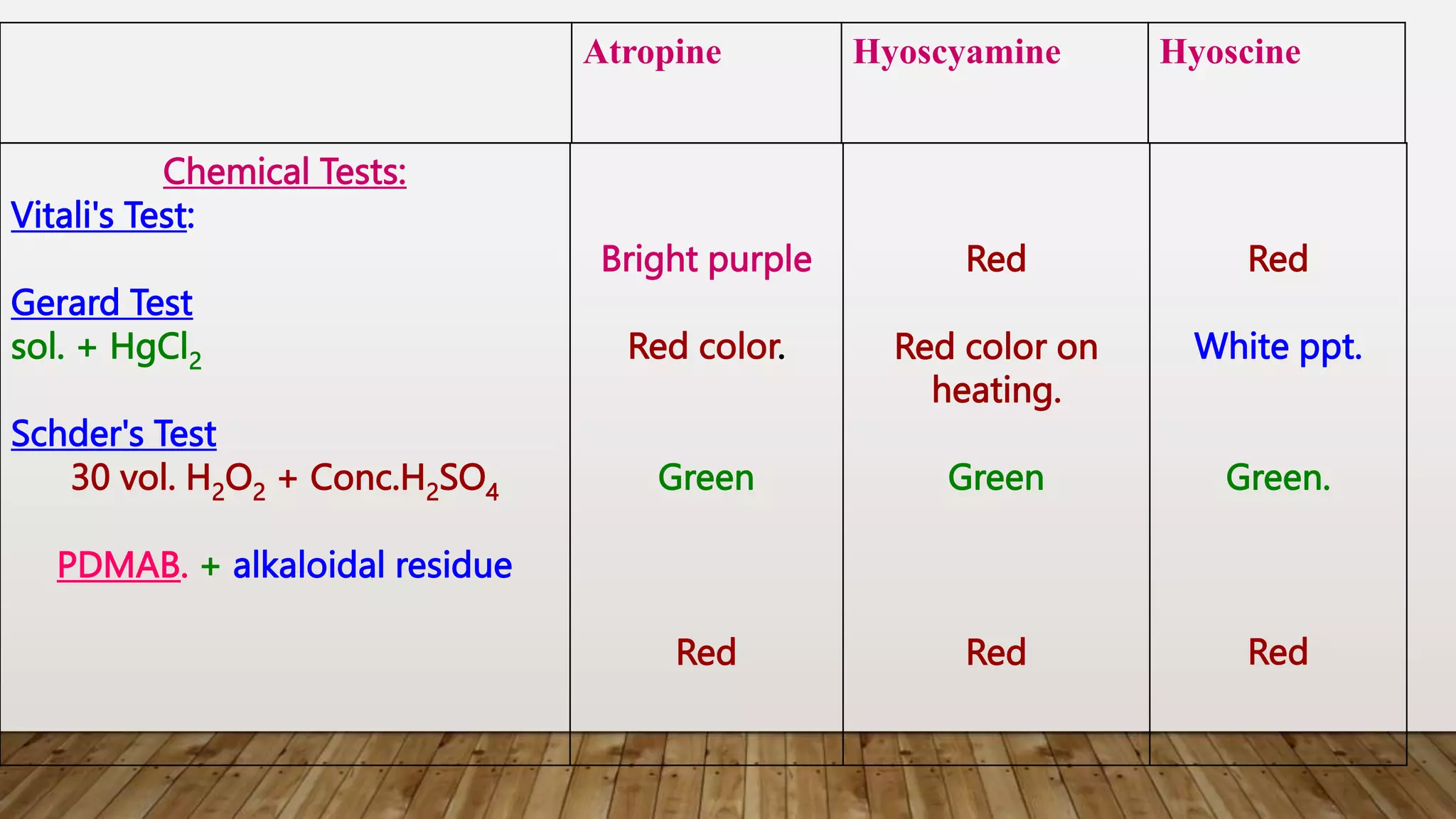
Hyoscine
Hyoscyamine
Atropine
Red
White ppt.
Green.
Red
Red
Red color on
heating.
Green
Red
Bright purple
Red color.
Green
Red
Chemical Tests:
Vitali's Test:
Gerard Test
sol. + HgCl2
Schder's Test
30 vol. H2O2 + Conc.H2SO4
PDMAB. + alkaloidal residue
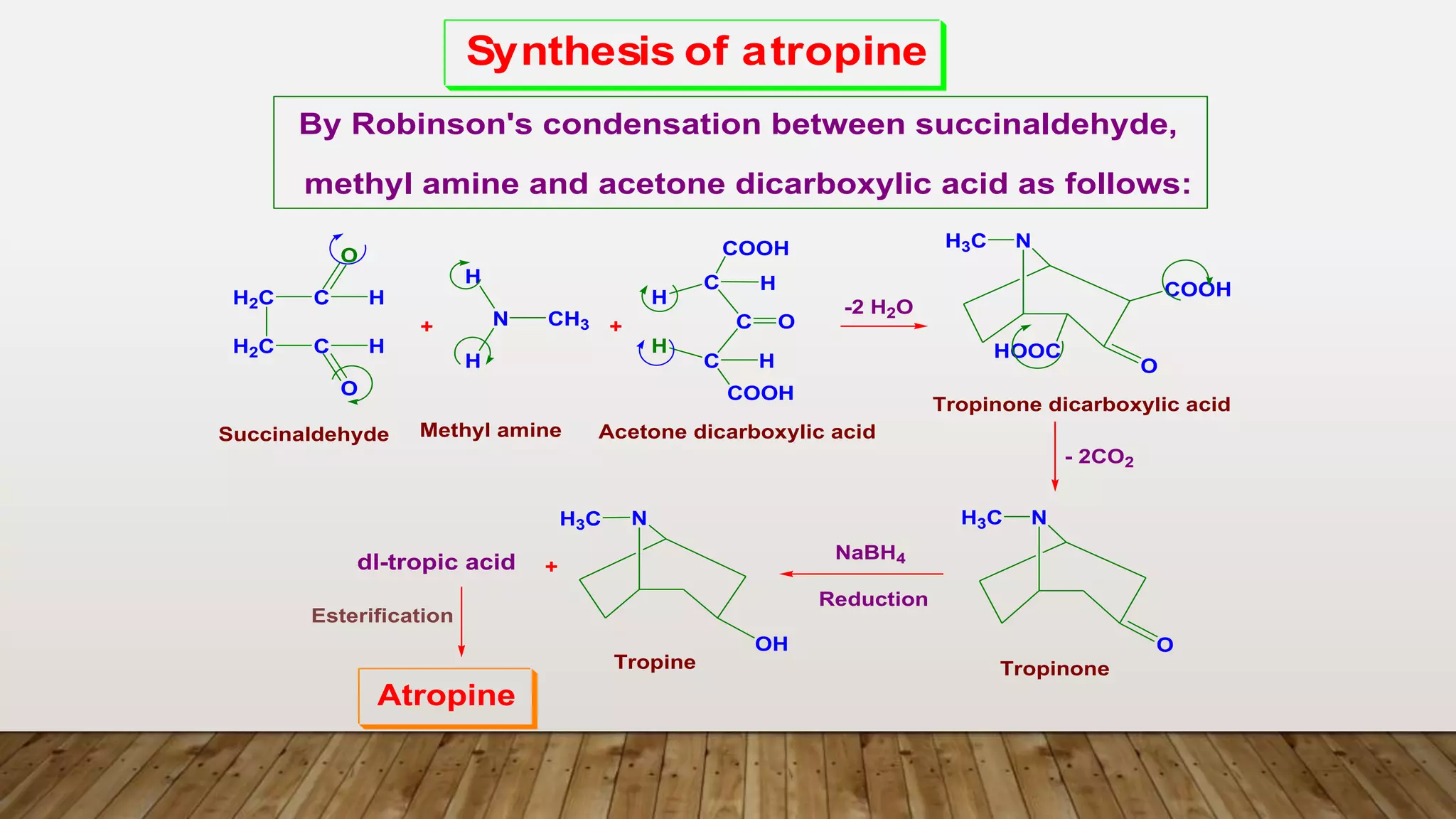
By Robinson's condensation between succinaldehyde,
Synthesis of atropine
H2C
H2C C
C
O
O
H
H
N CH3
H
H
H
H
C
C
C
COOH
H
COOH
H
N
H3C
COOH
HOOC
O
+ +
N
H3C
O
N
H3C
OH
O
dl-tropic acid
Atropine
+
-2 H2O
NaBH4
Succinaldehyde Methyl amine Acetone dicarboxylic acid
Tropinone dicarboxylic acid
Tropinone
Tropine
Reduction
Esterification
- 2CO2
methyl amine and acetone dicarboxylic acid as follows:
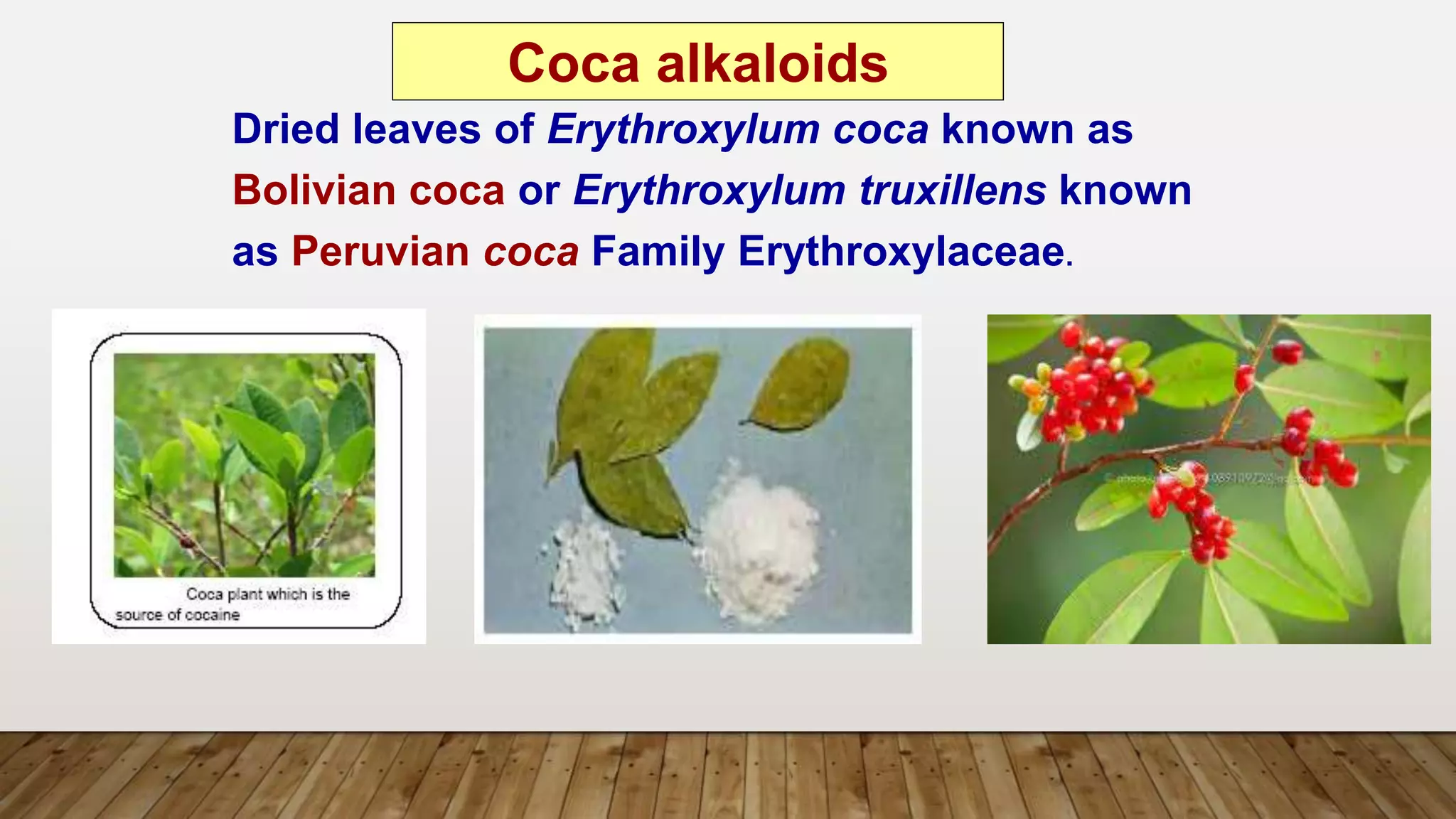
Dried leaves of Erythroxylum coca known as
Bolivian coca or Erythroxylum truxillens known
as Peruvian coca Family Erythroxylaceae.
Coca alkaloids
* Coca alkaloids are classified according to the chemical
structures into 3 basic types:
1) Ecgonine derivatives (2-carboxy-tropine). [base of Cocaine]
e.g. Cocaine, Cinnamyl Cocaine and a- and b-Truxillines.
2) Psudotropin derivatives e.g. Tropacocaine and Velerine.
3) Pyrrolidine derivatives e.g. Hygrine
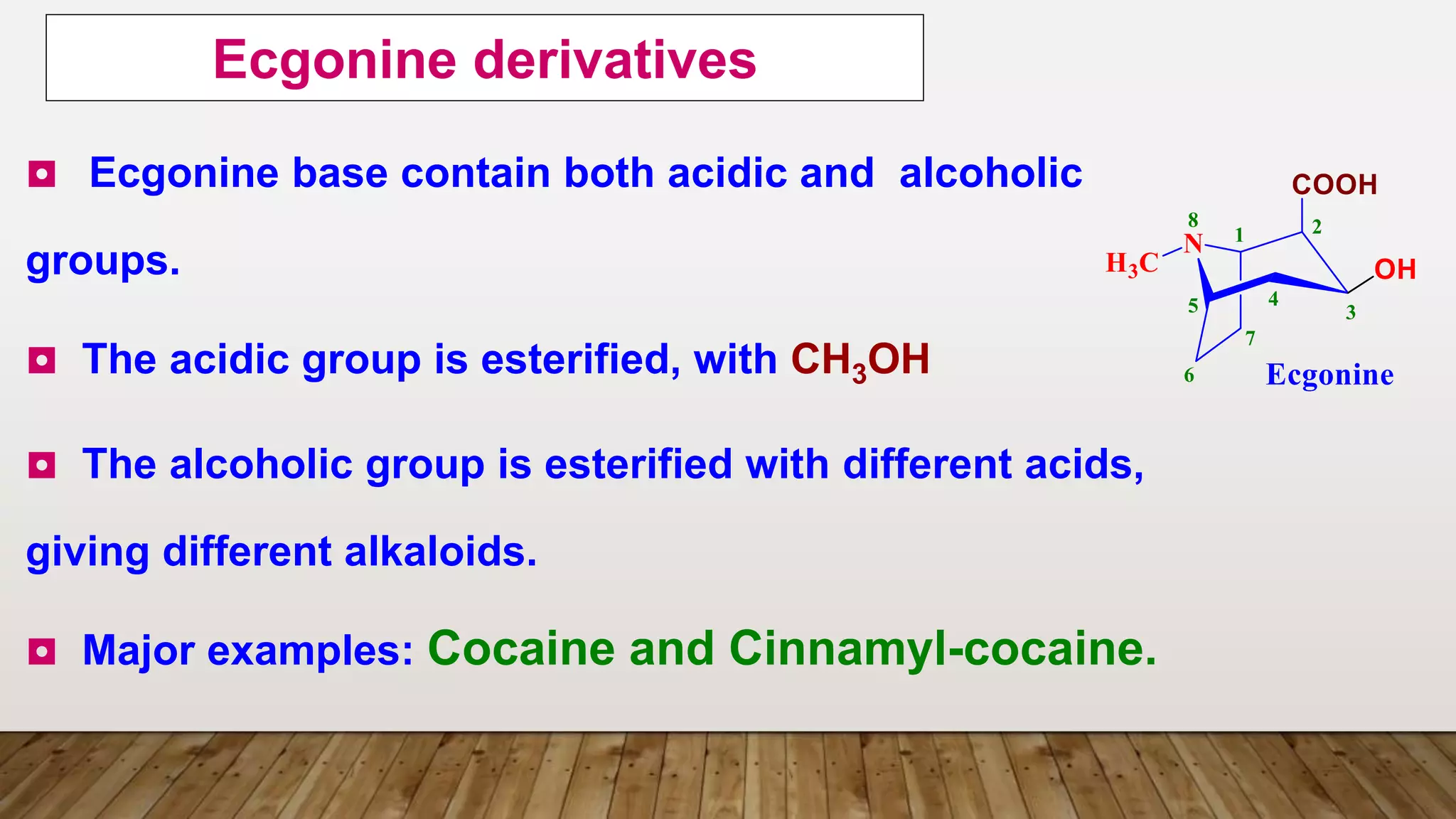
◘ Ecgonine base contain both acidic and alcoholic
groups.
◘ The acidic group is esterified, with CH3OH
◘ The alcoholic group is esterified with different acids,
giving different alkaloids.
◘ Major examples: Cocaine and Cinnamyl-cocaine.
Ecgonine derivatives
N
H3C C
O
OCH3
O
C O
N
H3C C
O
OCH3
O
Cinnamoylcocaine
O
Cocaine
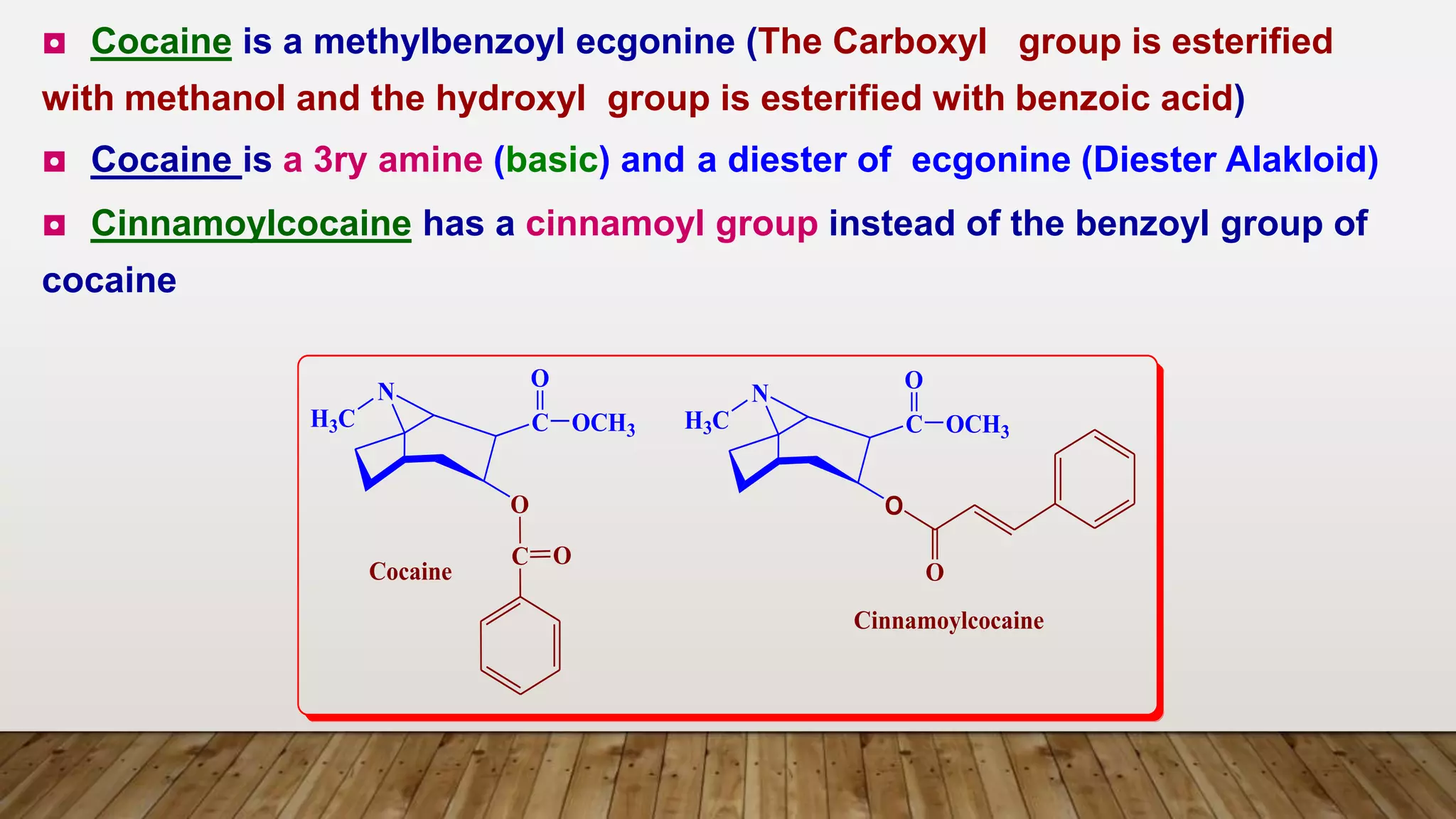
◘ Cocaine is a methylbenzoyl ecgonine (The Carboxyl group is esterified
with methanol and the hydroxyl group is esterified with benzoic acid)
◘ Cocaine is a 3ry amine (basic) and a diester of ecgonine (Diester Alakloid)
◘ Cinnamoylcocaine has a cinnamoyl group instead of the benzoyl group of
cocaine
Isolation of Cocaine
(from Peruvian coca leaves)
◘ Most cocaine manufacture continues to take place in Bolivia,
Colombia and Peru. Together these countries report the
majority
of cocaine.
◘ Digest the leaves with lime or Na2CO3 solution and extracting
with petroleum ether.
◘ The alkaloid is then extracted by dil. HCl
◘ The acidic solution is conc., where crystals of cocaine
HCl are obtained.
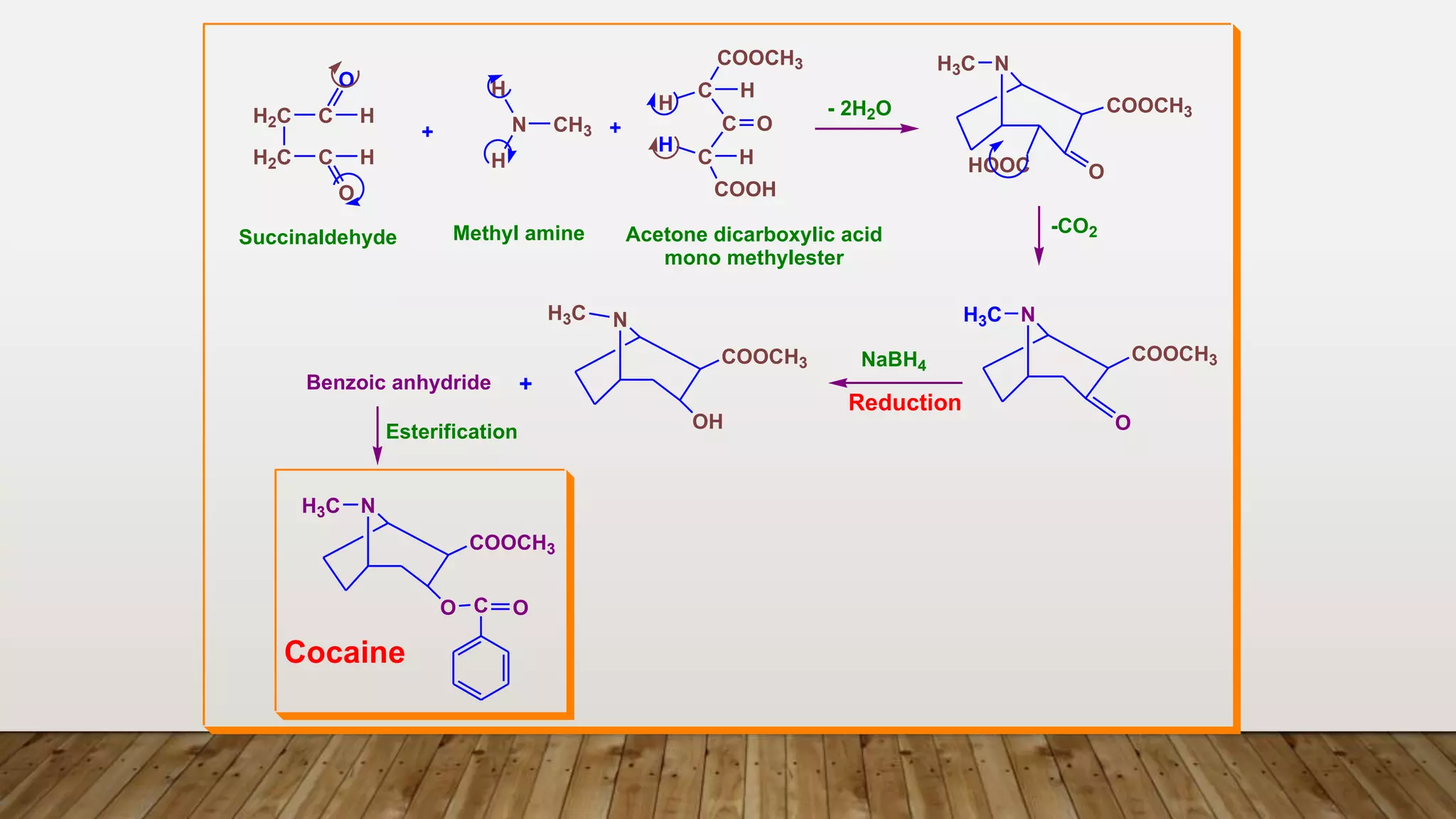
By Robinson’s condensation
between Succinaldehyde + Methyl amine +
Acetone dicarboxylic acid methyl ester
as follows:
Synthesis of Cocaine
H2C
H2C C
C
O
O
H
H N CH3
H
H
H
H
C
C
C
COOCH3
H
COOH
H
N
H3C
COOCH3
HOOC O
N
H3C
O
N
H3C
OH
O
- 2H2O
NaBH4
COOCH3
COOCH3
N
H3C
O
COOCH3
C O
+ +
Benzoic anhydride +
Succinaldehyde Methyl amine Acetone dicarboxylic acid
mono methylester
Reduction
Esterification
Cocaine
-CO2
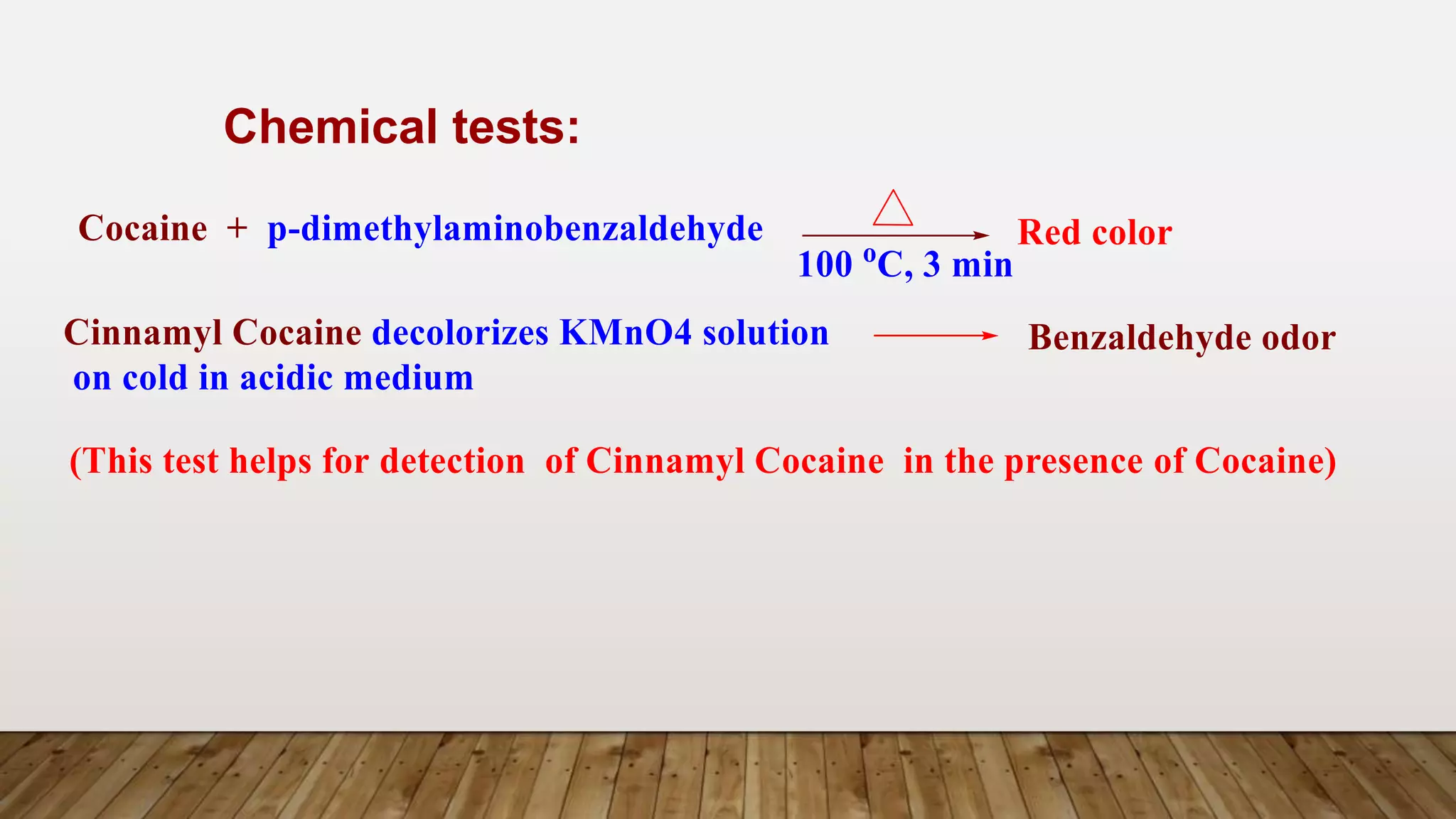
Chemical tests:
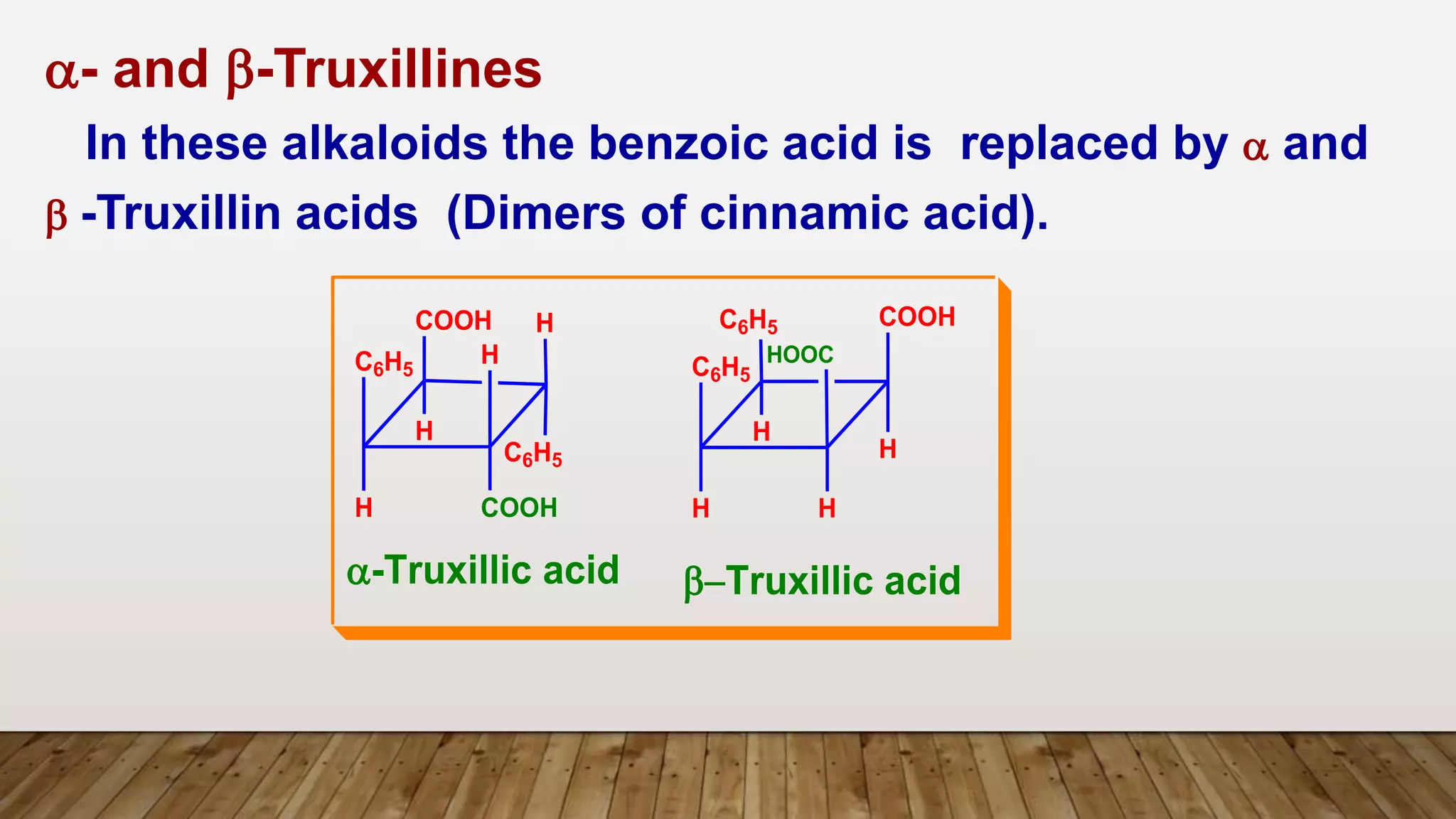
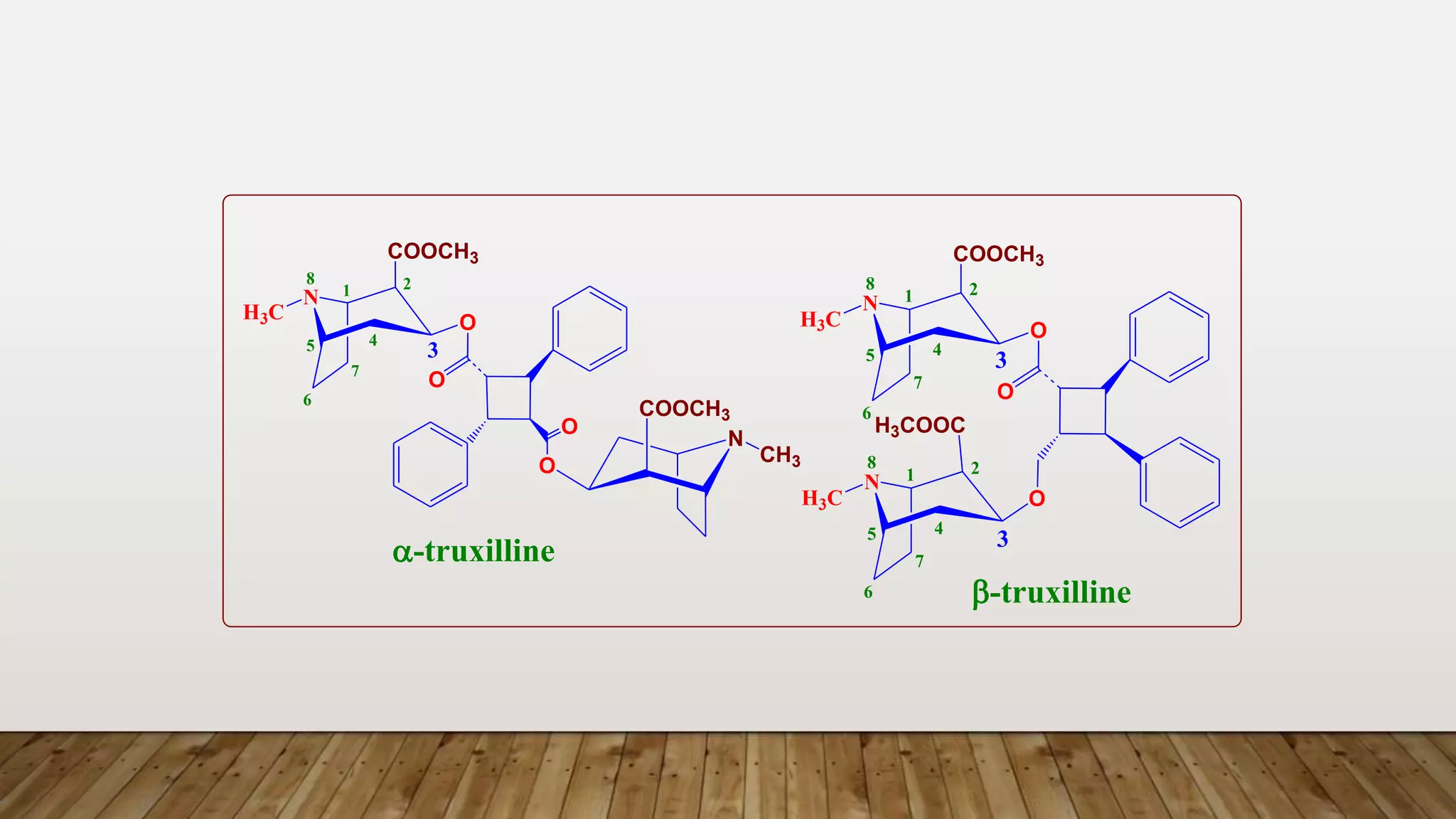
a- and b-Truxillines
In these alkaloids the benzoic acid is replaced by a and
b -Truxillin acids (Dimers of cinnamic acid).
C6H5
H
COOH H
H
C6H5
H
COOH
C6H5
H
C6H5 COOH
H
H
HOOC
H
a-Truxillic acid bTruxillic acid
N
H3C
1 2
3
4
5
6
7
8
O
COOCH3
O
O
O
N
COOCH3
CH3
N
H3C
1 2
3
4
5
6
7
8
O
COOCH3
O
N
H3C
1 2
3
4
5
6
7
8
O
H3COOC
a-truxilline
b-truxilline
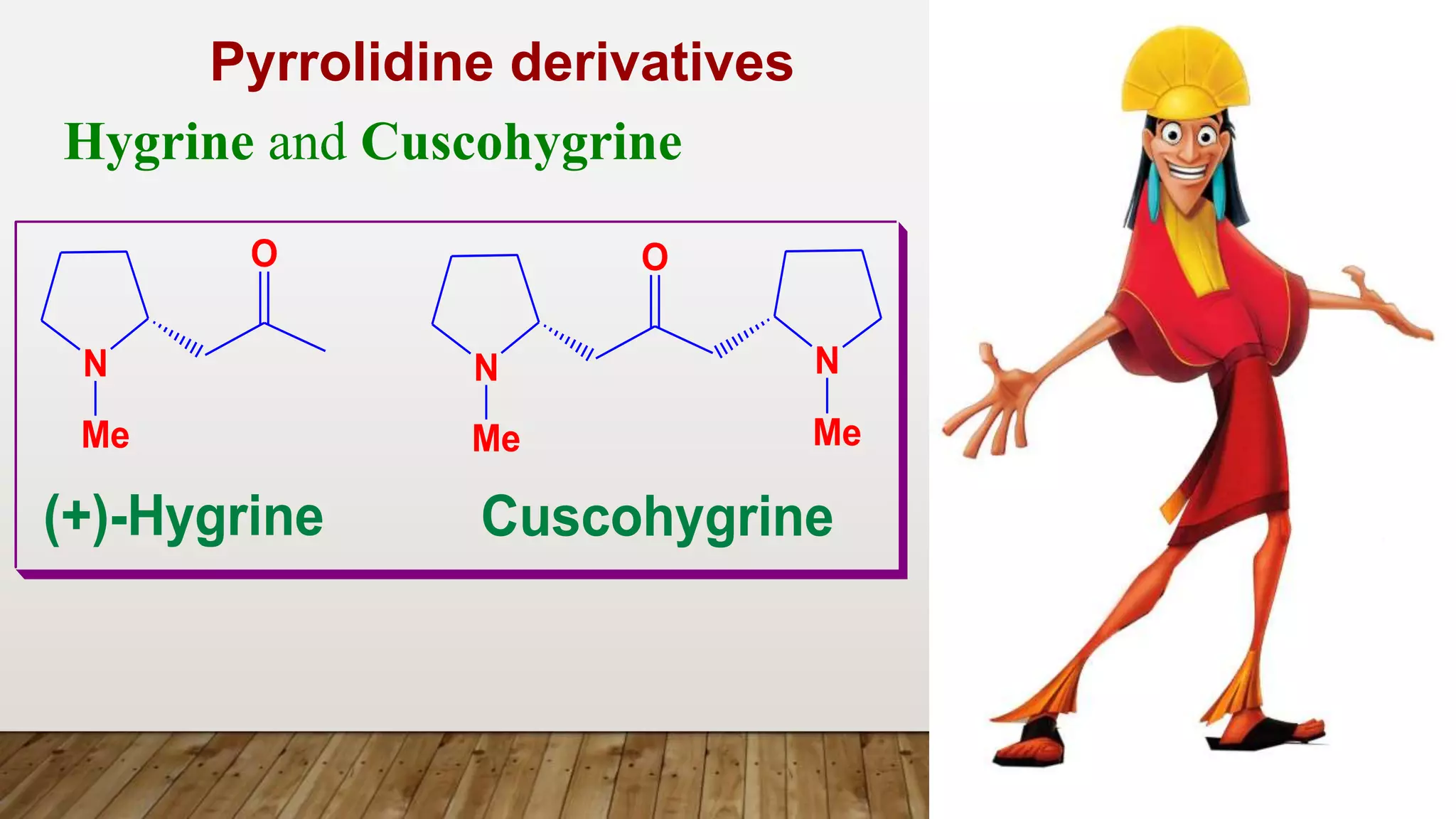
Pyrrolidine derivatives
Hygrine and Cuscohygrine
N
O
Me
(+)-Hygrine
N
O
Me
N
Me
Cuscohygrine
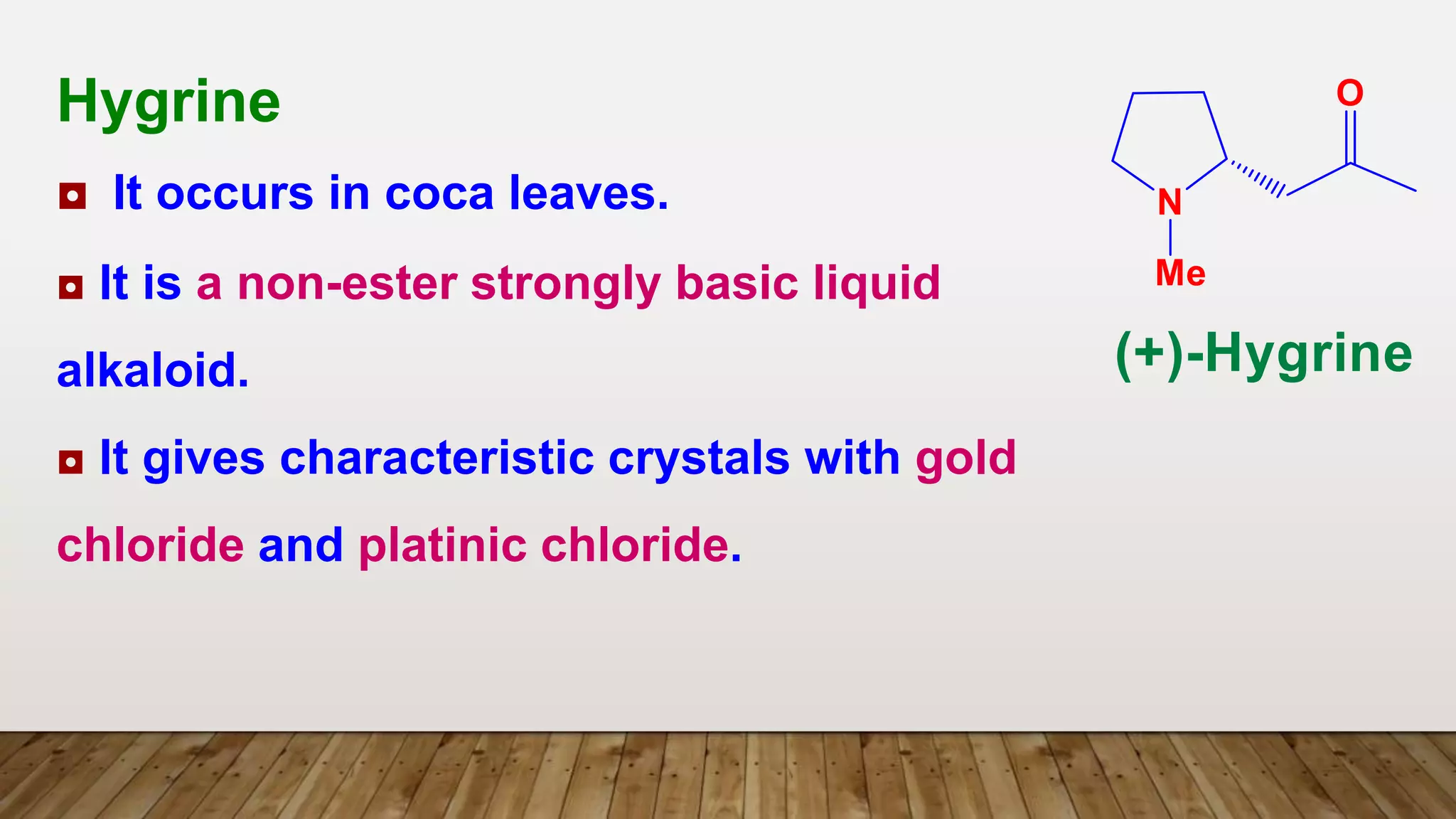
Hygrine
◘ It occurs in coca leaves.
◘ It is a non-ester strongly basic liquid
alkaloid.
◘ It gives characteristic crystals with gold
chloride and platinic chloride.
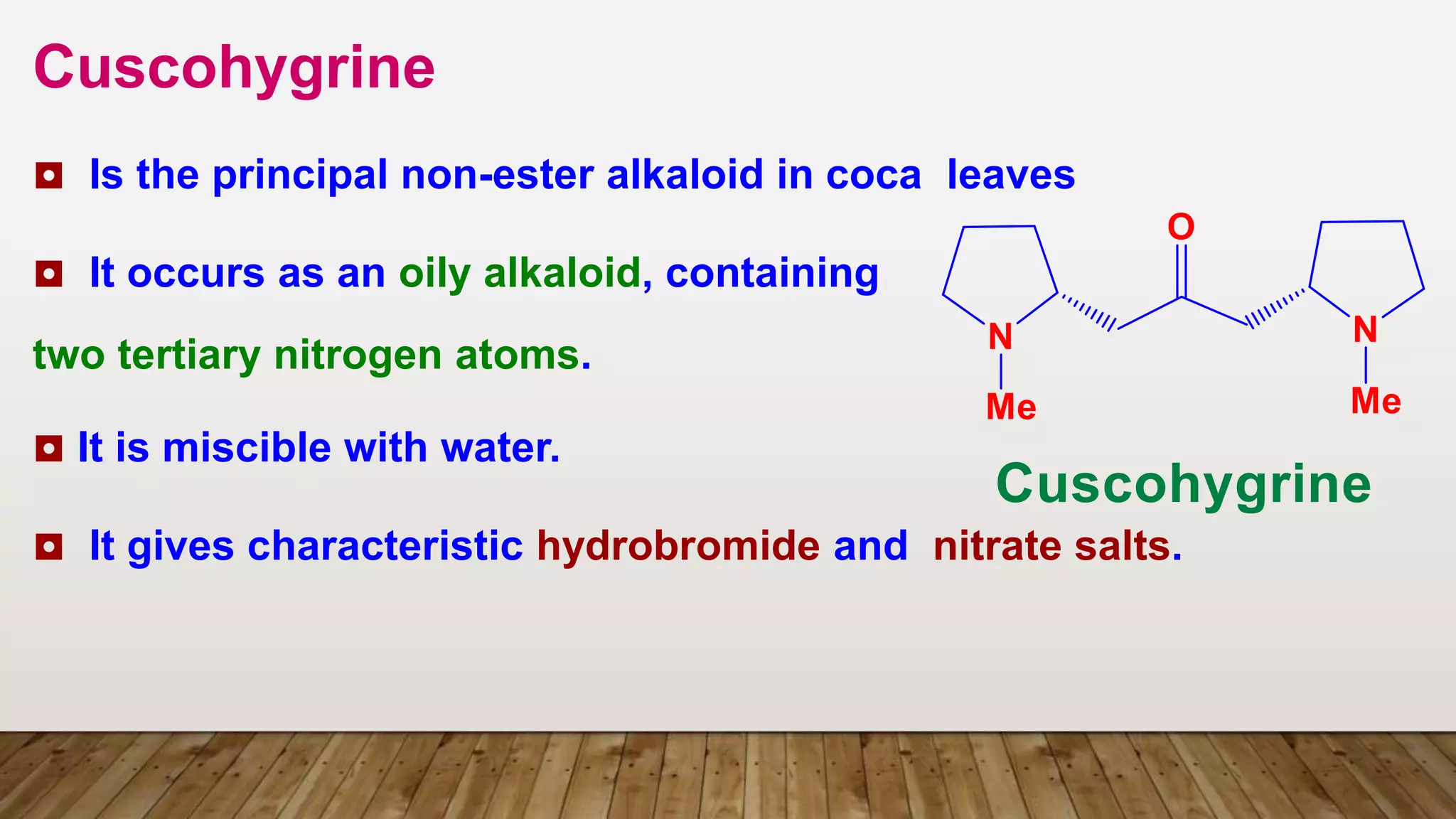
Cuscohygrine
◘ Is the principal non-ester alkaloid in coca leaves
◘ It occurs as an oily alkaloid, containing
two tertiary nitrogen atoms.
◘ It is miscible with water.
◘ It gives characteristic hydrobromide and nitrate salts.
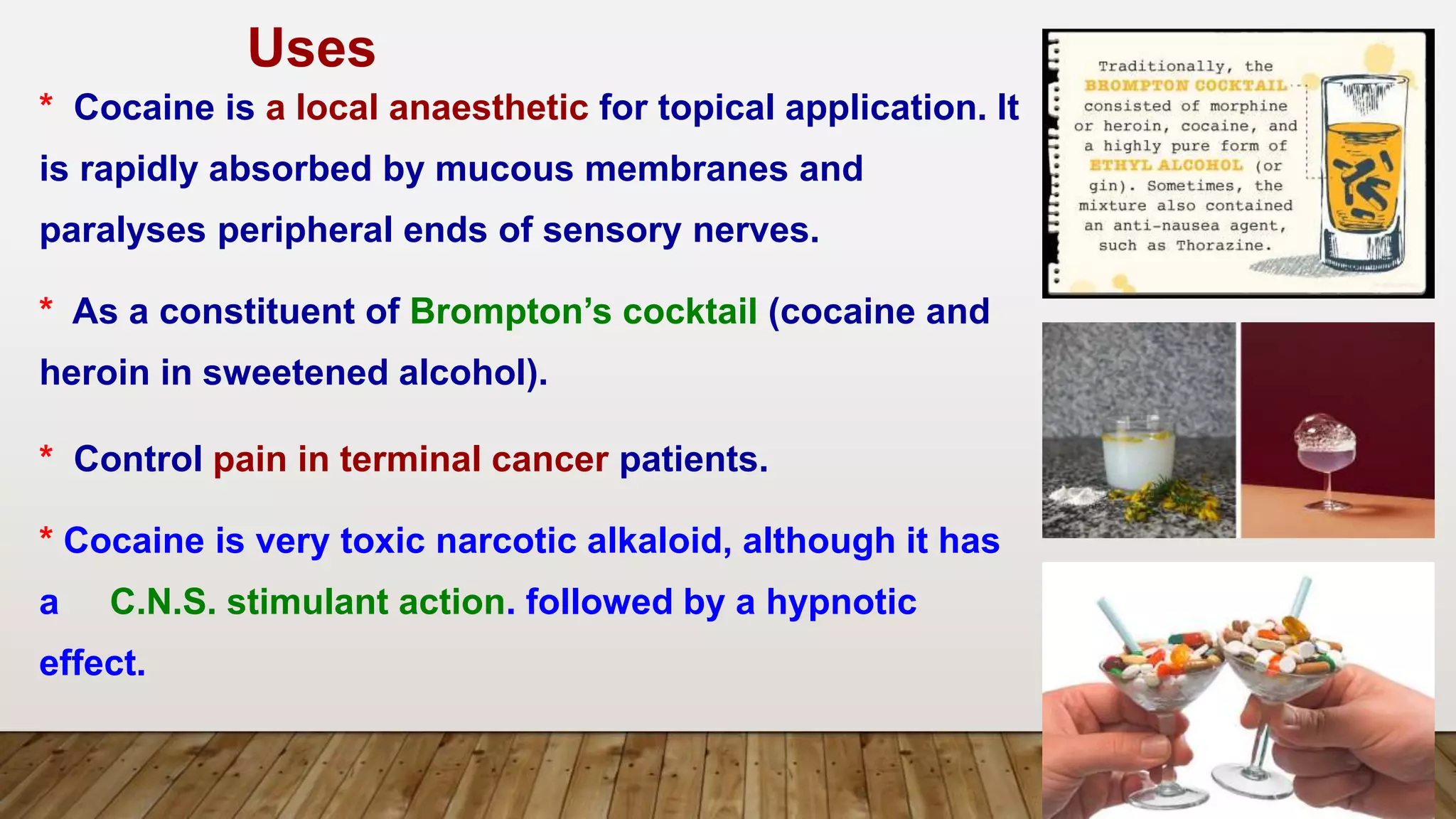
* Cocaine is a local anaesthetic for topical application. It
is rapidly absorbed by mucous membranes and
paralyses peripheral ends of sensory nerves.
* As a constituent of Brompton’s cocktail (cocaine and
heroin in sweetened alcohol).
* Control pain in terminal cancer patients.
* Cocaine is very toxic narcotic alkaloid, although it has
a C.N.S. stimulant action. followed by a hypnotic
effect.
Uses
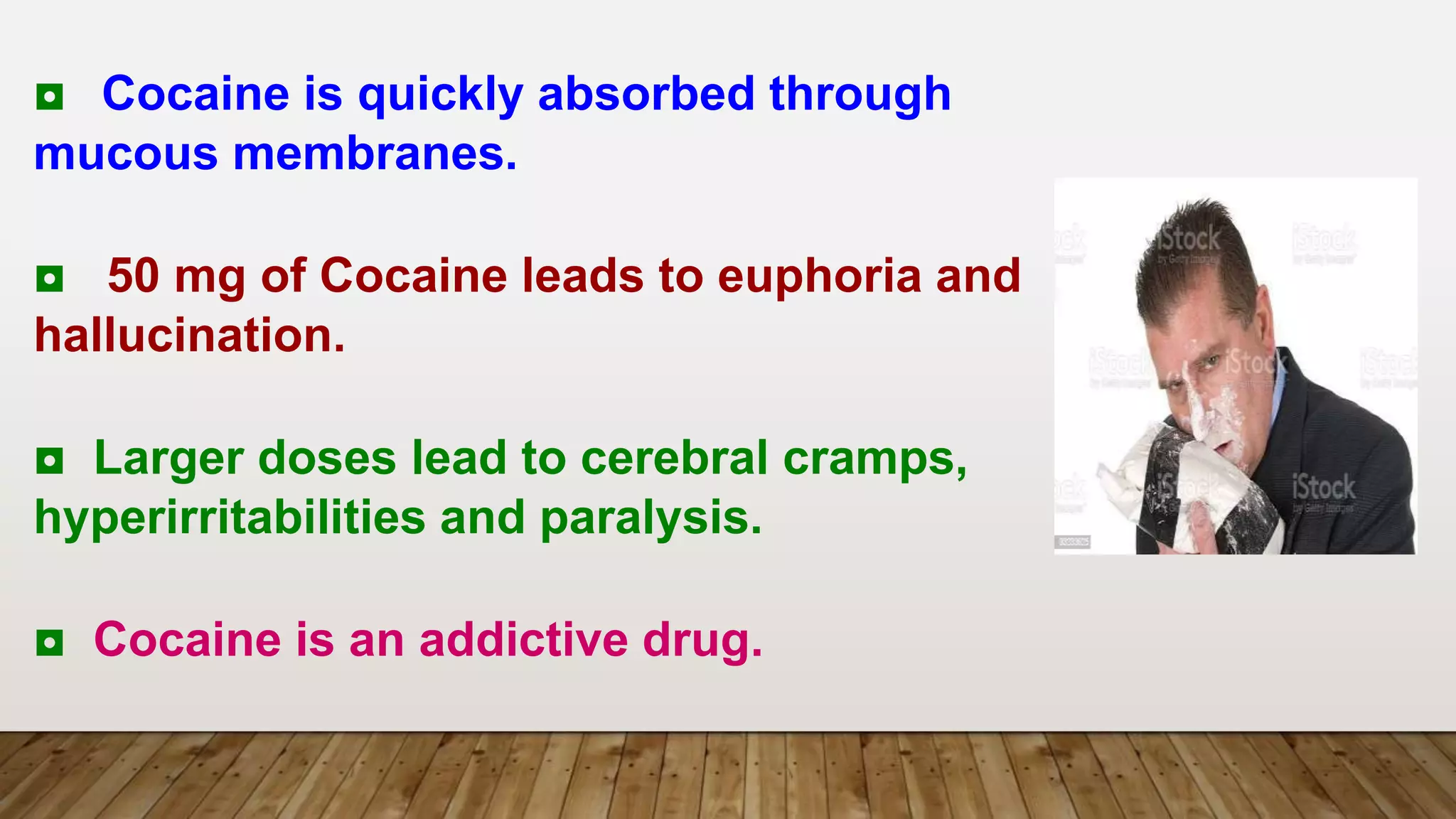
◘ Cocaine is quickly absorbed through
mucous membranes.
◘ 50 mg of Cocaine leads to euphoria and
hallucination.
◘ Larger doses lead to cerebral cramps,
hyperirritabilities and paralysis.
◘ Cocaine is an addictive drug.
5-Tropane_Akaloids_.pptx

5-Tropane_Akaloids_.pptx

  • 1.
    TROPANE ALKALOIDS Assoc. Prof.Dr. Mostafa Mahmoud Hegazy
  • 2.
     content  Solanaceousalkaloids (Atropine, Hyoscyamine and Hyoscine).  Coca alkaloids (Cocaine, Cinnamyl cocaine and α- and β-truxillines).
  • 3.
    ALKALOIDS DERIVED FROMORNITHINE AMINO ACID L-Ornithine NH2 NH2 COOH Tropane Alkaloids
  • 4.
    Tropane Alkaloids Tropane isa bicyclic, 7-membered compound formed by the condensation of Pyrrolidine and Piperidine with one nitrogen atom. Piperidine N H Pyrrolidine (C4N) N H Tropane N CH3
  • 5.
  • 6.
  • 7.
  • 8.
  • 9.
    L-Ornithine NH2 NH2 COOH Tropane N N H3C 1 2 3 4 5 6 7 CH3 = ◘ Tropane nucleusis a seven carbon bicyclic ring. nitrogen bridge is between Carbons 1 and 5
  • 10.
    ◘ Tropane alkaloidsare ester alkaloids, formed by esterification of an alcoholic base with specific organic acid. ◘ Being esters, they are unstable towards acid and alkali and are thermolabile.
  • 11.
    Alcoholic bases inTropane Alkaloids
  • 13.
    Esterifying acids inTropane Alkaloids * Tropic acid (a-phenyl-b-hydroxyl-propionic acid) * The optically active (l-form) occurs in Hyoscyamine and Hyoscine. * The optically inactive (Racemic mixture) [dl-form) occurs in Atropine
  • 14.
    Esterifying acids inTropane Alkaloids
  • 15.
    Examples of Tropanealakloids 1) Solanaceous alkaloids e.g. Atropine, Hyoscyamine and Hyoscine. 2) Coca alkaloids e.g. Cocaine, Cinnamyl cocaine and α- and β-truxillines.
  • 16.
    1) Atropa belladonna(Belladonna Leaves). 2) Datura stramonium (Thornapple). 3) Hyoscyamus niger (European henbane) 4) Hyoscyamus muticus (Egyptian henbane) SOLANACEOUS ALKALOIDS
  • 17.
    Solanaceous Alkaloids N O Me O H CH2OH (-)-Hyoscyamine N O O CH2OH Me Atropine During acid–base extraction, hyoscyamine tends to racaemise forming atropine i.e. (±)- hyoscyamine.  Indeed, the benzylic chiral center in the tropic acid moiety can be epimerised by action of heat and bases (Rosemblum and Taylor, 1955).
  • 18.
    Number of atropinechiral center(s)? N O O CH2OH Me Atropine  The ring is symmetric so all three carbon centers shown in are not chiral.  The sole chiral center is the α-carbon to carbonyl group.  Atropine is optically inactive due to intermolecular compensation (i.e. racemic modification).
  • 19.
    Hyoscine Hyoscyamine Atropine (dl- Hyoscyamine) Is opticallyactive, levorotatory (l-form) It is a syrupy liquid It has the same structure of Atropine but differs in having an optically active l-tropic acid moiety. It dose not occur naturally in the plant. It results from racemization of the naturally occurring l- Hyoscyamine during extraction. It hydrolyzed by dil. acid or alkali to yield l-tropic acid + Scopoline base It hydrolyzed by dil. Acid or alkali to yield l-tropic acid + tropine base It hydrolyzed by dil. Acid or alkali to yield dl-tropic acid + tropine base It converted to Atropine by keeping its alcoholic solution in the presence of dil. acid or alkali
  • 20.
    Hyoscine Hyoscyamine Atropine ( - )l ( - ) l (±) dl Optical activity. Naturally occurring. Naturally occurring. Not naturally occurring. Occurance Liquid. Solid. Solid. Condition l- tropic acid + scopoline base l- tropic acid + tropine base dl- tropic + tropine base Hydrolysis - Soluble. Insol. in Acetone: Ether (1:1) Oxalate Salt Weak base Strong base Strong base Basicity
  • 21.
    USES of Atropine ◘Atropine sulfate has an anti-cholinergic effect (parasympatholytic activity). ◘ A mydriatic (causes dilatation of the eye pupil). ◘ An antispasmodic (relaxes the intestinal and bronchial smooth muscles). ◘ A preanesthetic medication to stop body secretions. ◘ A CNS stimulant. ◘ An antidote to organophosphorus insecticides.
  • 22.
    ◘ The actionof Scopolamine (Hyoscine) differs from that of Atropine and Hyoscyamine in that there is No central nervous system stimulation. ◘ Hyoscine HBr is commonly used in as antispasmodic, sedative, and CNS depressant. USES of Scopolamine (Hyoscine)
  • 23.
    CNS effect ofthe plant vs major isolated Alkaloid(s)?!!! Belladonna, Datura and Hyoscyamus vs Atropine and Hyoscyamine
  • 24.
    Isolation of solanaceousalkaloids Atropine, Hyoscyamine and Hyoscine Principle ◘ Separation of hyoscine from both atropine and hyoscyamine depends on the difference in their basicity. Hyoscine is a weaker base. ◘ Separation of atropine from hyoscyamine is based on the difference in the solubility of their oxalates in a mixture of acetone and ether
  • 26.
    The concentration determinedby comparison of the observed optical rotation with the known specific rotation.
  • 27.
    Chemical tests ofTropane Alkaloids Vitali-Morin’s Test: * 1 mg of alkaloid + Fuming HNO3 * Evaporated to dryness on a water bath Yellow residue * Cooled * Add few drops of 3% alc. KOH solution Bright purple or Violet color
  • 28.
    Hyoscine Hyoscyamine Atropine Red White ppt. Green. Red Red Red coloron heating. Green Red Bright purple Red color. Green Red Chemical Tests: Vitali's Test: Gerard Test sol. + HgCl2 Schder's Test 30 vol. H2O2 + Conc.H2SO4 PDMAB. + alkaloidal residue
  • 29.
    By Robinson's condensationbetween succinaldehyde, Synthesis of atropine H2C H2C C C O O H H N CH3 H H H H C C C COOH H COOH H N H3C COOH HOOC O + + N H3C O N H3C OH O dl-tropic acid Atropine + -2 H2O NaBH4 Succinaldehyde Methyl amine Acetone dicarboxylic acid Tropinone dicarboxylic acid Tropinone Tropine Reduction Esterification - 2CO2 methyl amine and acetone dicarboxylic acid as follows:
  • 30.
    Dried leaves ofErythroxylum coca known as Bolivian coca or Erythroxylum truxillens known as Peruvian coca Family Erythroxylaceae. Coca alkaloids
  • 32.
    * Coca alkaloidsare classified according to the chemical structures into 3 basic types: 1) Ecgonine derivatives (2-carboxy-tropine). [base of Cocaine] e.g. Cocaine, Cinnamyl Cocaine and a- and b-Truxillines. 2) Psudotropin derivatives e.g. Tropacocaine and Velerine. 3) Pyrrolidine derivatives e.g. Hygrine
  • 33.
    ◘ Ecgonine basecontain both acidic and alcoholic groups. ◘ The acidic group is esterified, with CH3OH ◘ The alcoholic group is esterified with different acids, giving different alkaloids. ◘ Major examples: Cocaine and Cinnamyl-cocaine. Ecgonine derivatives
  • 34.
    N H3C C O OCH3 O C O N H3CC O OCH3 O Cinnamoylcocaine O Cocaine ◘ Cocaine is a methylbenzoyl ecgonine (The Carboxyl group is esterified with methanol and the hydroxyl group is esterified with benzoic acid) ◘ Cocaine is a 3ry amine (basic) and a diester of ecgonine (Diester Alakloid) ◘ Cinnamoylcocaine has a cinnamoyl group instead of the benzoyl group of cocaine
  • 35.
    Isolation of Cocaine (fromPeruvian coca leaves) ◘ Most cocaine manufacture continues to take place in Bolivia, Colombia and Peru. Together these countries report the majority of cocaine. ◘ Digest the leaves with lime or Na2CO3 solution and extracting with petroleum ether. ◘ The alkaloid is then extracted by dil. HCl ◘ The acidic solution is conc., where crystals of cocaine HCl are obtained.
  • 36.
    By Robinson’s condensation betweenSuccinaldehyde + Methyl amine + Acetone dicarboxylic acid methyl ester as follows: Synthesis of Cocaine
  • 37.
    H2C H2C C C O O H H NCH3 H H H H C C C COOCH3 H COOH H N H3C COOCH3 HOOC O N H3C O N H3C OH O - 2H2O NaBH4 COOCH3 COOCH3 N H3C O COOCH3 C O + + Benzoic anhydride + Succinaldehyde Methyl amine Acetone dicarboxylic acid mono methylester Reduction Esterification Cocaine -CO2
  • 38.
  • 39.
    a- and b-Truxillines Inthese alkaloids the benzoic acid is replaced by a and b -Truxillin acids (Dimers of cinnamic acid). C6H5 H COOH H H C6H5 H COOH C6H5 H C6H5 COOH H H HOOC H a-Truxillic acid bTruxillic acid
  • 40.
  • 41.
    Pyrrolidine derivatives Hygrine andCuscohygrine N O Me (+)-Hygrine N O Me N Me Cuscohygrine
  • 42.
    Hygrine ◘ It occursin coca leaves. ◘ It is a non-ester strongly basic liquid alkaloid. ◘ It gives characteristic crystals with gold chloride and platinic chloride.
  • 43.
    Cuscohygrine ◘ Is theprincipal non-ester alkaloid in coca leaves ◘ It occurs as an oily alkaloid, containing two tertiary nitrogen atoms. ◘ It is miscible with water. ◘ It gives characteristic hydrobromide and nitrate salts.
  • 44.
    * Cocaine isa local anaesthetic for topical application. It is rapidly absorbed by mucous membranes and paralyses peripheral ends of sensory nerves. * As a constituent of Brompton’s cocktail (cocaine and heroin in sweetened alcohol). * Control pain in terminal cancer patients. * Cocaine is very toxic narcotic alkaloid, although it has a C.N.S. stimulant action. followed by a hypnotic effect. Uses
  • 45.
    ◘ Cocaine isquickly absorbed through mucous membranes. ◘ 50 mg of Cocaine leads to euphoria and hallucination. ◘ Larger doses lead to cerebral cramps, hyperirritabilities and paralysis. ◘ Cocaine is an addictive drug.