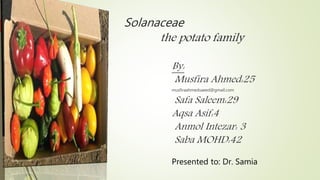
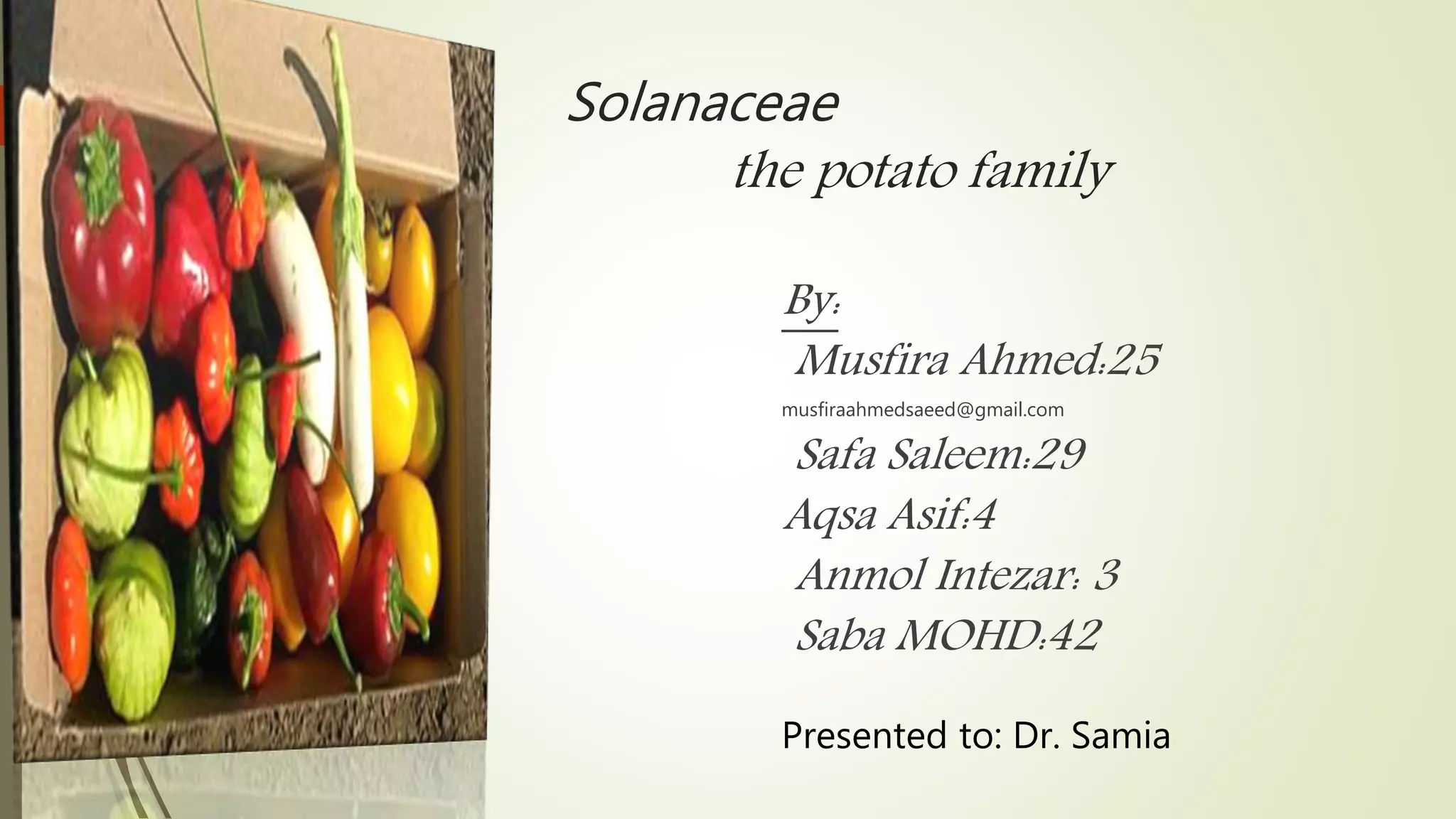
Solanaceae
the potato family
By:
Musfira Ahmed:25
musfiraahmedsaeed@gmail.com
Safa Saleem:29
Aqsa Asif:4
Anmol Intezar: 3
Saba MOHD:42
Presented to: Dr. Samia
 Introduction:
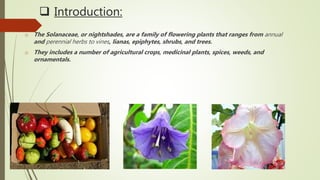
o The Solanaceae, or nightshades, are a family of flowering plants that ranges from annual
and perennial herbs to vines, lianas, epiphytes, shrubs, and trees.
o They includes a number of agricultural crops, medicinal plants, spices, weeds, and
ornamentals.
 Distribution
This family has about
 Genra. 90
 Species. 2000
 14 genra and 52 species are present in Pakistan (tropical and
temperate areas)
 Indigenous plant ::south Africa
 Natural plant ::east west asia
 Maim area in Pakistan : muzaffarbad. Karach, kashmir
 Members of solanaceae have mostly worldwide distribution
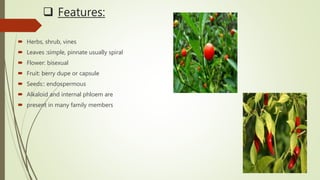
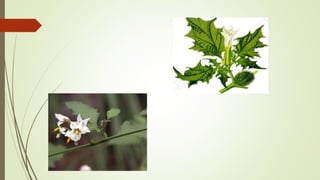
 Features:
 Herbs, shrub, vines
 Leaves :simple, pinnate usually spiral
 Flower: bisexual
 Fruit: berry dupe or capsule
 Seeds:: endospermous
 Alkaloid and internal phloem are
 present in many family members
 Economical uses
 Many members are cultivated for their alkaloid content eg. tobacco
 Various members are also grown as ornamentals
 Many members are edible such as capsicum, solanum tuberosum
 Various have medicinal properties eg. atropine
 Used as Deadly poison eg. datura
 Used as noxious weeds
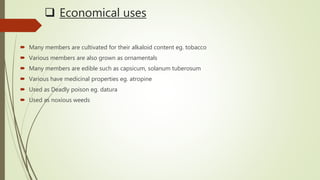
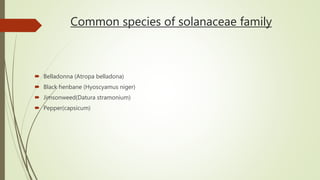
Common species of solanaceae family
 Belladonna (Atropa belladona)
 Black henbane (Hyoscyamus niger)
 Jimsonweed(Datura stramonium)
 Pepper(capsicum)
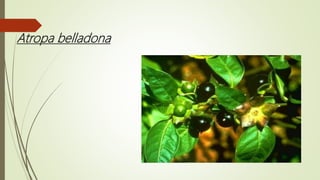
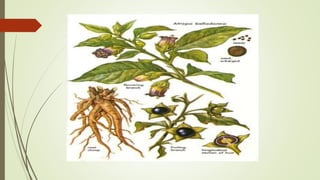
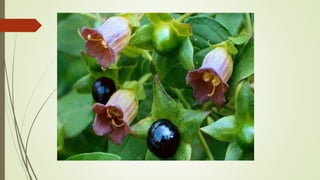
Atropa belladona
Atropa Belladonna commonly known as belladonna or
deadly night shade
❑ Synonyms:
Belladonna leaf, Belladonna herb.
❑ Biological source:
It consist of dried leaves and other parts of
atropa belladonna linn, atropa belladonna and
atropa acuminata.
❑ Family:
Solanaceae.
 Introduction
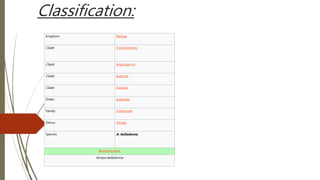
Classification:
Kingdom: Plantae
Clade: Tracheophytes
Clade: Angiosperms
Clade: Eudicots
Clade: Asterids
Order: Solanales
Family: Solanaceae
Genus: Atropa
Species: A. belladonna
Binomial name
Atropa belladonna
 Geographical features
 It is indigenous to and cultivated in England and other European countries.
 In India it is found in the western Himalayas from Shimla to Kashmir and
adjoining areas of Himachal Pradesh.
• Cultivation of belladonna at an altitude of 1400 meter from
sea level found to be satisfactory.
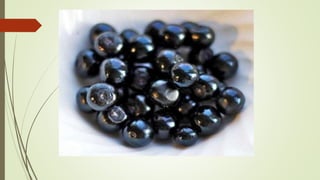
• Belladonna berries are to crushed to get the seeds for the
cultivation.
• Proper processing like washing and sieving is performed.
• The seedling are ready for the transplantation by the end of
September.
• The leaves as well as flowering tops are cut & sundried.
• The yield per hectare is found to be 200 to 600 kg.
 Cultivation & collection
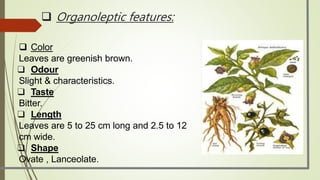
 Color
Leaves are greenish brown.
❑ Odour
Slight & characteristics.
❑ Taste
Bitter.
❑ Length
Leaves are 5 to 25 cm long and 2.5 to 12
cm wide.
❑ Shape
Ovate , Lanceolate.
 Organoleptic features:
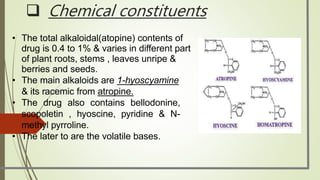
• The total alkaloidal(atopine) contents of
drug is 0.4 to 1% & varies in different part
of plant roots, stems , leaves unripe &
berries and seeds.
• The main alkaloids are 1-hyoscyamine
& its racemic from atropine.
• The drug also contains bellodonine,
scopoletin , hyoscine, pyridine & N-
methyl pyrroline.
• The later to are the volatile bases.
 Chemical constituents
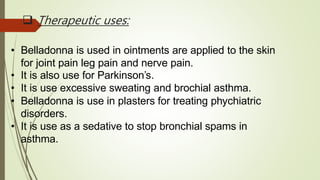
• Belladonna is used in ointments are applied to the skin
for joint pain leg pain and nerve pain.
• It is also use for Parkinson’s.
• It is use excessive sweating and brochial asthma.
• Belladonna is use in plasters for treating phychiatric
disorders.
• It is use as a sedative to stop bronchial spams in
asthma.
 Therapeutic uses:
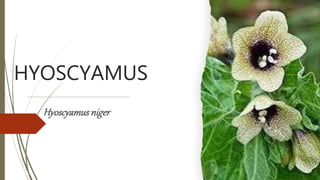
HYOSCYAMUS
Hyoscyamusniger
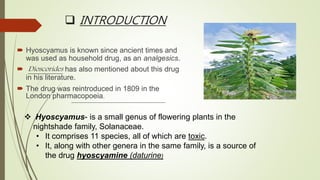
 INTRODUCTION
 Hyoscyamus is known since ancient times and
was used as household drug, as an analgesics.
 Dioscorides has also mentioned about this drug
in his literature.
 The drug was reintroduced in 1809 in the
London pharmacopoeia.
 Hyoscyamus- is a small genus of flowering plants in the
nightshade family, Solanaceae.
• It comprises 11 species, all of which are toxic.
• It, along with other genera in the same family, is a source of
the drug hyoscyamine (daturine)
 Classification:
 Kingdom : Plantae
 Subkingdom : Tracheobionta
 Division : Magnoliophyta
 Class : Magnoliopsida
 Order : Solanales
 Family : Solanaceae
 Genus : Hyoscyamus
 Species : niger
 Binomial name/ Botanical origin:
Hyscyamus niger
 Common names:
 Hyoscyamus herb
 Hyoscyamus leaves
 Henbane/ black henbane
 Stinking nightshade,
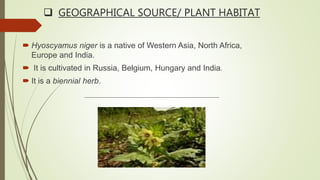
 GEOGRAPHICAL SOURCE/ PLANT HABITAT
 Hyoscyamus niger is a native of Western Asia, North Africa,
Europe and India.
 It is cultivated in Russia, Belgium, Hungary and India.
 It is a biennial herb.
 Cultivation & collection:
 Cultivation is done in temperate region at an altitude of 2400 to
3300m.
 The method of propagation is by seeds. The small seed beds are
raised and seeds are sown.
 The seeds require about two weeks for germination and then are
transplanted in field in the month of May by keeping a distance of half
meter between them and about 75cm between two rows.
 The plants are kept free of weeds and occasional hoeing is also
done.
 Crop is harvested when it reaches the maturity.
 Under all favorable conditions, the yield of the drug per hectare is
1000-1500kg.
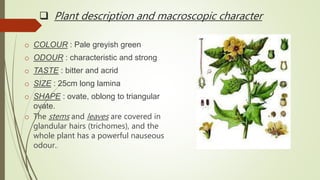
 Plant description and macroscopic character
o COLOUR : Pale greyish green
o ODOUR : characteristic and strong
o TASTE : bitter and acrid
o SIZE : 25cm long lamina
o SHAPE : ovate, oblong to triangular
ovate.
o The stems and leaves are covered in
glandular hairs (trichomes), and the
whole plant has a powerful nauseous
odour..
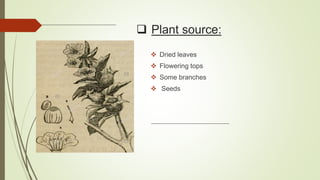
 Plant source:
 Dried leaves
 Flowering tops
 Some branches
 Seeds
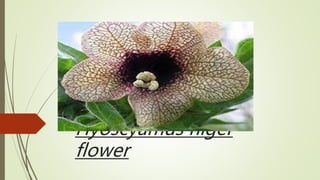
Hyoscyamus niger
flower
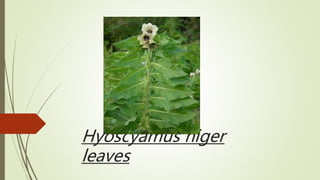
Hyoscyamus niger
leaves
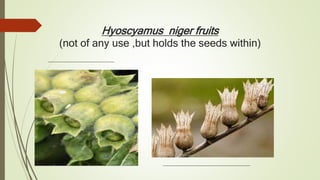
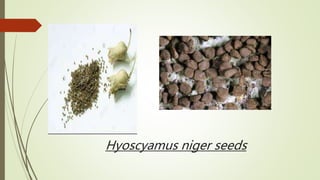
Hyoscyamus niger fruits
(not of any use ,but holds the seeds within)
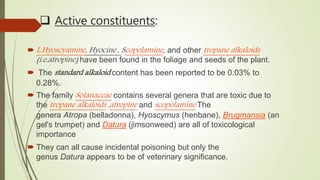
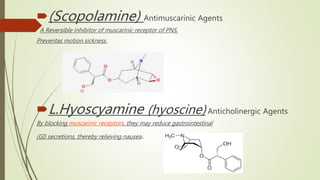
Hyoscyamus niger seeds
 Active constituents:
 L.Hyoscyamine, Hyocine , Scopolamine, and other tropane alkaloids
(i.e,atropine) have been found in the foliage and seeds of the plant.
 The standard alkaloid content has been reported to be 0.03% to
0.28%.
 The family Solanaceae contains several genera that are toxic due to
the tropane alkaloids ,atropine and scopolamine.The
genera Atropa (belladonna), Hyoscymus (henbane), Brugmansia (an
gel's trumpet) and Datura (jimsonweed) are all of toxicological
importance
 They can all cause incidental poisoning but only the
genus Datura appears to be of veterinary significance.
(Scopolamine) Antimuscarinic Agents
A Reversible inhibitor of muscarinic receptor of PNS.
Preventas motion sickness.
L.Hyoscyamine (hyoscine) Anticholinergic Agents
By blocking muscarinic receptors, they may reduce gastrointestinal
(GI) secretions, thereby relieving nausea.
 Therapeutical uses:
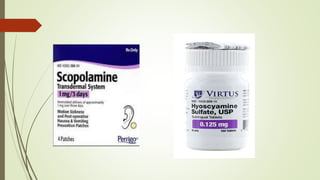
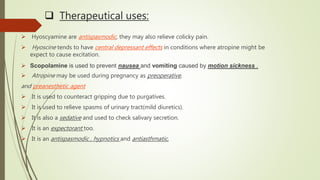
 Hyoscyamine are antispasmodic, they may also relieve colicky pain.
 Hyoscine tends to have central depressant effects in conditions where atropine might be
expect to cause excitation.
 Scopolamine is used to prevent nausea and vomiting caused by motion sickness .
 Atropine may be used during pregnancy as preoperative,
and preanesthetic agent
 It is used to counteract gripping due to purgatives.
 It is used to relieve spasms of urinary tract(mild diuretics).
 It is also a sedative and used to check salivary secretion.
 It is an expectorant too.
 It is an antispasmodic , hypnotics and antiasthmatic.
 TRADITIONALLY : used as an anti- inflammatory drug
 IN AYURVEDA : as an antparkinsons drug
DOSAGE: Hyoscyamine sulphate – 0.125mg tablet
,3-4times a day.
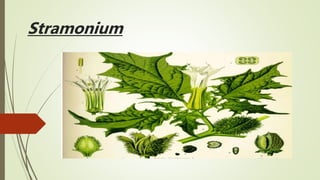
Stramonium
 History
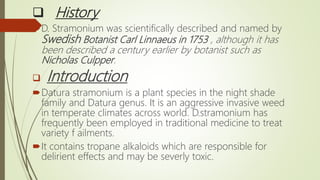
D. Stramonium was scientifically described and named by
Swedish Botanist Carl Linnaeus in 1753 , although it has
been described a century earlier by botanist such as
Nicholas Culpper.
 Introduction
Datura stramonium is a plant species in the night shade
family and Datura genus. It is an aggressive invasive weed
in temperate climates across world. D.stramonium has
frequently been employed in traditional medicine to treat
variety f ailments.
It contains tropane alkaloids which are responsible for
delirient effects and may be severly toxic.
Common names of stramonium
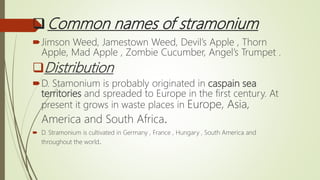
Jimson Weed, Jamestown Weed, Devil’s Apple , Thorn
Apple, Mad Apple , Zombie Cucumber, Angel’s Trumpet .
Distribution
D. Stamonium is probably originated in caspain sea
territories and spreaded to Europe in the first century. At
present it grows in waste places in Europe, Asia,
America and South Africa.
 D. Stramonium is cultivated in Germany , France , Hungary , South America and
throughout the world.
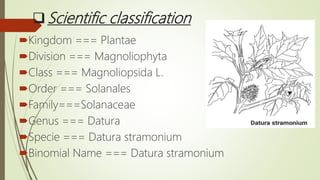
Scientific classification
Kingdom === Plantae
Division === Magnoliophyta
Class === Magnoliopsida L.
Order === Solanales
Family===Solanaceae
Genus === Datura
Specie === Datura stramonium
Binomial Name === Datura stramonium
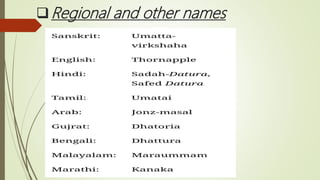
Regional and other names
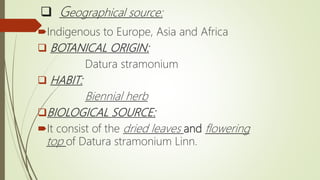
 Geographical source:
Indigenous to Europe, Asia and Africa
 BOTANICAL ORIGIN:
Datura stramonium
 HABIT:
Biennial herb
BIOLOGICAL SOURCE:
It consist of the dried leaves and flowering
top of Datura stramonium Linn.
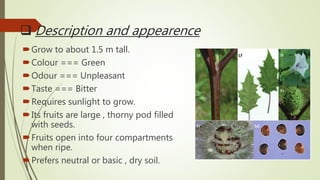
 Description and appearence
Grow to about 1.5 m tall.
Colour === Green
Odour === Unpleasant
Taste === Bitter
Requires sunlight to grow.
Its fruits are large , thorny pod filled
with seeds.
Fruits open into four compartments
when ripe.
Prefers neutral or basic , dry soil.
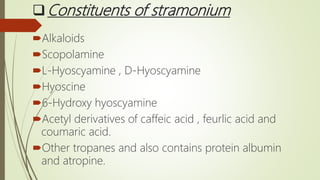
Constituents of stramonium
Alkaloids
Scopolamine
L-Hyoscyamine , D-Hyoscyamine
Hyoscine
6-Hydroxy hyoscyamine
Acetyl derivatives of caffeic acid , feurlic acid and
coumaric acid.
Other tropanes and also contains protein albumin
and atropine.
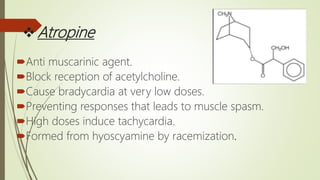
Atropine
Anti muscarinic agent.
Block reception of acetylcholine.
Cause bradycardia at very low doses.
Preventing responses that leads to muscle spasm.
High doses induce tachycardia.
Formed from hyoscyamine by racemization.
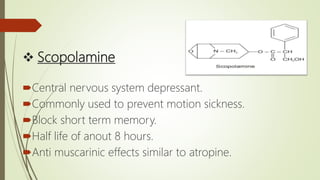
 Scopolamine
Central nervous system depressant.
Commonly used to prevent motion sickness.
Block short term memory.
Half life of anout 8 hours.
Anti muscarinic effects similar to atropine.
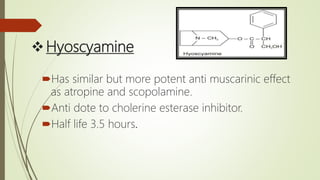
Hyoscyamine
Has similar but more potent anti muscarinic effect
as atropine and scopolamine.
Anti dote to cholerine esterase inhibitor.
Half life 3.5 hours.
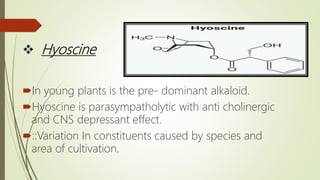
 Hyoscine
In young plants is the pre- dominant alkaloid.
Hyoscine is parasympatholytic with anti cholinergic
and CNS depressant effect.
::Variation In constituents caused by species and
area of cultivation.
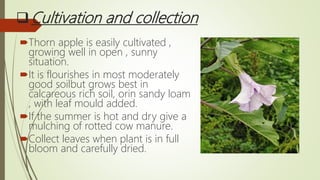
Cultivation and collection
Thorn apple is easily cultivated ,
growing well in open , sunny
situation.
It is flourishes in most moderately
good soilbut grows best in
calcareous rich soil, orin sandy loam
, with leaf mould added.
If the summer is hot and dry give a
mulching of rotted cow manure.
Collect leaves when plant is in full
bloom and carefully dried.
Quantitative standard
Dosage: 50-100mg of dried leaf or the same amount in infusion.
Total ash: Not more than 20.0 ./.
Total alkaloid: Not less than 0.05 ./. calculated as hyoscyamine.
Foreign matter: Not more than 3.0./. of stem having a diameter
exceeding 5mm.
Acid insoluble ash: Not more than 4.0./.
Poisoning
Detura stramonium is widespread annual plant , which can
produce poisoning with severe anti cholinergic syndrome,
toxic delirium, coma.
Teenagers ingest the roots, seeds, or ntire plant to btain its
hallucinogenic and euphoric effects.
The entire plant especially the foliage and seeds, is toxic
due o its content of tropane alkaloids.
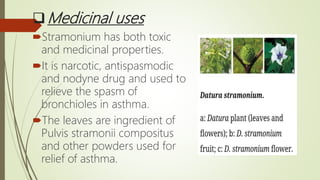
Medicinal uses
Stramonium has both toxic
and medicinal properties.
It is narcotic, antispasmodic
and nodyne drug and used to
relieve the spasm of
bronchioles in asthma.
The leaves are ingredient of
Pulvis stramonii compositus
and other powders used for
relief of asthma.
Continued…
The leaves may be made into cigarettes or smoked in
a pipe to relieve asthma.
Used in treatment of parkinsonism, boils, sores and
fish bites.
The flower juice used to treat earache.
The fruit juice is applied to scalp for curing dandruff
and falling hair.
Stramonium ointment containing lanolin, yellow wax
and petroleum, employed to cure haemorrhoids.
Leaves extract used externally for injuries, wounds,
bleeding and pain.
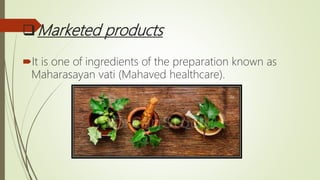
Marketed products
It is one of ingredients of the preparation known as
Maharasayan vati (Mahaved healthcare).
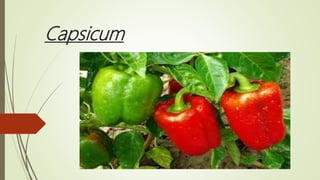
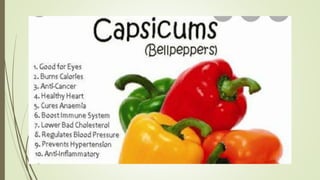
Capsicum
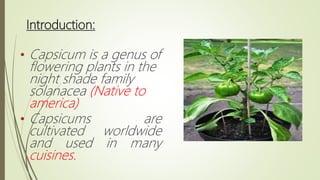
Introduction:
• Capsicum is a genus of
flowering plants in the
night shade family
solanacea (Native to
america)
• Capsicums are
cultivated worldwide
and used in many
cuisines.
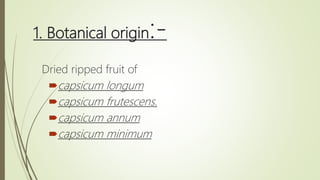
1. Botanical origin:-
Dried ripped fruit of
capsicum longum
capsicum frutescens.
capsicum annum
capsicum minimum
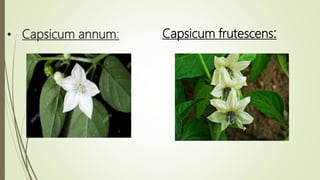
• Capsicum annum: Capsicum frutescens:
2. Common name:-
 Internationally used names for capsicum are :-
 English( chilli pepper, green pepper ,paprica ,red pepper &sweet pepper)
 French(paprica, poivron)
 capsicum also has many other common names on the basis of colour or shape such as
green pepper or green bell pepper Etc.
3. Part used:-
Dried ripe fruits of capsicum are commonly used.
 Red pepper is the synonym of Capsicum frutescens.
 Paprika &chilli are derived from capsicum Annum.
All the types of capsicum such as green pepper
& yellow bell pepper are commonly used in dried form.
4.Plant habit
“Habit means a usual Way of behaving.”
 A drug is either perennial (Living for several years) or biennial (lasting for two years
specifically).
 Capsicum is a biennial herb.(biennial plant is a flowering plant which take two years to
complete its biological life cycle).
 In first year capsicum undergo only its primary growth and must required second year to bear
best and of interest fruit.
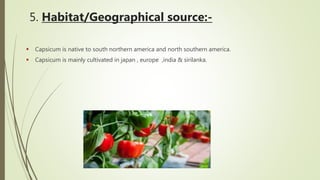
5. Habitat/Geographical source:-
 Capsicum is native to south northern america and north southern america.
 Capsicum is mainly cultivated in japan , europe ,india & sirilanka.
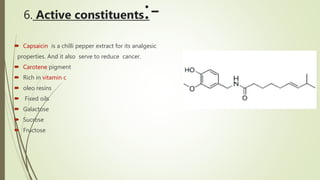
6. Active constituents:-
 Capsaicin is a chilli pepper extract for its analgesic
properties. And it also serve to reduce cancer.
 Carotene pigment
 Rich in vitamin c
 oleo resins
 Fixed oils
 Galactose
 Sucrose
 Fructose
7. Uses of capsicum:-
 Stimulant :- capsicum is immune stimulant and enhance the activity of immune system.
 Rubifacient:- it prevents the skin from pimples And rashes.
 Stomachic:- it reduce the risk of stomach ulcer.
 Capsaicin:- active constituent of capsicum prevents cancer.
 Carminative:- it relieves flatulence.
 Stimulant:- stimulate and enhance the activity of immune system
 Analgesic:- capsicum act as analgesic and pain.
thankyou

Solanacea

  • 1.
    Solanaceae the potato family By: MusfiraAhmed:25 musfiraahmedsaeed@gmail.com Safa Saleem:29 Aqsa Asif:4 Anmol Intezar: 3 Saba MOHD:42 Presented to: Dr. Samia
  • 2.
     Introduction: o TheSolanaceae, or nightshades, are a family of flowering plants that ranges from annual and perennial herbs to vines, lianas, epiphytes, shrubs, and trees. o They includes a number of agricultural crops, medicinal plants, spices, weeds, and ornamentals.
  • 3.
     Distribution This familyhas about  Genra. 90  Species. 2000  14 genra and 52 species are present in Pakistan (tropical and temperate areas)  Indigenous plant ::south Africa  Natural plant ::east west asia  Maim area in Pakistan : muzaffarbad. Karach, kashmir  Members of solanaceae have mostly worldwide distribution
  • 4.
     Features:  Herbs,shrub, vines  Leaves :simple, pinnate usually spiral  Flower: bisexual  Fruit: berry dupe or capsule  Seeds:: endospermous  Alkaloid and internal phloem are  present in many family members
  • 6.
     Economical uses Many members are cultivated for their alkaloid content eg. tobacco  Various members are also grown as ornamentals  Many members are edible such as capsicum, solanum tuberosum  Various have medicinal properties eg. atropine  Used as Deadly poison eg. datura  Used as noxious weeds
  • 7.
    Common species ofsolanaceae family  Belladonna (Atropa belladona)  Black henbane (Hyoscyamus niger)  Jimsonweed(Datura stramonium)  Pepper(capsicum)
  • 8.
  • 9.
    Atropa Belladonna commonlyknown as belladonna or deadly night shade ❑ Synonyms: Belladonna leaf, Belladonna herb. ❑ Biological source: It consist of dried leaves and other parts of atropa belladonna linn, atropa belladonna and atropa acuminata. ❑ Family: Solanaceae.  Introduction
  • 10.
    Classification: Kingdom: Plantae Clade: Tracheophytes Clade:Angiosperms Clade: Eudicots Clade: Asterids Order: Solanales Family: Solanaceae Genus: Atropa Species: A. belladonna Binomial name Atropa belladonna
  • 11.
     Geographical features It is indigenous to and cultivated in England and other European countries.  In India it is found in the western Himalayas from Shimla to Kashmir and adjoining areas of Himachal Pradesh.
  • 15.
    • Cultivation ofbelladonna at an altitude of 1400 meter from sea level found to be satisfactory. • Belladonna berries are to crushed to get the seeds for the cultivation. • Proper processing like washing and sieving is performed. • The seedling are ready for the transplantation by the end of September. • The leaves as well as flowering tops are cut & sundried. • The yield per hectare is found to be 200 to 600 kg.  Cultivation & collection
  • 16.
     Color Leaves aregreenish brown. ❑ Odour Slight & characteristics. ❑ Taste Bitter. ❑ Length Leaves are 5 to 25 cm long and 2.5 to 12 cm wide. ❑ Shape Ovate , Lanceolate.  Organoleptic features:
  • 17.
    • The totalalkaloidal(atopine) contents of drug is 0.4 to 1% & varies in different part of plant roots, stems , leaves unripe & berries and seeds. • The main alkaloids are 1-hyoscyamine & its racemic from atropine. • The drug also contains bellodonine, scopoletin , hyoscine, pyridine & N- methyl pyrroline. • The later to are the volatile bases.  Chemical constituents
  • 18.
    • Belladonna isused in ointments are applied to the skin for joint pain leg pain and nerve pain. • It is also use for Parkinson’s. • It is use excessive sweating and brochial asthma. • Belladonna is use in plasters for treating phychiatric disorders. • It is use as a sedative to stop bronchial spams in asthma.  Therapeutic uses:
  • 19.
  • 20.
     INTRODUCTION  Hyoscyamusis known since ancient times and was used as household drug, as an analgesics.  Dioscorides has also mentioned about this drug in his literature.  The drug was reintroduced in 1809 in the London pharmacopoeia.  Hyoscyamus- is a small genus of flowering plants in the nightshade family, Solanaceae. • It comprises 11 species, all of which are toxic. • It, along with other genera in the same family, is a source of the drug hyoscyamine (daturine)
  • 21.
     Classification:  Kingdom: Plantae  Subkingdom : Tracheobionta  Division : Magnoliophyta  Class : Magnoliopsida  Order : Solanales  Family : Solanaceae  Genus : Hyoscyamus  Species : niger  Binomial name/ Botanical origin: Hyscyamus niger  Common names:  Hyoscyamus herb  Hyoscyamus leaves  Henbane/ black henbane  Stinking nightshade,
  • 22.
     GEOGRAPHICAL SOURCE/PLANT HABITAT  Hyoscyamus niger is a native of Western Asia, North Africa, Europe and India.  It is cultivated in Russia, Belgium, Hungary and India.  It is a biennial herb.
  • 23.
     Cultivation &collection:  Cultivation is done in temperate region at an altitude of 2400 to 3300m.  The method of propagation is by seeds. The small seed beds are raised and seeds are sown.  The seeds require about two weeks for germination and then are transplanted in field in the month of May by keeping a distance of half meter between them and about 75cm between two rows.  The plants are kept free of weeds and occasional hoeing is also done.  Crop is harvested when it reaches the maturity.  Under all favorable conditions, the yield of the drug per hectare is 1000-1500kg.
  • 24.
     Plant descriptionand macroscopic character o COLOUR : Pale greyish green o ODOUR : characteristic and strong o TASTE : bitter and acrid o SIZE : 25cm long lamina o SHAPE : ovate, oblong to triangular ovate. o The stems and leaves are covered in glandular hairs (trichomes), and the whole plant has a powerful nauseous odour..
  • 25.
     Plant source: Dried leaves  Flowering tops  Some branches  Seeds
  • 26.
  • 27.
  • 28.
    Hyoscyamus niger fruits (notof any use ,but holds the seeds within)
  • 29.
  • 30.
     Active constituents: L.Hyoscyamine, Hyocine , Scopolamine, and other tropane alkaloids (i.e,atropine) have been found in the foliage and seeds of the plant.  The standard alkaloid content has been reported to be 0.03% to 0.28%.  The family Solanaceae contains several genera that are toxic due to the tropane alkaloids ,atropine and scopolamine.The genera Atropa (belladonna), Hyoscymus (henbane), Brugmansia (an gel's trumpet) and Datura (jimsonweed) are all of toxicological importance  They can all cause incidental poisoning but only the genus Datura appears to be of veterinary significance.
  • 31.
    (Scopolamine) Antimuscarinic Agents AReversible inhibitor of muscarinic receptor of PNS. Preventas motion sickness. L.Hyoscyamine (hyoscine) Anticholinergic Agents By blocking muscarinic receptors, they may reduce gastrointestinal (GI) secretions, thereby relieving nausea.
  • 33.
     Therapeutical uses: Hyoscyamine are antispasmodic, they may also relieve colicky pain.  Hyoscine tends to have central depressant effects in conditions where atropine might be expect to cause excitation.  Scopolamine is used to prevent nausea and vomiting caused by motion sickness .  Atropine may be used during pregnancy as preoperative, and preanesthetic agent  It is used to counteract gripping due to purgatives.  It is used to relieve spasms of urinary tract(mild diuretics).  It is also a sedative and used to check salivary secretion.  It is an expectorant too.  It is an antispasmodic , hypnotics and antiasthmatic.
  • 34.
     TRADITIONALLY :used as an anti- inflammatory drug  IN AYURVEDA : as an antparkinsons drug DOSAGE: Hyoscyamine sulphate – 0.125mg tablet ,3-4times a day.
  • 35.
  • 36.
     History D. Stramoniumwas scientifically described and named by Swedish Botanist Carl Linnaeus in 1753 , although it has been described a century earlier by botanist such as Nicholas Culpper.  Introduction Datura stramonium is a plant species in the night shade family and Datura genus. It is an aggressive invasive weed in temperate climates across world. D.stramonium has frequently been employed in traditional medicine to treat variety f ailments. It contains tropane alkaloids which are responsible for delirient effects and may be severly toxic.
  • 37.
    Common names ofstramonium Jimson Weed, Jamestown Weed, Devil’s Apple , Thorn Apple, Mad Apple , Zombie Cucumber, Angel’s Trumpet . Distribution D. Stamonium is probably originated in caspain sea territories and spreaded to Europe in the first century. At present it grows in waste places in Europe, Asia, America and South Africa.  D. Stramonium is cultivated in Germany , France , Hungary , South America and throughout the world.
  • 38.
    Scientific classification Kingdom ===Plantae Division === Magnoliophyta Class === Magnoliopsida L. Order === Solanales Family===Solanaceae Genus === Datura Specie === Datura stramonium Binomial Name === Datura stramonium
  • 39.
  • 40.
     Geographical source: Indigenousto Europe, Asia and Africa  BOTANICAL ORIGIN: Datura stramonium  HABIT: Biennial herb BIOLOGICAL SOURCE: It consist of the dried leaves and flowering top of Datura stramonium Linn.
  • 41.
     Description andappearence Grow to about 1.5 m tall. Colour === Green Odour === Unpleasant Taste === Bitter Requires sunlight to grow. Its fruits are large , thorny pod filled with seeds. Fruits open into four compartments when ripe. Prefers neutral or basic , dry soil.
  • 42.
    Constituents of stramonium Alkaloids Scopolamine L-Hyoscyamine, D-Hyoscyamine Hyoscine 6-Hydroxy hyoscyamine Acetyl derivatives of caffeic acid , feurlic acid and coumaric acid. Other tropanes and also contains protein albumin and atropine.
  • 43.
    Atropine Anti muscarinic agent. Blockreception of acetylcholine. Cause bradycardia at very low doses. Preventing responses that leads to muscle spasm. High doses induce tachycardia. Formed from hyoscyamine by racemization.
  • 44.
     Scopolamine Central nervoussystem depressant. Commonly used to prevent motion sickness. Block short term memory. Half life of anout 8 hours. Anti muscarinic effects similar to atropine.
  • 45.
    Hyoscyamine Has similar butmore potent anti muscarinic effect as atropine and scopolamine. Anti dote to cholerine esterase inhibitor. Half life 3.5 hours.
  • 46.
     Hyoscine In youngplants is the pre- dominant alkaloid. Hyoscine is parasympatholytic with anti cholinergic and CNS depressant effect. ::Variation In constituents caused by species and area of cultivation.
  • 47.
    Cultivation and collection Thornapple is easily cultivated , growing well in open , sunny situation. It is flourishes in most moderately good soilbut grows best in calcareous rich soil, orin sandy loam , with leaf mould added. If the summer is hot and dry give a mulching of rotted cow manure. Collect leaves when plant is in full bloom and carefully dried.
  • 48.
    Quantitative standard Dosage: 50-100mgof dried leaf or the same amount in infusion. Total ash: Not more than 20.0 ./. Total alkaloid: Not less than 0.05 ./. calculated as hyoscyamine. Foreign matter: Not more than 3.0./. of stem having a diameter exceeding 5mm. Acid insoluble ash: Not more than 4.0./.
  • 49.
    Poisoning Detura stramonium iswidespread annual plant , which can produce poisoning with severe anti cholinergic syndrome, toxic delirium, coma. Teenagers ingest the roots, seeds, or ntire plant to btain its hallucinogenic and euphoric effects. The entire plant especially the foliage and seeds, is toxic due o its content of tropane alkaloids.
  • 50.
    Medicinal uses Stramonium hasboth toxic and medicinal properties. It is narcotic, antispasmodic and nodyne drug and used to relieve the spasm of bronchioles in asthma. The leaves are ingredient of Pulvis stramonii compositus and other powders used for relief of asthma.
  • 51.
    Continued… The leaves maybe made into cigarettes or smoked in a pipe to relieve asthma. Used in treatment of parkinsonism, boils, sores and fish bites. The flower juice used to treat earache. The fruit juice is applied to scalp for curing dandruff and falling hair. Stramonium ointment containing lanolin, yellow wax and petroleum, employed to cure haemorrhoids. Leaves extract used externally for injuries, wounds, bleeding and pain.
  • 52.
    Marketed products It isone of ingredients of the preparation known as Maharasayan vati (Mahaved healthcare).
  • 53.
  • 54.
    Introduction: • Capsicum isa genus of flowering plants in the night shade family solanacea (Native to america) • Capsicums are cultivated worldwide and used in many cuisines.
  • 55.
    1. Botanical origin:- Driedripped fruit of capsicum longum capsicum frutescens. capsicum annum capsicum minimum
  • 56.
    • Capsicum annum:Capsicum frutescens:
  • 57.
    2. Common name:- Internationally used names for capsicum are :-  English( chilli pepper, green pepper ,paprica ,red pepper &sweet pepper)  French(paprica, poivron)  capsicum also has many other common names on the basis of colour or shape such as green pepper or green bell pepper Etc.
  • 58.
    3. Part used:- Driedripe fruits of capsicum are commonly used.  Red pepper is the synonym of Capsicum frutescens.  Paprika &chilli are derived from capsicum Annum. All the types of capsicum such as green pepper & yellow bell pepper are commonly used in dried form.
  • 59.
    4.Plant habit “Habit meansa usual Way of behaving.”  A drug is either perennial (Living for several years) or biennial (lasting for two years specifically).  Capsicum is a biennial herb.(biennial plant is a flowering plant which take two years to complete its biological life cycle).  In first year capsicum undergo only its primary growth and must required second year to bear best and of interest fruit.
  • 60.
    5. Habitat/Geographical source:- Capsicum is native to south northern america and north southern america.  Capsicum is mainly cultivated in japan , europe ,india & sirilanka.
  • 61.
    6. Active constituents:- Capsaicin is a chilli pepper extract for its analgesic properties. And it also serve to reduce cancer.  Carotene pigment  Rich in vitamin c  oleo resins  Fixed oils  Galactose  Sucrose  Fructose
  • 62.
    7. Uses ofcapsicum:-  Stimulant :- capsicum is immune stimulant and enhance the activity of immune system.  Rubifacient:- it prevents the skin from pimples And rashes.  Stomachic:- it reduce the risk of stomach ulcer.  Capsaicin:- active constituent of capsicum prevents cancer.  Carminative:- it relieves flatulence.  Stimulant:- stimulate and enhance the activity of immune system  Analgesic:- capsicum act as analgesic and pain.
  • 64.