a nt iba ct er ia l st udy of dif f er ent sol v ent
ex t r a ct s of Zingiber officinale
Submitted to
Biju Pattnaik University of Technology for the Award of the degree of :
Submittedby:
Mr. Ramshankar Nayak
Regd.No: 1203267013
Under the guidance of
Dr. Jnyanaranjan Panda
M.Pharm.,Ph.D
Associate Professor
ROLAND INSTITUTE OF PHARMACEUTICAL SCIENCES
BERHAMPUR-2015
B.Pharm, 7th Sem.
LITERATURE SURVEY
ON
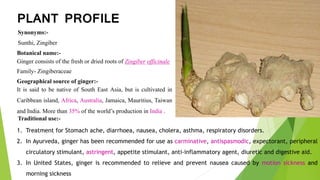
PLANT PROFILE
Synonyms:-
Sunthi, Zingiber
Botanical name:-
Ginger consists of the fresh or dried roots of Zingiber officinale
Family- Zingiberaceae
Geographical source of ginger:-
It is said to be native of South East Asia, but is cultivated in
Caribbean island, Africa, Australia, Jamaica, Mauritius, Taiwan
and India. More than 35% of the world’s production in India .
Traditional use:-
1. Treatment for Stomach ache, diarrhoea, nausea, cholera, asthma, respiratory disorders.
2. In Ayurveda, ginger has been recommended for use as carminative, antispasmodic, expectorant, peripheral
circulatory stimulant, astringent, appetite stimulant, anti-inflammatory agent, diuretic and digestive aid.
3. In United States, ginger is recommended to relieve and prevent nausea caused by motion sickness and
morning sickness
Chemical constituents:-
 The ginger rhizome contains 0.6 to 3.3 % essential oil, comprising more than 150
secondary metabolites.
 ginger oil, obtained from ginger contains of sesquiterpene hydrocarbons,
predominantly zingiberene.
 The oleoresin is present at 5 to 8 % in the dry rhizome and contains a broad
spectrum of phenylpropanoids.
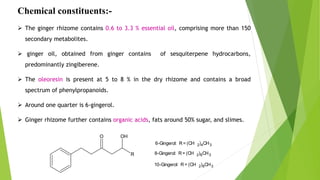
 Around one quarter is 6-gingerol.
 Ginger rhizome further contains organic acids, fats around 50% sugar, and slimes.
R
O OH
6-Gingerol: R= (CH 2)4CH3
8-Gingerol: R= (CH 2)6CH3
10-Gingerol: R= (CH 2)8CH3
Macroscopic character:-
Colour- Externally, it is buff coloured
Oder- Agreeable and pungent
Taste- Agreeable and pungent
Size- Rhizomes of ginger are about 5 to 15×1.5 to 6.5 cm.
Shape- The rhizomes are laterally compressed, bearing short flat, ovate
and oblique branches on the upper side, with bud at the apex.
LITERATURE REVIEW
Antimicrobial activity
 Zingiberene was the major compound is ginger oils.
 Antimicrobial activity of the oils against Bacillus subtilis, Pseudomonas
aeruginosa, Candida albicans, Trichoderma spp, Aspergillus niger, Pencillium spp.
and Saccharomyces cerevisiae.
 Fresh ginger oil (FG) was active against Aspergillus niger, candida and
Pseudomonas aeruginosa, weaker towards Saccharomyces cerevisiae and inactive
against Bacillus subtilis, Pencillium spp and Trichoderma spp.
 Dry ginger oil (DG) was more active towards Pencillium spp, Pseudomonas
aeruginosa , on par with standard towards Candida, weaker than standard against
Bacillus subtilis, Aspergillus niger,, Saccharomyces cereviseae.
 Ginger is a well-known spice and
 Used to treat diseases such as the common cold, cough and
gastrointestinal problems.
 Antibacterial activity of ginger is due to gingerol and shogaol
derived from the ethanolic extracts of ginger.
Anti-emetic activity
 Powdered ginger root is found to be effective in reducing
nausea and vomiting induced by low dose of
cyclophosphamide .
Anti-cancer activity
The major compounds present in ginger oil which shows anti-cancer activity are
 eucalyptol (14.2%)
 α-pinene (4%)
 cuparene (12.3%)
 bicycloheptane (11.4%)
 γ-muurolene (10%)
 α-farnesene (8%)
 β-myrcene (2.2%).
Gastrointestinal Effects:
Gingerol and shogaol are the two chemicals which are
responsible for the gastrointenstinal effect.
(6) shogaol generally more potent than (6)-gingerol.
Anti oxidant activity:
Aqueous and ethanolic extracts of Zingiber officinale were
evaluated for antioxidant activities using SOD, DPPH and ABTS
scavenging assay and lipid peroxidation assay.
Anticoagulant activity
 (8)-Gingerol, (8)-shogaol, (8)-paradol, and gingerol
analogues (1 and 5) exhibits anti platelet activity.
Cardiovascular activity
 gingerols and the related shogaols exhibit
 cardio depressant activity at low doses
 cardiotonic properties at higher doses.
Anti arthritic activity
[6]-gingerol and their derivatives inhibits joint swelling.
Preventing, both joint inflammation and destruction.
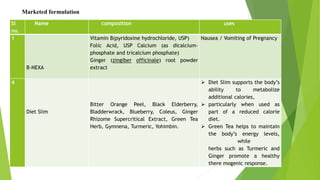
Marketed formulation
Sl
no.
Name composition uses
1
B-NEXA
Vitamin B(pyridoxine hydrochloride, USP)
Folic Acid, USP Calcium (as dicalcium-
phosphate and tricalcium phosphate)
Ginger (zingiber officinale) root powder
extract
Nausea / Vomiting of Pregnancy
4
Diet Slim
Bitter Orange Peel, Black Elderberry,
Bladderwrack, Blueberry, Coleus, Ginger
Rhizome Supercritical Extract, Green Tea
Herb, Gymnena, Turmeric, Yohimbin.
 Diet Slim supports the body’s
ability to metabolize
additional calories,
 particularly when used as
part of a reduced calorie
diet.
 Green Tea helps to maintain
the body’s energy levels,
while
herbs such as Turmeric and
Ginger promote a healthy
there mogenic response.
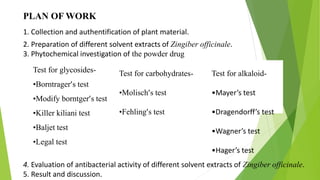
PLAN OF WORK
Test for carbohydrates-
•Molisch’s test
•Fehling’s test
Test for glycosides-
•Borntrager’s test
•Modify borntger’s test
•Killer kiliani test
•Baljet test
•Legal test
Test for alkaloid-
•Mayer’s test
•Dragendorff’s test
•Wagner’s test
•Hager’s test
1. Collection and authentification of plant material.
2. Preparation of different solvent extracts of Zingiber officinale.
3. Phytochemical investigation of the powder drug
4. Evaluation of antibacterial activity of different solvent extracts of Zingiber officinale.
5. Result and discussion.
Reference
1. Shen-nung pen ts’ao ching (Divine Husbandman’s Materia Medica).
2. Garodia P, Ichikawa H, Malani N, Sethi G, Aggarwal BB. From ancient medicine to
modern medicine: ayurvedic concepts of health and their role in inflammation and cancer. J
Soc Integr Oncol. 2007, 5, 25-37.
3. Eisenberg DM, Kessler RC, Foster C, Norlock FE, Calkins DR. Unconventional medicine
in the United States. Prevalence,costs, and patterns of use. N Engl J. 1993, 328, 246-252.
4. Eisenberg DM, Davis RB, Ettner SL, Appel S, Wilkey S. Trends in alternative medicine
use in the United States, JAMA. 1997, 280, 1569-1575.
5. Kokate CK, Purohit AP, Gokhale SB.Ginger,Pharmacognosy. 2010, 2, 103-105.
ginzer

ginzer

  • 1.
    a nt ibact er ia l st udy of dif f er ent sol v ent ex t r a ct s of Zingiber officinale Submitted to Biju Pattnaik University of Technology for the Award of the degree of : Submittedby: Mr. Ramshankar Nayak Regd.No: 1203267013 Under the guidance of Dr. Jnyanaranjan Panda M.Pharm.,Ph.D Associate Professor ROLAND INSTITUTE OF PHARMACEUTICAL SCIENCES BERHAMPUR-2015 B.Pharm, 7th Sem. LITERATURE SURVEY ON
  • 2.
    PLANT PROFILE Synonyms:- Sunthi, Zingiber Botanicalname:- Ginger consists of the fresh or dried roots of Zingiber officinale Family- Zingiberaceae Geographical source of ginger:- It is said to be native of South East Asia, but is cultivated in Caribbean island, Africa, Australia, Jamaica, Mauritius, Taiwan and India. More than 35% of the world’s production in India . Traditional use:- 1. Treatment for Stomach ache, diarrhoea, nausea, cholera, asthma, respiratory disorders. 2. In Ayurveda, ginger has been recommended for use as carminative, antispasmodic, expectorant, peripheral circulatory stimulant, astringent, appetite stimulant, anti-inflammatory agent, diuretic and digestive aid. 3. In United States, ginger is recommended to relieve and prevent nausea caused by motion sickness and morning sickness
  • 3.
    Chemical constituents:-  Theginger rhizome contains 0.6 to 3.3 % essential oil, comprising more than 150 secondary metabolites.  ginger oil, obtained from ginger contains of sesquiterpene hydrocarbons, predominantly zingiberene.  The oleoresin is present at 5 to 8 % in the dry rhizome and contains a broad spectrum of phenylpropanoids.  Around one quarter is 6-gingerol.  Ginger rhizome further contains organic acids, fats around 50% sugar, and slimes. R O OH 6-Gingerol: R= (CH 2)4CH3 8-Gingerol: R= (CH 2)6CH3 10-Gingerol: R= (CH 2)8CH3
  • 4.
    Macroscopic character:- Colour- Externally,it is buff coloured Oder- Agreeable and pungent Taste- Agreeable and pungent Size- Rhizomes of ginger are about 5 to 15×1.5 to 6.5 cm. Shape- The rhizomes are laterally compressed, bearing short flat, ovate and oblique branches on the upper side, with bud at the apex.
  • 5.
    LITERATURE REVIEW Antimicrobial activity Zingiberene was the major compound is ginger oils.  Antimicrobial activity of the oils against Bacillus subtilis, Pseudomonas aeruginosa, Candida albicans, Trichoderma spp, Aspergillus niger, Pencillium spp. and Saccharomyces cerevisiae.  Fresh ginger oil (FG) was active against Aspergillus niger, candida and Pseudomonas aeruginosa, weaker towards Saccharomyces cerevisiae and inactive against Bacillus subtilis, Pencillium spp and Trichoderma spp.  Dry ginger oil (DG) was more active towards Pencillium spp, Pseudomonas aeruginosa , on par with standard towards Candida, weaker than standard against Bacillus subtilis, Aspergillus niger,, Saccharomyces cereviseae.
  • 6.
     Ginger isa well-known spice and  Used to treat diseases such as the common cold, cough and gastrointestinal problems.  Antibacterial activity of ginger is due to gingerol and shogaol derived from the ethanolic extracts of ginger.
  • 7.
    Anti-emetic activity  Powderedginger root is found to be effective in reducing nausea and vomiting induced by low dose of cyclophosphamide .
  • 8.
    Anti-cancer activity The majorcompounds present in ginger oil which shows anti-cancer activity are  eucalyptol (14.2%)  α-pinene (4%)  cuparene (12.3%)  bicycloheptane (11.4%)  γ-muurolene (10%)  α-farnesene (8%)  β-myrcene (2.2%).
  • 9.
    Gastrointestinal Effects: Gingerol andshogaol are the two chemicals which are responsible for the gastrointenstinal effect. (6) shogaol generally more potent than (6)-gingerol.
  • 10.
    Anti oxidant activity: Aqueousand ethanolic extracts of Zingiber officinale were evaluated for antioxidant activities using SOD, DPPH and ABTS scavenging assay and lipid peroxidation assay.
  • 11.
    Anticoagulant activity  (8)-Gingerol,(8)-shogaol, (8)-paradol, and gingerol analogues (1 and 5) exhibits anti platelet activity.
  • 12.
    Cardiovascular activity  gingerolsand the related shogaols exhibit  cardio depressant activity at low doses  cardiotonic properties at higher doses.
  • 13.
    Anti arthritic activity [6]-gingeroland their derivatives inhibits joint swelling. Preventing, both joint inflammation and destruction.
  • 14.
    Marketed formulation Sl no. Name compositionuses 1 B-NEXA Vitamin B(pyridoxine hydrochloride, USP) Folic Acid, USP Calcium (as dicalcium- phosphate and tricalcium phosphate) Ginger (zingiber officinale) root powder extract Nausea / Vomiting of Pregnancy 4 Diet Slim Bitter Orange Peel, Black Elderberry, Bladderwrack, Blueberry, Coleus, Ginger Rhizome Supercritical Extract, Green Tea Herb, Gymnena, Turmeric, Yohimbin.  Diet Slim supports the body’s ability to metabolize additional calories,  particularly when used as part of a reduced calorie diet.  Green Tea helps to maintain the body’s energy levels, while herbs such as Turmeric and Ginger promote a healthy there mogenic response.
  • 15.
    PLAN OF WORK Testfor carbohydrates- •Molisch’s test •Fehling’s test Test for glycosides- •Borntrager’s test •Modify borntger’s test •Killer kiliani test •Baljet test •Legal test Test for alkaloid- •Mayer’s test •Dragendorff’s test •Wagner’s test •Hager’s test 1. Collection and authentification of plant material. 2. Preparation of different solvent extracts of Zingiber officinale. 3. Phytochemical investigation of the powder drug 4. Evaluation of antibacterial activity of different solvent extracts of Zingiber officinale. 5. Result and discussion.
  • 16.
    Reference 1. Shen-nung pents’ao ching (Divine Husbandman’s Materia Medica). 2. Garodia P, Ichikawa H, Malani N, Sethi G, Aggarwal BB. From ancient medicine to modern medicine: ayurvedic concepts of health and their role in inflammation and cancer. J Soc Integr Oncol. 2007, 5, 25-37. 3. Eisenberg DM, Kessler RC, Foster C, Norlock FE, Calkins DR. Unconventional medicine in the United States. Prevalence,costs, and patterns of use. N Engl J. 1993, 328, 246-252. 4. Eisenberg DM, Davis RB, Ettner SL, Appel S, Wilkey S. Trends in alternative medicine use in the United States, JAMA. 1997, 280, 1569-1575. 5. Kokate CK, Purohit AP, Gokhale SB.Ginger,Pharmacognosy. 2010, 2, 103-105.