PHARMACOGNOSY
Presented to: Dr. Samia
 Presented by :
Anashra Latif 19002
Bazal Shahid 19008
Fajar Adil 19010
Fatima Zahid 19013
Maryam Ijaz 19022
bazal31031999@gmail.com
ZINGIBERACEAE:
Zingiberaceae, also named as the ginger
family, is the largest family of the order
Zingiberales, it is divided into about 53
genera and made up of more than 1300
species.
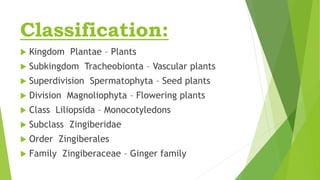
Classification:
 Kingdom Plantae – Plants
 Subkingdom Tracheobionta – Vascular plants
 Superdivision Spermatophyta – Seed plants
 Division Magnoliophyta – Flowering plants
 Class Liliopsida – Monocotyledons
 Subclass Zingiberidae
 Order Zingiberales
 Family Zingiberaceae – Ginger family
Spices and condiments :
Many species belong to the ginger
family have been widely used as
spices or flavoring agents, due to its
aromatic odors, pungent and spicy
taste.
Spices and condiments :
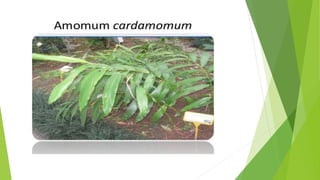
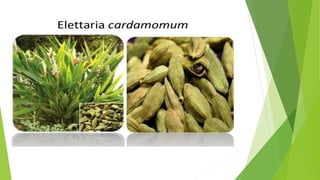
SPICES AND CONDIMENTS:
1. Amomum cardamon (Cardamon)
2. Elettaria cardamomum (Elayachi)
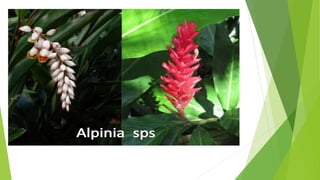
3.Alpinia oficinarum
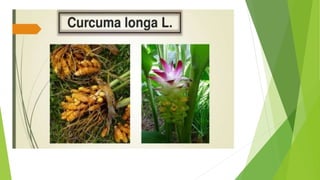
4. Curcuma longa
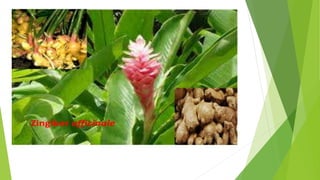
5. Zingiber officinale
Distribution:
 These aromatic herbs grow in moist areas
of the tropics and subtropics, including
some regions that are seasonably dry.
 Thet are especially abundant in Southeast
Asia.
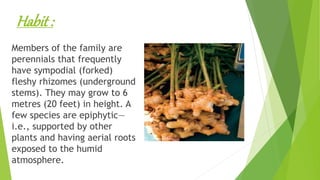
Habit :
Members of the family are
perennials that frequently
have sympodial (forked)
fleshy rhizomes (underground
stems). They may grow to 6
metres (20 feet) in height. A
few species are epiphytic—
i.e., supported by other
plants and having aerial roots
exposed to the humid
atmosphere.
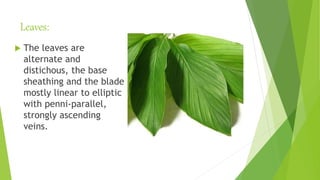
Leaves:
 The leaves are
alternate and
distichous, the base
sheathing and the blade
mostly linear to elliptic
with penni-parallel,
strongly ascending
veins.
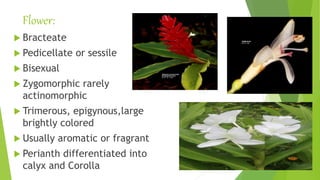
Flower:
 Bracteate
 Pedicellate or sessile
 Bisexual
 Zygomorphic rarely
actinomorphic
 Trimerous, epigynous,large
brightly colored
 Usually aromatic or fragrant
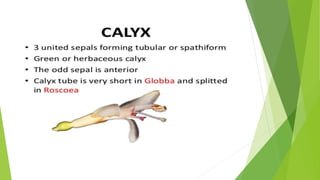
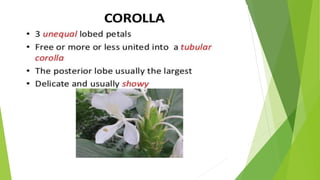
 Perianth differentiated into
calyx and Corolla
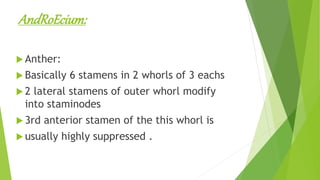
AndRoEcium:
 Anther:
 Basically 6 stamens in 2 whorls of 3 eachs
 2 lateral stamens of outer whorl modify
into staminodes
 3rd anterior stamen of the this whorl is
 usually highly suppressed .
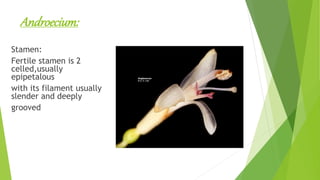
Androecium:
Stamen:
Fertile stamen is 2
celled,usually
epipetalous
with its filament usually
slender and deeply
grooved
Gynoecium:
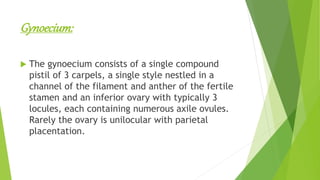
 The gynoecium consists of a single compound
pistil of 3 carpels, a single style nestled in a
channel of the filament and anther of the fertile
stamen and an inferior ovary with typically 3
locules, each containing numerous axile ovules.
Rarely the ovary is unilocular with parietal
placentation.
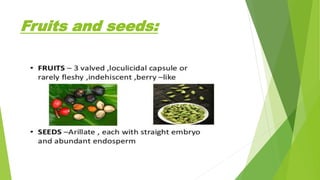
Fruits and seeds:
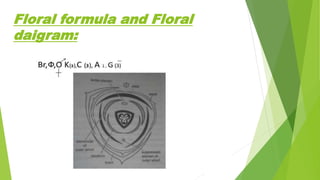
Floral formula and Floral
daigram:
Crudedrugs:
Following are the drugs that are related to this
family :
 Ginger
 Curcuma
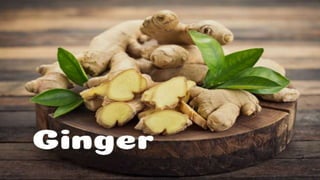
Ginger:
 Vernacular Name: Adrak
 Biological Source: Ginger consists of either the
scraped or unscraped rhizomes of Zingiber
officinale belonging to family Zingiberaceae.
 Parts Used: Rhizome
Chemical Constituents:
 Ginger contains about 0.25-3% of volatile
oil, 5-8% resinous matter, 56% starch and
protein. Volatile oil contains a mixture of
more than 25 constituents containing
monoterpenes and sesquiterpenes. The
pungent taste of ginger is due to the
presence of gingerol.
 The pungency of gingerol is destroyed by
boiling in 2% solution of KOH. Zingerone,
a pungent compound also occurs in the
rhizome but possesses a sweet odor.
Shogaol is a component of oil but is not
present in fresh rhizomes, it is formed by
dehydration of gingerol.
Uses :
Ginger is used as condiment.
Medicinally it is used as aromatic,
carminative, flavourant, stimulant and
stomachic. The oil of ginger is used as
mouthwashes and beverages (as flavoring agent).
Uses:
 Z.officinale is acrid, thermogenic,
laxative,digestive, emollient, appetizer,
stimulant,rubefacient, aphrodisiac, expectorant,
anti-helmintic, carminative, anodyne, useful in
anorexia and inflammations. Ginger root can
relieve symptoms of motion sickness due to
gingerols and shoagols.
Uses:
 It is also useful in the treatment of
following conditions: dropsy, otalgia,
cephalagia, asthma, cough, colic,
flatulance, anorexia, cholera, nausea,
vomiting, thrombosis and elephantiasis.
AdverseeffectAndinteraction:
 The findings that ginger is positive in E.coli
bacteria test for mutagenesis raises concerns
about its use in pregnant women. It is a potent
inhibitor of thromboxxane synthetase, there is a
possibility that ginger could increase the risk of
bleeding or bruising if given concomitantly with
anticoagulants or platelet-inhibiting drugs.
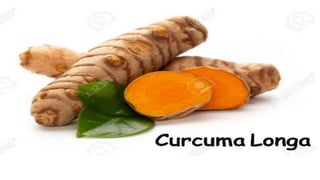
Curcuma longa:
 Vernacular Name: Haldi
 Biological Source: Turmeric consists of fresh,dried
rhizomesof Curcuma longa, belonging to
 Family Zingiberaceae
 Parts used: rhizomes and tubers
Chemical Constituents:
 Turmeric contains about 5% curcumanoids as a
coloring matter. The Curcumanoid contains
curcumine-l, curcumine-ll,curcumine-ll|. Turmeric
contains about 5% volatile oil. Their volatile oil
contains sesquiterpenes,alcohol and ketone and
monoterpene example,zingiberone,turmerone,
arturmerone, alcohol-p-tolylmethyl, carbenol,
cineole, borneole, etc. It also contains arabinose,
fructose, glucose and starch grains.
Uses:
 It is used as stomachic, carminative,aromatic,
antiperiodic, blood purifier and stimulant. It is also
an anti-arthritic, anti-inflammatory, anti-lipidemic,
carminative and digestant and anti-fertility. It is also
used in menstrual pain, liver diseases and to
produce choleritic and chologogue action.
Turmeric is used in curry powders, sauces and
paper impregnated with its tincture is used for the
borate and boric acid detection.
Uses:
 It is employed as coloring agent for formulations
like ointments and creams.
 Ethanolic extract of curcuma longa shows anti-
ulcerogenic property. Rhizome extract has anti-
diabetic action. Curcuma is used in conjunctivitis.
Uses:
 A recent study involving mice has shown
that turmeric slows the spread of breast
cancer in to lungs and other body
parts.Turmeric also enhances the effect of
taxol in reducing metastasis of breast
cancer.
Uses:
 The rhizome is well-known for its anti-gastric
ulcer and cholagogic properties. It is prescribed in
the therapy of gastric and duodenal ulcer,
hepatitis, jaundice, pain in the extrimities, boils
and impetigo.lt is also used as a poultice for
wounds.
Toxicology:
The clastogenic potential of Curcuma longa in
experimental rats in invivo conditions has been
evaluated. A single acute dose treatment
500mg/kg body weight could not significantly
induce micronucleated polychromatic
erythrocytes but caused considerably higher
chromosomal abberations.
Adversereactionsandinteractions:
 Fetal effects are unknown, and use during pregnancy,
other than as food spice, is probably best avoided.
Prolonged use has been associated with gastrointestinal
upsetband may increase the risk of peptic ulcer.Use in
patients with biliary obstruction or gallstones is
contraindicated. There is a potential for interaction with
NSAIDs and platelet-inhibiting drugs because of its effect
on prostaglandin synthesis.
Zingiberaceae