FLUID PRESSURE
•PASCAL’S LAW
•HYDRO-STATIC LAW
•FLUID PRESSUREAT A POINT
•PRESSURE MEASURING SYSTEMS
•PRESSURE MEASURING DEVICES
PASCAL’S LAW
 Pascal’s Law stated that the intensity of pressure at a given point is equal in all
direction for a static fluid or it can be said as when fluid is at rest in closed space,
pressure change a point is transmitted to every portion of fluid without any loss and
to the surface of closed space.
 Illustration –
According to the Pascal’s Law, pressure applied on piston will produce an equal
increase in pressure on another pressure only if the area of the second piston is 10
times that of first, the force on second piston will be 10 times greater though the
pressure is same as the that on first piston.
HYDRO-STATIC LAW
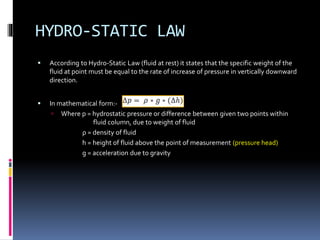
 According to Hydro-Static Law (fluid at rest) it states that the specific weight of the
fluid at point must be equal to the rate of increase of pressure in vertically downward
direction.
 In mathematical form:-
 Where p = hydrostatic pressure or difference between given two points within
fluid column, due to weight of fluid
ρ = density of fluid
h = height of fluid above the point of measurement (pressure head)
g = acceleration due to gravity
FLUID PRESSURE AT A POINT
 Consider a area dA in a mass of fluid and it is stationary. Then we can say that force
exerted by surrounding fluid on area dA will be perpendicular to the surface of the
area dA. Let dF be the force action on the area dA in normal direction. Then the
reaction of dF/dA can be known as the intensity of pressure on considered area.
Hence mathematically when fluid is at rest the pressure at a point is:-
 Then pressure at any point if force (F) is uniformly distrusted over the area(A) is given
by:-
 The units of pressure are: a) kgf/cm^2 and kgf/m^2 in MKS units, b) N/m^2 and
N/mm^2 in SI-units it is also known as Pascal represented by Pa. Other commonly
used units of pressure are kPa and bar.
PRESSURE MEASURING SYSTEMS
 There are two different systems to measure pressure on a fluid. In one
system, pressure is measured above the absolute zero or complete vacuum
it is called absolute pressure. Another way to measure pressure on a fluid is
by measuring it above atmospheric pressure and it is called gauge pressure.
Thus:
 Absolute Pressure – It is defined as the pressure which is measured with
reference to absolute vacuum pressure.
 Gauge Pressure – It is defined as the pressure measured above atmospheric
pressure (as datum) with the help of pressure measuring equipment. The
atmospheric pressure on the scale of equipment is marked as zero.
 Vacuum Pressure – Pressure measure above atmospheric pressure is known
as vacuum pressure.
Cont...
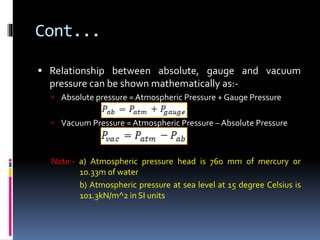
 Relationship between absolute, gauge and vacuum
pressure can be shown mathematically as:-
 Absolute pressure = Atmospheric Pressure + Gauge Pressure
 Vacuum Pressure = Atmospheric Pressure – Absolute Pressure
Note:- a) Atmospheric pressure head is 760 mm of mercury or
10.33m of water
b) Atmospheric pressure at sea level at 15 degree Celsius is
101.3kN/m^2 in SI units
PRESSURE MEASURING DEVICES
 The pressure of a fluid can be measured by the following devices:
 Manometers
 Mechanical Gauges
 Manometers – It is device used for measuring the pressure at a point in a
fluid by balancing the column of fluid by the same or different column of
the fluid.They are further classified as:
 Simple Manometers
 Differential Manometers
 Mechanical Gauges – It is device which uses spring or dead weight to
measure pressure by balancing it with fluid column. Commonly used
mechanical pressure gauges are:-
 Diaphragm pressure gauge
 Bellows pressure gauge
 Dead-Weight pressure gauge
 Bourdon tube pressure gauge
THANK YOU
 Please feel free to comment your suggestions
and any correction....

Fluid pressure

  • 1.
    FLUID PRESSURE •PASCAL’S LAW •HYDRO-STATICLAW •FLUID PRESSUREAT A POINT •PRESSURE MEASURING SYSTEMS •PRESSURE MEASURING DEVICES
  • 2.
    PASCAL’S LAW  Pascal’sLaw stated that the intensity of pressure at a given point is equal in all direction for a static fluid or it can be said as when fluid is at rest in closed space, pressure change a point is transmitted to every portion of fluid without any loss and to the surface of closed space.  Illustration – According to the Pascal’s Law, pressure applied on piston will produce an equal increase in pressure on another pressure only if the area of the second piston is 10 times that of first, the force on second piston will be 10 times greater though the pressure is same as the that on first piston.
  • 3.
    HYDRO-STATIC LAW  Accordingto Hydro-Static Law (fluid at rest) it states that the specific weight of the fluid at point must be equal to the rate of increase of pressure in vertically downward direction.  In mathematical form:-  Where p = hydrostatic pressure or difference between given two points within fluid column, due to weight of fluid ρ = density of fluid h = height of fluid above the point of measurement (pressure head) g = acceleration due to gravity
  • 4.
    FLUID PRESSURE ATA POINT  Consider a area dA in a mass of fluid and it is stationary. Then we can say that force exerted by surrounding fluid on area dA will be perpendicular to the surface of the area dA. Let dF be the force action on the area dA in normal direction. Then the reaction of dF/dA can be known as the intensity of pressure on considered area. Hence mathematically when fluid is at rest the pressure at a point is:-  Then pressure at any point if force (F) is uniformly distrusted over the area(A) is given by:-  The units of pressure are: a) kgf/cm^2 and kgf/m^2 in MKS units, b) N/m^2 and N/mm^2 in SI-units it is also known as Pascal represented by Pa. Other commonly used units of pressure are kPa and bar.
  • 5.
    PRESSURE MEASURING SYSTEMS There are two different systems to measure pressure on a fluid. In one system, pressure is measured above the absolute zero or complete vacuum it is called absolute pressure. Another way to measure pressure on a fluid is by measuring it above atmospheric pressure and it is called gauge pressure. Thus:  Absolute Pressure – It is defined as the pressure which is measured with reference to absolute vacuum pressure.  Gauge Pressure – It is defined as the pressure measured above atmospheric pressure (as datum) with the help of pressure measuring equipment. The atmospheric pressure on the scale of equipment is marked as zero.  Vacuum Pressure – Pressure measure above atmospheric pressure is known as vacuum pressure.
  • 6.
    Cont...  Relationship betweenabsolute, gauge and vacuum pressure can be shown mathematically as:-  Absolute pressure = Atmospheric Pressure + Gauge Pressure  Vacuum Pressure = Atmospheric Pressure – Absolute Pressure Note:- a) Atmospheric pressure head is 760 mm of mercury or 10.33m of water b) Atmospheric pressure at sea level at 15 degree Celsius is 101.3kN/m^2 in SI units
  • 7.
    PRESSURE MEASURING DEVICES The pressure of a fluid can be measured by the following devices:  Manometers  Mechanical Gauges  Manometers – It is device used for measuring the pressure at a point in a fluid by balancing the column of fluid by the same or different column of the fluid.They are further classified as:  Simple Manometers  Differential Manometers  Mechanical Gauges – It is device which uses spring or dead weight to measure pressure by balancing it with fluid column. Commonly used mechanical pressure gauges are:-  Diaphragm pressure gauge  Bellows pressure gauge  Dead-Weight pressure gauge  Bourdon tube pressure gauge
  • 8.
    THANK YOU  Pleasefeel free to comment your suggestions and any correction....