Dr. Badriya Al-mahrouqi
Senior Specialist – Family Physician
Outline
Definitions
Approach to patient with fever & rash
Differential diagnosis for fever and rash
Management of different cases of fever and
rash
WHAT IS ?
FEVER
- temporary ↑ in the body’s temperature in
response to some disease or illness (37.5°C)
RASH
- temporary eruption of the skin
- discrete red spots / generalized reddening
- accompanied by itching
MACULE
The lesion in
this image is a
macule
because it is
flat,
nonpalpable,
and of small
diameter.
Patch
A lesion which
is more than
0.5cm in
diameter with
an area of
colour change.
PAPULES
Solid, raised
lesion up to
0.5 cm in
greatest
diameter
NODULE
Similar to papule but
located deeper in
the dermis or
subcutaneous
tissue; differentiated
from papule by
palpability and
depth, rather than
size
PUSTULE
Circumscribed
elevation of skin
containing purulent
fluid of variable
character (i.e., fluid
may be white,
yellow, greenish or
hemorrhagic)
VESICLES
Circumscribed,
elevated, fluid-
containing lesion
less than 0.5 cm in
greatest diameter;
may be
intraepidermal or
subepidermal in
origin
BULLA
Same as
vesicle, except
lesion is more
than 0.5 cm in
greatest
diameter
'purpura
'purpura‘ is a purplish discolouration of the
skin produced by small bleeding vessels near
the surface or in the mucous membranes,
especially of the mouth and in the internal
organs.
When purpura spots are very small (<1 cm in
diameter), they are called petechiae or
petechial haemorrhages.
Larger, deeper purpura are referred to as
ecchymoses or bruising.
PLAQUE
elevated, palpable
lesions > 10 mm
in diameter
wheal
A wheal is an
oedematous
papule or plaque
caused by
swelling in the
dermis.
scale
heaped-up
accumulations
of horny
epithelium
Approach To Patient With Fever & Rash
FOUR general issues are important in the initial
evaluation of fever & rash:
ASSESS SEVERITY OF ILLNESS
CONFIRMATION OF FEVER & DETERMINE TYPE OF
RASH
NARROW THE RANGE OF POSSIBLE CAUSES
DO THE PROPER ACTION PLAN
TRIAGE
ASSESS SEVIRITY OF ILLNESS
Confirmation of fever
warning signs
 Decreased alertness
 Decreased BP
 Increased HR
 h/o seizure
 Petechial rash
 Neck stiffness
 Dehydration
CONFIRMATION OF FEVER
RULE OUT: outside factors:
 Body temperature is affected by dress –sleep –exercise-
nutrition – place temperature.
Accepted values:
 Rectal temperature :above (38ºC)
 Oral temperature: above (37.8ºC)
 Axillary temperature: above (37.2ºC)
 Forehead temperature: above (38ºC)
 Ear temperature (38ºC) in rectal mode (37.5ºC) in oral
mode
HISTORY
History Of Present Illness:
 Ask about MUSCATS
 MODE OF FEVER: DURATION & FLACTUWATION –SEVIRITY
 USED MEDICATION AND INVESTIGATION
 SYMPTOMS: rash – jaundice – lymphnodes-PAIN- COUGH
 CONTACT WITH ANIMALS AND SICK PEOPLE
 Admission
 TRAVEL HISTORY: include location, time since return, locale (eg, in back country, only
in cities), vaccinations received before travel, and any use of prophylactic antimalarial
drugs. All patients should be asked about possible exposures (eg, via unsafe food or
water, insect bites, animal contact, or unprotected sex).
 Sex - unprotected
HISTORY
Review of systems :
Symptoms and signs of differential diagnosis
DIFFERENTIAL DIAGNOSIS OF FEVER
WITH RASH
LESION PATHOGENS OR INFECTION
a) Maculopapular rash: central distribution VRS - Measles, rubella, roseola, erythema
infectiosum, EBV, echovirus, HBV, HIV
BACT - Erythema marginatum, scarlet
fever, erysipelas, 2° syphilis, leptospirosis,
Lyme dzs,
RICK – Rocky Mountain Spotted fever,
Typhus
OTH – RA, Kawasaki dis, drug rxn
DIFFERENTIAL DIAGNOSIS OF FEVER
WITH RASH
LESION PATHOGENS OR INFECTION
a) Maculopapular rash: peripheral distribution –
ERYTHEMA MULTIFORME
VRS - HSV, EBV, echovirus,
BACT - , 2° syphilis, leptospirosis, Lyme
dzs,
RICK – Rocky Mountain Spotted fever
OTH – RADIATION RX, drug rxn,
Meningococcemia, and dengue fever
b) Diffuse erythema with
desquamation
 Scarlet fever
 TOXIC SHOCK SYNDROME AND
SCALDED SKIN SYNDROME
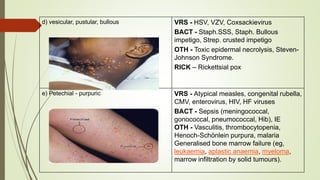
d) vesicular, pustular, bullous VRS - HSV, VZV, Coxsackievirus
BACT - Staph.SSS, Staph. Bullous
impetigo, Strep. crusted impetigo
OTH - Toxic epidermal necrolysis, Steven-
Johnson Syndrome.
RICK – Rickettsial pox
e) Petechial - purpuric VRS - Atypical measles, congenital rubella,
CMV, enterovirus, HIV, HF viruses
BACT - Sepsis (meningococcal,
gonococcal, pneumococcal, Hib), IE
OTH - Vasculitis, thrombocytopenia,
Henoch-Schönlein purpura, malaria
Generalised bone marrow failure (eg,
leukaemia, aplastic anaemia, myeloma,
marrow infiltration by solid tumours).
f) Erythema Nodosum VRS - EBV, HBV
BACT - Group A Streptococcus
TB, yersinia, Cat-Scratch Dzs
FUNGI - Coccidiomycosis,
histoplasmosis
OTH - Sarcoidosis, Inf. Bowel
dzs, OCP, SLE, Behçet dzs
HISTORY
Past medical history:
Known disorders that predispose to infection (eg,
HIV infection, diabetes, cancer, organ
transplantation, sickle cell disease, valvular heart
disorders—particularly if an artificial valve is
present)
Other known disorders that predispose
to fever (eg, rheumatologic disorders, SLE, gout,
sarcoidosis, hyperthyroidism, cancer)
HISTORY
Past medical history:
 Drug history should include specific questions about the following:
Drugs known to cause fever
 Drugs that predispose to increased risk of infection (eg, corticosteroids, anti-
TNF drugs, chemotherapeutic and antirejection drugs, other
immunosuppressant)
 Illicit use of injection drugs
 Vaccination history, particularly against hepatitis A and B and against
organisms that cause meningitis, influenza, or pneumococcal infection,
should be noted.
 SURGICAL HISTORY:
HISTORY
• SOCIAL HISTORY:
• SMOKING & ALCOHOL USE
• SEXUAL HISTORY
• OCUBATIONAL HISTORY (habits)
• TRADITIONAL EVENTS
• TRAVEL HISTORY
 In PHYSICAL EXAMINATION :
a) GENERAL STATUS
b) SKIN RASH Distribution pattern-MORPHOLOGY-
CONFIGURATION
C) Systemic examination searching for complications
Most common finding with fever
Stiff neck or bulging fontanel (meningitis)
 Strawberry tongue : scarlet fever – Kawasaki disease
 KOPLIK SPOTS: MEASLES
 FORSCHHEIMER SPOTS: RUBELLA
 PEELING IF SKIN OF FINGERS AND FOOT:SCARLET FEVER -
KAWASAKI
Management of different cases of fever
and rash
CASE SCENARIO
History:
 9 mo old girl, good general health condition
 Progressive fever for 5 days (max. 39.50C)
 Coryza, exudative conjunctivitis
 Severe cough and irritability
 No diarrhea, no vomiting
 No recent travel, no pets
 Rashes - over trunk, abdomen and back
- appear 4 days after onset of fever
- not elevated and no itching
- blanching on pressure
Confluent maculo-papular rash all
over the body
MEASLES
Characteristic EXPLAINATION
Causative Agent Measles virus ( ssRNA paramyxovirus)
Host Human
Invade Upper respiratory tract, regional LN
Transmited by Large respiratory droplets with no fomites (close contact
transm.)
Virus present Respiratory secretion, blood, urine
Period of
communicability
Contagious from 5 days before to 4 days after the appearance
of rash.
CLINICAL MANIFESTATION
 Divided into 4 phases :-
a) Incubation
- IP = 8 to 12 days from exposure to the onset of symptoms, 14 days from
exposure to the onset of rash.
b) Prodromal (catarrhal)
- cough, coryza, conjunctivitis (Stimson line) Koplik spots (buccal mucosa)
c) Exanthematous (rash)
- accompanied by high grade fever (40-40.5°C)
- The rash starts behind the ears and on the forehead at the hair line
spread down to the leg (descending)
- show severity of the illness
d) recovery
MACULAR RASH
KOPLIK SPOTS
CONJUNCTIVITIS
Other manifestations :
 Cervical lymphadenitis
 Spleenomegaly
 Abdominal pain
 encephalitis
 Mesenteric lymphadenopathy
 Otitis media
 Pneumonia common in infants
 Diarrhea
 Liver involvement – common in adult
COMPLICATIONS
Acute otitis media (10-15%)
Interstitial pneumonia (50-75% pathological chest XR)
 Myocarditis and pericarditis
Encephalitis (1/1000 cases) 7-10 days after rash
Subacute sclerosis panencephalitis
Mesenteric lymphadenitis
Action plan:
1- Collect Samples :Take 2 Blood Sample One Serum And
Heparinized – Throat Or Nasopharyngeal Swab- Urine Sample
And Send It To Central Lab – If No Lab Send To Hospital
2- Notify
3 – Give Supportive Care –ASSESS NEED FOR ADNISSION
OTHER WISE DISCHARGE HOME
MANAGEMENT
TREATMENT
Routine supportive care
maintain adequate hydration
antipyretics
IV ribavirin (severe infection)
High dose for vitamin A supplementation
Antibiotics for conjunctivitis-otitis media -
pneumonia
PREVENTION
MMR
Live attenuated measles vaccine
1st dose : 12-15 month of life
2nd dose : 18 months old
* Contraindicated for severe immunosupression
patient
RUBELLA
Characteristic EXPLAINATION
Causative
Agent
Rubella virus ( ssRNA, togavirus family)
Host Human
Invade Respiratory epithelium
Transmited by Susceptible contact
Infection in utero (congenital rubella synd) during the 1st
trimester
Virus present Nasopharyngeal secretion, urine
Period of
communicabilit
y
contagious from 2 days before until 5 to 7 days after the
onset of rash
CLINICAL MANIFESTATION
 IP = 14 to 21 days
 Rashes - begins on the face, spreads down to the body and lasts far three days.
Retroauricular,
posterior cervical,
posterior occipital
lymphadenopathy
Erythematous,
maculopapular,
discrete rashes
Forschheimer spots (rose-colored spots on the
soft palate)
Mild pharyngitis
Conjunctivitis
Anorexia
Headache
Low grade fever
Polyarthritis
Erythematous
maculopapular
discrete rash
Forschheimer
spots
COMPLICATIONS
 Rarely complicated compared to measles
 pregnancy – congenital rubella syndrome
- IUGR
- cataracts
- deafness
- patent ductus arteriosus (PDA)
PRINCIPLE OF MANAGEMENT
TREATMENT
 No specific therapy
 Routine supportive care
 Congenital Rubella Syndrome baby should be isolated
PREVENTION
 Live attenuated MMR vaccine
Children at age 12-15 months of life
Children at age 4-6 yrs old
Pregnant woman should be immunized after delivery
Clinical case
 History: 5 y old boy, no special
past medical history
 Low grade fever (38.30C) for 48
h
 Attends school
 No travel history
 No pets
 Vesicular rash on the trunk and
face
Varicella (chickenpox)
 Causes: Varicella zoster virus (VZV, herpesvirus family)
 Human are the only natural host
 Chickenpox (vericella) = manifestation of primary infection
 Highly contagious among susceptible individuals; secondary
attack rate is more than 90%)
 Contagiosity: 2 days before to 7 days after the onset of the
rash, when all lesions are crusted
Peak age: 5 to 10 years old
Peak seasonal infection: late winter and spring
Transmission: direct contact, droplet, and air
Incubation period: 14-16 days
Clinical manifestation
 Prodromal symptoms: fever, malaise, anorexia (preceed the rash
by 1 day)
 Characteristic rash: small red papules> Erythematous papules>
vesicular> vesicles ulcerate, crust and heal (new crops appear for
3-4 days)
 Pattern of rash: beginning on the trunk followed by the head, face,
and less commonly the extremities
 Pruritus is universal and marked
 Lesions may also present on mucosa membranes
 Lymphadenopathy may be generalized
Complication
 More severe for neonates, adults, and immunocompromised persons.
- Secondary infection of skin by streptococci pr staphylococci
- Thrombocytopenia and haemorragic lesions or bleeding may occur (varicella
gangrenosa)
- Pneumonia (15-20% 0f healty adults and immunlcompromised persons,
uncommon in healthy children)
- Myocarditis, pericarditis, orchitis, hepatitis, ulcerative gastritis,
glomerulonephritis and athritis may complicate
- Reye syndrome may follow varicella (aspirin use is contraindicated)
- Neurological complication: post infectious enencephaly, cerebellar ataxia,
nystagmus and tremor.
 Congenital infection
-characteristic: low birth weight, cortical atrophy, seizure, mental
retardation, chorioretinitis, cataracts,microcephaly
 Perinatal infection
-severe form of noenatal varicella
TREATMENT:
 Symptomatic therapy: Nonaspirin antipyretics, cool baths, careful
hygiene
 Antiviral treatment: acyclovir, famciclovir, valacyclovir
Prevention
Children with chickenpox should not return to school
until all vesicle have crusted
Live attenuated varicella (primary prevention)
Passive immunity by VZIG (secondary prevention)
for:
Susceptible pregnant women &
immunocompromised patient
New born of mother infected 5ds before delivery or 2
ds after delivery
Herpes Zoster
• After the primary infection, the varicella-zoster virus lies dormant in the
dorsal root ganglia. Herpes zoster is caused by reactivation of the
virus.
• incidence increases significantly with age and in immunocompromised
patients.
• The characteristic vesicular rash of herpes zoster usually affects a
single dermatome and rarely crosses the midline
• A prodrome of unusual skin sensations may evolve into pain, burning
and paresthesias, which precede the rash by two to three days.
complication
 Pain is the most debilitating feature of herpes zoster, and postherpetic neuralgia is
the most common long-term complication.
 Other potential complications include:
 secondary infection,
 meningo-encephalitis,
 transverse myelitis, pneumonitis,
 hepatitis, myocarditis, pancreatitis, esophagitis, cystitis, granulomatous arteritis,
conjunctivitis and Ramsay Hunt syndrome (herpes zoster involving the facial and
auditory nerves).
Treatment
Medications used include:
 steroids,
 analgesics,
anticonvulsants,
 antiviral agents.
Hand,foot and mouth
disease
Hand,foot and mouth disease
most often occurs in children under 10 years old.
Causes: coxsackie virus A16, enterovirus 71 (EV71)
and other enteroviruses.
The enterovirus group includes polioviruses,
coxsackieviruses, echoviruses and other
enteroviruses.
 more frequent in summer and early autumn (in
temperate countries)
moderately contagious.
A person is most contagious during the first week of
the illness.
transmitted from person to person via direct contact
with nose and throat discharges, saliva, fluid from
blisters, or the stool of infected persons.
(incubation period) is 3 to 7 days. Fever is often the
first symptom of HFMD followed by blister/rash.
Clinical manifestation
 mild fever,
 poor appetite,
 malaise ("feeling sick"), and
 frequently a sore throat.
 One or 2 days after the fever begins, painful sores develop in the mouth.
They begin as small red spots that blister and then often become ulcers.
 They are usually located on the tongue, gums, and inside of the cheeks.
 The skin rash develops over 1 to 2 days with flat or raised red spots, some
with blisters on the palms of the hand and the soles of the feet.
Blister on the palms of the hands Blister on the soles of the feet
Blister then become ulcer on the inner
gums
Blister on the dorsum of the feet
Complication
 HFMD caused by coxsackie virus A16 infection is a mild
disease and nearly all patients recover within 7 to 10 days.
Complications are uncommon.
HFMD caused by Enterovirus EV71 may be associated
with neurological complications such as aseptic meningitis
and encephalitis
Treatment
no specific effective antiviral drugs and vaccine available for
the treatment of HFMD.
Symptomatic treatment is given to provide relief from fever,
aches, or pain from the mouth ulcers.
Dehydration is a concern because the mouth sores may
make it difficult and painful for children to eat and drink.
Prevention
 good hygienic practices. Preventive measures include:
 a. Frequent hand washing, especially after diaper changes, after using toilet and before
preparing food,
 b. Maintain cleanliness of house, child care center, kindergartens or schools and its
surrounding,
 c. Cleaning of contaminated surfaces and soiled items with soap and water, and then
disinfecting them with diluted solution of chlorine-containing bleach (10%
concentration),
 d. Parents are advised not to bring young children to crowded public places such as
shopping centers, cinemas, swimming pools, markets or bus stations,
 e. Bring children to the nearest clinic if they show signs and symptoms. Refrain from
sending them to child care centers, kindergartens or schools.
 f. Avoidance of close contact (kissing, hugging, sharing utensils, etc.) with children
having HFMD illness to reduce of the risk of infection
• caused by Neisseria meningitidis (meningococcus)
• transmission: person-to-person by respiratory
droplets
 colonization of URT  penetrate into bloodstream
 go to CNS and causing meningitis
(meningococcal meningitis) / infect the blood
vessel (meningococcemia)
• Meningococcemia / meningococcal septicaemia:
 cutaneous signs:
1. Maculopapular – early, often on a painful joint
or pressure point
2. Petechiae (50-70%) – distribute at trunk and
extremities (can be anywhere else)
3. Purpura (may start anywhere on the body and
.
Meningococcal septicemia can kill
children in hours, therefore optimal
outcome requires immediate
recognition, prompt resuscitation
and antibiotics.
Although there are now
polysaccharide conjugate vaccines
against groups A and C
meningococcus, there is still no
effective vaccines for group B
meningococcus
 History: 7 y. old boy, good general health condition
 Sudden onset of sore throat since 24hrs and
fever at 39oC. Abdominal pain and
1 episode of vomiting
 No conjuntivitis,No rhinitis,No cough
 There is rash which look like sunburn
and feel like sandpaper
 Strawberry tongue
 Attends primary school, no recent travel
CLINICAL CASE
Scarlet Fever
 caused by group A streptococcus (GAS)--- transmission: direct contact through droplets
Although anyone can get scarlet fever, it usually affects children between 5 and 15 years old.
• symptoms:
 rashes:
 develop 24 hours after the fever -can begins at below ears , neck, chest and stomach
then spread all over the body within 1 to 2 days
 look like sunburn and feel like sandpaper
 more apparent at skin fold of elbow, armpit and groin area
 last for about 2-7 days
 as the rash faded, skin at the tips of lips and fingers begin to peel
 flush face --- fever >38.3°C------- swollen glands at the neck
white or yellow spot coating on the throat and tonsil
“strawberry tongue”
•
• In body folds, especially the armpits and elbows, fragile
blood vessels (capillaries) can rupture and cause classic
red streaks called Pastia lines. These may persist for 1-2
days after the generalised rash has gone.
 Diagnosis:
1.Throat culture remains the criterion standard for
confirmation of group A streptococcal upper respiratory
infection.
2.Complete blood count
 White blood cell (WBC) count in scarlet fever may increase to 12,000-16,000 per
mm3, with a differential of up to 95% polymorphonuclear lymphocytes.
 During the second week, eosinophilia, as high as 20%, can develop.
 Treatment : Penicillin remains the drug of choice.
Erythromycin can be considered as an alternative
KAWASAKI DISEASE
• characterized by fever at least for 5 days together
with 4 of the following 5 findings:
 conjungtival infection
 mucous membrane changes (pharyngeal red, dry,
cracied lips, strawberry tongue)
 cervical lymphadenopathy
 rash
 redness or swelling of the hands and feet,
generalized skin peeling
• age: 4 month – 6 years
• cause is unknown
• complication: coronary artery aneurysm, sudden
death
Complications
Coronary artery aneurysm
Prognosis
75% no sequelae, 25% coronary
abnormality (without treatment),
1-2% mortality in the acute phase
Erythema infectiosum
 Fifth disease is a mild rash illness caused by parvovirus B19. This disease, also called erythema
infectiosum, It is more common in children than adults. A person usually gets sick with fifth disease
within 4 to 14 days after getting infected with parvovirus B19.
 Signs & Symptoms
 The first symptoms of fifth disease are usually mild and may include
 fever,
 runny nose, and
 headache.
 After several days, you may get a red rash on your face called "slapped cheek" This rash is the most
recognized feature of fifth disease. It is more common in children than adults.
 Some people may get a second rash a few days later on their chest, back, buttocks, or arms and legs.
The rash may be itchy, especially on the soles of the feet. It can vary in intensity and usually goes away
in 7 to 10 days, but it can come and go for several weeks. As it starts to go away, it may look lacy.
 painful or swollen joints
The joint pain usually lasts 1 to 3 weeks, but it can last for months or longer. It usually goes away
without any long-term problems.
 Complications
 Fifth disease is usually mild for children and adults who are otherwise healthy. But for some
people fifth disease cause serious health complication. It can cause chronic anemia that
requires medical treatment.
 Transmission
 Parvovirus B19—which causes fifth disease—spreads through respiratory secretions
 Treatment
 Fifth disease is usually mild and will go away on its own. Children and adults who are
otherwise healthy usually recover completely. Treatment usually involves relieving
symptoms, such as fever, itching, and joint pain and swelling.
Roseoa infantum
 Roseola is a common childhood infection that is caused by the same family
of viruses that is responsible for chickenpox and shingles. Roseola is
primarily caused by a virus called human herpesvirus 6 (HHV-6) and less
frequently by human herpesvirus 7 (HHV-7). This virus can be spread by tiny
droplets
 Roseola is generally a childhood infection, with most cases occurring before the
age of 2.
 Roseola is a common childhood infection that is caused by the same family
of viruses that is responsible for chickenpox and shingles
 Symptoms:
 Fever last for 3-5 ds accompanied by malaise
 Fever subside after 4ds then
 characteristic faint, rosy-pink widespread rash that may develop. Small, flat,
discoloured spots on the skin with tiny raised bumps (2 mm to 5 mm in diameter)
first appear on the trunk of the body. This rash may then spread to the neck and
legs, but rarely will it involve the face. This rash is neither itchy nor pus-forming
and tends to whiten when pressure is applied to the reddened area. Typically, the
rash will clear within a few hours, but may last up to 2 days.
 Complication:
Children: febrile convulsion
Can cause meningoencephalitis, or hepatitis in adult
 Treatmnet :
Supportive
 Prevention:
No vaccine
INFECTIOUS MONONUCLEOSIS
 Caused by Epstein-Barr virus (EBV)
 Has particular tropism for B lymphocytes and epithelial cells of
the pharynx
 Transmission usually occurs by oral contact
Signs and symptoms
 Fever
 Malaise
 Tonsillopharygitis – often severe, limiting oral ingestion of fluids
and food, rarely breathing can be compromised
 Lymphadenopathy – prominent cervical lymph nodes
 Petechiae on the soft palate
 Splenomegaly (50%), hepatomegaly (10%)
 Maculopapular rash (5%)
 DIAGNOSIS
 Patients with infectious mononucleosis in the
differential diagnoses should have a CBC count
with differential and an evaluation of the
erythrocyte sedimentation rate (ESR)
 Because the liver is uniformly involved in EBV
infectious mononucleosis, mild elevation of the
serum transaminases is a constant finding in
early EBV infectious mononucleosis.
 Heterophile antibody tests
 Patients with infectious mononucleosis should first be tested with a
heterophile antibody test. The most commonly used is the latex
agglutination assay using horse RBCs, and it is marketed as the
Monospot test.
TREATMENT
 Medical Care
 Closely monitor patients with extreme tonsillar enlargement for
airway obstruction. Steroids are indicated for impending or
established airway obstruction in individuals with Epstein-Barr virus
(EBV) infectious mononucleosis.
Surgical Care
 Surgery is necessary for spontaneous splenic rupture, which occurs
in rare patients with EBV infectious mononucleosis and may be the
initial manifestation of the condition.
REFERRENCES
 Evaluating the Febrile Patient with a Rash. Am Fam Physician. 2000 Aug 15;62(4):804-816.
 www.slideshare.net/whiteraven68/2-fever-w-rash
 http://www.merckmanuals.com/professional/dermatologic-disorders/approach-to-the-dermatologic-
patient/description-of-skin-lesions
 http://www.fastbleep.com/medical-notes/other/4/52/310
 http://www.who.int/mediacentre/factsheets/fs286/en/
 http://www.cdscoman.org/uploads/cdscoman/CDS%20Manual.pdf
 http://www.cdc.gov/parvovirusb19/fifth-disease.html
 http://www.medicinenet.com/roseola/article.htm
 http://emedicine.medscape.com/article/1132465-treatment
THANK YOU

Fever & Rash

  • 1.
    Dr. Badriya Al-mahrouqi SeniorSpecialist – Family Physician
  • 2.
    Outline Definitions Approach to patientwith fever & rash Differential diagnosis for fever and rash Management of different cases of fever and rash
  • 3.
    WHAT IS ? FEVER -temporary ↑ in the body’s temperature in response to some disease or illness (37.5°C) RASH - temporary eruption of the skin - discrete red spots / generalized reddening - accompanied by itching
  • 4.
    MACULE The lesion in thisimage is a macule because it is flat, nonpalpable, and of small diameter.
  • 5.
    Patch A lesion which ismore than 0.5cm in diameter with an area of colour change.
  • 6.
    PAPULES Solid, raised lesion upto 0.5 cm in greatest diameter
  • 7.
    NODULE Similar to papulebut located deeper in the dermis or subcutaneous tissue; differentiated from papule by palpability and depth, rather than size
  • 8.
    PUSTULE Circumscribed elevation of skin containingpurulent fluid of variable character (i.e., fluid may be white, yellow, greenish or hemorrhagic)
  • 9.
    VESICLES Circumscribed, elevated, fluid- containing lesion lessthan 0.5 cm in greatest diameter; may be intraepidermal or subepidermal in origin
  • 10.
    BULLA Same as vesicle, except lesionis more than 0.5 cm in greatest diameter
  • 11.
    'purpura 'purpura‘ is apurplish discolouration of the skin produced by small bleeding vessels near the surface or in the mucous membranes, especially of the mouth and in the internal organs. When purpura spots are very small (<1 cm in diameter), they are called petechiae or petechial haemorrhages. Larger, deeper purpura are referred to as ecchymoses or bruising.
  • 12.
  • 13.
    wheal A wheal isan oedematous papule or plaque caused by swelling in the dermis.
  • 14.
  • 15.
    Approach To PatientWith Fever & Rash
  • 16.
    Approach To PatientWith Fever & Rash FOUR general issues are important in the initial evaluation of fever & rash: ASSESS SEVERITY OF ILLNESS CONFIRMATION OF FEVER & DETERMINE TYPE OF RASH NARROW THE RANGE OF POSSIBLE CAUSES DO THE PROPER ACTION PLAN
  • 17.
    TRIAGE ASSESS SEVIRITY OFILLNESS Confirmation of fever
  • 19.
    warning signs  Decreasedalertness  Decreased BP  Increased HR  h/o seizure  Petechial rash  Neck stiffness  Dehydration
  • 20.
    CONFIRMATION OF FEVER RULEOUT: outside factors:  Body temperature is affected by dress –sleep –exercise- nutrition – place temperature. Accepted values:  Rectal temperature :above (38ºC)  Oral temperature: above (37.8ºC)  Axillary temperature: above (37.2ºC)  Forehead temperature: above (38ºC)  Ear temperature (38ºC) in rectal mode (37.5ºC) in oral mode
  • 22.
    HISTORY History Of PresentIllness:  Ask about MUSCATS  MODE OF FEVER: DURATION & FLACTUWATION –SEVIRITY  USED MEDICATION AND INVESTIGATION  SYMPTOMS: rash – jaundice – lymphnodes-PAIN- COUGH  CONTACT WITH ANIMALS AND SICK PEOPLE  Admission  TRAVEL HISTORY: include location, time since return, locale (eg, in back country, only in cities), vaccinations received before travel, and any use of prophylactic antimalarial drugs. All patients should be asked about possible exposures (eg, via unsafe food or water, insect bites, animal contact, or unprotected sex).  Sex - unprotected
  • 23.
    HISTORY Review of systems: Symptoms and signs of differential diagnosis
  • 24.
    DIFFERENTIAL DIAGNOSIS OFFEVER WITH RASH LESION PATHOGENS OR INFECTION a) Maculopapular rash: central distribution VRS - Measles, rubella, roseola, erythema infectiosum, EBV, echovirus, HBV, HIV BACT - Erythema marginatum, scarlet fever, erysipelas, 2° syphilis, leptospirosis, Lyme dzs, RICK – Rocky Mountain Spotted fever, Typhus OTH – RA, Kawasaki dis, drug rxn
  • 25.
    DIFFERENTIAL DIAGNOSIS OFFEVER WITH RASH LESION PATHOGENS OR INFECTION a) Maculopapular rash: peripheral distribution – ERYTHEMA MULTIFORME VRS - HSV, EBV, echovirus, BACT - , 2° syphilis, leptospirosis, Lyme dzs, RICK – Rocky Mountain Spotted fever OTH – RADIATION RX, drug rxn, Meningococcemia, and dengue fever
  • 26.
    b) Diffuse erythemawith desquamation  Scarlet fever  TOXIC SHOCK SYNDROME AND SCALDED SKIN SYNDROME
  • 27.
    d) vesicular, pustular,bullous VRS - HSV, VZV, Coxsackievirus BACT - Staph.SSS, Staph. Bullous impetigo, Strep. crusted impetigo OTH - Toxic epidermal necrolysis, Steven- Johnson Syndrome. RICK – Rickettsial pox e) Petechial - purpuric VRS - Atypical measles, congenital rubella, CMV, enterovirus, HIV, HF viruses BACT - Sepsis (meningococcal, gonococcal, pneumococcal, Hib), IE OTH - Vasculitis, thrombocytopenia, Henoch-Schönlein purpura, malaria Generalised bone marrow failure (eg, leukaemia, aplastic anaemia, myeloma, marrow infiltration by solid tumours).
  • 28.
    f) Erythema NodosumVRS - EBV, HBV BACT - Group A Streptococcus TB, yersinia, Cat-Scratch Dzs FUNGI - Coccidiomycosis, histoplasmosis OTH - Sarcoidosis, Inf. Bowel dzs, OCP, SLE, Behçet dzs
  • 29.
    HISTORY Past medical history: Knowndisorders that predispose to infection (eg, HIV infection, diabetes, cancer, organ transplantation, sickle cell disease, valvular heart disorders—particularly if an artificial valve is present) Other known disorders that predispose to fever (eg, rheumatologic disorders, SLE, gout, sarcoidosis, hyperthyroidism, cancer)
  • 30.
    HISTORY Past medical history: Drug history should include specific questions about the following: Drugs known to cause fever  Drugs that predispose to increased risk of infection (eg, corticosteroids, anti- TNF drugs, chemotherapeutic and antirejection drugs, other immunosuppressant)  Illicit use of injection drugs  Vaccination history, particularly against hepatitis A and B and against organisms that cause meningitis, influenza, or pneumococcal infection, should be noted.  SURGICAL HISTORY:
  • 31.
    HISTORY • SOCIAL HISTORY: •SMOKING & ALCOHOL USE • SEXUAL HISTORY • OCUBATIONAL HISTORY (habits) • TRADITIONAL EVENTS • TRAVEL HISTORY
  • 32.
     In PHYSICALEXAMINATION : a) GENERAL STATUS b) SKIN RASH Distribution pattern-MORPHOLOGY- CONFIGURATION C) Systemic examination searching for complications
  • 33.
    Most common findingwith fever Stiff neck or bulging fontanel (meningitis)  Strawberry tongue : scarlet fever – Kawasaki disease  KOPLIK SPOTS: MEASLES  FORSCHHEIMER SPOTS: RUBELLA  PEELING IF SKIN OF FINGERS AND FOOT:SCARLET FEVER - KAWASAKI
  • 34.
    Management of differentcases of fever and rash
  • 35.
    CASE SCENARIO History:  9mo old girl, good general health condition  Progressive fever for 5 days (max. 39.50C)  Coryza, exudative conjunctivitis  Severe cough and irritability  No diarrhea, no vomiting  No recent travel, no pets  Rashes - over trunk, abdomen and back - appear 4 days after onset of fever - not elevated and no itching - blanching on pressure
  • 36.
  • 37.
    MEASLES Characteristic EXPLAINATION Causative AgentMeasles virus ( ssRNA paramyxovirus) Host Human Invade Upper respiratory tract, regional LN Transmited by Large respiratory droplets with no fomites (close contact transm.) Virus present Respiratory secretion, blood, urine Period of communicability Contagious from 5 days before to 4 days after the appearance of rash.
  • 38.
    CLINICAL MANIFESTATION  Dividedinto 4 phases :- a) Incubation - IP = 8 to 12 days from exposure to the onset of symptoms, 14 days from exposure to the onset of rash. b) Prodromal (catarrhal) - cough, coryza, conjunctivitis (Stimson line) Koplik spots (buccal mucosa) c) Exanthematous (rash) - accompanied by high grade fever (40-40.5°C) - The rash starts behind the ears and on the forehead at the hair line spread down to the leg (descending) - show severity of the illness d) recovery
  • 39.
  • 40.
    Other manifestations : Cervical lymphadenitis  Spleenomegaly  Abdominal pain  encephalitis  Mesenteric lymphadenopathy  Otitis media  Pneumonia common in infants  Diarrhea  Liver involvement – common in adult
  • 41.
    COMPLICATIONS Acute otitis media(10-15%) Interstitial pneumonia (50-75% pathological chest XR)  Myocarditis and pericarditis Encephalitis (1/1000 cases) 7-10 days after rash Subacute sclerosis panencephalitis Mesenteric lymphadenitis
  • 42.
    Action plan: 1- CollectSamples :Take 2 Blood Sample One Serum And Heparinized – Throat Or Nasopharyngeal Swab- Urine Sample And Send It To Central Lab – If No Lab Send To Hospital 2- Notify 3 – Give Supportive Care –ASSESS NEED FOR ADNISSION OTHER WISE DISCHARGE HOME
  • 43.
    MANAGEMENT TREATMENT Routine supportive care maintainadequate hydration antipyretics IV ribavirin (severe infection) High dose for vitamin A supplementation Antibiotics for conjunctivitis-otitis media - pneumonia
  • 44.
    PREVENTION MMR Live attenuated measlesvaccine 1st dose : 12-15 month of life 2nd dose : 18 months old * Contraindicated for severe immunosupression patient
  • 45.
    RUBELLA Characteristic EXPLAINATION Causative Agent Rubella virus( ssRNA, togavirus family) Host Human Invade Respiratory epithelium Transmited by Susceptible contact Infection in utero (congenital rubella synd) during the 1st trimester Virus present Nasopharyngeal secretion, urine Period of communicabilit y contagious from 2 days before until 5 to 7 days after the onset of rash
  • 46.
    CLINICAL MANIFESTATION  IP= 14 to 21 days  Rashes - begins on the face, spreads down to the body and lasts far three days. Retroauricular, posterior cervical, posterior occipital lymphadenopathy Erythematous, maculopapular, discrete rashes
  • 47.
    Forschheimer spots (rose-coloredspots on the soft palate) Mild pharyngitis Conjunctivitis Anorexia Headache Low grade fever Polyarthritis
  • 48.
  • 49.
    COMPLICATIONS  Rarely complicatedcompared to measles  pregnancy – congenital rubella syndrome - IUGR - cataracts - deafness - patent ductus arteriosus (PDA)
  • 50.
    PRINCIPLE OF MANAGEMENT TREATMENT No specific therapy  Routine supportive care  Congenital Rubella Syndrome baby should be isolated PREVENTION  Live attenuated MMR vaccine Children at age 12-15 months of life Children at age 4-6 yrs old Pregnant woman should be immunized after delivery
  • 51.
    Clinical case  History:5 y old boy, no special past medical history  Low grade fever (38.30C) for 48 h  Attends school  No travel history  No pets  Vesicular rash on the trunk and face
  • 52.
    Varicella (chickenpox)  Causes:Varicella zoster virus (VZV, herpesvirus family)  Human are the only natural host  Chickenpox (vericella) = manifestation of primary infection  Highly contagious among susceptible individuals; secondary attack rate is more than 90%)  Contagiosity: 2 days before to 7 days after the onset of the rash, when all lesions are crusted
  • 53.
    Peak age: 5to 10 years old Peak seasonal infection: late winter and spring Transmission: direct contact, droplet, and air Incubation period: 14-16 days
  • 54.
    Clinical manifestation  Prodromalsymptoms: fever, malaise, anorexia (preceed the rash by 1 day)  Characteristic rash: small red papules> Erythematous papules> vesicular> vesicles ulcerate, crust and heal (new crops appear for 3-4 days)  Pattern of rash: beginning on the trunk followed by the head, face, and less commonly the extremities  Pruritus is universal and marked  Lesions may also present on mucosa membranes  Lymphadenopathy may be generalized
  • 56.
    Complication  More severefor neonates, adults, and immunocompromised persons. - Secondary infection of skin by streptococci pr staphylococci - Thrombocytopenia and haemorragic lesions or bleeding may occur (varicella gangrenosa) - Pneumonia (15-20% 0f healty adults and immunlcompromised persons, uncommon in healthy children) - Myocarditis, pericarditis, orchitis, hepatitis, ulcerative gastritis, glomerulonephritis and athritis may complicate - Reye syndrome may follow varicella (aspirin use is contraindicated) - Neurological complication: post infectious enencephaly, cerebellar ataxia, nystagmus and tremor.
  • 57.
     Congenital infection -characteristic:low birth weight, cortical atrophy, seizure, mental retardation, chorioretinitis, cataracts,microcephaly  Perinatal infection -severe form of noenatal varicella TREATMENT:  Symptomatic therapy: Nonaspirin antipyretics, cool baths, careful hygiene  Antiviral treatment: acyclovir, famciclovir, valacyclovir
  • 59.
    Prevention Children with chickenpoxshould not return to school until all vesicle have crusted Live attenuated varicella (primary prevention) Passive immunity by VZIG (secondary prevention) for: Susceptible pregnant women & immunocompromised patient New born of mother infected 5ds before delivery or 2 ds after delivery
  • 60.
    Herpes Zoster • Afterthe primary infection, the varicella-zoster virus lies dormant in the dorsal root ganglia. Herpes zoster is caused by reactivation of the virus. • incidence increases significantly with age and in immunocompromised patients. • The characteristic vesicular rash of herpes zoster usually affects a single dermatome and rarely crosses the midline • A prodrome of unusual skin sensations may evolve into pain, burning and paresthesias, which precede the rash by two to three days.
  • 61.
    complication  Pain isthe most debilitating feature of herpes zoster, and postherpetic neuralgia is the most common long-term complication.  Other potential complications include:  secondary infection,  meningo-encephalitis,  transverse myelitis, pneumonitis,  hepatitis, myocarditis, pancreatitis, esophagitis, cystitis, granulomatous arteritis, conjunctivitis and Ramsay Hunt syndrome (herpes zoster involving the facial and auditory nerves).
  • 62.
    Treatment Medications used include: steroids,  analgesics, anticonvulsants,  antiviral agents.
  • 63.
  • 64.
    Hand,foot and mouthdisease most often occurs in children under 10 years old. Causes: coxsackie virus A16, enterovirus 71 (EV71) and other enteroviruses. The enterovirus group includes polioviruses, coxsackieviruses, echoviruses and other enteroviruses.  more frequent in summer and early autumn (in temperate countries)
  • 65.
    moderately contagious. A personis most contagious during the first week of the illness. transmitted from person to person via direct contact with nose and throat discharges, saliva, fluid from blisters, or the stool of infected persons. (incubation period) is 3 to 7 days. Fever is often the first symptom of HFMD followed by blister/rash.
  • 66.
    Clinical manifestation  mildfever,  poor appetite,  malaise ("feeling sick"), and  frequently a sore throat.  One or 2 days after the fever begins, painful sores develop in the mouth. They begin as small red spots that blister and then often become ulcers.  They are usually located on the tongue, gums, and inside of the cheeks.  The skin rash develops over 1 to 2 days with flat or raised red spots, some with blisters on the palms of the hand and the soles of the feet.
  • 67.
    Blister on thepalms of the hands Blister on the soles of the feet Blister then become ulcer on the inner gums Blister on the dorsum of the feet
  • 68.
    Complication  HFMD causedby coxsackie virus A16 infection is a mild disease and nearly all patients recover within 7 to 10 days. Complications are uncommon. HFMD caused by Enterovirus EV71 may be associated with neurological complications such as aseptic meningitis and encephalitis
  • 69.
    Treatment no specific effectiveantiviral drugs and vaccine available for the treatment of HFMD. Symptomatic treatment is given to provide relief from fever, aches, or pain from the mouth ulcers. Dehydration is a concern because the mouth sores may make it difficult and painful for children to eat and drink.
  • 70.
    Prevention  good hygienicpractices. Preventive measures include:  a. Frequent hand washing, especially after diaper changes, after using toilet and before preparing food,  b. Maintain cleanliness of house, child care center, kindergartens or schools and its surrounding,  c. Cleaning of contaminated surfaces and soiled items with soap and water, and then disinfecting them with diluted solution of chlorine-containing bleach (10% concentration),  d. Parents are advised not to bring young children to crowded public places such as shopping centers, cinemas, swimming pools, markets or bus stations,  e. Bring children to the nearest clinic if they show signs and symptoms. Refrain from sending them to child care centers, kindergartens or schools.  f. Avoidance of close contact (kissing, hugging, sharing utensils, etc.) with children having HFMD illness to reduce of the risk of infection
  • 72.
    • caused byNeisseria meningitidis (meningococcus) • transmission: person-to-person by respiratory droplets  colonization of URT  penetrate into bloodstream  go to CNS and causing meningitis (meningococcal meningitis) / infect the blood vessel (meningococcemia) • Meningococcemia / meningococcal septicaemia:  cutaneous signs: 1. Maculopapular – early, often on a painful joint or pressure point 2. Petechiae (50-70%) – distribute at trunk and extremities (can be anywhere else) 3. Purpura (may start anywhere on the body and .
  • 73.
    Meningococcal septicemia cankill children in hours, therefore optimal outcome requires immediate recognition, prompt resuscitation and antibiotics. Although there are now polysaccharide conjugate vaccines against groups A and C meningococcus, there is still no effective vaccines for group B meningococcus
  • 74.
     History: 7y. old boy, good general health condition  Sudden onset of sore throat since 24hrs and fever at 39oC. Abdominal pain and 1 episode of vomiting  No conjuntivitis,No rhinitis,No cough  There is rash which look like sunburn and feel like sandpaper  Strawberry tongue  Attends primary school, no recent travel CLINICAL CASE
  • 75.
    Scarlet Fever  causedby group A streptococcus (GAS)--- transmission: direct contact through droplets Although anyone can get scarlet fever, it usually affects children between 5 and 15 years old. • symptoms:  rashes:  develop 24 hours after the fever -can begins at below ears , neck, chest and stomach then spread all over the body within 1 to 2 days  look like sunburn and feel like sandpaper  more apparent at skin fold of elbow, armpit and groin area  last for about 2-7 days  as the rash faded, skin at the tips of lips and fingers begin to peel  flush face --- fever >38.3°C------- swollen glands at the neck white or yellow spot coating on the throat and tonsil “strawberry tongue” •
  • 76.
    • In bodyfolds, especially the armpits and elbows, fragile blood vessels (capillaries) can rupture and cause classic red streaks called Pastia lines. These may persist for 1-2 days after the generalised rash has gone.
  • 78.
     Diagnosis: 1.Throat cultureremains the criterion standard for confirmation of group A streptococcal upper respiratory infection. 2.Complete blood count  White blood cell (WBC) count in scarlet fever may increase to 12,000-16,000 per mm3, with a differential of up to 95% polymorphonuclear lymphocytes.  During the second week, eosinophilia, as high as 20%, can develop.  Treatment : Penicillin remains the drug of choice. Erythromycin can be considered as an alternative
  • 79.
    KAWASAKI DISEASE • characterizedby fever at least for 5 days together with 4 of the following 5 findings:  conjungtival infection  mucous membrane changes (pharyngeal red, dry, cracied lips, strawberry tongue)  cervical lymphadenopathy  rash  redness or swelling of the hands and feet, generalized skin peeling • age: 4 month – 6 years • cause is unknown • complication: coronary artery aneurysm, sudden death
  • 80.
    Complications Coronary artery aneurysm Prognosis 75%no sequelae, 25% coronary abnormality (without treatment), 1-2% mortality in the acute phase
  • 81.
    Erythema infectiosum  Fifthdisease is a mild rash illness caused by parvovirus B19. This disease, also called erythema infectiosum, It is more common in children than adults. A person usually gets sick with fifth disease within 4 to 14 days after getting infected with parvovirus B19.  Signs & Symptoms  The first symptoms of fifth disease are usually mild and may include  fever,  runny nose, and  headache.  After several days, you may get a red rash on your face called "slapped cheek" This rash is the most recognized feature of fifth disease. It is more common in children than adults.  Some people may get a second rash a few days later on their chest, back, buttocks, or arms and legs. The rash may be itchy, especially on the soles of the feet. It can vary in intensity and usually goes away in 7 to 10 days, but it can come and go for several weeks. As it starts to go away, it may look lacy.  painful or swollen joints The joint pain usually lasts 1 to 3 weeks, but it can last for months or longer. It usually goes away without any long-term problems.
  • 82.
     Complications  Fifthdisease is usually mild for children and adults who are otherwise healthy. But for some people fifth disease cause serious health complication. It can cause chronic anemia that requires medical treatment.  Transmission  Parvovirus B19—which causes fifth disease—spreads through respiratory secretions  Treatment  Fifth disease is usually mild and will go away on its own. Children and adults who are otherwise healthy usually recover completely. Treatment usually involves relieving symptoms, such as fever, itching, and joint pain and swelling.
  • 84.
    Roseoa infantum  Roseolais a common childhood infection that is caused by the same family of viruses that is responsible for chickenpox and shingles. Roseola is primarily caused by a virus called human herpesvirus 6 (HHV-6) and less frequently by human herpesvirus 7 (HHV-7). This virus can be spread by tiny droplets  Roseola is generally a childhood infection, with most cases occurring before the age of 2.  Roseola is a common childhood infection that is caused by the same family of viruses that is responsible for chickenpox and shingles
  • 85.
     Symptoms:  Feverlast for 3-5 ds accompanied by malaise  Fever subside after 4ds then  characteristic faint, rosy-pink widespread rash that may develop. Small, flat, discoloured spots on the skin with tiny raised bumps (2 mm to 5 mm in diameter) first appear on the trunk of the body. This rash may then spread to the neck and legs, but rarely will it involve the face. This rash is neither itchy nor pus-forming and tends to whiten when pressure is applied to the reddened area. Typically, the rash will clear within a few hours, but may last up to 2 days.
  • 86.
     Complication: Children: febrileconvulsion Can cause meningoencephalitis, or hepatitis in adult  Treatmnet : Supportive  Prevention: No vaccine
  • 88.
    INFECTIOUS MONONUCLEOSIS  Causedby Epstein-Barr virus (EBV)  Has particular tropism for B lymphocytes and epithelial cells of the pharynx  Transmission usually occurs by oral contact
  • 89.
    Signs and symptoms Fever  Malaise  Tonsillopharygitis – often severe, limiting oral ingestion of fluids and food, rarely breathing can be compromised  Lymphadenopathy – prominent cervical lymph nodes  Petechiae on the soft palate  Splenomegaly (50%), hepatomegaly (10%)  Maculopapular rash (5%)
  • 90.
     DIAGNOSIS  Patientswith infectious mononucleosis in the differential diagnoses should have a CBC count with differential and an evaluation of the erythrocyte sedimentation rate (ESR)  Because the liver is uniformly involved in EBV infectious mononucleosis, mild elevation of the serum transaminases is a constant finding in early EBV infectious mononucleosis.  Heterophile antibody tests  Patients with infectious mononucleosis should first be tested with a heterophile antibody test. The most commonly used is the latex agglutination assay using horse RBCs, and it is marketed as the Monospot test.
  • 91.
    TREATMENT  Medical Care Closely monitor patients with extreme tonsillar enlargement for airway obstruction. Steroids are indicated for impending or established airway obstruction in individuals with Epstein-Barr virus (EBV) infectious mononucleosis. Surgical Care  Surgery is necessary for spontaneous splenic rupture, which occurs in rare patients with EBV infectious mononucleosis and may be the initial manifestation of the condition.
  • 92.
    REFERRENCES  Evaluating theFebrile Patient with a Rash. Am Fam Physician. 2000 Aug 15;62(4):804-816.  www.slideshare.net/whiteraven68/2-fever-w-rash  http://www.merckmanuals.com/professional/dermatologic-disorders/approach-to-the-dermatologic- patient/description-of-skin-lesions  http://www.fastbleep.com/medical-notes/other/4/52/310  http://www.who.int/mediacentre/factsheets/fs286/en/  http://www.cdscoman.org/uploads/cdscoman/CDS%20Manual.pdf  http://www.cdc.gov/parvovirusb19/fifth-disease.html  http://www.medicinenet.com/roseola/article.htm  http://emedicine.medscape.com/article/1132465-treatment
  • 93.