Case presentationBY:SHAZLIN BT. SABAAHSALWA HANIM BT. MOHD. SAIFUDDINKAMARULZAMAN B. MUZAINI
DEMOGRAPHIC DETAILInitials 	: MHAge		: 6 years and 8 months oldEthnicity	: MalayGender	: MaleDOA	:23/12/2010DOD	: 25/12/2010Informant	: Grandmother
PRESENTING COMPLAINMH, a 6 years and 8 months old Malay boy, a known case of G6PD and asthma was admitted to HSB due to fever, cough and 1 episode of vomiting since one day prior to admission and S.O.B and rapid breathing 4 hours prior to admission.
HISTORY OF PRESENTING COMPLAINHe was previously well until 1 day prior to admission when he started to develop fever.The fever was sudden onset and low grade as he was warm to touchGrandmother claimed that the fever might be due to playing actively during the evening.There is no chills or rigor.His mother gave him syrup PCM but fever didn't subside.He vomit once after taking the medication.The vomitus contain some clear mucus and also the medication.The amount is about one table spoonNot blood-stained or bile-stained.
cont..The fever also associated with productive coughSputum was light yellow in colour with some clear mucus.Amount was about one tea spoon.It occurred mostly during night.Patient did not take any medication for this problem.At night, mother noticed that he was snoring during sleeping.Then around 12a.m, he suddenly awaken from sleep. He starts to cough continuously and develop the shortness of breath together with rapid breathing. He was then brought by his grandparents to HSB.
cont..Came to Sg. Buloh to visit aunt since 2 days prior to admission.Both his and his aunt housing area are not a dengue prone area.His father just recovered from fever 1 week prior to MH admissionNo other family members have the same symptom like him
SYSTEMIC REVIEWCVS	: No excessive night sweating, no orthopnea.CNS	: No headache/dizziness, no episode of fainting or fit 	   	  attack.GIT	: No constipation, no diarrhea, normal bowel habit.MSK	: No muscle pain or join pain.Urinary System: No dysuria or hematuria.Skin	: No rashes or itchiness.ENT	: No sore throat, no runny nose.
PAST MEDICAL/SURGICAL HxHe has been diagnosed to have asthma  since he was 4 years old.The pattern of the attack is once in 2 monthsIt occur mostly when px took cold drinks, cold weather or do vigorous exerciseHe also has the intervals symptoms of cough and wheezing.The last attack was on OctoberTook nebulizer  at GP/hospital in Ipoh if attack occur but no hospitalization required.No hx of eczema.
DRUGS HxHe is not on any medicationDoctor advice him to take MDI but mother insist as she claimed that px did not know how to handle the medication.
ALLERGIESNo known allergies
BIRTH HxBorn at Hospital Kota BaruFTSVDWeight : 2.5kgAntenatal, intrapartum and postpartum hx was uneventfulAdmitted to NICU for 15 days due to neonatal jaundice  diagnosed to have G6PD
FEEDING HxGrandmother did not recall how long he had exclusive breastfeedingCurrently he is on family diet with balance and adequate amount of fish, meat and rice
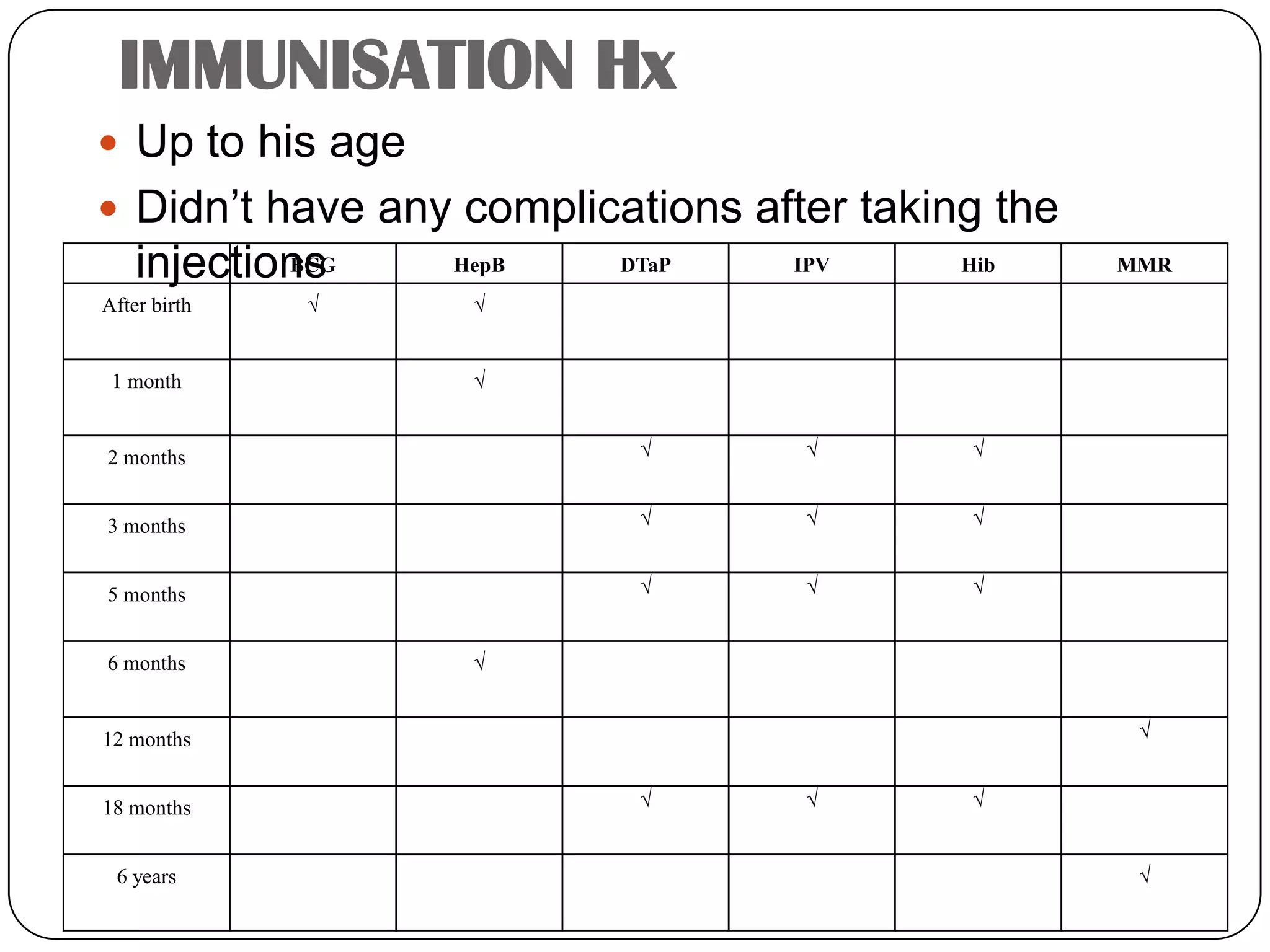
IMMUNISATION HxUp to his ageDidn’t have any complications after taking the injections
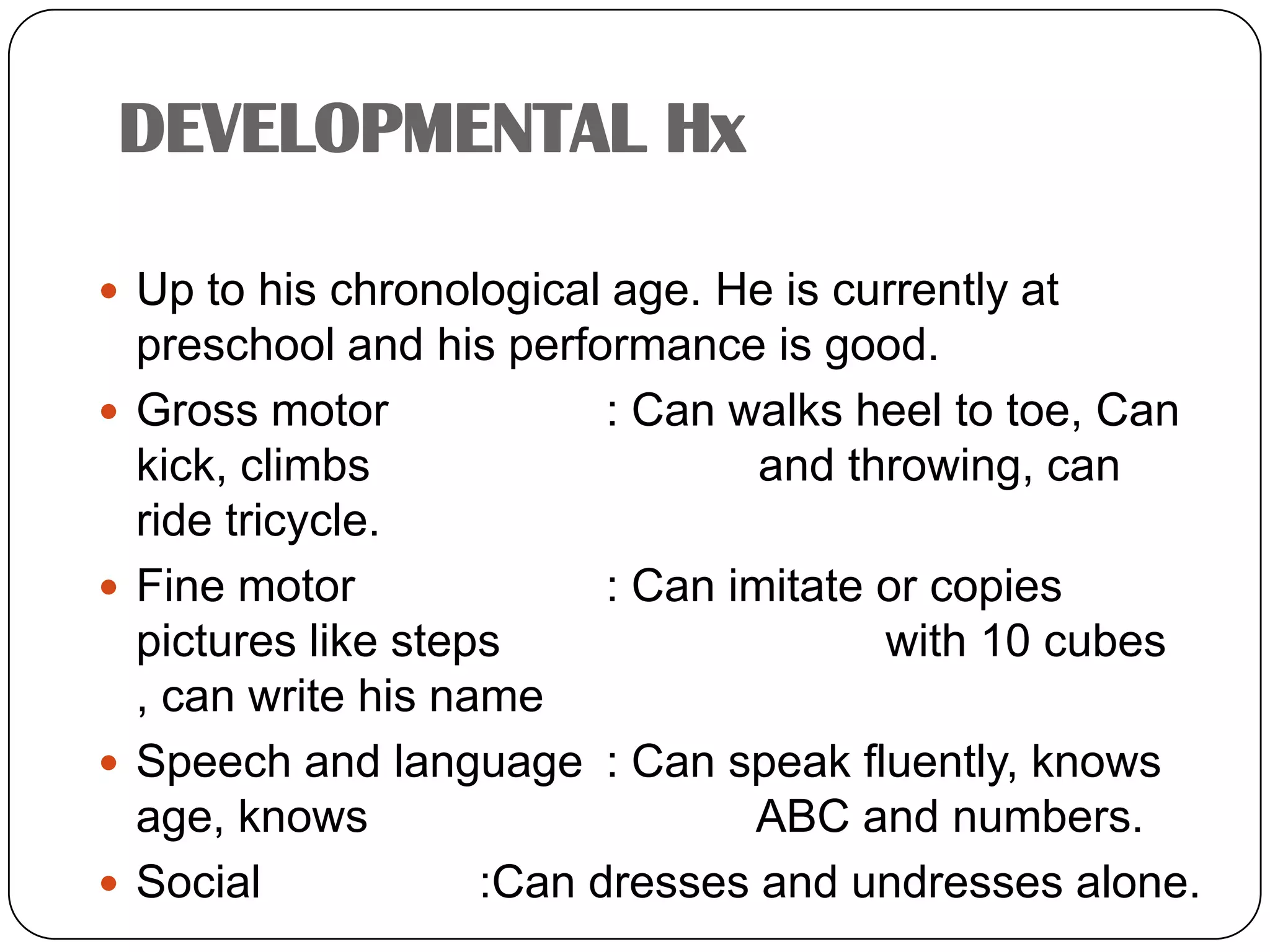
DEVELOPMENTAL HxUp to his chronological age. He is currently at preschool and his performance is good.Gross motor		: Can walks heel to toe, Can kick, climbs 			  and throwing, can ride tricycle.Fine motor		: Can imitate or copies pictures like steps 			  with 10 cubes , can write his nameSpeech and language	: Can speak fluently, knows age, knows 			  ABC and numbers.Social		:Can dresses and undresses alone.
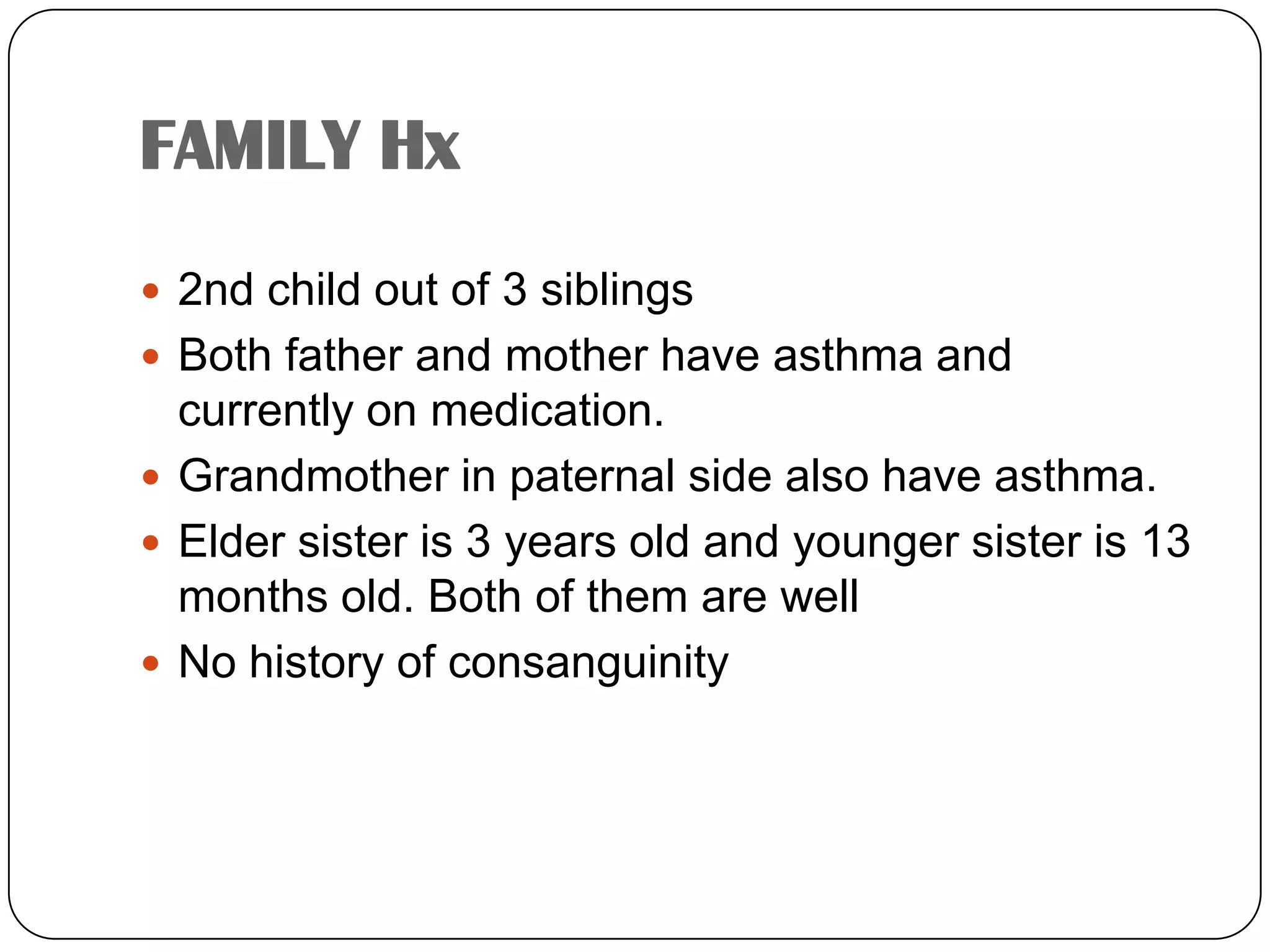
FAMILY Hx2nd child out of 3 siblingsBoth father and mother have asthma and currently on medication.Grandmother in paternal side also have asthma.Elder sister is 3 years old and younger sister is 13 months old. Both of them are wellNo history of consanguinity
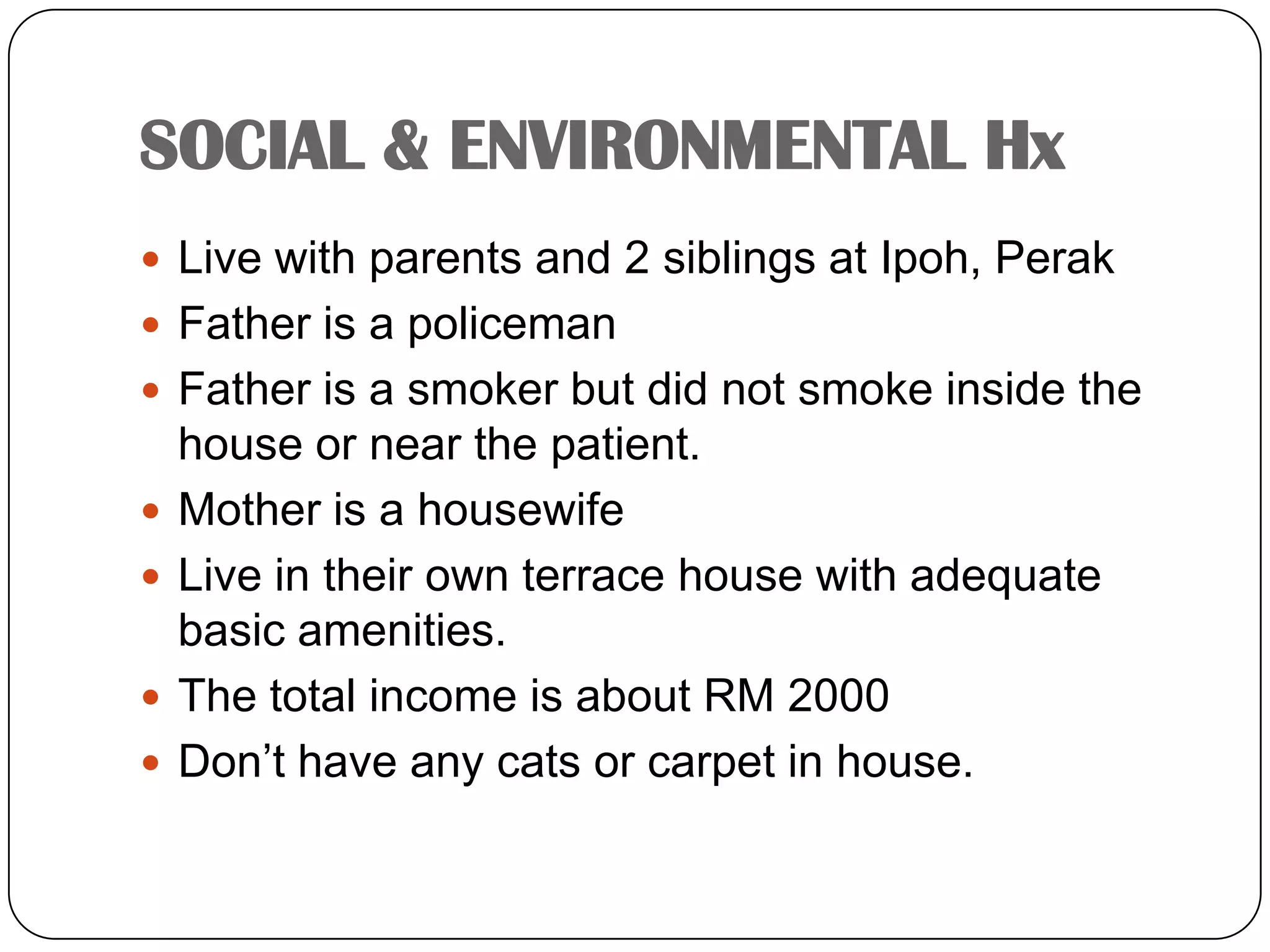
SOCIAL & ENVIRONMENTAL HxLive with parents and 2 siblings at Ipoh, PerakFather is a policemanFather is a smoker but did not smoke inside the house or near the patient.Mother is a housewifeLive in their own terrace house with adequate basic amenities.The total income is about RM 2000Don’t have any cats or carpet in house.
EFFECT OF ILLNESS They have to delay their plan to return back to Ipoh since patient was admitted.Father have to take leave from works for a few more days.Regarding the asthma, he had to go to GP several times in order to get the treatment if the asthma attack occur. Thus, a lot of time and money have been spent.The asthma also affecting MH lifestyle since this condition  had restricted him from doing certain activities or eat certain food.However, the disease didn’t give much effects in his school activities.

PHYSICAL EXAMINATION
MH was sitting on the bed comfortably. His grandmother was sitting next to him. He was conscious and cooperative and orientated to time and place. He is not in pain. He was in respiratory distress as there was suprasternal and subcostal recession. His hydration and nutritional status were good. There was a brannula attached to the dorsum of his left hand.  No gross deformities and abnormal movement seen. 1. GENERAL CONDITION
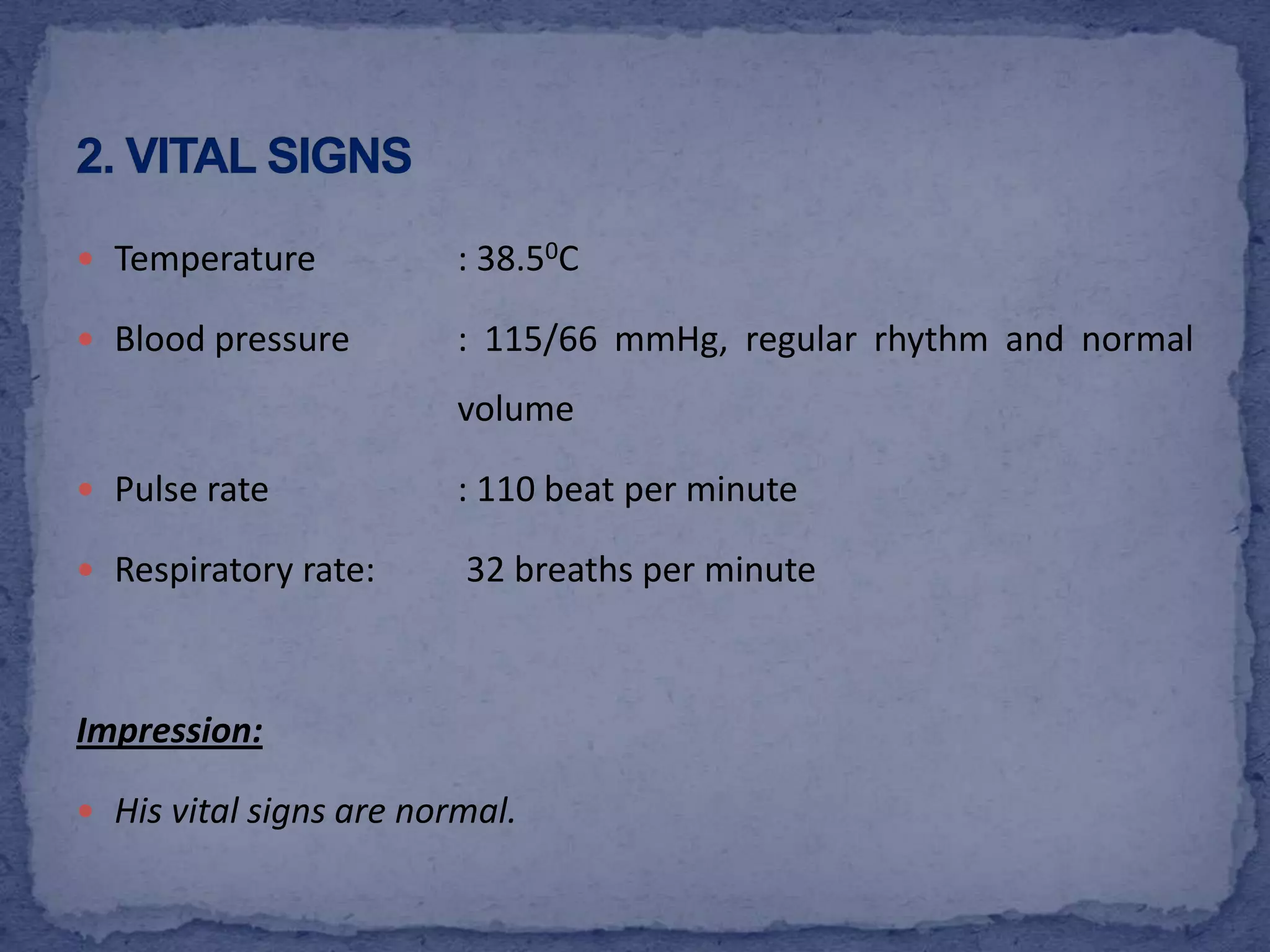
Temperature		: 38.50CBlood pressure	: 115/66 mmHg, regular rhythm and normal 			volumePulse rate		: 110 beat per minuteRespiratory rate:	 32 breaths per minuteImpression: His vital signs are normal. 2. VITAL SIGNS
Height	: 110cm. (10thcentile)Weight	: 17kg. (10thcentile)BMI		: 14.05kg/m2. (10thcentile)Impression:His growth is within 10thcentile.3.Anthropometric measurements
Appearance: No dysmorphic features.Face: No cyanosis, no pallor, no pursed lips.Oral cavity: Moist tongue and mucous membraneNo gum bleedingNo ulcersNo central cyanosisOral hygiene was goodEyes: No yellow discoloration, pink conjunctivae Ear, nose and throat: There was no nasal discharge, no ear discharge and the throat was mildly injected.4. Examination  face, head, neck & limbs
Neck: No cervical lymph nodes enlargement.Skin: Normal skin tone,no eczema, no rashes and no petechiae.Extremities:Warm peripheries No cyanosis at the nail bed No clubbing of fingersNo palmarerythemaCapillary refilling time was less than two secondsNo peripheral oedemaNo koilonychias.Impression: No abnormal findings.
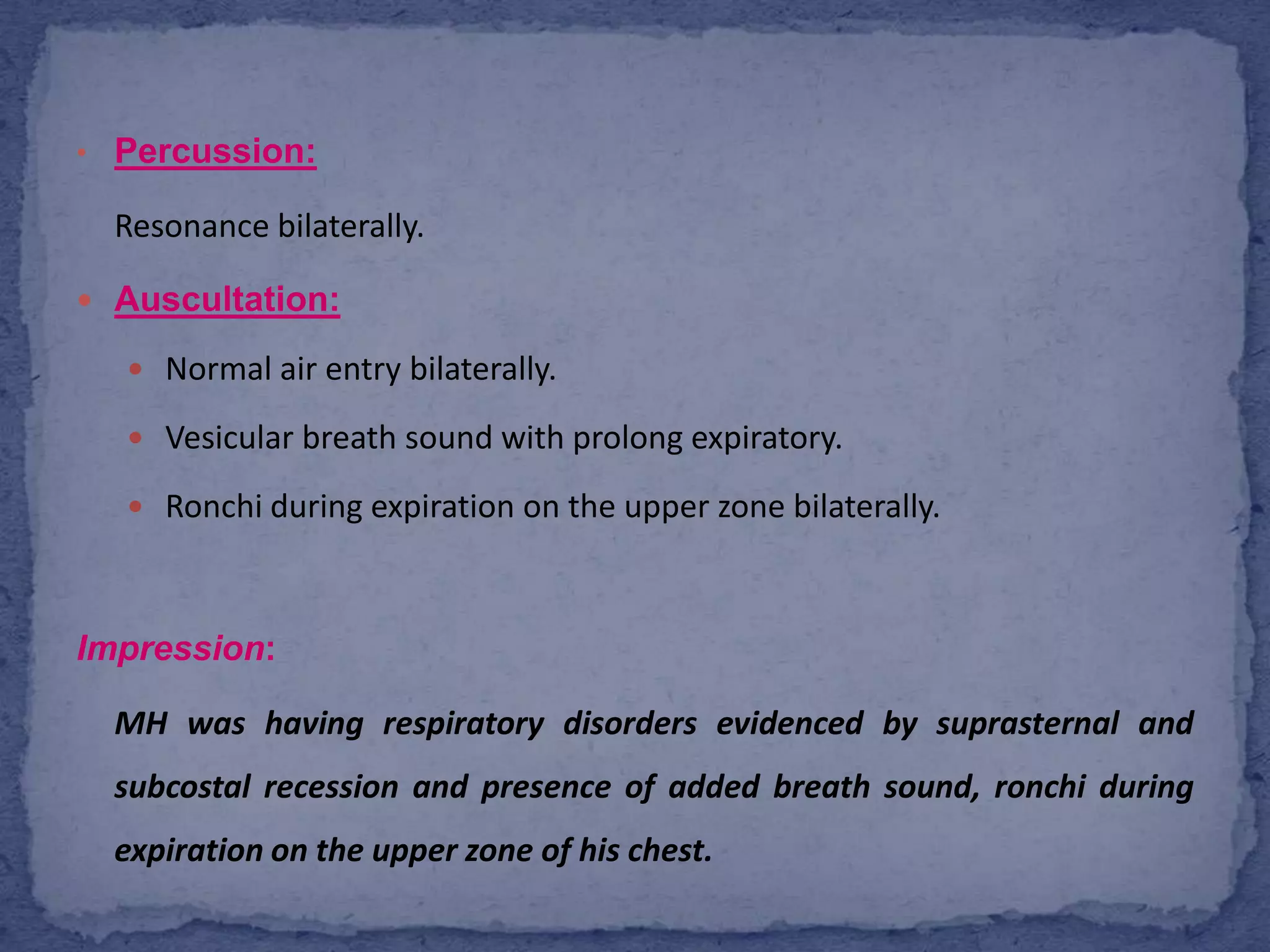
SYSTEMIC EXAMINATION1.RESPIRATORY SYSTEMInspection:The chest was barrel shape. There was no scar on the chest wall and no dilated veins. There were suprasternal and subcostal recession. The chest moved symmetrically with respiration.Palpation:The trachea was centrally located. The chest expansion was symmetrical bilaterally. The apex beat was palpable at 5th intercostals within midclavicular line. Vocal fremitus was equal bilaterally.
 Percussion:Resonance bilaterally.Auscultation:Normal air entry bilaterally. Vesicular breath sound with prolong expiratory. Ronchi during expiration on the upper zone bilaterally.Impression:  MH was having respiratory disorders evidenced by suprasternal and subcostal recession and presence of added breath sound, ronchi during expiration on the upper zone of his chest.
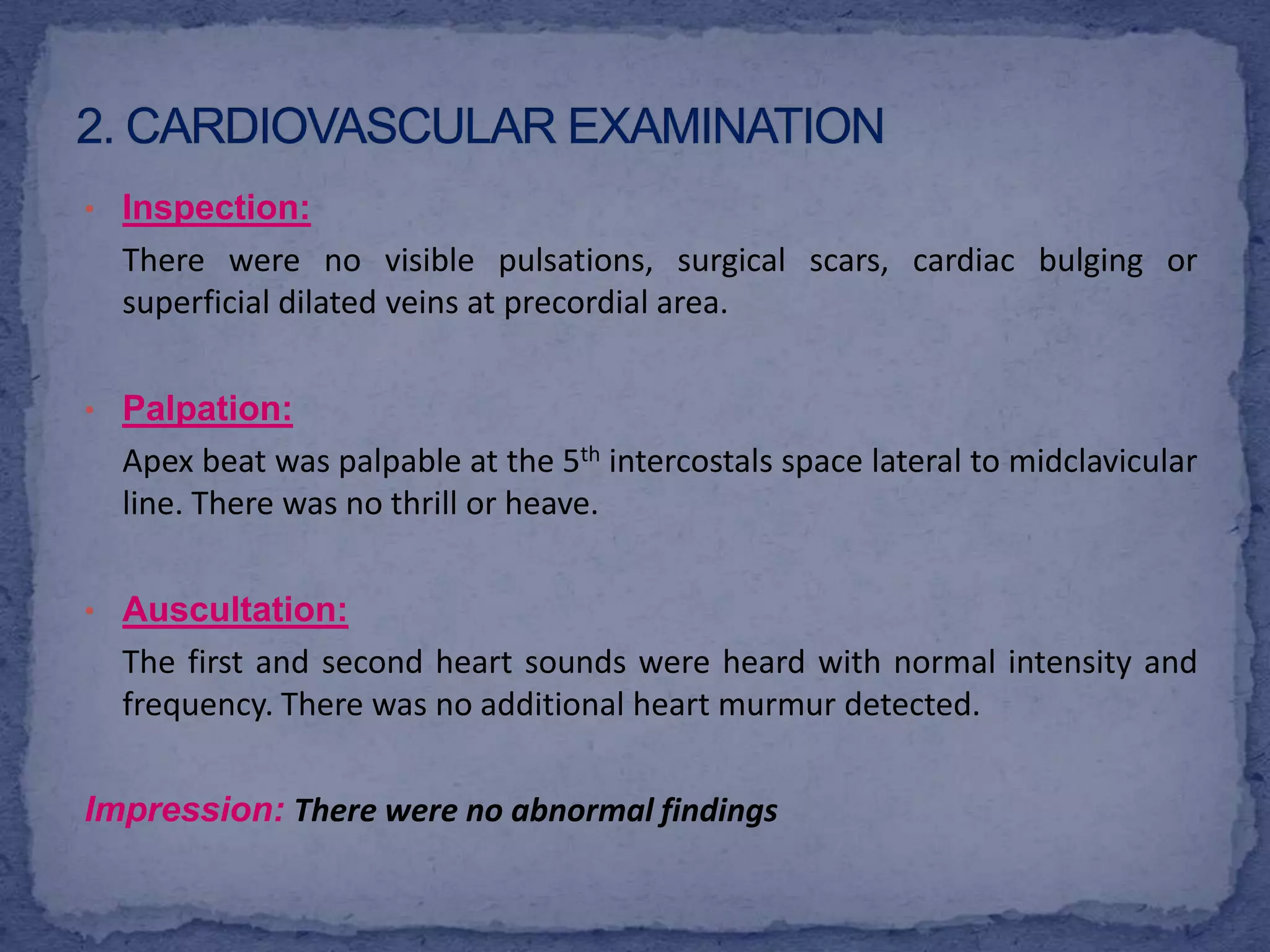
2. Cardiovascular ExaminationInspection:There were no visible pulsations, surgical scars, cardiac bulging or superficial dilated veins at precordial area. Palpation:	Apex beat was palpable at the 5th intercostals space lateral to midclavicular line. There was no thrill or heave. Auscultation:	The first and second heart sounds were heard with normal intensity and frequency. There was no additional heart murmur detected. Impression:There were no abnormal findings 
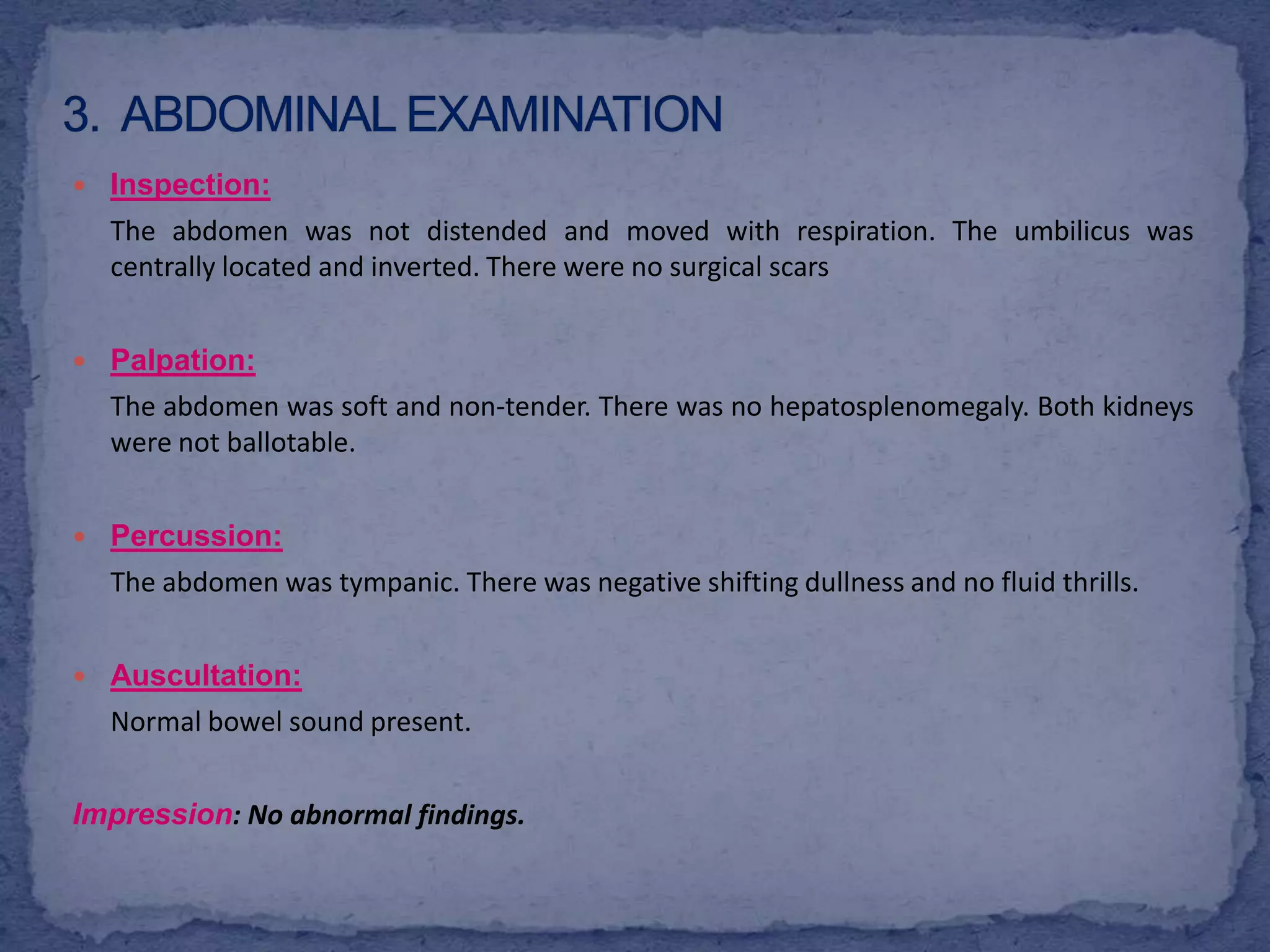
3.  Abdominal examinationInspection: The abdomen was not distended and moved with respiration. The umbilicus was centrally located and inverted. There were no surgical scars Palpation:	The abdomen was soft and non-tender. There was no hepatosplenomegaly. Both kidneys were not ballotable.Percussion:The abdomen was tympanic. There was negative shifting dullness and no fluid thrills.Auscultation:	Normal bowel sound present. Impression: No abnormal findings.
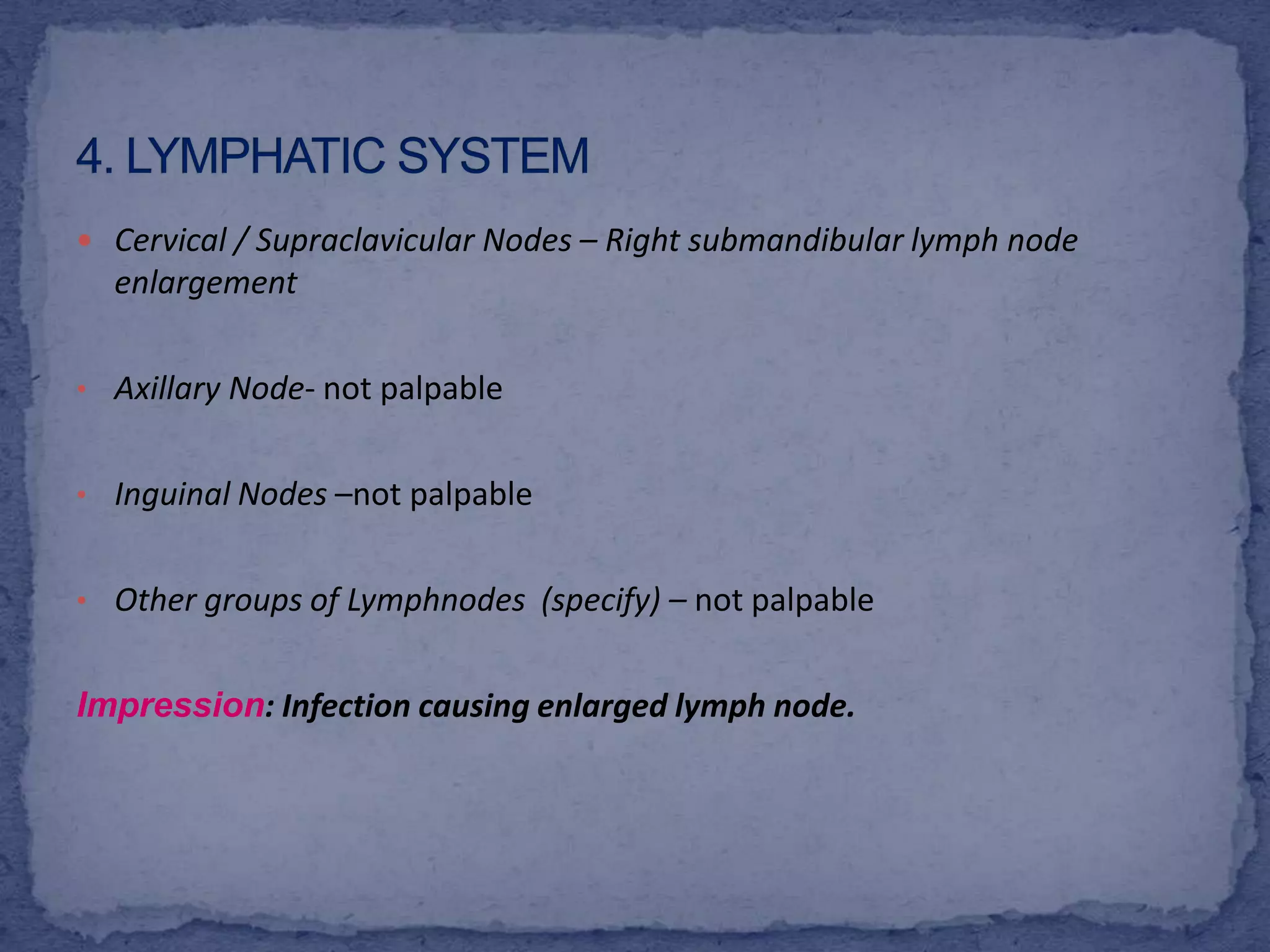
4. Lymphatic SystemCervical / Supraclavicular Nodes – Right submandibular lymph node enlargementAxillary Node- not palpable
Inguinal Nodes –not palpable
Other groups of Lymphnodes  (specify) – not palpableImpression: Infection causing enlarged lymph node.
4. Central Nervous SystemMental status: She was alert and well oriented to time, place and person.  Cranial nerves:Intact. Motor systemInspection: The upper and lower limbs were symmetrical. There was no muscle wasting, abnormal movement or posture, or gross deformity. The skin was normal and there was no surgical scar or fasciculation seen. The muscle bulk was equal bilaterally and not wasted. Muscle tone:The muscle tone of the upper and lower limbs was normal.
Muscle power:The power of all muscles tested in the upper and lower limbs was normal, with grade 5/5.	Reflexes:The reflexes of upper and lower limbs were present with normal intensity. Babinski reflex was negative.Coordination: The coordination of the upper and lower limbs was normal.Gait: Normal.	 Impression:No abnormal findings.
SUMMARYMH, 6years old Malay boy, a known case of asthma and G6PD deficiency was admitted due to fever and cough one day prior to admission, shortness of breath and rapid breathing 4hours prior to admission.On physical examination, the chest was barrel shaped,suprasternal and subcostal recession, vesicular breath sound with prolong expiration and ronchi on upper zone bilaterally during expiration was noted.
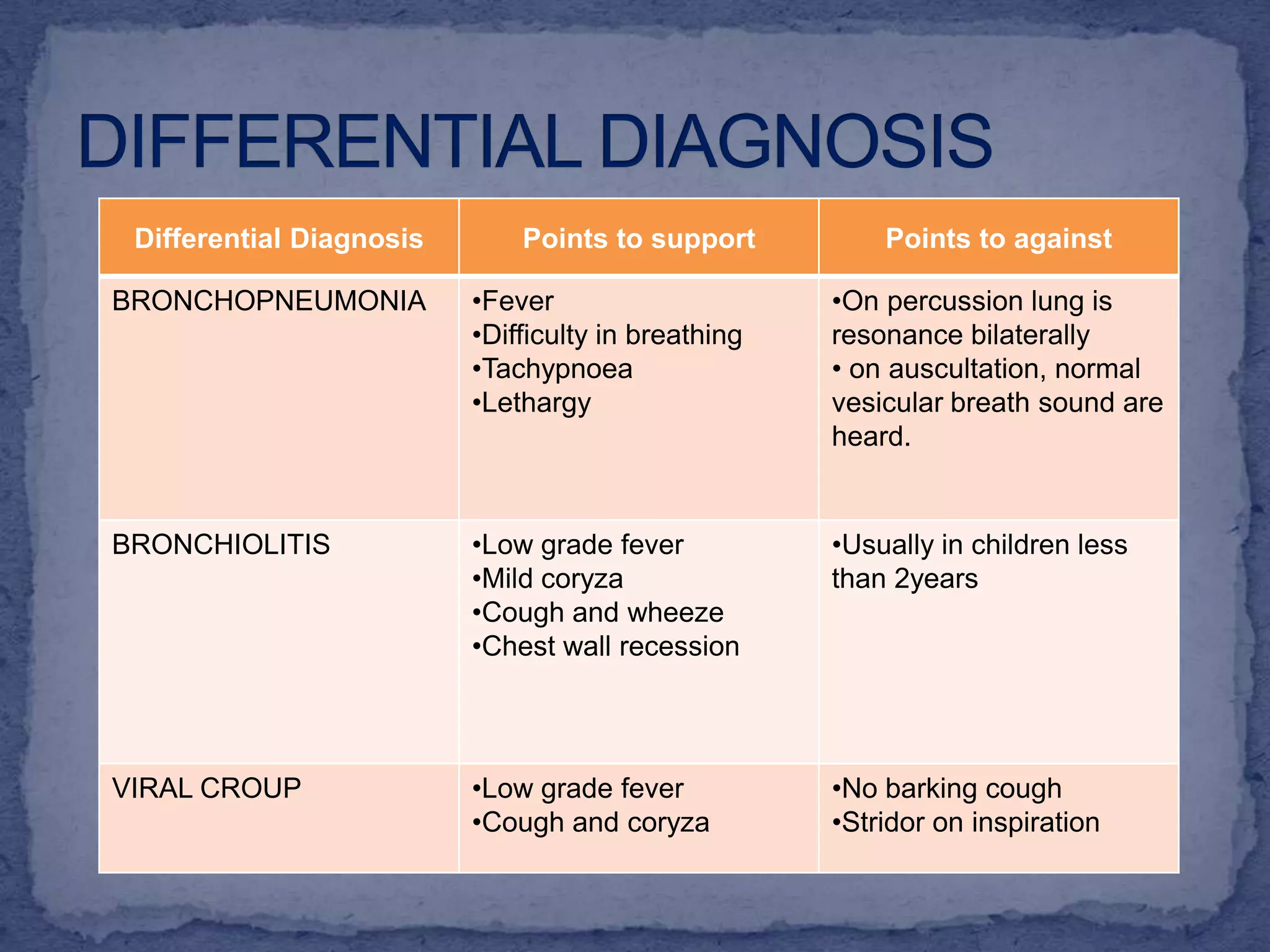
PROVISIONAL DIAGNOSISBronchial asthmaPoints to support: Known case of asthma since 2years agoMH developed shortness of breath and rapid breathing that was exacerbated by coughVesicular breath sound with prolong expiration Suprasternal and subcostal recessionRonchi was heard on the upper zone during expiration bilaterally
DIFFERENTIAL DIAGNOSIS
INVESTIGATIONS
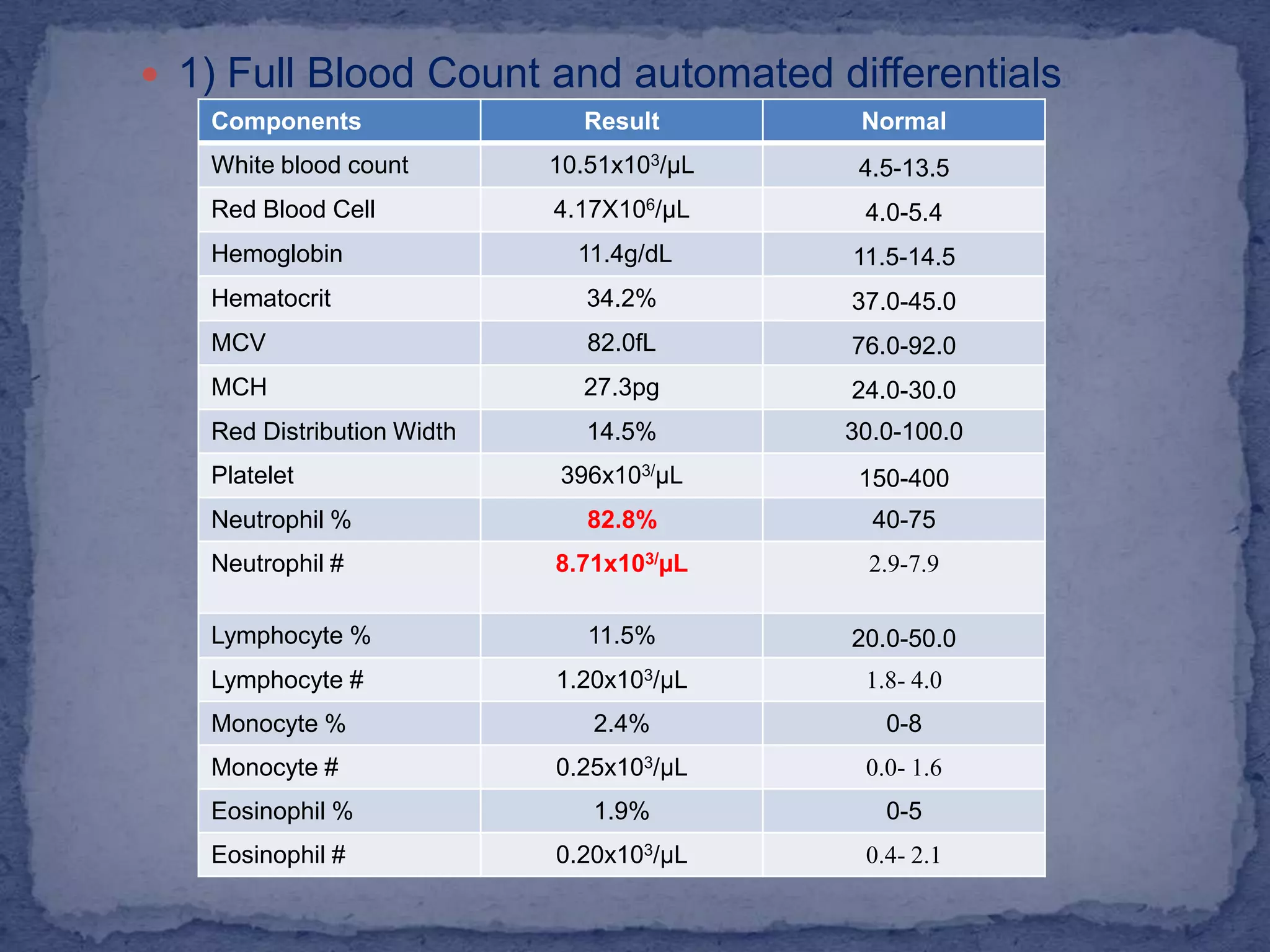
1) Full Blood Count and automated differentials
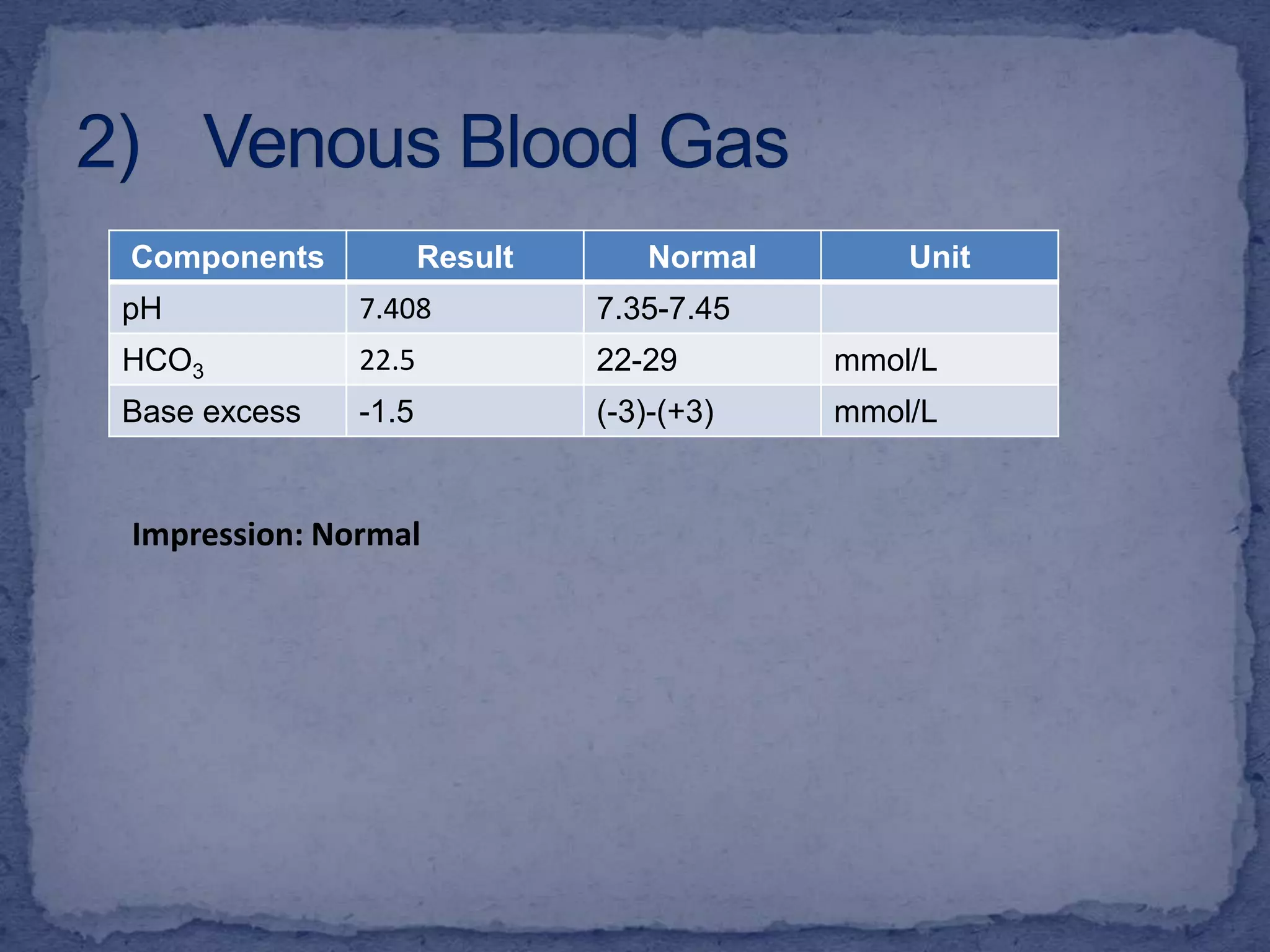
2) 	Venous Blood GasImpression: Normal
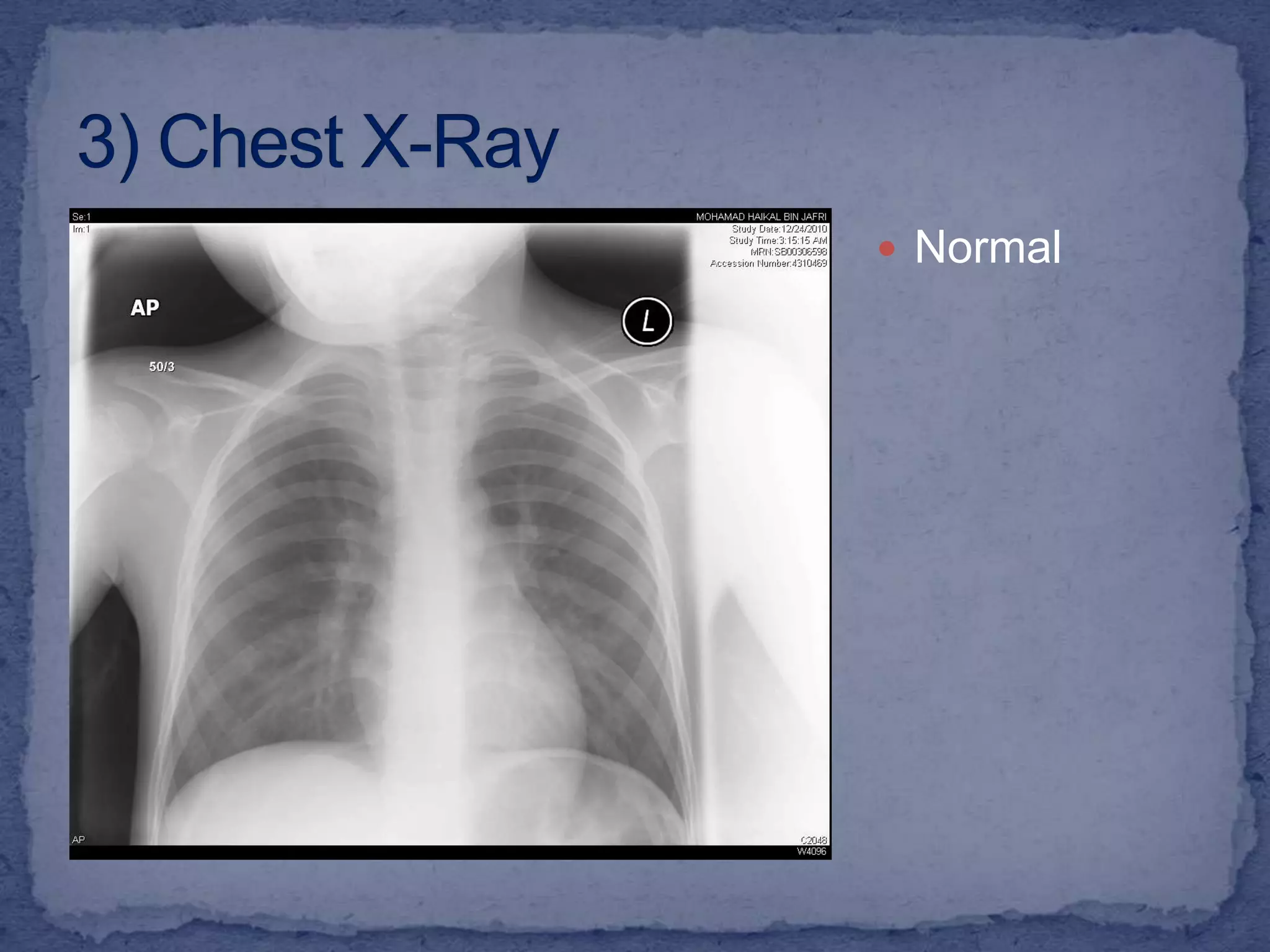
Normal 3) Chest X-Ray
MANAGEMENT
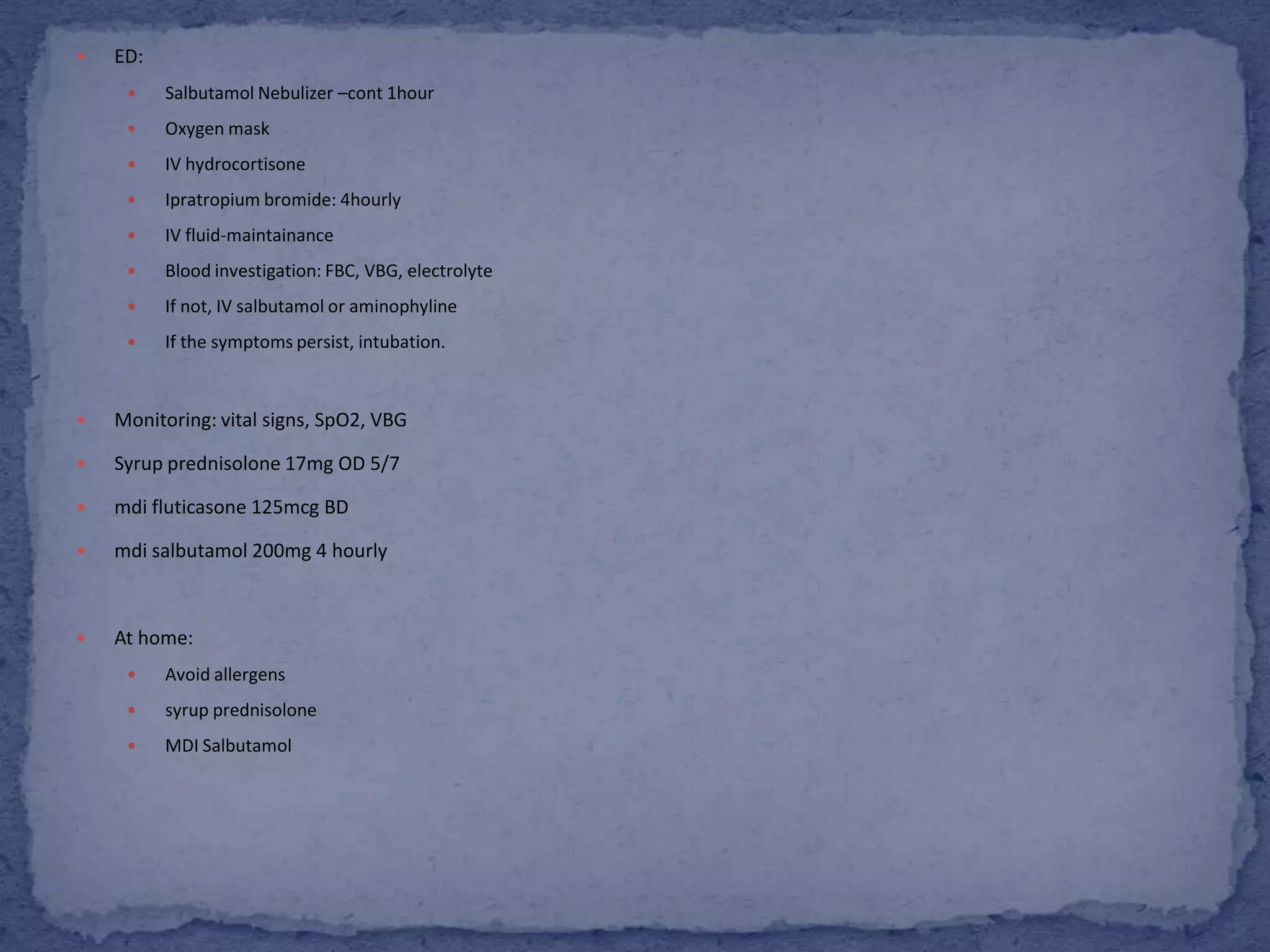
ED: Salbutamol Nebulizer –cont 1hourOxygen maskIV hydrocortisoneIpratropiumbromide: 4hourlyIV fluid-maintainanceBlood investigation: FBC, VBG, electrolyteIf not, IV salbutamoloraminophylineIf the symptoms persist, intubation.Monitoring: vital signs, SpO2, VBGSyrup prednisolone 17mg OD 5/7                mdifluticasone 125mcg BD mdisalbutamol 200mg 4 hourly At home:Avoid allergenssyrup prednisoloneMDI Salbutamol
DISCUSSION OF ASTHMAKAMARULZAMAN BIN MUZAINI2008402286
Chronic inflammatory disorder of airways that causes recurrent episodes of wheezing, breathlessness, chest tightness and coughing.DEFINITION
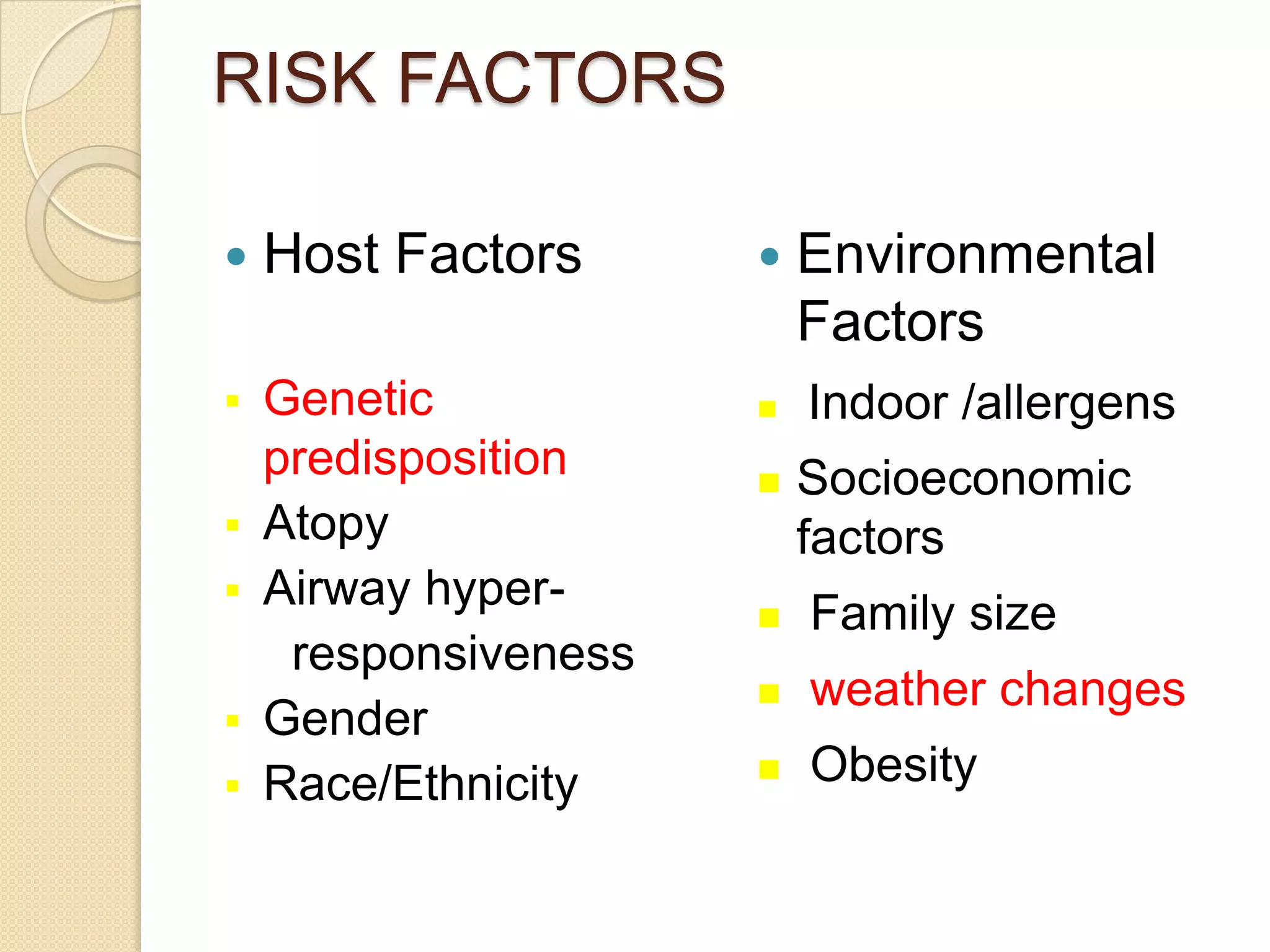
RISK FACTORSHost FactorsGenetic predisposition
Atopy
Airway hyper-     responsivenessGender
Race/EthnicityEnvironmental FactorsIndoor /allergens
Socioeconomic factors
 Family size
weather changes
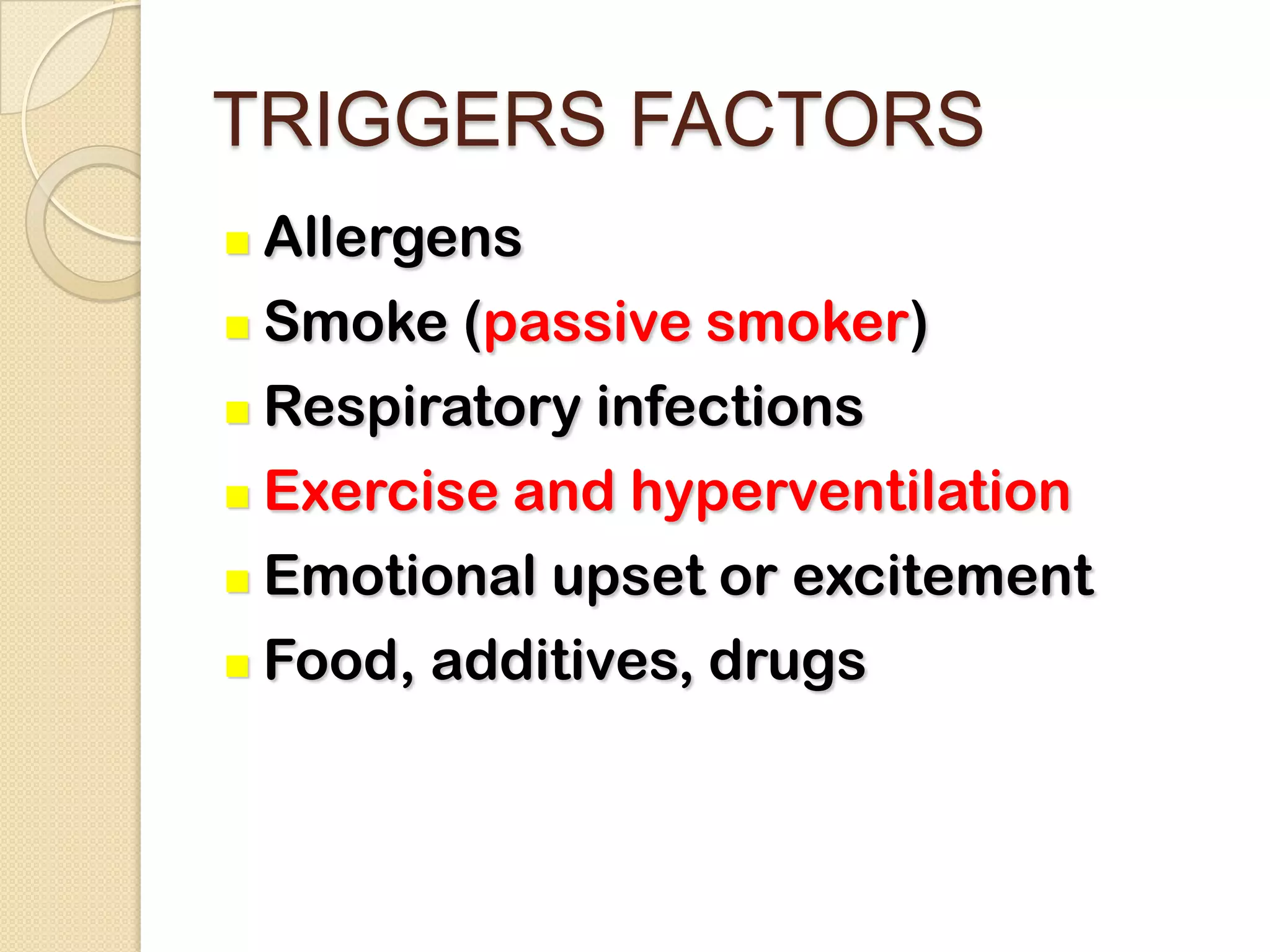
 ObesityTRIGGERS FACTORSAllergens
Smoke (passive smoker)
Respiratory infections
Exercise and hyperventilation
Emotional upset or excitement
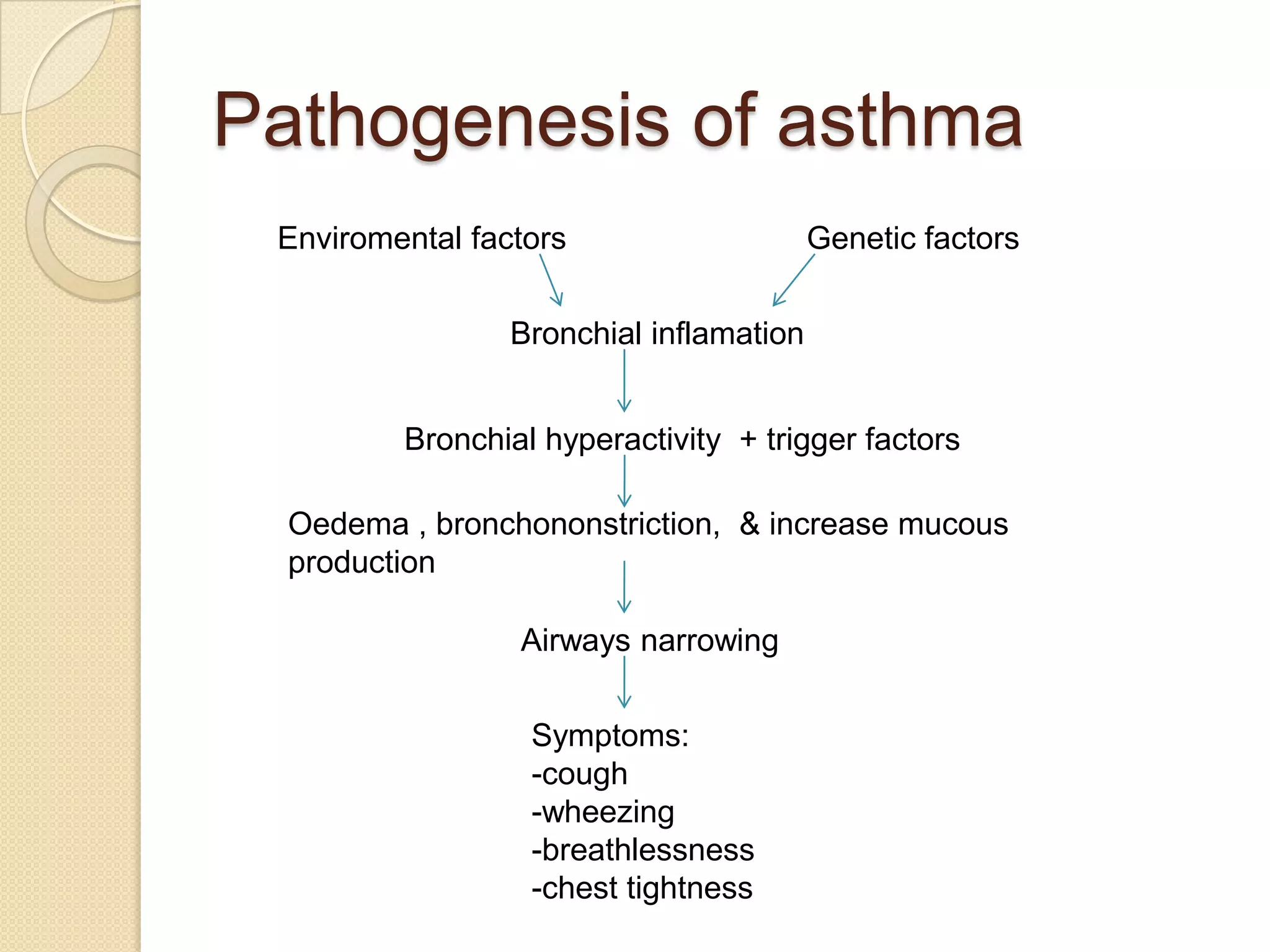
Food, additives, drugsPathogenesis of asthmaEnviromental factorsGenetic factorsBronchial inflamationBronchial hyperactivity  + trigger factorsOedema , bronchononstriction,  & increase mucous productionAirways narrowingSymptoms:-cough-wheezing-breathlessness-chest tightness
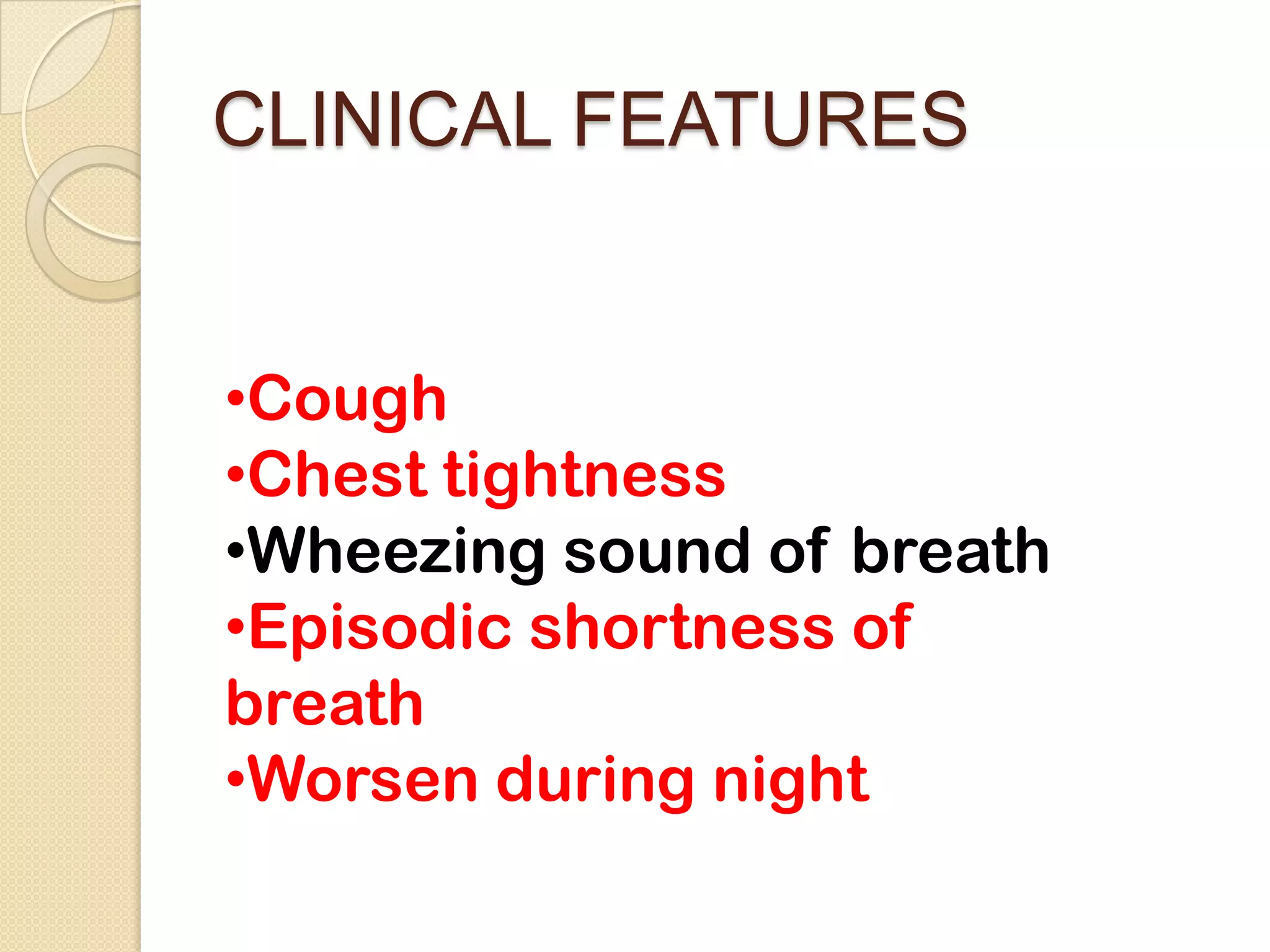
CLINICAL FEATURESCough
Chest tightness
Wheezing sound of breath
Episodic shortness of    breath
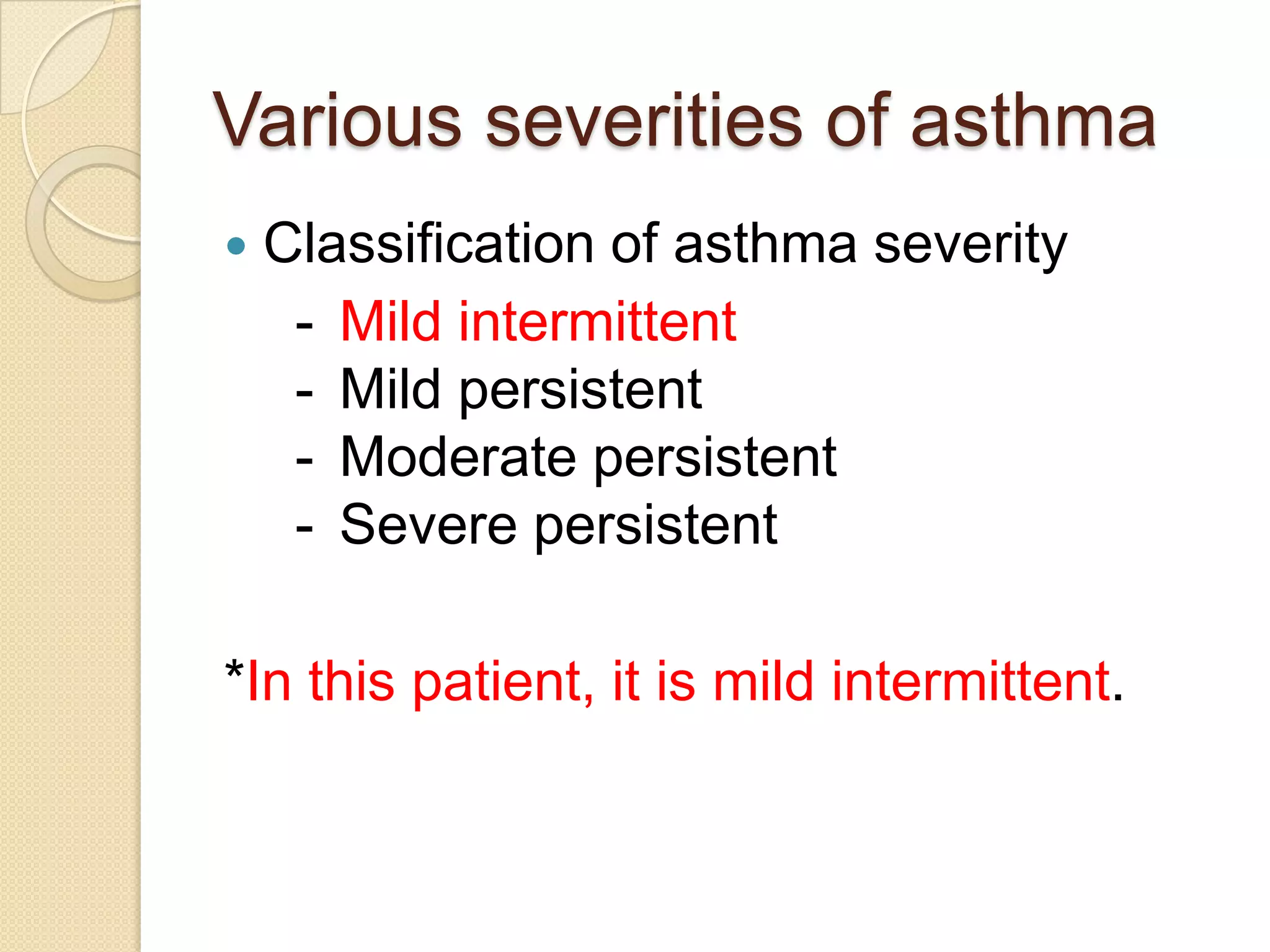
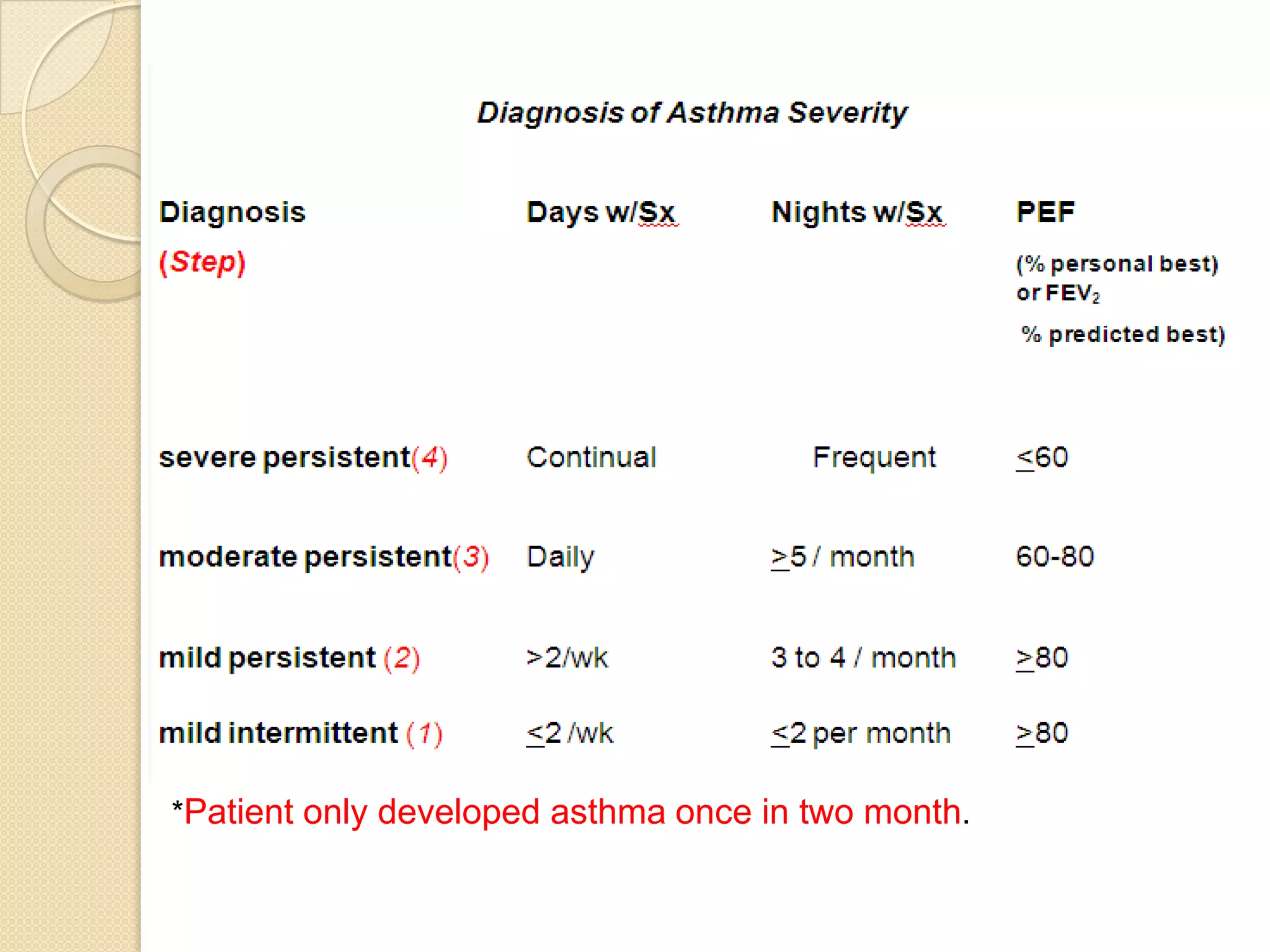
Worsen during nightVarious severities of asthmaClassification of asthma severity	-	Mild intermittent -	Mild persistent -	Moderate persistent -	Severe persistent*In this patient, it is mild intermittent.

10. asthma

  • 1.
    Case presentationBY:SHAZLIN BT.SABAAHSALWA HANIM BT. MOHD. SAIFUDDINKAMARULZAMAN B. MUZAINI
  • 2.
    DEMOGRAPHIC DETAILInitials :MHAge : 6 years and 8 months oldEthnicity : MalayGender : MaleDOA :23/12/2010DOD : 25/12/2010Informant : Grandmother
  • 3.
    PRESENTING COMPLAINMH, a6 years and 8 months old Malay boy, a known case of G6PD and asthma was admitted to HSB due to fever, cough and 1 episode of vomiting since one day prior to admission and S.O.B and rapid breathing 4 hours prior to admission.
  • 4.
    HISTORY OF PRESENTINGCOMPLAINHe was previously well until 1 day prior to admission when he started to develop fever.The fever was sudden onset and low grade as he was warm to touchGrandmother claimed that the fever might be due to playing actively during the evening.There is no chills or rigor.His mother gave him syrup PCM but fever didn't subside.He vomit once after taking the medication.The vomitus contain some clear mucus and also the medication.The amount is about one table spoonNot blood-stained or bile-stained.
  • 5.
    cont..The fever alsoassociated with productive coughSputum was light yellow in colour with some clear mucus.Amount was about one tea spoon.It occurred mostly during night.Patient did not take any medication for this problem.At night, mother noticed that he was snoring during sleeping.Then around 12a.m, he suddenly awaken from sleep. He starts to cough continuously and develop the shortness of breath together with rapid breathing. He was then brought by his grandparents to HSB.
  • 6.
    cont..Came to Sg.Buloh to visit aunt since 2 days prior to admission.Both his and his aunt housing area are not a dengue prone area.His father just recovered from fever 1 week prior to MH admissionNo other family members have the same symptom like him
  • 7.
    SYSTEMIC REVIEWCVS : Noexcessive night sweating, no orthopnea.CNS : No headache/dizziness, no episode of fainting or fit attack.GIT : No constipation, no diarrhea, normal bowel habit.MSK : No muscle pain or join pain.Urinary System: No dysuria or hematuria.Skin : No rashes or itchiness.ENT : No sore throat, no runny nose.
  • 8.
    PAST MEDICAL/SURGICAL HxHehas been diagnosed to have asthma since he was 4 years old.The pattern of the attack is once in 2 monthsIt occur mostly when px took cold drinks, cold weather or do vigorous exerciseHe also has the intervals symptoms of cough and wheezing.The last attack was on OctoberTook nebulizer at GP/hospital in Ipoh if attack occur but no hospitalization required.No hx of eczema.
  • 9.
    DRUGS HxHe isnot on any medicationDoctor advice him to take MDI but mother insist as she claimed that px did not know how to handle the medication.
  • 10.
  • 11.
    BIRTH HxBorn atHospital Kota BaruFTSVDWeight : 2.5kgAntenatal, intrapartum and postpartum hx was uneventfulAdmitted to NICU for 15 days due to neonatal jaundice  diagnosed to have G6PD
  • 12.
    FEEDING HxGrandmother didnot recall how long he had exclusive breastfeedingCurrently he is on family diet with balance and adequate amount of fish, meat and rice
  • 13.
    IMMUNISATION HxUp tohis ageDidn’t have any complications after taking the injections
  • 14.
    DEVELOPMENTAL HxUp tohis chronological age. He is currently at preschool and his performance is good.Gross motor : Can walks heel to toe, Can kick, climbs and throwing, can ride tricycle.Fine motor : Can imitate or copies pictures like steps with 10 cubes , can write his nameSpeech and language : Can speak fluently, knows age, knows ABC and numbers.Social :Can dresses and undresses alone.
  • 15.
    FAMILY Hx2nd childout of 3 siblingsBoth father and mother have asthma and currently on medication.Grandmother in paternal side also have asthma.Elder sister is 3 years old and younger sister is 13 months old. Both of them are wellNo history of consanguinity
  • 16.
    SOCIAL & ENVIRONMENTALHxLive with parents and 2 siblings at Ipoh, PerakFather is a policemanFather is a smoker but did not smoke inside the house or near the patient.Mother is a housewifeLive in their own terrace house with adequate basic amenities.The total income is about RM 2000Don’t have any cats or carpet in house.
  • 17.
    EFFECT OF ILLNESSThey have to delay their plan to return back to Ipoh since patient was admitted.Father have to take leave from works for a few more days.Regarding the asthma, he had to go to GP several times in order to get the treatment if the asthma attack occur. Thus, a lot of time and money have been spent.The asthma also affecting MH lifestyle since this condition had restricted him from doing certain activities or eat certain food.However, the disease didn’t give much effects in his school activities.

  • 18.
  • 19.
    MH was sittingon the bed comfortably. His grandmother was sitting next to him. He was conscious and cooperative and orientated to time and place. He is not in pain. He was in respiratory distress as there was suprasternal and subcostal recession. His hydration and nutritional status were good. There was a brannula attached to the dorsum of his left hand. No gross deformities and abnormal movement seen. 1. GENERAL CONDITION
  • 20.
    Temperature : 38.50CBlood pressure :115/66 mmHg, regular rhythm and normal volumePulse rate : 110 beat per minuteRespiratory rate: 32 breaths per minuteImpression: His vital signs are normal. 2. VITAL SIGNS
  • 21.
    Height : 110cm. (10thcentile)Weight :17kg. (10thcentile)BMI : 14.05kg/m2. (10thcentile)Impression:His growth is within 10thcentile.3.Anthropometric measurements
  • 22.
    Appearance: No dysmorphicfeatures.Face: No cyanosis, no pallor, no pursed lips.Oral cavity: Moist tongue and mucous membraneNo gum bleedingNo ulcersNo central cyanosisOral hygiene was goodEyes: No yellow discoloration, pink conjunctivae Ear, nose and throat: There was no nasal discharge, no ear discharge and the throat was mildly injected.4. Examination face, head, neck & limbs
  • 23.
    Neck: No cervicallymph nodes enlargement.Skin: Normal skin tone,no eczema, no rashes and no petechiae.Extremities:Warm peripheries No cyanosis at the nail bed No clubbing of fingersNo palmarerythemaCapillary refilling time was less than two secondsNo peripheral oedemaNo koilonychias.Impression: No abnormal findings.
  • 24.
    SYSTEMIC EXAMINATION1.RESPIRATORY SYSTEMInspection:Thechest was barrel shape. There was no scar on the chest wall and no dilated veins. There were suprasternal and subcostal recession. The chest moved symmetrically with respiration.Palpation:The trachea was centrally located. The chest expansion was symmetrical bilaterally. The apex beat was palpable at 5th intercostals within midclavicular line. Vocal fremitus was equal bilaterally.
  • 25.
     Percussion:Resonance bilaterally.Auscultation:Normal airentry bilaterally. Vesicular breath sound with prolong expiratory. Ronchi during expiration on the upper zone bilaterally.Impression: MH was having respiratory disorders evidenced by suprasternal and subcostal recession and presence of added breath sound, ronchi during expiration on the upper zone of his chest.
  • 26.
    2. Cardiovascular ExaminationInspection:Therewere no visible pulsations, surgical scars, cardiac bulging or superficial dilated veins at precordial area. Palpation: Apex beat was palpable at the 5th intercostals space lateral to midclavicular line. There was no thrill or heave. Auscultation: The first and second heart sounds were heard with normal intensity and frequency. There was no additional heart murmur detected. Impression:There were no abnormal findings 
  • 27.
    3. AbdominalexaminationInspection: The abdomen was not distended and moved with respiration. The umbilicus was centrally located and inverted. There were no surgical scars Palpation: The abdomen was soft and non-tender. There was no hepatosplenomegaly. Both kidneys were not ballotable.Percussion:The abdomen was tympanic. There was negative shifting dullness and no fluid thrills.Auscultation: Normal bowel sound present. Impression: No abnormal findings.
  • 28.
    4. Lymphatic SystemCervical/ Supraclavicular Nodes – Right submandibular lymph node enlargementAxillary Node- not palpable
  • 29.
  • 30.
    Other groups ofLymphnodes (specify) – not palpableImpression: Infection causing enlarged lymph node.
  • 31.
    4. Central NervousSystemMental status: She was alert and well oriented to time, place and person.  Cranial nerves:Intact. Motor systemInspection: The upper and lower limbs were symmetrical. There was no muscle wasting, abnormal movement or posture, or gross deformity. The skin was normal and there was no surgical scar or fasciculation seen. The muscle bulk was equal bilaterally and not wasted. Muscle tone:The muscle tone of the upper and lower limbs was normal.
  • 32.
    Muscle power:The powerof all muscles tested in the upper and lower limbs was normal, with grade 5/5. Reflexes:The reflexes of upper and lower limbs were present with normal intensity. Babinski reflex was negative.Coordination: The coordination of the upper and lower limbs was normal.Gait: Normal.  Impression:No abnormal findings.
  • 33.
    SUMMARYMH, 6years oldMalay boy, a known case of asthma and G6PD deficiency was admitted due to fever and cough one day prior to admission, shortness of breath and rapid breathing 4hours prior to admission.On physical examination, the chest was barrel shaped,suprasternal and subcostal recession, vesicular breath sound with prolong expiration and ronchi on upper zone bilaterally during expiration was noted.
  • 34.
    PROVISIONAL DIAGNOSISBronchial asthmaPointsto support: Known case of asthma since 2years agoMH developed shortness of breath and rapid breathing that was exacerbated by coughVesicular breath sound with prolong expiration Suprasternal and subcostal recessionRonchi was heard on the upper zone during expiration bilaterally
  • 35.
  • 36.
  • 37.
    1) Full BloodCount and automated differentials
  • 38.
    2) Venous BloodGasImpression: Normal
  • 39.
  • 40.
  • 41.
    ED: Salbutamol Nebulizer–cont 1hourOxygen maskIV hydrocortisoneIpratropiumbromide: 4hourlyIV fluid-maintainanceBlood investigation: FBC, VBG, electrolyteIf not, IV salbutamoloraminophylineIf the symptoms persist, intubation.Monitoring: vital signs, SpO2, VBGSyrup prednisolone 17mg OD 5/7                mdifluticasone 125mcg BD mdisalbutamol 200mg 4 hourly At home:Avoid allergenssyrup prednisoloneMDI Salbutamol
  • 42.
  • 43.
    Chronic inflammatory disorderof airways that causes recurrent episodes of wheezing, breathlessness, chest tightness and coughing.DEFINITION
  • 44.
  • 45.
  • 46.
    Airway hyper- responsivenessGender
  • 47.
  • 48.
  • 49.
  • 50.
  • 51.
  • 52.
  • 53.
  • 54.
  • 55.
  • 56.
    Food, additives, drugsPathogenesisof asthmaEnviromental factorsGenetic factorsBronchial inflamationBronchial hyperactivity + trigger factorsOedema , bronchononstriction, & increase mucous productionAirways narrowingSymptoms:-cough-wheezing-breathlessness-chest tightness
  • 57.
  • 58.
  • 59.
  • 60.
  • 61.
    Worsen during nightVariousseverities of asthmaClassification of asthma severity - Mild intermittent - Mild persistent - Moderate persistent - Severe persistent*In this patient, it is mild intermittent.
  • 62.
    *Patient only developedasthma once in two month.
  • 63.
  • 64.
  • 65.
  • 66.
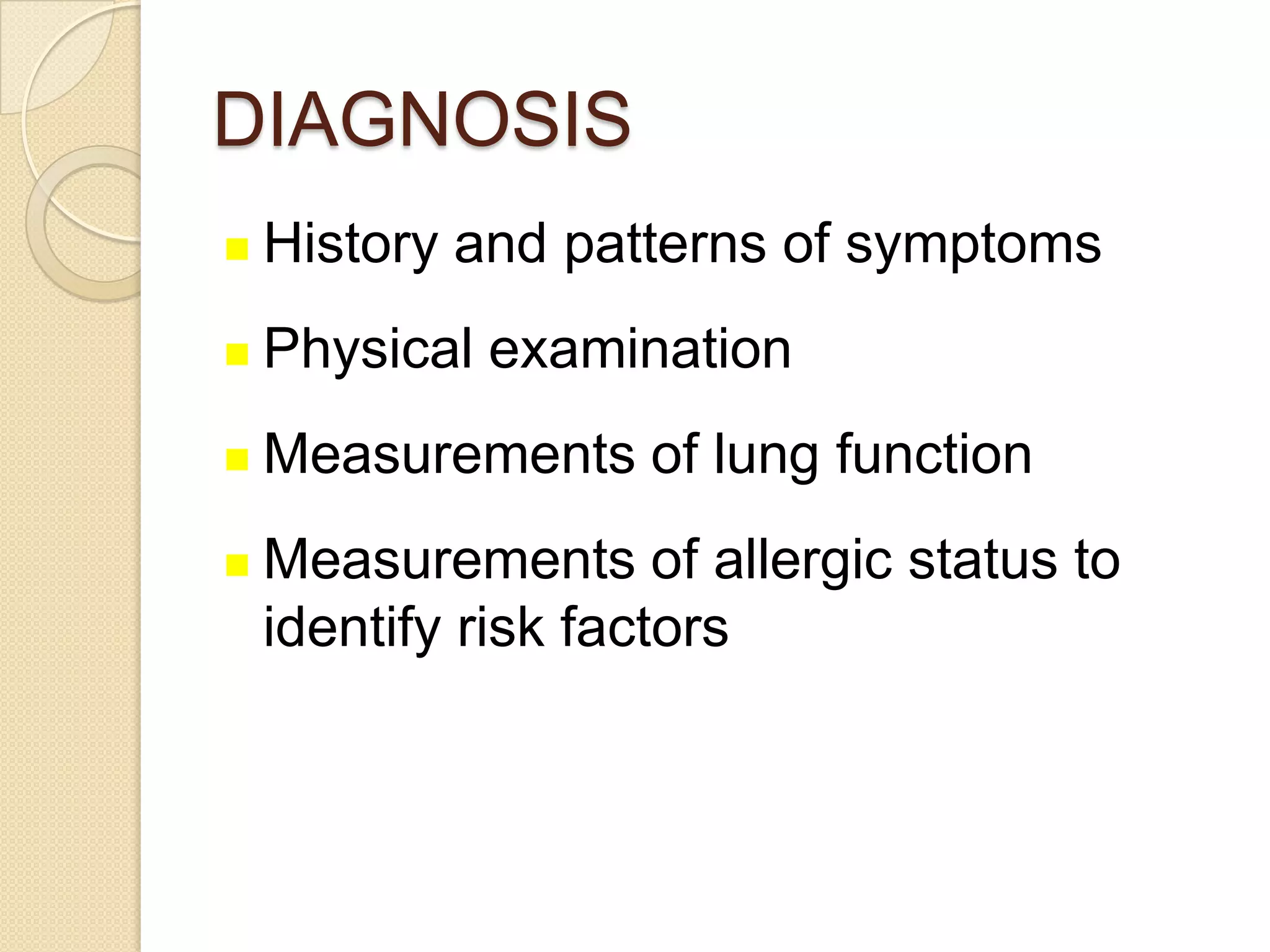
    Measurements of allergicstatus to identify risk factorsTAKING HISTORYSince when it start & previous attack? -since 4 years old, once in 2 months, last attack was on OctoberAggravating and relieving factors? -cold drinks, cold weather or do vigorous exerciseHave any prolong URTI sx? - No significancePrev hospital administration? - No hospital administration before this.History of atopy? - No eczemaFamily history of asthma? -Strong family hx of asthmaImpact on lifestyle? -Not impact patient lifestyle as he only developed mild intermittent asthma
  • 67.
    PHYSICAL EXAMINATIONOBSERVATION -(tachypnic,wheezing, drowsiness, central cyanosis, hyperinflated chest, head bobbing, peripheral cyanosis, using accessory muscle when breathing, SCR ,ICR & suprasternal recession)PALPATION - Decrease symetrically chest wall expansionPERCUSSION -resonance AUSCULTATION -(reduced breath sound, rhonci, vesicular breath sound with prolong expiration time)
  • 68.
    INVESTIGATION1)LUNG FUNCTION TESTThiscan be done by using Peak Expiratory Flow Rate(PEFR).
  • 69.
    2)Blood and sputumtest.3)Chest X-ray.Asthmatic patient may have increase number of neutrophils in pheripheral bloodHelpful in excluding a pneumothorax / pneumonia.
  • 70.
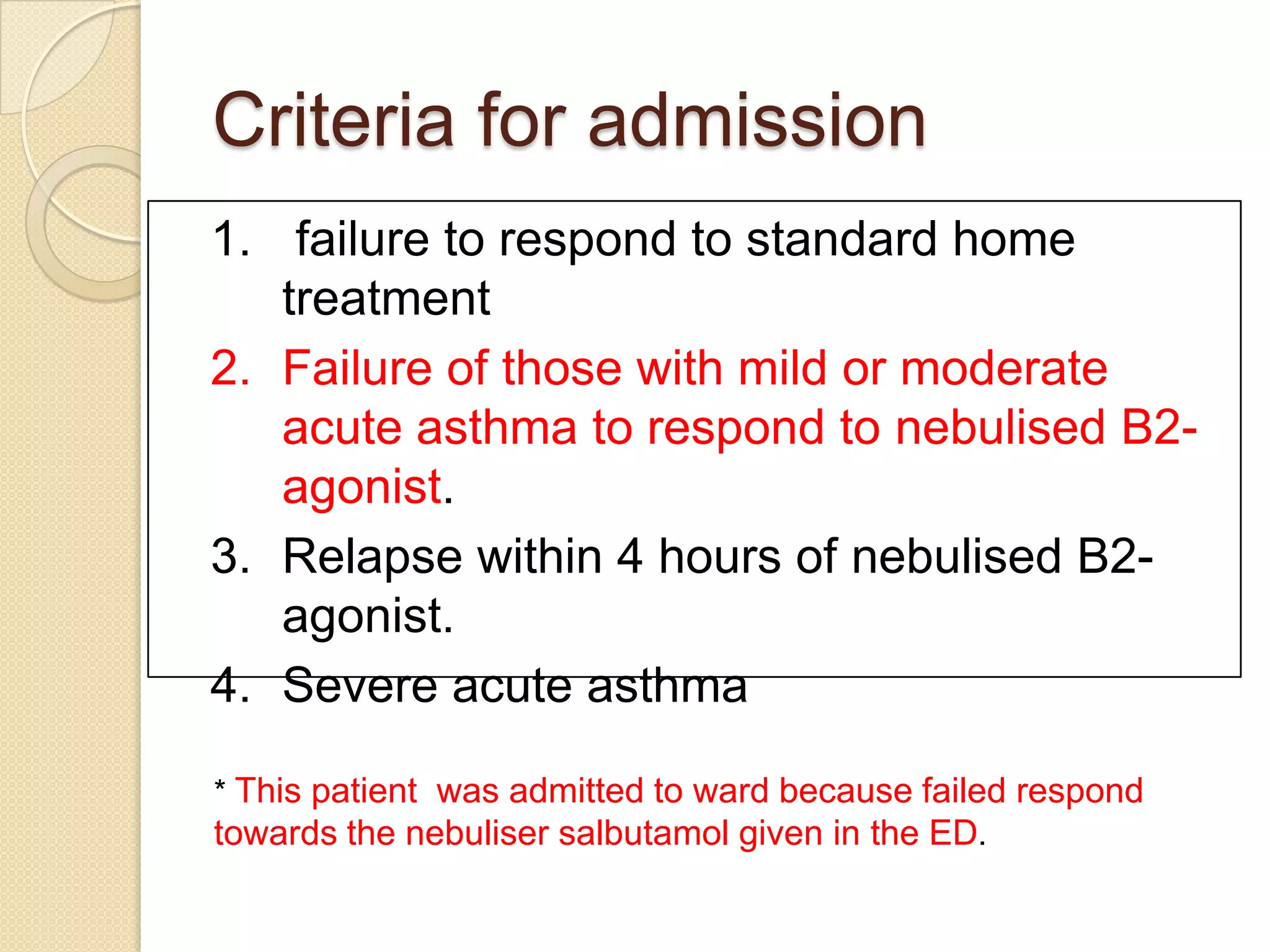
    Criteria for admissionfailure to respond to standard home treatmentFailure of those with mild or moderate acute asthma to respond to nebulised B2-agonist.Relapse within 4 hours of nebulised B2-agonist.Severe acute asthma* This patient was admitted to ward because failed respond towards the nebulisersalbutamol given in the ED.
  • 71.
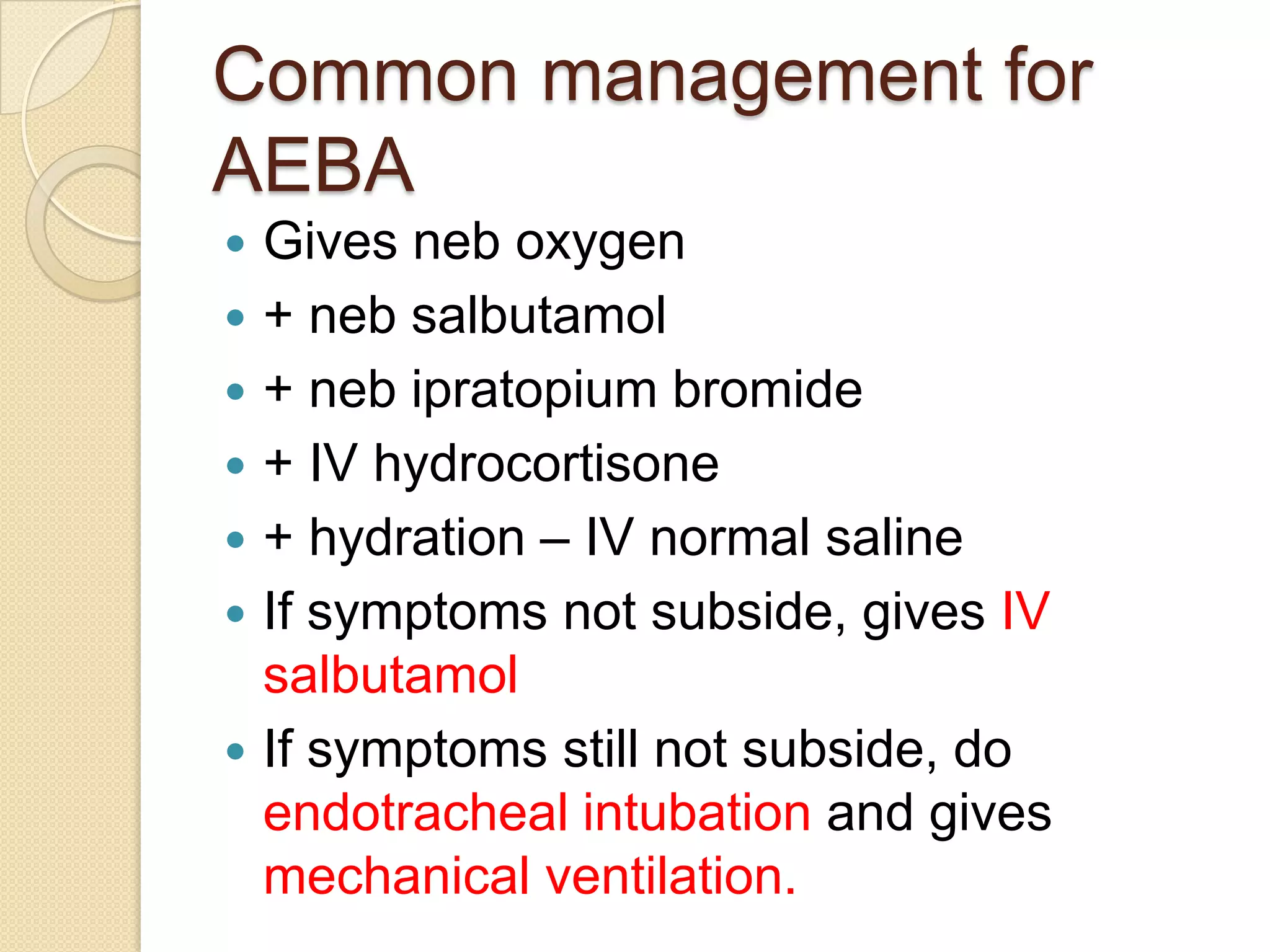
    Common management forAEBAGives neb oxygen+ neb salbutamol+ neb ipratopium bromide+ IV hydrocortisone+ hydration – IV normal salineIf symptoms not subside, gives IV salbutamolIf symptoms still not subside, do endotracheal intubation and gives mechanical ventilation.
  • 72.
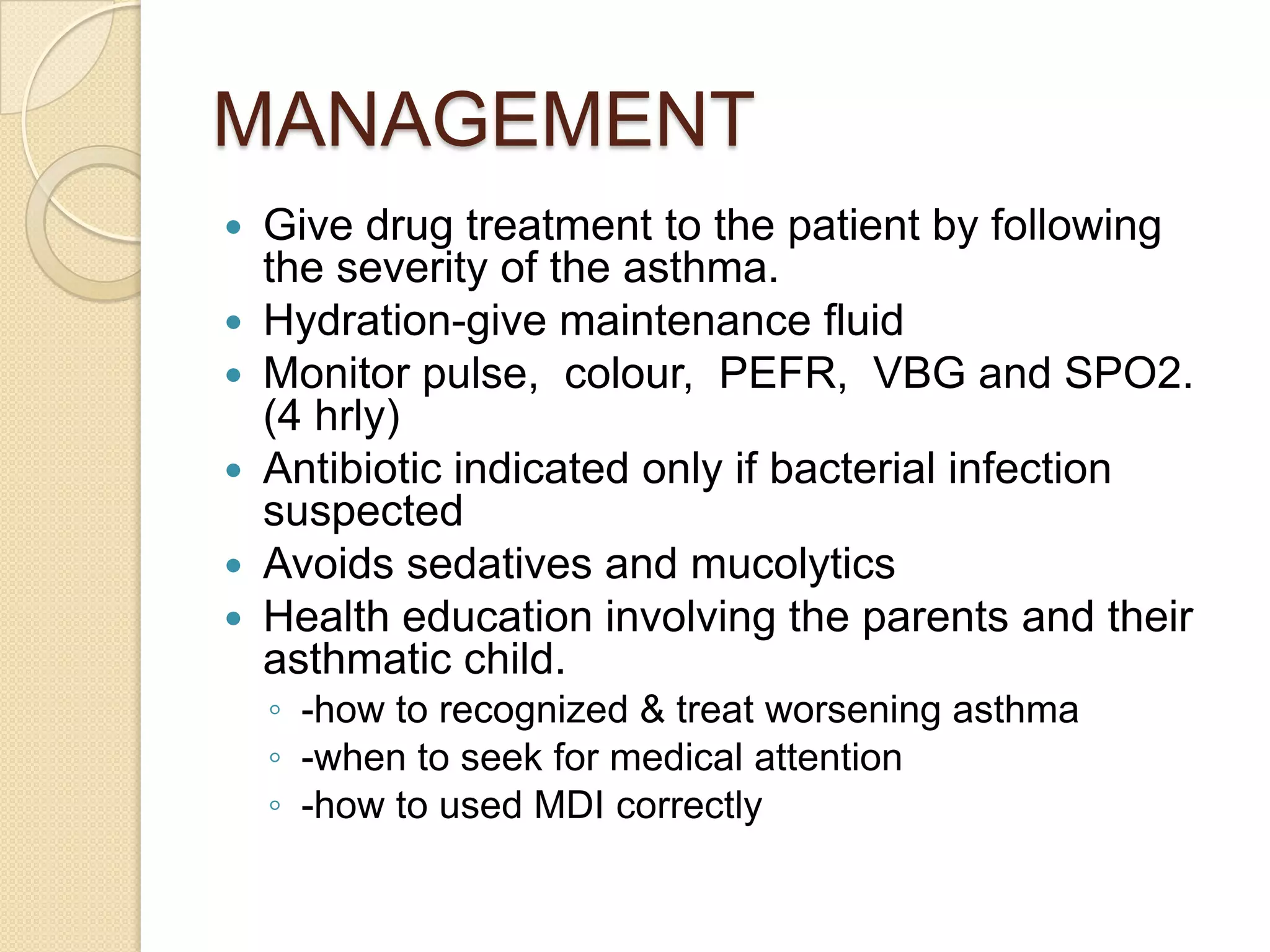
    MANAGEMENTGive drug treatmentto the patient by following the severity of the asthma.Hydration-give maintenance fluidMonitor pulse, colour, PEFR, VBG and SPO2. (4 hrly)Antibiotic indicated only if bacterial infection suspectedAvoids sedatives and mucolyticsHealth education involving the parents and their asthmatic child.-how to recognized & treat worsening asthma-when to seek for medical attention-how to used MDI correctly
  • 73.
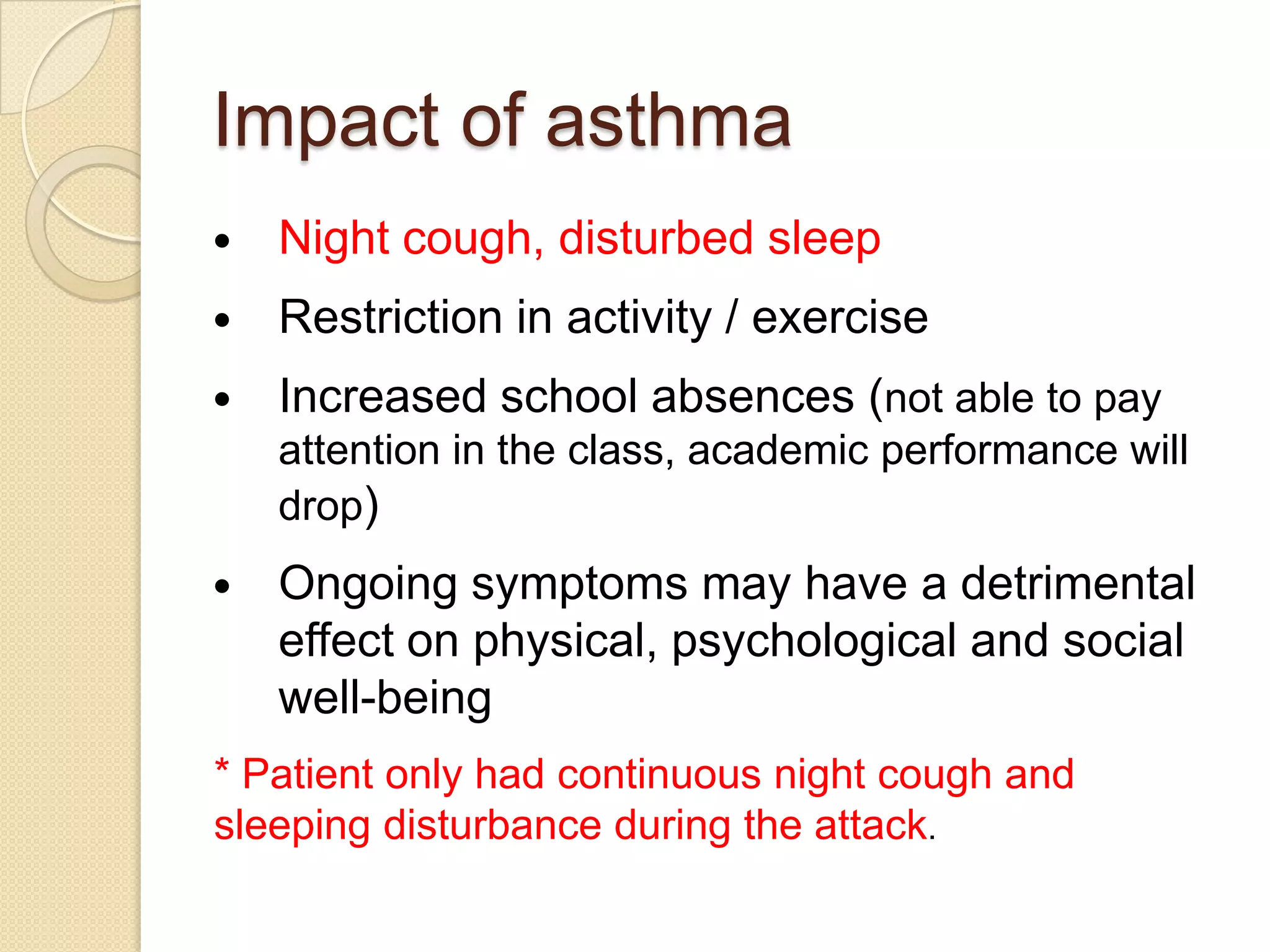
    Impact of asthmaNightcough, disturbed sleepRestriction in activity / exerciseIncreased school absences (not able to pay attention in the class, academic performance will drop)Ongoing symptoms may have a detrimental effect on physical, psychological and social well-being* Patient only had continuous night cough and sleeping disturbance during the attack.
  • 74.
    Acute severe asthmaInabilityto complete a sentence in one breath.Respiratory rate >50/minTachycardia >140/minPEFR <50% from normal
  • 75.
    LIFE-THREATENING ASTHMASilent chestand cyanosis.Exhaustion,confusion or coma.PEFR <33% of prediction.
  • 76.
    PREVENTIONEducation of thefamily members is a vital role : - teaching basic asthma facts - explain role of medication given - teaching environmental control measures - improving parents skills in the use of spacer device MDI. *in this case, the parents of the patient did not know how to use the device & his father is a smoker
  • 77.
    COMPLICATION STATUS ASTHMATICUS -Isan acute exacerbation of asthma attack which do not respond adequately to therapeutic measures and required hospitalization
  • 78.