By Ahmed Mo’ness
1
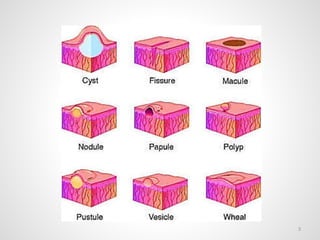
Character of “RASH”
2
3
Important Questions
with every “RASH”
Blanching ?
• Yes = infection/dermatological disease
• No = purpera/petechie = blood/vessel disease
Feverish ?
• Yes = mostly systemic infection
• No = mostly local dermatological disease
4
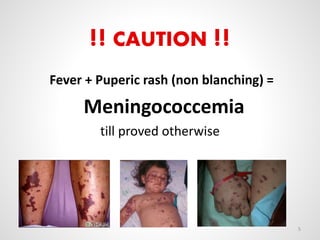
!! CAUTION !!
Fever + Puperic rash (non blanching) =
Meningococcemia
till proved otherwise
5
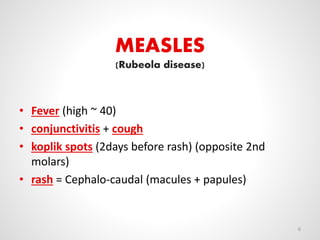
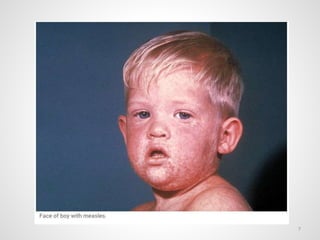
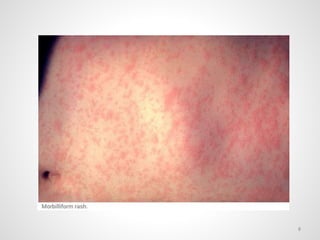
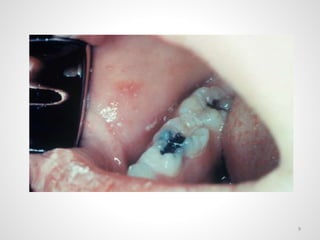
MEASLES
(Rubeola disease)
• Fever (high ~ 40)
• conjunctivitis + cough
• koplik spots (2days before rash) (opposite 2nd
molars)
• rash = Cephalo-caudal (macules + papules)
6
7
8
9
• Investigations
– measles IgG , IgM
• ttt
– supportive + fluids + Vit.A (important)
10
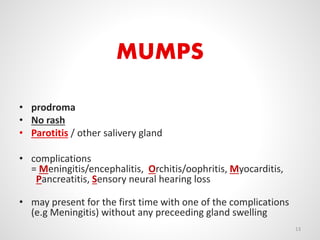
RUBELLA
(German Measles)
• prodroma (not common)
• Rash = as measles but not ill looking
• LNs (post auricular, post cervical , sub occipital)
• Forschemier spots (soft palate) (20%)
11
• inv
– rubella IgG , IgM
• ttt
– supportive
12
MUMPS
• prodroma
• No rash
• Parotitis / other salivery gland
• complications
= Meningitis/encephalitis, Orchitis/oophritis, Myocarditis,
Pancreatitis, Sensory neural hearing loss
• may present for the first time with one of the complications
(e.g Meningitis) without any preceeding gland swelling
13
• Invistigations
– mumps IgG , IgM
– serum Amylase (parotitis or pancreatitis )
– CSF culture , CSF PCR
• ttt
– supportive + fluids + isolation
14
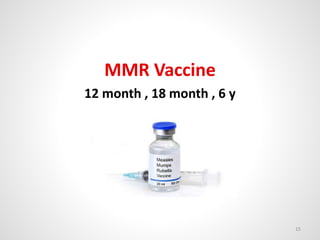
MMR Vaccine
12 month , 18 month , 6 y
15
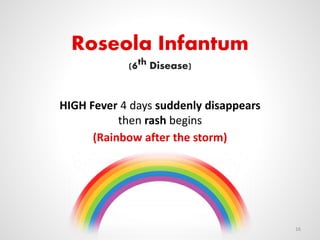
Roseola Infantum
(6th Disease)
HIGH Fever 4 days suddenly disappears
then rash begins
(Rainbow after the storm)
16
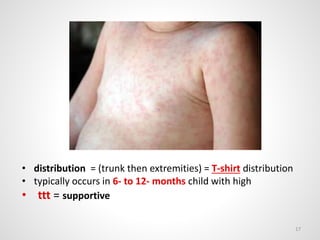
• distribution = (trunk then extremities) = T-shirt distribution
• typically occurs in 6- to 12- months child with high
• ttt = supportive
17
Erythema Infectiosum
(5th Disease)
• Usually NO to Low grade fever
• Rash appears in 2 phases
18
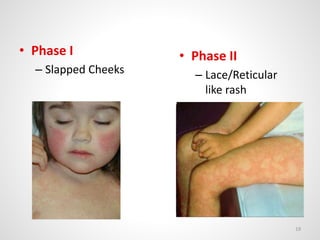
• Phase I
– Slapped Cheeks
• Phase II
– Lace/Reticular
like rash
19
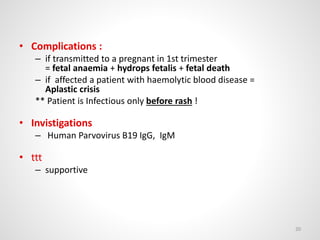
• Complications :
– if transmitted to a pregnant in 1st trimester
= fetal anaemia + hydrops fetalis + fetal death
– if affected a patient with haemolytic blood disease =
Aplastic crisis
** Patient is Infectious only before rash !
• Invistigations
– Human Parvovirus B19 IgG, IgM
• ttt
– supportive
20
Some History
Pre-Vaccination Era
• 1st = Measles
• 2nd = Scarlet
• 3rd = Rubella
• 4th = SSSS (Dukes' disease)
• 5th = Erythema Infectiosum
• 6th = Roseola Infantum
21
Scarlet Fever
• Fever
• pharyngitis / tonsilitis
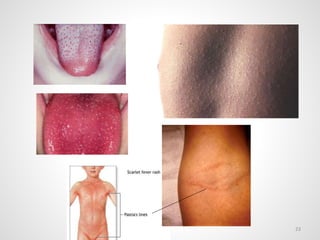
• Strawberry tongue + circumoral pallor
• Sandpaper-like skin rash
• Pastia lines
• Desquamation of the palms
22
23
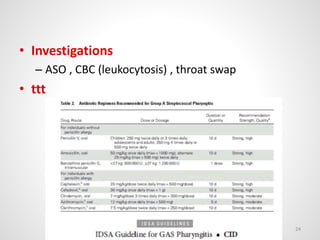
• Investigations
– ASO , CBC (leukocytosis) , throat swap
• ttt
24
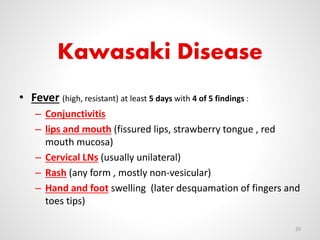
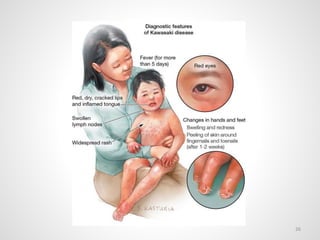
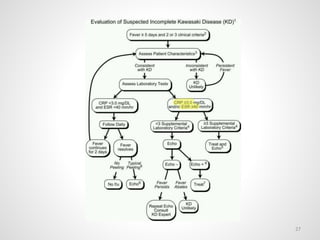
Kawasaki Disease
• Fever (high, resistant) at least 5 days with 4 of 5 findings :
– Conjunctivitis
– lips and mouth (fissured lips, strawberry tongue , red
mouth mucosa)
– Cervical LNs (usually unilateral)
– Rash (any form , mostly non-vesicular)
– Hand and foot swelling (later desquamation of fingers and
toes tips)
25
26
27
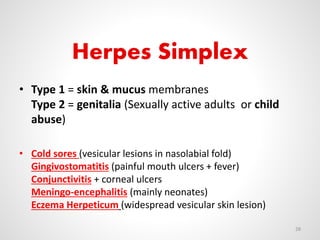
Herpes Simplex
• Type 1 = skin & mucus membranes
Type 2 = genitalia (Sexually active adults or child
abuse)
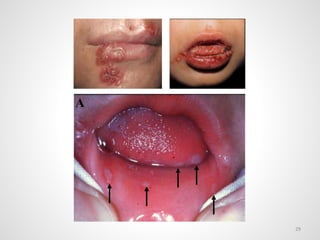
• Cold sores (vesicular lesions in nasolabial fold)
Gingivostomatitis (painful mouth ulcers + fever)
Conjunctivitis + corneal ulcers
Meningo-encephalitis (mainly neonates)
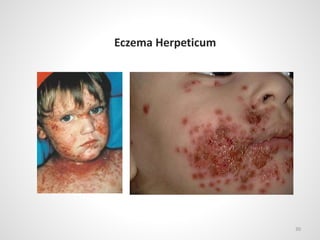
Eczema Herpeticum (widespread vesicular skin lesion)
28
29
Eczema Herpeticum
30
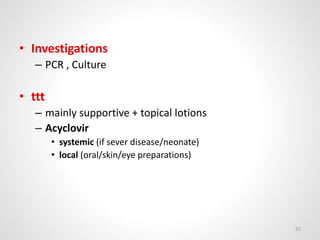
• Investigations
– PCR , Culture
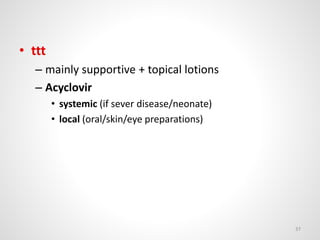
• ttt
– mainly supportive + topical lotions
– Acyclovir
• systemic (if sever disease/neonate)
• local (oral/skin/eye preparations)
31
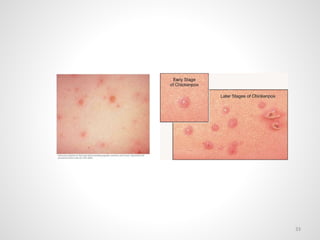
Chicken Box
• Varicella-Zoster Virus Primary infection
• no prodroma (usually)
• Rash
- itchy
- vesicle + red base
(macule then papule then vesicle / may crust )
- scalp , face , trunk , proximal limbs , palms , soles ,
mucus membranes
32
33
• complications
– 2ry bacterial infection = imptigo / cellulitis
– spread of infection -> chest , heart , CNS
– thrombocytopenia
• ttt
– mainly supportive + topical lotions
– Acyclovir
• systemic (if sever disease/neonate)
• local (oral/skin/eye preparations)
34
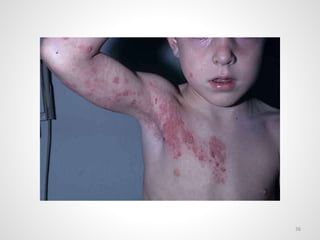
Herpes Zoster
• Varicella-Zoster Virus Reactivation
• no prodroma (usually)
• Rash =
- painful
- vesicle on red base
- unilateral side of body = dermatome supplied by
sensory nerve
** regional LNs may be present
** acute stage of the disease = pain only over the affected dermatome
followed later by the rash
35
36
• ttt
– mainly supportive + topical lotions
– Acyclovir
• systemic (if sever disease/neonate)
• local (oral/skin/eye preparations)
37
Impetigo
• Most common bacterial skin infection
• Strept / Staph A. / MRSA
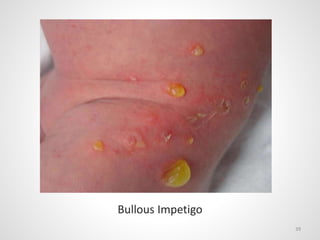
• Bullous
– Thin walled , clear, yellowish Bullae later rupture without crusts.
– May affect face / trunks / extremeties
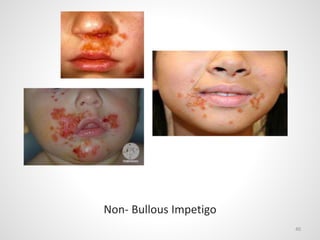
• Non-Bullous
– More contagious
– Crusts
– Affect Perioral / Perinasal / Extremeties
38
39
Bullous Impetigo
40
Non- Bullous Impetigo
• ttt
– Topical +/- Systemic ABs
– Benzathine Penicillin (IM) or Co-trimoxazole (oral 3 days)
41
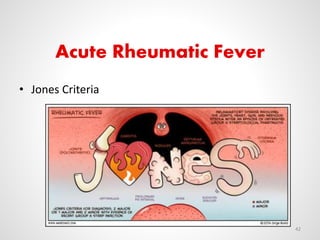
Acute Rheumatic Fever
• Jones Criteria
42
43
Erythema Multiforme
• Self limited
• Due to infections, Drugs
• Minor form = affect skin only
• Major form = affect skin + MM
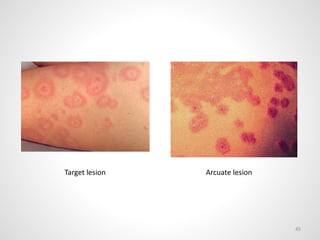
• Target lesion = pathognomonic
• Arcuate lesions = atypical form
44
Target lesion Arcuate lesion
45
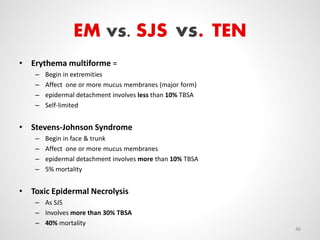
EM vs. SJS vs. TEN
• Erythema multiforme =
– Begin in extremities
– Affect one or more mucus membranes (major form)
– epidermal detachment involves less than 10% TBSA
– Self-limited
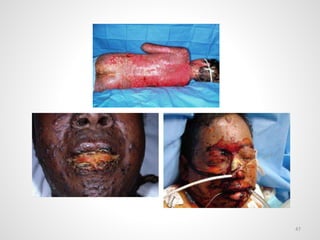
• Stevens-Johnson Syndrome
– Begin in face & trunk
– Affect one or more mucus membranes
– epidermal detachment involves more than 10% TBSA
– 5% mortality
• Toxic Epidermal Necrolysis
– As SJS
– Involves more than 30% TBSA
– 40% mortality
46
47
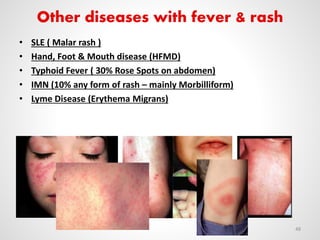
Other diseases with fever & rash
• SLE ( Malar rash )
• Hand, Foot & Mouth disease (HFMD)
• Typhoid Fever ( 30% Rose Spots on abdomen)
• IMN (10% any form of rash – mainly Morbilliform)
• Lyme Disease (Erythema Migrans)
48
NUMBERS
 Incubation Period
 Fever timing to rash
 Infectivity period
+ Mode of infection
49
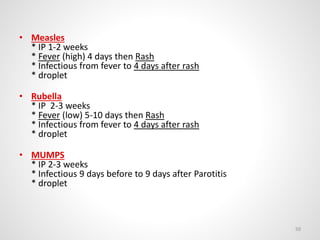
• Measles
* IP 1-2 weeks
* Fever (high) 4 days then Rash
* Infectious from fever to 4 days after rash
* droplet
• Rubella
* IP 2-3 weeks
* Fever (low) 5-10 days then Rash
* Infectious from fever to 4 days after rash
* droplet
• MUMPS
* IP 2-3 weeks
* Infectious 9 days before to 9 days after Parotitis
* droplet
50
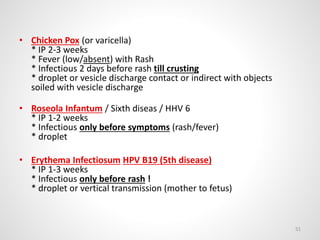
• Chicken Pox (or varicella)
* IP 2-3 weeks
* Fever (low/absent) with Rash
* Infectious 2 days before rash till crusting
* droplet or vesicle discharge contact or indirect with objects
soiled with vesicle discharge
• Roseola Infantum / Sixth diseas / HHV 6
* IP 1-2 weeks
* Infectious only before symptoms (rash/fever)
* droplet
• Erythema Infectiosum HPV B19 (5th disease)
* IP 1-3 weeks
* Infectious only before rash !
* droplet or vertical transmission (mother to fetus)
51
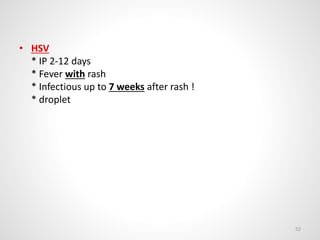
• HSV
* IP 2-12 days
* Fever with rash
* Infectious up to 7 weeks after rash !
* droplet
52
THANKS
53

Fever and Rash

  • 1.
  • 2.
  • 3.
  • 4.
    Important Questions with every“RASH” Blanching ? • Yes = infection/dermatological disease • No = purpera/petechie = blood/vessel disease Feverish ? • Yes = mostly systemic infection • No = mostly local dermatological disease 4
  • 5.
    !! CAUTION !! Fever+ Puperic rash (non blanching) = Meningococcemia till proved otherwise 5
  • 6.
    MEASLES (Rubeola disease) • Fever(high ~ 40) • conjunctivitis + cough • koplik spots (2days before rash) (opposite 2nd molars) • rash = Cephalo-caudal (macules + papules) 6
  • 7.
  • 8.
  • 9.
  • 10.
    • Investigations – measlesIgG , IgM • ttt – supportive + fluids + Vit.A (important) 10
  • 11.
    RUBELLA (German Measles) • prodroma(not common) • Rash = as measles but not ill looking • LNs (post auricular, post cervical , sub occipital) • Forschemier spots (soft palate) (20%) 11
  • 12.
    • inv – rubellaIgG , IgM • ttt – supportive 12
  • 13.
    MUMPS • prodroma • Norash • Parotitis / other salivery gland • complications = Meningitis/encephalitis, Orchitis/oophritis, Myocarditis, Pancreatitis, Sensory neural hearing loss • may present for the first time with one of the complications (e.g Meningitis) without any preceeding gland swelling 13
  • 14.
    • Invistigations – mumpsIgG , IgM – serum Amylase (parotitis or pancreatitis ) – CSF culture , CSF PCR • ttt – supportive + fluids + isolation 14
  • 15.
    MMR Vaccine 12 month, 18 month , 6 y 15
  • 16.
    Roseola Infantum (6th Disease) HIGHFever 4 days suddenly disappears then rash begins (Rainbow after the storm) 16
  • 17.
    • distribution =(trunk then extremities) = T-shirt distribution • typically occurs in 6- to 12- months child with high • ttt = supportive 17
  • 18.
    Erythema Infectiosum (5th Disease) •Usually NO to Low grade fever • Rash appears in 2 phases 18
  • 19.
    • Phase I –Slapped Cheeks • Phase II – Lace/Reticular like rash 19
  • 20.
    • Complications : –if transmitted to a pregnant in 1st trimester = fetal anaemia + hydrops fetalis + fetal death – if affected a patient with haemolytic blood disease = Aplastic crisis ** Patient is Infectious only before rash ! • Invistigations – Human Parvovirus B19 IgG, IgM • ttt – supportive 20
  • 21.
    Some History Pre-Vaccination Era •1st = Measles • 2nd = Scarlet • 3rd = Rubella • 4th = SSSS (Dukes' disease) • 5th = Erythema Infectiosum • 6th = Roseola Infantum 21
  • 22.
    Scarlet Fever • Fever •pharyngitis / tonsilitis • Strawberry tongue + circumoral pallor • Sandpaper-like skin rash • Pastia lines • Desquamation of the palms 22
  • 23.
  • 24.
    • Investigations – ASO, CBC (leukocytosis) , throat swap • ttt 24
  • 25.
    Kawasaki Disease • Fever(high, resistant) at least 5 days with 4 of 5 findings : – Conjunctivitis – lips and mouth (fissured lips, strawberry tongue , red mouth mucosa) – Cervical LNs (usually unilateral) – Rash (any form , mostly non-vesicular) – Hand and foot swelling (later desquamation of fingers and toes tips) 25
  • 26.
  • 27.
  • 28.
    Herpes Simplex • Type1 = skin & mucus membranes Type 2 = genitalia (Sexually active adults or child abuse) • Cold sores (vesicular lesions in nasolabial fold) Gingivostomatitis (painful mouth ulcers + fever) Conjunctivitis + corneal ulcers Meningo-encephalitis (mainly neonates) Eczema Herpeticum (widespread vesicular skin lesion) 28
  • 29.
  • 30.
  • 31.
    • Investigations – PCR, Culture • ttt – mainly supportive + topical lotions – Acyclovir • systemic (if sever disease/neonate) • local (oral/skin/eye preparations) 31
  • 32.
    Chicken Box • Varicella-ZosterVirus Primary infection • no prodroma (usually) • Rash - itchy - vesicle + red base (macule then papule then vesicle / may crust ) - scalp , face , trunk , proximal limbs , palms , soles , mucus membranes 32
  • 33.
  • 34.
    • complications – 2rybacterial infection = imptigo / cellulitis – spread of infection -> chest , heart , CNS – thrombocytopenia • ttt – mainly supportive + topical lotions – Acyclovir • systemic (if sever disease/neonate) • local (oral/skin/eye preparations) 34
  • 35.
    Herpes Zoster • Varicella-ZosterVirus Reactivation • no prodroma (usually) • Rash = - painful - vesicle on red base - unilateral side of body = dermatome supplied by sensory nerve ** regional LNs may be present ** acute stage of the disease = pain only over the affected dermatome followed later by the rash 35
  • 36.
  • 37.
    • ttt – mainlysupportive + topical lotions – Acyclovir • systemic (if sever disease/neonate) • local (oral/skin/eye preparations) 37
  • 38.
    Impetigo • Most commonbacterial skin infection • Strept / Staph A. / MRSA • Bullous – Thin walled , clear, yellowish Bullae later rupture without crusts. – May affect face / trunks / extremeties • Non-Bullous – More contagious – Crusts – Affect Perioral / Perinasal / Extremeties 38
  • 39.
  • 40.
  • 41.
    • ttt – Topical+/- Systemic ABs – Benzathine Penicillin (IM) or Co-trimoxazole (oral 3 days) 41
  • 42.
    Acute Rheumatic Fever •Jones Criteria 42
  • 43.
  • 44.
    Erythema Multiforme • Selflimited • Due to infections, Drugs • Minor form = affect skin only • Major form = affect skin + MM • Target lesion = pathognomonic • Arcuate lesions = atypical form 44
  • 45.
  • 46.
    EM vs. SJSvs. TEN • Erythema multiforme = – Begin in extremities – Affect one or more mucus membranes (major form) – epidermal detachment involves less than 10% TBSA – Self-limited • Stevens-Johnson Syndrome – Begin in face & trunk – Affect one or more mucus membranes – epidermal detachment involves more than 10% TBSA – 5% mortality • Toxic Epidermal Necrolysis – As SJS – Involves more than 30% TBSA – 40% mortality 46
  • 47.
  • 48.
    Other diseases withfever & rash • SLE ( Malar rash ) • Hand, Foot & Mouth disease (HFMD) • Typhoid Fever ( 30% Rose Spots on abdomen) • IMN (10% any form of rash – mainly Morbilliform) • Lyme Disease (Erythema Migrans) 48
  • 49.
    NUMBERS  Incubation Period Fever timing to rash  Infectivity period + Mode of infection 49
  • 50.
    • Measles * IP1-2 weeks * Fever (high) 4 days then Rash * Infectious from fever to 4 days after rash * droplet • Rubella * IP 2-3 weeks * Fever (low) 5-10 days then Rash * Infectious from fever to 4 days after rash * droplet • MUMPS * IP 2-3 weeks * Infectious 9 days before to 9 days after Parotitis * droplet 50
  • 51.
    • Chicken Pox(or varicella) * IP 2-3 weeks * Fever (low/absent) with Rash * Infectious 2 days before rash till crusting * droplet or vesicle discharge contact or indirect with objects soiled with vesicle discharge • Roseola Infantum / Sixth diseas / HHV 6 * IP 1-2 weeks * Infectious only before symptoms (rash/fever) * droplet • Erythema Infectiosum HPV B19 (5th disease) * IP 1-3 weeks * Infectious only before rash ! * droplet or vertical transmission (mother to fetus) 51
  • 52.
    • HSV * IP2-12 days * Fever with rash * Infectious up to 7 weeks after rash ! * droplet 52
  • 53.