APPROACH TO HYPERTENSION
IN CHILDHOOD
Dr. Tauhid Iqbali
M.D. Pediatrics
Hypertension in children
Hypertension is defined as average SBP and/or DBP that is greater than
or equal to the 95th percentile for sex, age, and height on three or more
occasions
What is it?
Pre-hypertension is defined as average SBP or DBP levels that are
greater than or equal to the 90th percentile, but less than the 95th
percentile.
Definition
Stage I hypertension : Systolic or diastolic blood pressure between 95th
percentile & 99th percentile + 5mmHg
Stage II hypertension : Systolic or diastolic blood pressure > 99th
percentile+ 5mmHg
white-coat hypertension : Systolic or diastolic blood pressure above the 95th
percentile in a physician’s office or clinic, who is normotensive outside the
clinical setting.
Primary Vs Secondary Hypertension in children
In infants and younger children, systemic hypertension is uncommon, but
when present, it is usually indicative of an underlying disease process
(secondary hypertension).
Adolescents may acquire primary or essential hypertension
The severity of hypertension is helpful in distinguishing secondary from
primary hypertension
In general, children and adolescents with essential hypertension
have blood pressure values at or only slightly above the 95th
percentile for age
Measurement of Blood Pressure in Children
Every children >3 years old who are seen in a medical setting should have their BP
measured.
Conditions Under Which Children <3 Years Old Should Have Blood Pressure Measured
• History of prematurity, very low birth weight
• Congenital heart disease (repaired or nonrepaired)
• Recurrent urinary tract infections, hematuria, or proteinuria
• Known renal disease or urologic malformations
• Family history of congenital renal disease
• Solid organ transplant
• Malignancy or bone marrow transplant
• Treatment with drugs known to raise BP
• Other systemic illnesses associated with hypertension (neurofibromatosis, tuberous
• sclerosis, etc.)
• Evidence of elevated intracranial pressure
Measurement of Blood Pressure in Children cont..
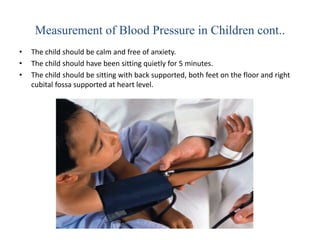
• The child should be calm and free of anxiety.
• The child should have been sitting quietly for 5 minutes.
• The child should be sitting with back supported, both feet on the floor and right
cubital fossa supported at heart level.
Measurement of Blood Pressure in Children cont..
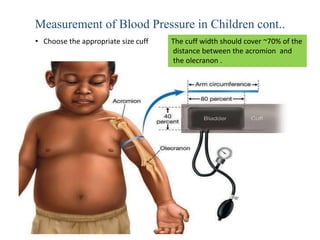
• Choose the appropriate size cuff The cuff width should cover ~70% of the
distance between the acromion and
the olecranon .
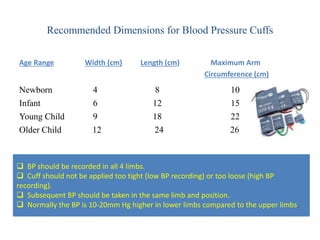
Recommended Dimensions for Blood Pressure Cuffs
Age Range Width (cm) Length (cm) Maximum Arm
Circumference (cm)
Newborn 4 8 10
Infant 6 12 15
Young Child 9 18 22
Older Child 12 24 26
 BP should be recorded in all 4 limbs.
 Cuff should not be applied too tight (low BP recording) or too loose (high BP
recording).
 Subsequent BP should be taken in the same limb and position.
 Normally the BP is 10-20mm Hg higher in lower limbs compared to the upper limbs.
Etiology
Hypertension in the newborn is most often associated with:
• Umbilical artery catheterization
• Renal artery thrombosis
Hypertension during early childhood may be due to :
• Renal disease ( 90%)
• Co-arctation of the aorta
• Endocrine disorders
• Medications
In adolescents
• Essential hypertension becomes increasingly common
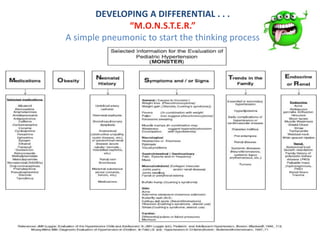
DEVELOPING A DIFFERENTIAL . . .
“M.O.N.S.T.E.R.”
A simple pneumonic to start the thinking process
10
Initial Diagnostic Algorithm in the Evaluation of Hypertension
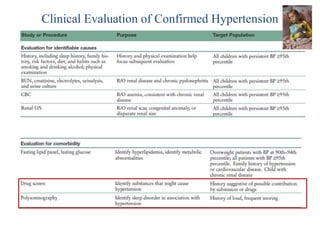
Clinical Evaluation of Confirmed Hypertension
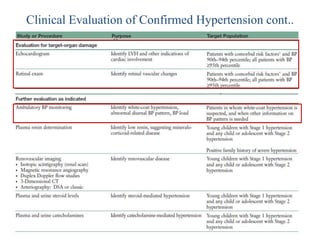
Clinical Evaluation of Confirmed Hypertension cont..
Target-Organ Abnormalities in Childhood Hypertension
• Left ventricular hypertrophy (LVH) is the most common evidence of target-organ
damage (40%).
• Pediatric patients with established hypertension should have echocardiographic
assessment of left ventricular mass at diagnosis and periodically thereafter.
• LV Mass (g) = 0.80 [1.04 (IVS + LVED + LVPW)³ – (LVED)³] + 0.6
Left ventricular end-diastolic dimension (LVED), Intraventricular septal thickness (IVS),
Left ventricular posterior wall thickness (LVPW)
• The presence of LVH is an indication to initiate or intensify antihypertensive therapy.
Other target-organ abnormalities (such as determination of carotid intimal-medial
thickness and evaluation of urine for microalbuminuria) is not recommended for routine
clinical use.
A conservative cut point that determines the presence of LVH is 51 g/m² ͘⁷
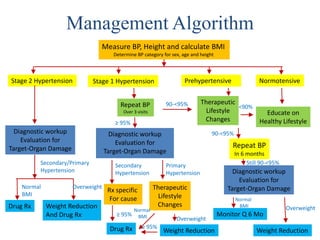
Management Algorithm
Measure BP, Height and calculate BMI
Determine BP category for sex, age and height
Stage 2 Hypertension Stage 1 Hypertension Prehypertensive Normotensive
Diagnostic workup
Evaluation for
Target-Organ Damage
Secondary/Primary
Hypertension
Normal
BMI
Drug Rx Weight Reduction
And Drug Rx
Overweight
Repeat BP
Over 3 visits
≥ 95%
Diagnostic workup
Evaluation for
Target-Organ Damage
Secondary
Hypertension
Primary
Hypertension
Rx specific
For cause
≥ 95%
Drug Rx
Therapeutic
Lifestyle
Changes
Overweight
Weight Reduction
Normal
BMI
≥ 95%
Therapeutic
Lifestyle
Changes
Repeat BP
In 6 months
Diagnostic workup
Evaluation for
Target-Organ Damage
Normal
BMI
Monitor Q 6 Mo
Overweight
Weight Reduction
Educate on
Healthy Lifestyle
90-<95%
90-<95% <90%
Still 90-<95%
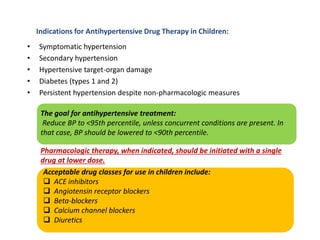
Indications for Antihypertensive Drug Therapy in Children:
• Symptomatic hypertension
• Secondary hypertension
• Hypertensive target-organ damage
• Diabetes (types 1 and 2)
• Persistent hypertension despite non-pharmacologic measures
The goal for antihypertensive treatment:
Reduce BP to <95th percentile, unless concurrent conditions are present. In
that case, BP should be lowered to <90th percentile.
Pharmacologic therapy, when indicated, should be initiated with a single
drug at lower dose.
Acceptable drug classes for use in children include:
 ACE inhibitors
 Angiotensin receptor blockers
 Beta-blockers
 Calcium channel blockers
 Diuretics
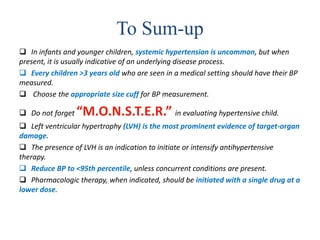
To Sum-up
 In infants and younger children, systemic hypertension is uncommon, but when
present, it is usually indicative of an underlying disease process.
 Every children >3 years old who are seen in a medical setting should have their BP
measured.
 Choose the appropriate size cuff for BP measurement.
 Do not forget “M.O.N.S.T.E.R.” in evaluating hypertensive child.
 Left ventricular hypertrophy (LVH) is the most prominent evidence of target-organ
damage.
 The presence of LVH is an indication to initiate or intensify antihypertensive
therapy.
 Reduce BP to <95th percentile, unless concurrent conditions are present.
 Pharmacologic therapy, when indicated, should be initiated with a single drug at a
lower dose.
Any Questions?
Pediatric hypertension

Pediatric hypertension

  • 1.
    APPROACH TO HYPERTENSION INCHILDHOOD Dr. Tauhid Iqbali M.D. Pediatrics
  • 2.
    Hypertension in children Hypertensionis defined as average SBP and/or DBP that is greater than or equal to the 95th percentile for sex, age, and height on three or more occasions What is it? Pre-hypertension is defined as average SBP or DBP levels that are greater than or equal to the 90th percentile, but less than the 95th percentile.
  • 3.
    Definition Stage I hypertension: Systolic or diastolic blood pressure between 95th percentile & 99th percentile + 5mmHg Stage II hypertension : Systolic or diastolic blood pressure > 99th percentile+ 5mmHg white-coat hypertension : Systolic or diastolic blood pressure above the 95th percentile in a physician’s office or clinic, who is normotensive outside the clinical setting.
  • 4.
    Primary Vs SecondaryHypertension in children In infants and younger children, systemic hypertension is uncommon, but when present, it is usually indicative of an underlying disease process (secondary hypertension). Adolescents may acquire primary or essential hypertension The severity of hypertension is helpful in distinguishing secondary from primary hypertension In general, children and adolescents with essential hypertension have blood pressure values at or only slightly above the 95th percentile for age
  • 5.
    Measurement of BloodPressure in Children Every children >3 years old who are seen in a medical setting should have their BP measured. Conditions Under Which Children <3 Years Old Should Have Blood Pressure Measured • History of prematurity, very low birth weight • Congenital heart disease (repaired or nonrepaired) • Recurrent urinary tract infections, hematuria, or proteinuria • Known renal disease or urologic malformations • Family history of congenital renal disease • Solid organ transplant • Malignancy or bone marrow transplant • Treatment with drugs known to raise BP • Other systemic illnesses associated with hypertension (neurofibromatosis, tuberous • sclerosis, etc.) • Evidence of elevated intracranial pressure
  • 6.
    Measurement of BloodPressure in Children cont.. • The child should be calm and free of anxiety. • The child should have been sitting quietly for 5 minutes. • The child should be sitting with back supported, both feet on the floor and right cubital fossa supported at heart level.
  • 7.
    Measurement of BloodPressure in Children cont.. • Choose the appropriate size cuff The cuff width should cover ~70% of the distance between the acromion and the olecranon .
  • 8.
    Recommended Dimensions forBlood Pressure Cuffs Age Range Width (cm) Length (cm) Maximum Arm Circumference (cm) Newborn 4 8 10 Infant 6 12 15 Young Child 9 18 22 Older Child 12 24 26  BP should be recorded in all 4 limbs.  Cuff should not be applied too tight (low BP recording) or too loose (high BP recording).  Subsequent BP should be taken in the same limb and position.  Normally the BP is 10-20mm Hg higher in lower limbs compared to the upper limbs.
  • 9.
    Etiology Hypertension in thenewborn is most often associated with: • Umbilical artery catheterization • Renal artery thrombosis Hypertension during early childhood may be due to : • Renal disease ( 90%) • Co-arctation of the aorta • Endocrine disorders • Medications In adolescents • Essential hypertension becomes increasingly common
  • 10.
    DEVELOPING A DIFFERENTIAL. . . “M.O.N.S.T.E.R.” A simple pneumonic to start the thinking process 10
  • 11.
    Initial Diagnostic Algorithmin the Evaluation of Hypertension
  • 12.
    Clinical Evaluation ofConfirmed Hypertension
  • 13.
    Clinical Evaluation ofConfirmed Hypertension cont..
  • 14.
    Target-Organ Abnormalities inChildhood Hypertension • Left ventricular hypertrophy (LVH) is the most common evidence of target-organ damage (40%). • Pediatric patients with established hypertension should have echocardiographic assessment of left ventricular mass at diagnosis and periodically thereafter. • LV Mass (g) = 0.80 [1.04 (IVS + LVED + LVPW)³ – (LVED)³] + 0.6 Left ventricular end-diastolic dimension (LVED), Intraventricular septal thickness (IVS), Left ventricular posterior wall thickness (LVPW) • The presence of LVH is an indication to initiate or intensify antihypertensive therapy. Other target-organ abnormalities (such as determination of carotid intimal-medial thickness and evaluation of urine for microalbuminuria) is not recommended for routine clinical use. A conservative cut point that determines the presence of LVH is 51 g/m² ͘⁷
  • 15.
    Management Algorithm Measure BP,Height and calculate BMI Determine BP category for sex, age and height Stage 2 Hypertension Stage 1 Hypertension Prehypertensive Normotensive Diagnostic workup Evaluation for Target-Organ Damage Secondary/Primary Hypertension Normal BMI Drug Rx Weight Reduction And Drug Rx Overweight Repeat BP Over 3 visits ≥ 95% Diagnostic workup Evaluation for Target-Organ Damage Secondary Hypertension Primary Hypertension Rx specific For cause ≥ 95% Drug Rx Therapeutic Lifestyle Changes Overweight Weight Reduction Normal BMI ≥ 95% Therapeutic Lifestyle Changes Repeat BP In 6 months Diagnostic workup Evaluation for Target-Organ Damage Normal BMI Monitor Q 6 Mo Overweight Weight Reduction Educate on Healthy Lifestyle 90-<95% 90-<95% <90% Still 90-<95%
  • 16.
    Indications for AntihypertensiveDrug Therapy in Children: • Symptomatic hypertension • Secondary hypertension • Hypertensive target-organ damage • Diabetes (types 1 and 2) • Persistent hypertension despite non-pharmacologic measures The goal for antihypertensive treatment: Reduce BP to <95th percentile, unless concurrent conditions are present. In that case, BP should be lowered to <90th percentile. Pharmacologic therapy, when indicated, should be initiated with a single drug at lower dose. Acceptable drug classes for use in children include:  ACE inhibitors  Angiotensin receptor blockers  Beta-blockers  Calcium channel blockers  Diuretics
  • 17.
    To Sum-up  Ininfants and younger children, systemic hypertension is uncommon, but when present, it is usually indicative of an underlying disease process.  Every children >3 years old who are seen in a medical setting should have their BP measured.  Choose the appropriate size cuff for BP measurement.  Do not forget “M.O.N.S.T.E.R.” in evaluating hypertensive child.  Left ventricular hypertrophy (LVH) is the most prominent evidence of target-organ damage.  The presence of LVH is an indication to initiate or intensify antihypertensive therapy.  Reduce BP to <95th percentile, unless concurrent conditions are present.  Pharmacologic therapy, when indicated, should be initiated with a single drug at a lower dose.
  • 18.

Editor's Notes

  • #5 That means they usually have secondary hypertension. However
  • #6 Fourth report and American Heart Association(AHA) recomends hOWEVER
  • #7 While measuring BP…
  • #8 The cuff width should cover ~70% of the distance between the acromion and the olecranon . The cuff bladder length should be 80 to 100% of the arm circumference, and the cuff bladder width should be at least 40% of the arm circumference at the midpoint of the acromion-olecranon distance.
  • #11  • Medications o Remember that many drugs carry the side-effect of possible HTN. Include over-the-counter meds and even licorice (glycyrrhizic acid)! • Obesity/Obstructive Sleep Apnea (OSA) o Obesity is defined as BMI ≥ 95% and there is a 3-5x greater liklelihood of having HTN o Those with OSA have higher DBP’s and are diagnosed by polysomnography 􀂃 Increased DBP is thought to be due to increased sympathetic nervous system activation • Neonatal History o Events early in life, including prenatal maternal history, can give a clue as to the etiology of a patient’s HTN • Symptoms and/or Signs o Searching for symptoms or signs through history and a systems-based approach to the physical exam are important and may direct one toward specific etiologies • Trends in the Family o A thorough family history should be obtained regarding cardiovascular disease o Though essential HTN exists, an evaluation of a child with HTN should be pursued to exclude secondary causes • Endocrine/Renal o The endocrine and renal systems host a variety of etiologies for HTN • Other: o A systems-based approach may elicit other etiologies for HTN o Remember trauma can be a cause of HTN (burns, traction, perirenal hematoma, increased ICP, spinal cord injury, etc.)
  • #15 Retinal examination
  • #16 Fourth report recomended Fresh fruits, fresh vegetables , non fat dairy and reduction in salt intake Regular aerobic activity for at least 30-60 min on most day along with reduction of sedantary activities to less than 2 hours per day
  • #17 eg. Hyperlipidemia ,End organ damage, Obesity, CKD etc. Bp still high another drug with the complementary mechanism of action , still high add another drug of different class.