‫هللا‬ ‫سبحان‬
‫الرحيم‬ ‫الرحمن‬ ‫هللا‬ ‫بسم‬
‫و‬‫به‬‫نستعين‬
General Anatomy
Anatomy Group
Department of Clinical Anatomy
2020
SKELETAL
SYSTEM
Dr. Gamal Said
4
List the functions of bone.
Identify the two divisions of the skeleton.
Describe the microscopic structure of bone.
List the different types of bones and give examples.
Identify the parts of a long bone.
Identify the subdivisions of the axial skeleton.
Identify the bones of the skull and the face.
Identify the various regions of the vertebral column.
Identify the subdivisions of the appendicular skeleton.
List the bony components of the pectoral and pelvic girdles and
upper and lower limbs.
Identify the major bony landmarks in the bones of the body.
Upon completion of this lecture, you will be able to:
 The skeletal system is formed mostly of bones and
cartilages. The bones are connected together by
number of joints to form the “skeleton of the body”.
Functions of bones:
 They form the skeleton, which gives the general framework
of the body, determining its shape and length.
 They provide attachment of muscles and other ligaments.
 They allow different movements of the body by acting as
levers.
 They have protective function for some vital organs e.g. the
brain is protected by the skull, the heart and lungs are
protected by thoracic wall.
 They are important storage places for calcium salts.
 They have haemopoietic function through the production of
blood cells by the red bone marrow (present in sternum, ribs
and ends of long bones).
Types of bones:
 Long bones: are longer than they are wide. They are found in
the limbs e.g. femur, humerus (the metatarsal, metacarpal
bones and phalanges are considered as short long bones).
 Short bones: are cuboidal in shape. They are found in the
hand and foot e.g. carpal and tarsal bones.
 Flat bones: are thin and flattened such as scapula, ribs and
skull bones.
 Irregular bones: they are irregular in shape. They have many
processes such as vertebrae and pelvic bones.
 Pneumatic bones: they have air filled cavities within it e.g.
some facial bones like maxilla).
N.B. the following 2 bone types are usually classified separately:
 Sesamoid bones: are found embedded within certain tendons,
such as the patella and fabella.
 Sutural bones: they occur between the sutures of the skull.
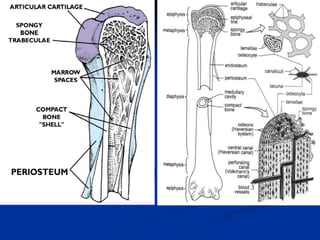
Description of a long bone
A long bone consists of shaft and two ends:
 Shaft (diaphysis):
 It is tubular form of compact bone that contains a central cavity
(medullary or bone marrow cavity). This cavity is lined by a
cellular membrane called “endosteum”.
 During growth the diaphysis is separated from the epiphysis by
the epiphyseal cartilage.
 The metaphysis is the part of the diaphysis adjacent to the
epiphyseal cartilage.
 The diaphysis is covered by a vascular membrane "periosteum",
which has an osteogenic power as it contains osteoblasts (bone-
forming cells). It causes the increase in breadth of bones and it is
needed to repair any fractures of bone. It gives attachment to
ligaments and tendons.
 Ends:
 They are the expanded ends of a long bone. Each one is called
“epiphysis”.
 They are formed of spongy bone covered by a thin layer of
compact bone.
 The articular surfaces of the ends are covered by hyaline cart.
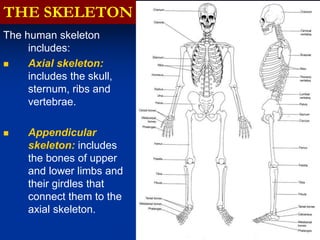
THE SKELETON
The human skeleton
includes:
 Axial skeleton:
includes the skull,
sternum, ribs and
vertebrae.
 Appendicular
skeleton: includes
the bones of upper
and lower limbs and
their girdles that
connect them to the
axial skeleton.
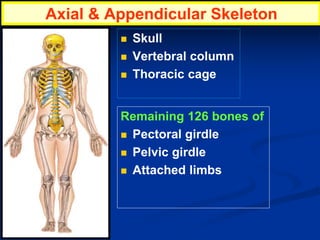
 Skull
 Vertebral column
 Thoracic cage
Remaining 126 bones of
 Pectoral girdle
 Pelvic girdle
 Attached limbs
Axial & Appendicular Skeleton
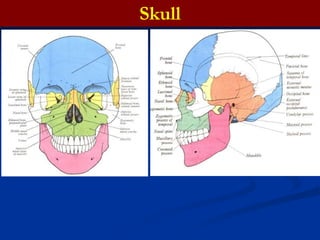
Skull
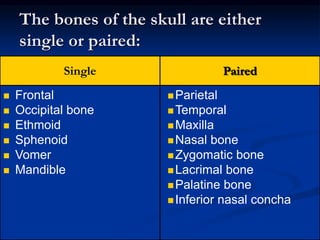
The bones of the skull are either
single or paired:
Single Paired
 Frontal
 Occipital bone
 Ethmoid
 Sphenoid
 Vomer
 Mandible
Parietal
Temporal
Maxilla
Nasal bone
Zygomatic bone
Lacrimal bone
Palatine bone
Inferior nasal concha
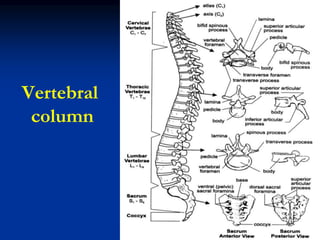
Vertebral
column
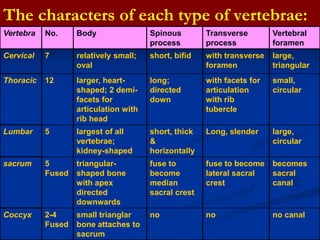
The characters of each type of vertebrae:
Vertebra No. Body Spinous
process
Transverse
process
Vertebral
foramen
Cervical 7 relatively small;
oval
short, bifid with transverse
foramen
large,
triangular
Thoracic 12 larger, heart-
shaped; 2 demi-
facets for
articulation with
rib head
long;
directed
down
with facets for
articulation
with rib
tubercle
small,
circular
Lumbar 5 largest of all
vertebrae;
kidney-shaped
short, thick
&
horizontally
Long, slender large,
circular
sacrum 5
Fused
triangular-
shaped bone
with apex
directed
downwards
fuse to
become
median
sacral crest
fuse to become
lateral sacral
crest
becomes
sacral
canal
Coccyx 2-4
Fused
small trianglar
bone attaches to
sacrum
no no no canal
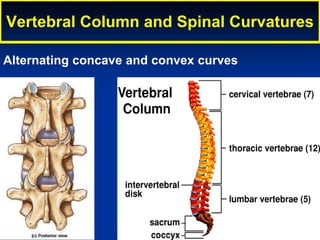
Vertebral Column and Spinal Curvatures
Alternating concave and convex curves
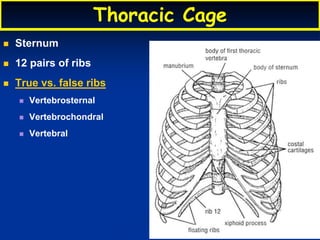
Thoracic Cage
 Sternum
 12 pairs of ribs
 True vs. false ribs
 Vertebrosternal
 Vertebrochondral
 Vertebral
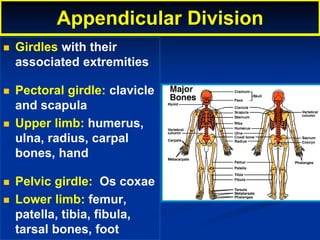
Appendicular Division
 Girdles with their
associated extremities
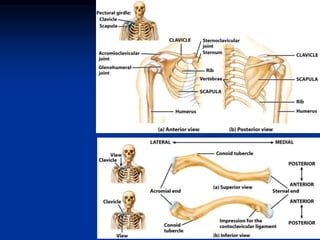
 Pectoral girdle: clavicle
and scapula
 Upper limb: humerus,
ulna, radius, carpal
bones, hand
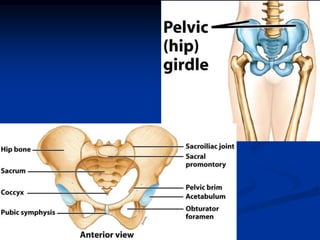
 Pelvic girdle: Os coxae
 Lower limb: femur,
patella, tibia, fibula,
tarsal bones, foot
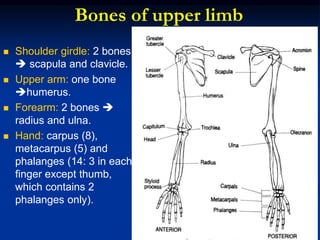
Bones of upper limb
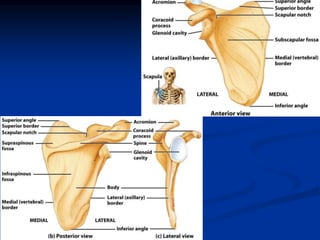
 Shoulder girdle: 2 bones
 scapula and clavicle.
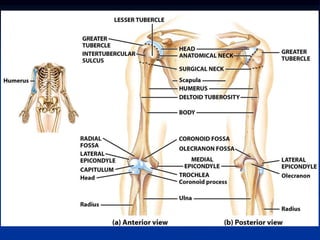
 Upper arm: one bone
humerus.
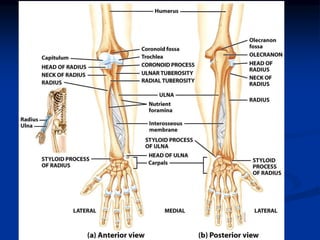
 Forearm: 2 bones 
radius and ulna.
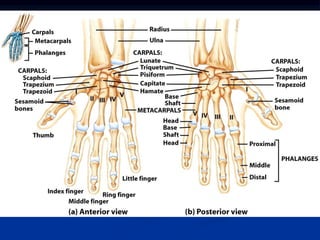
 Hand: carpus (8),
metacarpus (5) and
phalanges (14: 3 in each
finger except thumb,
which contains 2
phalanges only).
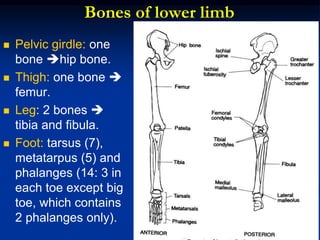
Bones of lower limb
 Pelvic girdle: one
bone hip bone.
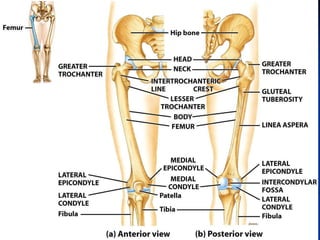
 Thigh: one bone 
femur.
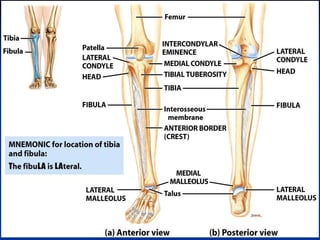
 Leg: 2 bones 
tibia and fibula.
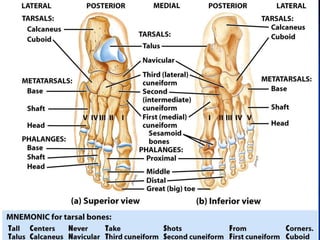
 Foot: tarsus (7),
metatarpus (5) and
phalanges (14: 3 in
each toe except big
toe, which contains
2 phalanges only).
2. cpp skeletal system  dr. gamal 2020

2. cpp skeletal system dr. gamal 2020

  • 1.
    ‫هللا‬ ‫سبحان‬ ‫الرحيم‬ ‫الرحمن‬‫هللا‬ ‫بسم‬ ‫و‬‫به‬‫نستعين‬
  • 2.
  • 3.
  • 4.
    4 List the functionsof bone. Identify the two divisions of the skeleton. Describe the microscopic structure of bone. List the different types of bones and give examples. Identify the parts of a long bone. Identify the subdivisions of the axial skeleton. Identify the bones of the skull and the face. Identify the various regions of the vertebral column. Identify the subdivisions of the appendicular skeleton. List the bony components of the pectoral and pelvic girdles and upper and lower limbs. Identify the major bony landmarks in the bones of the body. Upon completion of this lecture, you will be able to:
  • 5.
     The skeletalsystem is formed mostly of bones and cartilages. The bones are connected together by number of joints to form the “skeleton of the body”. Functions of bones:  They form the skeleton, which gives the general framework of the body, determining its shape and length.  They provide attachment of muscles and other ligaments.  They allow different movements of the body by acting as levers.  They have protective function for some vital organs e.g. the brain is protected by the skull, the heart and lungs are protected by thoracic wall.  They are important storage places for calcium salts.  They have haemopoietic function through the production of blood cells by the red bone marrow (present in sternum, ribs and ends of long bones).
  • 6.
    Types of bones: Long bones: are longer than they are wide. They are found in the limbs e.g. femur, humerus (the metatarsal, metacarpal bones and phalanges are considered as short long bones).  Short bones: are cuboidal in shape. They are found in the hand and foot e.g. carpal and tarsal bones.  Flat bones: are thin and flattened such as scapula, ribs and skull bones.  Irregular bones: they are irregular in shape. They have many processes such as vertebrae and pelvic bones.  Pneumatic bones: they have air filled cavities within it e.g. some facial bones like maxilla). N.B. the following 2 bone types are usually classified separately:  Sesamoid bones: are found embedded within certain tendons, such as the patella and fabella.  Sutural bones: they occur between the sutures of the skull.
  • 8.
    Description of along bone A long bone consists of shaft and two ends:  Shaft (diaphysis):  It is tubular form of compact bone that contains a central cavity (medullary or bone marrow cavity). This cavity is lined by a cellular membrane called “endosteum”.  During growth the diaphysis is separated from the epiphysis by the epiphyseal cartilage.  The metaphysis is the part of the diaphysis adjacent to the epiphyseal cartilage.  The diaphysis is covered by a vascular membrane "periosteum", which has an osteogenic power as it contains osteoblasts (bone- forming cells). It causes the increase in breadth of bones and it is needed to repair any fractures of bone. It gives attachment to ligaments and tendons.  Ends:  They are the expanded ends of a long bone. Each one is called “epiphysis”.  They are formed of spongy bone covered by a thin layer of compact bone.  The articular surfaces of the ends are covered by hyaline cart.
  • 10.
    THE SKELETON The humanskeleton includes:  Axial skeleton: includes the skull, sternum, ribs and vertebrae.  Appendicular skeleton: includes the bones of upper and lower limbs and their girdles that connect them to the axial skeleton.
  • 11.
     Skull  Vertebralcolumn  Thoracic cage Remaining 126 bones of  Pectoral girdle  Pelvic girdle  Attached limbs Axial & Appendicular Skeleton
  • 12.
  • 13.
    The bones ofthe skull are either single or paired: Single Paired  Frontal  Occipital bone  Ethmoid  Sphenoid  Vomer  Mandible Parietal Temporal Maxilla Nasal bone Zygomatic bone Lacrimal bone Palatine bone Inferior nasal concha
  • 14.
  • 15.
    The characters ofeach type of vertebrae: Vertebra No. Body Spinous process Transverse process Vertebral foramen Cervical 7 relatively small; oval short, bifid with transverse foramen large, triangular Thoracic 12 larger, heart- shaped; 2 demi- facets for articulation with rib head long; directed down with facets for articulation with rib tubercle small, circular Lumbar 5 largest of all vertebrae; kidney-shaped short, thick & horizontally Long, slender large, circular sacrum 5 Fused triangular- shaped bone with apex directed downwards fuse to become median sacral crest fuse to become lateral sacral crest becomes sacral canal Coccyx 2-4 Fused small trianglar bone attaches to sacrum no no no canal
  • 16.
    Vertebral Column andSpinal Curvatures Alternating concave and convex curves
  • 17.
    Thoracic Cage  Sternum 12 pairs of ribs  True vs. false ribs  Vertebrosternal  Vertebrochondral  Vertebral
  • 18.
    Appendicular Division  Girdleswith their associated extremities  Pectoral girdle: clavicle and scapula  Upper limb: humerus, ulna, radius, carpal bones, hand  Pelvic girdle: Os coxae  Lower limb: femur, patella, tibia, fibula, tarsal bones, foot
  • 19.
    Bones of upperlimb  Shoulder girdle: 2 bones  scapula and clavicle.  Upper arm: one bone humerus.  Forearm: 2 bones  radius and ulna.  Hand: carpus (8), metacarpus (5) and phalanges (14: 3 in each finger except thumb, which contains 2 phalanges only).
  • 25.
    Bones of lowerlimb  Pelvic girdle: one bone hip bone.  Thigh: one bone  femur.  Leg: 2 bones  tibia and fibula.  Foot: tarsus (7), metatarpus (5) and phalanges (14: 3 in each toe except big toe, which contains 2 phalanges only).