(A Project of National Medical Centre Karachi)

     PELVIC GIRDLE & LOWER LIMBS.
                    BY:
              Shahzad Bashir.
            Lecturer, NMC ION.


4/6/2013                                         1
O B J E C T I V ES
• Identify the bones of the pelvic girdle and their
  principal markings.
• Describe the division of the pelvic girdle into
  false and true pelvis.
• Compare the principal differences between female
  and male pelvis.
• Identify the bones of the lower limb and their
  principal markings.
• Describe the joints between the upper limb bones.

4/6/2013                                          2
BONES OF THE LOWER LIMBS.
S. NO.     REGION       NAME           NUMBER.
   1.      PELVIS   Innominate Bone.      1
   2.      THIGH        Femur.            1
   3.       KNEE        Patella.          1
   4.       LEG      Fibula/ Tibia.     1 Each
   5.      ANKLE        Tarsals           7.
   6.      FOOT.      Metatarsals         5.
   7.       TOES       Phalanges         14.


4/6/2013                                         3
PELVIC (HIP) GIRDLE.
• The pelvic (hip) girdle consists of the two hip
  bones.
• Also called coxal or pelvic bones or coxa
  (cox= hip).
• The hip bones unite anteriorly at a joint called
  the symphysis pubic.
• They unite posteriorly with the sacrum at the
  SACROILIAC JOINTS, to form Bony Pelvis.

4/6/2013                                             4
BONES OF THE PELVIC GIRDLE
   • Formed by two coxal (coxae) bones.
   • Composed of three pairs of fused bones.
           – Ilium (Superior)
           – Ischium (Posterior)
           – Pubis (Anterior)

   • All three bones meet at a Cup- Shaped Cavity called
     ACETABULAM into which fits head of the FEMUR
     to form FEMURO- ACETABULUM JOINT
     OR HIP JOINT.

4/6/2013                                             5
BONES OF THE PELVIC GIRDLE
• The total weight of the upper body rests on the pelvis.
• It protects several organs
   – Reproductive organs
   – Urinary bladder
   – Part of the large intestine
• Functionally, the bony pelvis provides a strong and
  stable support for the vertebral column and pelvic and
  lower abdominal organs.
• The pelvic girdle of the bony pelvis also connects the
  bones of the lower limbs to the axial skeleton.
4/6/2013                                                6
The Pelvis
           Hip bone


                                       Sacral promontory


      Obturator foramen


4/6/2013                                           7
THE PELVIS
  Hip bone                                      Pelvic brim landmarks:


Pelvic
(hip)                                                   Sacroiliac joint
girdle
                                                    Sacral promontory

                                                        Sacrum


                                                     Acetabulum

                                              Pubic crest
Pelvic brim                                 Obturator foramen
                Coccyx

     4/6/2013
                          Symphysis Pubic                        8
ILIUM
• It is a Flat Bone.
• Makes the upper part of PELVIC BONE.
• Ileum is the largest part of the three components of the hip
   bone.
• Ilum contain FOUR major Features.
1. ILIAC CREST: (For attachment of abdominal muscles).
2. ILIAC SPINES: (For attachment of muscles).
3. ARTICULAR SURFACE: (For articulation with Sacrum to
    form SACRO- ILIAC JOINT.
4. GREATER SCIATIC NOTCH: (Through which pass the
    sciatic nerve, the longest nerve in the body)

4/6/2013                                                         9
THE PELVIS: RIGHT COXAL BONE
                       Auricular surface
Lesser sciatic notch


                                           Superior ramus of pubis


4/6/2013                                                    10
ISCHIUM.
• Irregular bone.
• The thickest and strongest portion of PELVIC BONE.
• Ischium is comprised of a superior body and an
  inferior ramus (ram= branch).
• Ischium contain three major Features.
 1. ISCHIAL SPINES: (For attachment of Muscle).
 2. LESSER SCIATIC NOTCH: (Through which
     passes lesser sciatic nerve).
 3. ISCHIAL TUBEROSITY: (Lies below at the
     lowest point on which the trunk rests in the sitting
     position).
4/6/2013                                               11
PUBIS
•   Irregular bone.
•   Consists of a body and 2 Rami (Superior & Inferior)
•   The Pubis bone meet Anteriorly at SYMPHYSIS PUBIS.
•   Pubis also contain three major features:
     1. OBTURATOR FORAMEN: (Largest foramen in the
         skeleton). A large whole through which pass the blood
         vessels and nerves vessels & is cover by Obturator
         membrane.
     2. SYMPHYSIS PUBIS: Is the joint between the two pubes
         of the hip bones consists of a disc of fibrocartilage.
     3. PUBIC ARCH:


4/6/2013                                                      12
OBTURATOR FORAMEN.

• Largest foramen in the skeleton.

• A large whole below the ACETABULUM
    through which pass the blood vessels and
    nerves vessels & is cover by Obturator
    membrane.


4/6/2013                                       13
ACETABULAM

• Deep Cup-shaped Cavity formed at the union
    of the 3 bones.

• Pubis forms the front part.

• Ilium form the upper part.

• Ischium form the back part.

4/6/2013                                       14
GENDER DIFFERENCES OF THE
             PELVIS.
• It is divided into 2 parts by the BRIUM OF THE
    PELVIS.
• The GREATER OR FALSE PELVIS is above the
    BRIUM.
• The LESSER OR TRUE PELVIS is below the
    BRIUM.
• The female pelvis is wider than male for child birth.

4/6/2013                                                  15
GENDER DIFFERENCES OF THE
              PELVIS
• The female inlet is larger and more circular.
• The female pelvis as a whole is shallower, and
  the bones are lighter and thinner.
• The female ilia flare more laterally.
• The female sacrum is shorter and less curved.
• The female ischial spines are shorter and
  farther apart; thus the outlet is larger.
• The female pubic arch is more rounded
  because the angle of the pubic arch is greater.

4/6/2013                                        16
GENDER DIFFERENCES OF THE
              PELVIS


4/6/2013                        17
GENDER DIFFERENCES OF THE
                 PELVIS
• Comparison of Female and Male Pelves.
  S.No.     POINT OF COMPARISON      FEMALE                        MALE

  1.        General structure        Light and thin.               Heavy and thick.

  2.        False (greater) pelvis   Shallow.                      Deep.

  3.        Pelvic brim (inlet)      Larger and more oval.         Smaller and heart-
                                                                   shaped.
  4.        Acetabulum               Small and faces anteriorly.   Large and faces
                                                                   laterally.
  5.        Obturator foramen        Oval.                         Round.

  6.        Pubic arch               Greater than 90 angle.        Less than 90 angle.


 4/6/2013                                                                             18
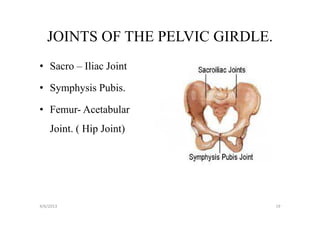
JOINTS OF THE PELVIC GIRDLE.
• Sacro – Iliac Joint

• Symphysis Pubis.

• Femur- Acetabular
    Joint. ( Hip Joint)


4/6/2013                          19
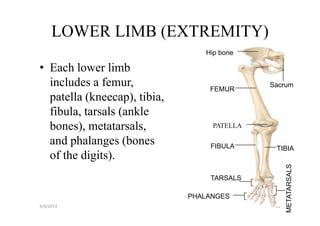
LOWER LIMB (EXTREMITY)
                                 Hip bone

• Each lower limb
  includes a femur,               FEMUR
                                             Sacrum
  patella (kneecap), tibia,
  fibula, tarsals (ankle
  bones), metatarsals,             PATELLA

  and phalanges (bones            FIBULA      TIBIA
  of the digits).


                                                   METATARSALS
                                  TARSALS

                              PHALANGES
4/6/2013                                      20
LOWER LIMB
     Lower Limb Consists of :

                                   Femur
•    Femur
                        Femur                                   Patella
•    Patella
•    Tibia                        Fibula

•    Fibula                                                 T
                                                                Tibia
                                             (c) Lateral view
•    Tarsals            Patella

•    Metatarsals         Fibula    Femur
•    Phalanges           Tibia     Medial
                                                                 Lateral
                                   condyle
                                                                 condyle
                                                                Fibula
                                                            T
                                                                Tibia
                                    T
                   Metatarsals      Tarsals (d) Posterior view

    4/6/2013                      Phalanges                                21
                         (b)
FEMUR.
• Long bone, One in number.

• Also known as THIGH BONE.

• It is the longest and Strongest & heaviest bone
    of the body.

• Extends from hip to thigh.

• Has a shaft and Two Extremities.
4/6/2013                                        22
FEMUR.
• UPPER EXTREMITY:
• 2/3rd sphere head with small Depression called
  FOVEA CAPITIS for attachment of TERES
  LIAGMENT.
• Long Neck.
• Greater Trochanter (Laterally)
• Lesser Trochanter ( Medially)
• Inter- Trochanter Line ( Anteriorly)
• Inter – Trochanteric Crest (Posteriorly)
• Gluteal tuberosity (Posteriorly) for attachment of
  thigh muscle.
4/6/2013                                               23
FEMUR.

• SHAFT:

• Cylindrical and Smooth.

• Curved forwards.

• LINEA ASPERA (Posteriorly), a rough line
    posteriorly for the attachment of muscles.

4/6/2013                                         24
FEMUR
                                                     Head Neck

                             Fovea capitis                             Greater
                                                                       trochanter
                                         Head
                                                                        Intertrochanteric crest
                                                                         Lesser
           Greater                                                       trochanter
           trochanter
                                                                           Gluteal
            Lesser                                                         tuberosity
            trochanter
                                                                           Linea
                                                                           aspera


                                                       Intercondylar
                                                       fossa
                                        Medial                             Lateral
                                        epicondyle                         epicondyle
                           Medial
                           epicondyle
           Lateral                                               Lateral
           epicondyle                                 Medial     condyle
                                                      condyle
4/6/2013                 Patellar                                                          25
                                  (a)                (b)
                         surface
FEMUR


                   Figure 5.25a–b
4/6/2013                    26
FEMUR
                    View
Femur
                      HEAD

                                                            FOVEA CAPITIS
                   GREATER
                   TROCHANTER

        INTERTROCHANTERIC                                NECK
        CREST

         LESSER TROCHANTER


                        (c) Medial view of proximal end of femur


    4/6/2013                                                                27
FEMUR.
• LOWER EXTREMITY:
• Have 2 Condyles (Medial& Lateral) for articulation
     with TIBIA.
• Superior to the condyles are the medial and the lateral
     epicondyle, to which ligaments of the knee joint
     attach.
• PATELLA SURFACE: Anteriorly for articulation
     with patella.
• INTER-CONDYLER FOSSA: Posteriorly B/W 2
     Condyles.
• POPLITEAL SURFACE: Above the Fossa
     Posteriorly.
4/6/2013                                                28
JOINTS OF FEMUR.

• FEMURO- ACETABULAR JOINT. (Hip Joint)

• FEMURO – TIBIAL JOINT. (Knee Joint)

• ARTICULATES WITH PATELLA.


4/6/2013                                29
HIP JOINT.
                                      Hip bone                                 GREATER
GREATER                                                                        TROCHANTER
TROCHANTER                              HEAD
                                         NECK
                                   INTERTROCHANTERIC                           GLUTEAL
                                   LINE       CREST                            TUBEROSITY
                                  LESSER TROCHANTER
                                        FEMUR
                                                                             LINEA ASPERA
                                        BODY
                                        (SHAFT)
 LATERAL
                                                                            INTERCONDYLAR
 EPICONDYLE
                                                                            FOSSA
                                   MEDIAL EPICONDYLE
  LATERAL                                                                     LATERAL
                                   MEDIAL CONDYLE
  CONDYLE                                                                     CONDYLE
                                    Patella
    Fibula                                                                   Fibula
                                      Tibia

   4/6/2013   (a) Anterior view                        (b) Posterior view             30
PATELLA.
• Triangular bone one in number.
• Sesamoid bone developed in tendons of
  QUADRICEPS FEMORIS MUSLE.
• Also know as KNEE CAP.
• Lies in front of knee joint.
• BASE points upward.


4/6/2013                                  31
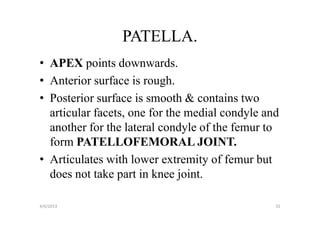
PATELLA.
• APEX points downwards.
• Anterior surface is rough.
• Posterior surface is smooth & contains two
  articular facets, one for the medial condyle and
  another for the lateral condyle of the femur to
  form PATELLOFEMORAL JOINT.
• Articulates with lower extremity of femur but
  does not take part in knee joint.

4/6/2013                                         32
Articular
           (a) Anterior view               (b) Posterior view   facet
                                                                for lateral
                                                                femoral
                                    Base                        condyle


                               Articular facet
                               for medial
                               femoral condyle


                                   Apex
              Patella


4/6/2013                                                                33
TIBIA.
• The tibia is larger, weight-bearing bone of the leg.
• The tibia articulates at its proximal end with the
  femur and fibula, and at its distal end with the
  fibula and the talus bone of the ankle.
• One in number.
• Long bone.
• Also called SHIN BONE.
• MEDIAL LEG BONE.
• Two Extremities and 1 Shaft.
4/6/2013                                           34
TIBIA
                                          Intercondylar
                                          eminence
                             Lateral       Medial
    • Shin bone              Condyle       Condyle
                             Head of      Tibial
                             fibula       tuberosity
    • Medial to fibula
                                          Anterior
                                          crest
    • Condyles               Fibula
                                         Tibia

    • Tibial tuberosity
    • Anterior crest
    • Makes the medial
    malleolus                Lateral
                                         Medial
                                         malleolus
4/6/2013                     malleolus                    35
TIBIA.
• UPPER EXTREMITY:
• Wide and flat.
• Medial & Lateral Condyles for articulation with Femur
     to form TIBIOFEMORAL JOINTS (knee).
• Inferior surface of the lateral Condyle is FACET for
     articulation with the head of the FIBULA (Laterally) to
     form SUPERIOR TIBIOFIBULAR JOINT.
• CARTILAGES lies on Condyles.
• INTERCONDYLAR EMINENCE: (Slightly concave
     condyles are separated by an upward projection).
• TIBIAL TUBEROSITY:(On the anterior surface is a
     point of attachment for the patellar ligament).
4/6/2013                                                  36
TIBIA & FIBULA.
                                           Femur.
            Patella
LATERAL                               INTERCONDYLAR
                                                                                   LATERAL
CONDYLE.                              EMINENCE.
                                                                                   CONDYLE.
  HEAD.                                MEDIAL CONDYLE.                              HEAD.
                                       TIBIAL TUBEROSITY.
                                           TIBIA.
 FIBULA.
                                 Interosseous membrane.
                                                                                   FIBULA.
                                 ANTERIOR BORDER (CREST).


                                       MEDIAL MALLEOLUS.                          LATERAL
 LATERAL
 MALLEOLUS.                              Talus.                                   MALLEOLUS.

                                                                                 Calcaneus.


 4/6/2013         (a) Anterior view                         (b) Posterior view                37
TIBIA & FIBULA.
TIBIA.
• SHAFT:
• Triangular
• ANTERIOR BORDER (CREST) OR SHIN: (Anteriorly)
  (Inferior to the tibial tuberosity is a sharp ridge that can be felt
  below the skin)

• LOWER EXTREMITY:
• MEDIAL MALLEOLUS: (Articulates with the talus of the ankle,
  the prominence on the medial surface of the ankle.
• FIBULAR NOTCH: (Articulates with the distal end of the fibula
  to form the DISTAL/INFERIOR TIBIOFIBULAR JOINT.


  4/6/2013                                                               39
TIBIA.


Tibia
                       FIBULAR
 View                  NOTCH

                           MEDIAL
                           MALLEOLUS


   4/6/2013                            40
JOINTS OF TIBIA.
• FEMURO-TIBIAL JOINT.(With Tibia)

• SUPERIOR- TIBIO -FIBULAR JOINT.(Between Tibia
    & Fibula).

• INFERIOR TIBIO -FIBULAR JOINT. (Between Tibia
    & Fibula).

• TIBIO -TARSAL-JOINT (Ankle Joint)(With Talus).

4/6/2013                                           41
FIBULA.
• One in number.
• Long bone, Lateral bone of leg.
• Fibula does not articulate with the femur, but it does help
  stabilize the ankle joint.
• Shaft and 2 Extremities.
• Head of fibula articulates with the lateral Condyle of Tibia-
  Forming PROXIMAL/SUPERIOR TIBIO FIBULAR
  JOINT.
• Lower Extremity of Fibula have LATERAL MALLEOLUS
  articulates with Talus of Ankle.
• Lower extremity of also articulate with Tibia to form
  DISTAL/INFERIOR TIBIO-FIBULAR JOINT.
• Lateral Malleolus forms the prominence on the lateral
  surface of the ankle.
4/6/2013                                                      42
TIBIA & FIBULA.
FIBULA.
                                       Intercondylar
                                       eminence
                          Lateral       Medial
• Lateral to tibia        Condyle       Condyle
                          Head of      Tibial
                          fibula       tuberosity
• Long, slender                        Anterior
                                       crest

• Head                    Fibula
                                      Tibia

• Makes the lateral
malleolus
• Non-weight bearing
                                      Medial
                          Lateral     malleolus
4/6/2013                  malleolus                    44
JOINTS OF FIBULA.

• PROXIMAL/SUPERIOR –TIBIO-FIBULAR
    JOINT.(Between Tibia & Fibula).

• DISTAL/INFERIOR- TIBIO-FIBULAR
    JOINT.(Between Tibia & Fibula).

• FIBULO- TARSAL JOINT.(Ankle Joint)


4/6/2013                               45
TARSALS
• The tarsus (ankle) is the proximal region of the
  foot and consists of seven tarsal bones.
• They include the talus (ankle bone) and
  calcaneus (heel), located in the posterior part
  of the foot.
• The calcaneus is the largest and strongest
  tarsal bone.
• Joints between tarsal bones are called
  INTERTARSAL JOINTS.

4/6/2013                                         46
TARSALS.
MNEMONIC for tarsal bones:
Tall Centers Never        Take            Shots            From            Corners.
Talus Calcaneus Navicular Third cuneiform Second cuneiform First cuneiform Cuboid


Tarsals Bone: (7)
   • Calcaneus
   • Talus                                                          Fibula
                                                                   Tibia
   • Navicular
                                                                   Talus
                                                                     T

   • Cuboid                                  Metatarsals
                                                            Medial
                                                                   Navicular
                                                            cuneiform
   • Lateral (3rd)                           (metatarsus)
                                      Phalanges                                           Calcaneus

   cuneiform                                                                              Calcaneal
                                                                                          tuberosity
   • Intermediate (2nd)                                                        Tarsals
                                       (b)
   cuneiform                                                                   (tarsus)

   • Medial (1st)
   cuneiform
 4/6/2013                                                                                    47
FOOT
TARSALS.
• CALCANEUS OR OSCALIS:
• Largest of the Tarsals.

• Lies Posteriorly forming HEEL.

• Articulates with TALUS superiorly.

• Articulates with anteriorly with CUBOID.


4/6/2013                                     49
TARSALS.
• TALUS:
• The most superior tarsal bone, is the only bone of the foot that
  articulates with the fibula and tibia.
• During walking, the talus transmits about half the weight of the
  body to the calcaneus.
• Central and highest point of foot.
• Supports TIBIA , FIBULA and articulates with CALCANEUS
  inferiorly.

• NAVICULAR:
• Boat-Shaped Bone.
• Lies medially, Talus behind and 3 Cuneiform in front.
4/6/2013                                                        50
TARSALS.
• CUNEIFORM:
• Three in Number.
• Wedge – Shaped.
• Articulates with Navicular Posteriorly and with
  Metatarsals anteriorly & with Cuboid laterally.

• CUBOID:
• One in number.
• Cube-shaped.

4/6/2013                                            51
JOINTS OF TARSALS.

• TIBIO – TARSALS JOINT.

• FIBULO – TARSALS JOINT. Ankle Joint.

• INTERTARSAL JOINTS.(Between Tarsals)

• TARSO – META – TARSAL JOINT. (With
    Metatarsals)


4/6/2013                                 52
METATARSUS.
• The metatarsus, the intermediate region of the foot,
  consists of five bone called Metatarsals.
• The metatarsals articulate proximally with the first,
  second, and third cuneiform bones and with the cuboid to
  form the TARSOMETATARSAL joints.
• Distally, they articulate with the proximal row of phalanges
  to form the METATARSOPHALANGEAL joints.
• The first metatarsal is thicker than the others because it
  bears more weight.

• JOINTS OF META-TARSALS.
• TARSO-META-TARSALS.(With Tarsals)
• META-TARSO- PHALANGEAL JOINT.(With Phalanges)
 4/6/2013                                                  53
FOOT


I
    II III
             IV
                  V
FOOT

             Calcaneus


             Talus                                      Tarsals(tarsus)
             Navicular
              Cuboid
            Lateral cuneiform
           Intermediate cuneiform
            Medial cuneiform
                                    5
                                        4
                                            3           Metatarsals (metatarsus)
                                                2   1

           Proximal phalanx

            Middle phalanx

            Distal phalanx                              Phalanges


4/6/2013                                                                           55
               (a)
PHALANGES.
• The phalanges comprise the distal component of the foot.
• Each phalanx (singular) consists of a proximal base, an
  intermediate shaft, and a distal head.
• The great or big toe is called hallux has two phalanges.
• The other four toes each have three phalanges—proximal,
  middle, and distal.(Total 14 in numbers in each Side)
• Joints between phalanges of the foot, like those of the hand,
  are called INTERPHALANGEAL joints.
• Long bone forming Toes.

• JOINTS OF PHALANGES.
• META-TARSO-PHALANGEAL JOINT.(With Metatarsals).
• INTER- PHALANGEAL JOINT.(Between Phalanges).
4/6/2013                                       56
FOOT
ARCHES OF THE FOOT
• Bones of the foot are arranged to form three
  strong arches
• Arches are fully developed by age 12 or 13.
  – Two longitudinal (Lateral & Medial).
  – One transverse.

  FUNCTION OF ARCHES:
  Arches help the foot support and distribute the weight
  of the body and provide leverage during walking.
ARCHES OF THE FOOT
JOINTS OF UPPER LIMBS.
•   Acromio-Clavicular Joint.
•   Sterno-Clavicular Joint.
•   Humero -Scapular Joint. (Shoulder Joint)
•   Humero- Ulnar Joint.         (Elbow Joint)
•   Humero- Radial Joint.
•   Superior -Radio Ulnar Joint.
•   Inferior- Radio Ulnar Joint.
•   Radio –Carpal Joint. (Wrist Joint)
•   Carpo –Meta-Carpal Joint.
•   Meta Carpo –Phalangeal Joint.
•   Inter- Phalangeal Joint.

4/6/2013                                         60
JOINTS OF LOWER LIMBS.
•   Femuro - Acetabular Joint (Hip Joint)
•   Femuro – Tibial Joint (Knee Joint)
•   Superior – Tibial - Fibular Joint.
•   Inferior – Tibial – Fibular Joint.
•   Tibio Tarsals Joint.      (Ankle Joint)
•   Fibulo - Tarsal Joint.
•   Tarso - Meta – Tarsal Joint.
•   Meta – Tarso- Phalangeal Joint.
•   Inter - Phalangeal Joint.

4/6/2013                                      61
REFERENCES

  • Tortora, G. J. & Grabowski, S.R. (2000).
    Principles of anatomy and physiology (12th
    ed.). New York: John Wiley & sons Inc.
  • Eline, N.M, Essential of human anatomy &
    physiology (9th ed.). New York: John Wiley &
    sons Inc.


4/6/2013                                       62

Final apendicular skeleton (lower limbs).

  • 1.
    (A Project ofNational Medical Centre Karachi) PELVIC GIRDLE & LOWER LIMBS. BY: Shahzad Bashir. Lecturer, NMC ION. 4/6/2013 1
  • 2.
    O B JE C T I V ES • Identify the bones of the pelvic girdle and their principal markings. • Describe the division of the pelvic girdle into false and true pelvis. • Compare the principal differences between female and male pelvis. • Identify the bones of the lower limb and their principal markings. • Describe the joints between the upper limb bones. 4/6/2013 2
  • 3.
    BONES OF THELOWER LIMBS. S. NO. REGION NAME NUMBER. 1. PELVIS Innominate Bone. 1 2. THIGH Femur. 1 3. KNEE Patella. 1 4. LEG Fibula/ Tibia. 1 Each 5. ANKLE Tarsals 7. 6. FOOT. Metatarsals 5. 7. TOES Phalanges 14. 4/6/2013 3
  • 4.
    PELVIC (HIP) GIRDLE. •The pelvic (hip) girdle consists of the two hip bones. • Also called coxal or pelvic bones or coxa (cox= hip). • The hip bones unite anteriorly at a joint called the symphysis pubic. • They unite posteriorly with the sacrum at the SACROILIAC JOINTS, to form Bony Pelvis. 4/6/2013 4
  • 5.
    BONES OF THEPELVIC GIRDLE • Formed by two coxal (coxae) bones. • Composed of three pairs of fused bones. – Ilium (Superior) – Ischium (Posterior) – Pubis (Anterior) • All three bones meet at a Cup- Shaped Cavity called ACETABULAM into which fits head of the FEMUR to form FEMURO- ACETABULUM JOINT OR HIP JOINT. 4/6/2013 5
  • 6.
    BONES OF THEPELVIC GIRDLE • The total weight of the upper body rests on the pelvis. • It protects several organs – Reproductive organs – Urinary bladder – Part of the large intestine • Functionally, the bony pelvis provides a strong and stable support for the vertebral column and pelvic and lower abdominal organs. • The pelvic girdle of the bony pelvis also connects the bones of the lower limbs to the axial skeleton. 4/6/2013 6
  • 7.
    The Pelvis Hip bone Sacral promontory Obturator foramen 4/6/2013 7
  • 8.
    THE PELVIS Hip bone Pelvic brim landmarks: Pelvic (hip) Sacroiliac joint girdle Sacral promontory Sacrum Acetabulum Pubic crest Pelvic brim Obturator foramen Coccyx 4/6/2013 Symphysis Pubic 8
  • 9.
    ILIUM • It isa Flat Bone. • Makes the upper part of PELVIC BONE. • Ileum is the largest part of the three components of the hip bone. • Ilum contain FOUR major Features. 1. ILIAC CREST: (For attachment of abdominal muscles). 2. ILIAC SPINES: (For attachment of muscles). 3. ARTICULAR SURFACE: (For articulation with Sacrum to form SACRO- ILIAC JOINT. 4. GREATER SCIATIC NOTCH: (Through which pass the sciatic nerve, the longest nerve in the body) 4/6/2013 9
  • 10.
    THE PELVIS: RIGHTCOXAL BONE Auricular surface Lesser sciatic notch Superior ramus of pubis 4/6/2013 10
  • 11.
    ISCHIUM. • Irregular bone. •The thickest and strongest portion of PELVIC BONE. • Ischium is comprised of a superior body and an inferior ramus (ram= branch). • Ischium contain three major Features. 1. ISCHIAL SPINES: (For attachment of Muscle). 2. LESSER SCIATIC NOTCH: (Through which passes lesser sciatic nerve). 3. ISCHIAL TUBEROSITY: (Lies below at the lowest point on which the trunk rests in the sitting position). 4/6/2013 11
  • 12.
    PUBIS • Irregular bone. • Consists of a body and 2 Rami (Superior & Inferior) • The Pubis bone meet Anteriorly at SYMPHYSIS PUBIS. • Pubis also contain three major features: 1. OBTURATOR FORAMEN: (Largest foramen in the skeleton). A large whole through which pass the blood vessels and nerves vessels & is cover by Obturator membrane. 2. SYMPHYSIS PUBIS: Is the joint between the two pubes of the hip bones consists of a disc of fibrocartilage. 3. PUBIC ARCH: 4/6/2013 12
  • 13.
    OBTURATOR FORAMEN. • Largestforamen in the skeleton. • A large whole below the ACETABULUM through which pass the blood vessels and nerves vessels & is cover by Obturator membrane. 4/6/2013 13
  • 14.
    ACETABULAM • Deep Cup-shapedCavity formed at the union of the 3 bones. • Pubis forms the front part. • Ilium form the upper part. • Ischium form the back part. 4/6/2013 14
  • 15.
    GENDER DIFFERENCES OFTHE PELVIS. • It is divided into 2 parts by the BRIUM OF THE PELVIS. • The GREATER OR FALSE PELVIS is above the BRIUM. • The LESSER OR TRUE PELVIS is below the BRIUM. • The female pelvis is wider than male for child birth. 4/6/2013 15
  • 16.
    GENDER DIFFERENCES OFTHE PELVIS • The female inlet is larger and more circular. • The female pelvis as a whole is shallower, and the bones are lighter and thinner. • The female ilia flare more laterally. • The female sacrum is shorter and less curved. • The female ischial spines are shorter and farther apart; thus the outlet is larger. • The female pubic arch is more rounded because the angle of the pubic arch is greater. 4/6/2013 16
  • 17.
    GENDER DIFFERENCES OFTHE PELVIS 4/6/2013 17
  • 18.
    GENDER DIFFERENCES OFTHE PELVIS • Comparison of Female and Male Pelves. S.No. POINT OF COMPARISON FEMALE MALE 1. General structure Light and thin. Heavy and thick. 2. False (greater) pelvis Shallow. Deep. 3. Pelvic brim (inlet) Larger and more oval. Smaller and heart- shaped. 4. Acetabulum Small and faces anteriorly. Large and faces laterally. 5. Obturator foramen Oval. Round. 6. Pubic arch Greater than 90 angle. Less than 90 angle. 4/6/2013 18
  • 19.
    JOINTS OF THEPELVIC GIRDLE. • Sacro – Iliac Joint • Symphysis Pubis. • Femur- Acetabular Joint. ( Hip Joint) 4/6/2013 19
  • 20.
    LOWER LIMB (EXTREMITY) Hip bone • Each lower limb includes a femur, FEMUR Sacrum patella (kneecap), tibia, fibula, tarsals (ankle bones), metatarsals, PATELLA and phalanges (bones FIBULA TIBIA of the digits). METATARSALS TARSALS PHALANGES 4/6/2013 20
  • 21.
    LOWER LIMB Lower Limb Consists of : Femur • Femur Femur Patella • Patella • Tibia Fibula • Fibula T Tibia (c) Lateral view • Tarsals Patella • Metatarsals Fibula Femur • Phalanges Tibia Medial Lateral condyle condyle Fibula T Tibia T Metatarsals Tarsals (d) Posterior view 4/6/2013 Phalanges 21 (b)
  • 22.
    FEMUR. • Long bone,One in number. • Also known as THIGH BONE. • It is the longest and Strongest & heaviest bone of the body. • Extends from hip to thigh. • Has a shaft and Two Extremities. 4/6/2013 22
  • 23.
    FEMUR. • UPPER EXTREMITY: •2/3rd sphere head with small Depression called FOVEA CAPITIS for attachment of TERES LIAGMENT. • Long Neck. • Greater Trochanter (Laterally) • Lesser Trochanter ( Medially) • Inter- Trochanter Line ( Anteriorly) • Inter – Trochanteric Crest (Posteriorly) • Gluteal tuberosity (Posteriorly) for attachment of thigh muscle. 4/6/2013 23
  • 24.
    FEMUR. • SHAFT: • Cylindricaland Smooth. • Curved forwards. • LINEA ASPERA (Posteriorly), a rough line posteriorly for the attachment of muscles. 4/6/2013 24
  • 25.
    FEMUR Head Neck Fovea capitis Greater trochanter Head Intertrochanteric crest Lesser Greater trochanter trochanter Gluteal Lesser tuberosity trochanter Linea aspera Intercondylar fossa Medial Lateral epicondyle epicondyle Medial epicondyle Lateral Lateral epicondyle Medial condyle condyle 4/6/2013 Patellar 25 (a) (b) surface
  • 26.
    FEMUR Figure 5.25a–b 4/6/2013 26
  • 27.
    FEMUR View Femur HEAD FOVEA CAPITIS GREATER TROCHANTER INTERTROCHANTERIC NECK CREST LESSER TROCHANTER (c) Medial view of proximal end of femur 4/6/2013 27
  • 28.
    FEMUR. • LOWER EXTREMITY: •Have 2 Condyles (Medial& Lateral) for articulation with TIBIA. • Superior to the condyles are the medial and the lateral epicondyle, to which ligaments of the knee joint attach. • PATELLA SURFACE: Anteriorly for articulation with patella. • INTER-CONDYLER FOSSA: Posteriorly B/W 2 Condyles. • POPLITEAL SURFACE: Above the Fossa Posteriorly. 4/6/2013 28
  • 29.
    JOINTS OF FEMUR. •FEMURO- ACETABULAR JOINT. (Hip Joint) • FEMURO – TIBIAL JOINT. (Knee Joint) • ARTICULATES WITH PATELLA. 4/6/2013 29
  • 30.
    HIP JOINT. Hip bone GREATER GREATER TROCHANTER TROCHANTER HEAD NECK INTERTROCHANTERIC GLUTEAL LINE CREST TUBEROSITY LESSER TROCHANTER FEMUR LINEA ASPERA BODY (SHAFT) LATERAL INTERCONDYLAR EPICONDYLE FOSSA MEDIAL EPICONDYLE LATERAL LATERAL MEDIAL CONDYLE CONDYLE CONDYLE Patella Fibula Fibula Tibia 4/6/2013 (a) Anterior view (b) Posterior view 30
  • 31.
    PATELLA. • Triangular boneone in number. • Sesamoid bone developed in tendons of QUADRICEPS FEMORIS MUSLE. • Also know as KNEE CAP. • Lies in front of knee joint. • BASE points upward. 4/6/2013 31
  • 32.
    PATELLA. • APEX pointsdownwards. • Anterior surface is rough. • Posterior surface is smooth & contains two articular facets, one for the medial condyle and another for the lateral condyle of the femur to form PATELLOFEMORAL JOINT. • Articulates with lower extremity of femur but does not take part in knee joint. 4/6/2013 32
  • 33.
    Articular (a) Anterior view (b) Posterior view facet for lateral femoral Base condyle Articular facet for medial femoral condyle Apex Patella 4/6/2013 33
  • 34.
    TIBIA. • The tibiais larger, weight-bearing bone of the leg. • The tibia articulates at its proximal end with the femur and fibula, and at its distal end with the fibula and the talus bone of the ankle. • One in number. • Long bone. • Also called SHIN BONE. • MEDIAL LEG BONE. • Two Extremities and 1 Shaft. 4/6/2013 34
  • 35.
    TIBIA Intercondylar eminence Lateral Medial • Shin bone Condyle Condyle Head of Tibial fibula tuberosity • Medial to fibula Anterior crest • Condyles Fibula Tibia • Tibial tuberosity • Anterior crest • Makes the medial malleolus Lateral Medial malleolus 4/6/2013 malleolus 35
  • 36.
    TIBIA. • UPPER EXTREMITY: •Wide and flat. • Medial & Lateral Condyles for articulation with Femur to form TIBIOFEMORAL JOINTS (knee). • Inferior surface of the lateral Condyle is FACET for articulation with the head of the FIBULA (Laterally) to form SUPERIOR TIBIOFIBULAR JOINT. • CARTILAGES lies on Condyles. • INTERCONDYLAR EMINENCE: (Slightly concave condyles are separated by an upward projection). • TIBIAL TUBEROSITY:(On the anterior surface is a point of attachment for the patellar ligament). 4/6/2013 36
  • 37.
    TIBIA & FIBULA. Femur. Patella LATERAL INTERCONDYLAR LATERAL CONDYLE. EMINENCE. CONDYLE. HEAD. MEDIAL CONDYLE. HEAD. TIBIAL TUBEROSITY. TIBIA. FIBULA. Interosseous membrane. FIBULA. ANTERIOR BORDER (CREST). MEDIAL MALLEOLUS. LATERAL LATERAL MALLEOLUS. Talus. MALLEOLUS. Calcaneus. 4/6/2013 (a) Anterior view (b) Posterior view 37
  • 38.
  • 39.
    TIBIA. • SHAFT: • Triangular •ANTERIOR BORDER (CREST) OR SHIN: (Anteriorly) (Inferior to the tibial tuberosity is a sharp ridge that can be felt below the skin) • LOWER EXTREMITY: • MEDIAL MALLEOLUS: (Articulates with the talus of the ankle, the prominence on the medial surface of the ankle. • FIBULAR NOTCH: (Articulates with the distal end of the fibula to form the DISTAL/INFERIOR TIBIOFIBULAR JOINT. 4/6/2013 39
  • 40.
    TIBIA. Tibia FIBULAR View NOTCH MEDIAL MALLEOLUS 4/6/2013 40
  • 41.
    JOINTS OF TIBIA. •FEMURO-TIBIAL JOINT.(With Tibia) • SUPERIOR- TIBIO -FIBULAR JOINT.(Between Tibia & Fibula). • INFERIOR TIBIO -FIBULAR JOINT. (Between Tibia & Fibula). • TIBIO -TARSAL-JOINT (Ankle Joint)(With Talus). 4/6/2013 41
  • 42.
    FIBULA. • One innumber. • Long bone, Lateral bone of leg. • Fibula does not articulate with the femur, but it does help stabilize the ankle joint. • Shaft and 2 Extremities. • Head of fibula articulates with the lateral Condyle of Tibia- Forming PROXIMAL/SUPERIOR TIBIO FIBULAR JOINT. • Lower Extremity of Fibula have LATERAL MALLEOLUS articulates with Talus of Ankle. • Lower extremity of also articulate with Tibia to form DISTAL/INFERIOR TIBIO-FIBULAR JOINT. • Lateral Malleolus forms the prominence on the lateral surface of the ankle. 4/6/2013 42
  • 43.
  • 44.
    FIBULA. Intercondylar eminence Lateral Medial • Lateral to tibia Condyle Condyle Head of Tibial fibula tuberosity • Long, slender Anterior crest • Head Fibula Tibia • Makes the lateral malleolus • Non-weight bearing Medial Lateral malleolus 4/6/2013 malleolus 44
  • 45.
    JOINTS OF FIBULA. •PROXIMAL/SUPERIOR –TIBIO-FIBULAR JOINT.(Between Tibia & Fibula). • DISTAL/INFERIOR- TIBIO-FIBULAR JOINT.(Between Tibia & Fibula). • FIBULO- TARSAL JOINT.(Ankle Joint) 4/6/2013 45
  • 46.
    TARSALS • The tarsus(ankle) is the proximal region of the foot and consists of seven tarsal bones. • They include the talus (ankle bone) and calcaneus (heel), located in the posterior part of the foot. • The calcaneus is the largest and strongest tarsal bone. • Joints between tarsal bones are called INTERTARSAL JOINTS. 4/6/2013 46
  • 47.
    TARSALS. MNEMONIC for tarsalbones: Tall Centers Never Take Shots From Corners. Talus Calcaneus Navicular Third cuneiform Second cuneiform First cuneiform Cuboid Tarsals Bone: (7) • Calcaneus • Talus Fibula Tibia • Navicular Talus T • Cuboid Metatarsals Medial Navicular cuneiform • Lateral (3rd) (metatarsus) Phalanges Calcaneus cuneiform Calcaneal tuberosity • Intermediate (2nd) Tarsals (b) cuneiform (tarsus) • Medial (1st) cuneiform 4/6/2013 47
  • 48.
  • 49.
    TARSALS. • CALCANEUS OROSCALIS: • Largest of the Tarsals. • Lies Posteriorly forming HEEL. • Articulates with TALUS superiorly. • Articulates with anteriorly with CUBOID. 4/6/2013 49
  • 50.
    TARSALS. • TALUS: • Themost superior tarsal bone, is the only bone of the foot that articulates with the fibula and tibia. • During walking, the talus transmits about half the weight of the body to the calcaneus. • Central and highest point of foot. • Supports TIBIA , FIBULA and articulates with CALCANEUS inferiorly. • NAVICULAR: • Boat-Shaped Bone. • Lies medially, Talus behind and 3 Cuneiform in front. 4/6/2013 50
  • 51.
    TARSALS. • CUNEIFORM: • Threein Number. • Wedge – Shaped. • Articulates with Navicular Posteriorly and with Metatarsals anteriorly & with Cuboid laterally. • CUBOID: • One in number. • Cube-shaped. 4/6/2013 51
  • 52.
    JOINTS OF TARSALS. •TIBIO – TARSALS JOINT. • FIBULO – TARSALS JOINT. Ankle Joint. • INTERTARSAL JOINTS.(Between Tarsals) • TARSO – META – TARSAL JOINT. (With Metatarsals) 4/6/2013 52
  • 53.
    METATARSUS. • The metatarsus,the intermediate region of the foot, consists of five bone called Metatarsals. • The metatarsals articulate proximally with the first, second, and third cuneiform bones and with the cuboid to form the TARSOMETATARSAL joints. • Distally, they articulate with the proximal row of phalanges to form the METATARSOPHALANGEAL joints. • The first metatarsal is thicker than the others because it bears more weight. • JOINTS OF META-TARSALS. • TARSO-META-TARSALS.(With Tarsals) • META-TARSO- PHALANGEAL JOINT.(With Phalanges) 4/6/2013 53
  • 54.
    FOOT I II III IV V
  • 55.
    FOOT Calcaneus Talus Tarsals(tarsus) Navicular Cuboid Lateral cuneiform Intermediate cuneiform Medial cuneiform 5 4 3 Metatarsals (metatarsus) 2 1 Proximal phalanx Middle phalanx Distal phalanx Phalanges 4/6/2013 55 (a)
  • 56.
    PHALANGES. • The phalangescomprise the distal component of the foot. • Each phalanx (singular) consists of a proximal base, an intermediate shaft, and a distal head. • The great or big toe is called hallux has two phalanges. • The other four toes each have three phalanges—proximal, middle, and distal.(Total 14 in numbers in each Side) • Joints between phalanges of the foot, like those of the hand, are called INTERPHALANGEAL joints. • Long bone forming Toes. • JOINTS OF PHALANGES. • META-TARSO-PHALANGEAL JOINT.(With Metatarsals). • INTER- PHALANGEAL JOINT.(Between Phalanges). 4/6/2013 56
  • 57.
  • 58.
    ARCHES OF THEFOOT • Bones of the foot are arranged to form three strong arches • Arches are fully developed by age 12 or 13. – Two longitudinal (Lateral & Medial). – One transverse. FUNCTION OF ARCHES: Arches help the foot support and distribute the weight of the body and provide leverage during walking.
  • 59.
  • 60.
    JOINTS OF UPPERLIMBS. • Acromio-Clavicular Joint. • Sterno-Clavicular Joint. • Humero -Scapular Joint. (Shoulder Joint) • Humero- Ulnar Joint. (Elbow Joint) • Humero- Radial Joint. • Superior -Radio Ulnar Joint. • Inferior- Radio Ulnar Joint. • Radio –Carpal Joint. (Wrist Joint) • Carpo –Meta-Carpal Joint. • Meta Carpo –Phalangeal Joint. • Inter- Phalangeal Joint. 4/6/2013 60
  • 61.
    JOINTS OF LOWERLIMBS. • Femuro - Acetabular Joint (Hip Joint) • Femuro – Tibial Joint (Knee Joint) • Superior – Tibial - Fibular Joint. • Inferior – Tibial – Fibular Joint. • Tibio Tarsals Joint. (Ankle Joint) • Fibulo - Tarsal Joint. • Tarso - Meta – Tarsal Joint. • Meta – Tarso- Phalangeal Joint. • Inter - Phalangeal Joint. 4/6/2013 61
  • 62.
    REFERENCES •Tortora, G. J. & Grabowski, S.R. (2000). Principles of anatomy and physiology (12th ed.). New York: John Wiley & sons Inc. • Eline, N.M, Essential of human anatomy & physiology (9th ed.). New York: John Wiley & sons Inc. 4/6/2013 62