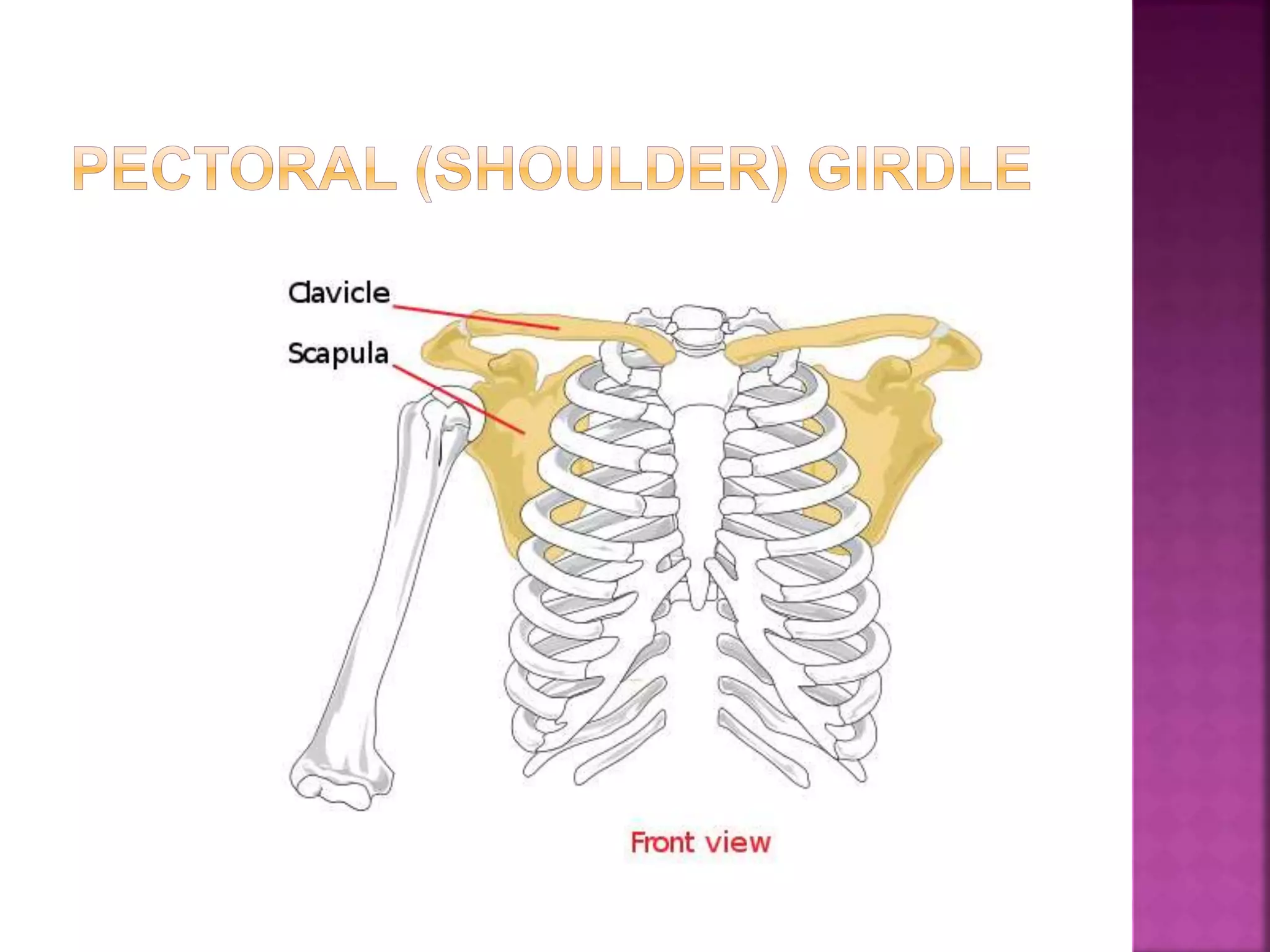
 The paired pectoral girdles each consist of two
bones,
 the anterior clavicle and the posterior scapula.
 The shoulder girdles function to attach the upper
limbs to the axial skeleton.
 In addition, the bones of the shoulder girdles
serve as attachment points for many trunk and
neck muscles.
 The pectoral girdle is exceptionally light and
allows the upper limb a degree of mobility not
seen anywhere else in the body.
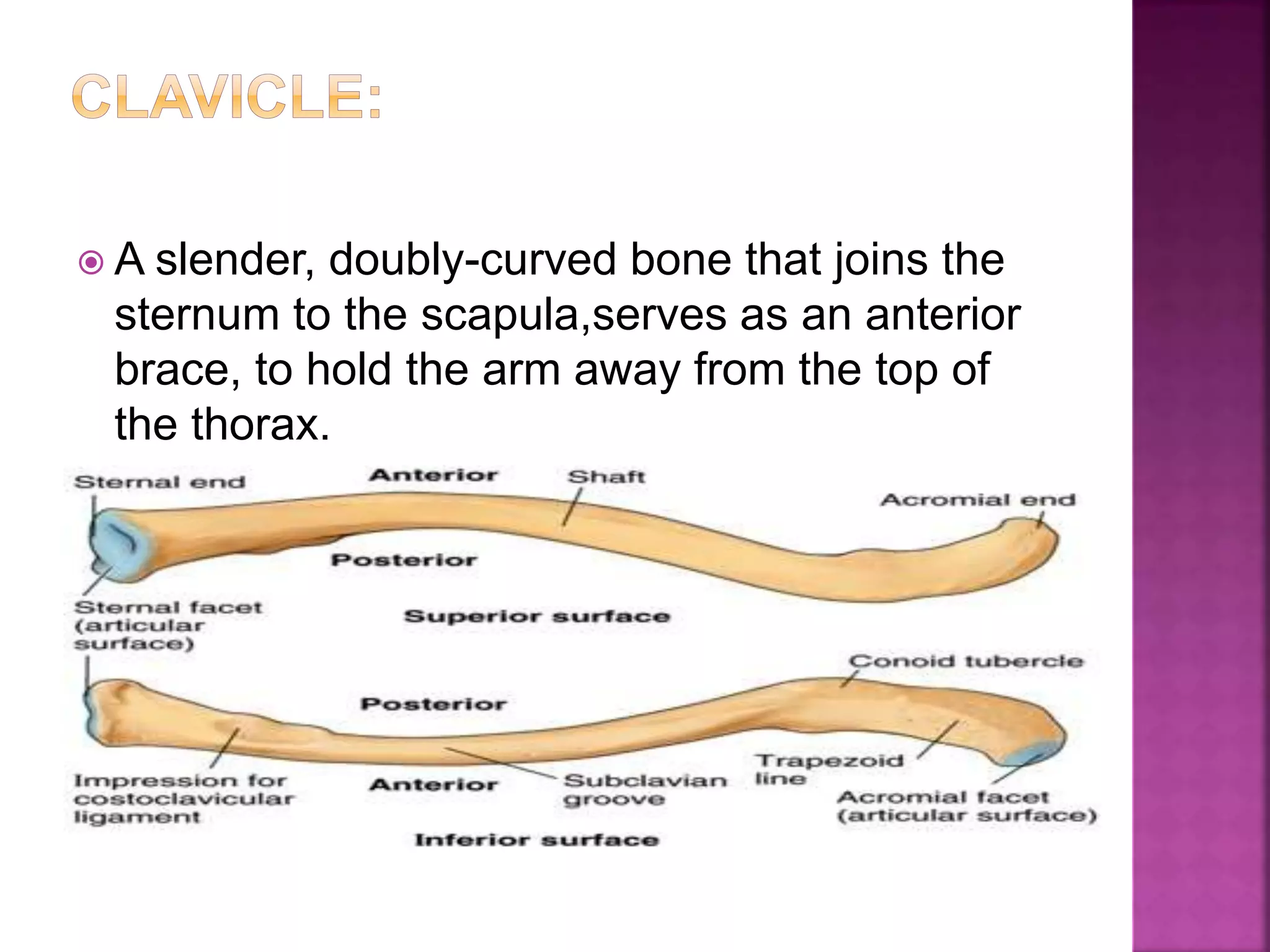
 A slender, doubly-curved bone that joins the
sternum to the scapula,serves as an anterior
brace, to hold the arm away from the top of
the thorax.
 Landmarks / Markings:
 STERNAL END: Rounded terminus of
clavicle; articulates with the sternal
manubrium.
 ACROMIAL END: Flattened terminus of
clavicle; articulates with the scapula to form
part of the shoulder joint.
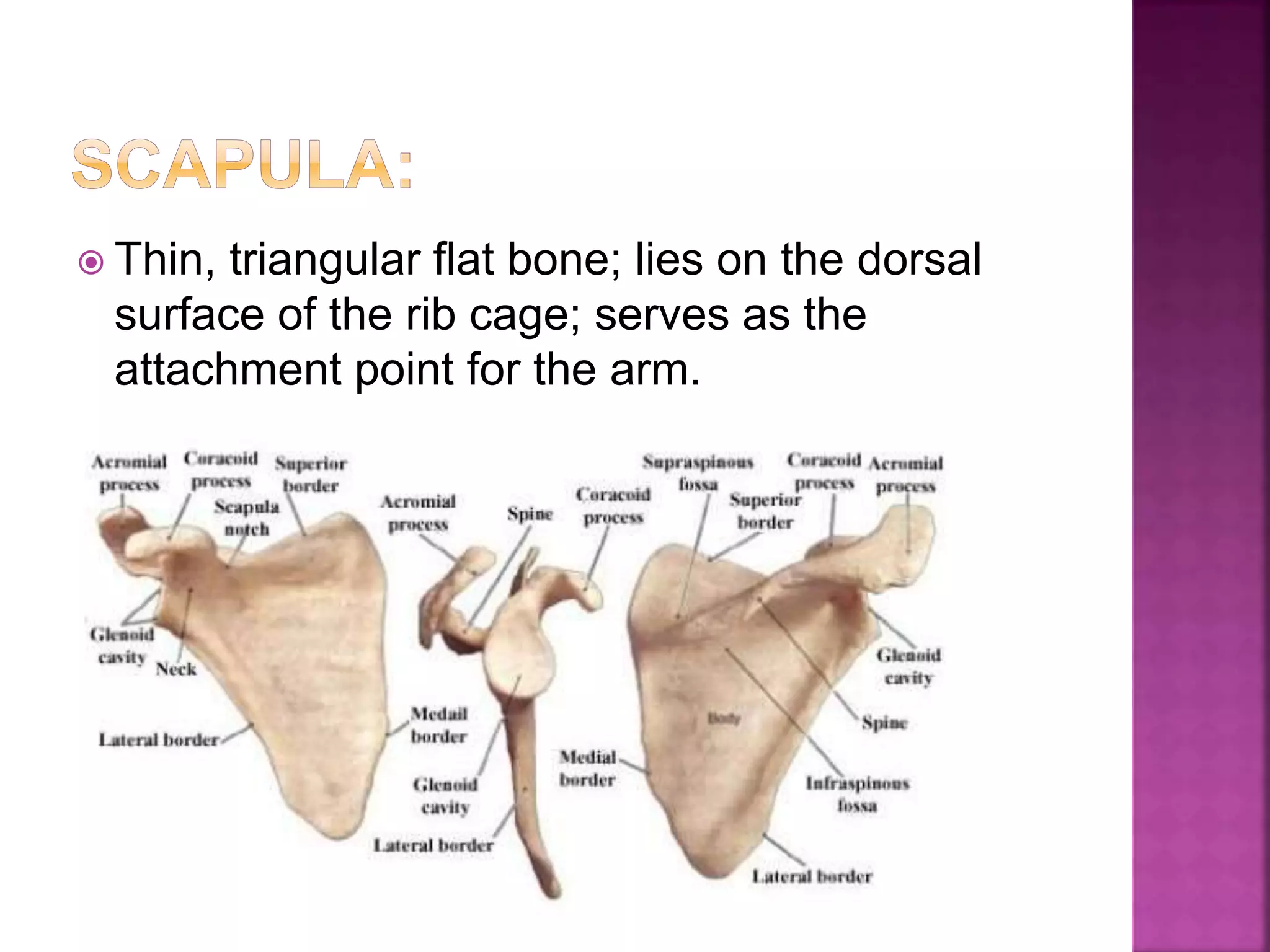
 Thin, triangular flat bone; lies on the dorsal
surface of the rib cage; serves as the
attachment point for the arm.
 Borders / angles:
 Superior border: Short, sharp border that forms
the upper margin of the scapula when articulated
with the axial skeleton.
 Medial (vertebral) border: Border which parallels
the vertebral column when articulated with the axial
skeleton; joins with superior border at the superior
angle.
 Lateral (axillary) border: The thick border that
abuts the armpit when articulated with the axial
skeleton; joins with superior border at the lateral
angle and joins with medial border at the inferior
angle.
 Landmarks / Markings:
 Glenoid cavity (fossa): Small, shallow
depression superior to the lateral border, near
the lateral angle; articulates with humerus of
the arm.
 Spine: Prominent ridge rising from the upper
posterior surface of the scapula; site of
muscle attachment.
 Acromion: Enlarged, roughened triangular
structure projecting projection off the lateral
end of the scapular spine; articulates with the
acromial end of the clavicle.
 Coracoid process: Beak-like structure
projecting anteriorly from the superior
scapular border; site of muscle attachment.
 Suprascapular notch: Shallow groove in the
superior border of the scapula at the base of
the coracoid process; passageway for nerves.
 Supraspinous fossa: Deep depression
superior to the spine on the posterior surface
of the scapula; site of muscle attachment.
 Infraspinous fossa: Shallow depression
inferior to the spine on the posterior surface of
the scapula; site of muscle attachment.
 Subscapular fossa: Shallow depression
formed by the entire anterior scapular surface;
site of muscle attachment.
 The upper arm consists of a single bone, the
humerus .
 The largest and longest bone of the upper
limb, it articulates with the scapula at the
shoulder and with the radius and ulna
(forearm bones) at the elbow.
 Landmarks / Markings:
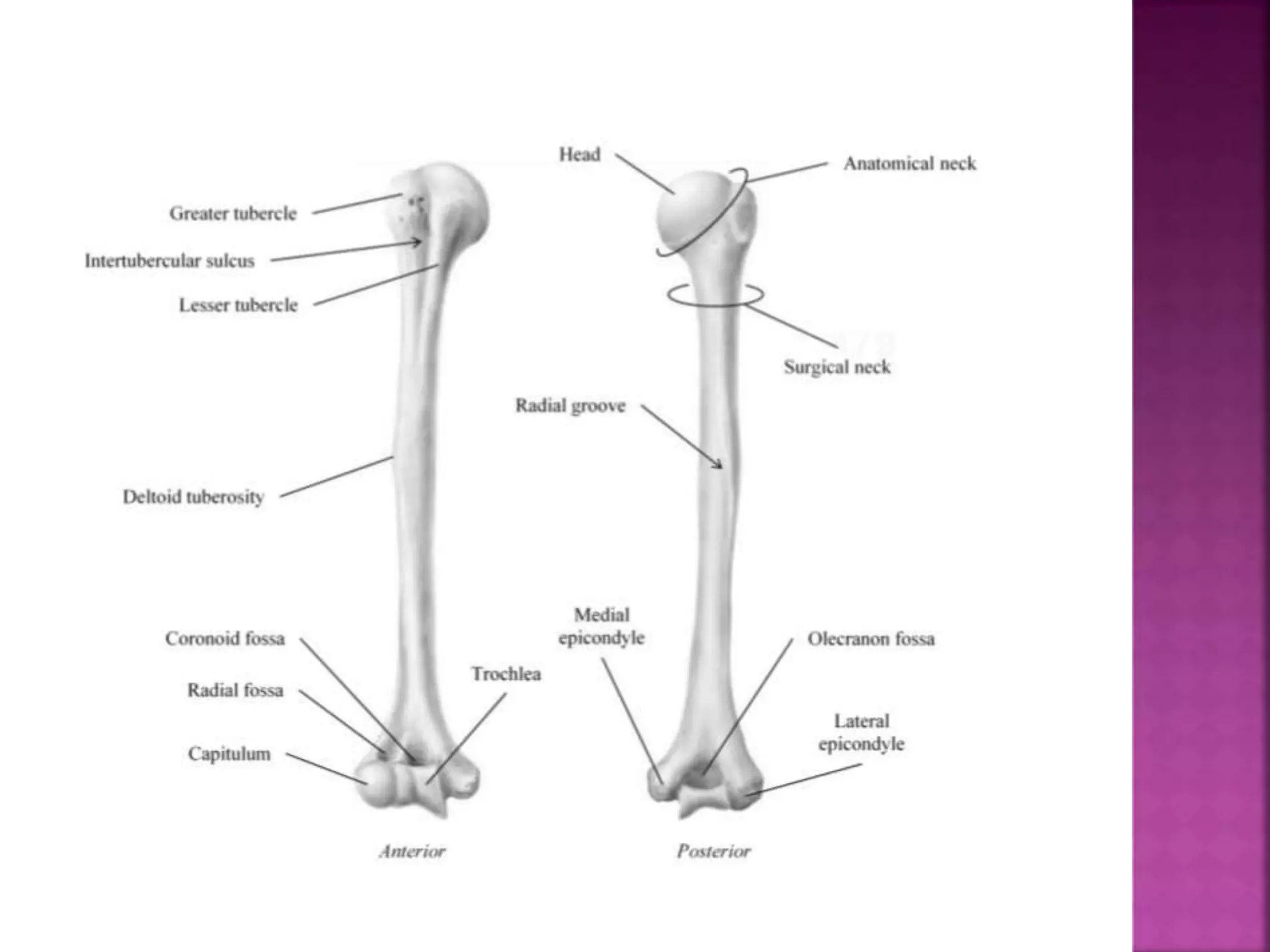
 Head: Smooth, hemispherical projection at
the proximal end of the humerus; articulates
with glenoid cavity of scapula.
 Anatomical neck: Slight constriction just
distal to the head of the humerus.
 Greater Tubercle: Large prominence just
distal to the anatomical neck on the lateral
surface of the humerus; site of muscle
attachment.
 Lesser Tubercle: Small prominence just
distal to the anatomical neck on the medial
surface of the humerus; site of muscle
attachment
 Intertubercular sulcus: Shallow groove
between lesser and greater tubercles; guides
tendon.
 Surgical neck: Constricted region of the
humerus just distal to the tubercles; common
site of bone fracture.
 Deltoid tuberosity: V-shaped rough region
on the lateral aspect of the humerus about
midway down the shaft; site of muscle
attachment.
 Radial groove: A shallow depression running
obliquely down the posterior aspect of the
humerus shaft; nerve passageway
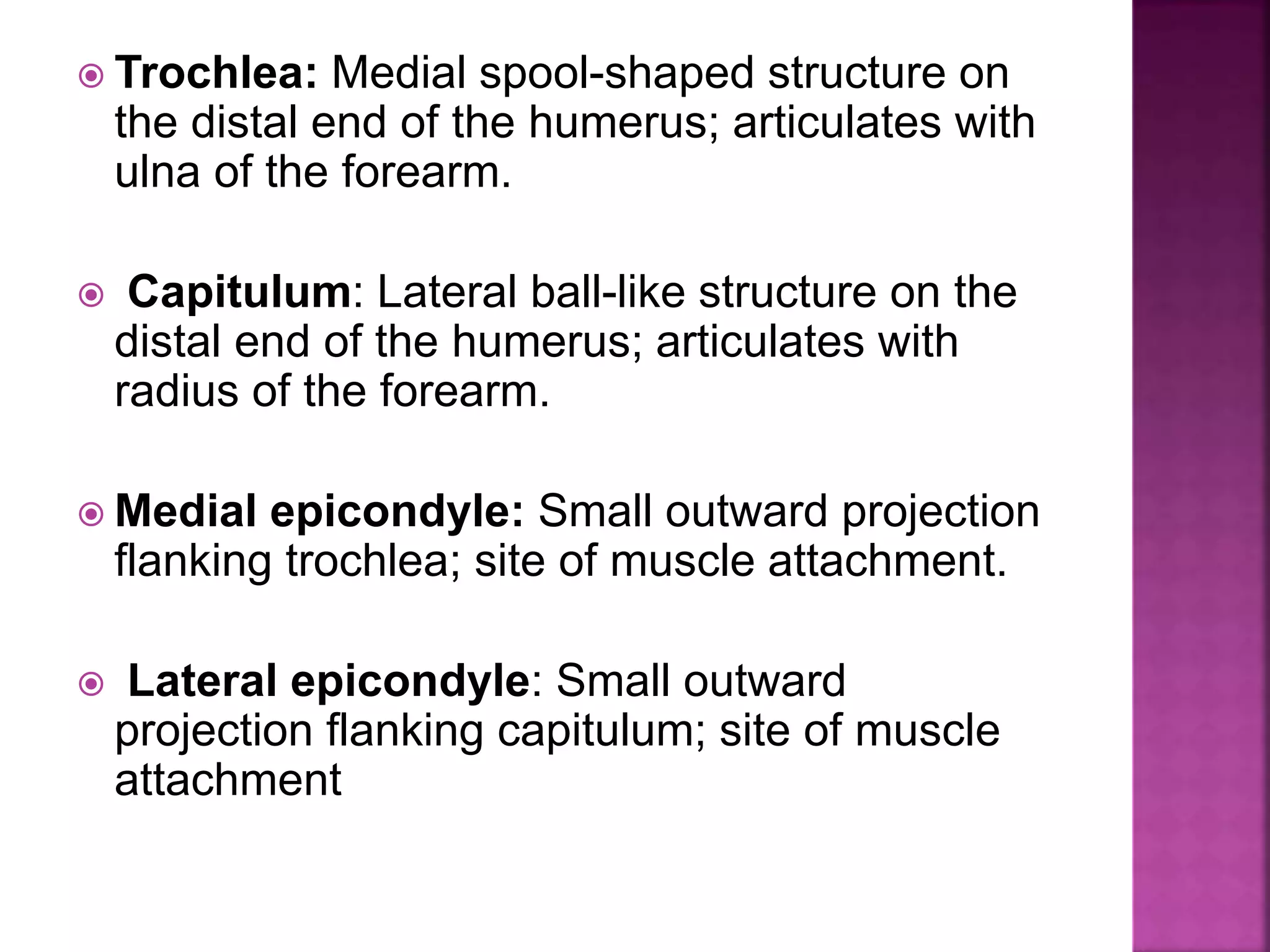
 Trochlea: Medial spool-shaped structure on
the distal end of the humerus; articulates with
ulna of the forearm.
 Capitulum: Lateral ball-like structure on the
distal end of the humerus; articulates with
radius of the forearm.
 Medial epicondyle: Small outward projection
flanking trochlea; site of muscle attachment.
 Lateral epicondyle: Small outward
projection flanking capitulum; site of muscle
attachment
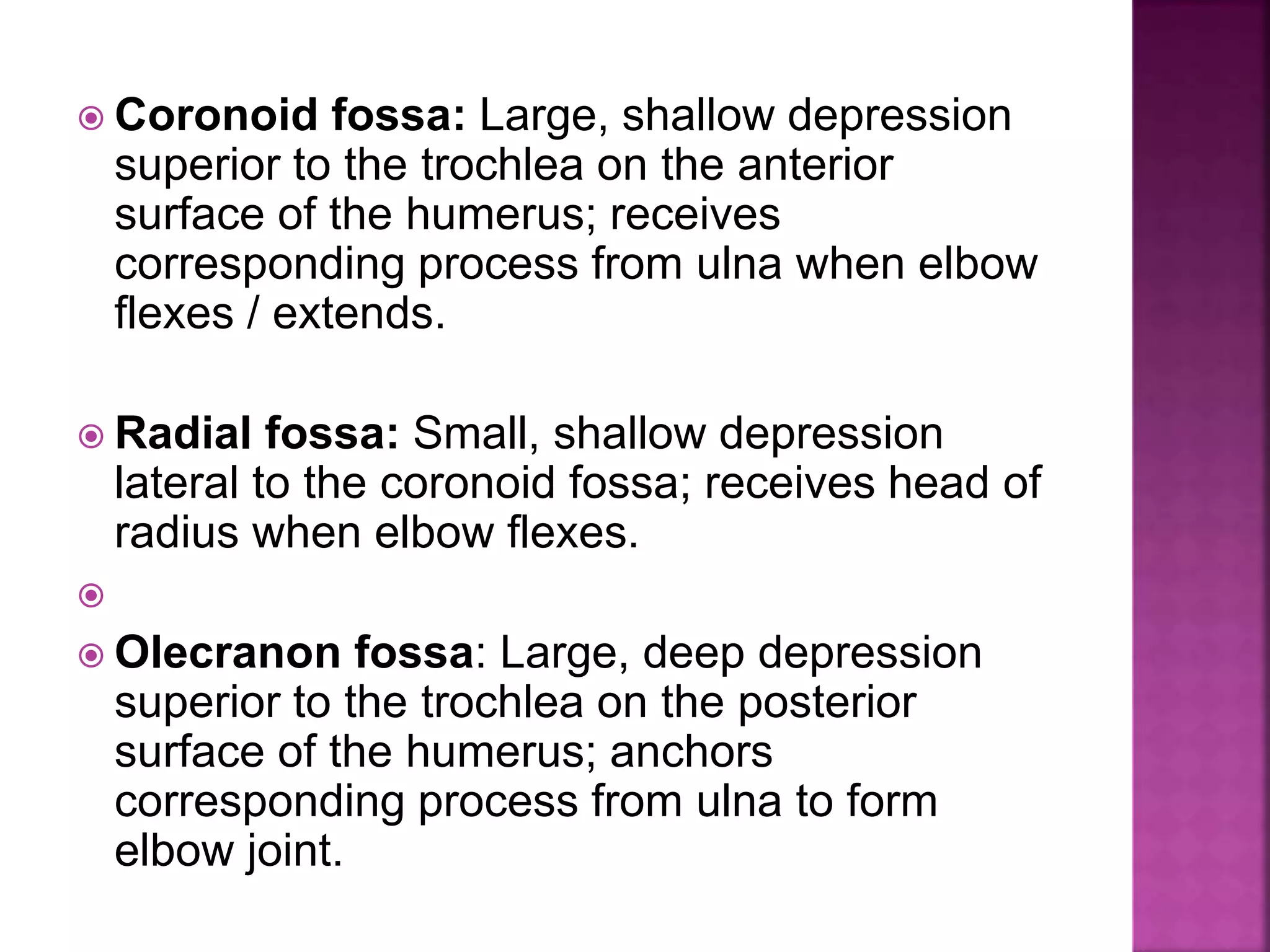
 Coronoid fossa: Large, shallow depression
superior to the trochlea on the anterior
surface of the humerus; receives
corresponding process from ulna when elbow
flexes / extends.
 Radial fossa: Small, shallow depression
lateral to the coronoid fossa; receives head of
radius when elbow flexes.

 Olecranon fossa: Large, deep depression
superior to the trochlea on the posterior
surface of the humerus; anchors
corresponding process from ulna to form
elbow joint.
 Two parallel bones, the radius and the ulna,
form the forearm .
 Their proximal ends articulate with the
humerus and their distal ends articulate with
the wrist bones.
 Long, slender bone with a hook at the
proximal end that forms the elbow joint with
the humerus; lies medially in the forearm
when the body is in anatomical position.
 Landmarks / Markings:
 Olecranon process: Large protuberance on
the proximal end of the ulna; forms the upper
portion of the hook that articulates with the
trochlea of the humerus.
 Coronoid process: Small process located
just distal to the olecranon process; forms the
lower portion of the hook that articulates with
the trochlea of the humerus.
 Trochlear notch: Deep concavity found
between the olecranon process and coronoid
process; ‘grips’ trochlea to form elbow joint.
 Radial notch: Small depression on the lateral
side of the coronoid process; articulates with
head of radius.

 Head: Knob-like structure and the distal end
of the ulna; articulates with wrist bone.
 Styloid process: Pointed process medial to
the head of the ulna; site of ligament
attachment
 Long bone that is thin at its proximal end and
wide at its distal end; lies laterally in the
forearm when the body is in anatomical
position.
 Landmarks / Markings:
 Head: Wheel-shaped proximal end of radius;
articulates with capitulum of humerus and radial notch
of ulna.
 Radial tuberosity: Rough projection just inferior to
the head of the radius; site of muscle attachment.
 Ulnar notch: Medial shallow depression on the distal
end of the radius; articulates with the ulna.
 Styloid process: Pointed process lateral to the ulnar
notch; site of ligament attachment.
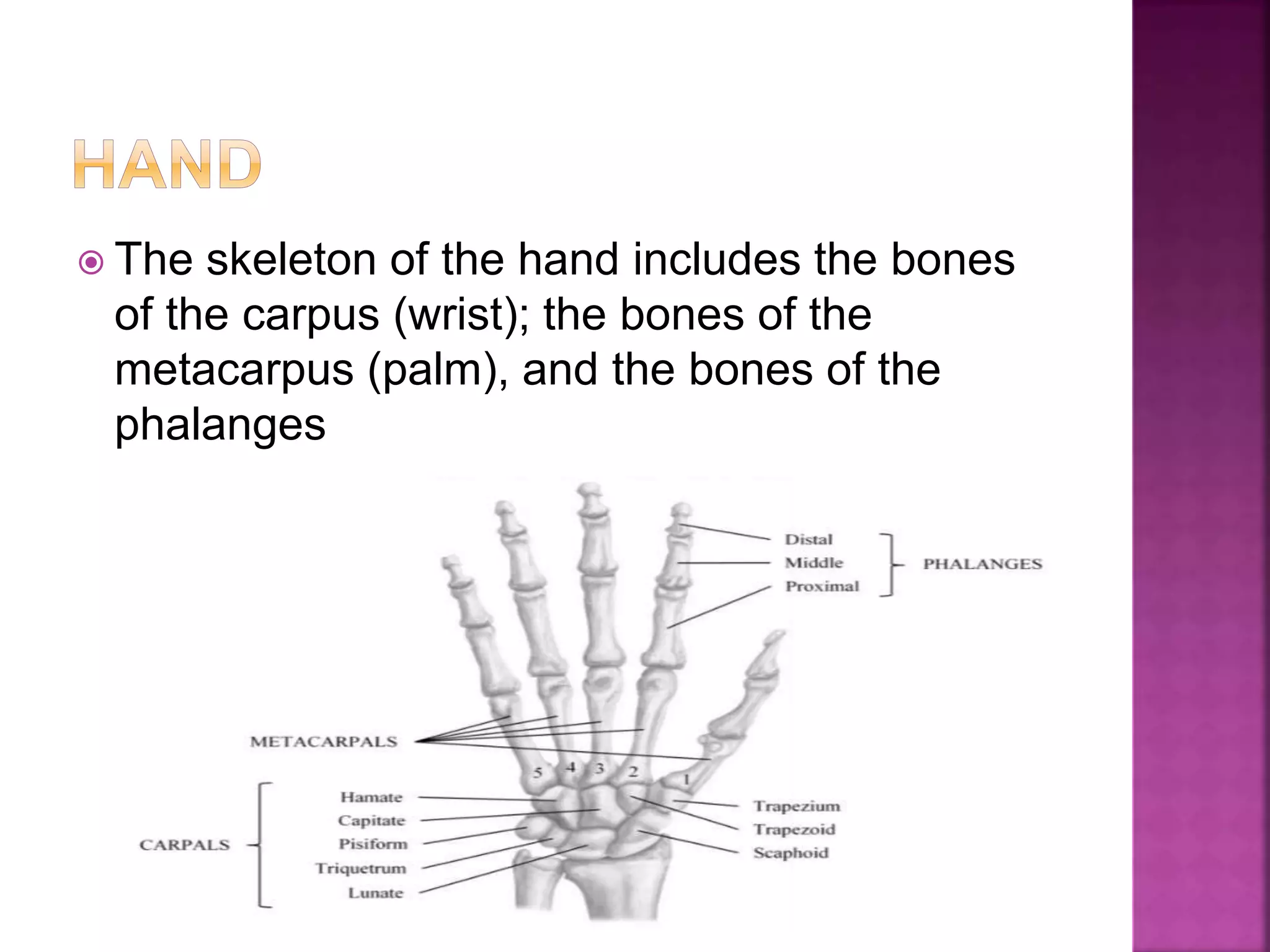
 The skeleton of the hand includes the bones
of the carpus (wrist); the bones of the
metacarpus (palm), and the bones of the
phalanges
 Eight (8) marble-size short bones closely
united by ligaments; quite flexible due to
gliding movements between bones.
 1) Scaphoid 5) Trapezium
6) Trapezoid
2)Lunate 7) Capitate
8) Hamate
3) Triquetrum
4) Pisiform
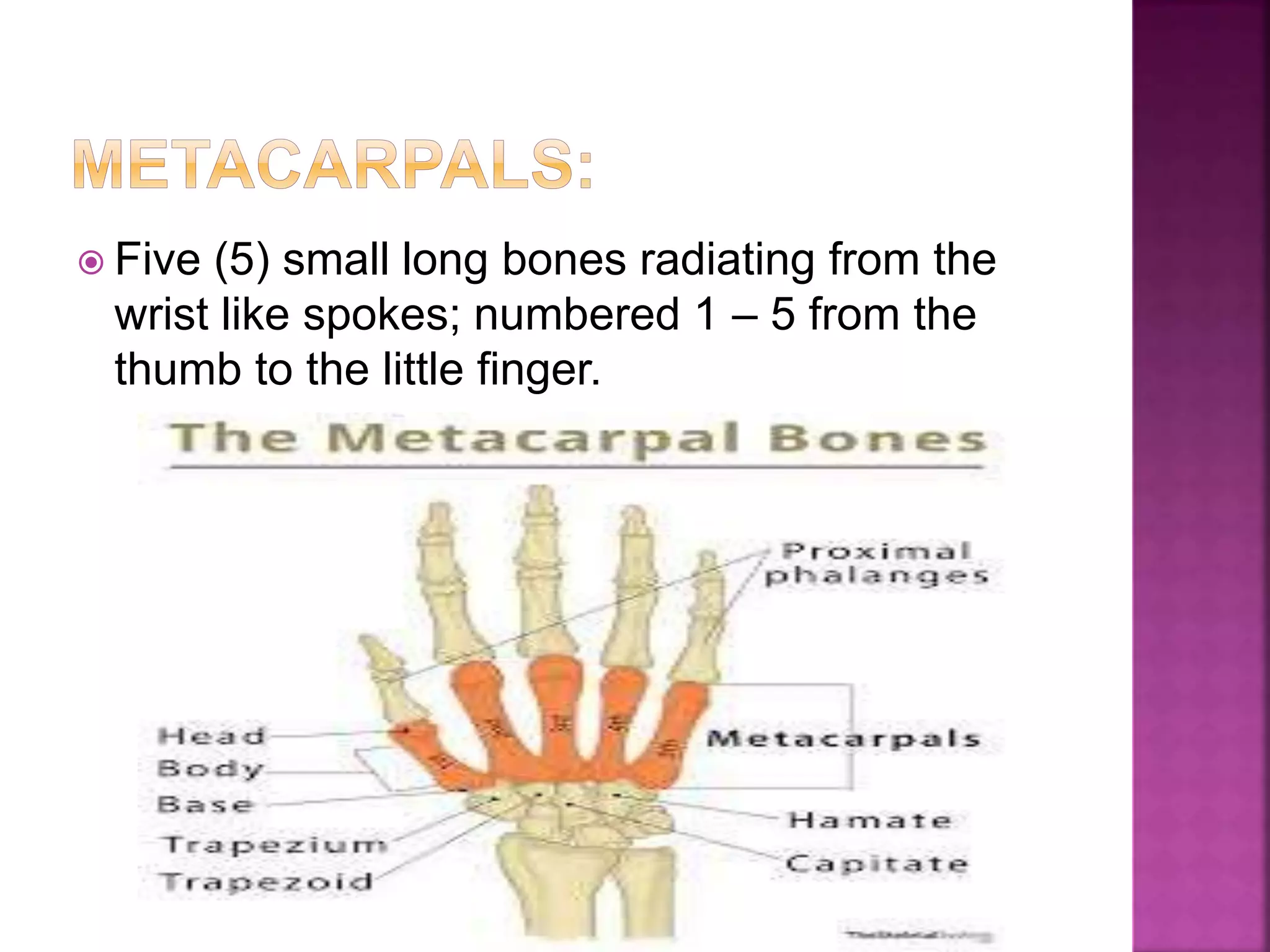
 Five (5) small long bones radiating from the
wrist like spokes; numbered 1 – 5 from the
thumb to the little finger.
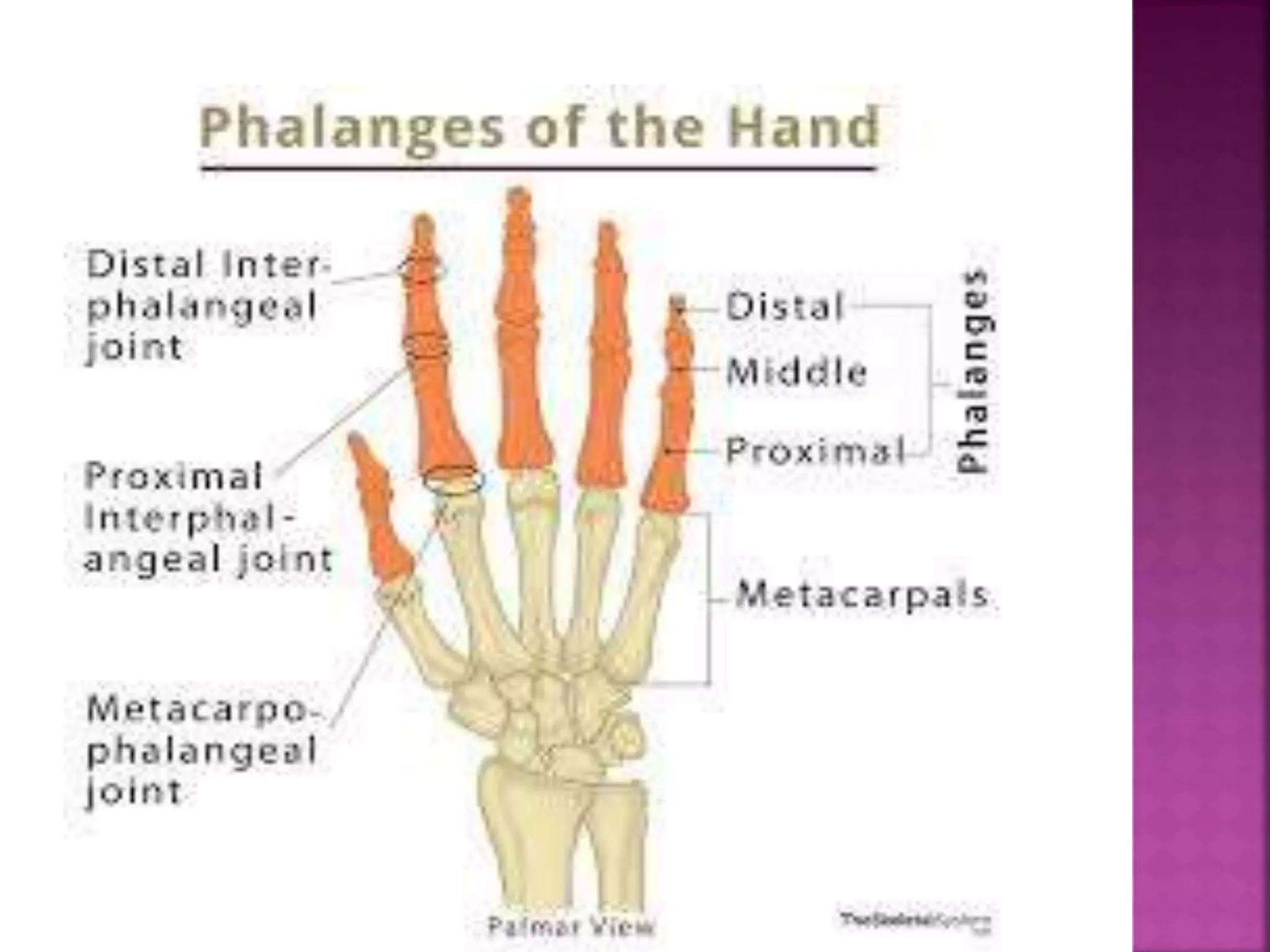
 Fourteen (14) miniature long bones that form
the fingers; numbered 1 – 5 from the thumb
(pollex) to the little finger.
 1) Proximal phalange (1 – 5)
 2) Middle phalange (2 – 5)
 3) Distal phalange (1 – 5)
Appendicular Skeleton-Shoulder girdle and upper limb

Appendicular Skeleton-Shoulder girdle and upper limb

  • 3.
     The pairedpectoral girdles each consist of two bones,  the anterior clavicle and the posterior scapula.  The shoulder girdles function to attach the upper limbs to the axial skeleton.  In addition, the bones of the shoulder girdles serve as attachment points for many trunk and neck muscles.  The pectoral girdle is exceptionally light and allows the upper limb a degree of mobility not seen anywhere else in the body.
  • 4.
     A slender,doubly-curved bone that joins the sternum to the scapula,serves as an anterior brace, to hold the arm away from the top of the thorax.
  • 5.
     Landmarks /Markings:  STERNAL END: Rounded terminus of clavicle; articulates with the sternal manubrium.  ACROMIAL END: Flattened terminus of clavicle; articulates with the scapula to form part of the shoulder joint.
  • 6.
     Thin, triangularflat bone; lies on the dorsal surface of the rib cage; serves as the attachment point for the arm.
  • 7.
     Borders /angles:  Superior border: Short, sharp border that forms the upper margin of the scapula when articulated with the axial skeleton.  Medial (vertebral) border: Border which parallels the vertebral column when articulated with the axial skeleton; joins with superior border at the superior angle.  Lateral (axillary) border: The thick border that abuts the armpit when articulated with the axial skeleton; joins with superior border at the lateral angle and joins with medial border at the inferior angle.
  • 8.
     Landmarks /Markings:  Glenoid cavity (fossa): Small, shallow depression superior to the lateral border, near the lateral angle; articulates with humerus of the arm.  Spine: Prominent ridge rising from the upper posterior surface of the scapula; site of muscle attachment.
  • 9.
     Acromion: Enlarged,roughened triangular structure projecting projection off the lateral end of the scapular spine; articulates with the acromial end of the clavicle.  Coracoid process: Beak-like structure projecting anteriorly from the superior scapular border; site of muscle attachment.
  • 10.
     Suprascapular notch:Shallow groove in the superior border of the scapula at the base of the coracoid process; passageway for nerves.  Supraspinous fossa: Deep depression superior to the spine on the posterior surface of the scapula; site of muscle attachment.
  • 11.
     Infraspinous fossa:Shallow depression inferior to the spine on the posterior surface of the scapula; site of muscle attachment.  Subscapular fossa: Shallow depression formed by the entire anterior scapular surface; site of muscle attachment.
  • 12.
     The upperarm consists of a single bone, the humerus .  The largest and longest bone of the upper limb, it articulates with the scapula at the shoulder and with the radius and ulna (forearm bones) at the elbow.
  • 14.
     Landmarks /Markings:  Head: Smooth, hemispherical projection at the proximal end of the humerus; articulates with glenoid cavity of scapula.  Anatomical neck: Slight constriction just distal to the head of the humerus.
  • 15.
     Greater Tubercle:Large prominence just distal to the anatomical neck on the lateral surface of the humerus; site of muscle attachment.  Lesser Tubercle: Small prominence just distal to the anatomical neck on the medial surface of the humerus; site of muscle attachment
  • 16.
     Intertubercular sulcus:Shallow groove between lesser and greater tubercles; guides tendon.  Surgical neck: Constricted region of the humerus just distal to the tubercles; common site of bone fracture.
  • 17.
     Deltoid tuberosity:V-shaped rough region on the lateral aspect of the humerus about midway down the shaft; site of muscle attachment.  Radial groove: A shallow depression running obliquely down the posterior aspect of the humerus shaft; nerve passageway
  • 18.
     Trochlea: Medialspool-shaped structure on the distal end of the humerus; articulates with ulna of the forearm.  Capitulum: Lateral ball-like structure on the distal end of the humerus; articulates with radius of the forearm.  Medial epicondyle: Small outward projection flanking trochlea; site of muscle attachment.  Lateral epicondyle: Small outward projection flanking capitulum; site of muscle attachment
  • 19.
     Coronoid fossa:Large, shallow depression superior to the trochlea on the anterior surface of the humerus; receives corresponding process from ulna when elbow flexes / extends.  Radial fossa: Small, shallow depression lateral to the coronoid fossa; receives head of radius when elbow flexes.   Olecranon fossa: Large, deep depression superior to the trochlea on the posterior surface of the humerus; anchors corresponding process from ulna to form elbow joint.
  • 20.
     Two parallelbones, the radius and the ulna, form the forearm .  Their proximal ends articulate with the humerus and their distal ends articulate with the wrist bones.
  • 22.
     Long, slenderbone with a hook at the proximal end that forms the elbow joint with the humerus; lies medially in the forearm when the body is in anatomical position.
  • 23.
     Landmarks /Markings:  Olecranon process: Large protuberance on the proximal end of the ulna; forms the upper portion of the hook that articulates with the trochlea of the humerus.  Coronoid process: Small process located just distal to the olecranon process; forms the lower portion of the hook that articulates with the trochlea of the humerus.  Trochlear notch: Deep concavity found between the olecranon process and coronoid process; ‘grips’ trochlea to form elbow joint.
  • 24.
     Radial notch:Small depression on the lateral side of the coronoid process; articulates with head of radius.   Head: Knob-like structure and the distal end of the ulna; articulates with wrist bone.  Styloid process: Pointed process medial to the head of the ulna; site of ligament attachment
  • 25.
     Long bonethat is thin at its proximal end and wide at its distal end; lies laterally in the forearm when the body is in anatomical position.
  • 26.
     Landmarks /Markings:  Head: Wheel-shaped proximal end of radius; articulates with capitulum of humerus and radial notch of ulna.  Radial tuberosity: Rough projection just inferior to the head of the radius; site of muscle attachment.  Ulnar notch: Medial shallow depression on the distal end of the radius; articulates with the ulna.  Styloid process: Pointed process lateral to the ulnar notch; site of ligament attachment.
  • 27.
     The skeletonof the hand includes the bones of the carpus (wrist); the bones of the metacarpus (palm), and the bones of the phalanges
  • 28.
     Eight (8)marble-size short bones closely united by ligaments; quite flexible due to gliding movements between bones.  1) Scaphoid 5) Trapezium 6) Trapezoid 2)Lunate 7) Capitate 8) Hamate 3) Triquetrum 4) Pisiform
  • 30.
     Five (5)small long bones radiating from the wrist like spokes; numbered 1 – 5 from the thumb to the little finger.
  • 31.
     Fourteen (14)miniature long bones that form the fingers; numbered 1 – 5 from the thumb (pollex) to the little finger.  1) Proximal phalange (1 – 5)  2) Middle phalange (2 – 5)  3) Distal phalange (1 – 5)