MATHEMATICS 9
QUADRATIC EQUATION
Lesson 1: Nature of the Roots of Quadratic Equation
Lesson 2: Sum and Product of Roots Quadratic Equations
Lesson 1: Nature of the Roots of
Quadratic Equation
DISCRIMINANT
In a quadratic formula, 𝑥 =
−𝑏± 𝑏2−4𝑎𝑐
2𝑎
, the radicand b2 – 4ac is called the
discriminant.
The nature of the roots of a quadratic equation can be determined using
discriminant.
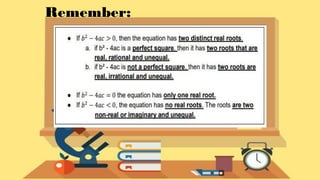
Remember:
Example 1:
x2 – 6x + 8 = 0
Solutions:
Determine the values of a, b, and c.
x2 – 6x + 8 = 0 → a = 1, b = –6, c = 8
Substitute the values of a, b, and c in the discriminant formula.
b2 – 4ac = (-6)2 – 4(1)(8)
= 36 – 32
= 4
Since the discriminant is 4 and it is positive and a perfect square
number, then there are two roots that are real, rational, and unequal.
Example 2:
x2 – 6x + 7 = 0
Solutions:
Determine the values of a, b, and c.
x2 – 6x + 7 = 0 → a = 1, b = –6, c = 7
Substitute the values of a, b, and c in the discriminant formula.
b2 – 4ac = (-6)2 – 4(1)(7)
= 36 – 28
= 8
Since the discriminant is 8 and it is positive and not a perfect square
number, then there are two roots that are real, irrational, and unequal.
Example 3:
x2 – 6x + 9 = 0
Solutions:
Determine the values of a, b, and c.
x2 – 6x + 9 = 0 → a = 1, b = –6, c = 9
Substitute the values of a, b, and c in the discriminant formula.
b2 – 4ac = (-6)2 – 4(1)(9)
= 36 – 36
= 0
The discriminant is 0, the root is only one real root.
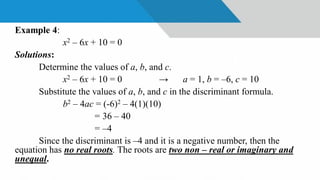
Example 4:
x2 – 6x + 10 = 0
Solutions:
Determine the values of a, b, and c.
x2 – 6x + 10 = 0 → a = 1, b = –6, c = 10
Substitute the values of a, b, and c in the discriminant formula.
b2 – 4ac = (-6)2 – 4(1)(10)
= 36 – 40
= –4
Since the discriminant is –4 and it is a negative number, then the
equation has no real roots. The roots are two non – real or imaginary and
unequal.
Example 5: Answer the given word problem.
Supposed that Rodolfo has a vacant lot in his backyard. He wants to make
as many rectangular plots as possible such that the length of each plot is 2 meters
longer its width, in which the area of the plot is (x)(x + 2) = 10 m2.
A. Express the area of the rectangular plot in standard form.
B. Find the values of a, b, and c.
C. What is the value of the discriminant?
D. Describe the nature of the roots of the given quadratic equation.
Example 5:
Solutions:
A. Express the area of the rectangular plot in standard form.
(x)(x + 2) = 10 → x2 + 2x = 10 → x2 + 2x – 10 = 0
B. Find the values of a, b, and c.
a = 1, b = 2, c = –10
C. What is the value of the discriminant?
b2 – 4ac = (2)2 – 4(1)(-10)
= 4 + 40
= 44
D. Describe the nature of the roots of the given quadratic equation.
The discriminant is 44 and it is positive and not perfect square, then the nature
of the roots are two real, irrational and unequal numbers.
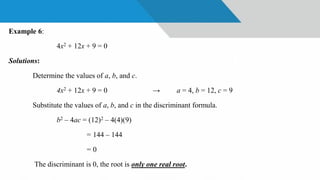
Example 6:
4x2 + 12x + 9 = 0
Solutions:
Determine the values of a, b, and c.
4x2 + 12x + 9 = 0 → a = 4, b = 12, c = 9
Substitute the values of a, b, and c in the discriminant formula.
b2 – 4ac = (12)2 – 4(4)(9)
= 144 – 144
= 0
The discriminant is 0, the root is only one real root.
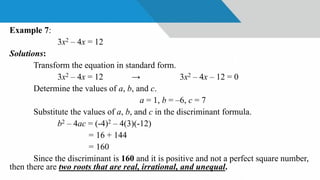
Example 7:
3x2 – 4x = 12
Solutions:
Transform the equation in standard form.
3x2 – 4x = 12 → 3x2 – 4x – 12 = 0
Determine the values of a, b, and c.
a = 1, b = –6, c = 7
Substitute the values of a, b, and c in the discriminant formula.
b2 – 4ac = (-4)2 – 4(3)(-12)
= 16 + 144
= 160
Since the discriminant is 160 and it is positive and not a perfect square number,
then there are two roots that are real, irrational, and unequal.
Lesson 2: Sum and Product of Roots
of Quadratic Equations
The sum and product of the roots of quadratic equations can be solved using
the values of a, b, and c.
The sum of the roots of a quadratic equation is
−𝒃
𝒂
.
𝒙𝟏 + 𝒙𝟐 =
−𝒃
𝒂
The product of the roots of a quadratic equation is
𝒄
𝒂
.
𝒙𝟏 ∙ 𝒙𝟐 =
𝒄
𝒂
Example 1: Find the sum and product of the roots of x2 + 8x + 5 = 0.
Solutions:
Determine the values of a, b, and c.
x2 + 8x + 5 = 0 → a = 1, b = 8, c = 5
Substitute the values of a, b and c in the formula.
Sum = 𝑥1 + 𝑥2 =
−𝑏
𝑎
=
−(8)
1
=
−8
1
= −𝟖
Product = 𝑥1 ∙ 𝑥2 =
𝑐
𝑎
=
5
1
= 𝟓
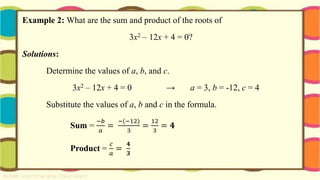
Example 2: What are the sum and product of the roots of
3x2 – 12x + 4 = 0?
Solutions:
Determine the values of a, b, and c.
3x2 – 12x + 4 = 0 → a = 3, b = -12, c = 4
Substitute the values of a, b and c in the formula.
Sum =
−𝑏
𝑎
=
−(−12)
3
=
12
3
= 𝟒
Product =
𝑐
𝑎
=
𝟒
𝟑
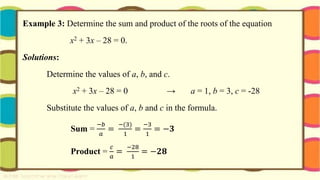
Example 3: Determine the sum and product of the roots of the equation
x2 + 3x – 28 = 0.
Solutions:
Determine the values of a, b, and c.
x2 + 3x – 28 = 0 → a = 1, b = 3, c = -28
Substitute the values of a, b and c in the formula.
Sum =
−𝑏
𝑎
=
−(3)
1
=
−3
1
= −𝟑
Product =
𝑐
𝑎
=
−28
1
= −𝟐𝟖
Example 4: Find a quadratic equation in which the sum of the solutions is −
𝟏
𝟐
and
the product of the solution is
𝟐
𝟑
.
Solutions:
In finding the quadratic equation given the its sum and product, we can use
the form
x2 – (sum of roots)x + (product of roots) = 0
Substitute the given sum and product to the formula, we get
x2 – (sum of roots)x + (product of roots) = 0
𝑥2 − −
1
2
𝑥 +
2
3
= 0 → 𝑥2 +
1
2
𝑥 +
2
3
= 0
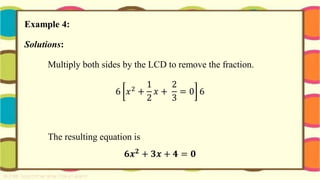
Example 4:
Solutions:
Multiply both sides by the LCD to remove the fraction.
6 𝑥2
+
1
2
𝑥 +
2
3
= 0 6
The resulting equation is
𝟔𝒙𝟐 + 𝟑𝒙 + 𝟒 = 𝟎
Example 5: Determine the sum and product of the roots of the equation
x2 – 6x = 0.
Solutions:
Determine the values of a, b, and c.
x2 – 6x = 0 → a = 1, b = -6, c = 0
Substitute the values of a, b and c in the formula.
Sum =
−𝑏
𝑎
=
−(−6)
1
=
6
1
= 𝟔
Product =
𝑐
𝑎
=
0
1
= 𝟎
Example 6: Find the sum and product of the roots of the equation
(x – 7)2 = 16.
Solutions:
Transform the equation in standard form.
(x – 7)2 = 16 → x2 – 14x + 49 = 16
x2 – 14x + 33 = 0
Determine the values of a, b, and c.
x2 – 14x + 33 = 0 → a = 1, b = -14, c = 33
Substitute the values of a, b and c in the formula.
Sum =
−𝑏
𝑎
=
−(−14)
1
=
14
1
= 𝟏𝟒
Product =
𝑐
𝑎
=
33
1
= 𝟑𝟑