Graphing Quadratic Functions

                 Graphs of Quadratic Functions
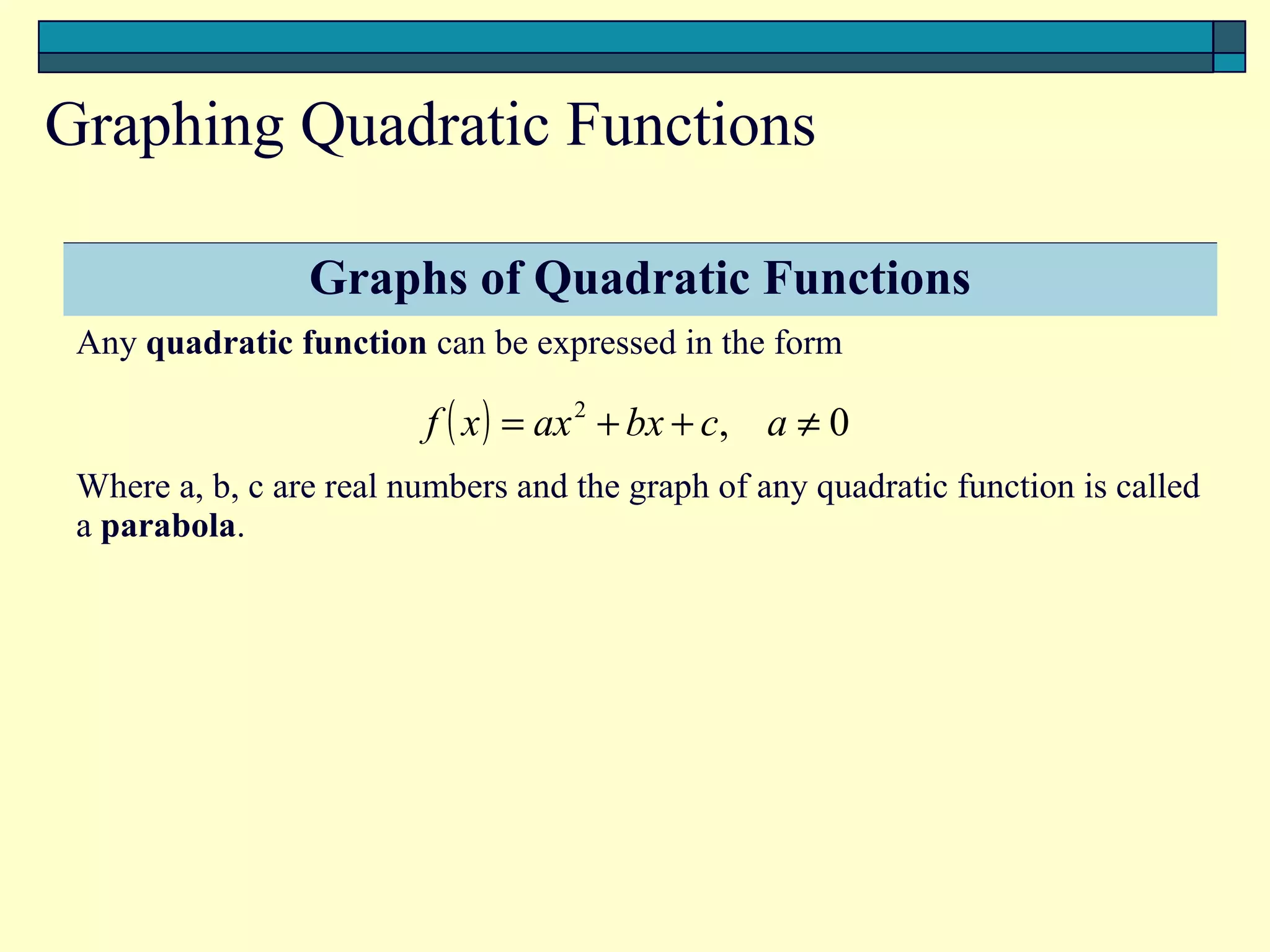
 Any quadratic function can be expressed in the form

                         f ( x ) = ax 2 + bx + c, a ≠ 0
 Where a, b, c are real numbers and the graph of any quadratic function is called
 a parabola.
Graphing Quadratic Functions
                   30                                                                       30

                   25                                                                       24

                   20
                                                                                            18
                   15
                                                                                            12
                   10
                                                                                             6
                   5

                   0                                                                         0
  -6   -4     -2        0   2        4        6                     -6       -4       -2          0   2     4      6
                   -5                                                                        -6


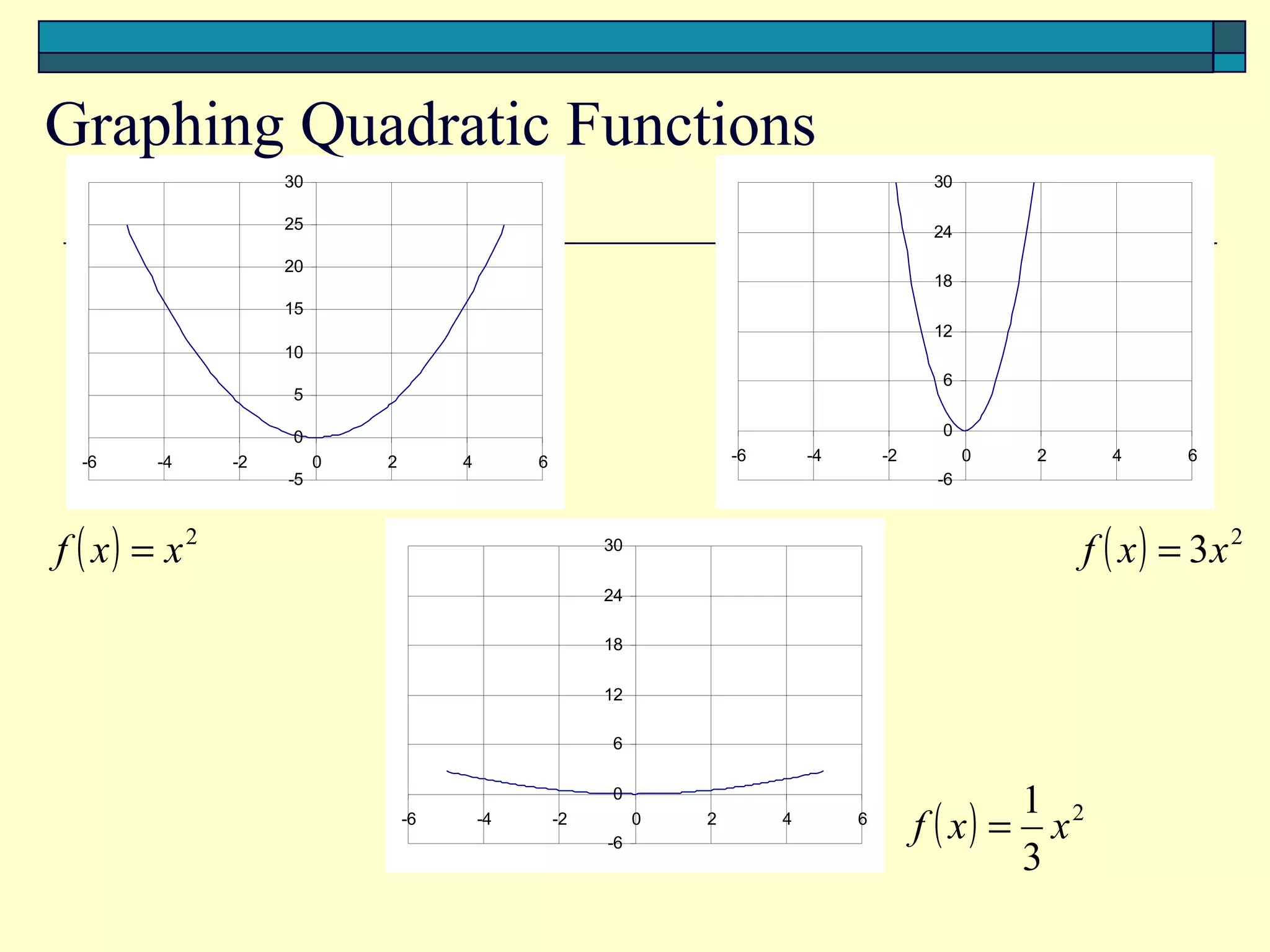
f ( x) = x2                                            30
                                                                                                          f ( x ) = 3x 2
                                                       24

                                                       18

                                                       12

                                                       6


                                                                                                      1 2
                                                                                           f ( x) =
                                                       0
                                -6       -4       -2
                                                       -6
                                                            0   2        4        6
                                                                                                        x
                                                                                                      3
Graphing Quadratic Functions
   Graphing Quadratic Functions With Equations in
                       the Form f ( x ) = a( x − h ) 2T k
                                                      +
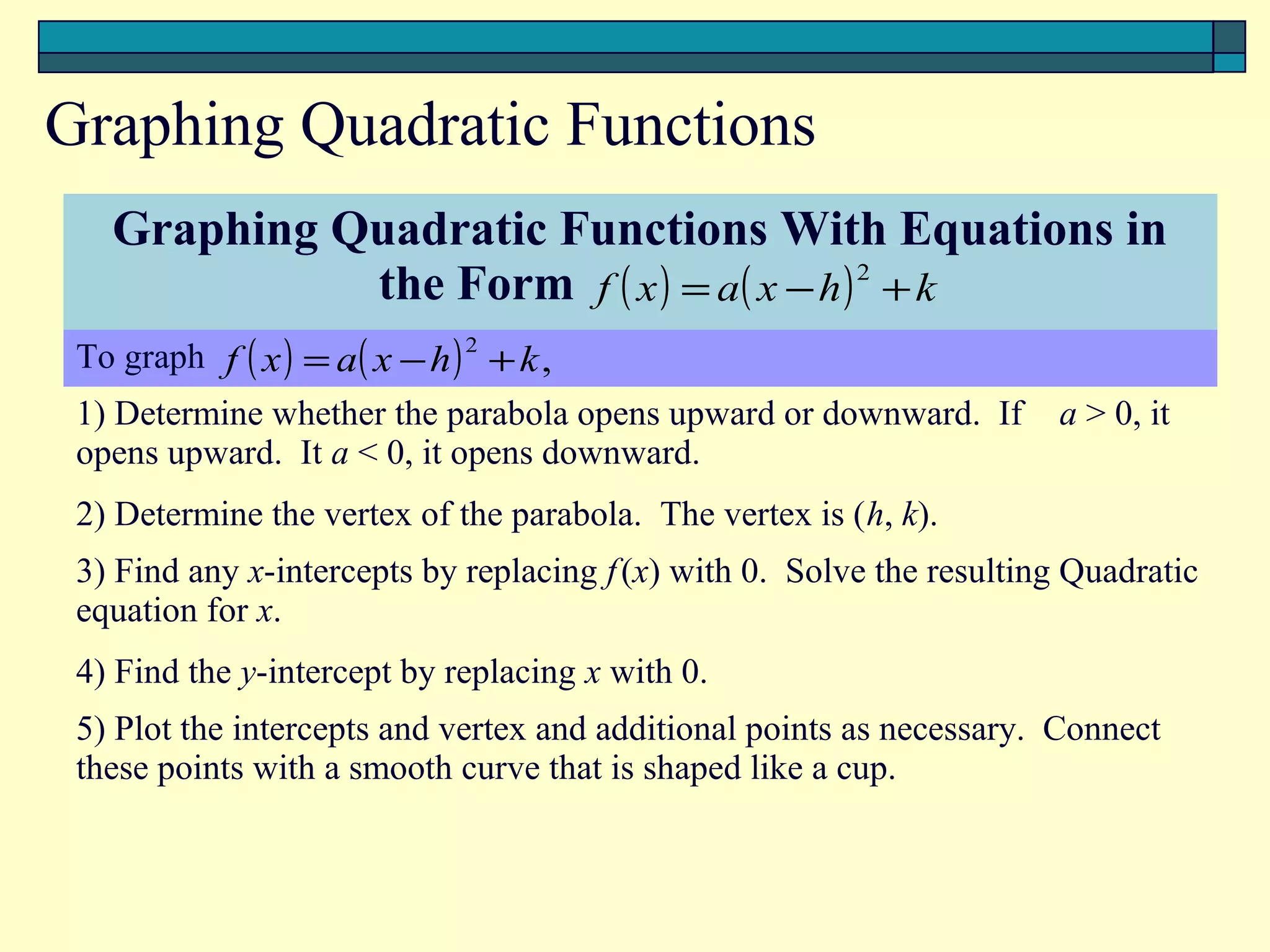
 To graph f ( x ) = a( x − h ) 2 + k ,
 1) Determine whether the parabola opens upward or downward. If        a > 0, it
 opens upward. It a < 0, it opens downward.
 2) Determine the vertex of the parabola. The vertex is (h, k).
 3) Find any x-intercepts by replacing f (x) with 0. Solve the resulting Quadratic
 equation for x.
 4) Find the y-intercept by replacing x with 0.
 5) Plot the intercepts and vertex and additional points as necessary. Connect
 these points with a smooth curve that is shaped like a cup.
Graphing Quadratic Functions
EXAMPLE

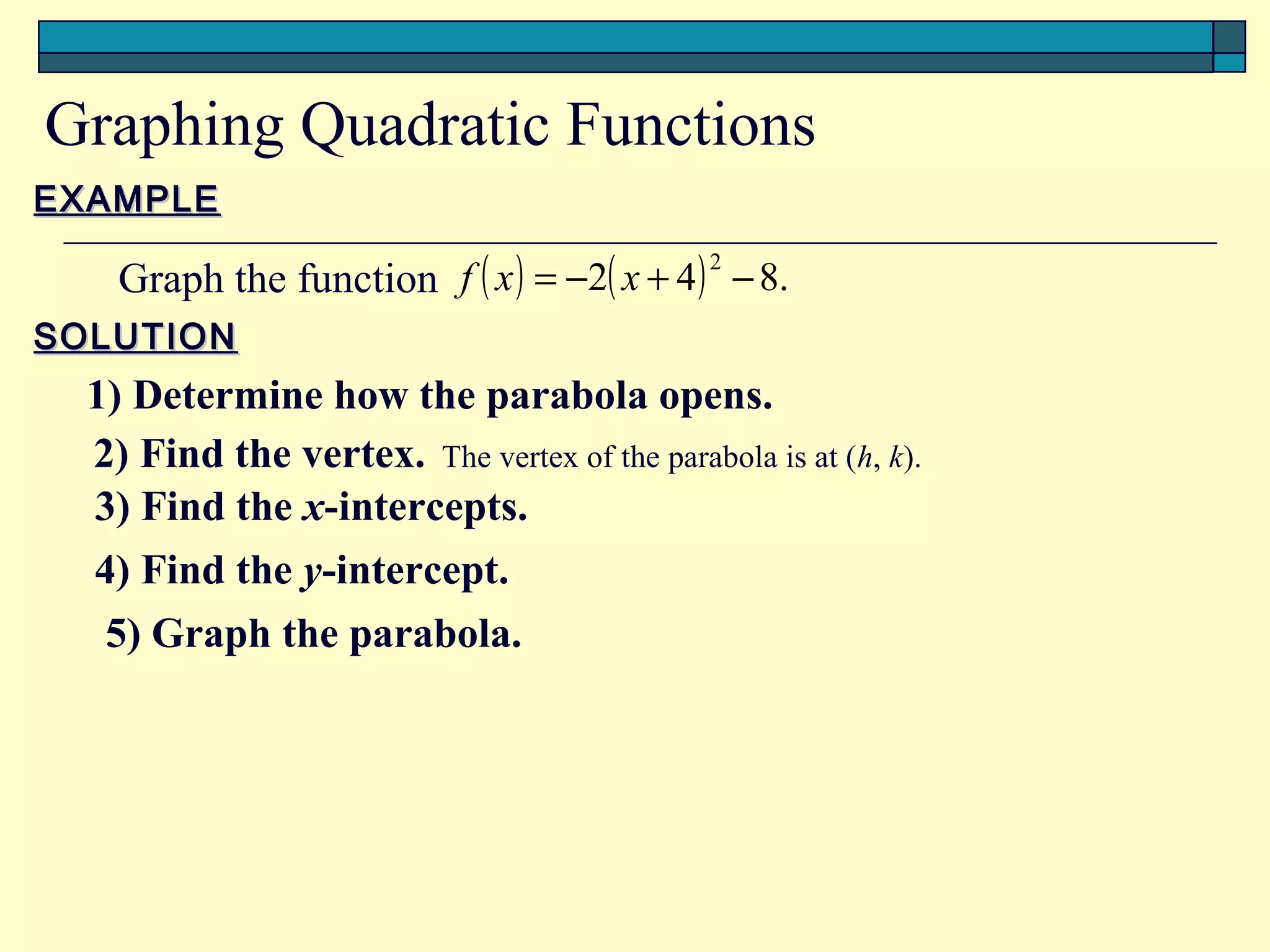
    Graph the function f ( x ) = −2( x + 4 ) − 8.
                                            2


SOLUTION
  1) Determine how the parabola opens.
  2) Find the vertex. The vertex of the parabola is at (h, k).
  3) Find the x-intercepts.
  4) Find the y-intercept.
   5) Graph the parabola.
Graphing Quadratic Functions

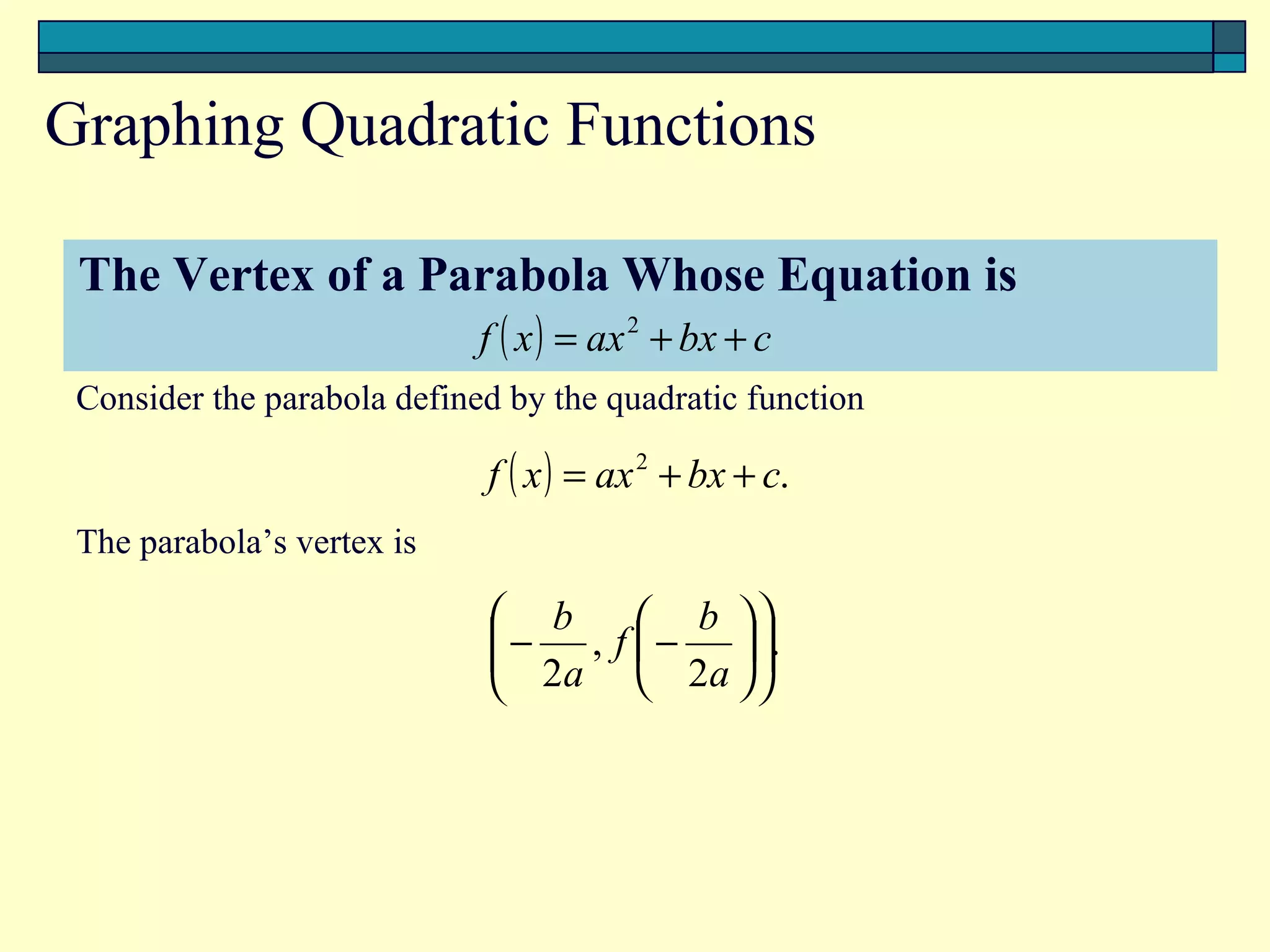
 The Vertex of a Parabola Whose Equation is
                   f ( x ) = ax 2 +T + c
                                   bx
 Consider the parabola defined by the quadratic function

                             f ( x ) = ax 2 + bx + c.
 The parabola’s vertex is

                              b          b 
                             − ,
                              2a      f  −  .
                                          2a  
                                                 
Graphing Quadratic Functions
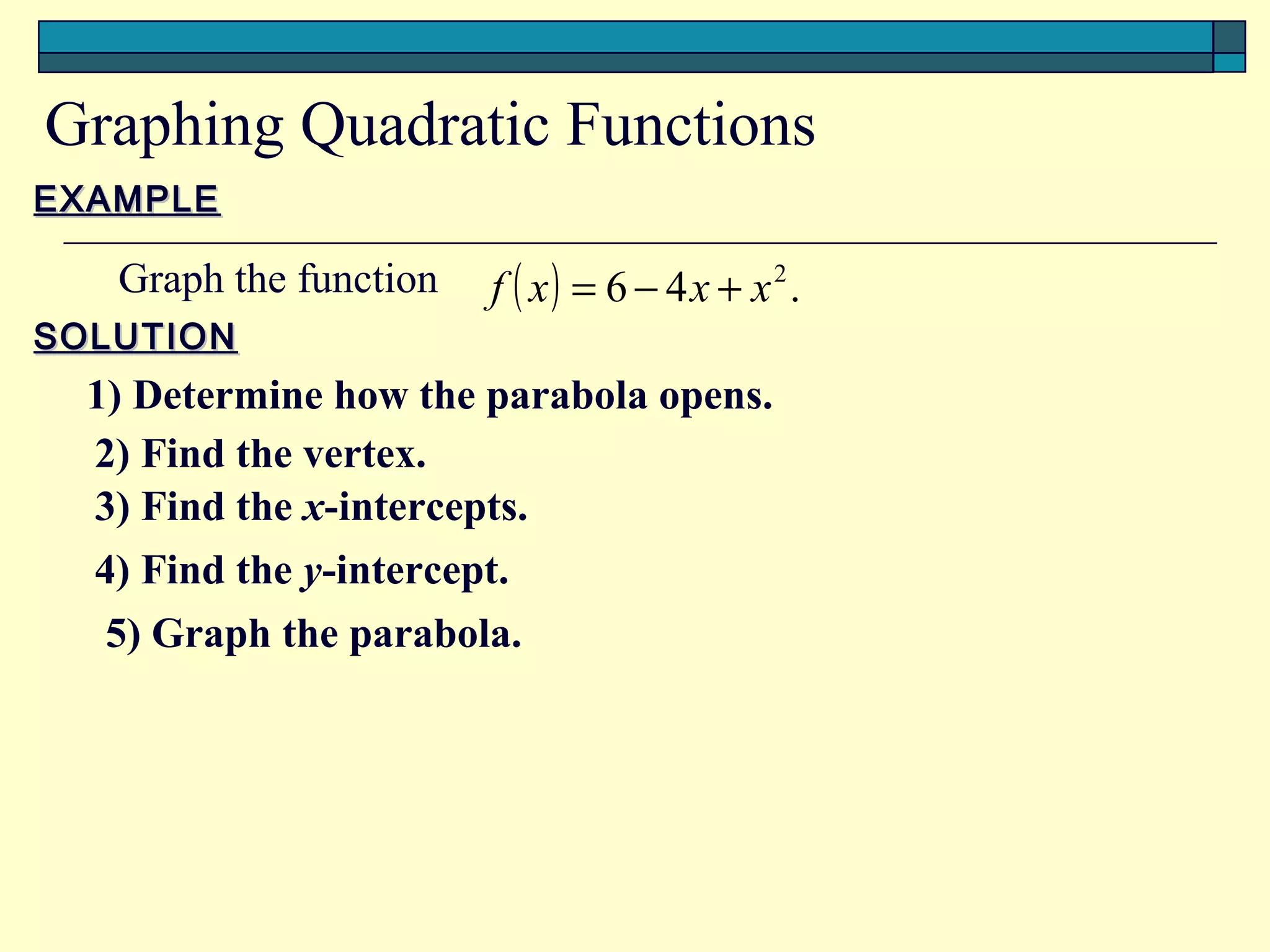
EXAMPLE

   Graph the function   f ( x) = 6 − 4x + x2.
SOLUTION
  1) Determine how the parabola opens.
  2) Find the vertex.
  3) Find the x-intercepts.
  4) Find the y-intercept.
   5) Graph the parabola.
Minimums & Maximums
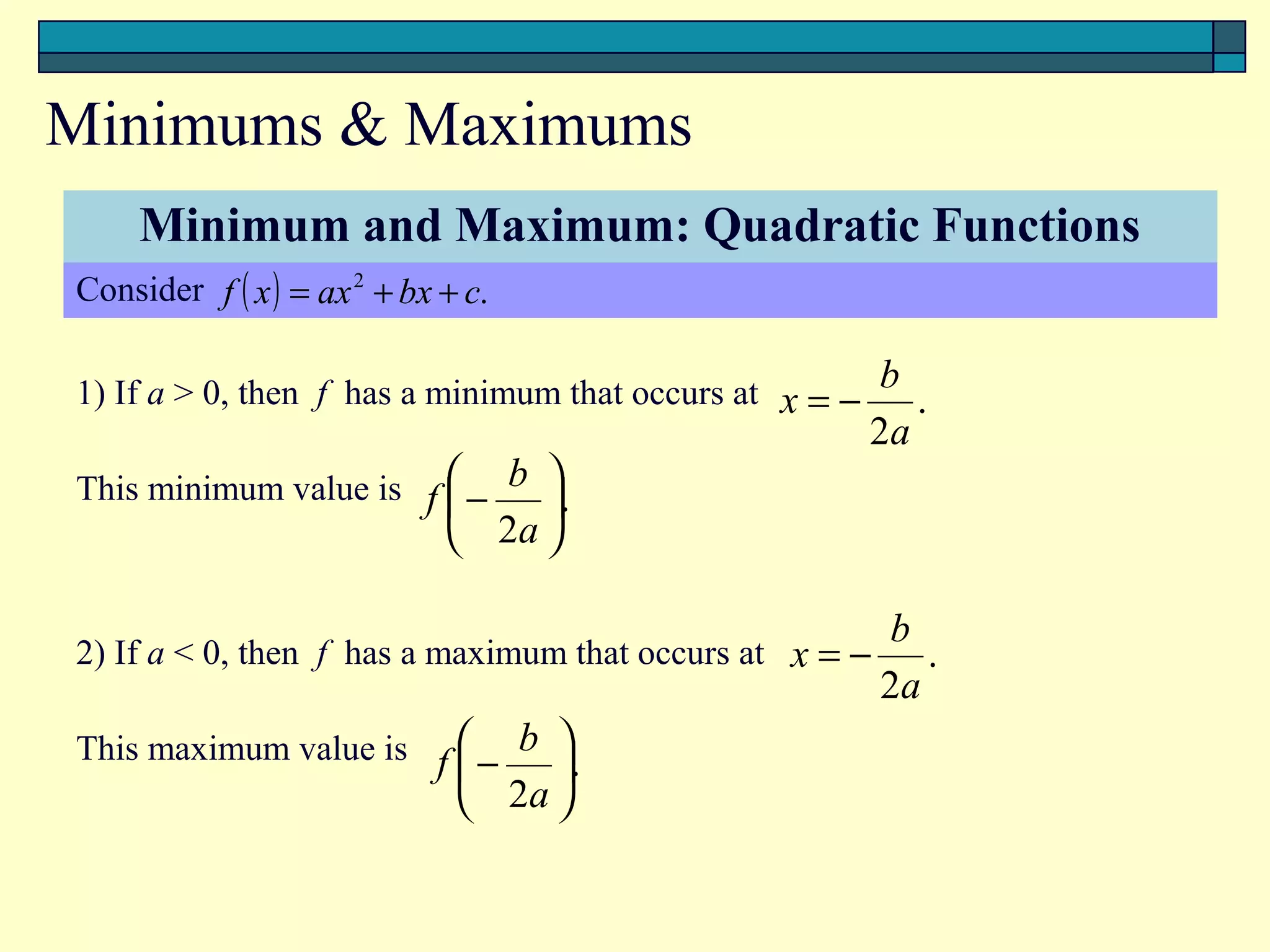
   Minimum and Maximum: Quadratic Functions
Consider f ( x ) = ax 2 + bx + c.

1) If a > 0, then f has a minimum that occurs at x = − b .
                                                      2a
This minimum value is f  − b .
                             
                          2a 

                                                       b
2) If a < 0, then f has a maximum that occurs at x = −    .
                                                       2a
This maximum value is f  − b .
                                
                            2a 
Minimums & Maximums
EXAMPLE

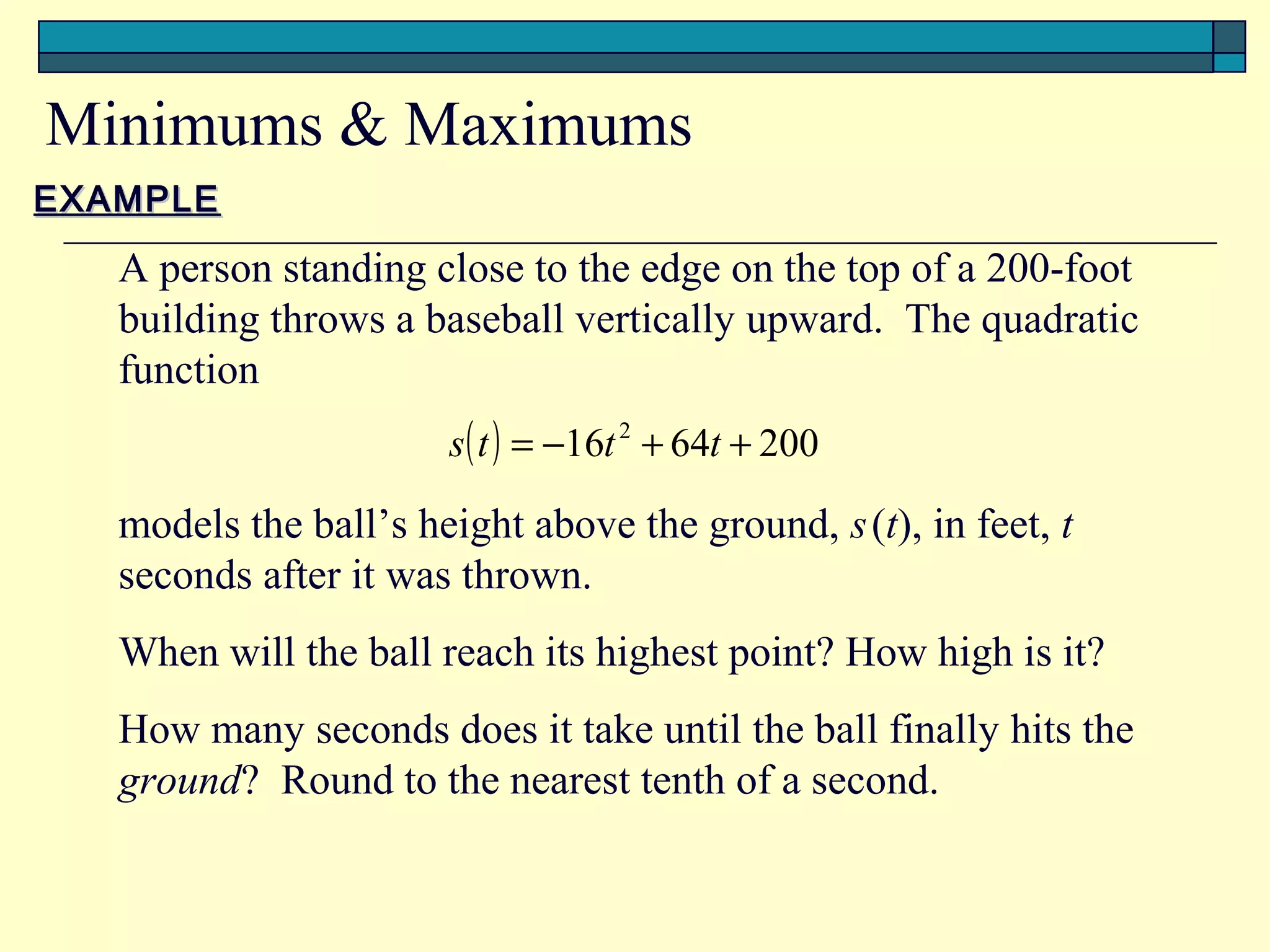
   A person standing close to the edge on the top of a 200-foot
   building throws a baseball vertically upward. The quadratic
   function
                       s ( t ) = −16t 2 + 64t + 200

   models the ball’s height above the ground, s (t), in feet, t
   seconds after it was thrown.
   When will the ball reach its highest point? How high is it?
   How many seconds does it take until the ball finally hits the
   ground? Round to the nearest tenth of a second.
11.3 Quadratic Functions & Their Graphs
 Reference: Blitzer’s Introductory and Intermediate Algebra

Mat 128 11 3

  • 1.
    Graphing Quadratic Functions Graphs of Quadratic Functions Any quadratic function can be expressed in the form f ( x ) = ax 2 + bx + c, a ≠ 0 Where a, b, c are real numbers and the graph of any quadratic function is called a parabola.
  • 2.
    Graphing Quadratic Functions 30 30 25 24 20 18 15 12 10 6 5 0 0 -6 -4 -2 0 2 4 6 -6 -4 -2 0 2 4 6 -5 -6 f ( x) = x2 30 f ( x ) = 3x 2 24 18 12 6 1 2 f ( x) = 0 -6 -4 -2 -6 0 2 4 6 x 3
  • 3.
    Graphing Quadratic Functions Graphing Quadratic Functions With Equations in the Form f ( x ) = a( x − h ) 2T k + To graph f ( x ) = a( x − h ) 2 + k , 1) Determine whether the parabola opens upward or downward. If a > 0, it opens upward. It a < 0, it opens downward. 2) Determine the vertex of the parabola. The vertex is (h, k). 3) Find any x-intercepts by replacing f (x) with 0. Solve the resulting Quadratic equation for x. 4) Find the y-intercept by replacing x with 0. 5) Plot the intercepts and vertex and additional points as necessary. Connect these points with a smooth curve that is shaped like a cup.
  • 4.
    Graphing Quadratic Functions EXAMPLE Graph the function f ( x ) = −2( x + 4 ) − 8. 2 SOLUTION 1) Determine how the parabola opens. 2) Find the vertex. The vertex of the parabola is at (h, k). 3) Find the x-intercepts. 4) Find the y-intercept. 5) Graph the parabola.
  • 5.
    Graphing Quadratic Functions The Vertex of a Parabola Whose Equation is f ( x ) = ax 2 +T + c bx Consider the parabola defined by the quadratic function f ( x ) = ax 2 + bx + c. The parabola’s vertex is  b  b  − ,  2a f  −  .   2a   
  • 6.
    Graphing Quadratic Functions EXAMPLE Graph the function f ( x) = 6 − 4x + x2. SOLUTION 1) Determine how the parabola opens. 2) Find the vertex. 3) Find the x-intercepts. 4) Find the y-intercept. 5) Graph the parabola.
  • 7.
    Minimums & Maximums Minimum and Maximum: Quadratic Functions Consider f ( x ) = ax 2 + bx + c. 1) If a > 0, then f has a minimum that occurs at x = − b . 2a This minimum value is f  − b .    2a  b 2) If a < 0, then f has a maximum that occurs at x = − . 2a This maximum value is f  − b .    2a 
  • 8.
    Minimums & Maximums EXAMPLE A person standing close to the edge on the top of a 200-foot building throws a baseball vertically upward. The quadratic function s ( t ) = −16t 2 + 64t + 200 models the ball’s height above the ground, s (t), in feet, t seconds after it was thrown. When will the ball reach its highest point? How high is it? How many seconds does it take until the ball finally hits the ground? Round to the nearest tenth of a second.
  • 9.
    11.3 Quadratic Functions& Their Graphs Reference: Blitzer’s Introductory and Intermediate Algebra