Emergency Medical Services (EMS) evolved from early battlefield medical care during wars to today's organized community response systems. EMS aims to provide immediate care to patients with sudden illness or injury. Over time, advances like motorized ambulances, helicopter evacuations, paramedic training programs, and emphasis on pre-hospital trauma care improved patient outcomes. The 1966 White Paper and Highway Safety Act prompted the development of standardized EMS education, systems, and oversight through agencies like the National Highway Safety Administration.
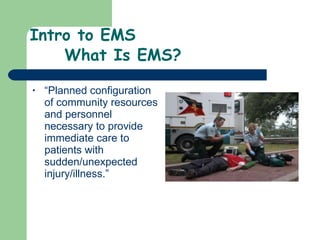
Intro to EMS What Is EMS? “ Planned configuration of community resources and personnel necessary to provide immediate care to patients with sudden/unexpected injury/illness.”
3.
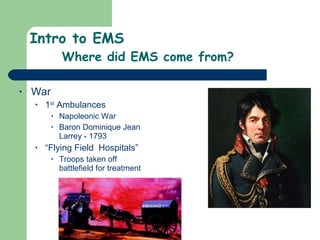
Intro to EMSWhere did EMS come from? War 1 st Ambulances Napoleonic War Baron Dominique Jean Larrey - 1793 “ Flying Field Hospitals” Troops taken off battlefield for treatment
4.
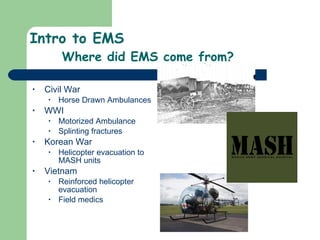
Intro to EMSWhere did EMS come from? Civil War Horse Drawn Ambulances WWI Motorized Ambulance Splinting fractures Korean War Helicopter evacuation to MASH units Vietnam Reinforced helicopter evacuation Field medics
5.
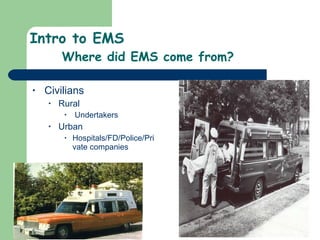
Intro to EMSWhere did EMS come from? Civilians Rural Undertakers Urban Hospitals/FD/Police/Private companies
6.
7.
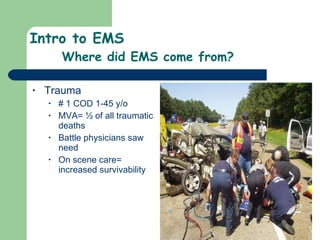
Intro to EMSWhere did EMS come from? Trauma # 1 COD 1-45 y/o MVA= ½ of all traumatic deaths Battle physicians saw need On scene care= increased survivability
8.
Intro to EMSWhere did EMS come from? The “White Paper”- 1966 “ Accidental Death and Disability: The Neglected Disease of Modern Society” National Academy of Science Prompted federal grants “ Safe Transport and Handling of ill/injured people” National Highway Safety Act - 1966 Established National Highway Safety Administration (NHSTA) under U.S. D.O.T. Improve EMS education/est. EMS system
9.
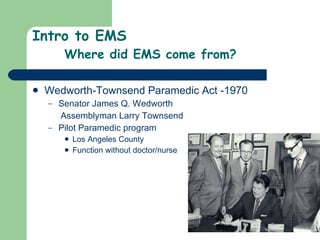
Intro to EMSWhere did EMS come from? Wedworth-Townsend Paramedic Act -1970 Senator James Q. Wedworth Assemblyman Larry Townsend Pilot Paramedic program Los Angeles County Function without doctor/nurse
10.
Overview of theEMS System… 911 Access to ALL components of EMS Enhanced 911 Exact location of caller Emergency Medical Dispatch Dispatchers provide basic 1 st aid instructors U.S. D.O.T. Curriculum Non 911 systems Separate numbers separate services
11.
Overview of theEMS system… Levels of training First responder EMT-Basic EMT-Enhanced EMT-Intermediate EMT-Paramedic
12.
The Healthcare SystemEmergency Department/Medicine Intersection of prehopsital/hospital care Young specialty AMA recognition 1975 Specialty Centers Trauma Centers Burn Centers Pediatric Centers Poison Centers
13.
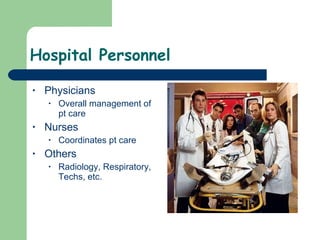
Hospital Personnel Physicians Overall management of pt care Nurses Coordinates pt care Others Radiology, Respiratory, Techs, etc.
14.
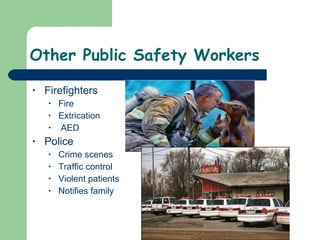
Other Public SafetyWorkers Firefighters Fire Extrication AED Police Crime scenes Traffic control Violent patients Notifies family
15.
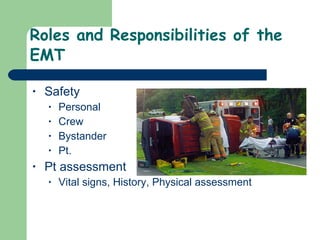
Roles and Responsibilitiesof the EMT Safety Personal Crew Bystander Pt. Pt assessment Vital signs, History, Physical assessment
16.
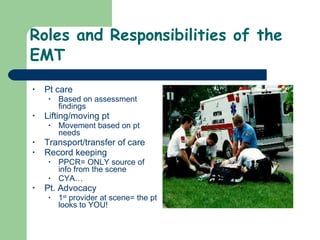
Roles and Responsibilitiesof the EMT Pt care Based on assessment findings Lifting/moving pt Movement based on pt needs Transport/transfer of care Record keeping PPCR= ONLY source of info from the scene CYA… Pt. Advocacy 1 st provider at scene= the pt looks to YOU!
17.
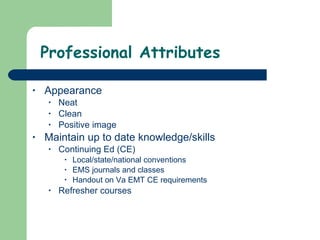
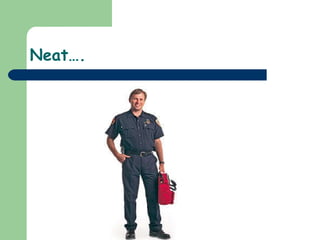
Professional Attributes AppearanceNeat Clean Positive image Maintain up to date knowledge/skills Continuing Ed (CE) Local/state/national conventions EMS journals and classes Handout on Va EMT CE requirements Refresher courses
18.
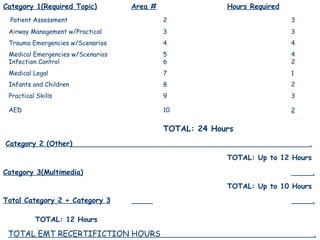
Category 1(Required Topic)Area # Hours Required Patient Assessment 2 3 Airway Management w/Practical 3 3 Trauma Emergencies w/Scenarios 4 4 Medical Emergencies w/Scenarios 5 4 Infection Control 6 2 Medical Legal 7 1 Infants and Children 8 2 Practical Skills 9 3 AED 10 2 TOTAL: 24 Hours Category 2 (Other) . TOTAL: Up to 12 Hours Category 3(Multimedia) . TOTAL: Up to 10 Hours Total Category 2 + Category 3 . TOTAL: 12 Hours TOTAL EMT RECERTIFICTION HOURS . TOTAL: 36 Hours
Quality Improvement “Asystem of internal/external reviews and audits of all aspects of an EMS system so as to identify those aspects needing improvement to assure the public receives the highest quality of prehospital care.” Anyone else think that’s a terribly long definition??
22.
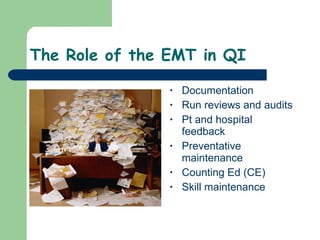
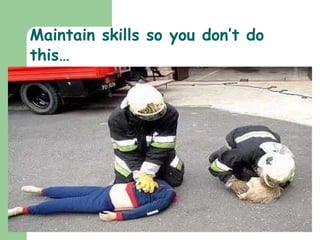
The Role ofthe EMT in QI Documentation Run reviews and audits Pt and hospital feedback Preventative maintenance Counting Ed (CE) Skill maintenance
Medical Direction “Aphysician responsible for the clinical and pt care aspects of the EMS system” EVERY EMS system MUST have one We are extensions of the OMD
25.
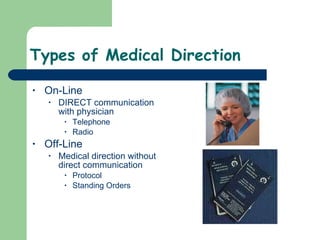
Types of MedicalDirection On-Line DIRECT communication with physician Telephone Radio Off-Line Medical direction without direct communication Protocol Standing Orders
26.
Extra Credit toANYONE who can tell me who these guys are and why they ROCK!!!