MR. JOVEN BOTIN BILBAO
Deputy Chief Nursing Officer
Al Hayat National Hospital
• Define TRIAGE and explain when it is appropriate
for use
• List three reasons a patient triage and tracking system
is required for successful operations
• Categorize the Triage status of patients utilizing the
START and JumpSTART Triage Systems
• Explain the design and use of paper Triage Tags
• Identify five capabilities of the paper Maryland Triage
Tags
 The sorting of and allocation of treatment to patients and especially battle and
disaster victims according to a system of priorities designed to maximize the
number of survivors (from the French trier, to sort) (Merriam-Webster)
 Developed by Baron Dominique-Jean Larrey, Napoleon's Chief Surgeon, for
use by the first ambulance corps—the ambulances volantes—during the early
1800s
• Sorting of patients to provide for the
survival of the most patients
• Assignment of resources in the most
efficient method
• Most severe survivable injuries receive
rapid treatment
• Accountability of patients
Simple Triage And Rapid
Treatment
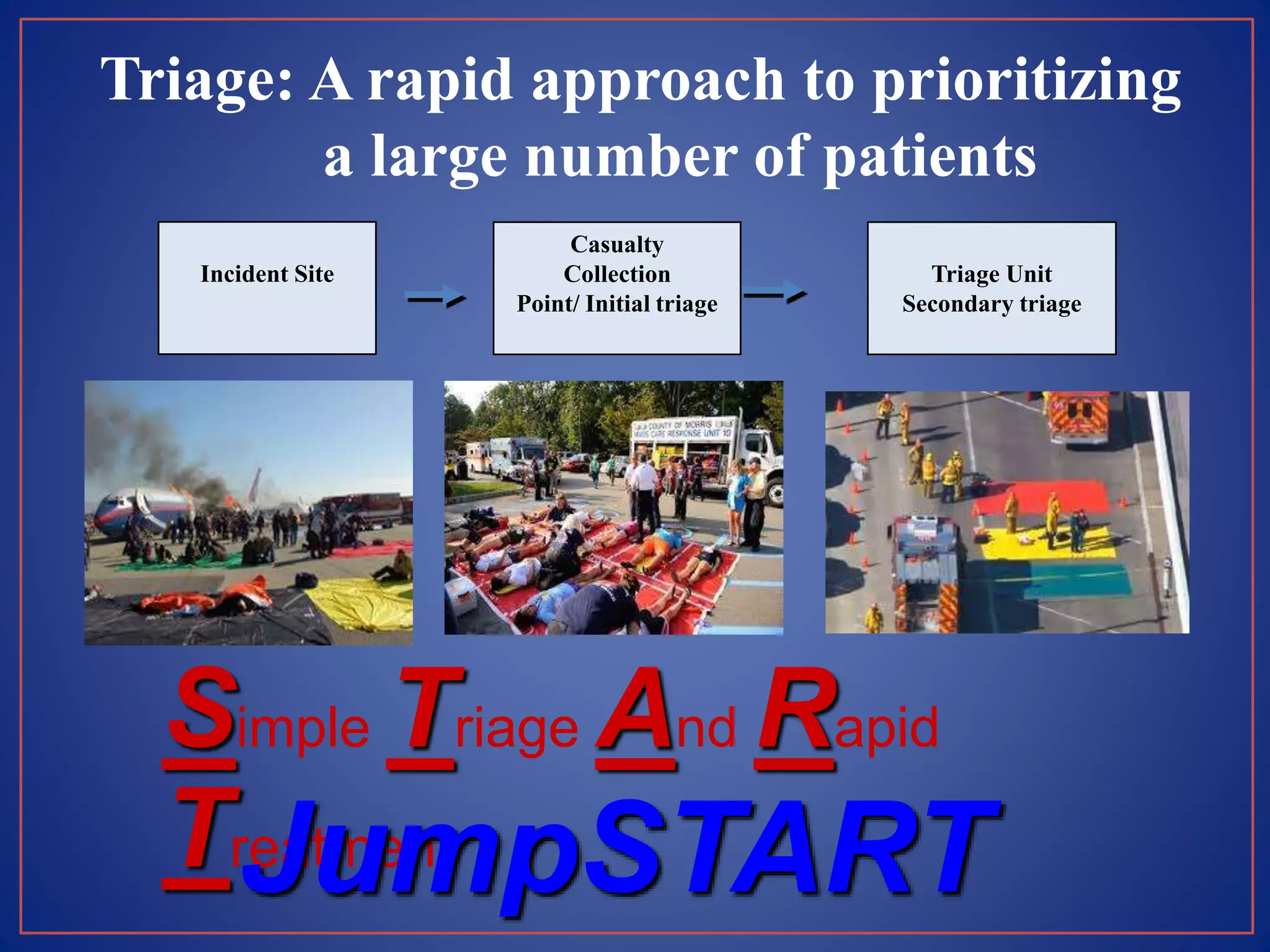
Triage: A rapid approach to prioritizing
a large number of patients
JumpSTART
Incident Site Triage Unit
Secondary triage
Casualty
Collection
Point/ Initial triage
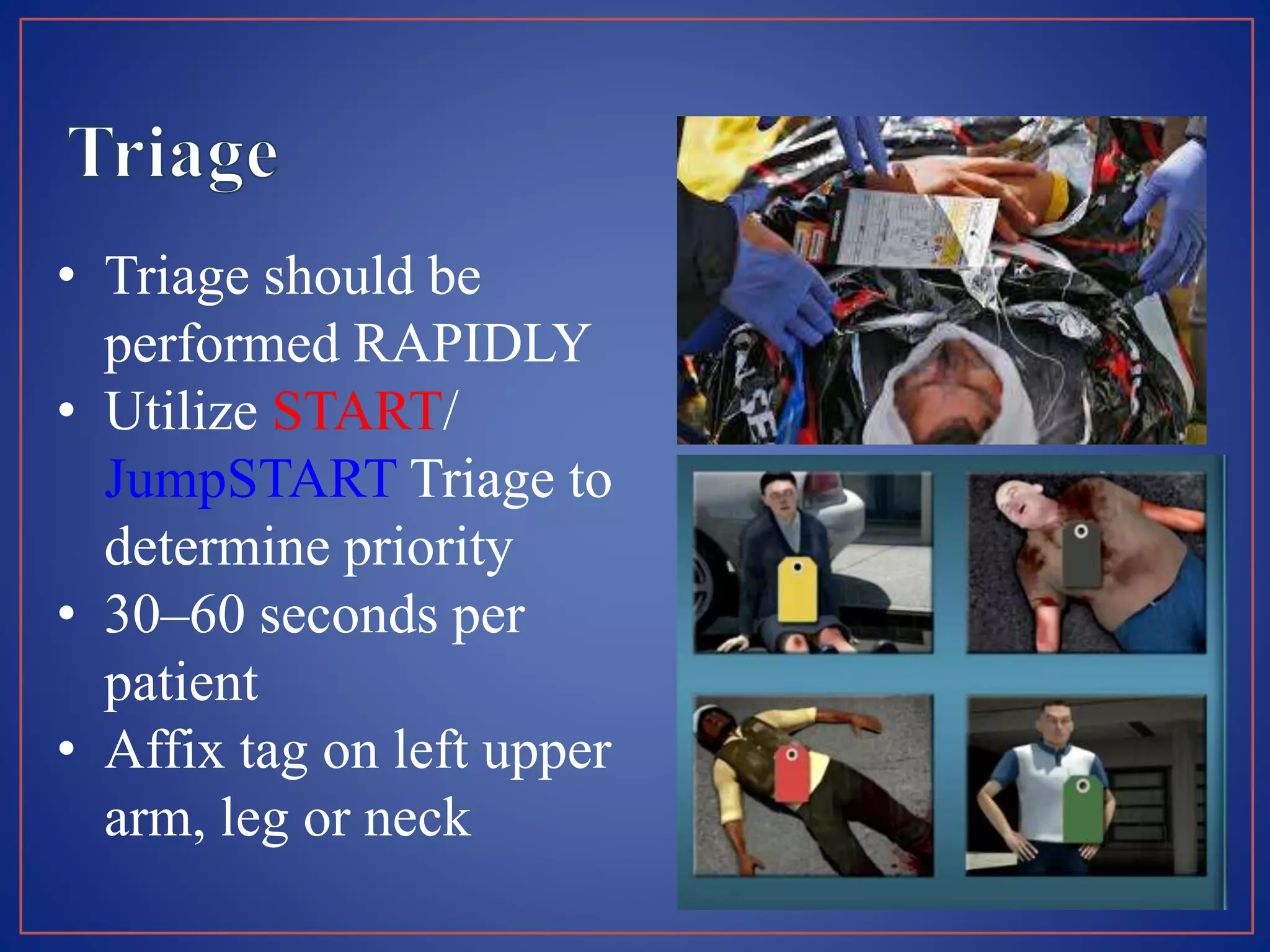
• Triage should be
performed RAPIDLY
• Utilize START/
JumpSTART Triage to
determine priority
• 30–60 seconds per
patient
• Affix tag on left upper
arm, leg or neck
•Clear the “walking wounded” with verbal
instruction:
If you can hear me and you can move, walk to…
•Direct patients to the casualty collection point
/ initial Triage Area or treatment area for
detailed assessment and medical care
•Assign a Green Minor Manager to the area to
control patients and manage area
•Tag will be issued at the casualty collection
point / initial Triage Area
•These patients may be classified as MINOR
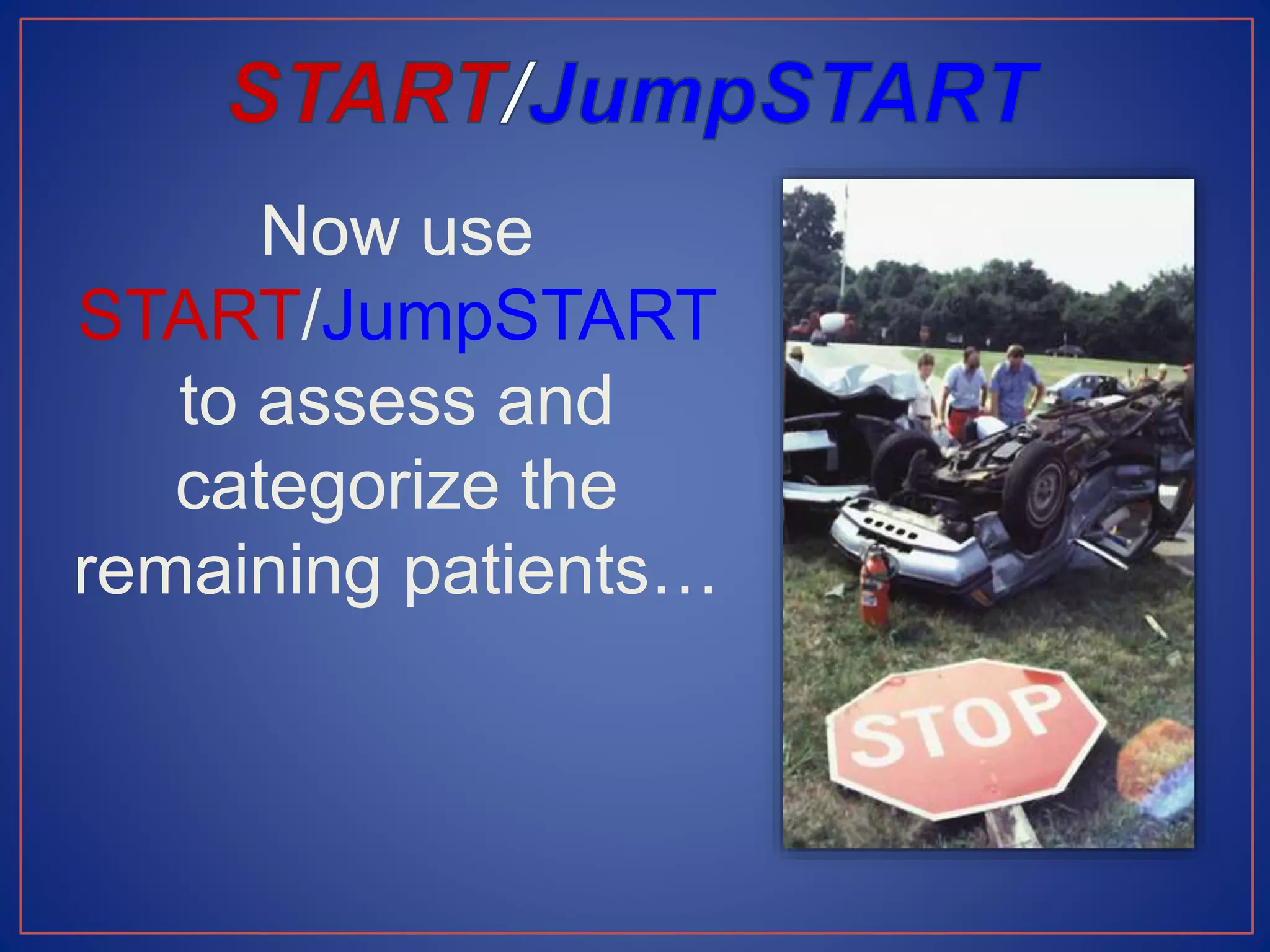
Now use
START/JumpSTART
to assess and
categorize the
remaining patients…
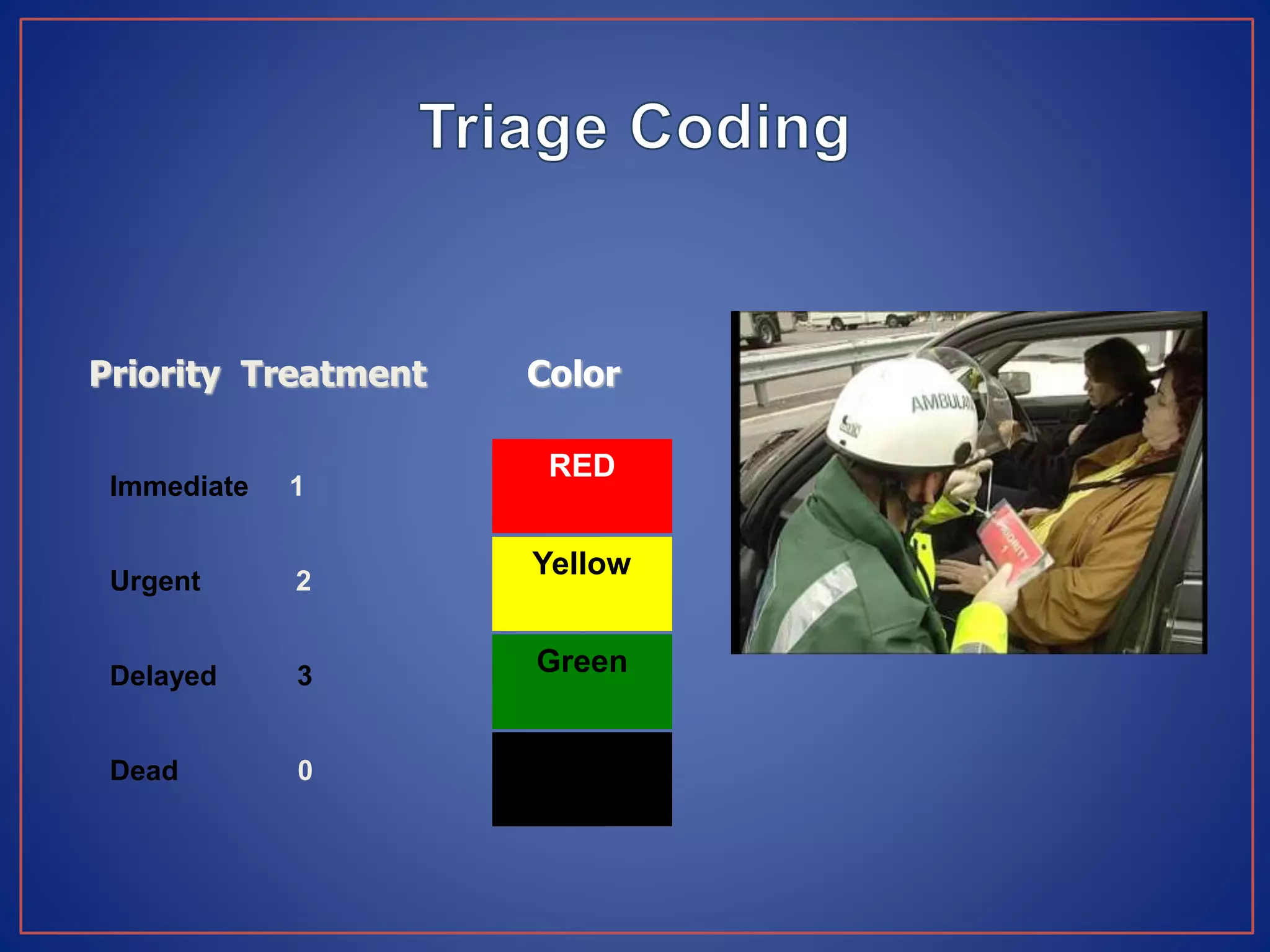
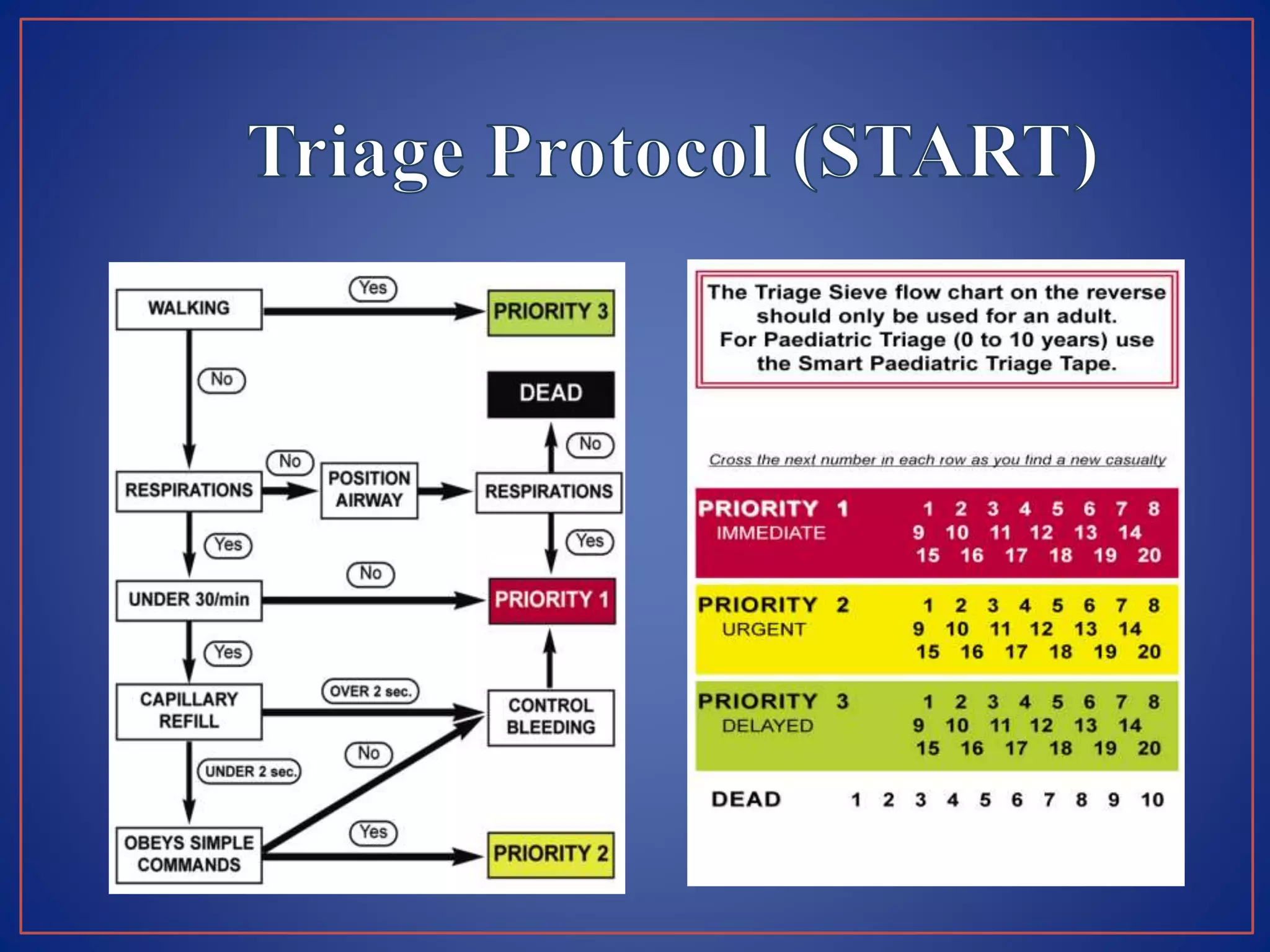
Immediate 1
Urgent 2
Delayed 3
Dead 0
RED
Yellow
Green
Black
ColorPriority Treatment
Categorize the
patients by
assessing each
patient’s RPMs…
Respirations
Pulse/perfusion
Mental Status
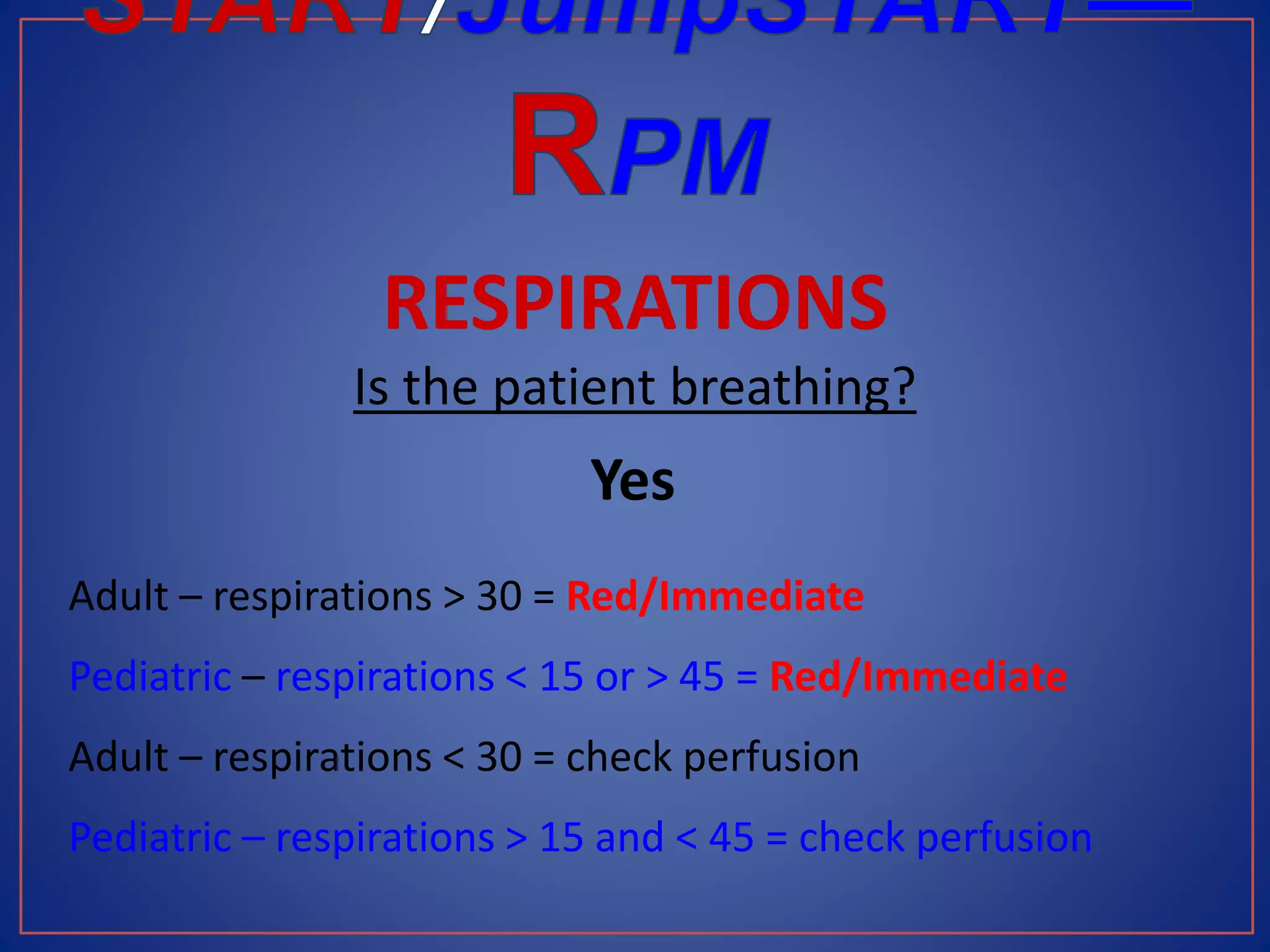
RESPIRATIONS
Is the patient breathing?
Yes
Adult – respirations > 30 = Red/Immediate
Pediatric – respirations < 15 or > 45 = Red/Immediate
Adult – respirations < 30 = check perfusion
Pediatric – respirations > 15 and < 45 = check perfusion
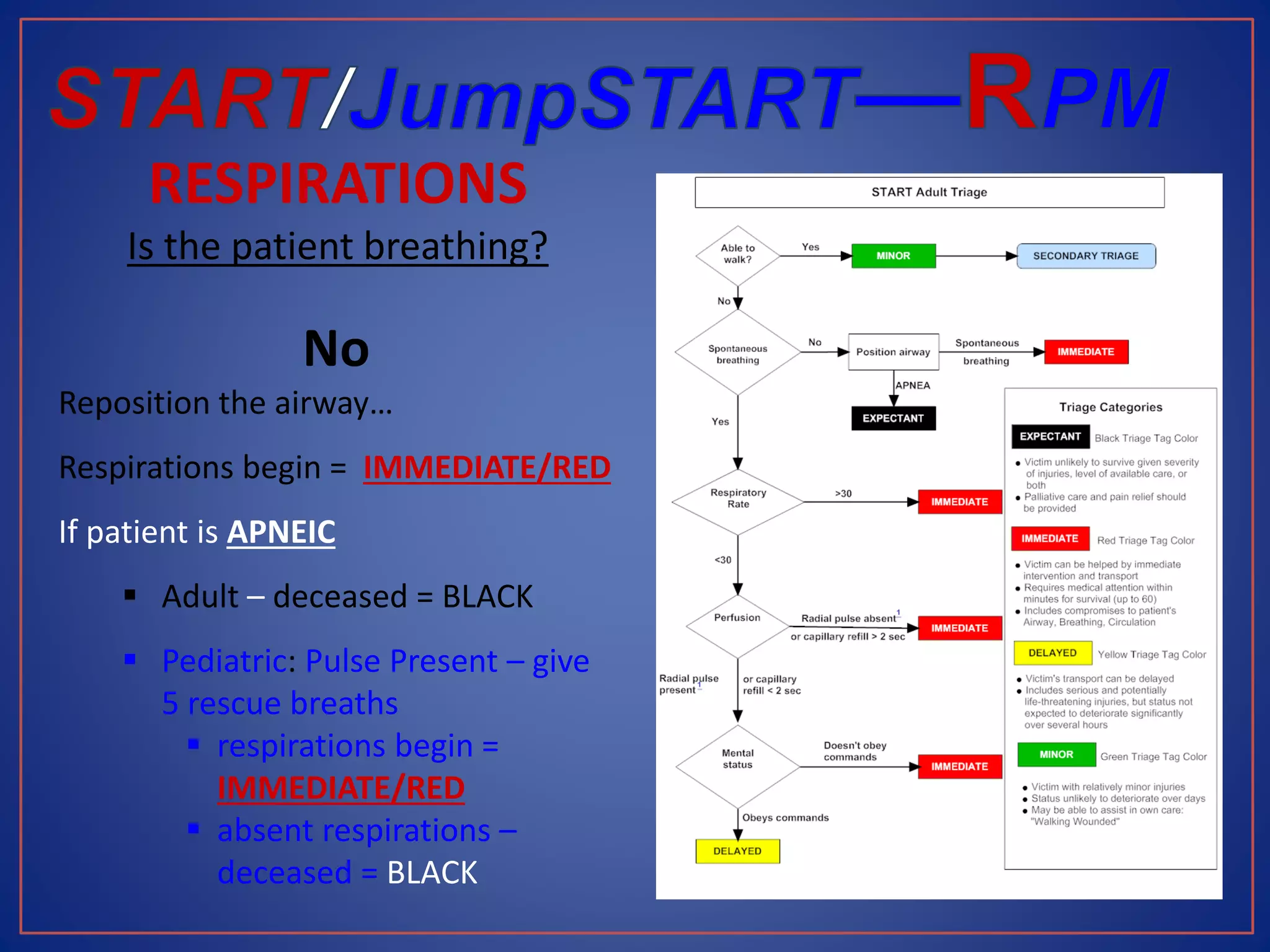
No
Reposition the airway…
Respirations begin = IMMEDIATE/RED
If patient is APNEIC
 Adult – deceased = BLACK
 Pediatric: Pulse Present – give
5 rescue breaths
 respirations begin =
IMMEDIATE/RED
 absent respirations –
deceased = BLACK
RESPIRATIONS
Is the patient breathing?
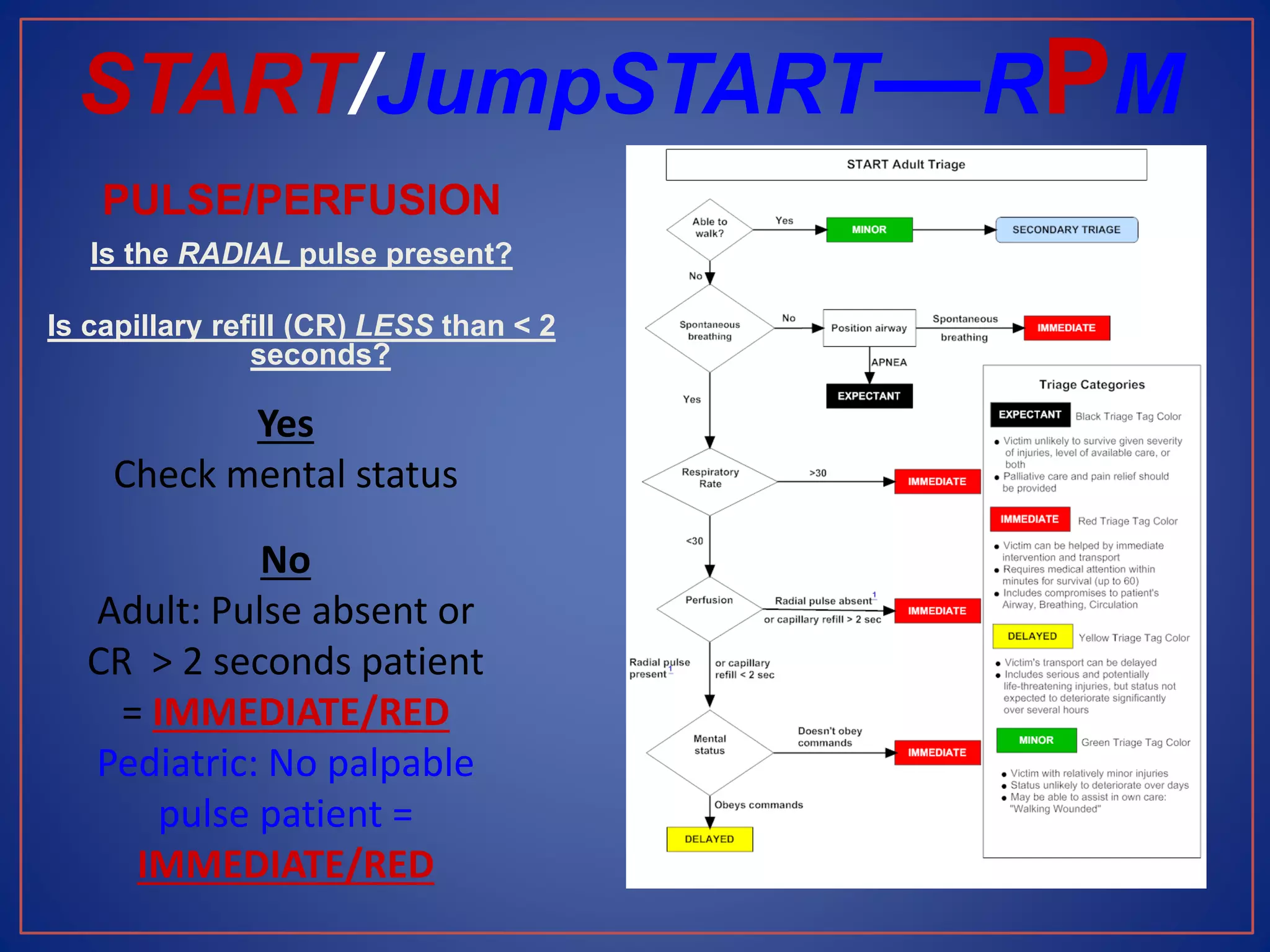
PULSE/PERFUSION
Is the RADIAL pulse present?
Is capillary refill (CR) LESS than < 2
seconds?
Yes
Check mental status
No
Adult: Pulse absent or
CR > 2 seconds patient
= IMMEDIATE/RED
Pediatric: No palpable
pulse patient =
IMMEDIATE/RED
START/JumpSTART—RPM
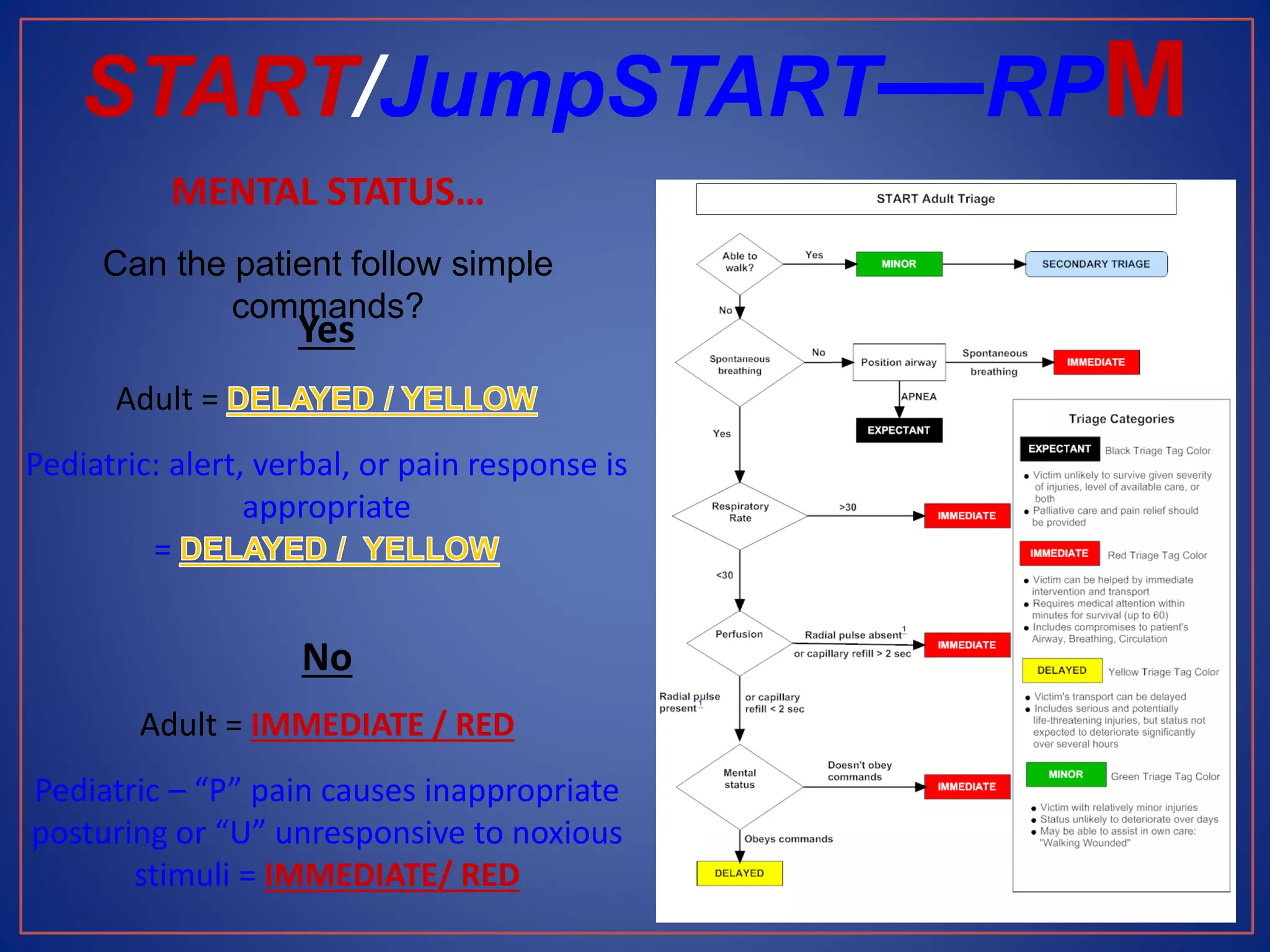
MENTAL STATUS…
Can the patient follow simple
commands?
Yes
Adult =
Pediatric: alert, verbal, or pain response is
appropriate
=
No
Adult = IMMEDIATE / RED
Pediatric – “P” pain causes inappropriate
posturing or “U” unresponsive to noxious
stimuli = IMMEDIATE/ RED
START/JumpSTART—RPM
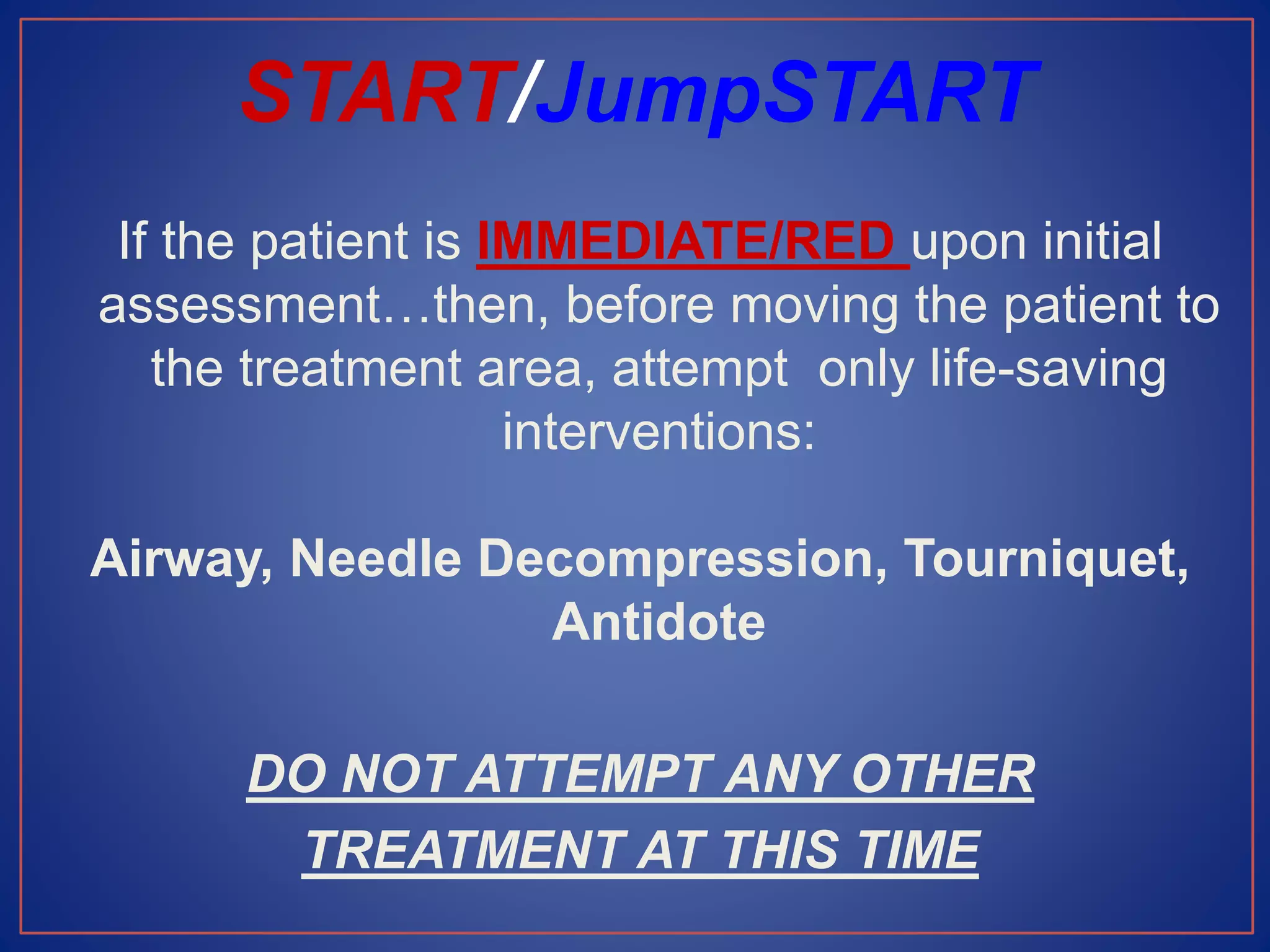
If the patient is IMMEDIATE/RED upon initial
assessment…then, before moving the patient to
the treatment area, attempt only life-saving
interventions:
Airway, Needle Decompression, Tourniquet,
Antidote
DO NOT ATTEMPT ANY OTHER
TREATMENT AT THIS TIME
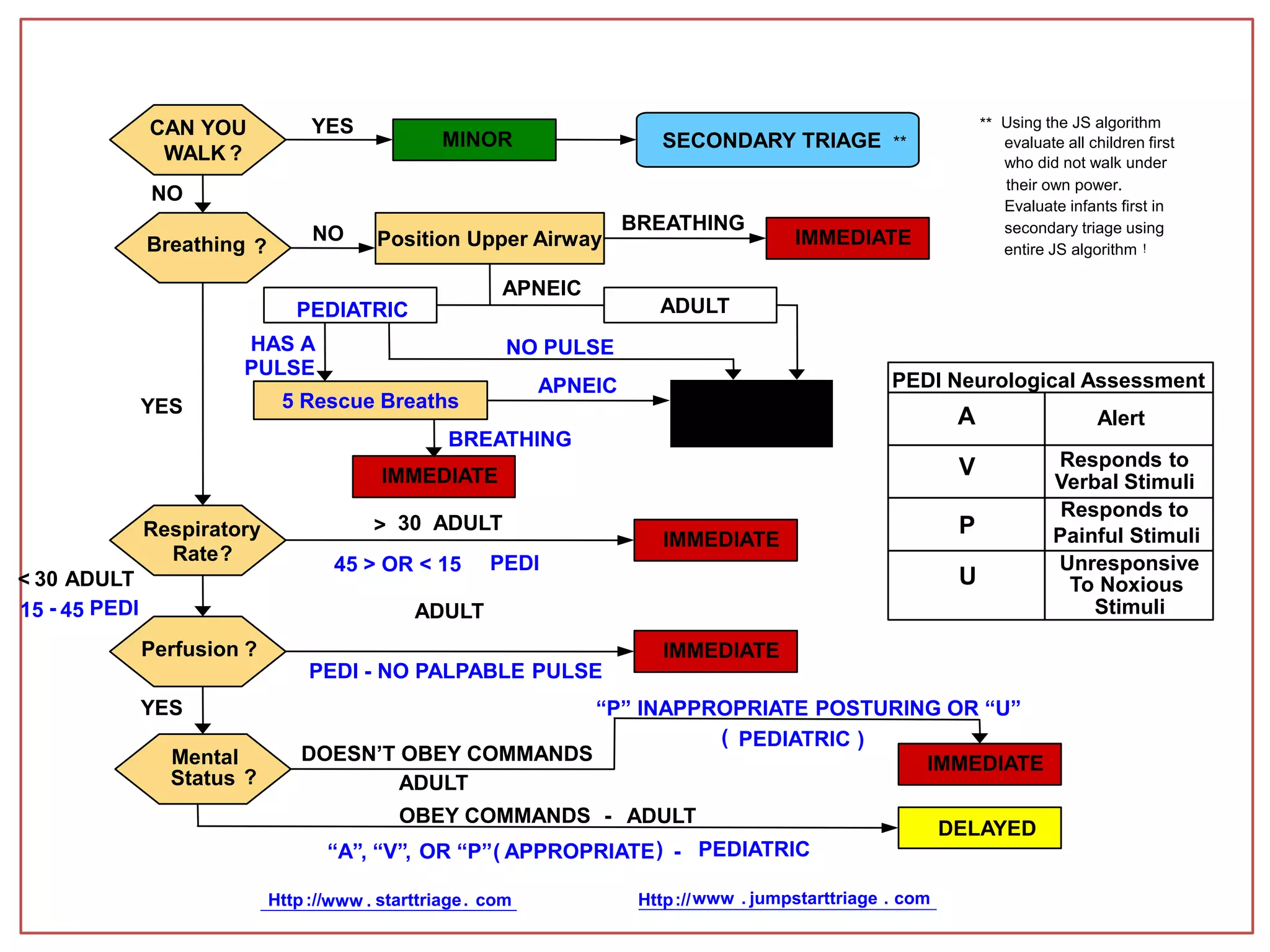
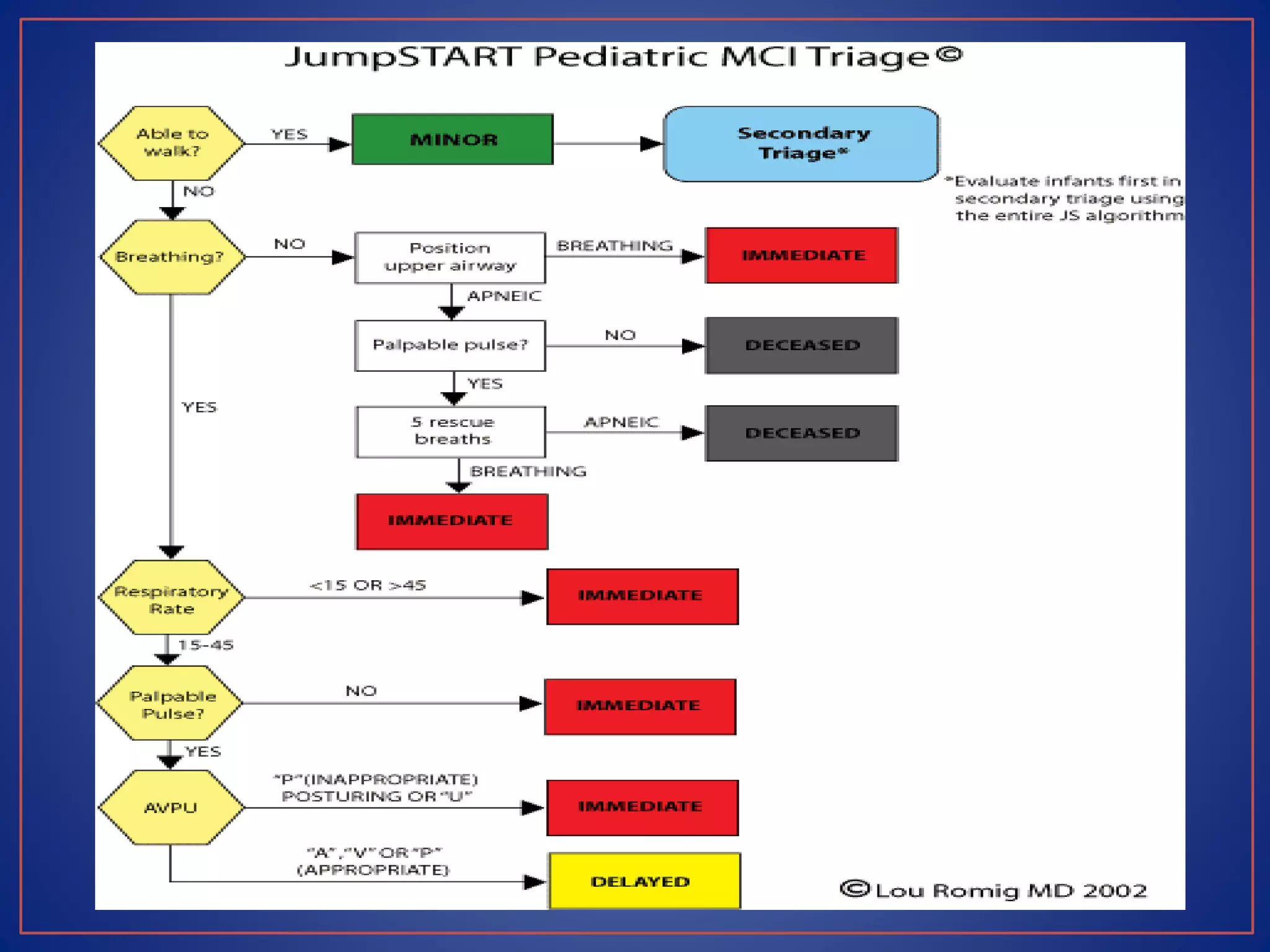
START/JumpSTART
CAN YOU
WALK ?
Breathing ?
Respiratory
Rate?
5 Rescue Breaths
IMMEDIATE
IMMEDIATE
IMMEDIATE
Expected /
Deceased
DELAYED
MINOR SECONDARY TRIAGE **
** Using the JS algorithm
evaluate all children first
who did not walk under
their own power.
Evaluate infants first in
secondary triage using
entire JS algorithm !
BREATHING
Position Upper Airway
APNEIC
NO
YES
HAS A
PULSE
NO PULSE
APNEIC
ADULT
NO
YES
YES
BREATHING
< 30 ADULT
15 - 45 PEDI
> 30 ADULT
45 > OR < 15 PEDI
ADULT
CR >2 Sec or NO PALPABLE PULSE
PEDI - NO PALPABLE PULSE
IMMEDIATE
“P” INAPPROPRIATE POSTURING OR “U”
( PEDIATRIC )
IMMEDIATE
Perfusion ?
DOESN’T OBEY COMMANDS
ADULT
Mental
Status ?
PEDIATRIC
OBEY COMMANDS - ADULT
“A”, “V”, OR “P”( APPROPRIATE) - PEDIATRIC
Http://www . jumpstarttriage . comHttp ://www . starttriage. com
PEDI Neurological Assessment
A Alert
V Responds to
Verbal Stimuli
P
Responds to
Painful Stimuli
Unresponsive
To Noxious
Stimuli
U
Combined START/JumpSTART Triage
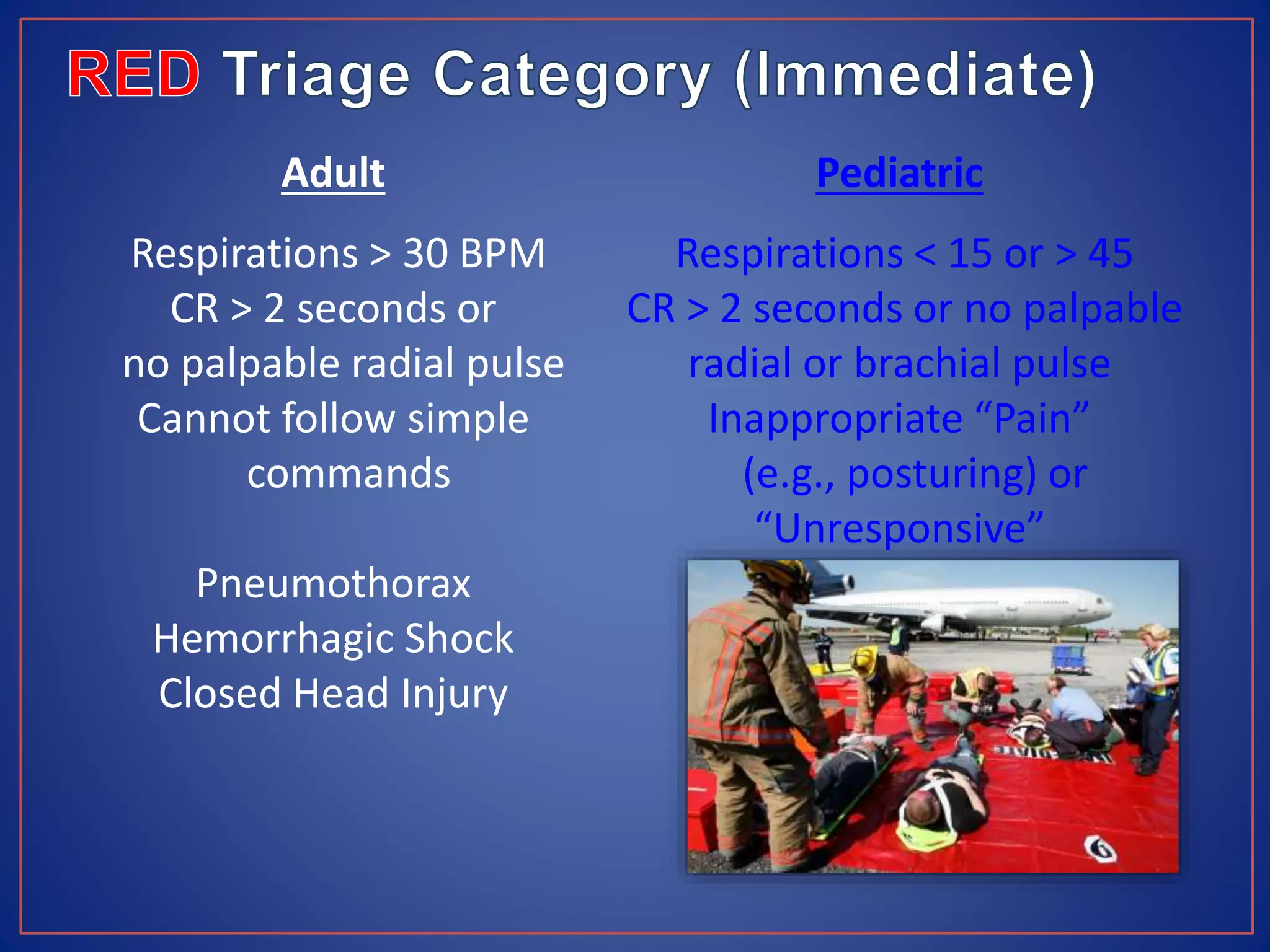
Adult
Respirations > 30 BPM
CR > 2 seconds or
no palpable radial pulse
Cannot follow simple
commands
Pneumothorax
Hemorrhagic Shock
Closed Head Injury
Pediatric
Respirations < 15 or > 45
CR > 2 seconds or no palpable
radial or brachial pulse
Inappropriate “Pain”
(e.g., posturing) or
“Unresponsive”
Adult: respirations, capillary refill, and mentation are
normal
• Isolated burns
• Extremity fractures
• Stable other trauma
• Most patients with
medical complaints
Pediatric: “A,” “V,” or appropriate “P”
(e.g., withdrawal from pain stimulus)
• “Walking
wounded”
• Psychological
casualties
• Always look for
children being
carried and
assess them
• This category is not currently in use and
must not be utilized until approved by
MIEMSS
• It is included on the paper tags in
anticipation of national recognition and
acceptance in the future
is for the patient that is not likely to
survive even with emergent interventions
• Obvious mortality or death
(pulseless and apneic)
• Decapitation
• Blunt trauma arrest
• Injuries incompatible with life
(future )
• Brain matter visible
(future )
BLACK Triage Category (Deceased)
• Triage allows for effective and efficient
care, helping to increase the
survivability for as many patients as
possible
• Assignment of resources will increase
efficiency
• Most severely injured patients will
receive rapid treatment and transport
in logical order
• Ensures accountability of all patients
• Allows for family reunification
Secondary Triage
An improvised explosive device is detonated at a large
outdoor sporting event. At least 50 people are confirmed
injured. EMS is on scene, but patients begin to arrive at
your hospital before EMS.
Triage and “Tag” the following patients.
Apneic
Pulse-less
Missing LUE
Apneic
Pulse-less
Missing LUE
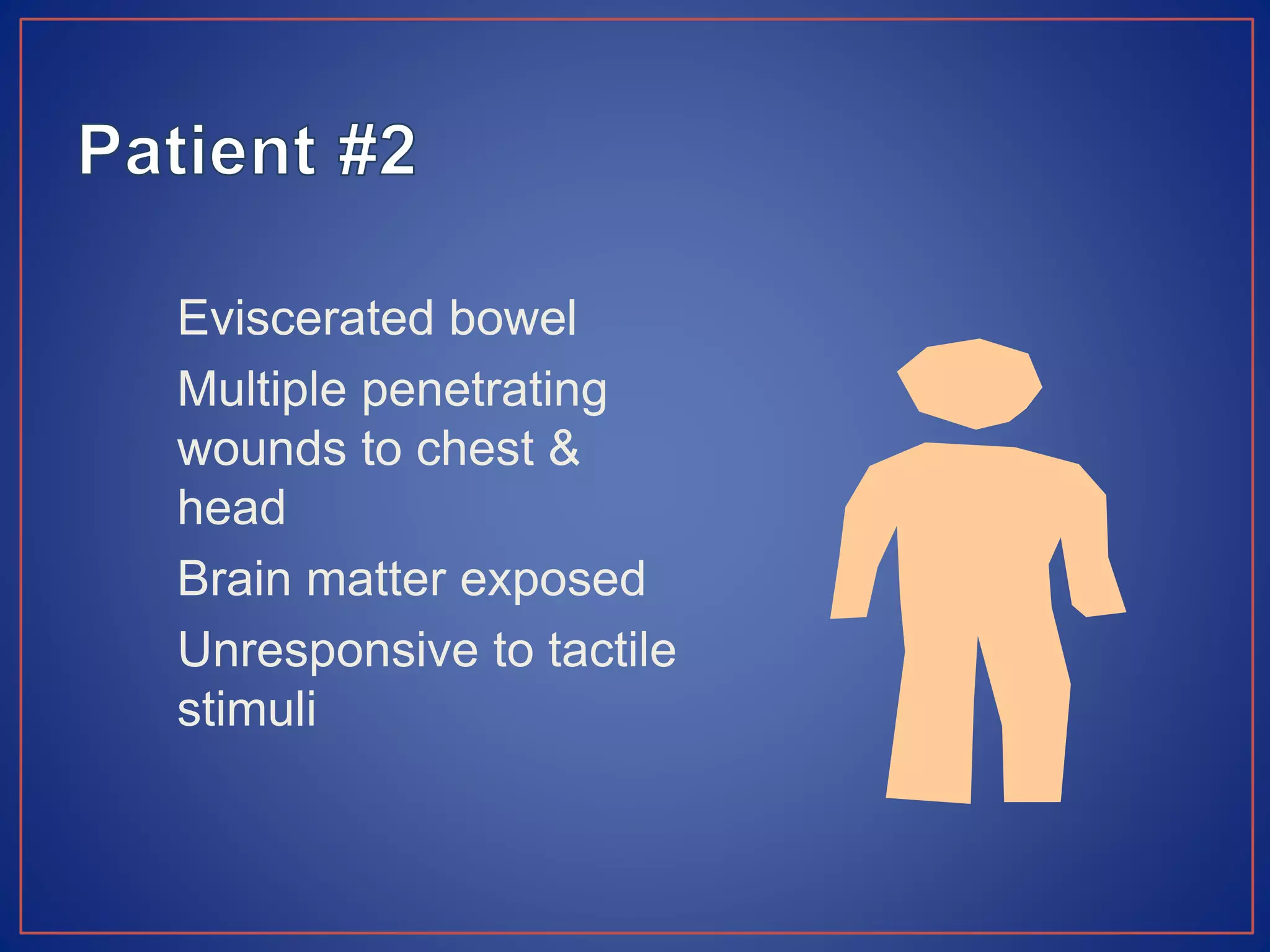
Eviscerated bowel
Multiple penetrating
wounds to chest &
head
Brain matter exposed
Unresponsive to tactile
stimuli
Eviscerated bowel
Multiple penetrating
wounds to chest &
head
Brain matter exposed
Unresponsive to tactile
stimuli
Abd. Tenderness and
minor penetrating
trauma
Ambulating
A & O x 3
RR 24
Strong radial pulse
Abd. Tenderness and
minor penetrating
trauma
Ambulating
A & O x 3
RR 24
Strong radial pulse
Multiple penetrating
injuries, blood in ears
Responds only to pain
Airway clear
RR 20
Strong Radial pulse
Multiple penetrating
injuries, blood in ears
Responds only to pain
Airway clear
RR 20
Strong Radial pulse
Extremity fractures, blood
in ears
A & O x 3
RR 26
Strong radial pulse
Extremity fractures, blood
in ears
A & O x 3
RR 26
Strong radial pulse
Child, screaming
Minor lacs, blood in ears
RR 30
Moving all extremities
Child, screaming
Minor lacs, blood in ears
RR 30
Moving all extremities
Amputated fingers, head
injury
A & O x 3
Dizzy
RR 24
Smells like beer
Amputated fingers, head
injury
A & O x 3
Dizzy
RR 24
Smells like beer
Chest pain, SOB
No trauma noted
RR 34
Shallow
Weak radial pulse
Chest pain, SOB
No trauma noted
RR 34
Shallow
Weak radial pulse
Blood in nose, mouth and
ears
Not breathing
Blood in nose, mouth and
ears
Not breathing
What would you do?
Blood in nose, mouth and
ears
Not breathing
RR 10 with manual opening
Some penetrating trauma
Unresponsive
Apneic
No radial pulse
Carotid 130/min
Some penetrating trauma
Unresponsive
Apneic
No radial pulse
Carotid 130/min
Arterial bleed from leg
Responsive to pain
RR 34
No radial pulse
Carotid 130/min
Arterial bleed from leg
Responsive to pain
RR 34
No radial pulse
Carotid 130/min
Minor lacs
Crying
Ambulatory
RR 24
Minor lacs
Crying
Ambulatory
RR 24
Deviate trachea
RR 40
Weak radial pulse
+JVD
Cyanosis
Deviate trachea
RR 40
Weak radial pulse
+JVD
Cyanosis
Open fracture of RUE
Non-ambulatory
A & O x 3
RR 26
Strong radial pulse
Open fracture of RUE
Non-ambulatory
A & O x 3
RR 26
Strong radial pulse
100% TBS burns (partial
and full)
A & O x 2
RR 36
Coughing
Strong radial pulse
100% TBS burns (partial
and full)
A & O x 2
RR 36
Coughing
Strong radial pulse
CP, SOB
Slurred speech
R sided weakness
A & O x 1
RR 24
Strong radial pulse
CP, SOB
Slurred speech
R sided weakness
A & O x 1
RR 24
Strong radial pulse
Avulsion RUE
Arterial bleed
A & O x 2
RR 30
“I’m thirsty”
Avulsion RUE
Arterial bleed
A & O x 2
RR 30
“I’m thirsty”
Open fractures BLE
Blood in ears
A & O x 3
RR 28
Strong radial pulse
Open fractures BLE
Blood in ears
A & O x 3
RR 28
Strong radial pulse
Hysterical, screaming
Blood in ears
A & O x 3
RR 36
Strong radial pulse
Hysterical, screaming
Blood in ears
A & O x 3
RR 36
Strong radial pulse
Child
Cyanotic from nipple line
up
Apneic
Child
Cyanotic from nipple line
up
Apneic
• Increase familiarity/proficiency of the START and Jump
START triage methodologies
• Increase familiarity with the Tag Triage System
• Train with a standardized methodology and system

Mass Casualty Triage System START, and JumpSTART

  • 1.
    MR. JOVEN BOTINBILBAO Deputy Chief Nursing Officer Al Hayat National Hospital
  • 2.
    • Define TRIAGEand explain when it is appropriate for use • List three reasons a patient triage and tracking system is required for successful operations • Categorize the Triage status of patients utilizing the START and JumpSTART Triage Systems • Explain the design and use of paper Triage Tags • Identify five capabilities of the paper Maryland Triage Tags
  • 3.
     The sortingof and allocation of treatment to patients and especially battle and disaster victims according to a system of priorities designed to maximize the number of survivors (from the French trier, to sort) (Merriam-Webster)  Developed by Baron Dominique-Jean Larrey, Napoleon's Chief Surgeon, for use by the first ambulance corps—the ambulances volantes—during the early 1800s
  • 4.
    • Sorting ofpatients to provide for the survival of the most patients • Assignment of resources in the most efficient method • Most severe survivable injuries receive rapid treatment • Accountability of patients
  • 5.
    Simple Triage AndRapid Treatment Triage: A rapid approach to prioritizing a large number of patients JumpSTART Incident Site Triage Unit Secondary triage Casualty Collection Point/ Initial triage
  • 6.
    • Triage shouldbe performed RAPIDLY • Utilize START/ JumpSTART Triage to determine priority • 30–60 seconds per patient • Affix tag on left upper arm, leg or neck
  • 7.
    •Clear the “walkingwounded” with verbal instruction: If you can hear me and you can move, walk to… •Direct patients to the casualty collection point / initial Triage Area or treatment area for detailed assessment and medical care •Assign a Green Minor Manager to the area to control patients and manage area •Tag will be issued at the casualty collection point / initial Triage Area •These patients may be classified as MINOR
  • 8.
    Now use START/JumpSTART to assessand categorize the remaining patients…
  • 9.
    Immediate 1 Urgent 2 Delayed3 Dead 0 RED Yellow Green Black ColorPriority Treatment
  • 11.
    Categorize the patients by assessingeach patient’s RPMs… Respirations Pulse/perfusion Mental Status
  • 12.
    RESPIRATIONS Is the patientbreathing? Yes Adult – respirations > 30 = Red/Immediate Pediatric – respirations < 15 or > 45 = Red/Immediate Adult – respirations < 30 = check perfusion Pediatric – respirations > 15 and < 45 = check perfusion
  • 13.
    No Reposition the airway… Respirationsbegin = IMMEDIATE/RED If patient is APNEIC  Adult – deceased = BLACK  Pediatric: Pulse Present – give 5 rescue breaths  respirations begin = IMMEDIATE/RED  absent respirations – deceased = BLACK RESPIRATIONS Is the patient breathing?
  • 14.
    PULSE/PERFUSION Is the RADIALpulse present? Is capillary refill (CR) LESS than < 2 seconds? Yes Check mental status No Adult: Pulse absent or CR > 2 seconds patient = IMMEDIATE/RED Pediatric: No palpable pulse patient = IMMEDIATE/RED START/JumpSTART—RPM
  • 15.
    MENTAL STATUS… Can thepatient follow simple commands? Yes Adult = Pediatric: alert, verbal, or pain response is appropriate = No Adult = IMMEDIATE / RED Pediatric – “P” pain causes inappropriate posturing or “U” unresponsive to noxious stimuli = IMMEDIATE/ RED START/JumpSTART—RPM
  • 16.
    If the patientis IMMEDIATE/RED upon initial assessment…then, before moving the patient to the treatment area, attempt only life-saving interventions: Airway, Needle Decompression, Tourniquet, Antidote DO NOT ATTEMPT ANY OTHER TREATMENT AT THIS TIME START/JumpSTART
  • 17.
    CAN YOU WALK ? Breathing? Respiratory Rate? 5 Rescue Breaths IMMEDIATE IMMEDIATE IMMEDIATE Expected / Deceased DELAYED MINOR SECONDARY TRIAGE ** ** Using the JS algorithm evaluate all children first who did not walk under their own power. Evaluate infants first in secondary triage using entire JS algorithm ! BREATHING Position Upper Airway APNEIC NO YES HAS A PULSE NO PULSE APNEIC ADULT NO YES YES BREATHING < 30 ADULT 15 - 45 PEDI > 30 ADULT 45 > OR < 15 PEDI ADULT CR >2 Sec or NO PALPABLE PULSE PEDI - NO PALPABLE PULSE IMMEDIATE “P” INAPPROPRIATE POSTURING OR “U” ( PEDIATRIC ) IMMEDIATE Perfusion ? DOESN’T OBEY COMMANDS ADULT Mental Status ? PEDIATRIC OBEY COMMANDS - ADULT “A”, “V”, OR “P”( APPROPRIATE) - PEDIATRIC Http://www . jumpstarttriage . comHttp ://www . starttriage. com PEDI Neurological Assessment A Alert V Responds to Verbal Stimuli P Responds to Painful Stimuli Unresponsive To Noxious Stimuli U Combined START/JumpSTART Triage
  • 18.
    Adult Respirations > 30BPM CR > 2 seconds or no palpable radial pulse Cannot follow simple commands Pneumothorax Hemorrhagic Shock Closed Head Injury Pediatric Respirations < 15 or > 45 CR > 2 seconds or no palpable radial or brachial pulse Inappropriate “Pain” (e.g., posturing) or “Unresponsive”
  • 19.
    Adult: respirations, capillaryrefill, and mentation are normal • Isolated burns • Extremity fractures • Stable other trauma • Most patients with medical complaints Pediatric: “A,” “V,” or appropriate “P” (e.g., withdrawal from pain stimulus)
  • 20.
    • “Walking wounded” • Psychological casualties •Always look for children being carried and assess them
  • 21.
    • This categoryis not currently in use and must not be utilized until approved by MIEMSS • It is included on the paper tags in anticipation of national recognition and acceptance in the future is for the patient that is not likely to survive even with emergent interventions
  • 22.
    • Obvious mortalityor death (pulseless and apneic) • Decapitation • Blunt trauma arrest • Injuries incompatible with life (future ) • Brain matter visible (future ) BLACK Triage Category (Deceased)
  • 23.
    • Triage allowsfor effective and efficient care, helping to increase the survivability for as many patients as possible • Assignment of resources will increase efficiency • Most severely injured patients will receive rapid treatment and transport in logical order • Ensures accountability of all patients • Allows for family reunification
  • 26.
  • 28.
    An improvised explosivedevice is detonated at a large outdoor sporting event. At least 50 people are confirmed injured. EMS is on scene, but patients begin to arrive at your hospital before EMS. Triage and “Tag” the following patients.
  • 29.
  • 30.
  • 31.
    Eviscerated bowel Multiple penetrating woundsto chest & head Brain matter exposed Unresponsive to tactile stimuli
  • 32.
    Eviscerated bowel Multiple penetrating woundsto chest & head Brain matter exposed Unresponsive to tactile stimuli
  • 33.
    Abd. Tenderness and minorpenetrating trauma Ambulating A & O x 3 RR 24 Strong radial pulse
  • 34.
    Abd. Tenderness and minorpenetrating trauma Ambulating A & O x 3 RR 24 Strong radial pulse
  • 35.
    Multiple penetrating injuries, bloodin ears Responds only to pain Airway clear RR 20 Strong Radial pulse
  • 36.
    Multiple penetrating injuries, bloodin ears Responds only to pain Airway clear RR 20 Strong Radial pulse
  • 37.
    Extremity fractures, blood inears A & O x 3 RR 26 Strong radial pulse
  • 38.
    Extremity fractures, blood inears A & O x 3 RR 26 Strong radial pulse
  • 39.
    Child, screaming Minor lacs,blood in ears RR 30 Moving all extremities
  • 40.
    Child, screaming Minor lacs,blood in ears RR 30 Moving all extremities
  • 41.
    Amputated fingers, head injury A& O x 3 Dizzy RR 24 Smells like beer
  • 42.
    Amputated fingers, head injury A& O x 3 Dizzy RR 24 Smells like beer
  • 43.
    Chest pain, SOB Notrauma noted RR 34 Shallow Weak radial pulse
  • 44.
    Chest pain, SOB Notrauma noted RR 34 Shallow Weak radial pulse
  • 45.
    Blood in nose,mouth and ears Not breathing
  • 46.
    Blood in nose,mouth and ears Not breathing What would you do?
  • 47.
    Blood in nose,mouth and ears Not breathing RR 10 with manual opening
  • 48.
  • 49.
  • 50.
    Arterial bleed fromleg Responsive to pain RR 34 No radial pulse Carotid 130/min
  • 51.
    Arterial bleed fromleg Responsive to pain RR 34 No radial pulse Carotid 130/min
  • 52.
  • 53.
  • 54.
    Deviate trachea RR 40 Weakradial pulse +JVD Cyanosis
  • 55.
    Deviate trachea RR 40 Weakradial pulse +JVD Cyanosis
  • 56.
    Open fracture ofRUE Non-ambulatory A & O x 3 RR 26 Strong radial pulse
  • 57.
    Open fracture ofRUE Non-ambulatory A & O x 3 RR 26 Strong radial pulse
  • 58.
    100% TBS burns(partial and full) A & O x 2 RR 36 Coughing Strong radial pulse
  • 59.
    100% TBS burns(partial and full) A & O x 2 RR 36 Coughing Strong radial pulse
  • 60.
    CP, SOB Slurred speech Rsided weakness A & O x 1 RR 24 Strong radial pulse
  • 61.
    CP, SOB Slurred speech Rsided weakness A & O x 1 RR 24 Strong radial pulse
  • 62.
    Avulsion RUE Arterial bleed A& O x 2 RR 30 “I’m thirsty”
  • 63.
    Avulsion RUE Arterial bleed A& O x 2 RR 30 “I’m thirsty”
  • 64.
    Open fractures BLE Bloodin ears A & O x 3 RR 28 Strong radial pulse
  • 65.
    Open fractures BLE Bloodin ears A & O x 3 RR 28 Strong radial pulse
  • 66.
    Hysterical, screaming Blood inears A & O x 3 RR 36 Strong radial pulse
  • 67.
    Hysterical, screaming Blood inears A & O x 3 RR 36 Strong radial pulse
  • 68.
  • 69.
  • 70.
    • Increase familiarity/proficiencyof the START and Jump START triage methodologies • Increase familiarity with the Tag Triage System • Train with a standardized methodology and system