Principles of
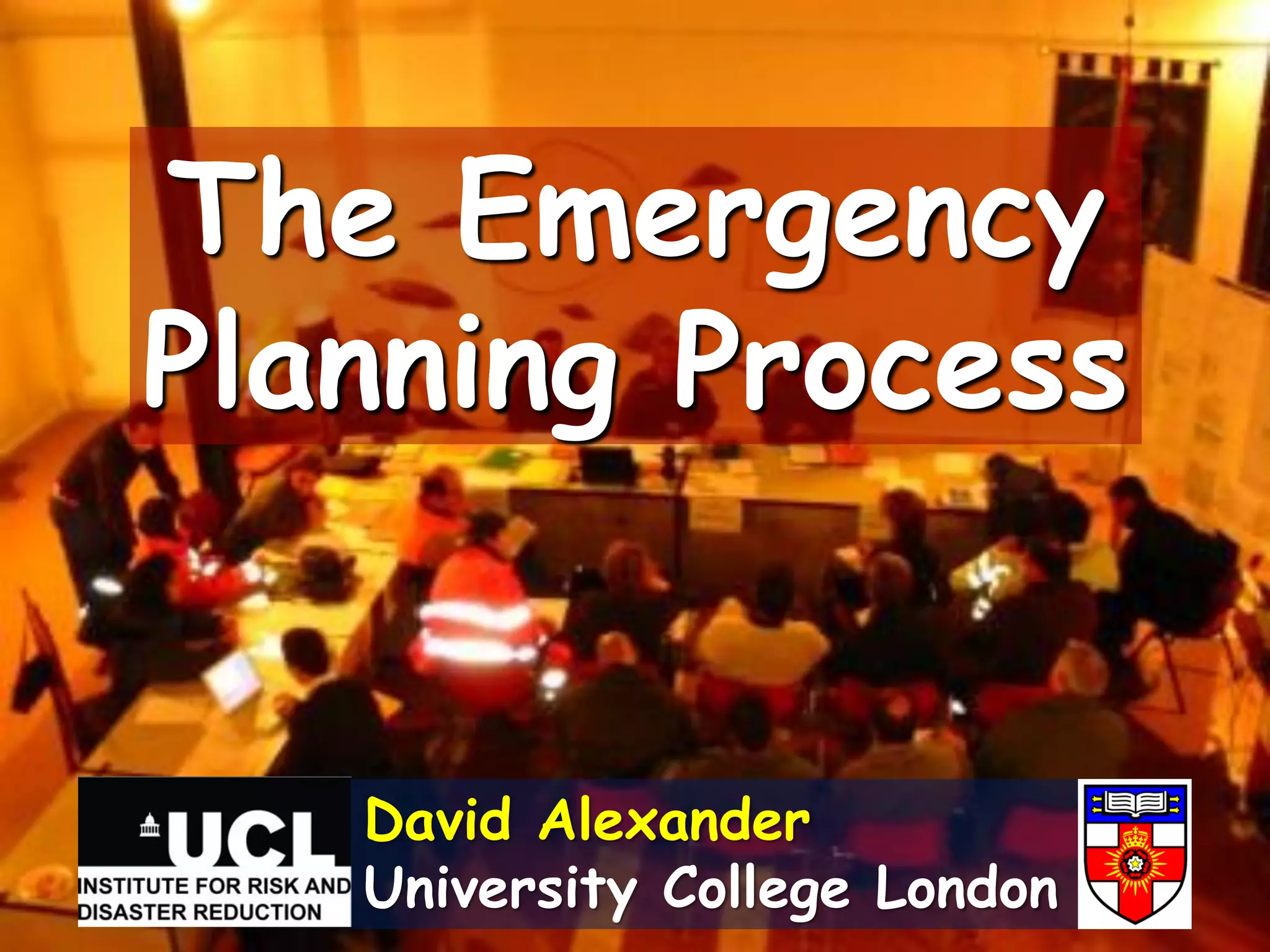
Emergency Planning
David Alexander
University College London
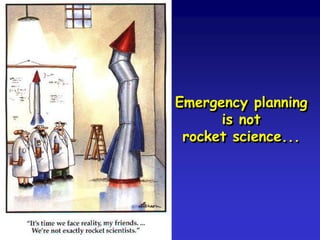
Emergency planning
is not
rocket science...
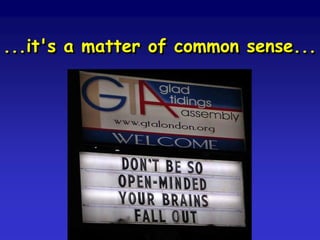
...it's a matter of common sense...
...and organisation!
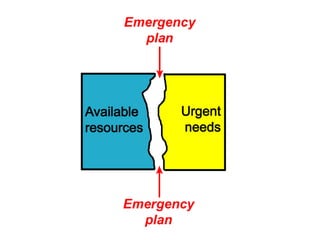
The essence of disaster management:-
To tackle pressing needs with
maximum efficiency and speed but
with scarce resources and in the
absence of necessary information
BUT emergency planning is a young field that lacks
international consensus on standards, procedures,
the legal basis and institutional arrangements.
Major event
management
Incident
management
Population
(community)
protection
Hazard
forecasting,
monitoring,
etc.
Plans,
procedures,
protocols
Human and
material
resources
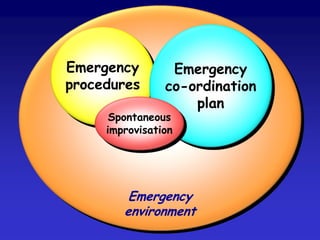
Emergency
environment
Emergency
procedures
Emergency
co-ordination
plan
Spontaneous
improvisation
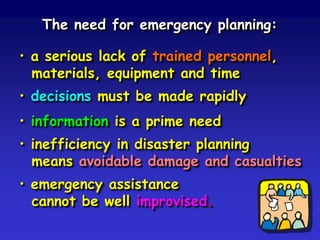
The need for emergency planning:
• a serious lack of trained personnel,
materials, equipment and time
• decisions must be made rapidly
• information is a prime need
• inefficiency in disaster planning
means avoidable damage and casualties
• emergency assistance
cannot be well improvised.
The main objective of the plan is to
inform, instruct and direct participants
about what procedures and
emergency resources to use.
13 principles of
emergency planning
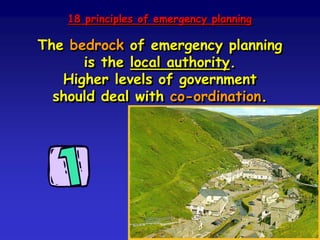
Principle no. 1
In an emergency the theatre of
operations is always the local area.
Local organisation and emergency planning
are fundamental and indispensable.
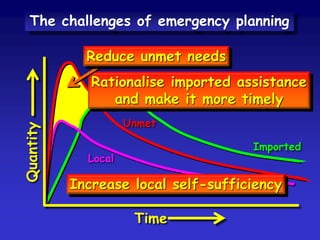
QUANTITY
TIME
needs
local self-help
imported assistance
unmet needsReduce unmet needs
Increase local self-sufficiency
Rationalise imported assistance
and make it more timely
The challenges of emergency planning
Volontary
sector:
support and
integration
Private
sector:
integration
Disaster
Municipality or other local
authority: emergency operations
Province, region, state, county:
co-ordination, assistance
Nation: policies of
compatibility, harmonisation
and co-ordination
International:
exchange and support
A hierarchy
of emergency
plans
Micro-
emergency
Disaster or
catastrophe
Macro-
emergency
Meso-
emergency
Single
municipality
Several
municipalities
Regional
coordination
National
coordination
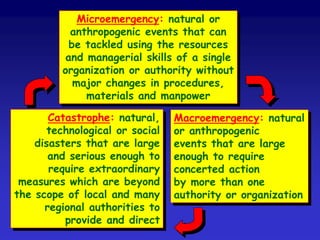
Microemergency: natural or
anthropogenic events that can
be tackled using the resources
and managerial skills of a single
organization or authority without
major changes in procedures,
materials and manpower
Catastrophe: natural,
technological or social
disasters that are large
and serious enough to
require extraordinary
measures which are beyond
the scope of local and many
regional authorities to
provide and direct
Macroemergency: natural
or anthropogenic
events that are large
enough to require
concerted action
by more than one
authority or organization
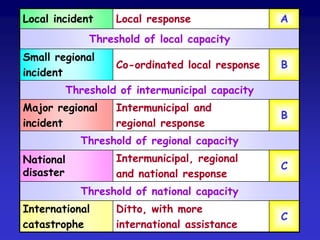
Local incident Local response A
Threshold of local capacity
Small regional
incident
Co-ordinated local response B
Threshold of intermunicipal capacity
Major regional
incident
Intermunicipal and
regional response
B
Threshold of regional capacity
National
disaster
Intermunicipal, regional
and national response
C
Threshold of national capacity
International
catastrophe
Ditto, with more
international assistance
C
Aid from outside the disaster area should
reinforce, not replace, local initiatives.
Main objectives: develop a state of local
self-sufficiency and maintain public order.
The bedrock level is the local authority:
higher levels of government should support
and harmonise local emergency responses.
Principle no. 2
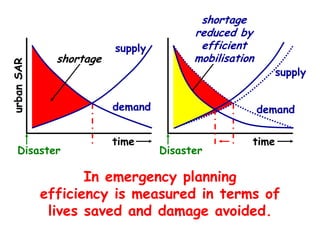
In emergency planning efficiency
is measured in terms of lives saved
and damage avoided or contained.
supply
demand
time
Disaster
supply
demand
time
urbanSAR
shortage
Disaster
shortage
reduced by
efficient
mobilisation
Principle no. 3
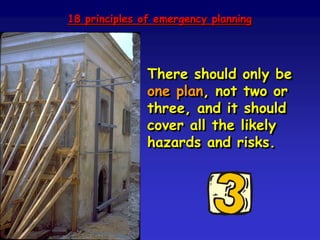
The most efficient emergency preparedness
involves generic, all-hazards planning.
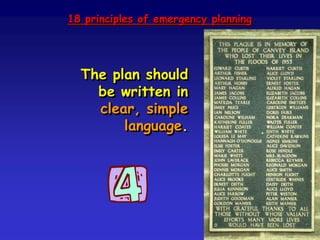
There should be only one plan and it
should be written in clear, simple language:
ambiguity can be dangerous.
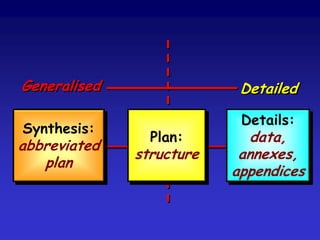
Synthesis:
abbreviated
plan
Details:
data,
annexes,
appendices
Generalised Detailed
Plan:
structure
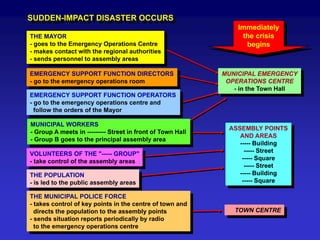
SUDDEN-IMPACT DISASTER OCCURS
TOWN CENTRE
MUNICIPAL EMERGENCY
OPERATIONS CENTRE
- in the Town Hall
ASSEMBLY POINTS
AND AREAS
----- Building
----- Street
----- Square
----- Street
----- Building
----- Square
Immediately
the crisis
begins
THE MAYOR
- goes to the Emergency Operations Centre
- makes contact with the regional authorities
- sends personnel to assembly areas
EMERGENCY SUPPORT FUNCTION DIRECTORS
- go to the emergency operations room
EMERGENCY SUPPORT FUNCTION OPERATORS
- go to the emergency operations centre and
follow the orders of the Mayor
MUNICIPAL WORKERS
- Group A meets in --------- Street in front of Town Hall
- Group B goes to the principal assembly area
VOLUNTEERS OF THE "----- GROUP"
- take control of the assembly areas
THE POPULATION
- is led to the public assembly areas
THE MUNICIPAL POLICE FORCE
- takes control of key points in the centre of town and
directs the population to the assembly points
- sends situation reports periodically by radio
to the emergency operations centre
Principle no. 4
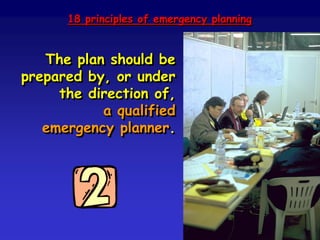
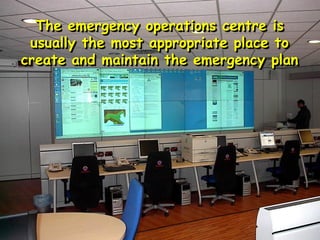
An emergency plan is an instrument
that is best created and maintained
by a qualified emergency planner
and is usually best housed in an
emergency operations centre.
Principle no. 5
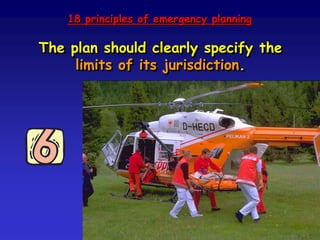
The plan should be clear about
where, when and to whom it applies.
It should specify the
limits of its jurisdiction.
Principle no. 6
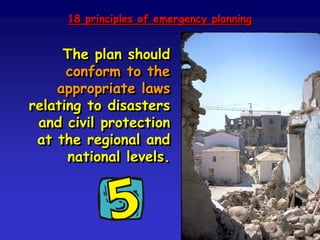
The plan should conform to regional,
national and international laws on civil
protection, environmental management,
health and safety, and so on.
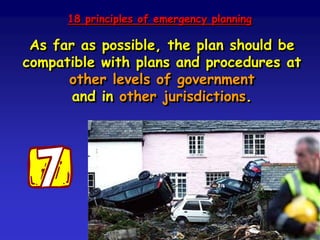
Principle no. 7
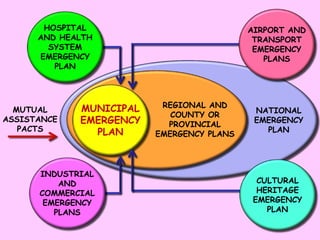
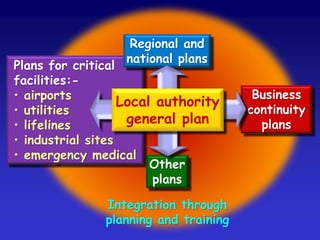
Plans should be compatible between levels
of government, sectors and functions.
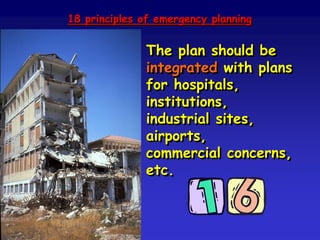
Plans should be integrated for government
agencies, hospitals, industrial sites,
airports, commercial concerns, etc.
NATIONAL
EMERGENCY
PLAN
REGIONAL AND
COUNTY OR
PROVINCIAL
EMERGENCY PLANS
MUNICIPAL
EMERGENCY
PLAN
MUTUAL
ASSISTANCE
PACTS
AIRPORT AND
TRANSPORT
EMERGENCY
PLANS
HOSPITAL
AND HEALTH
SYSTEM
EMERGENCY
PLAN
INDUSTRIAL
AND
COMMERCIAL
EMERGENCY
PLANS
CULTURAL
HERITAGE
EMERGENCY
PLAN
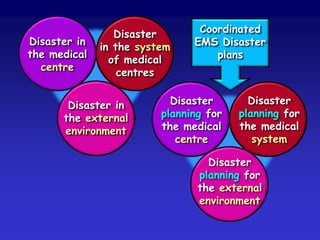
Disaster in
the medical
centre
Disaster in
the external
environment
Disaster
in the system
of medical
centres
Disaster
planning for
the medical
centre
Disaster
planning for
the external
environment
Disaster
planning for
the medical
system
Coordinated
EMS Disaster
plans
Functional
divisions:
government,
healthcare,
commerce, etc.
Hierarchical
divisions:
national,
regional,
local, etc.
Geographical
divisions:
catchments,
jurisdictions,
areas, etc.
Organisational
divisions:
police, fire,
ambulance,
etc.
Division
and
integration
Principle no. 8
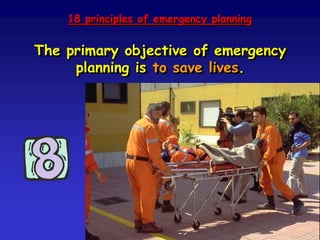
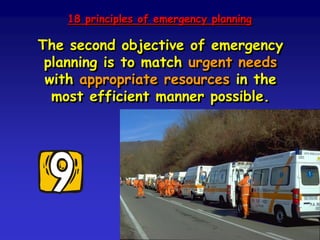
The plan should focus on saving lives and
reducing damage by matching urgent needs
with appropriate available resources.
Realism is necessary in emergency planning:
it is wrong to plan to use resources
that are not available.
Principle no. 9
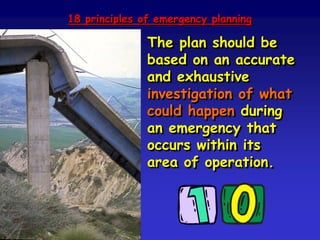
Plans should be based on reference
scenarios of what is likely to happen.
Scenario methodology involves rigorous,
formal investigation of probable chains of
damaging events, plus their consequences
and what actions will be needed.
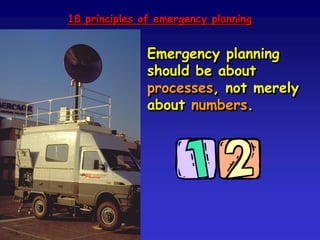
Emergency planning should be about
processes, not merely numbers.
evolution
development
of the
scenarioevolution
time
zero
formal evaluation of the
outcome of the scenario
consequences
at time n
Scenario
methodology
in emergency
planning
consequences
at time 2
consequences
at time 1
reference
event
initial
conditions
evaluation of
the progress
of the scenario
historical
analysis
hypothetical
ingredients
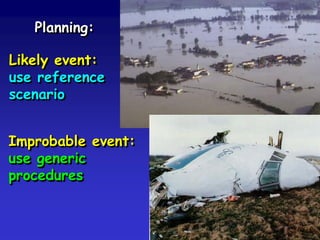
Likely event:
use reference
scenario
Planning:
Improbable event:
use generic
procedures
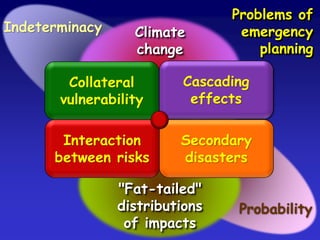
Cascading
effects
Collateral
vulnerability
Secondary
disasters
Interaction
between risks
Climate
change
Probability
Indeterminacy
"Fat-tailed"
distributions
of impacts
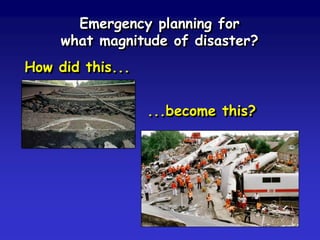
How did this...
Emergency planning for
what magnitude of disaster?
...become this?
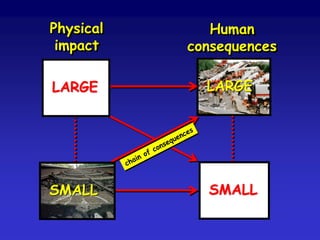
SMALLSMALL
LARGE
Physical
impact
Human
consequences
LARGE
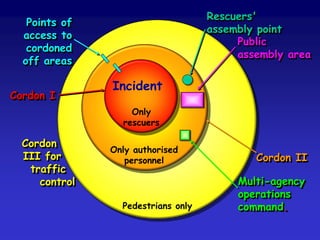
Pedestrians only
Cordon
III for
traffic
control Multi-agency
operations
command.
Public
assembly area
Rescuers'
assembly point
Points of
access to
cordoned
off areas
Only
rescuers
Cordon I
Only authorised
personnel Cordon II
Incident
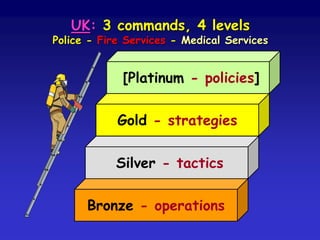
Bronze - operations
Silver - tactics
Gold - strategies
[Diamond - policies]
UK: 3 commands, 4 levels
Police - Fire Services - Medical Services
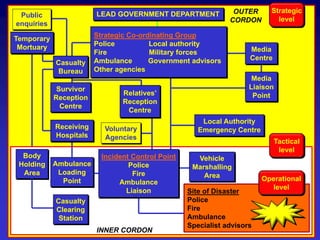
LEAD GOVERNMENT DEPARTMENT
Media
Centre
Media
Liaison
Point
Temporary
Mortuary
Survivor
Reception
Centre
Receiving
Hospitals
Relatives’
Reception
Centre
Local Authority
Emergency Centre
Strategic Co-ordinating Group
Police Local authority
Fire Military forces
Ambulance Government advisors
Other agencies
Strategic
level
Voluntary
Agencies
Casualty
Bureau
Public
enquiries
OUTER
CORDON
Body
Holding
Area
Ambulance
Loading
Point
Casualty
Clearing
Station
Vehicle
Marshalling
Area
Incident Control Point
Police
Fire
Ambulance
Liaison
Tactical
level
INNER CORDON
Site of Disaster
Police
Fire
Ambulance
Specialist advisors
Operational
level
Time
Response
Emergency
isolation
phase
Major
incident
declared
Consolidation
phase
Recovery
phase
Investigation
Stand-down
Funerals
Debriefings
Anniversaries
Plan revision
Inquests
Public enquiries
Trials
Awards
Memorials
Training
Court cases
Anatomy of a major incident
Locus of
control
Locus of
collaboration
(support)
Tension of
opposites
Command
function
principle
Support
function
principle
Spectrum of
alternatives
Two models of organisation
of civil protection services
Command function principle: allocating
tasks according to level and objectives
of decision-making
(strategic, tactical, operational).
Support function principle: allocating
tasks according to functional sector
(e.g. communications, logistics, utilities).
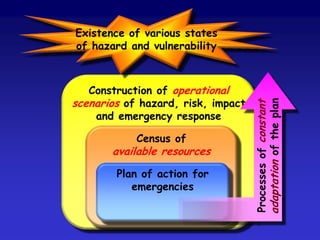
Principle no. 10
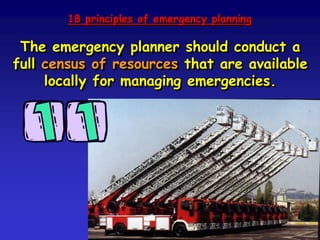
The emergency planner should
conduct a census of resources
available for managing crisis situations.
Construction of operational
scenarios of hazard, risk, impact
and emergency response
Existence of various states
of hazard and vulnerability
Census of
available resources
Plan of action for
emergencies
Processesofconstant
adaptationoftheplan
Principle no. 11
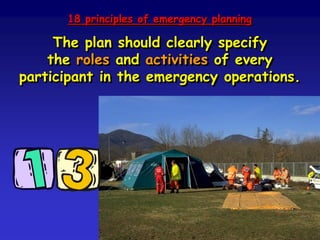
Planning is about ensuring that every
participant has a valid role in the
emergency response and is aware of the
roles of other participants, especially
those from other organisations.
The essence of emergency management
is to be able to appreciate what other
agencies are doing or are expected to do.
This requires a common language and a
common culture: it also requires good
inter-organisational communication.
Broad professional training
in emergency management
Professional experience
and training
Disciplinary training
(e.g. bachelor's degree)
Common
culture
Common
language
Common
objectives
Principle no. 12
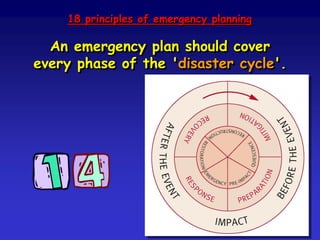
The emergency plan should apply to all
phases of the 'disaster cycle' and should
aim to provide sustainable civil protection.
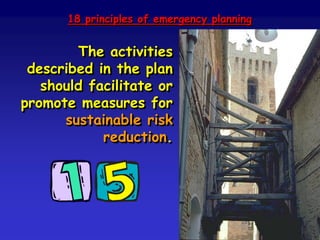
Sustainable emergency management:-
• is centred upon the local level
(but is harmonised from above)
• has the support and
involvement of the population
• is based on plans that are fully
disseminated and frequently revised
• is a fundamental, every-day service
for the population and is taken seriously.
Principle no. 13
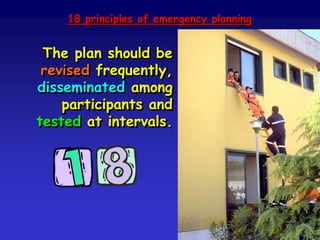
An emergency plan should be a living
document that is widely disseminated
and frequently tested and revised. It
should be the property of all participants.
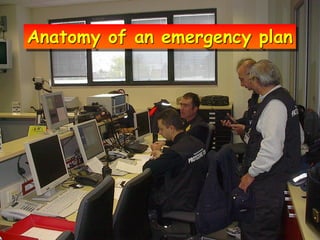
Anatomy of an emergency plan
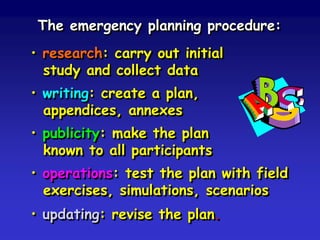
The emergency planning procedure:-
• research: carry out initial
study and collect data
• writing: create a plan,
appendices, annexes
• publicity: make the plan
known to all participants
• operations: test the plan with field
exercises, simulations, scenarios
• updating: revise the plan.
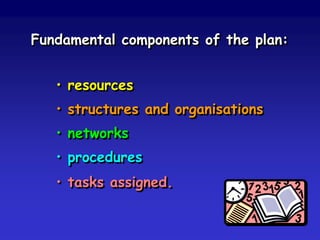
Fundamental components of the plan:-
• resources
• structures and organisations
• networks
• procedures
• tasks assigned.
Local emergency resources:-
• personnel and manpower
• vehicles and heavy plant
• equipment
• materials, consumable supplies, fuel
• institutions and organisations.
• services
Other emergency resources:-
• mutual aid pacts and agreements
• regional and national resources.
• military assistance to
civil communities (MACC)
Basic elements of the emergency plan:
• the participating organisations
• command structures
• communications channels
• emergency response procedures.
The ingredients of an emergency plan (1):
• explain the problem
• scenarios of hazard, vulnerability,
risk and impact
• inventory of available resources
• command centres and support functions
• describe monitoring, prediction and
warning systems and procedures.
• assign tasks to emergency workers
• communications protocols and procedures
• procedures for various eventualities
(breakages, interruptions and
unexpected problems)
• training and education initiatives.
The ingredients of an emergency plan (2):
Conclusions
Revision
Exercising Evaluation
Activation Disaster
Preparatory study
Dissemination Information
Creation and
updating
of plan
Stakeholders'
opinions
Training
Apparent
chaos
Result
Feedback
and revision
Feedback
andrevision
Evaluation
Testing
Disaster
Plan
Model
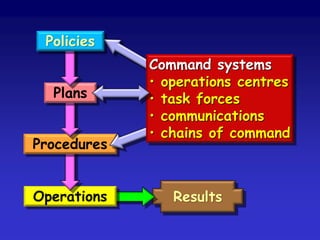
ResultsOperations
Procedures
Plans
Policies
Command systems
• operations centres
• task forces
• communications
• chains of command
Incident
Contingency planning in
the pre-emergency phase (days)
Emergency response
planning
Permanent emergency plan
Operational planning
Short-term strategic
planning (hours → days)
Short-term tactical
planning (hours)
Recovery and
reconstruction
planning
Strategic,
tactical & operational
planning
Aftermath
Disaster
Monitoring
prediction
& warning
Permanent emergency plan
Business continuity plan
Emergency planning and management
should be
fully programmed activities
based on a good estimation and accurate
knowledge of probable needs, but with
improvisation
to cope with unexpected developments:
we must reinforce the planned
activities and reduce the improvisation.
David.Alexander@ucl.ac.uk
emergency-planning.blogspot.com
On your phone: m.slideshare.net/dealexander
Available from Amazon

Principles Of Emergency Planning