MASS CASUALTY AND
TRIAGE
INTRODUCTION
Mass casualty situations may impose
tremendous strain on the available
manpower and resources.
Military mass casualties handling
dependent on
 Severity of Injury
 Medical professionals
 Resuscitation equipment
 Evacuation capabilities
CONCEPT OF TRIAGE
Triage derived from the French word ‘trier’
meaning to sort.
Triage is an attempt to impose order
during chaos and make an initially
overwhelming situation manageable.
HISTORICAL BACKGROUND
Initial development – Napoleonic wars
France 1800s.
American civil war
 Primary amputation mortality rate: 28%
 Secondary amputation rate: 52%
1900s in emergency departments
TRIAGE - DEFINITION
Triage is the dynamic process of sorting
casualties to identify the priority of
treatment and evacuation of wounded,
given the limitations of the current
situation, the mission and available
resources (time, equipment, supplies,
personnel and evacuation capabilities).
US Dept of Defense
TRIAGE - DEFINITION
Medical triage is the categorisation of a
patient or casualty based on clinical
evaluation, for the purpose of establishing
priorities for treatment and evacuation.
United Nations
TRIAGE- CATEGORISATION
Goal of Combat Medicine
 Return of the greatest possible number of
soldiers to combat and the preservation of life,
limb and eyesight in those who must be
evacuated
Factors for Triage categorisation
 Requirement of resuscitation
 Surgery requirements
 Prognosis
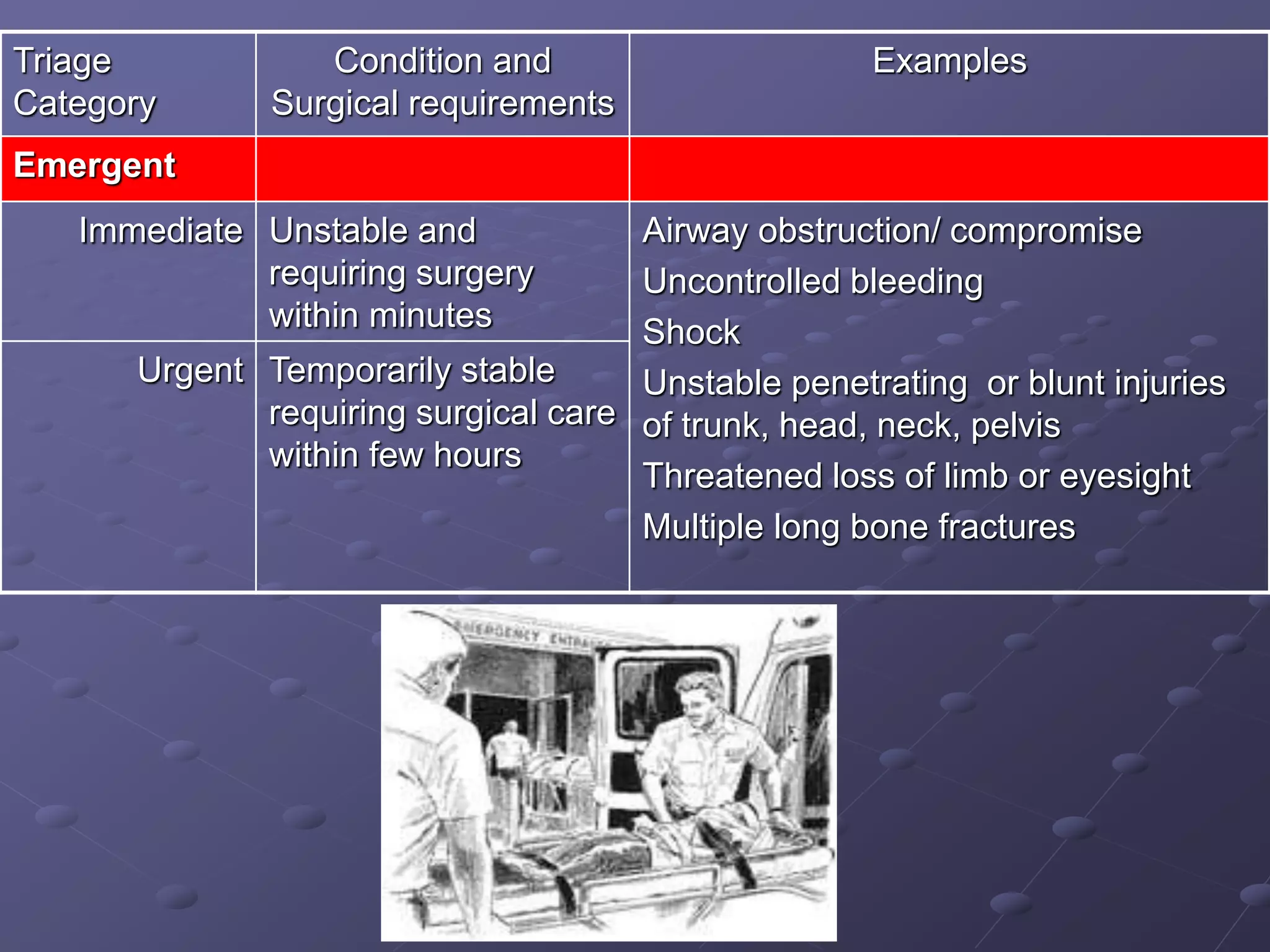
Triage
Category
Condition and
Surgical requirements
Examples
Emergent
Immediate Unstable and
requiring surgery
within minutes
Airway obstruction/ compromise
Uncontrolled bleeding
Shock
Unstable penetrating or blunt injuries
of trunk, head, neck, pelvis
Threatened loss of limb or eyesight
Multiple long bone fractures
Urgent Temporarily stable
requiring surgical care
within few hours
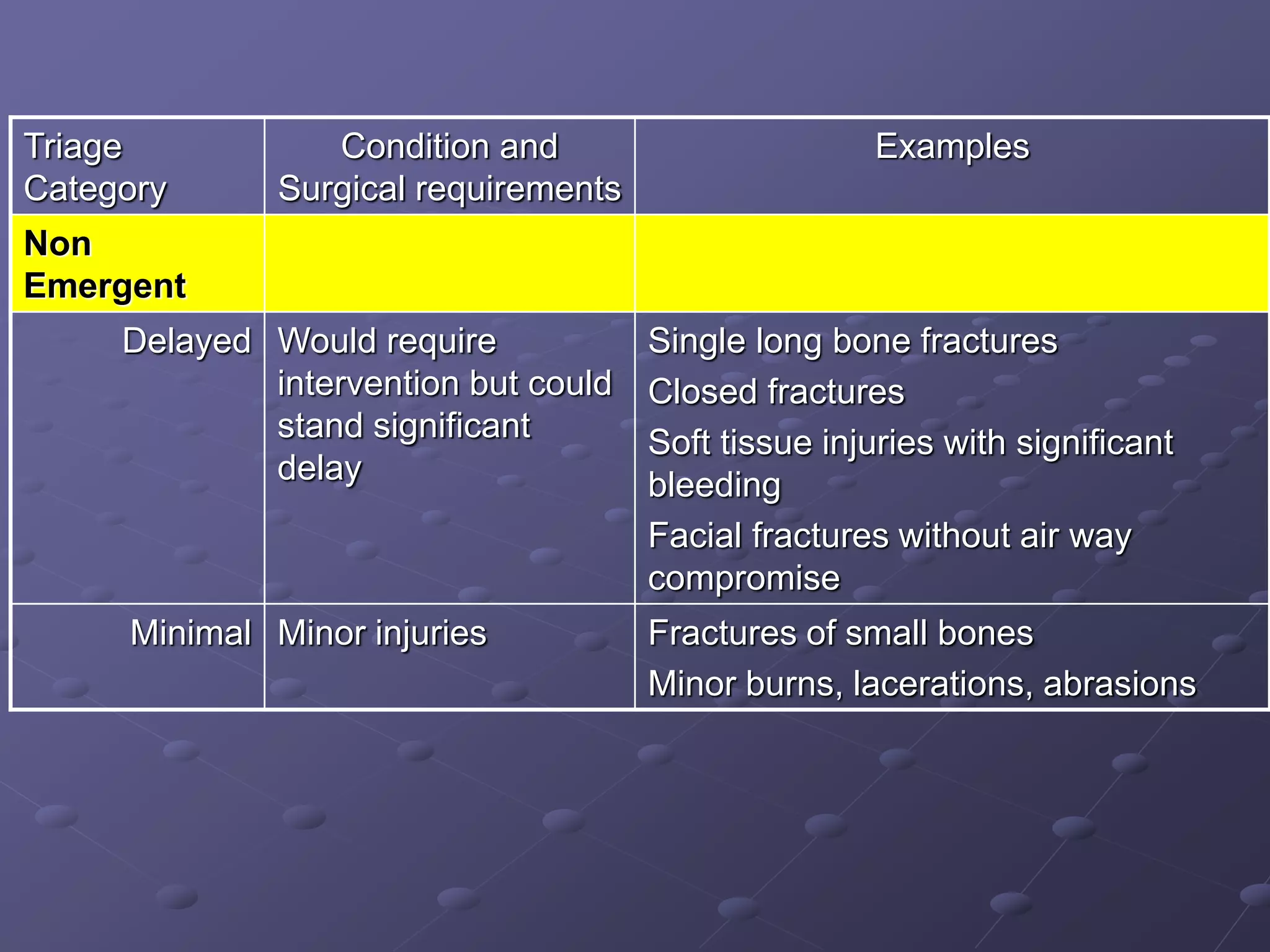
Triage
Category
Condition and
Surgical requirements
Examples
Non
Emergent
Delayed Would require
intervention but could
stand significant
delay
Single long bone fractures
Closed fractures
Soft tissue injuries with significant
bleeding
Facial fractures without air way
compromise
Minimal Minor injuries Fractures of small bones
Minor burns, lacerations, abrasions
Triage
Category
Condition and
Surgical requirements
Examples
Expectant
Expectant Non salvagable
paients
Penetrating head wounds and high
spinal cord injuries
Mutilating explosive wounds involving
multiple anatomical sites and organs
Burns >60% TBSA
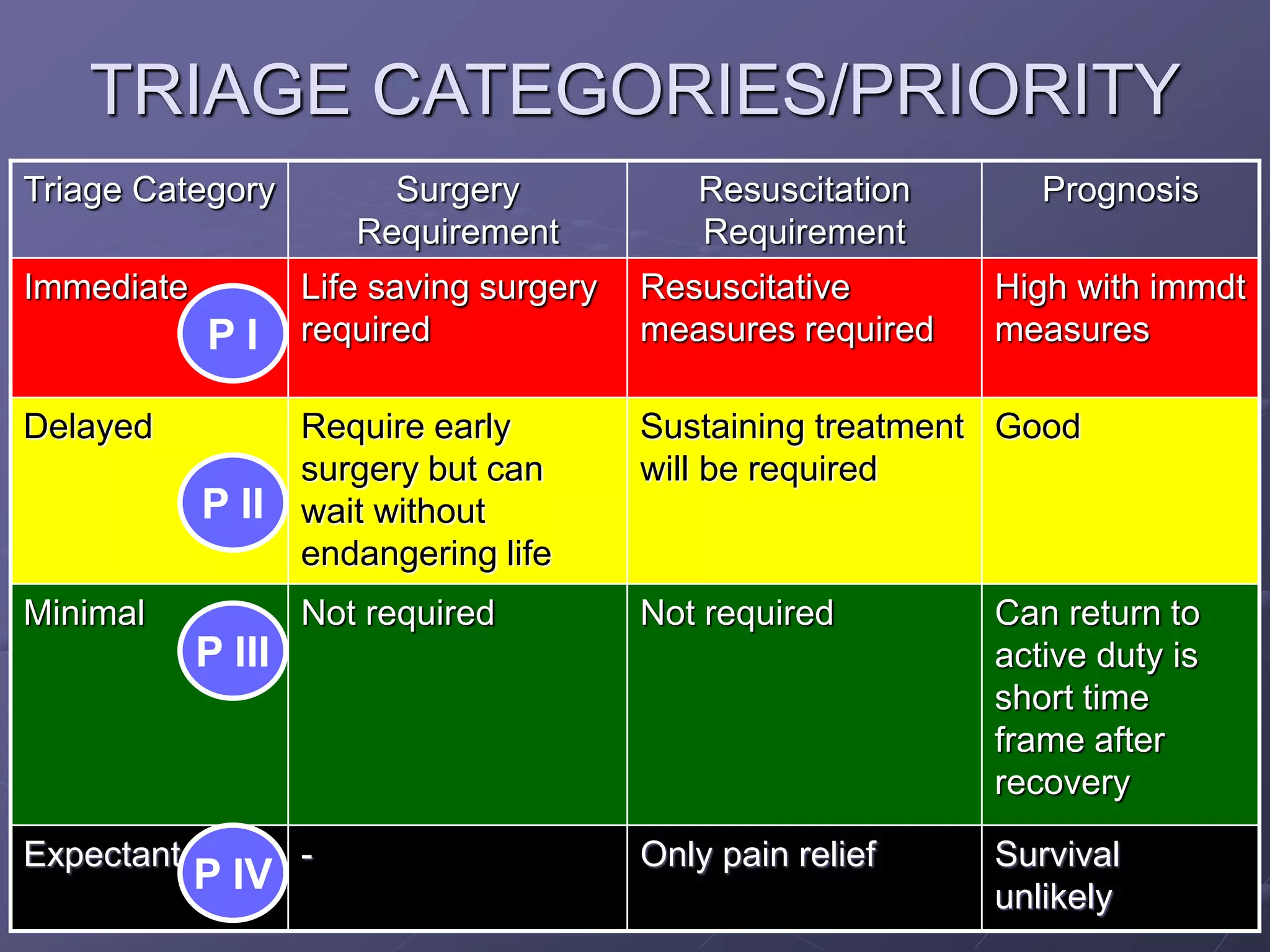
TRIAGE CATEGORIES/PRIORITY
Triage Category Surgery
Requirement
Resuscitation
Requirement
Prognosis
Immediate Life saving surgery
required
Resuscitative
measures required
High with immdt
measures
Delayed Require early
surgery but can
wait without
endangering life
Sustaining treatment
will be required
Good
Minimal Not required Not required Can return to
active duty is
short time
frame after
recovery
Expectant - Only pain relief Survival
unlikely
P I
P II
P III
P IV
EXAMPLE
OF
TRIAGE
TAG
FLOW OF
PATIENTS
FROM
TRIAGE
AREAS
RESUSCITATION
AREA
ASSESSMENT OF CASUALTIES
Method of triage
Triage can be performed rapidly by
assessing
 Ability to walk
 Airway
 Respiratory rate
 Pulse rate or capillary return
1
2
ATLS
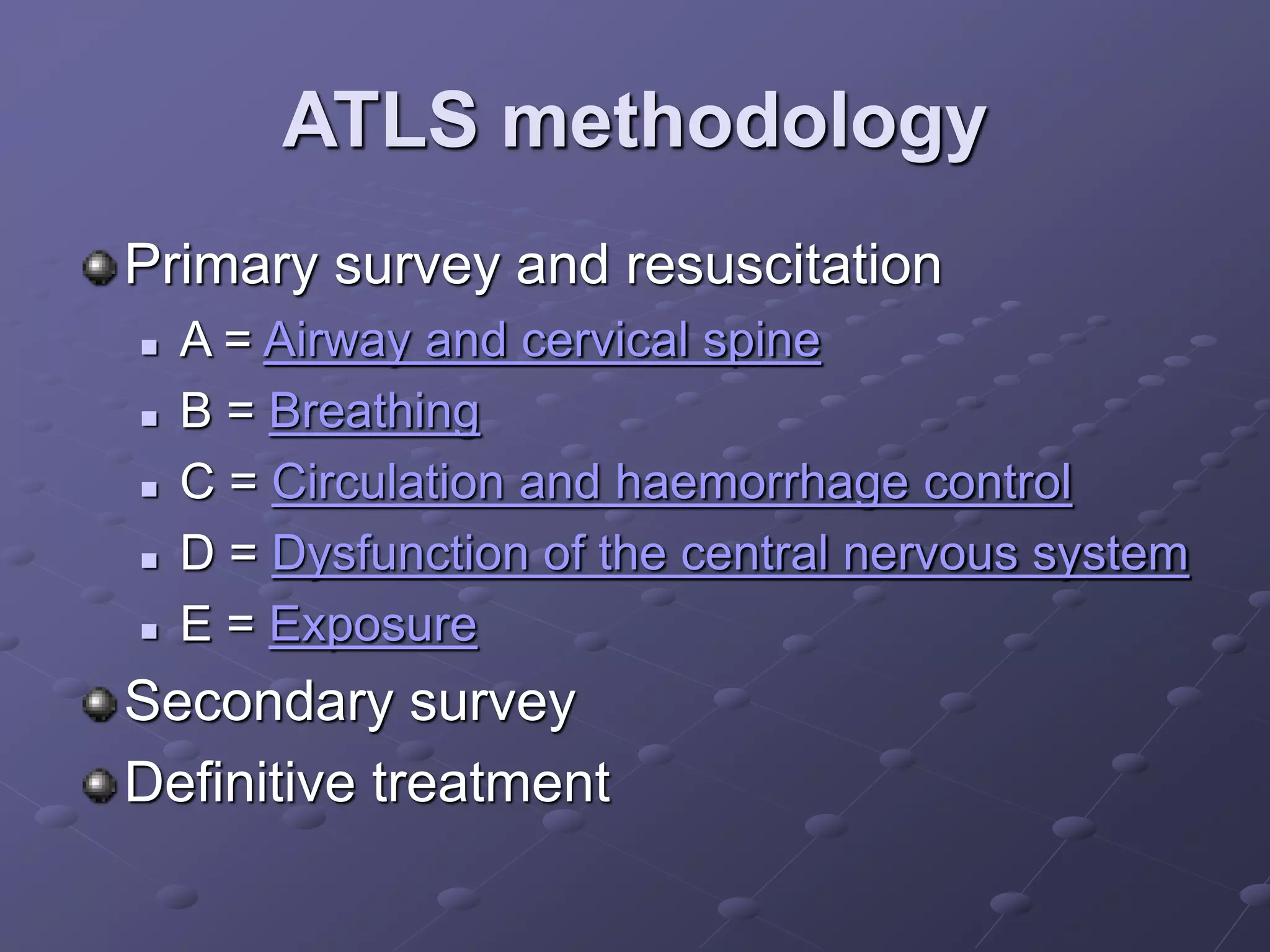
ATLS methodology
Primary survey and resuscitation
 A = Airway and cervical spine
 B = Breathing
 C = Circulation and haemorrhage control
 D = Dysfunction of the central nervous system
 E = Exposure
Secondary survey
Definitive treatment
TRAUMA SCORING SYSTEMS
Evaluating trauma management and
outcome
Input
 Anatomical scoring systems
Abbreviated injury score
Injury severity score
 Physiological scoring systems
Glasgow coma scale
Trauma score
Revised trauma score
TRISS methodology
TRAUMA SCORING SYSTEMS
Evaluating trauma management and
outcome
Treatment
 Individual patient
 System of patient care
Outcome
 Morbidity
 Mortality
THANK YOU
METHOD FOR TRAIGE
Airway and cervical spine
Always assume that patient has cervical spine injury
Place in hard collar and keep on until cervical spine has
been 'cleared'
If patient can talk then he is able to maintain own airway
If airway compromised initially attempt a chin lift and
clear airway of foreign bodies
If gag reflex present insert nasopharyngeal airway
If no gag reflex patient will need endotracheal intubation
If unable to intubate will require a cricothyroidotomy
Give 100% oxygen through a Hudson mask
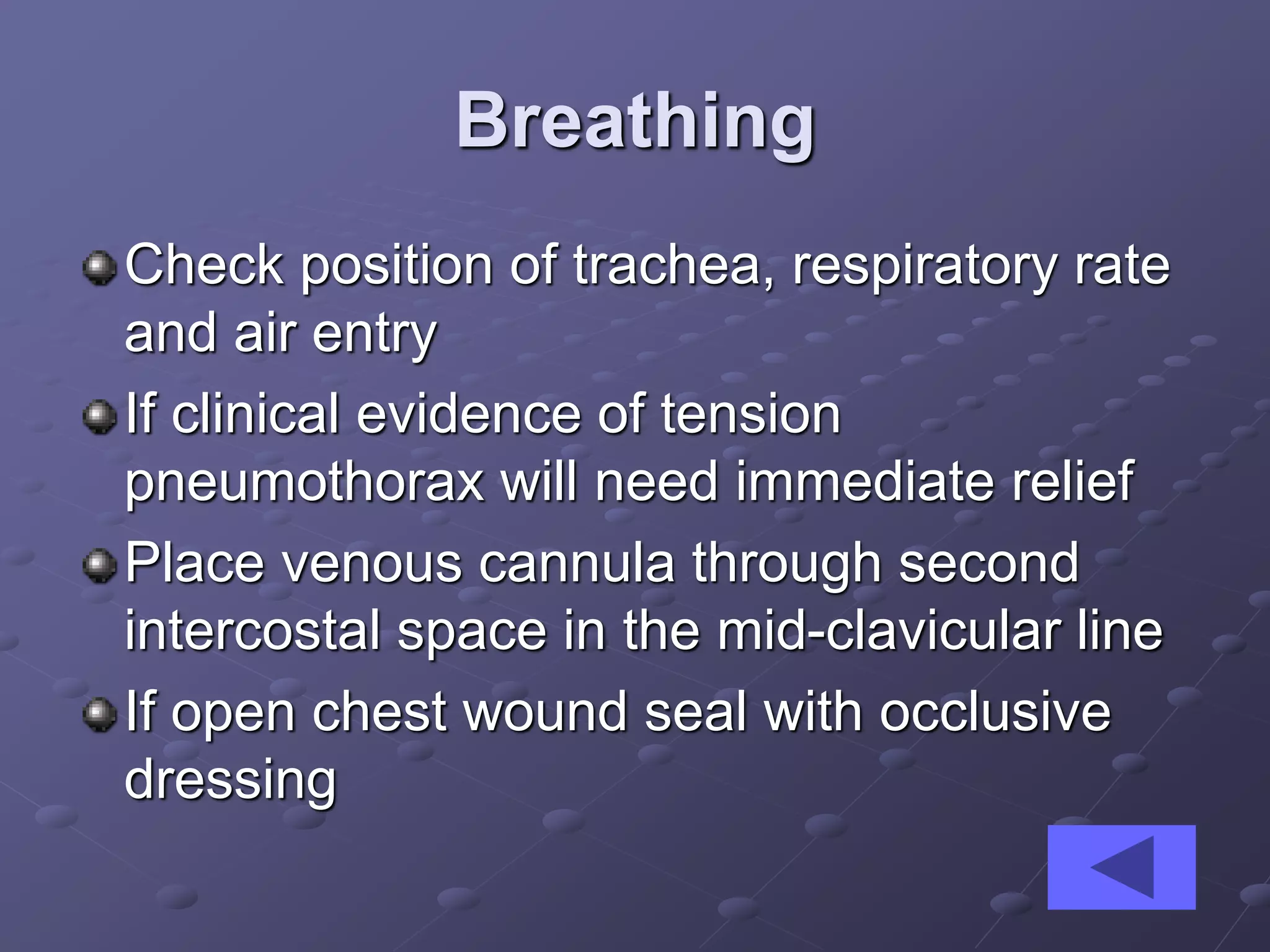
Breathing
Check position of trachea, respiratory rate
and air entry
If clinical evidence of tension
pneumothorax will need immediate relief
Place venous cannula through second
intercostal space in the mid-clavicular line
If open chest wound seal with occlusive
dressing
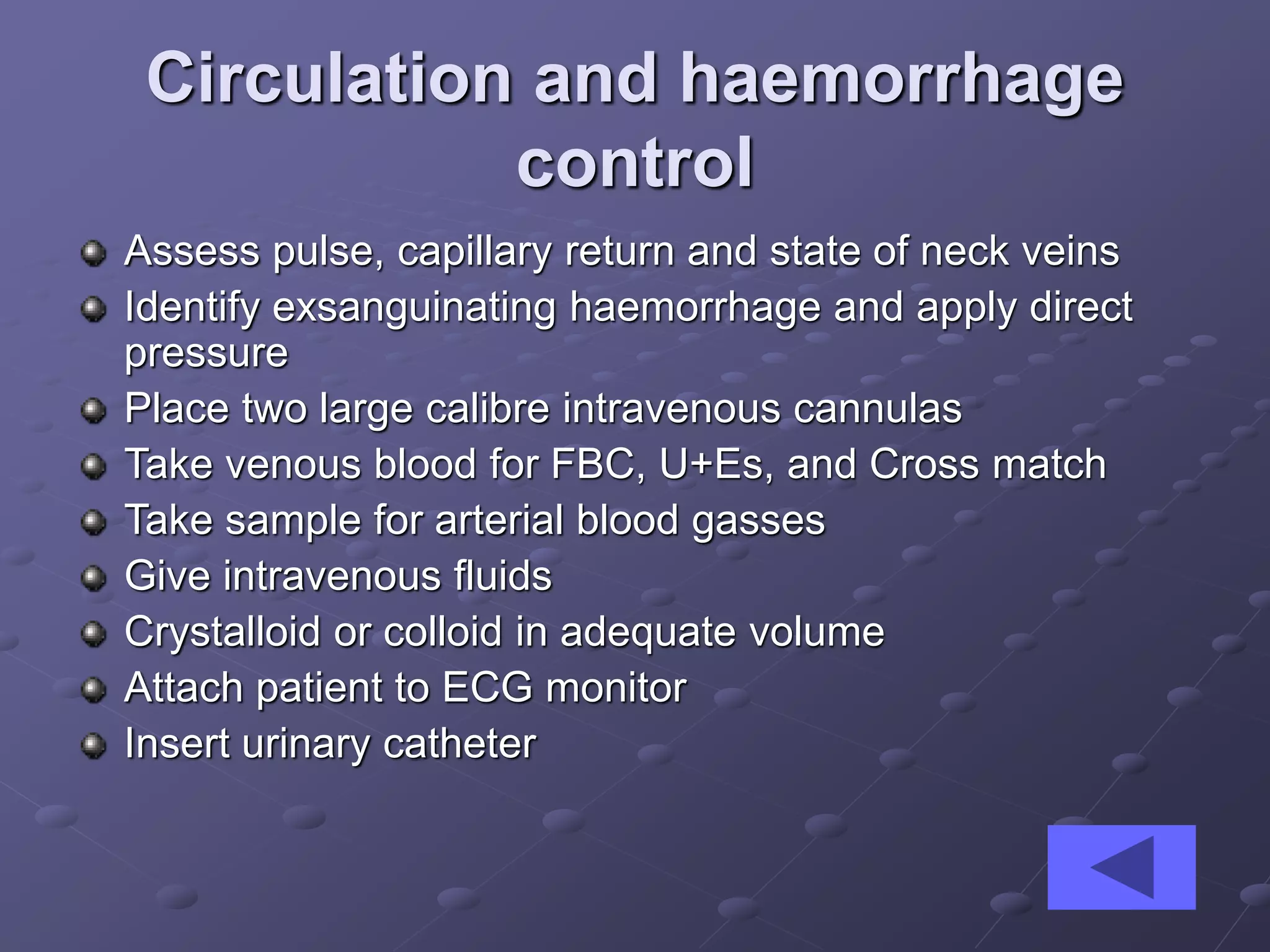
Circulation and haemorrhage
control
Assess pulse, capillary return and state of neck veins
Identify exsanguinating haemorrhage and apply direct
pressure
Place two large calibre intravenous cannulas
Take venous blood for FBC, U+Es, and Cross match
Take sample for arterial blood gasses
Give intravenous fluids
Crystalloid or colloid in adequate volume
Attach patient to ECG monitor
Insert urinary catheter
Dysfunction
Assess level of consciousness using
AVPU method
 A = alert
 V = responding to voice
 P = responding to pain
 U = unresponsive
Assess pupil size, equality and
responsiveness
Exposure
Fully undress patients
Avoid hypothermia
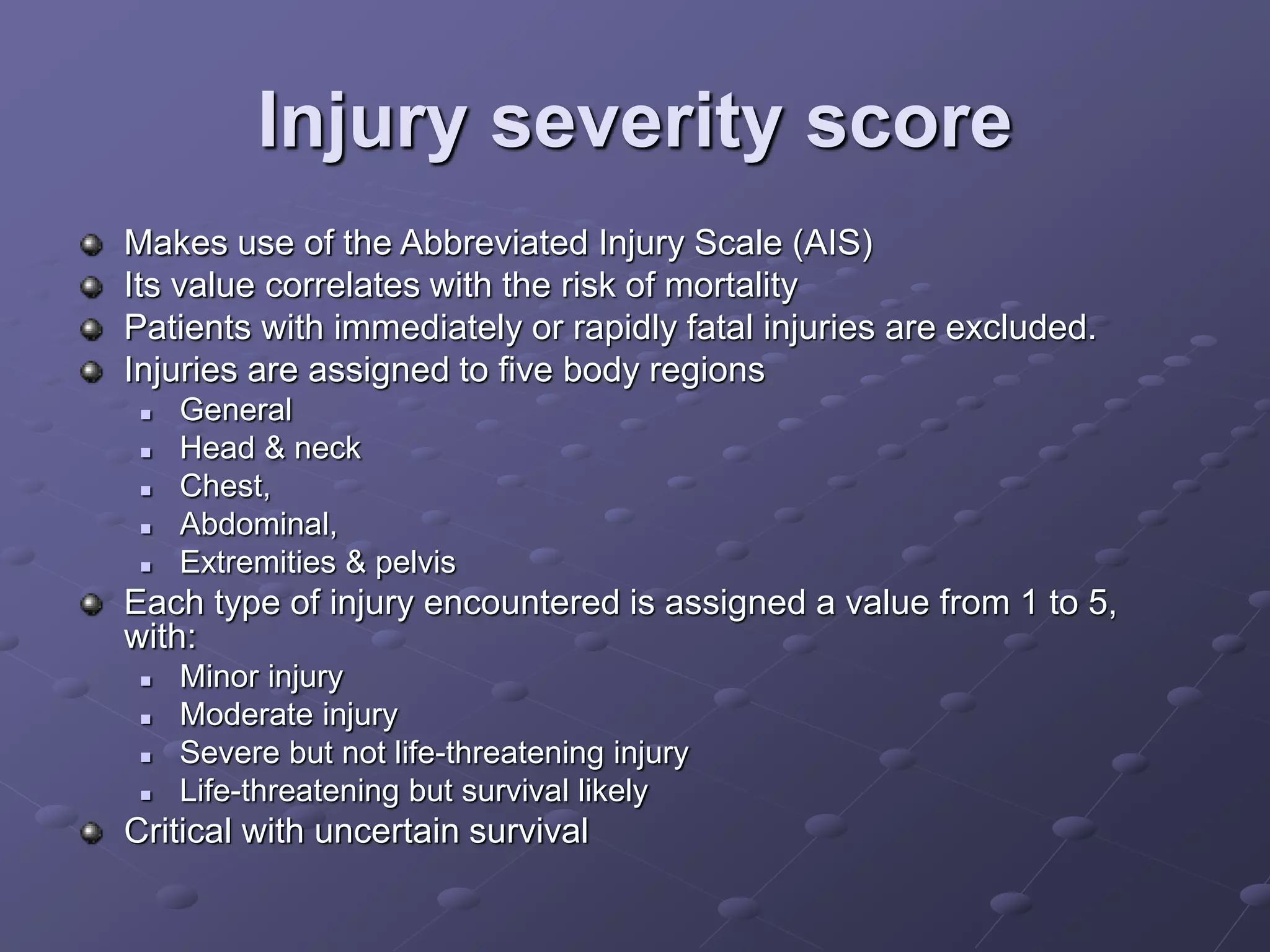
Injury severity score
Makes use of the Abbreviated Injury Scale (AIS)
Its value correlates with the risk of mortality
Patients with immediately or rapidly fatal injuries are excluded.
Injuries are assigned to five body regions
 General
 Head & neck
 Chest,
 Abdominal,
 Extremities & pelvis
Each type of injury encountered is assigned a value from 1 to 5,
with:
 Minor injury
 Moderate injury
 Severe but not life-threatening injury
 Life-threatening but survival likely
Critical with uncertain survival
Injury severity score
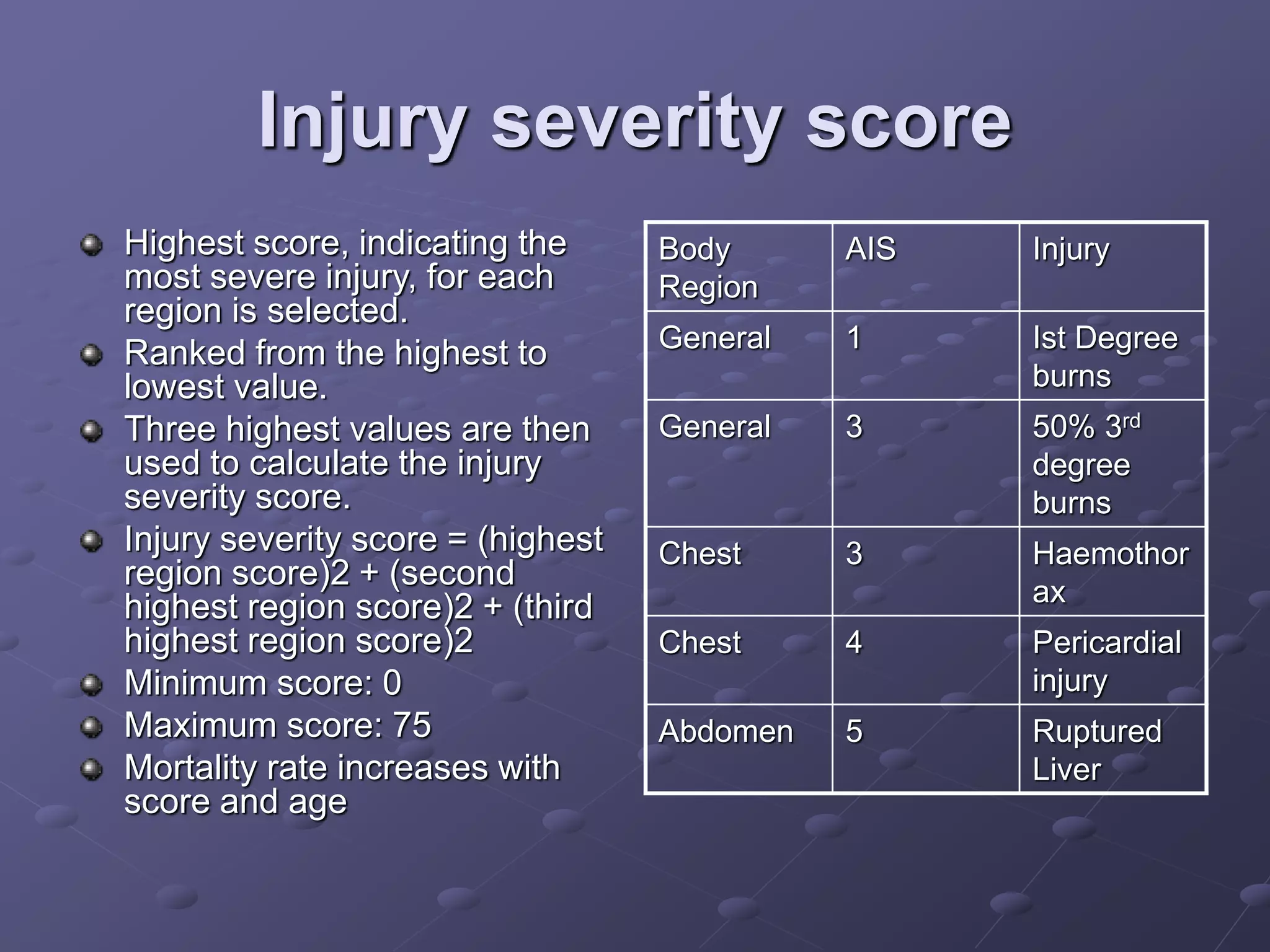
Highest score, indicating the
most severe injury, for each
region is selected.
Ranked from the highest to
lowest value.
Three highest values are then
used to calculate the injury
severity score.
Injury severity score = (highest
region score)2 + (second
highest region score)2 + (third
highest region score)2
Minimum score: 0
Maximum score: 75
Mortality rate increases with
score and age
Body
Region
AIS Injury
General 1 Ist Degree
burns
General 3 50% 3rd
degree
burns
Chest 3 Haemothor
ax
Chest 4 Pericardial
injury
Abdomen 5 Ruptured
Liver
Mortality (%) according to ISS and
age
Score
Mortality (%)
<49
Mortality (%) 50-
69
Mortality (%) >70
5 0 3 13
10 2 4 15
15 3 5 16
20 6 16 31
25 9 26 44
30 21 42 65
35 31 56 82
40 47 62 92
45 61 67 100
50 75 83 100
55 89 100 100
GLASGOW COMA SCALE
REVISED TRAUMA SCORE
Parameter Finding Points
Respiratory rate 10-29 per minute 4
> 29 per minute 3
6-9 per minute 2
1-5 per minute 1
Nil 0
Systolic blood pressure >89 mm Hg 4
76-89 mm Hg 3
50-75 mm Hg 2
1-49 mm Hg 1
Nil 0
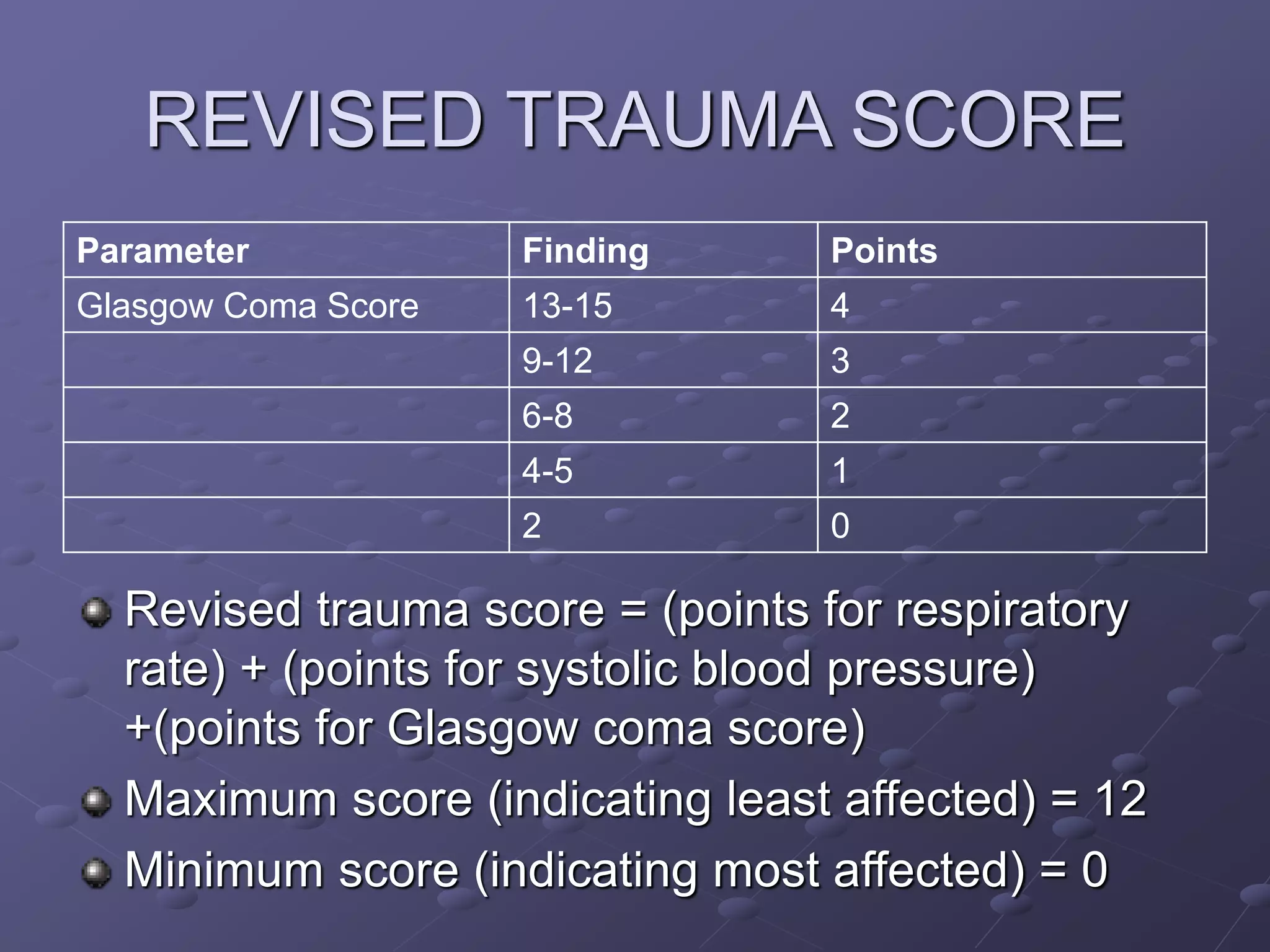
REVISED TRAUMA SCORE
Parameter Finding Points
Glasgow Coma Score 13-15 4
9-12 3
6-8 2
4-5 1
2 0
Revised trauma score = (points for respiratory
rate) + (points for systolic blood pressure)
+(points for Glasgow coma score)
Maximum score (indicating least affected) = 12
Minimum score (indicating most affected) = 0
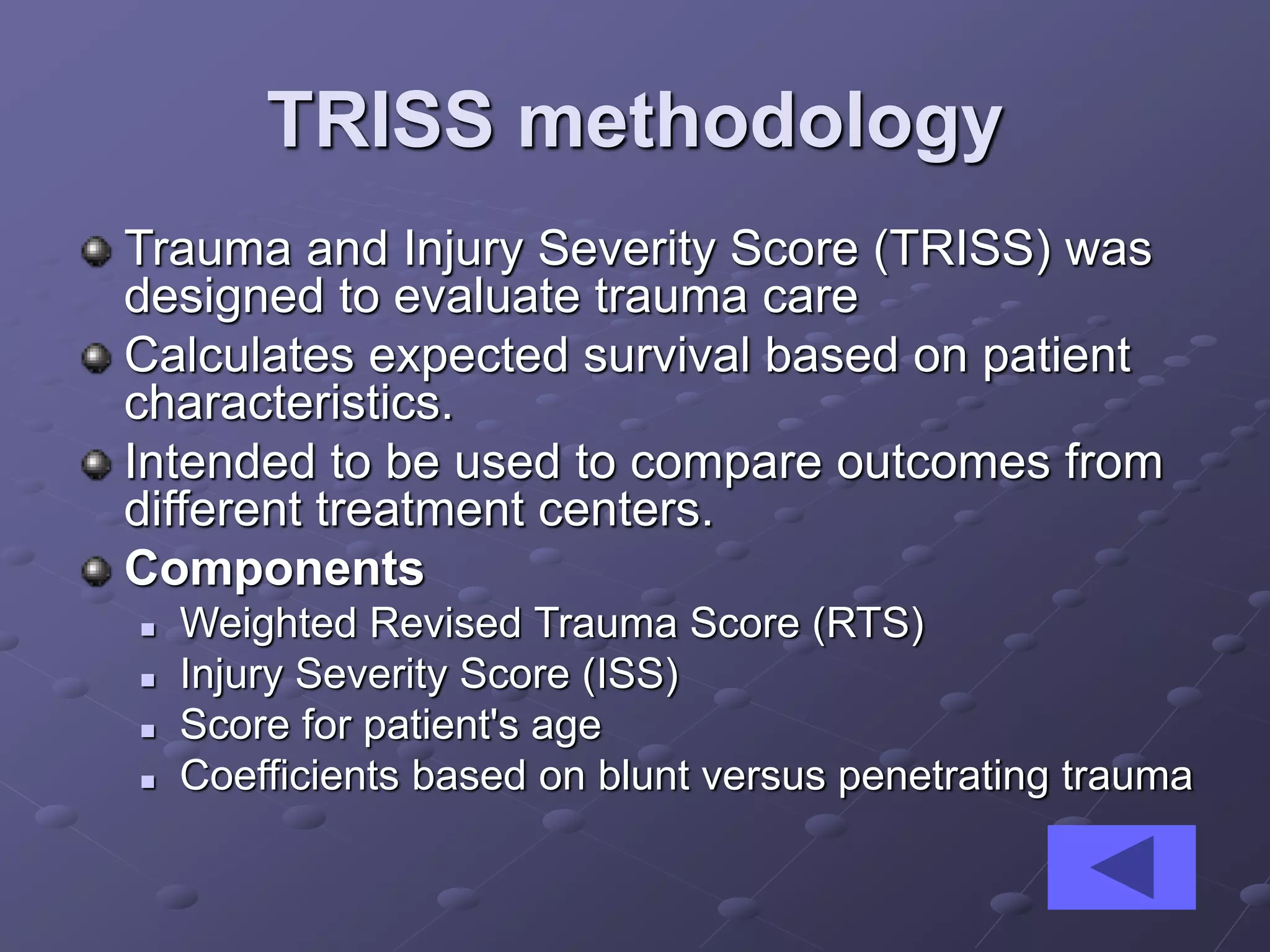
TRISS methodology
Trauma and Injury Severity Score (TRISS) was
designed to evaluate trauma care
Calculates expected survival based on patient
characteristics.
Intended to be used to compare outcomes from
different treatment centers.
Components
 Weighted Revised Trauma Score (RTS)
 Injury Severity Score (ISS)
 Score for patient's age
 Coefficients based on blunt versus penetrating trauma

Mass casualty and triage

  • 1.
  • 2.
    INTRODUCTION Mass casualty situationsmay impose tremendous strain on the available manpower and resources. Military mass casualties handling dependent on  Severity of Injury  Medical professionals  Resuscitation equipment  Evacuation capabilities
  • 3.
    CONCEPT OF TRIAGE Triagederived from the French word ‘trier’ meaning to sort. Triage is an attempt to impose order during chaos and make an initially overwhelming situation manageable.
  • 4.
    HISTORICAL BACKGROUND Initial development– Napoleonic wars France 1800s. American civil war  Primary amputation mortality rate: 28%  Secondary amputation rate: 52% 1900s in emergency departments
  • 5.
    TRIAGE - DEFINITION Triageis the dynamic process of sorting casualties to identify the priority of treatment and evacuation of wounded, given the limitations of the current situation, the mission and available resources (time, equipment, supplies, personnel and evacuation capabilities). US Dept of Defense
  • 6.
    TRIAGE - DEFINITION Medicaltriage is the categorisation of a patient or casualty based on clinical evaluation, for the purpose of establishing priorities for treatment and evacuation. United Nations
  • 7.
    TRIAGE- CATEGORISATION Goal ofCombat Medicine  Return of the greatest possible number of soldiers to combat and the preservation of life, limb and eyesight in those who must be evacuated Factors for Triage categorisation  Requirement of resuscitation  Surgery requirements  Prognosis
  • 8.
    Triage Category Condition and Surgical requirements Examples Emergent ImmediateUnstable and requiring surgery within minutes Airway obstruction/ compromise Uncontrolled bleeding Shock Unstable penetrating or blunt injuries of trunk, head, neck, pelvis Threatened loss of limb or eyesight Multiple long bone fractures Urgent Temporarily stable requiring surgical care within few hours
  • 9.
    Triage Category Condition and Surgical requirements Examples Non Emergent DelayedWould require intervention but could stand significant delay Single long bone fractures Closed fractures Soft tissue injuries with significant bleeding Facial fractures without air way compromise Minimal Minor injuries Fractures of small bones Minor burns, lacerations, abrasions
  • 10.
    Triage Category Condition and Surgical requirements Examples Expectant ExpectantNon salvagable paients Penetrating head wounds and high spinal cord injuries Mutilating explosive wounds involving multiple anatomical sites and organs Burns >60% TBSA
  • 11.
    TRIAGE CATEGORIES/PRIORITY Triage CategorySurgery Requirement Resuscitation Requirement Prognosis Immediate Life saving surgery required Resuscitative measures required High with immdt measures Delayed Require early surgery but can wait without endangering life Sustaining treatment will be required Good Minimal Not required Not required Can return to active duty is short time frame after recovery Expectant - Only pain relief Survival unlikely P I P II P III P IV
  • 12.
  • 13.
  • 14.
  • 15.
    ASSESSMENT OF CASUALTIES Methodof triage Triage can be performed rapidly by assessing  Ability to walk  Airway  Respiratory rate  Pulse rate or capillary return 1 2 ATLS
  • 16.
    ATLS methodology Primary surveyand resuscitation  A = Airway and cervical spine  B = Breathing  C = Circulation and haemorrhage control  D = Dysfunction of the central nervous system  E = Exposure Secondary survey Definitive treatment
  • 17.
    TRAUMA SCORING SYSTEMS Evaluatingtrauma management and outcome Input  Anatomical scoring systems Abbreviated injury score Injury severity score  Physiological scoring systems Glasgow coma scale Trauma score Revised trauma score TRISS methodology
  • 18.
    TRAUMA SCORING SYSTEMS Evaluatingtrauma management and outcome Treatment  Individual patient  System of patient care Outcome  Morbidity  Mortality
  • 19.
  • 21.
  • 22.
    Airway and cervicalspine Always assume that patient has cervical spine injury Place in hard collar and keep on until cervical spine has been 'cleared' If patient can talk then he is able to maintain own airway If airway compromised initially attempt a chin lift and clear airway of foreign bodies If gag reflex present insert nasopharyngeal airway If no gag reflex patient will need endotracheal intubation If unable to intubate will require a cricothyroidotomy Give 100% oxygen through a Hudson mask
  • 23.
    Breathing Check position oftrachea, respiratory rate and air entry If clinical evidence of tension pneumothorax will need immediate relief Place venous cannula through second intercostal space in the mid-clavicular line If open chest wound seal with occlusive dressing
  • 24.
    Circulation and haemorrhage control Assesspulse, capillary return and state of neck veins Identify exsanguinating haemorrhage and apply direct pressure Place two large calibre intravenous cannulas Take venous blood for FBC, U+Es, and Cross match Take sample for arterial blood gasses Give intravenous fluids Crystalloid or colloid in adequate volume Attach patient to ECG monitor Insert urinary catheter
  • 25.
    Dysfunction Assess level ofconsciousness using AVPU method  A = alert  V = responding to voice  P = responding to pain  U = unresponsive Assess pupil size, equality and responsiveness
  • 26.
  • 27.
    Injury severity score Makesuse of the Abbreviated Injury Scale (AIS) Its value correlates with the risk of mortality Patients with immediately or rapidly fatal injuries are excluded. Injuries are assigned to five body regions  General  Head & neck  Chest,  Abdominal,  Extremities & pelvis Each type of injury encountered is assigned a value from 1 to 5, with:  Minor injury  Moderate injury  Severe but not life-threatening injury  Life-threatening but survival likely Critical with uncertain survival
  • 28.
    Injury severity score Highestscore, indicating the most severe injury, for each region is selected. Ranked from the highest to lowest value. Three highest values are then used to calculate the injury severity score. Injury severity score = (highest region score)2 + (second highest region score)2 + (third highest region score)2 Minimum score: 0 Maximum score: 75 Mortality rate increases with score and age Body Region AIS Injury General 1 Ist Degree burns General 3 50% 3rd degree burns Chest 3 Haemothor ax Chest 4 Pericardial injury Abdomen 5 Ruptured Liver
  • 29.
    Mortality (%) accordingto ISS and age Score Mortality (%) <49 Mortality (%) 50- 69 Mortality (%) >70 5 0 3 13 10 2 4 15 15 3 5 16 20 6 16 31 25 9 26 44 30 21 42 65 35 31 56 82 40 47 62 92 45 61 67 100 50 75 83 100 55 89 100 100
  • 30.
  • 31.
    REVISED TRAUMA SCORE ParameterFinding Points Respiratory rate 10-29 per minute 4 > 29 per minute 3 6-9 per minute 2 1-5 per minute 1 Nil 0 Systolic blood pressure >89 mm Hg 4 76-89 mm Hg 3 50-75 mm Hg 2 1-49 mm Hg 1 Nil 0
  • 32.
    REVISED TRAUMA SCORE ParameterFinding Points Glasgow Coma Score 13-15 4 9-12 3 6-8 2 4-5 1 2 0 Revised trauma score = (points for respiratory rate) + (points for systolic blood pressure) +(points for Glasgow coma score) Maximum score (indicating least affected) = 12 Minimum score (indicating most affected) = 0
  • 33.
    TRISS methodology Trauma andInjury Severity Score (TRISS) was designed to evaluate trauma care Calculates expected survival based on patient characteristics. Intended to be used to compare outcomes from different treatment centers. Components  Weighted Revised Trauma Score (RTS)  Injury Severity Score (ISS)  Score for patient's age  Coefficients based on blunt versus penetrating trauma