Chapter 1
EMS Systems
Preparatory
Integrates comprehensive knowledge of the
EMS system, safety/well-being of the
paramedic, and medical/legal and ethical
issues, which are intended to improve the
health of EMS personnel, patients, and the
community.
National EMS Education
Standard Competencies
Emergency Medical Services (EMS)
Systems
• EMS systems
• History of EMS
• Roles/responsibilities/professionalism of EMS
personnel
• Quality improvement
• Patient safety
National EMS Education
Standard Competencies
Research
• Impact of research on emergency medical
responder (EMR) care
• Data collection
• Evidence-based decision making
• Research principles to interpret literature and
advocate evidence-based practice
National EMS Education
Standard Competencies
Introduction
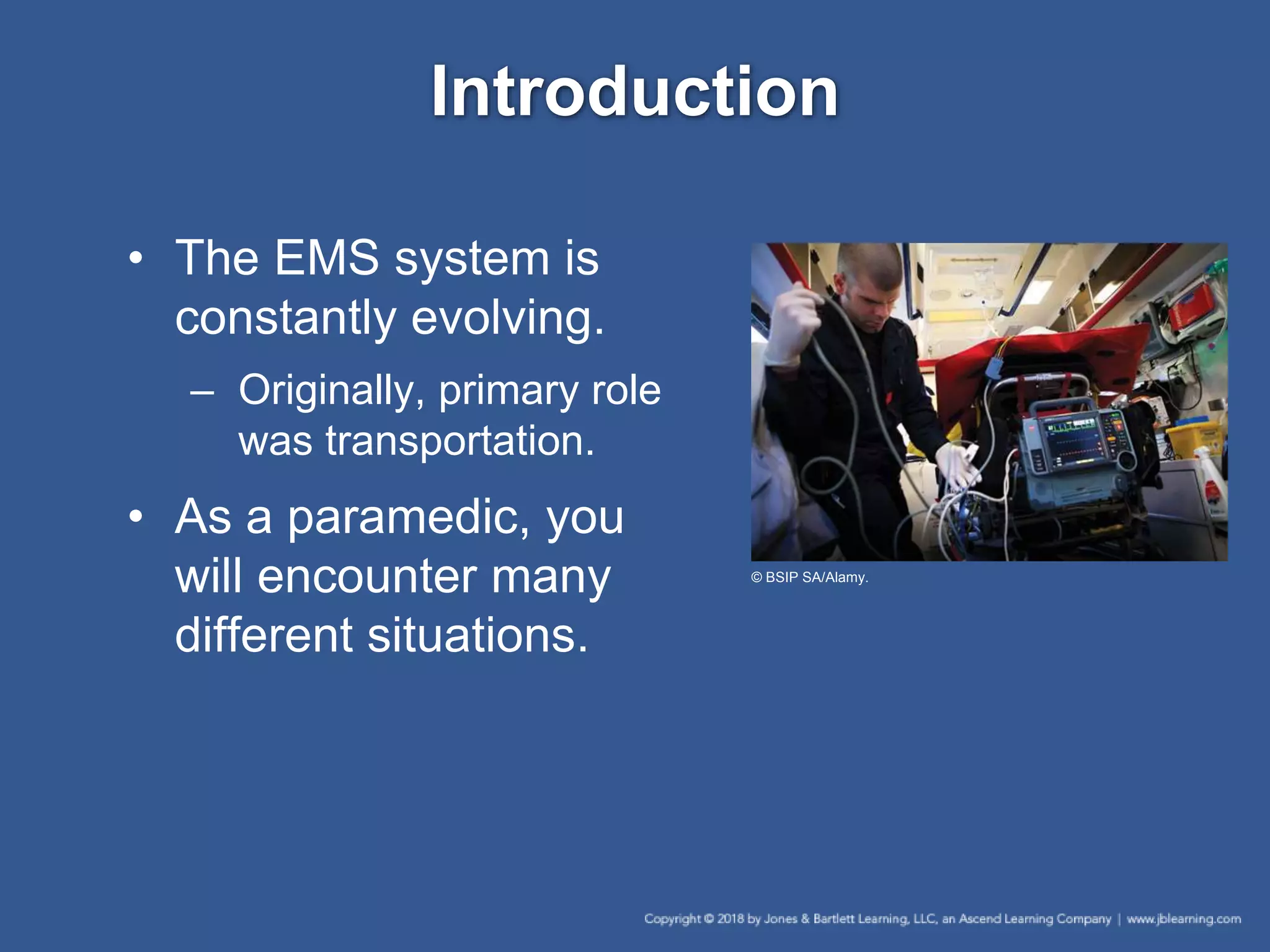
• The EMS system is
constantly evolving.
– Originally, primary role
was transportation.
• As a paramedic, you
will encounter many
different situations.
© BSIP SA/Alamy.
Introduction
• The public’s perception of you is based on:
– TV and articles
– Patient’s previous experiences
– Your treatment of their loved ones
• Continued education is a must.
• Treat everyone with respect and dignity.
EMS System Development
• Much of the prehospital emergency care
paramedics deliver is attributed to visionary
advances of pioneers such as:
– Dr. Peter Safar
– Dr. Nancy Caroline
• You may be surprised how long organized
systems have been in place.
The History of EMS
• 1487
– First use of an
ambulance
– Transport only
• 1800s
– First prehospital
system for triaging
and transporting
patients
• 1926
– Start of service
similar to present
day
• 1940s
– Fire and police
department–based
EMS
– No standards set
The 20th Century and Modern
Technology
• EMS made major
strides after WWII.
– Bringing hospital to
field gave patients a
better chance for
survival
– Korean War
• First use of a
helicopter
• MASH units
© National Library of Medicine.
The 20th Century and Modern
Technology
• 1956
– Mouth-to-mouth resuscitation was developed.
• Late 1950s/early 1960s
– Focus shifted to bringing hospital to patients.
– Mobile intensive care units (MICUs) developed.
The 20th Century and Modern
Technology
• 1965: “The White Paper” released
– Findings included:
• Lack of uniform laws and standards
• Equipment of poor quality or nonexistent
• Lack of communication
• Lack of training
• Only part-time staff
The 20th Century and Modern
Technology
• “The White Paper” outlined 10 critical points
for EMS system.
– Led to National Highway Safety Act
– Created US Department of Transportation (US
DOT)
• 1968
– Training standards implemented
– 9-1-1 system created
The 20th Century and Modern
Technology
• 1969
– First true paramedic
program
– Standards for
ambulance design
and equipment
• 1970s
– NREMT began Courtesy of Eugene L. Nagel and the Miami Fire Department.
The 20th Century and Modern
Technology
• 1970s (cont’d)
– 1971: Emergency Care and Transportation of the
Sick and Injured by the AAOS
– 1973: Emergency Medical Services Systems Act
– 1977: First National Standard Curriculum for
paramedics by US DOT
The 20th Century and Modern
Technology
• 1980s/1990s
– The number of trained personnel grew
significantly.
– NHTSA developed 10 system elements to help
sustain EMS system.
– Responsibility for EMS transferred to the states.
– Major legislative initiatives came about.
The 21st Century Progress
• Numerous initiatives are appearing:
– EMS Compass
– EMS training used in other areas of health care
(as opposed to strictly in an ambulance)
– Community paramedicine
Licensure, Certification, and
Registration
• Depending on your state, you may be
registered or licensed.
– Board of registration holds your:
• Education records
• State or local licensure
• Recertification
– Once you complete your initial paramedic
education, depending on your state, you will be
able to take your state’s certification
examination.
Licensure, Certification, and
Registration
• Passing grade on certification examination:
– Ensures all health care providers have the
same basic level of knowledge and skill
– Entitles you to a state- and/or NREMT-issued
certificate or license
Licensure, Certification, and
Registration
• Licensure:
– How states control
who practices
– Also known as
certification or
credentialing
– Unlawful to
practice without
licensure
• Holding a license
shows that you:
– Completed initial
education
– Met the
requirements to
achieve the license
Licensure, Certification, and
Registration
• CoAEMSP
– The only accrediting body for paramedic
programs to date
– Mission to continuously improve the quality of
EMS education through accreditation and
recognition services
Licensure, Certification, and
Registration
• Reciprocity
– Certification granted from another state/agency
– Requirements:
• Hold a current state licensure
• Be in good standing
• National Registry certification
Traditional EMS Employment
• Once you become licensed, a variety of
career options are available to you:
– Fire-based EMS
– Third-service EMS
– Private EMS agency
– Hospital-based EMS
– Hybrid or other
The EMS System
• A complex network of coordinated services
that provides care to the community
• The public needs to be taught how to:
– Recognize emergencies
– Activate the EMS system
– Provide basic care
The EMS System
– Bystander care
– Dispatch
– Response
– Prehospital
assessment and
care
– Transportation
– Emergency
department care
– Definitive care
– Rehabilitation
• Patient outcomes determined by:
The EMS System
• Dispatchers
– Usually the public’s first contact
– Training level varies by state
• Scene not necessarily what dispatcher
relays
– Never under- or overestimate information
The EMS System
• As a paramedic, you must:
– Develop a care plan
– Determine the most appropriate facility within a
reasonable distance
Levels of Education
• EMS system functions from a federal to
local level.
– Federal: National EMS Scope of Practice Model
– State: Licensure, laws, and regulations
– Local: Medical director decides day-to-day limits
Levels of Education
• The national guidelines are designed to
create more consistent delivery of EMS
nationally.
– Medical director can limit the scope of practice.
• In 2009, the National EMS Education
Standards were revised.
– Federal administrative source
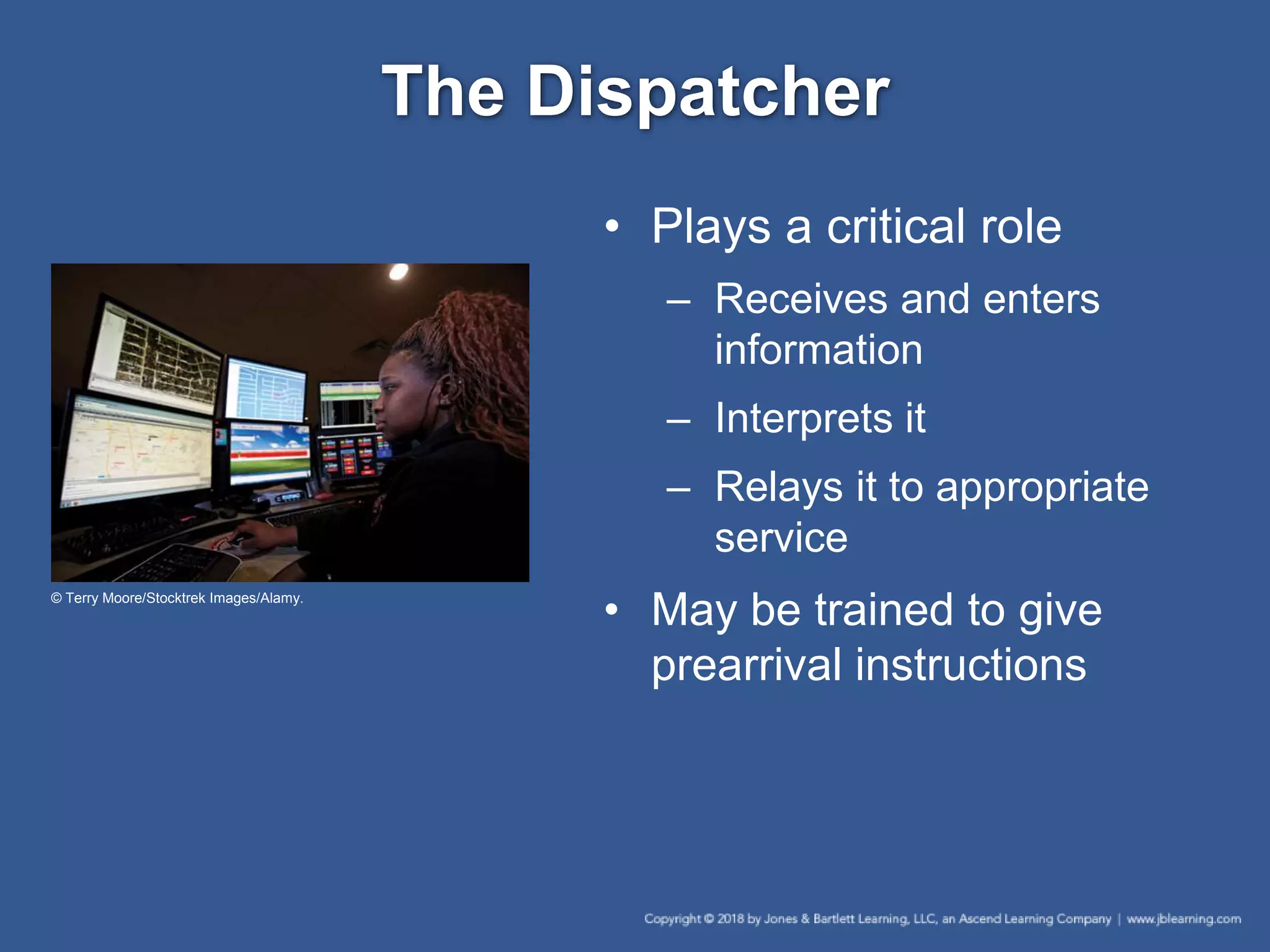
The Dispatcher
• Plays a critical role
– Receives and enters
information
– Interprets it
– Relays it to appropriate
service
• May be trained to give
prearrival instructions
© Terry Moore/Stocktrek Images/Alamy.
Emergency Medical Responder
(EMR)
• The EMR was formerly
called “first responder.”
• Requirements vary by
state.
• EMRs should be able
to:
– Recognize seriousness
of condition
– Provide basic care
– Relay information
© Glen E. Ellman.
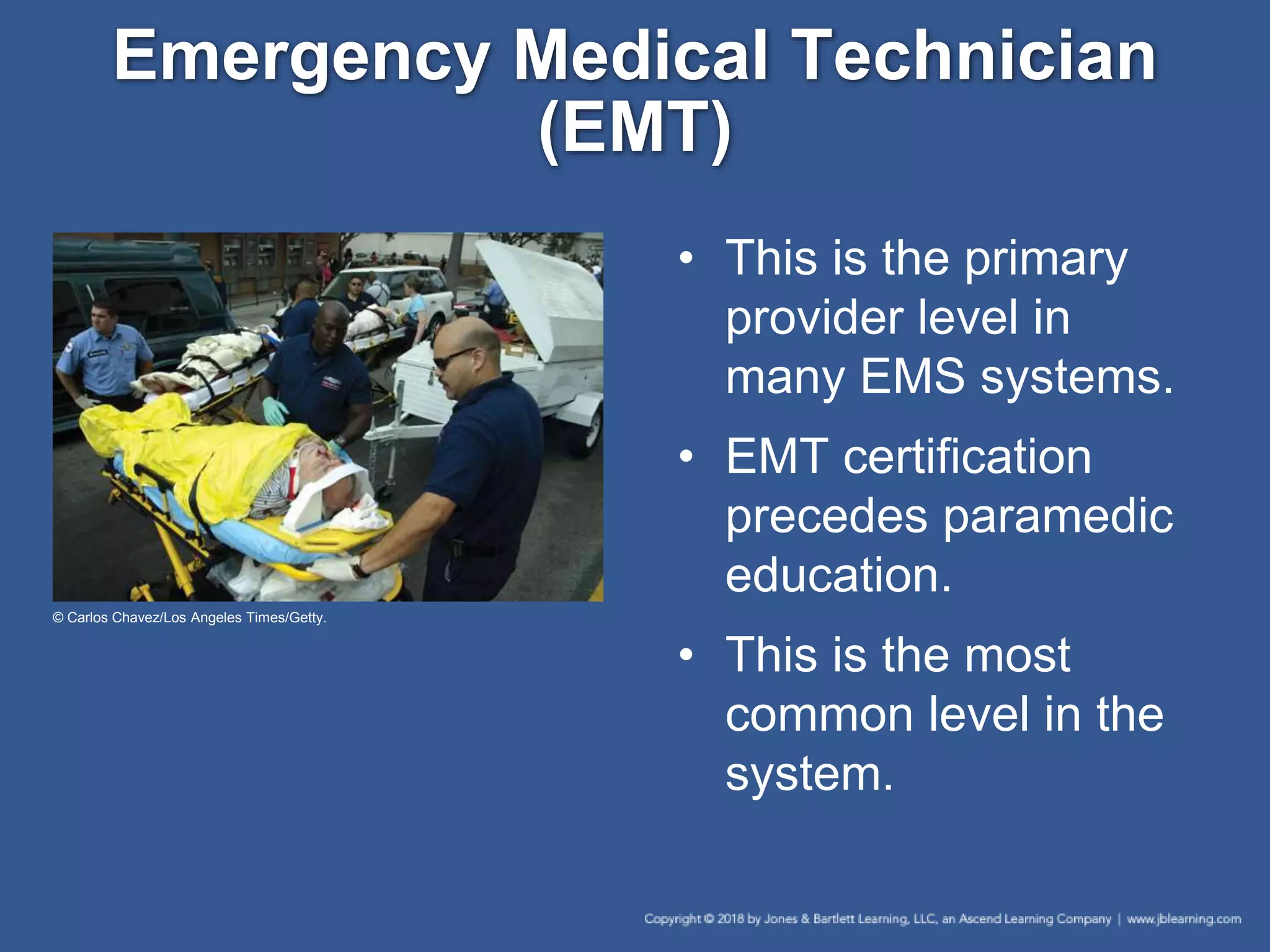
Emergency Medical Technician
(EMT)
• This is the primary
provider level in
many EMS systems.
• EMT certification
precedes paramedic
education.
• This is the most
common level in the
system.
© Carlos Chavez/Los Angeles Times/Getty.
Advanced EMT (AEMT)
• Formerly EMT-I
• Initially developed in 1985
– Major revision in 1999
• Trained in:
– More advanced pathophysiology
– Some advanced procedures
Paramedic
• Highest skill level to be nationally certified
– 1998: Major revisions to curriculum greatly
increased level of training and skills.
• Even if independently licensed, you must:
– Function under guidance of physicians
– Be affiliated with a paramedic-level service
Paramedic Education
• Initial education
– Most states base education programs on the
National EMS Education Standards.
• Outline minimum knowledge needed for
practice
– States require varying hours of education.
• National average: 1,000-1,500 hours
Paramedic Education
• Continuing education
– Most states require a certain number of
hours/refresher programs.
– Attend conferences and seminars.
– Read EMS journals.
– Consider CAPCE-accredited programs.
– Get everyone involved in postrun critiques.
• The responsibility for continuing education
rests with you.
Additional Types of Transports
• Specialty center
– Require in-house
staffs of specialists
– Possibility of slightly
longer transport
time
– Know:
• Location of centers
• Protocol for direct
transport
• Interfacility
– Use for:
• Nonambulatory
patients
• Patients who require
medical monitoring
– Other medical
professionals may
accompany patient.
Working With Other
Professionals
• Hospital staff
– Become familiar with the hospital.
– You may consult with staff by using the radio
through established (online) procedures.
– The best patient care occurs when emergency
care providers have close rapport.
Working With Other
Professionals
• Public safety agents
– Some have EMS
training.
• Can better perform
certain functions
than you
– Interagency
cooperation benefits
the patient.© Mark C. Ide.
Working With Other
Professionals
• Continuity of care
– The community has expectations of EMS.
– Focus on prevention.
– You will interact with many professionals and
groups.
– Understand your role, as well as theirs.
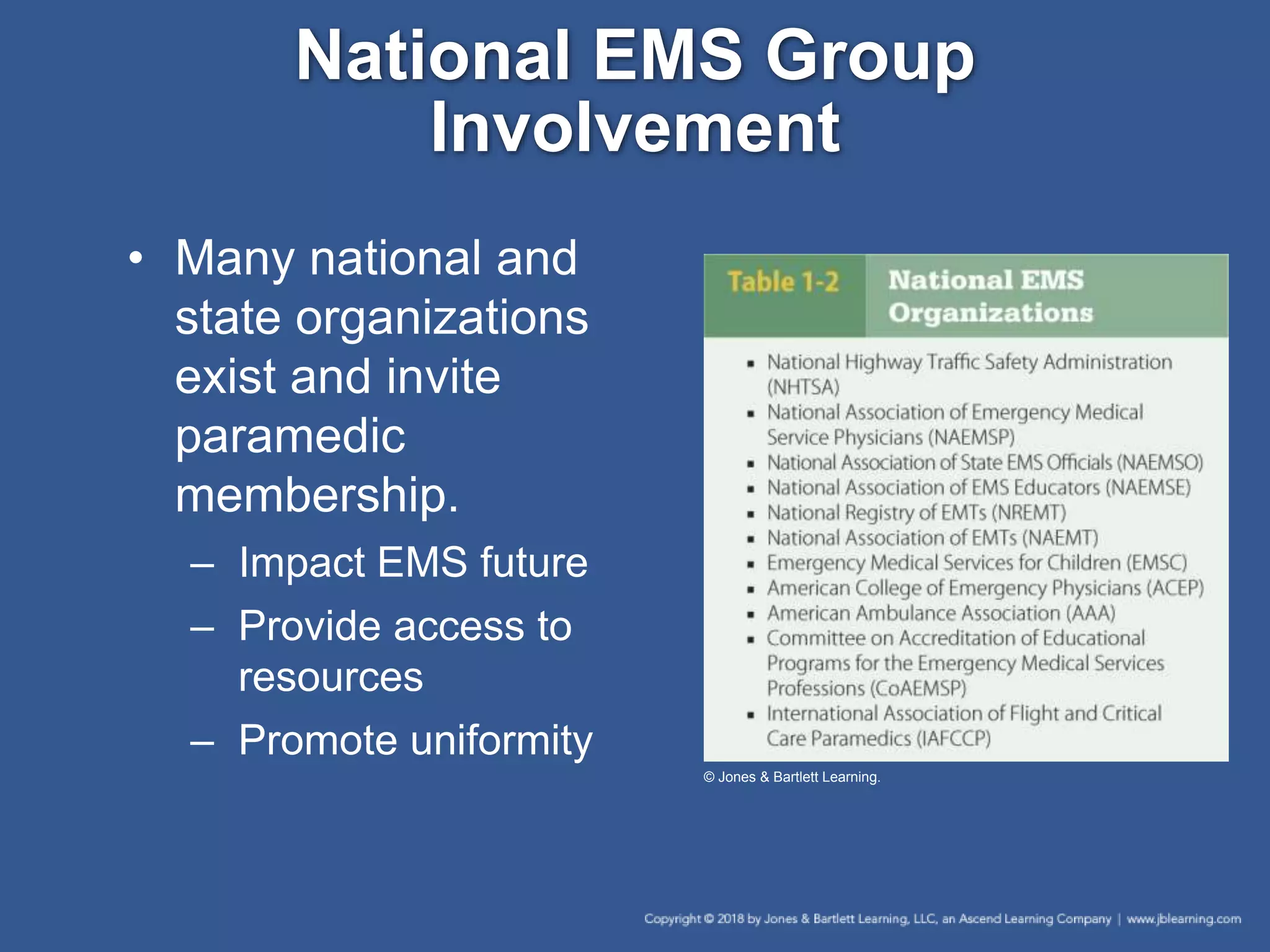
National EMS Group
Involvement
• Many national and
state organizations
exist and invite
paramedic
membership.
– Impact EMS future
– Provide access to
resources
– Promote uniformity
© Jones & Bartlett Learning.
Professionalism
• You have responsibilities as a health care
professional.
• You will be measured by:
– Standards, competencies, and education
requirements
– Performance parameters
– Code of ethics
Professionalism
• You are in a highly visible role in your
community.
• You must:
– Instill confidence.
– Establish and maintain credibility.
– Show concern for your patients.
Professionalism
• Your appearance is of utmost importance.
– Has more impact than you may think
• Present a professional image and treat
colleagues with respect.
– Arguing with colleagues is inappropriate.
– Raise issues at the appropriate time and place.
Professionalism
– Integrity
– Empathy
– Self-motivation
• Have an internal
drive for excellence.
– Confidence
• Strive to be the best
paramedic you can.
– Communications
• Express and
exchange ideas,
thoughts, and
findings.
• Listen well.
• Documentation is
important.
• Attributes of professionalism:
Professionalism
– Teamwork and
respect
• Work together.
– Patient advocacy
• Act in the patient’s
best interest.
– Injury prevention
– Careful delivery of
service
– Time management
• Prioritize your
patient’s needs.
– Administration
• Attributes of professionalism (cont’d):
Professionalism
• More health care locations are using
paramedic services, including:
– Administering vaccinations
– Performing special transports
Roles and Responsibilities
© Jones & Bartlett Learning; Photo: © Glen E. Ellman.
Roles and Responsibilities
• Teach the
community about
prevention of injury
and illness.
– Appropriate use of
EMS
– CPR and AED
training
– Influenza and
pandemic issues
Courtesy of Captain David Jackson, Saginaw Township Fire Department
Medical Direction
• Paramedics carry out advanced skills.
– Must take direction from medical directors
• Medical directors may perform many roles:
– Educate and train
– Recommend new personnel and equipment
– Develop protocols, guidelines, and quality
improvement programs
Medical Direction
• Roles of the medical director (cont’d):
– Provide input for patient care
– Interface between EMS and other agencies
– Advocate for EMS
– Serve as “medical conscience”
Medical Direction
• Medical directors provide online and off-line
medical control.
• Online
– Provides immediate
and specific patient
care resources
– Allows for continuous
quality improvement
– Can offer on-scene
assistance
• Off-line
– Allows for the
development of:
• Protocols or
guidelines
• Standing orders
• Procedures
• Training
Improving System Quality
• Continuous quality improvement (CQI)
– Tool to continually evaluate care
– Quality control: Process of assessing current
practices, looking for ways to improve
– Dynamic process
Improving System Quality
• Review ambulance
runs when possible.
• Focus of CQI is
improving care.
• CQI can be a peer
review.
– Try to rotate peer
review team
– Be professional
© Jones & Bartlett Learning. Courtesy of MIEMSS.
Improving System Quality
• CQI programs help
prevent problems
by:
– Evaluating day-to-
day operations
– Identifying
possible stress
points
• Look for ways to
eliminate human
error.
– Ensure adequate
lighting
– Limit interruptions
– Store medications
properly
Improving System Quality
• Ways to eliminate human error (cont’d)
– Be careful when handing patients off.
– Three main sources of errors:
• Rules-based failure
• Knowledge-based failure
• Skills-based failure
Improving System Quality
• Ways to eliminate human error (cont’d)
– Agencies need clear protocols.
– Be aware of your environment.
– Ask yourself, “Why am I doing this?”
– Use cheat sheets.
– Be conscientious of protocols.
EMS Research
• EMS has been drawn toward evidence-
based practice.
– Protocols should be based on scientific findings.
• Research typically performed by educated
researchers with a PhD or MD degree.
– Some colleges and universities offer an EMS
track for paramedics.
The Research Process
• Identify the problem, procedure, or
question.
• Develop research agenda by specifying:
– Questions to be answered
– Specific aims to be addressed
– Methods by which the study will be carried out
– Methods to gather data
• Stick to the research agenda.
The Research Process
• Determine the research domain.
– Area of research
– Domains: clinical, systems, or education
• Research may be performed within a
research consortium.
– Paramedics may be involved by gathering data.
Funding
• Researchers should use an institutional
review board (IRB) when a project begins.
• Major research requires specific funding.
– Any type of support is considered funding.
• Researchers should:
– Disclose sources of funding.
– Maintain transparency of research methods.
Types of Research
• Qualitative
– Focuses on
questions within
surrounding events
and concurrent
processes
– Often used when
quantitative
research does not
provide answers
• Quantitative
– Based on numeric
data
– Three types:
• Experimental
(scientific
approach)
• Nonexperimental
(descriptive)
• Survey
Types of Research
• Retrospective
– Examines available data
– May be used to:
• Develop educational sessions for EMS personnel
• Plan public education and prevention strategies
– In large studies, data often collected from
widespread databases
• Techniques can be used at the local level
Types of Research
• Other types of research:
– Prospective
– Cohort
– Case study
– Cross-sectional design
– Longitudinal design
– Literature review
Research Methods
• Identify the group(s) necessary for research.
• Ways to select subjects for research:
– Systematic sampling
– Alternative time sampling
– Convenience sampling
• Even in the best cases, sampling errors
occur.
Research Methods
• Studies can be:
– Blinded
• Investigators not
told project
specifics
• Single-, double-,
or triple-blinded
– Unblinded
• Participants
advised of all
aspects
• Research statistics
can be:
– Descriptive
• Observations
made
• No attempts made
to alter event
– Inferential
• Hypothesis used
to prove a finding
Ethical Considerations
• The organization’s IRB monitors whether a
study is conducted ethically and ensures:
– Protection of participants
– Appropriate conduct
• Risks must not outweigh potential benefits.
• Conflicts of interest must be identified.
Ethical Considerations
• All subjects must:
– Give consent.
– Know their rights
will be protected.
– Participate
voluntarily.
– Be informed of all
potential risks.
– Be free to
withdraw at any
time.
© Jones & Bartlett Learning. Courtesy of MIEMSS.
Evaluating Medical Research
• When evaluating research, look for certain
criteria to determine the research quality.
– Know what questions to answer.
• Read every part of the research paper and
review:
– The hypothesis and population
– The patient and selection criteria
– The analysis of the data
– The authors and their conclusions
Evaluating Medical Research
• Peer review helps ensure quality.
– Subject matter experts review material prior to
publication.
• Internet sites can be valid tools.
• Studies must follow a structured process.
• There will always be limitations.
• Review research carefully.
Evidence-Based Practice
• Care should focus on procedures that have
proven useful in improving patient
outcomes.
– Evidence-based practice will have a growing
role in EMS.
• Stay up to date on health care advances.
– Make sure you understand new research
results.
Evidence-Based Practice
• Researchers often rate the quality of a study
to ensure quality evidence.
– There are many different rating systems.
– The American Heart Association assigns class
(strength) of recommendation and levels (quality)
of evidence.
Evidence-Based Practice
• Research determines the effectiveness of
treatment.
– Can help identify which procedures,
medications, and treatments do and do not work
• When following a new study, measure the
results with your CQI program.

EMS Systems

  • 1.
  • 2.
    Preparatory Integrates comprehensive knowledgeof the EMS system, safety/well-being of the paramedic, and medical/legal and ethical issues, which are intended to improve the health of EMS personnel, patients, and the community. National EMS Education Standard Competencies
  • 3.
    Emergency Medical Services(EMS) Systems • EMS systems • History of EMS • Roles/responsibilities/professionalism of EMS personnel • Quality improvement • Patient safety National EMS Education Standard Competencies
  • 4.
    Research • Impact ofresearch on emergency medical responder (EMR) care • Data collection • Evidence-based decision making • Research principles to interpret literature and advocate evidence-based practice National EMS Education Standard Competencies
  • 5.
    Introduction • The EMSsystem is constantly evolving. – Originally, primary role was transportation. • As a paramedic, you will encounter many different situations. © BSIP SA/Alamy.
  • 6.
    Introduction • The public’sperception of you is based on: – TV and articles – Patient’s previous experiences – Your treatment of their loved ones • Continued education is a must. • Treat everyone with respect and dignity.
  • 7.
    EMS System Development •Much of the prehospital emergency care paramedics deliver is attributed to visionary advances of pioneers such as: – Dr. Peter Safar – Dr. Nancy Caroline • You may be surprised how long organized systems have been in place.
  • 8.
    The History ofEMS • 1487 – First use of an ambulance – Transport only • 1800s – First prehospital system for triaging and transporting patients • 1926 – Start of service similar to present day • 1940s – Fire and police department–based EMS – No standards set
  • 9.
    The 20th Centuryand Modern Technology • EMS made major strides after WWII. – Bringing hospital to field gave patients a better chance for survival – Korean War • First use of a helicopter • MASH units © National Library of Medicine.
  • 10.
    The 20th Centuryand Modern Technology • 1956 – Mouth-to-mouth resuscitation was developed. • Late 1950s/early 1960s – Focus shifted to bringing hospital to patients. – Mobile intensive care units (MICUs) developed.
  • 11.
    The 20th Centuryand Modern Technology • 1965: “The White Paper” released – Findings included: • Lack of uniform laws and standards • Equipment of poor quality or nonexistent • Lack of communication • Lack of training • Only part-time staff
  • 12.
    The 20th Centuryand Modern Technology • “The White Paper” outlined 10 critical points for EMS system. – Led to National Highway Safety Act – Created US Department of Transportation (US DOT) • 1968 – Training standards implemented – 9-1-1 system created
  • 13.
    The 20th Centuryand Modern Technology • 1969 – First true paramedic program – Standards for ambulance design and equipment • 1970s – NREMT began Courtesy of Eugene L. Nagel and the Miami Fire Department.
  • 14.
    The 20th Centuryand Modern Technology • 1970s (cont’d) – 1971: Emergency Care and Transportation of the Sick and Injured by the AAOS – 1973: Emergency Medical Services Systems Act – 1977: First National Standard Curriculum for paramedics by US DOT
  • 15.
    The 20th Centuryand Modern Technology • 1980s/1990s – The number of trained personnel grew significantly. – NHTSA developed 10 system elements to help sustain EMS system. – Responsibility for EMS transferred to the states. – Major legislative initiatives came about.
  • 16.
    The 21st CenturyProgress • Numerous initiatives are appearing: – EMS Compass – EMS training used in other areas of health care (as opposed to strictly in an ambulance) – Community paramedicine
  • 17.
    Licensure, Certification, and Registration •Depending on your state, you may be registered or licensed. – Board of registration holds your: • Education records • State or local licensure • Recertification – Once you complete your initial paramedic education, depending on your state, you will be able to take your state’s certification examination.
  • 18.
    Licensure, Certification, and Registration •Passing grade on certification examination: – Ensures all health care providers have the same basic level of knowledge and skill – Entitles you to a state- and/or NREMT-issued certificate or license
  • 19.
    Licensure, Certification, and Registration •Licensure: – How states control who practices – Also known as certification or credentialing – Unlawful to practice without licensure • Holding a license shows that you: – Completed initial education – Met the requirements to achieve the license
  • 20.
    Licensure, Certification, and Registration •CoAEMSP – The only accrediting body for paramedic programs to date – Mission to continuously improve the quality of EMS education through accreditation and recognition services
  • 21.
    Licensure, Certification, and Registration •Reciprocity – Certification granted from another state/agency – Requirements: • Hold a current state licensure • Be in good standing • National Registry certification
  • 22.
    Traditional EMS Employment •Once you become licensed, a variety of career options are available to you: – Fire-based EMS – Third-service EMS – Private EMS agency – Hospital-based EMS – Hybrid or other
  • 23.
    The EMS System •A complex network of coordinated services that provides care to the community • The public needs to be taught how to: – Recognize emergencies – Activate the EMS system – Provide basic care
  • 24.
    The EMS System –Bystander care – Dispatch – Response – Prehospital assessment and care – Transportation – Emergency department care – Definitive care – Rehabilitation • Patient outcomes determined by:
  • 25.
    The EMS System •Dispatchers – Usually the public’s first contact – Training level varies by state • Scene not necessarily what dispatcher relays – Never under- or overestimate information
  • 26.
    The EMS System •As a paramedic, you must: – Develop a care plan – Determine the most appropriate facility within a reasonable distance
  • 27.
    Levels of Education •EMS system functions from a federal to local level. – Federal: National EMS Scope of Practice Model – State: Licensure, laws, and regulations – Local: Medical director decides day-to-day limits
  • 28.
    Levels of Education •The national guidelines are designed to create more consistent delivery of EMS nationally. – Medical director can limit the scope of practice. • In 2009, the National EMS Education Standards were revised. – Federal administrative source
  • 29.
    The Dispatcher • Playsa critical role – Receives and enters information – Interprets it – Relays it to appropriate service • May be trained to give prearrival instructions © Terry Moore/Stocktrek Images/Alamy.
  • 30.
    Emergency Medical Responder (EMR) •The EMR was formerly called “first responder.” • Requirements vary by state. • EMRs should be able to: – Recognize seriousness of condition – Provide basic care – Relay information © Glen E. Ellman.
  • 31.
    Emergency Medical Technician (EMT) •This is the primary provider level in many EMS systems. • EMT certification precedes paramedic education. • This is the most common level in the system. © Carlos Chavez/Los Angeles Times/Getty.
  • 32.
    Advanced EMT (AEMT) •Formerly EMT-I • Initially developed in 1985 – Major revision in 1999 • Trained in: – More advanced pathophysiology – Some advanced procedures
  • 33.
    Paramedic • Highest skilllevel to be nationally certified – 1998: Major revisions to curriculum greatly increased level of training and skills. • Even if independently licensed, you must: – Function under guidance of physicians – Be affiliated with a paramedic-level service
  • 34.
    Paramedic Education • Initialeducation – Most states base education programs on the National EMS Education Standards. • Outline minimum knowledge needed for practice – States require varying hours of education. • National average: 1,000-1,500 hours
  • 35.
    Paramedic Education • Continuingeducation – Most states require a certain number of hours/refresher programs. – Attend conferences and seminars. – Read EMS journals. – Consider CAPCE-accredited programs. – Get everyone involved in postrun critiques. • The responsibility for continuing education rests with you.
  • 36.
    Additional Types ofTransports • Specialty center – Require in-house staffs of specialists – Possibility of slightly longer transport time – Know: • Location of centers • Protocol for direct transport • Interfacility – Use for: • Nonambulatory patients • Patients who require medical monitoring – Other medical professionals may accompany patient.
  • 37.
    Working With Other Professionals •Hospital staff – Become familiar with the hospital. – You may consult with staff by using the radio through established (online) procedures. – The best patient care occurs when emergency care providers have close rapport.
  • 38.
    Working With Other Professionals •Public safety agents – Some have EMS training. • Can better perform certain functions than you – Interagency cooperation benefits the patient.© Mark C. Ide.
  • 39.
    Working With Other Professionals •Continuity of care – The community has expectations of EMS. – Focus on prevention. – You will interact with many professionals and groups. – Understand your role, as well as theirs.
  • 40.
    National EMS Group Involvement •Many national and state organizations exist and invite paramedic membership. – Impact EMS future – Provide access to resources – Promote uniformity © Jones & Bartlett Learning.
  • 41.
    Professionalism • You haveresponsibilities as a health care professional. • You will be measured by: – Standards, competencies, and education requirements – Performance parameters – Code of ethics
  • 42.
    Professionalism • You arein a highly visible role in your community. • You must: – Instill confidence. – Establish and maintain credibility. – Show concern for your patients.
  • 43.
    Professionalism • Your appearanceis of utmost importance. – Has more impact than you may think • Present a professional image and treat colleagues with respect. – Arguing with colleagues is inappropriate. – Raise issues at the appropriate time and place.
  • 44.
    Professionalism – Integrity – Empathy –Self-motivation • Have an internal drive for excellence. – Confidence • Strive to be the best paramedic you can. – Communications • Express and exchange ideas, thoughts, and findings. • Listen well. • Documentation is important. • Attributes of professionalism:
  • 45.
    Professionalism – Teamwork and respect •Work together. – Patient advocacy • Act in the patient’s best interest. – Injury prevention – Careful delivery of service – Time management • Prioritize your patient’s needs. – Administration • Attributes of professionalism (cont’d):
  • 46.
    Professionalism • More healthcare locations are using paramedic services, including: – Administering vaccinations – Performing special transports
  • 47.
    Roles and Responsibilities ©Jones & Bartlett Learning; Photo: © Glen E. Ellman.
  • 48.
    Roles and Responsibilities •Teach the community about prevention of injury and illness. – Appropriate use of EMS – CPR and AED training – Influenza and pandemic issues Courtesy of Captain David Jackson, Saginaw Township Fire Department
  • 49.
    Medical Direction • Paramedicscarry out advanced skills. – Must take direction from medical directors • Medical directors may perform many roles: – Educate and train – Recommend new personnel and equipment – Develop protocols, guidelines, and quality improvement programs
  • 50.
    Medical Direction • Rolesof the medical director (cont’d): – Provide input for patient care – Interface between EMS and other agencies – Advocate for EMS – Serve as “medical conscience”
  • 51.
    Medical Direction • Medicaldirectors provide online and off-line medical control. • Online – Provides immediate and specific patient care resources – Allows for continuous quality improvement – Can offer on-scene assistance • Off-line – Allows for the development of: • Protocols or guidelines • Standing orders • Procedures • Training
  • 52.
    Improving System Quality •Continuous quality improvement (CQI) – Tool to continually evaluate care – Quality control: Process of assessing current practices, looking for ways to improve – Dynamic process
  • 53.
    Improving System Quality •Review ambulance runs when possible. • Focus of CQI is improving care. • CQI can be a peer review. – Try to rotate peer review team – Be professional © Jones & Bartlett Learning. Courtesy of MIEMSS.
  • 54.
    Improving System Quality •CQI programs help prevent problems by: – Evaluating day-to- day operations – Identifying possible stress points • Look for ways to eliminate human error. – Ensure adequate lighting – Limit interruptions – Store medications properly
  • 55.
    Improving System Quality •Ways to eliminate human error (cont’d) – Be careful when handing patients off. – Three main sources of errors: • Rules-based failure • Knowledge-based failure • Skills-based failure
  • 56.
    Improving System Quality •Ways to eliminate human error (cont’d) – Agencies need clear protocols. – Be aware of your environment. – Ask yourself, “Why am I doing this?” – Use cheat sheets. – Be conscientious of protocols.
  • 57.
    EMS Research • EMShas been drawn toward evidence- based practice. – Protocols should be based on scientific findings. • Research typically performed by educated researchers with a PhD or MD degree. – Some colleges and universities offer an EMS track for paramedics.
  • 58.
    The Research Process •Identify the problem, procedure, or question. • Develop research agenda by specifying: – Questions to be answered – Specific aims to be addressed – Methods by which the study will be carried out – Methods to gather data • Stick to the research agenda.
  • 59.
    The Research Process •Determine the research domain. – Area of research – Domains: clinical, systems, or education • Research may be performed within a research consortium. – Paramedics may be involved by gathering data.
  • 60.
    Funding • Researchers shoulduse an institutional review board (IRB) when a project begins. • Major research requires specific funding. – Any type of support is considered funding. • Researchers should: – Disclose sources of funding. – Maintain transparency of research methods.
  • 61.
    Types of Research •Qualitative – Focuses on questions within surrounding events and concurrent processes – Often used when quantitative research does not provide answers • Quantitative – Based on numeric data – Three types: • Experimental (scientific approach) • Nonexperimental (descriptive) • Survey
  • 62.
    Types of Research •Retrospective – Examines available data – May be used to: • Develop educational sessions for EMS personnel • Plan public education and prevention strategies – In large studies, data often collected from widespread databases • Techniques can be used at the local level
  • 63.
    Types of Research •Other types of research: – Prospective – Cohort – Case study – Cross-sectional design – Longitudinal design – Literature review
  • 64.
    Research Methods • Identifythe group(s) necessary for research. • Ways to select subjects for research: – Systematic sampling – Alternative time sampling – Convenience sampling • Even in the best cases, sampling errors occur.
  • 65.
    Research Methods • Studiescan be: – Blinded • Investigators not told project specifics • Single-, double-, or triple-blinded – Unblinded • Participants advised of all aspects • Research statistics can be: – Descriptive • Observations made • No attempts made to alter event – Inferential • Hypothesis used to prove a finding
  • 66.
    Ethical Considerations • Theorganization’s IRB monitors whether a study is conducted ethically and ensures: – Protection of participants – Appropriate conduct • Risks must not outweigh potential benefits. • Conflicts of interest must be identified.
  • 67.
    Ethical Considerations • Allsubjects must: – Give consent. – Know their rights will be protected. – Participate voluntarily. – Be informed of all potential risks. – Be free to withdraw at any time. © Jones & Bartlett Learning. Courtesy of MIEMSS.
  • 68.
    Evaluating Medical Research •When evaluating research, look for certain criteria to determine the research quality. – Know what questions to answer. • Read every part of the research paper and review: – The hypothesis and population – The patient and selection criteria – The analysis of the data – The authors and their conclusions
  • 69.
    Evaluating Medical Research •Peer review helps ensure quality. – Subject matter experts review material prior to publication. • Internet sites can be valid tools. • Studies must follow a structured process. • There will always be limitations. • Review research carefully.
  • 70.
    Evidence-Based Practice • Careshould focus on procedures that have proven useful in improving patient outcomes. – Evidence-based practice will have a growing role in EMS. • Stay up to date on health care advances. – Make sure you understand new research results.
  • 71.
    Evidence-Based Practice • Researchersoften rate the quality of a study to ensure quality evidence. – There are many different rating systems. – The American Heart Association assigns class (strength) of recommendation and levels (quality) of evidence.
  • 72.
    Evidence-Based Practice • Researchdetermines the effectiveness of treatment. – Can help identify which procedures, medications, and treatments do and do not work • When following a new study, measure the results with your CQI program.