Joe Daugherty
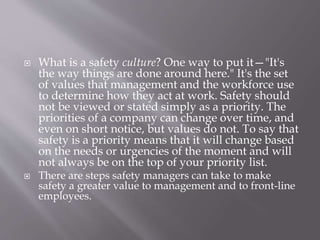
๏‚จ What is a safety culture? One way to put itโ€”"It's
the way things are done around here." It's the set
of values that management and the workforce use
to determine how they act at work. Safety should
not be viewed or stated simply as a priority. The
priorities of a company can change over time, and
even on short notice, but values do not. To say that
safety is a priority means that it will change based
on the needs or urgencies of the moment and will
not always be on the top of your priority list.
๏‚จ There are steps safety managers can take to make
safety a greater value to management and to front-line
employees.
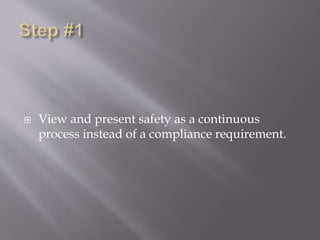
๏‚จ View and present safety as a continuous
process instead of a compliance requirement.
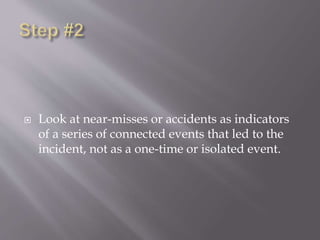
๏‚จ Look at near-misses or accidents as indicators
of a series of connected events that led to the
incident, not as a one-time or isolated event.
๏‚จ Integrate safety activities into the system, not
announce as a new priority that appears to
workers as yet another add-on, flavor of the
month initiative.
๏‚จ Make the effort to encourage workers for
improving safety performance; watch for
improvements and recognize them.
๏‚จ Get employees involved in the safety decision-
making process instead of dictating new
policies and priorities.
๏‚จ When near-misses or accidents occur, look first
at why the system failed instead of looking to
place blame. Don't just look at what went
wrong, but get into the habit of thinking about
the process of recognizing the hazard and
finding a way to control the hazard.
๏‚จ Look at accident investigations as action
planning, not fault-finding missions.
๏‚จ When instituting a new control, explain to
affected workers why they are being asked to
change what they normally do, and what
success will look like.
๏‚จ Identify all of the "hidden" costs of workplace
injuries and illnesses, such as lost work days,
worker's compensation, and replacing a
worker, and measure them over time. If you
can measure it, you can manage it. Make the
case to management that these costs can be
managed and reduced with a stronger
commitment to safety.
๏‚จ Real change in safety performance will come about
with a change in the safety culture of an
organization. Think about the change in the use of
seat belts from 30 years ago to now. What got
people to put them on without even thinking
about them? Gory accidents? Probably not. It was
leadership backing up a change in behavior, and
then repetitive education, enforcement, and
encouragement. Change in culture requires
consistent leadership and repetition. A systematic
change in the values of the target audience is
needed, not a new priority that comes and goes
with funding priorities

Safety Culture Power Point

  • 1.
  • 2.
    ๏‚จ What isa safety culture? One way to put itโ€”"It's the way things are done around here." It's the set of values that management and the workforce use to determine how they act at work. Safety should not be viewed or stated simply as a priority. The priorities of a company can change over time, and even on short notice, but values do not. To say that safety is a priority means that it will change based on the needs or urgencies of the moment and will not always be on the top of your priority list. ๏‚จ There are steps safety managers can take to make safety a greater value to management and to front-line employees.
  • 3.
    ๏‚จ View andpresent safety as a continuous process instead of a compliance requirement.
  • 4.
    ๏‚จ Look atnear-misses or accidents as indicators of a series of connected events that led to the incident, not as a one-time or isolated event.
  • 5.
    ๏‚จ Integrate safetyactivities into the system, not announce as a new priority that appears to workers as yet another add-on, flavor of the month initiative.
  • 6.
    ๏‚จ Make theeffort to encourage workers for improving safety performance; watch for improvements and recognize them.
  • 7.
    ๏‚จ Get employeesinvolved in the safety decision- making process instead of dictating new policies and priorities.
  • 8.
    ๏‚จ When near-missesor accidents occur, look first at why the system failed instead of looking to place blame. Don't just look at what went wrong, but get into the habit of thinking about the process of recognizing the hazard and finding a way to control the hazard.
  • 9.
    ๏‚จ Look ataccident investigations as action planning, not fault-finding missions.
  • 10.
    ๏‚จ When institutinga new control, explain to affected workers why they are being asked to change what they normally do, and what success will look like.
  • 11.
    ๏‚จ Identify allof the "hidden" costs of workplace injuries and illnesses, such as lost work days, worker's compensation, and replacing a worker, and measure them over time. If you can measure it, you can manage it. Make the case to management that these costs can be managed and reduced with a stronger commitment to safety.
  • 12.
    ๏‚จ Real changein safety performance will come about with a change in the safety culture of an organization. Think about the change in the use of seat belts from 30 years ago to now. What got people to put them on without even thinking about them? Gory accidents? Probably not. It was leadership backing up a change in behavior, and then repetitive education, enforcement, and encouragement. Change in culture requires consistent leadership and repetition. A systematic change in the values of the target audience is needed, not a new priority that comes and goes with funding priorities