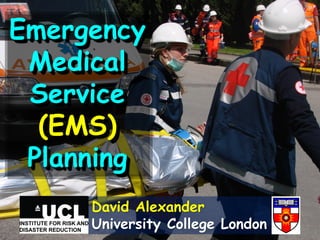
Emergency
Medical
Service
(EMS)
Planning
David Alexander
University College London
The emergency medical challenge
• a critical part of critical infrastructure
• rationing of essential
medical and health services
• bringing medical response into the field
• rationalising medical transportation
• preparing for emergencies inside
and outside the medical centre.
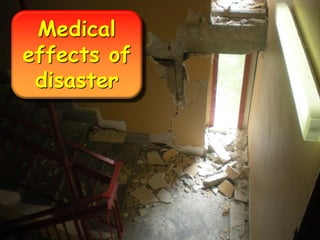
Medical
effects of
disaster
The phases of a medical emergency:
(1) Impact
• damage to health facilities, lifelines
• damage to communications channels
• loss of some medical personnel
(2) Emergency - isolation
• medical aid administered with manpower,
equipment, supplies immediately
available in disaster area
(3) Rehabilitation
• local resources augmented by those
from outside the area
DISASTER
VICTIM
Search and rescue
NOT INJURED

INJURED

Medical assistance

Public health measures

HEALTHY

WORSENING
OF PATIENT'S
CONDITION

INFECTED
Medical assistance

IMPROVEMENT
OF PATIENT'S
CONDITION

RECOVERS
IMPROVEMENT
OF PATIENT'S
CONDITION

DISEASES

WORSENING
OF PATIENT'S
CONDITION

Mortuary
DEATH and funeral
services

INJURIES
Earthquakes: expected pattern of injuries
dead
serious
multiple injuries
simple fractures
minor injuries:
bruises, lacerations, etc.
Ratio of serious to slight injuries:
from 1:9 to 1:30
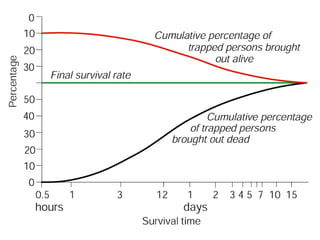
Percentage of people brought out
alive from under collapsed builings
100

50

0
0.5
1
Hours
3
1
2 3 4 5 7 10 15
Days
Survival time
12
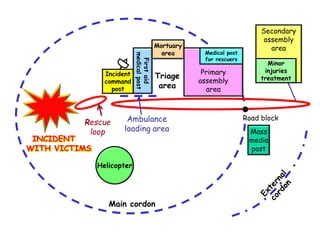
Rescue
loop

INCIDENT
WITH VICTIMS

First aid
medical post

Incident
command
post

Mortuary
area

Triage
area

Ambulance
loading area

Helicopter

Main cordon

Medical post
for rescuers

Primary
assembly
area

Secondary
assembly
area
Minor
injuries
treatment

Road block
Mass
media
post
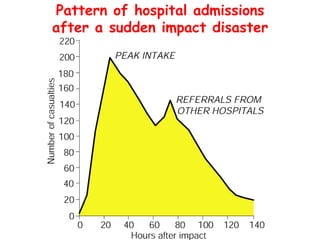
Pattern of hospital admissions
after a sudden impact disaster
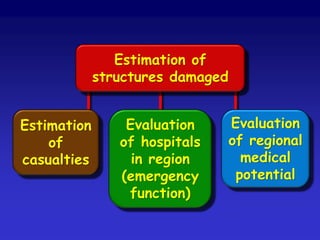
Estimation of
structures damaged
Estimation
of
casualties

Evaluation
of hospitals
in region
(emergency
function)

Evaluation
of regional
medical
potential
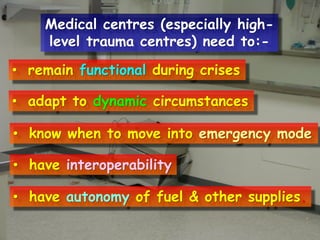
Medical centres (especially highlevel trauma centres) need to:• remain functional during crises
• adapt to dynamic circumstances
• know when to move into emergency mode
• have interoperability
• have autonomy of fuel & other supplies.
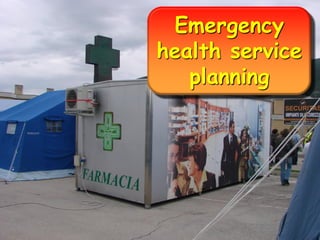
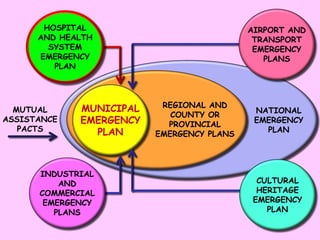
Emergency
health service
planning
HOSPITAL
AND HEALTH
SYSTEM
EMERGENCY
PLAN

MUTUAL
ASSISTANCE
PACTS

MUNICIPAL
EMERGENCY
PLAN

INDUSTRIAL
AND
COMMERCIAL
EMERGENCY
PLANS

AIRPORT AND
TRANSPORT
EMERGENCY
PLANS

REGIONAL AND
COUNTY OR
PROVINCIAL
EMERGENCY PLANS

NATIONAL
EMERGENCY
PLAN

CULTURAL
HERITAGE
EMERGENCY
PLAN
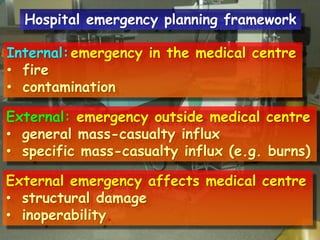
Hospital emergency planning framework
Internal: emergency in the medical centre
• fire
• contamination
External: emergency outside medical centre
• general mass-casualty influx
• specific mass-casualty influx (e.g. burns)
External emergency affects medical centre
• structural damage
• inoperability.
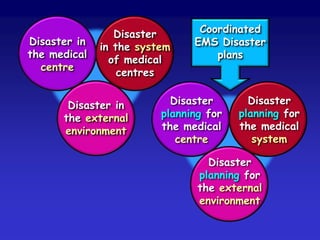
Disaster in
the medical
centre

Disaster
in the system
of medical
centres

Disaster in
the external
environment

Coordinated
EMS Disaster
plans

Disaster
planning for
the medical
centre

Disaster
planning for
the medical
system

Disaster
planning for
the external
environment
Plan for the following medical aid:• rescue: medical assistance during SAR
• first aid: advance medical post
• hospital: main or prolonged treatment

• transfer: inter-hospital movement
[HEMS / road ambulance interaction].
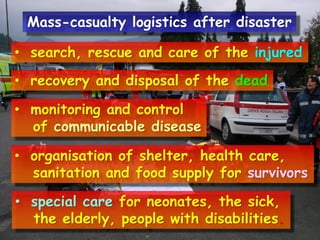
Mass-casualty logistics after disaster
• search, rescue and care of the injured

• recovery and disposal of the dead
• monitoring and control
of communicable disease
• organisation of shelter, health care,
sanitation and food supply for survivors
• special care for neonates, the sick,
the elderly, people with disabilities.
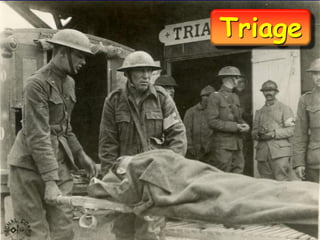
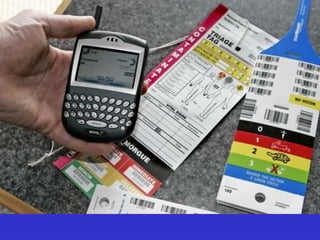
Triage
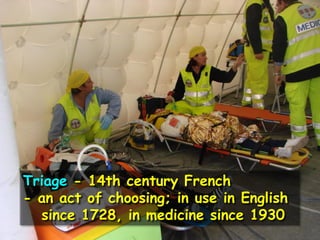
Triage - 14th century French
- an act of choosing; in use in English
since 1728, in medicine since 1930
Triage: the classification of injuries
on the basis of who would gain the
greatest benefit from the most
immediate attention.
A form of rationing scarce medical
resources in times of excessive
demand for them.
Highest priority to patients:
• whose prognosis would increase
dramatically with some rapid and
simple medical care
Lower priority to patients:
• with simple or light injuries, or
• who are moribund and would
need intensive care for
limited or uncertain benefit.
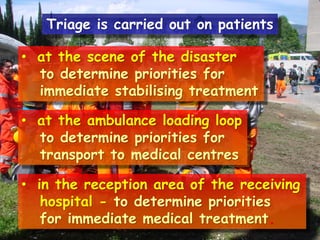
Triage is carried out on patients
• at the scene of the disaster
to determine priorities for
immediate stabilising treatment
• at the ambulance loading loop
to determine priorities for
transport to medical centres
• in the reception area of the receiving
hospital - to determine priorities
for immediate medical treatment.
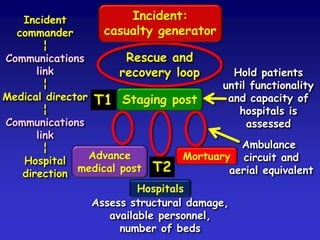
Incident:
Incident
casualty generator
commander
¦
Rescue and
Communications
link
Hold patients
recovery loop
¦
until functionality
Medical director T1 Staging post
and capacity of
¦
hospitals is
Communications
assessed
link
Ambulance
¦
Advance
Mortuary circuit and
Hospital
T2
aerial equivalent
direction medical post
Hospitals
Assess structural damage,
available personnel,
number of beds
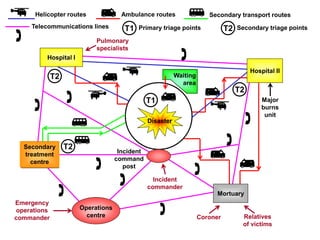
Helicopter routes

Ambulance routes

Telecommunications lines

T1

Secondary transport routes

T2

Primary triage points

Secondary triage points

Pulmonary
specialists
Hospital I
Hospital II

Waiting
area

T2

T2
T1

Major
burns
unit

Disaster

Secondary
treatment
centre

T2

Incident
command
post
Incident
commander
Mortuary

Emergency
operations
commander

Operations
centre

Coroner

Relatives
of victims
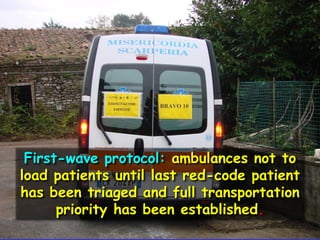
First-wave protocol: ambulances not to
load patients until last red-code patient
has been triaged and full transportation
priority has been established.
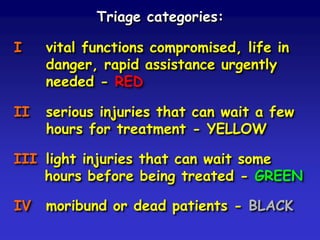
Triage categories:
I

vital functions compromised, life in
danger, rapid assistance urgently
needed - RED

II

serious injuries that can wait a few
hours for treatment - YELLOW

III light injuries that can wait some
hours before being treated - GREEN

IV

moribund or dead patients - BLACK
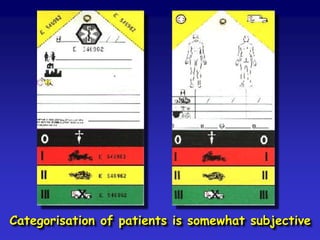
Categorisation of patients is somewhat subjective
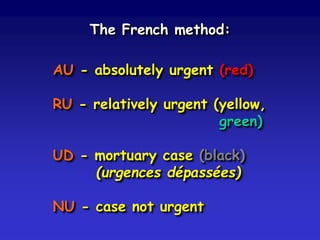
The French method:
AU - absolutely urgent (red)

RU - relatively urgent (yellow,
green)
UD - mortuary case (black)
(urgences dépassées)
NU - case not urgent
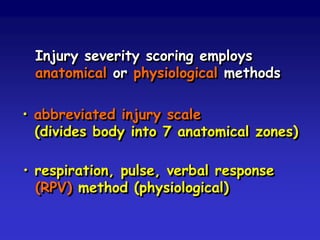
Injury severity scoring employs
anatomical or physiological methods
• abbreviated injury scale
(divides body into 7 anatomical zones)
• respiration, pulse, verbal response
(RPV) method (physiological)
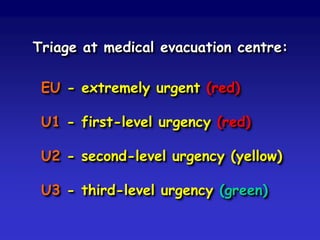
Triage at medical evacuation centre:
EU - extremely urgent (red)
U1 - first-level urgency (red)

U2 - second-level urgency (yellow)
U3 - third-level urgency (green)
Trauma index:
A - ambulatory (0-1)
MS - moderately serious (2-4)

CR - critical but will recover (5-7)
CRU - critical, not likely to recover
(>7)
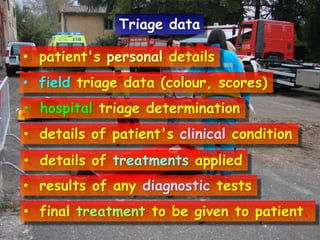
Triage data
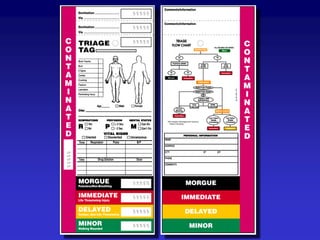
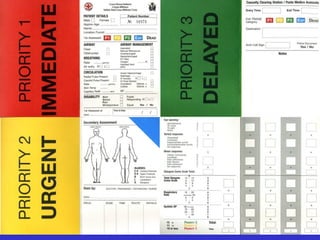
• patient's personal details
• field triage data (colour, scores)

• hospital triage determination
• details of patient's clinical condition
• details of treatments applied
• results of any diagnostic tests
• final treatment to be given to patient.
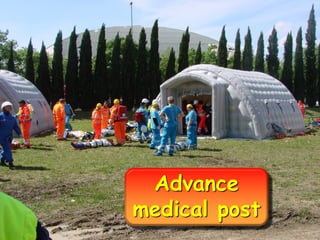
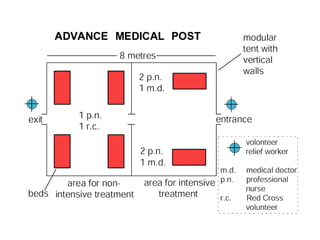
Advance
medical post
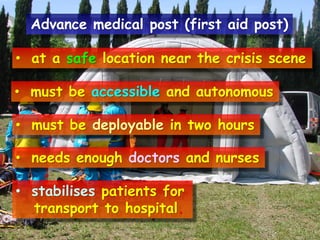
Advance medical post (first aid post)
• at a safe location near the crisis scene

• must be accessible and autonomous
• must be deployable in two hours
• needs enough doctors and nurses
• stabilises patients for
transport to hospital.
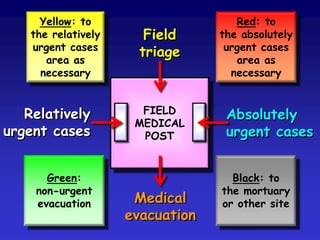
Yellow: to
the relatively
urgent cases
area as
necessary

Relatively
urgent cases
Green:
non-urgent
evacuation

Field
triage

FIELD
MEDICAL
POST

Medical
evacuation

Red: to
the absolutely
urgent cases
area as
necessary

Absolutely
urgent cases
Black: to
the mortuary
or other site
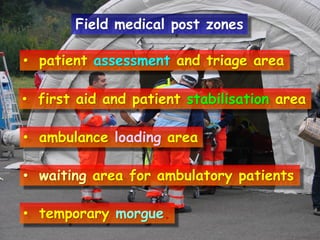
Field medical post zones
• patient assessment and triage area
• first aid and patient stabilisation area

• ambulance loading area
• waiting area for ambulatory patients

• temporary morgue.
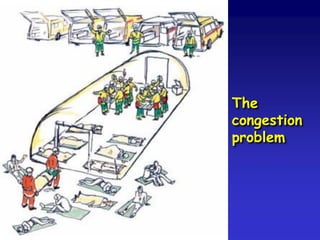
The
congestion
problem
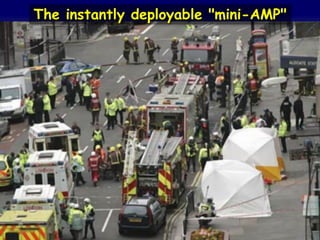
The instantly deployable "mini-AMP"
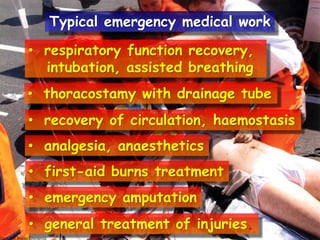
Typical emergency medical work
• respiratory function recovery,
intubation, assisted breathing
• thoracostamy with drainage tube
• recovery of circulation, haemostasis

• analgesia, anaesthetics
• first-aid burns treatment
• emergency amputation
• general treatment of injuries.
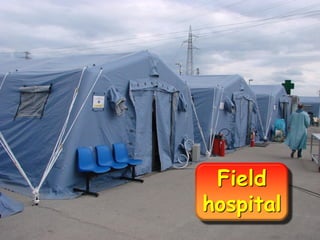
Field
hospital
Field hospital: an autonomous, usually
portable structure with clinical, diagnostic
and general medical capabilities

• slow to deploy, expensive
to run, often underutilised
• more useful for general medicine
than disaster medicine
• can substitute for damaged
permanent hospitals
• needs to be well equipped and staffed
• can be modular, can be containerised.
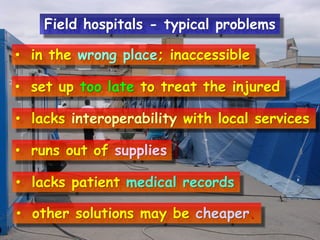
Field hospitals - typical problems
• in the wrong place; inaccessible
• set up too late to treat the injured
• lacks interoperability with local services
• runs out of supplies
• lacks patient medical records

• other solutions may be cheaper.
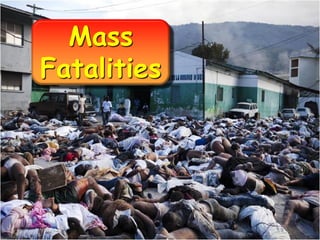
Mass
Fatalities
The dead:-

• plan for body recovery
• identification of bodies

• labelling and photography
• death certification

• uncontaminated preservation of evidence
• collection and storage of personal effects

• organising an area for
examination of bodies.
The dead:• organising a temporary mortuary

• finding a suitable building
• organising logistical and
administrative support
• health and safety at work
• role of the chief pathologist.
The dead:• identification commission
directed by the chief pathologist
• orthodontic specialist

• expert on biometry
(fingerprints, etc.)
• forensic anthropolist?
• recording and preserving evidence
of positive identification
• police and social services
contact near relatives.
The dead:• organise identification visits
to bodies in a separate area of the
mortuary, with controlled access
• organise and direct services to receive
relatives and friends of the deceased
• the need to preserve dignity
• religious and cultural needs of relatives
• minimise the stress on relatives
• exclude the mass media.
When an inquest is needed

• violent or unnatural death
• cause of death not known
• other specific circumstances.
The coroner must establish:• the identity of the deceased
• how and of what he or she died
• when and where he or she died

• the registration of death, which
depends on these factors.
No one owns a body,
but there are "rights of possession"

To avoid confusion, and to avoid
overburdening hospitals, the bodies must
be taken to a temporary mortuary
located at a distance and in an area
protected against public intrusion.
The temporary mortuary is used for:• identifying the bodies

• establishing the cause of death
• preserving the body (if necessary)
• cosmetology (if requested)

• preparing the body for the funeral.
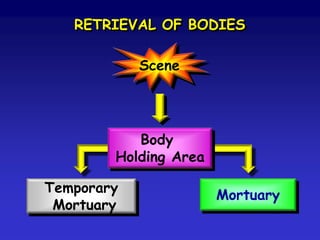
RETRIEVAL OF BODIES
Scene

Body
Holding Area
Temporary
Mortuary

Mortuary
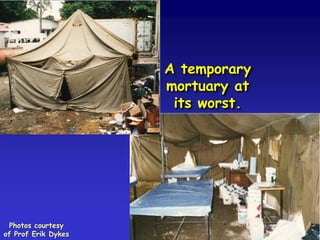
A temporary
mortuary at
its worst.

Photos courtesy
of Prof Erik Dykes
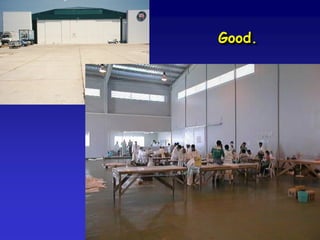
Good.
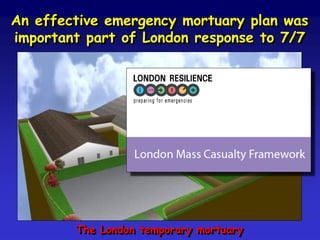
An effective emergency mortuary plan was
important part of London response to 7/7

The London temporary mortuary
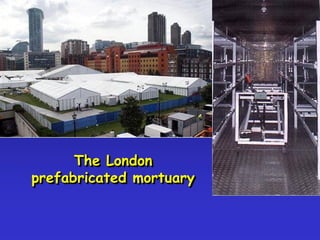
The London
prefabricated mortuary
Requirements for a temporary mortuary
("dry area"):• access for ambulances and parking area
• security and privacy

• lights, heating, ventilation
• hot and cold running water, drainage
• telephones.
Requirements for a temporary mortuary
("dry area"):• a room for body identification
• an office for the coroner
• an x-ray room [+ developing facilities]
• showers and toilets
• area for stockpiling coffins
• screens for the mortuary entrance.
Requirements for a temporary mortuary
("wet area"):• tables for autopsies
• area for washing bodies
• area for examining teeth
• area for embalming.
Requirements for a temporary mortuary
("wet area"):-

• refrigerators
• overall dimensions: 200 sq. metres
- 30 x 2 m for managing 200 bodies
- a larger work area for pathologists.
Identification of disaster victims
• needs information on the deceased
to be collected from relatives or
medical, dental or criminal record data
• needs sufficient post mortem data.
Means of identifying bodies

Using only one criterion:• visual recognition by relatives
or close friends of the deceased
• fingerprints (only for people
with a police record).
Means of identifying bodies
Using at least two criteria together:-

• fingerprints (taken at victim's home
and compared with those of the body)
• dental records
• surgical scars, skin blemishes,
tattoos, piercings, etc.
Means of identifying bodies
Using at least two criteria together:• clothes and personal effects (money,
documents, telephone, jewellery, etc.)
• estimate of the age of the subject
• exclusion and elimination criteria.
An example of religious requirements
bodies of practising muslims:• identification is urgent because of
need to ascertain identity as a muslim
• keep bodies of muslims together
• bodies laid out on clean surfaces
and covered with simple white sheets
• head turned towards right shoulder
• face turned towards Mecca
• bodies always buried, never cremated.
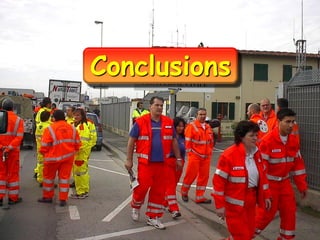
Conclusions
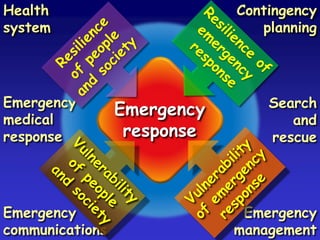
Health
system

Emergency
medical
response

Emergency
communications

Contingency
planning

Emergency
response

Search
and
rescue

Emergency
management
Section 6.1
pp. 189-216

Medical emergency planning

  • 1.
  • 2.
    The emergency medicalchallenge • a critical part of critical infrastructure • rationing of essential medical and health services • bringing medical response into the field • rationalising medical transportation • preparing for emergencies inside and outside the medical centre.
  • 3.
  • 4.
    The phases ofa medical emergency: (1) Impact • damage to health facilities, lifelines • damage to communications channels • loss of some medical personnel (2) Emergency - isolation • medical aid administered with manpower, equipment, supplies immediately available in disaster area (3) Rehabilitation • local resources augmented by those from outside the area
  • 5.
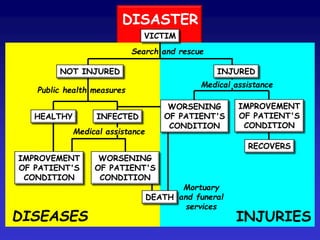
    DISASTER VICTIM Search and rescue NOTINJURED INJURED Medical assistance Public health measures HEALTHY WORSENING OF PATIENT'S CONDITION INFECTED Medical assistance IMPROVEMENT OF PATIENT'S CONDITION RECOVERS IMPROVEMENT OF PATIENT'S CONDITION DISEASES WORSENING OF PATIENT'S CONDITION Mortuary DEATH and funeral services INJURIES
  • 6.
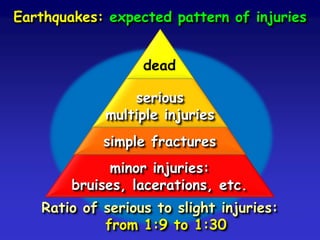
    Earthquakes: expected patternof injuries dead serious multiple injuries simple fractures minor injuries: bruises, lacerations, etc. Ratio of serious to slight injuries: from 1:9 to 1:30
  • 8.
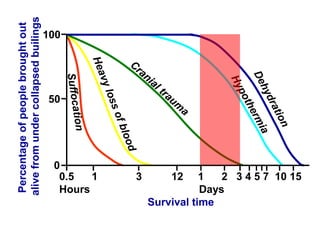
    Percentage of peoplebrought out alive from under collapsed builings 100 50 0 0.5 1 Hours 3 1 2 3 4 5 7 10 15 Days Survival time 12
  • 11.
    Rescue loop INCIDENT WITH VICTIMS First aid medicalpost Incident command post Mortuary area Triage area Ambulance loading area Helicopter Main cordon Medical post for rescuers Primary assembly area Secondary assembly area Minor injuries treatment Road block Mass media post
  • 13.
    Pattern of hospitaladmissions after a sudden impact disaster
  • 14.
    Estimation of structures damaged Estimation of casualties Evaluation ofhospitals in region (emergency function) Evaluation of regional medical potential
  • 15.
    Medical centres (especiallyhighlevel trauma centres) need to:• remain functional during crises • adapt to dynamic circumstances • know when to move into emergency mode • have interoperability • have autonomy of fuel & other supplies.
  • 16.
  • 17.
  • 18.
    Hospital emergency planningframework Internal: emergency in the medical centre • fire • contamination External: emergency outside medical centre • general mass-casualty influx • specific mass-casualty influx (e.g. burns) External emergency affects medical centre • structural damage • inoperability.
  • 19.
    Disaster in the medical centre Disaster inthe system of medical centres Disaster in the external environment Coordinated EMS Disaster plans Disaster planning for the medical centre Disaster planning for the medical system Disaster planning for the external environment
  • 20.
    Plan for thefollowing medical aid:• rescue: medical assistance during SAR • first aid: advance medical post • hospital: main or prolonged treatment • transfer: inter-hospital movement [HEMS / road ambulance interaction].
  • 21.
    Mass-casualty logistics afterdisaster • search, rescue and care of the injured • recovery and disposal of the dead • monitoring and control of communicable disease • organisation of shelter, health care, sanitation and food supply for survivors • special care for neonates, the sick, the elderly, people with disabilities.
  • 22.
  • 23.
    Triage - 14thcentury French - an act of choosing; in use in English since 1728, in medicine since 1930
  • 24.
    Triage: the classificationof injuries on the basis of who would gain the greatest benefit from the most immediate attention. A form of rationing scarce medical resources in times of excessive demand for them.
  • 25.
    Highest priority topatients: • whose prognosis would increase dramatically with some rapid and simple medical care Lower priority to patients: • with simple or light injuries, or • who are moribund and would need intensive care for limited or uncertain benefit.
  • 26.
    Triage is carriedout on patients • at the scene of the disaster to determine priorities for immediate stabilising treatment • at the ambulance loading loop to determine priorities for transport to medical centres • in the reception area of the receiving hospital - to determine priorities for immediate medical treatment.
  • 27.
    Incident: Incident casualty generator commander ¦ Rescue and Communications link Holdpatients recovery loop ¦ until functionality Medical director T1 Staging post and capacity of ¦ hospitals is Communications assessed link Ambulance ¦ Advance Mortuary circuit and Hospital T2 aerial equivalent direction medical post Hospitals Assess structural damage, available personnel, number of beds
  • 28.
    Helicopter routes Ambulance routes Telecommunicationslines T1 Secondary transport routes T2 Primary triage points Secondary triage points Pulmonary specialists Hospital I Hospital II Waiting area T2 T2 T1 Major burns unit Disaster Secondary treatment centre T2 Incident command post Incident commander Mortuary Emergency operations commander Operations centre Coroner Relatives of victims
  • 29.
    First-wave protocol: ambulancesnot to load patients until last red-code patient has been triaged and full transportation priority has been established.
  • 30.
    Triage categories: I vital functionscompromised, life in danger, rapid assistance urgently needed - RED II serious injuries that can wait a few hours for treatment - YELLOW III light injuries that can wait some hours before being treated - GREEN IV moribund or dead patients - BLACK
  • 31.
    Categorisation of patientsis somewhat subjective
  • 35.
    The French method: AU- absolutely urgent (red) RU - relatively urgent (yellow, green) UD - mortuary case (black) (urgences dépassées) NU - case not urgent
  • 36.
    Injury severity scoringemploys anatomical or physiological methods • abbreviated injury scale (divides body into 7 anatomical zones) • respiration, pulse, verbal response (RPV) method (physiological)
  • 37.
    Triage at medicalevacuation centre: EU - extremely urgent (red) U1 - first-level urgency (red) U2 - second-level urgency (yellow) U3 - third-level urgency (green)
  • 38.
    Trauma index: A -ambulatory (0-1) MS - moderately serious (2-4) CR - critical but will recover (5-7) CRU - critical, not likely to recover (>7)
  • 39.
    Triage data • patient'spersonal details • field triage data (colour, scores) • hospital triage determination • details of patient's clinical condition • details of treatments applied • results of any diagnostic tests • final treatment to be given to patient.
  • 40.
  • 41.
    Advance medical post(first aid post) • at a safe location near the crisis scene • must be accessible and autonomous • must be deployable in two hours • needs enough doctors and nurses • stabilises patients for transport to hospital.
  • 42.
    Yellow: to the relatively urgentcases area as necessary Relatively urgent cases Green: non-urgent evacuation Field triage FIELD MEDICAL POST Medical evacuation Red: to the absolutely urgent cases area as necessary Absolutely urgent cases Black: to the mortuary or other site
  • 44.
    Field medical postzones • patient assessment and triage area • first aid and patient stabilisation area • ambulance loading area • waiting area for ambulatory patients • temporary morgue.
  • 45.
  • 46.
  • 47.
    Typical emergency medicalwork • respiratory function recovery, intubation, assisted breathing • thoracostamy with drainage tube • recovery of circulation, haemostasis • analgesia, anaesthetics • first-aid burns treatment • emergency amputation • general treatment of injuries.
  • 48.
  • 49.
    Field hospital: anautonomous, usually portable structure with clinical, diagnostic and general medical capabilities • slow to deploy, expensive to run, often underutilised • more useful for general medicine than disaster medicine • can substitute for damaged permanent hospitals • needs to be well equipped and staffed • can be modular, can be containerised.
  • 50.
    Field hospitals -typical problems • in the wrong place; inaccessible • set up too late to treat the injured • lacks interoperability with local services • runs out of supplies • lacks patient medical records • other solutions may be cheaper.
  • 51.
  • 52.
    The dead:- • planfor body recovery • identification of bodies • labelling and photography • death certification • uncontaminated preservation of evidence • collection and storage of personal effects • organising an area for examination of bodies.
  • 53.
    The dead:• organisinga temporary mortuary • finding a suitable building • organising logistical and administrative support • health and safety at work • role of the chief pathologist.
  • 54.
    The dead:• identificationcommission directed by the chief pathologist • orthodontic specialist • expert on biometry (fingerprints, etc.) • forensic anthropolist? • recording and preserving evidence of positive identification • police and social services contact near relatives.
  • 55.
    The dead:• organiseidentification visits to bodies in a separate area of the mortuary, with controlled access • organise and direct services to receive relatives and friends of the deceased • the need to preserve dignity • religious and cultural needs of relatives • minimise the stress on relatives • exclude the mass media.
  • 56.
    When an inquestis needed • violent or unnatural death • cause of death not known • other specific circumstances.
  • 57.
    The coroner mustestablish:• the identity of the deceased • how and of what he or she died • when and where he or she died • the registration of death, which depends on these factors.
  • 58.
    No one ownsa body, but there are "rights of possession" To avoid confusion, and to avoid overburdening hospitals, the bodies must be taken to a temporary mortuary located at a distance and in an area protected against public intrusion.
  • 59.
    The temporary mortuaryis used for:• identifying the bodies • establishing the cause of death • preserving the body (if necessary) • cosmetology (if requested) • preparing the body for the funeral.
  • 60.
    RETRIEVAL OF BODIES Scene Body HoldingArea Temporary Mortuary Mortuary
  • 61.
    A temporary mortuary at itsworst. Photos courtesy of Prof Erik Dykes
  • 62.
  • 63.
    An effective emergencymortuary plan was important part of London response to 7/7 The London temporary mortuary
  • 64.
  • 65.
    Requirements for atemporary mortuary ("dry area"):• access for ambulances and parking area • security and privacy • lights, heating, ventilation • hot and cold running water, drainage • telephones.
  • 66.
    Requirements for atemporary mortuary ("dry area"):• a room for body identification • an office for the coroner • an x-ray room [+ developing facilities] • showers and toilets • area for stockpiling coffins • screens for the mortuary entrance.
  • 67.
    Requirements for atemporary mortuary ("wet area"):• tables for autopsies • area for washing bodies • area for examining teeth • area for embalming.
  • 68.
    Requirements for atemporary mortuary ("wet area"):- • refrigerators • overall dimensions: 200 sq. metres - 30 x 2 m for managing 200 bodies - a larger work area for pathologists.
  • 69.
    Identification of disastervictims • needs information on the deceased to be collected from relatives or medical, dental or criminal record data • needs sufficient post mortem data.
  • 70.
    Means of identifyingbodies Using only one criterion:• visual recognition by relatives or close friends of the deceased • fingerprints (only for people with a police record).
  • 71.
    Means of identifyingbodies Using at least two criteria together:- • fingerprints (taken at victim's home and compared with those of the body) • dental records • surgical scars, skin blemishes, tattoos, piercings, etc.
  • 72.
    Means of identifyingbodies Using at least two criteria together:• clothes and personal effects (money, documents, telephone, jewellery, etc.) • estimate of the age of the subject • exclusion and elimination criteria.
  • 73.
    An example ofreligious requirements bodies of practising muslims:• identification is urgent because of need to ascertain identity as a muslim • keep bodies of muslims together • bodies laid out on clean surfaces and covered with simple white sheets • head turned towards right shoulder • face turned towards Mecca • bodies always buried, never cremated.
  • 74.
  • 75.
  • 76.