Limmer et al., Emergency Care, 11th Edition
© 2009 by Pearson Education, Inc., Upper Saddle River, NJ
DOT
Directory
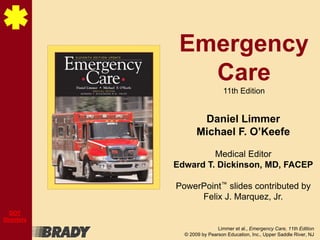
Emergency
Care
11th Edition
Daniel Limmer
Michael F. O’Keefe
Medical Editor
Edward T. Dickinson, MD, FACEP
PowerPoint™ slides contributed by
Felix J. Marquez, Jr.
Limmer et al., Emergency Care, 11th Edition
© 2009 by Pearson Education, Inc., Upper Saddle River, NJ
DOT
Directory
Chapter 1
Introduction to
Emergency Medical Care
Limmer et al., Emergency Care, 11th Edition
© 2009 by Pearson Education, Inc., Upper Saddle River, NJ
DOT
Directory
U.S. DOT Objectives Directory
U.S. DOT Objectives are covered and/or supported by the PowerPoint™ Slide
Program and Notes for Emergency Care, 11th Ed. Please see the Chapter 1
correlation below.
*KNOWLEDGE AND ATTITUDE
• 1-1.1 Define Emergency Medical Services (EMS) systems. Slides 6-11, 13-14,
16, 24
• 1-1.2 Differentiate the roles and responsibilities of the EMT from other
prehospital care providers. Slides 17-20
• 1-1.3 Describe the roles and responsibilities related to personal safety. Slide 18
• 1-1.4 Discuss the roles and responsibilities of the EMT toward the safety of the
crew, the patient, and bystanders. Slide 18
• 1-1.5 Define quality improvement, and discuss the EMT’s role in the process.
Slides 25-27
• 1-1.6 Define medical direction, and discuss the EMT’s role in the process. Slides
28-32
• 1-1.7 State the specific statutes and regulations in your state regarding the EMS
system.
(cont.)
Limmer et al., Emergency Care, 11th Edition
© 2009 by Pearson Education, Inc., Upper Saddle River, NJ
DOT
Directory
U.S. DOT Objectives Directory
*KNOWLEDGE AND ATTITUDE
• 1-1.8 Assess areas of personal attitude and conduct of the EMT. Slides 21-23
• 1-1.9 Characterize the various methods used to access the EMS system in your
community. Slides 12, 15
(cont.)
Limmer et al., Emergency Care, 11th Edition
© 2009 by Pearson Education, Inc., Upper Saddle River, NJ
DOT
Directory
Overview
of the EMS System
Limmer et al., Emergency Care, 11th Edition
© 2009 by Pearson Education, Inc., Upper Saddle River, NJ
DOT
Directory
1790s
The French began to transport wounded soldiers
from the battlefield.
1900s
Non-military ambulance services began in some
major cities.
1966
The National Highway Safety Act charged the U.S.
Department of Transportation (DOT) with developing
EMS Standards.
Overview of the EMS System
Limmer et al., Emergency Care, 11th Edition
© 2009 by Pearson Education, Inc., Upper Saddle River, NJ
DOT
Directory
1970s
The National Registry of Emergency Medical
Technicians (NREMT) was founded to establish
professional standards.
1973
Congress passed the National Emergency Medical
Service System Act.
Overview of the EMS System
Limmer et al., Emergency Care, 11th Edition
© 2009 by Pearson Education, Inc., Upper Saddle River, NJ
DOT
Directory
NHTSA initiates an EMS Technical
Assessment Program based on 10 key
components of EMS with a set of
standards for EMS systems.
National Highway Traffic Safety
Administration (NHTSA)
(cont.)
Limmer et al., Emergency Care, 11th Edition
© 2009 by Pearson Education, Inc., Upper Saddle River, NJ
DOT
Directory
Regulation and
policy
Resource
management
Human resources
and training
Transportation
Facilities
Communications
Public information
and education
Medical direction
Trauma systems
Evaluation
EMS Systems: 10 Key Components
National Highway Traffic Safety
Administration (NHTSA)
Limmer et al., Emergency Care, 11th Edition
© 2009 by Pearson Education, Inc., Upper Saddle River, NJ
DOT
Directory
Prehospital Care
– First Responders/EMTs/
EMT-Intermediates/EMT-Paramedics
Emergency Departments
– Patient Care Technicians/Nurses/Physicians
Components of the EMS System
(cont.)
Limmer et al., Emergency Care, 11th Edition
© 2009 by Pearson Education, Inc., Upper Saddle River, NJ
DOT
Directory
Specialty facilities:
Cardiac center
Stroke center
Trauma centers
Burn centers
Pediatric centers
Other specialty centers
–Poison control center
Components of the EMS System
Limmer et al., Emergency Care, 11th Edition
© 2009 by Pearson Education, Inc., Upper Saddle River, NJ
DOT
Directory
911
– Toll-free number
Enhanced 911 system
– Automatically identifies the caller’s phone
number and location
Communities without 911
– Standard seven-digit number to reach EMS
Accessing the EMS System
Limmer et al., Emergency Care, 11th Edition
© 2009 by Pearson Education, Inc., Upper Saddle River, NJ
DOT
Directory
Physicians
Nurses
Other healthcare professionals
Emergency Department Hospital
Personnel
Limmer et al., Emergency Care, 11th Edition
© 2009 by Pearson Education, Inc., Upper Saddle River, NJ
DOT
Directory
Local law enforcement
State and federal law enforcement
Liaison with Other Public Safety
Workers
Limmer et al., Emergency Care, 11th Edition
© 2009 by Pearson Education, Inc., Upper Saddle River, NJ
DOT
Directory
The Chain of EMS Human
Resources
Limmer et al., Emergency Care, 11th Edition
© 2009 by Pearson Education, Inc., Upper Saddle River, NJ
DOT
Directory
First Responder
Emergency Medical Technician
(EMT)
EMT–Intermediate
EMT–Paramedic
Levels of EMS Training
Limmer et al., Emergency Care, 11th Edition
© 2009 by Pearson Education, Inc., Upper Saddle River, NJ
DOT
Directory
Roles and Responsibilities
of the EMT
Limmer et al., Emergency Care, 11th Edition
© 2009 by Pearson Education, Inc., Upper Saddle River, NJ
DOT
Directory
Personal safety
Safety of crew,
patient, and
bystanders
Patient assessment
Patient care
Lifting and moving
patients safely
Transport/transfer
of care
Record-keeping/
data collection
Patient advocacy
Roles and Responsibilities
Limmer et al., Emergency Care, 11th Edition
© 2009 by Pearson Education, Inc., Upper Saddle River, NJ
DOT
Directory
Careful documentation
Becoming involved in the QI
process
Obtaining feedback from
hospital staff
Role of the EMT
(cont.)
Limmer et al., Emergency Care, 11th Edition
© 2009 by Pearson Education, Inc., Upper Saddle River, NJ
DOT
Directory
Maintaining equipment
Continuing education
Maintaining skills
Role of the EMT
Limmer et al., Emergency Care, 11th Edition
© 2009 by Pearson Education, Inc., Upper Saddle River, NJ
DOT
Directory
Traits
of a
Good EMT
Limmer et al., Emergency Care, 11th Edition
© 2009 by Pearson Education, Inc., Upper Saddle River, NJ
DOT
Directory
Maintains a presentable appearance
Keeps knowledge and skills
up-to-date
Makes patients’ needs a priority
without endangering self or others
Professional Attributes
and Traits
(cont.)
Limmer et al., Emergency Care, 11th Edition
© 2009 by Pearson Education, Inc., Upper Saddle River, NJ
DOT
Directory
Maintains current knowledge of
local, state, and national issues
affecting EMS
Professional Attributes
and Traits
Limmer et al., Emergency Care, 11th Edition
© 2009 by Pearson Education, Inc., Upper Saddle River, NJ
DOT
Directory
National
Registry of
Emergency
Medical
Technicians
Limmer et al., Emergency Care, 11th Edition
© 2009 by Pearson Education, Inc., Upper Saddle River, NJ
DOT
Directory
Quality
Improvement
Limmer et al., Emergency Care, 11th Edition
© 2009 by Pearson Education, Inc., Upper Saddle River, NJ
DOT
Directory
Continuous self-review to identify
aspects of the system that require
improvement to ensure that the
public receives the highest quality
prehospital care
Quality Improvement (QI)
(cont.)
Limmer et al., Emergency Care, 11th Edition
© 2009 by Pearson Education, Inc., Upper Saddle River, NJ
DOT
Directory
If a problem is identified, a plan is
developed and implemented to
prevent further occurrences of the
same problem.
Quality Improvement (QI)
Limmer et al., Emergency Care, 11th Edition
© 2009 by Pearson Education, Inc., Upper Saddle River, NJ
DOT
Directory
Medical Direction
Limmer et al., Emergency Care, 11th Edition
© 2009 by Pearson Education, Inc., Upper Saddle River, NJ
DOT
Directory
The Medical Director is a physician
who assumes the ultimate
responsibility for medical direction,
or oversight of the patient care
aspects of the EMS system.
Every Emergency Medical Service
must have a Medical Director.
Medical Direction
(cont.)
Limmer et al., Emergency Care, 11th Edition
© 2009 by Pearson Education, Inc., Upper Saddle River, NJ
DOT
Directory
Oversees training
Develops protocols
Develops standing orders
Plays an integral part of the QI
process
Medical Direction
Limmer et al., Emergency Care, 11th Edition
© 2009 by Pearson Education, Inc., Upper Saddle River, NJ
DOT
Directory
EMT is operating as a designated
agent of the physician.
Care rendered is considered an
extension of the medical
director’s authority (varies by
state law).
EMT Relationship with Medical
Director
Limmer et al., Emergency Care, 11th Edition
© 2009 by Pearson Education, Inc., Upper Saddle River, NJ
DOT
Directory
On-line
– Telephone
– Radio
Off-line
– Protocols
– Standing orders
Types of Medical Direction
Limmer et al., Emergency Care, 11th Edition
© 2009 by Pearson Education, Inc., Upper Saddle River, NJ
DOT
Directory
1. What are the components of the
Emergency Medical Services
system?
2. What are some of the special
designations that hospitals may
have? List them, and name the
special centers you have in your
region.
Review Questions
(cont.)
Limmer et al., Emergency Care, 11th Edition
© 2009 by Pearson Education, Inc., Upper Saddle River, NJ
DOT
Directory
3. What are the four national levels of
EMS training and certification?
4. What are the roles and
responsibilities of the EMT?
5. What are the desirable personal
and physical attributes of the
EMT?
Review Questions
(cont.)
Limmer et al., Emergency Care, 11th Edition
© 2009 by Pearson Education, Inc., Upper Saddle River, NJ
DOT
Directory
6. What is the definition of the term
quality improvement?
7. What is the difference between on-
line and off-line medical direction?
Review Questions
Limmer et al., Emergency Care, 11th Edition
© 2009 by Pearson Education, Inc., Upper Saddle River, NJ
DOT
Directory
What would have been a more
appropriate action for Chuck when the
shift started?
What behavior characteristics of
Chuck’s would be considered
unprofessional?
Street Scenes
(cont.)
Limmer et al., Emergency Care, 11th Edition
© 2009 by Pearson Education, Inc., Upper Saddle River, NJ
DOT
Directory
What would you expect from someone
providing initial field training?
What did Susan Miller do that was
appropriate and professional?
Street Scenes
(cont.)
Limmer et al., Emergency Care, 11th Edition
© 2009 by Pearson Education, Inc., Upper Saddle River, NJ
DOT
Directory
How was Susan’s behavior beneficial
to you as a new EMT?
What personal traits are the
professional standards for EMTs?
Street Scenes

Ems 131 chapter_1

  • 1.
    Limmer et al.,Emergency Care, 11th Edition © 2009 by Pearson Education, Inc., Upper Saddle River, NJ DOT Directory Emergency Care 11th Edition Daniel Limmer Michael F. O’Keefe Medical Editor Edward T. Dickinson, MD, FACEP PowerPoint™ slides contributed by Felix J. Marquez, Jr.
  • 2.
    Limmer et al.,Emergency Care, 11th Edition © 2009 by Pearson Education, Inc., Upper Saddle River, NJ DOT Directory Chapter 1 Introduction to Emergency Medical Care
  • 3.
    Limmer et al.,Emergency Care, 11th Edition © 2009 by Pearson Education, Inc., Upper Saddle River, NJ DOT Directory U.S. DOT Objectives Directory U.S. DOT Objectives are covered and/or supported by the PowerPoint™ Slide Program and Notes for Emergency Care, 11th Ed. Please see the Chapter 1 correlation below. *KNOWLEDGE AND ATTITUDE • 1-1.1 Define Emergency Medical Services (EMS) systems. Slides 6-11, 13-14, 16, 24 • 1-1.2 Differentiate the roles and responsibilities of the EMT from other prehospital care providers. Slides 17-20 • 1-1.3 Describe the roles and responsibilities related to personal safety. Slide 18 • 1-1.4 Discuss the roles and responsibilities of the EMT toward the safety of the crew, the patient, and bystanders. Slide 18 • 1-1.5 Define quality improvement, and discuss the EMT’s role in the process. Slides 25-27 • 1-1.6 Define medical direction, and discuss the EMT’s role in the process. Slides 28-32 • 1-1.7 State the specific statutes and regulations in your state regarding the EMS system. (cont.)
  • 4.
    Limmer et al.,Emergency Care, 11th Edition © 2009 by Pearson Education, Inc., Upper Saddle River, NJ DOT Directory U.S. DOT Objectives Directory *KNOWLEDGE AND ATTITUDE • 1-1.8 Assess areas of personal attitude and conduct of the EMT. Slides 21-23 • 1-1.9 Characterize the various methods used to access the EMS system in your community. Slides 12, 15 (cont.)
  • 5.
    Limmer et al.,Emergency Care, 11th Edition © 2009 by Pearson Education, Inc., Upper Saddle River, NJ DOT Directory Overview of the EMS System
  • 6.
    Limmer et al.,Emergency Care, 11th Edition © 2009 by Pearson Education, Inc., Upper Saddle River, NJ DOT Directory 1790s The French began to transport wounded soldiers from the battlefield. 1900s Non-military ambulance services began in some major cities. 1966 The National Highway Safety Act charged the U.S. Department of Transportation (DOT) with developing EMS Standards. Overview of the EMS System
  • 7.
    Limmer et al.,Emergency Care, 11th Edition © 2009 by Pearson Education, Inc., Upper Saddle River, NJ DOT Directory 1970s The National Registry of Emergency Medical Technicians (NREMT) was founded to establish professional standards. 1973 Congress passed the National Emergency Medical Service System Act. Overview of the EMS System
  • 8.
    Limmer et al.,Emergency Care, 11th Edition © 2009 by Pearson Education, Inc., Upper Saddle River, NJ DOT Directory NHTSA initiates an EMS Technical Assessment Program based on 10 key components of EMS with a set of standards for EMS systems. National Highway Traffic Safety Administration (NHTSA) (cont.)
  • 9.
    Limmer et al.,Emergency Care, 11th Edition © 2009 by Pearson Education, Inc., Upper Saddle River, NJ DOT Directory Regulation and policy Resource management Human resources and training Transportation Facilities Communications Public information and education Medical direction Trauma systems Evaluation EMS Systems: 10 Key Components National Highway Traffic Safety Administration (NHTSA)
  • 10.
    Limmer et al.,Emergency Care, 11th Edition © 2009 by Pearson Education, Inc., Upper Saddle River, NJ DOT Directory Prehospital Care – First Responders/EMTs/ EMT-Intermediates/EMT-Paramedics Emergency Departments – Patient Care Technicians/Nurses/Physicians Components of the EMS System (cont.)
  • 11.
    Limmer et al.,Emergency Care, 11th Edition © 2009 by Pearson Education, Inc., Upper Saddle River, NJ DOT Directory Specialty facilities: Cardiac center Stroke center Trauma centers Burn centers Pediatric centers Other specialty centers –Poison control center Components of the EMS System
  • 12.
    Limmer et al.,Emergency Care, 11th Edition © 2009 by Pearson Education, Inc., Upper Saddle River, NJ DOT Directory 911 – Toll-free number Enhanced 911 system – Automatically identifies the caller’s phone number and location Communities without 911 – Standard seven-digit number to reach EMS Accessing the EMS System
  • 13.
    Limmer et al.,Emergency Care, 11th Edition © 2009 by Pearson Education, Inc., Upper Saddle River, NJ DOT Directory Physicians Nurses Other healthcare professionals Emergency Department Hospital Personnel
  • 14.
    Limmer et al.,Emergency Care, 11th Edition © 2009 by Pearson Education, Inc., Upper Saddle River, NJ DOT Directory Local law enforcement State and federal law enforcement Liaison with Other Public Safety Workers
  • 15.
    Limmer et al.,Emergency Care, 11th Edition © 2009 by Pearson Education, Inc., Upper Saddle River, NJ DOT Directory The Chain of EMS Human Resources
  • 16.
    Limmer et al.,Emergency Care, 11th Edition © 2009 by Pearson Education, Inc., Upper Saddle River, NJ DOT Directory First Responder Emergency Medical Technician (EMT) EMT–Intermediate EMT–Paramedic Levels of EMS Training
  • 17.
    Limmer et al.,Emergency Care, 11th Edition © 2009 by Pearson Education, Inc., Upper Saddle River, NJ DOT Directory Roles and Responsibilities of the EMT
  • 18.
    Limmer et al.,Emergency Care, 11th Edition © 2009 by Pearson Education, Inc., Upper Saddle River, NJ DOT Directory Personal safety Safety of crew, patient, and bystanders Patient assessment Patient care Lifting and moving patients safely Transport/transfer of care Record-keeping/ data collection Patient advocacy Roles and Responsibilities
  • 19.
    Limmer et al.,Emergency Care, 11th Edition © 2009 by Pearson Education, Inc., Upper Saddle River, NJ DOT Directory Careful documentation Becoming involved in the QI process Obtaining feedback from hospital staff Role of the EMT (cont.)
  • 20.
    Limmer et al.,Emergency Care, 11th Edition © 2009 by Pearson Education, Inc., Upper Saddle River, NJ DOT Directory Maintaining equipment Continuing education Maintaining skills Role of the EMT
  • 21.
    Limmer et al.,Emergency Care, 11th Edition © 2009 by Pearson Education, Inc., Upper Saddle River, NJ DOT Directory Traits of a Good EMT
  • 22.
    Limmer et al.,Emergency Care, 11th Edition © 2009 by Pearson Education, Inc., Upper Saddle River, NJ DOT Directory Maintains a presentable appearance Keeps knowledge and skills up-to-date Makes patients’ needs a priority without endangering self or others Professional Attributes and Traits (cont.)
  • 23.
    Limmer et al.,Emergency Care, 11th Edition © 2009 by Pearson Education, Inc., Upper Saddle River, NJ DOT Directory Maintains current knowledge of local, state, and national issues affecting EMS Professional Attributes and Traits
  • 24.
    Limmer et al.,Emergency Care, 11th Edition © 2009 by Pearson Education, Inc., Upper Saddle River, NJ DOT Directory National Registry of Emergency Medical Technicians
  • 25.
    Limmer et al.,Emergency Care, 11th Edition © 2009 by Pearson Education, Inc., Upper Saddle River, NJ DOT Directory Quality Improvement
  • 26.
    Limmer et al.,Emergency Care, 11th Edition © 2009 by Pearson Education, Inc., Upper Saddle River, NJ DOT Directory Continuous self-review to identify aspects of the system that require improvement to ensure that the public receives the highest quality prehospital care Quality Improvement (QI) (cont.)
  • 27.
    Limmer et al.,Emergency Care, 11th Edition © 2009 by Pearson Education, Inc., Upper Saddle River, NJ DOT Directory If a problem is identified, a plan is developed and implemented to prevent further occurrences of the same problem. Quality Improvement (QI)
  • 28.
    Limmer et al.,Emergency Care, 11th Edition © 2009 by Pearson Education, Inc., Upper Saddle River, NJ DOT Directory Medical Direction
  • 29.
    Limmer et al.,Emergency Care, 11th Edition © 2009 by Pearson Education, Inc., Upper Saddle River, NJ DOT Directory The Medical Director is a physician who assumes the ultimate responsibility for medical direction, or oversight of the patient care aspects of the EMS system. Every Emergency Medical Service must have a Medical Director. Medical Direction (cont.)
  • 30.
    Limmer et al.,Emergency Care, 11th Edition © 2009 by Pearson Education, Inc., Upper Saddle River, NJ DOT Directory Oversees training Develops protocols Develops standing orders Plays an integral part of the QI process Medical Direction
  • 31.
    Limmer et al.,Emergency Care, 11th Edition © 2009 by Pearson Education, Inc., Upper Saddle River, NJ DOT Directory EMT is operating as a designated agent of the physician. Care rendered is considered an extension of the medical director’s authority (varies by state law). EMT Relationship with Medical Director
  • 32.
    Limmer et al.,Emergency Care, 11th Edition © 2009 by Pearson Education, Inc., Upper Saddle River, NJ DOT Directory On-line – Telephone – Radio Off-line – Protocols – Standing orders Types of Medical Direction
  • 33.
    Limmer et al.,Emergency Care, 11th Edition © 2009 by Pearson Education, Inc., Upper Saddle River, NJ DOT Directory 1. What are the components of the Emergency Medical Services system? 2. What are some of the special designations that hospitals may have? List them, and name the special centers you have in your region. Review Questions (cont.)
  • 34.
    Limmer et al.,Emergency Care, 11th Edition © 2009 by Pearson Education, Inc., Upper Saddle River, NJ DOT Directory 3. What are the four national levels of EMS training and certification? 4. What are the roles and responsibilities of the EMT? 5. What are the desirable personal and physical attributes of the EMT? Review Questions (cont.)
  • 35.
    Limmer et al.,Emergency Care, 11th Edition © 2009 by Pearson Education, Inc., Upper Saddle River, NJ DOT Directory 6. What is the definition of the term quality improvement? 7. What is the difference between on- line and off-line medical direction? Review Questions
  • 36.
    Limmer et al.,Emergency Care, 11th Edition © 2009 by Pearson Education, Inc., Upper Saddle River, NJ DOT Directory What would have been a more appropriate action for Chuck when the shift started? What behavior characteristics of Chuck’s would be considered unprofessional? Street Scenes (cont.)
  • 37.
    Limmer et al.,Emergency Care, 11th Edition © 2009 by Pearson Education, Inc., Upper Saddle River, NJ DOT Directory What would you expect from someone providing initial field training? What did Susan Miller do that was appropriate and professional? Street Scenes (cont.)
  • 38.
    Limmer et al.,Emergency Care, 11th Edition © 2009 by Pearson Education, Inc., Upper Saddle River, NJ DOT Directory How was Susan’s behavior beneficial to you as a new EMT? What personal traits are the professional standards for EMTs? Street Scenes