1
Everything Science www.everythingscience.co.za
19. Quantitative aspects of chemical change
Chemistry: Chemical change
Grade 10
2
Everything Science www.everythingscience.co.za
Moles and molar mass
The mole (n) (abbreviation mol) is the SI (Standard International) unit for amount of substance.
The number of particles in a mole is called Avogadro’s number and its value is 6,022 × 1023
.
These particles could be atoms, molecules or other particle units, depending on the substance.
The molar mass (M) is the mass of one mole of a substance and is measured in grams per
mole or g·mol−1
. The numerical value of an element’s molar mass is the same as its relative
atomic mass. For a covalent compound, the molar mass has the same numerical value as the
molecular mass of that compound. For an ionic substance, the molar mass has the same
numerical value as the formula mass of the substance.
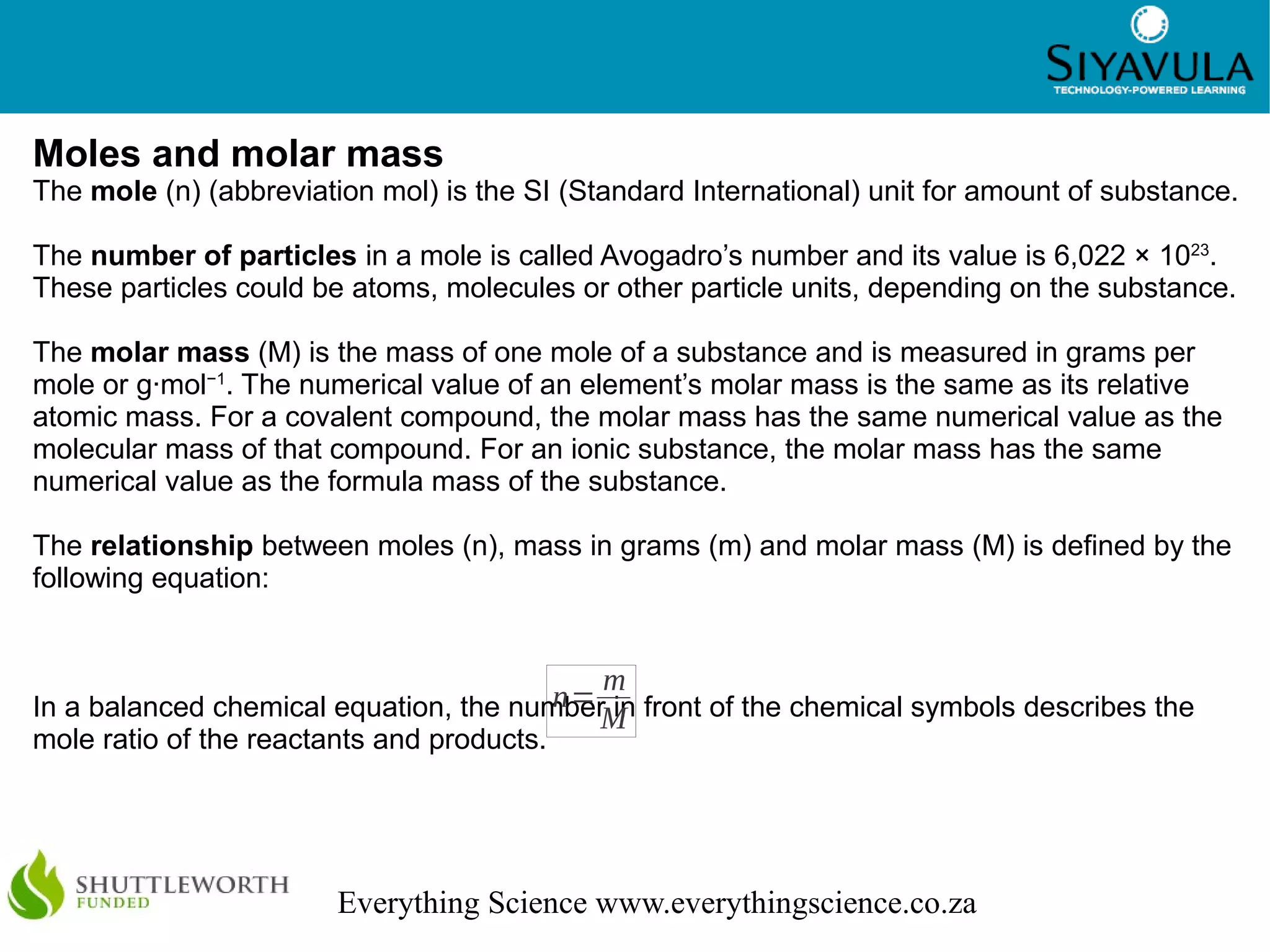
The relationship between moles (n), mass in grams (m) and molar mass (M) is defined by the
following equation:
In a balanced chemical equation, the number in front of the chemical symbols describes the
mole ratio of the reactants and products.
n=
m
M
3
Everything Science www.everythingscience.co.za
Calculations using moles
The empirical formula of a compound is an expression of the relative number of each type of
atom in the compound.
The molecular formula of a compound describes the actual number of atoms of each
element in a molecule of the compound.
The formula of a substance can be used to calculate the percentage by mass that each
element contributes to the compound.
The percentage composition of a substance can be used to deduce its chemical formula.
We can use the products of a reaction to determine the formula of one of the reactants.
We can find the number of moles of waters of crystallisation.
4
Everything Science www.everythingscience.co.za
Gases and liquids
One mole of gas occupies a volume of 22, 4 dm3 at S.T.P..
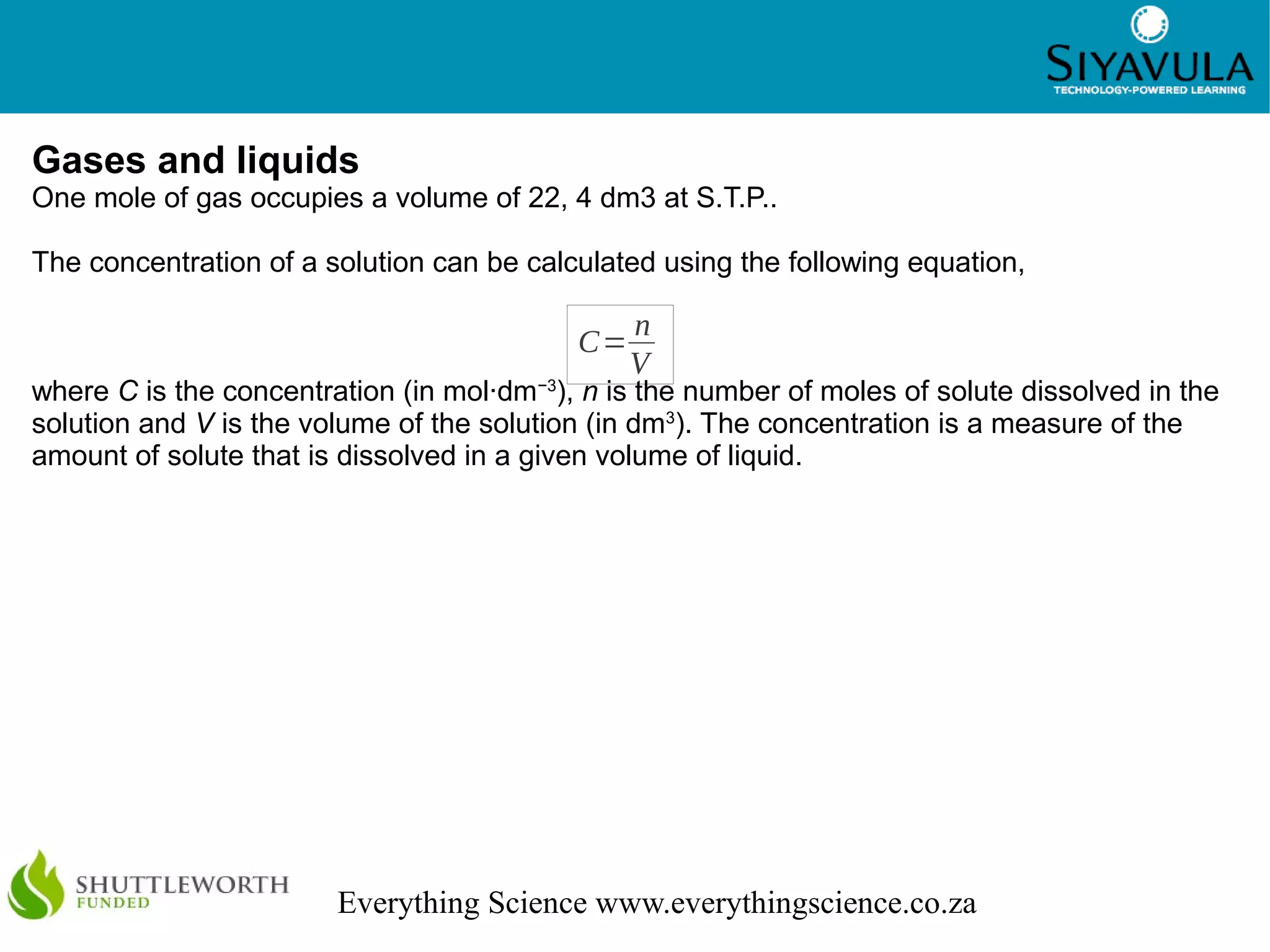
The concentration of a solution can be calculated using the following equation,
where C is the concentration (in mol·dm−3
), n is the number of moles of solute dissolved in the
solution and V is the volume of the solution (in dm3
). The concentration is a measure of the
amount of solute that is dissolved in a given volume of liquid.
C=
n
V
5
Everything Science www.everythingscience.co.za
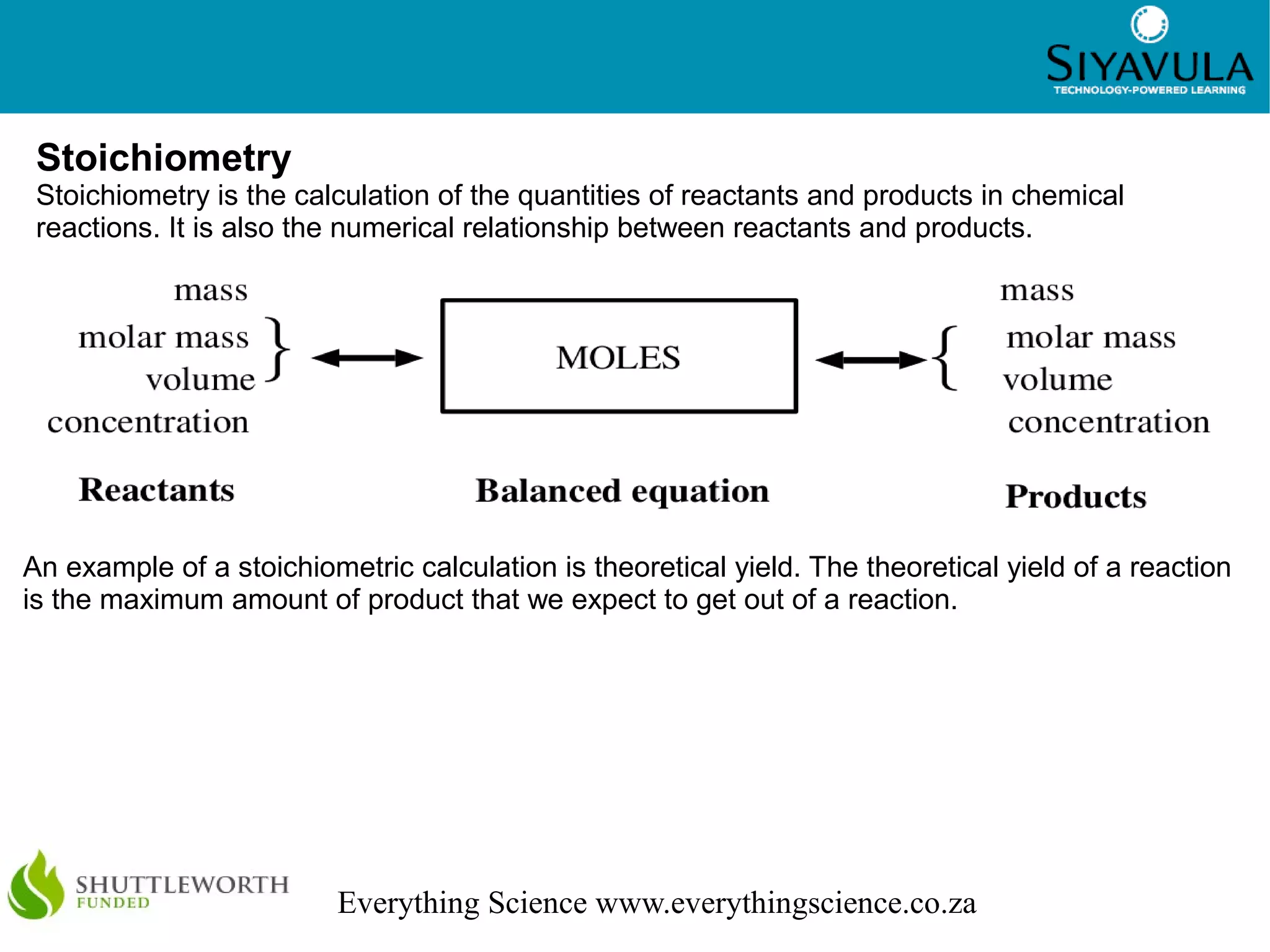
Stoichiometry
Stoichiometry is the calculation of the quantities of reactants and products in chemical
reactions. It is also the numerical relationship between reactants and products.
An example of a stoichiometric calculation is theoretical yield. The theoretical yield of a reaction
is the maximum amount of product that we expect to get out of a reaction.
6
Everything Science www.everythingscience.co.za
For more practice or to ask an expert for help on this
section see:
www.everythingscience.co.za
Shortcode: ESAFW
6
Everything Science www.everythingscience.co.za
For more practice or to ask an expert for help on this
section see:
www.everythingscience.co.za
Shortcode: ESAFW

Quantitative aspects of chemical change - grade 10

  • 1.
    1 Everything Science www.everythingscience.co.za 19.Quantitative aspects of chemical change Chemistry: Chemical change Grade 10
  • 2.
    2 Everything Science www.everythingscience.co.za Molesand molar mass The mole (n) (abbreviation mol) is the SI (Standard International) unit for amount of substance. The number of particles in a mole is called Avogadro’s number and its value is 6,022 × 1023 . These particles could be atoms, molecules or other particle units, depending on the substance. The molar mass (M) is the mass of one mole of a substance and is measured in grams per mole or g·mol−1 . The numerical value of an element’s molar mass is the same as its relative atomic mass. For a covalent compound, the molar mass has the same numerical value as the molecular mass of that compound. For an ionic substance, the molar mass has the same numerical value as the formula mass of the substance. The relationship between moles (n), mass in grams (m) and molar mass (M) is defined by the following equation: In a balanced chemical equation, the number in front of the chemical symbols describes the mole ratio of the reactants and products. n= m M
  • 3.
    3 Everything Science www.everythingscience.co.za Calculationsusing moles The empirical formula of a compound is an expression of the relative number of each type of atom in the compound. The molecular formula of a compound describes the actual number of atoms of each element in a molecule of the compound. The formula of a substance can be used to calculate the percentage by mass that each element contributes to the compound. The percentage composition of a substance can be used to deduce its chemical formula. We can use the products of a reaction to determine the formula of one of the reactants. We can find the number of moles of waters of crystallisation.
  • 4.
    4 Everything Science www.everythingscience.co.za Gasesand liquids One mole of gas occupies a volume of 22, 4 dm3 at S.T.P.. The concentration of a solution can be calculated using the following equation, where C is the concentration (in mol·dm−3 ), n is the number of moles of solute dissolved in the solution and V is the volume of the solution (in dm3 ). The concentration is a measure of the amount of solute that is dissolved in a given volume of liquid. C= n V
  • 5.
    5 Everything Science www.everythingscience.co.za Stoichiometry Stoichiometryis the calculation of the quantities of reactants and products in chemical reactions. It is also the numerical relationship between reactants and products. An example of a stoichiometric calculation is theoretical yield. The theoretical yield of a reaction is the maximum amount of product that we expect to get out of a reaction.
  • 6.
    6 Everything Science www.everythingscience.co.za Formore practice or to ask an expert for help on this section see: www.everythingscience.co.za Shortcode: ESAFW
  • 7.
    6 Everything Science www.everythingscience.co.za Formore practice or to ask an expert for help on this section see: www.everythingscience.co.za Shortcode: ESAFW