1
Lecture Notes in
Fluid Mechanics
Barhm Abdullah Mohamad
Erbil Polytechnic University
LinkedIn: https://www.linkedin.com/in/barhm-mohamad-900b1b138/
Google Scholar: https://scholar.google.com/citations?user=KRQ96qgAAAAJ&hl=en
ResearchGate: https://www.researchgate.net/profile/Barhm_Mohamad
YouTube channel: https://www.youtube.com/channel/UC16-u0i4mxe6TmAUQH0kmNw
2
C H A P T E R 1
Fluid mechanics
Fluid mechanics is a science in study the fluid of liquids and gases in the cases of
silence and movement and the forces acting on them can be divided materials found in
nature into two branches.
A- Solid Matters.
B-Fluid Matters:
Fluid material is divided into two parts:
1- Liquid Matters.
2- Gaseous Matters.
Fluid mechanics include fluid materials such as water, air and other while unique
science (Hydraulics) in the water as a liquid within the fluid material.
Hydrodynamics science is the study of the (Flow Fields) for materials may be not the
viscosity or compression or correlation but may even be a few special the weight
important and fluid called (Ideal fluid).
A fluid: is any substance that conforms the shape of its container and does not
permanently resist distortion. Gases, liquids and vapors are considered to have the
characteristic of fluids.
If a fluid affected by changes in pressure, it is called compressible fluid otherwise, it is
called incompressible fluid [1].
1.1 Units
The basic dimensions in fluid mechanics are below:
Property Symbol SI Unit English Unit
Force F N Ib
Length L m, cm Ft, in
Mass M Kg Slug
Time T S, min, hr S, min, hr
Temperature t Co Fo
3
1.2 Derived units
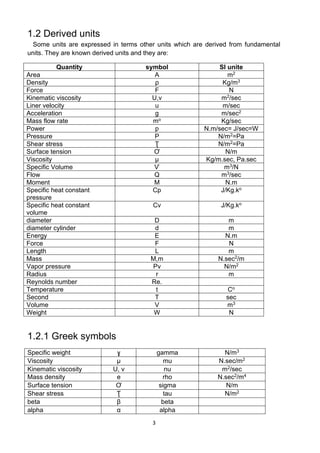
Some units are expressed in terms other units which are derived from fundamental
units. They are known derived units and they are:
Quantity symbol SI unite
Area A m2
Density ρ Kg/m3
Force F N
Kinematic viscosity U,ν m2/sec
Liner velocity u m/sec
Acceleration g m/sec2
Mass flow rate mo Kg/sec
Power ƿ N.m/sec= J/sec=W
Pressure P N/m2=Pa
Shear stress Ʈ N/m2=Pa
Surface tension Ơ N/m
Viscosity µ Kg/m.sec, Pa.sec
Specific Volume Ѵ m3/N
Flow Q m3/sec
Moment M N.m
Specific heat constant
pressure
Cp J/Kg.ko
Specific heat constant
volume
Cv J/Kg.ko
diameter D m
diameter cylinder d m
Energy E N.m
Force F N
Length L m
Mass M,m N.sec2/m
Vapor pressure Pv N/m2
Radius r m
Reynolds number Re.
Temperature t Co
Second T sec
Volume V m3
Weight W N
1.2.1 Greek symbols
Specific weight ɣ gamma N/m3
Viscosity µ mu N.sec/m2
Kinematic viscosity U, ν nu m2/sec
Mass density e rho N.sec2/m4
Surface tension Ơ sigma N/m
Shear stress Ʈ tau N/m2
beta β beta
alpha α alpha
4
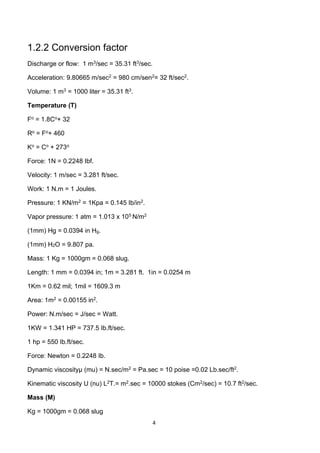
1.2.2 Conversion factor
Discharge or flow: 1 m3/sec = 35.31 ft3/sec.
Acceleration: 9.80665 m/sec2 = 980 cm/sen2= 32 ft/sec2.
Volume: 1 m3 = 1000 liter = 35.31 ft3.
Temperature (T)
Fo = 1.8Co+ 32
Ro = Fo+ 460
Ko = Co + 273o
Force: 1N = 0.2248 Ibf.
Velocity: 1 m/sec = 3.281 ft/sec.
Work: 1 N.m = 1 Joules.
Pressure: 1 KN/m2 = 1Kpa = 0.145 Ib/in2.
Vapor pressure: 1 atm = 1.013 x 10⁵ N/m2
(1mm) Hg = 0.0394 in Hg.
(1mm) H2O = 9.807 pa.
Mass: 1 Kg = 1000gm = 0.068 slug.
Length: 1 mm = 0.0394 in; 1m = 3.281 ft. 1in = 0.0254 m
1Km = 0.62 mil; 1mil = 1609.3 m
Area: 1m2 = 0.00155 in2.
Power: N.m/sec = J/sec = Watt.
1KW = 1.341 HP = 737.5 Ib.ft/sec.
1 hp = 550 Ib.ft/sec.
Force: Newton = 0.2248 Ib.
Dynamic viscosityµ (mu) = N.sec/m2 = Pa.sec = 10 poise =0.02 Lb.sec/ft2.
Kinematic viscosity U (nu) L2T.= m2.sec = 10000 stokes (Cm2/sec) = 10.7 ft2/sec.
Mass (M)
Kg = 1000gm = 0.068 slug
5
Lean body mass Lbm = 454 gm
Ton = 1000 kg
Mass density (M/L3) Kg/m3 = 0.00194 slug/ft3
Weighted density ɣ (W/L3) = N.m3 = 0.006 Lbf/ ft3.
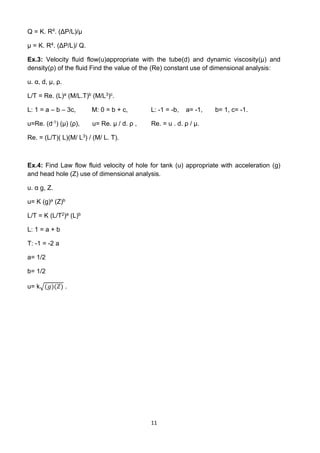
Ex.1: What all units of the system quantity:
1- Force 2- Pressure 3- Work 4-Power 5- Mass density.
Solution:
1- Force:
Force = Mass X Acceleration F = M x g F= M x Length/ time2.
2- pressure:
P = Force / area
3- Work:
W = F x Distance.
4- Power:
Power =
work
time
5- mass density:
ρ =
Mass
Volume
H.W: Find the units for viscosity, Sp.wt., pressure, mass, density.
1.3 Characteristics of flow and fluid property
1- mass density: or density [symbol: ρ (rho)]
It is ratio of mass of fluid to its volume.
ρ=
mass of fluid
volume of fluid
=
m
v
……………………..…………(1)
The common units used of density are kg/m3, g/cm3, Ib/ft3.
2- Weight density: or specific weight or: [symbol: (Sp. wt.)]
The ratio of weight of fluid to it is volume at standard temperature and pressure.
Sp. Wt. =
weight of fluid
volume of fluid
=
w
V
…………………………(2)
The common units used of density are
N
m3
,
dyne
cm3
,
Ib
ft3
.
6
The common weight density of water is 9.81
KN
𝑚3
.
Can express the relationship between the density of the equation: ɣ = ρ . g
Resulting from the Newton equation: (F = M . g). The use of the force of attraction
and accelerating (W= M. g) And dividing the parties to volume (W/V=M/V. g). We
get (ɣ=ρ. g).
3- Relative density:
is the ratio between the density of the material and the density of water at 4Co,
where the great water density under normal atmospheric pressure.
Relative density =
Density of the material
The density of water
………..…………(3)
4- Specific volume: [symbol: V]
The ratio of volume of fluid to it is mass. It is the reverse of mass density.
V =
Volume of fluid
Mass of fluid
……………………………….(4)
The common units used of density are
m3
kg
,
cm3
g
,
ft3
Ib
.
5- Compressibility
Is the portability size of the fluid to change the impact of external forces located
the fluid. Liquid its portability (Incompressibility). Gas its portability
compressibility to resize and reason is to the distances between the molecules
of the fluid.
6- Viscosity: resistance is carried out by the layers of the fluid to the external force.
That all of the fluid in nature has a viscosity resulting from fractions cohesion and
momentum exchange between the different layers of the fluid rises and these
fluids called fluid true or viscous fluid where the friction between the layers flow
when and where you get two cases of the flow:
A-laminar flow: Does not occurs blending.
B -turbulent flow: Occurs rotational blending between the fluid layers.
Ideal fluid: No viscosity they are not found in nature, but a portion of the fluid
viscosity is too small to the extent that it ignored in the calculations and the
viscosity of the types:
1- Dynamic viscosity: [symbol: µ (mu)] Dynamic viscosity: know is the shear stress
and speed slope
Change vilocity
Change distance
(
du
dy
).
µ=
Shear strain
Rate of shear strain
=
τ
du
dy
………………………..(5)
τ = µ.
du
dy
………………………………….(6)
7
shear strain: Is the force acting on a body fluid or solid in unit area of the body.
Shearing strain j =
f
A
,
force
area
……………………(7)
Viscosity of any fluid depends only on temperature. Vigorous and increases molecular
mixing, thus the viscosity, increases. In case of a liquid, we find that increasing. Its
temperature separates the molecules from each other, weakening. The attraction
between them so the viscosity decreases.
Thus, the relation between temperature and the viscosity is shown in figure below.
The relation between shear stress & velocity gradient (
du
dy
).
Consider a, fluid confined between two plats as shown in, figure below. Which are
situated at a very short distance (y) a part show in fig. the fluid motion is assumed to
take place in a series of infinitely then layers, free to slide one over the other is no
turbulence; the layer adjacent to the stationary plate is at rest while the layer adjacent to
the moving plate has a velocity (u).
F A
τ
u
L u
Oil
Where:
u: Velocity of the moving plate (varies linearly from at the stationary surface to maximum
at the contact surface between the moving plate and oil).
A: Contact area between the moving plate and oil.
F: Applied force to the moving plate.
L: Thickness of oil layer.
This expression for the viscous stress was first proven by Newton equation of viscosity.
Almost all fluids have a constant coefficient of proportionality and are referred to as
Newtonian fluids and the fluids that do not follow this law are non- Newtonian fluids. The
figure below shows these types of fluids.
2- Kinematic viscosity: [symbol: U (nu)]
8
The ratio of the dynamic viscosity to the fluid mass density.
U=
µ
ρ
=
M
L.T
.
L3
M
……………………….…………….(8)
The common units used of kinematic viscosity are (
m2
sec
,
cm2
sec
,
ft2
sec
, stoke).
m2
sec
= 10 stoke.
1.4 Flow Characteristics
The term flow Characteristics refers to a quantity that may change from one point to
another or from one space to another:
1- Shear stress: [symbol: τ (tau)]
It is the force per unit surface area that resists the sliding of the fluid layers.
The common units for shear stress are N/m2 = Pa, dyne/cm2.
2- Pressure: [symbol: P]
It is the force per unit cross sectional area normal to the force direction.
The common units used for pressure is N/m2 = Pa, dyne/cm2, atm, bar, psi,
The pressure difference between two points refers to (ΔP).
The pressure could be expressed as liquid height (or head).
Where: P = ρ.g.h and ΔP = ρ.g.Δh
h: is the liquid height or head, units (m, cm, and ft).
3- Velocity: [symbol: u]
is defined as average distance achieved for the time of units (
𝑚
𝑠𝑒𝑐
).
4- Discharge or Flow rate: [symbol: Q]
Discharge is the volume of fluid transferred per unit time.
Q = A. u where A: is the cross sectional area of the flow normal to the flow direction.
And the common units used for volumetric flow are m3/sec, cm3/sec, ft3/sec.
5- Force: [symbol: F]
Is all that is produced or is tries to produce or stop or change movement. Units
Newton, dyne. N = 100000 dyne.
6- Time: [symbol: T, t] the Units is second.
9
7- Acceleration: [symbol: g] is the Rate of change of speed per unit time, the Units
𝑚
𝑠𝑒𝑐2
.
1.5 Dimensional analysis
Is an important means of modern science of Fluid Mechanics is a field of mathematics
fields where deals with mathematics dimensions quantities.
The methods of dimensional analysis set out on the basis of Fourier for homogeneity
dimensional known since 1822, which show that the equation that express normal
relations between the quantities must be homogeneous and any that the dimensions of
the left side are the same dimensions right side, used to check the examples
mathematical through the dimensions of quantities required.
Analyses dimensional helps to know the way to get a lot of information from the
experiences of a few.
In order to clarification the steps we take one sporting equations, but the expressive
power equation on the surface in a liquid consonant.
F = ɣ. h. A ………………………….……………..(9)
assume that the dimensions of the specific weight and height and area known and
unknown dimensions of force.
The dimensions of the force made up of mass, length and time can be know from the
equation.
F = M. L / T2 ……………………………………..(10)
Dimensions (F) = Dimensions(ɣ). Dimensions(h). Dimensions(A).
M1. L1. T-2 = (ML-2T-2). (L1). (L2) ……………………………..(11)
Where the unknowns are (a, b, c).
If applied to the base of the homogeneity analysis ^ basic be conform on each side of
the equation.
a= 1, b= -2 + 1 + 2 = 1, c= -2.
So, the Dimensions (F) Equals.
M1. L1. T-2 = ML/T2
Equal to the force that can be the directly simplification and without mathematical
operations, but what work above is the usual way to get dimensional information for any
amount.
Another example of the solution assumes the force that can be received from the
circular hole depends on the flow rate Q and average speed u and mass density of the
10
liquid, but the relationship between the variables is not known with this simple defined
about these variables can be written mathematical equation:
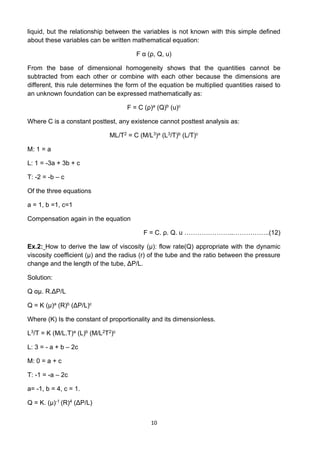
F α (ρ, Q, u)
From the base of dimensional homogeneity shows that the quantities cannot be
subtracted from each other or combine with each other because the dimensions are
different, this rule determines the form of the equation be multiplied quantities raised to
an unknown foundation can be expressed mathematically as:
F = C (ρ)a (Q)b (u)c
Where C is a constant posttest, any existence cannot posttest analysis as:
ML/T2 = C (M/L3)a (L3/T)b (L/T)c
M: 1 = a
L: 1 = -3a + 3b + c
T: -2 = -b – c
Of the three equations
a = 1, b =1, c=1
Compensation again in the equation
F = C. ρ. Q. u …………………..……………..(12)
Ex.2: How to derive the law of viscosity (µ): flow rate(Q) appropriate with the dynamic
viscosity coefficient (µ) and the radius (r) of the tube and the ratio between the pressure
change and the length of the tube, ΔP/L.
Solution:
Q αµ. R.ΔP/L
Q = K (µ)a (R)b (ΔP/L)c
Where (K) Is the constant of proportionality and its dimensionless.
L3/T = K (M/L.T)a (L)b (M/L2T2)c
L: 3 = - a + b – 2c
M: 0 = a + c
T: -1 = -a – 2c
a= -1, b = 4, c = 1.
Q = K. (µ)-1 (R)4 (ΔP/L)
11
Q = K. R4. (ΔP/L)/µ
µ = K. R4. (ΔP/L)/ Q.
Ex.3: Velocity fluid flow(u)appropriate with the tube(d) and dynamic viscosity(µ) and
density(ρ) of the fluid Find the value of the (Re) constant use of dimensional analysis:
u. α, d, µ, ρ.
L/T = Re. (L)a (M/L.T)b (M/L3)c.
L: 1 = a – b – 3c, M: 0 = b + c, L: -1 = -b, a= -1, b= 1, c= -1.
u=Re. (d-1) (µ) (ρ), u= Re. µ / d. ρ , Re. = u . d. ρ / µ.
Re. = (L/T)( L)(M/ L3) / (M/ L. T).
Ex.4: Find Law flow fluid velocity of hole for tank (u) appropriate with acceleration (g)
and head hole (Z) use of dimensional analysis.
u. α g, Z.
u= K (g)a (Z)b
L/T = K (L/T2)a (L)b
L: 1 = a + b
T: -1 = -2 a
a= 1/2
b= 1/2
u= k√(𝑔)(𝑍) .
12
C H A P T E R 2
Static fluid
Is a state of the fluid at rest and there is no relative movement between the different
layers, shall be velocity is zero and as a result have zero shear stress no matter how the
viscosity of the fluid and the workforce static fluid pressure forces only.
The term pressure in the fluid to signify the force of the fluid pressure located on the unit
area of the real surface.
P =
𝐹
𝐴
……………………..………………..(13)
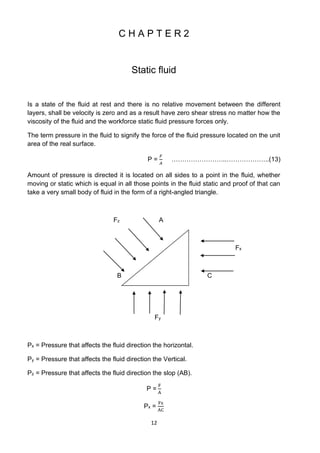
Amount of pressure is directed it is located on all sides to a point in the fluid, whether
moving or static which is equal in all those points in the fluid static and proof of that can
take a very small body of fluid in the form of a right-angled triangle.
Fz A
Fx
B C
Fy
Px = Pressure that affects the fluid direction the horizontal.
Py = Pressure that affects the fluid direction the Vertical.
Pz = Pressure that affects the fluid direction the slop (AB).
P =
F
A
Px =
Fx
AC
13
Fx = Px . AC …………………….………(14)
Fz = Pz . AB …………………………….(15)
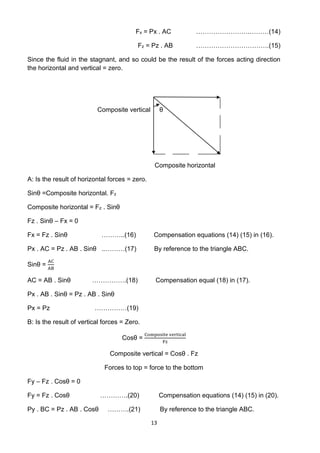
Since the fluid in the stagnant, and so could be the result of the forces acting direction
the horizontal and vertical = zero.
Composite vertical θ
Composite horizontal
A: Is the result of horizontal forces = zero.
Sinθ =Composite horizontal. Fz
Composite horizontal = Fz . Sinθ
Fz . Sinθ – Fx = 0
Fx = Fz . Sinθ ………..(16) Compensation equations (14) (15) in (16).
Px . AC = Pz . AB . Sinθ ..………(17) By reference to the triangle ABC.
Sinθ =
AC
AB
AC = AB . Sinθ …………….(18) Compensation equal (18) in (17).
Px . AB . Sinθ = Pz . AB . Sinθ
Px = Pz ……………(19)
B: Is the result of vertical forces = Zero.
Cosθ =
Composite vertical
Fz
Composite vertical = Cosθ . Fz
Forces to top = force to the bottom
Fy – Fz . Cosθ = 0
Fy = Fz . Cosθ ………….(20) Compensation equations (14) (15) in (20).
Py . BC = Pz . AB . Cosθ ……….(21) By reference to the triangle ABC.
14
BC
AB
= Cosθ
BC = AB . Cosθ …………….(22) Compensation equal (22) in (21).
Py . AB . Cosθ = Pz . AB . Cosθ
Py = Pz …………………………..(23) Equal equations (19) and (23).
Px = Py = Pz.
2.1 Atmospheric pressure - pressure and absolute
standard
Atmospheric pressure - is the pressure that Directs air on the earth's surface as a result
of weight, but this pressure changes with height and temperature and humidity, so it is a
way to calculated different by calculating fluid pressure. And uses Barometer to measure
atmospheric pressure and there are several types of metal Barometer and (Barometer
Torricelli’s).
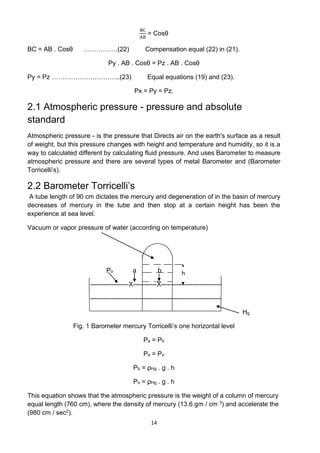
2.2 Barometer Torricelli’s
A tube length of 90 cm dictates the mercury and degeneration of in the basin of mercury
decreases of mercury in the tube and then stop at a certain height has been the
experience at sea level.
Vacuum or vapor pressure of water (according on temperature)
Po a b
------------------X-----------X----------------------------
-------------------------------------------------------------
Hg
Fig. 1 Barometer mercury Torricelli’s one horizontal level
Pa = Pb
Pa = Po
Pb = ρHg . g . h
Po = ρHg . g . h
This equation shows that the atmospheric pressure is the weight of a column of mercury
equal length (760 cm), where the density of mercury (13.6 gm / cm 3) and accelerate the
(980 cm / sec2).
h
15
Po = ρHg . g . h
Po = 13.6 gm / cm 3 X 980 cm/sec2 X 760 cm
Po = 1.013 X 10⁶ dyne/cm2. =1.013 N/m2 (Pa) = 1 atm = 0.987 bar = 1 bar
= 33.9 Ft H2O = 29.9 in Hg = 14.7 Psi (Ib/in2).
2.3 Standard pressure and absolute pressure
Standard pressure is the pressure that can be measured by devices such as manometer
pressure Borden gauge where atmospheric pressure is based. Standard pressure at a
point in a liquid is the pressure of the fluid only without adding atmospheric pressure. If
we add atmospheric pressure to standard pressure is considered absolute pressure.
Abs. Pressure = Gage Pressure + Atm. Pressure ……….………(24)
Note:
1- Gage pressure = Abs. Pressure – Atm. Pressure
2- Vacuum Pressure + Abs. Pressure = Atm. Pressure.
3- Vacuum Pressure = Negative pressure relative.
2.3.1 Pressure Gauges
1- Bourdon Gage:
Used to measure the standard pressure (relative) for air and gases confined as in the
wheel cars and consists of a metal tube curved (A) and one end closed and relate screw
(D) and other reach the source of the pressure causing pressure open slightly across the
tube moves the cursor (C) shows the amount of compression.
2- Aneroid Gage:
Used to measure the absolute pressure is a mechanical device consists of a short
cylinder empty (A) is surrounded by high light sensitive membrane (Diaphragm) (B) and
related arm (D) which indicator is installed (C) and read zero when the index does not
exist any pressure, so it measures the absolute pressure.
3- Open Manometer:
Is a tube-shaped transparent uses the height of the liquid surface in the tank open and if
the tank is closed and under particular pressure fluid then measure the height of the
liquid surface in Manometer plus rising output of the pressure off the liquid.
Used manometer also to measure the pressure in the water pipes and fluids the ongoing
and it must be contact angle in the pipe (90⸰) and Manometer openings should be flush
16
with the inner tube to get the correct reading. It may be the pressure in the pipe or tank
High, improves the use of heavy liquid such as mercury, for example in Manometer to
avoid excessive for Manometer [2].
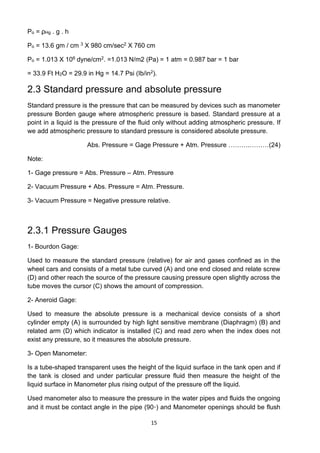
Ex.5: Measured pressure fluid tank by manometer simple open and be shaped (U) and
connect tank containing fluid to be measured pressure is being fluid in the tube and
touching mercury in manometer and the advantage of mercury high and specific weight
is calculated pressure after it gets balance level liquid ends of manometer and at (a - a).
Solution:
Patm
Tank A
h1 h2
a a
Hg
P =
F
A
=
W
A
=
M .g
A
P =
M
V
.V .g
A
=
ρ .A .h g
A
P = ρ . g . h Since the pressure at a level equal (a-a)
PA + ρA . gh1 = Patm + ρHg . gh2
PA = Patm+ ρHg . gh2 – ρA . gh1
Ex.6: Monometer normal simple open pressure when (A) less than atmospheric
pressure (unstable).
Patm
Tank A
Hg
a a
Solution:
At the level of (a-a) equal pressure.
1
h
2
h
17
PA = Patm – ρA .gh1 – ρHg. gh2
PA + ρA .gh1 + ρHg . gh2 = Patm
2.3.3 Differential manometer
A transparent tube character (U) of up between tubes or 2 tank to measure the pressure
difference between two points and use heavier or lighter fluids of the fluid in the tubes or
2 tank.
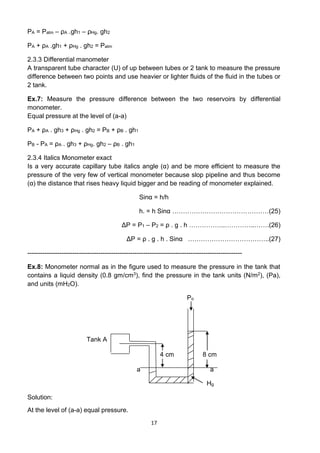
Ex.7: Measure the pressure difference between the two reservoirs by differential
monometer.
Equal pressure at the level of (a-a)
PA + ρA . gh3 + ρHg . gh2 = PB + ρB . gh1
PB - PA = ρA . gh3 + ρHg. gh2 – ρB . gh1
2.3.4 Italics Monometer exact
Is a very accurate capillary tube italics angle (α) and be more efficient to measure the
pressure of the very few of vertical monometer because slop pipeline and thus become
(α) the distance that rises heavy liquid bigger and be reading of monometer explained.
Sinα = h/h
h. = h Sinα ………………………………………(25)
ΔP = P1 – P2 = ρ . g . h ……………..…………..…….(26)
ΔP = ρ . g . h . Sinα ………………………………..(27)
----------------------------------------------------------------------------------------------------
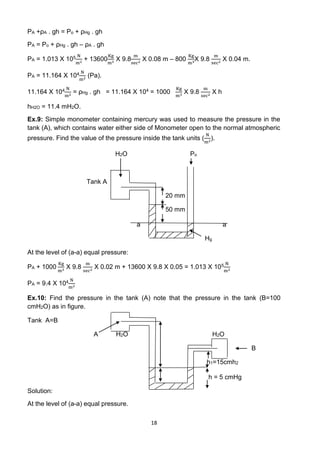
Ex.8: Monometer normal as in the figure used to measure the pressure in the tank that
contains a liquid density (0.8 gm/cm3), find the pressure in the tank units (N/m2), (Pa),
and units (mH2O).
Po
Tank A
4 cm 8 cm
a a
Hg
Solution:
At the level of (a-a) equal pressure.
18
PA +ρA . gh = Po + ρHg . gh
PA = Po + ρHg . gh – ρA . gh
PA = 1.013 X 10⁵ N
m2
+ 13600
Kg
m3
X 9.8
m
sec2
X 0.08 m – 800
Kg
m3
X 9.8
m
sec2
X 0.04 m.
PA = 11.164 X 10⁴ N
m2
(Pa).
11.164 X 10⁴ N
m2 = ρHg . gh = 11.164 X 104 = 1000
Kg
m3 X 9.8
m
sec2 X h
hH2O = 11.4 mH2O.
Ex.9: Simple monometer containing mercury was used to measure the pressure in the
tank (A), which contains water either side of Monometer open to the normal atmospheric
pressure. Find the value of the pressure inside the tank units (
N
m2
).
H2O Po
Tank A
20 mm
50 mm
a a
Hg
At the level of (a-a) equal pressure:
PA + 1000
Kg
m3
X 9.8
m
sec2
X 0.02 m + 13600 X 9.8 X 0.05 = 1.013 X 10⁵ N
m2
PA = 9.4 X 10⁴ N
m2
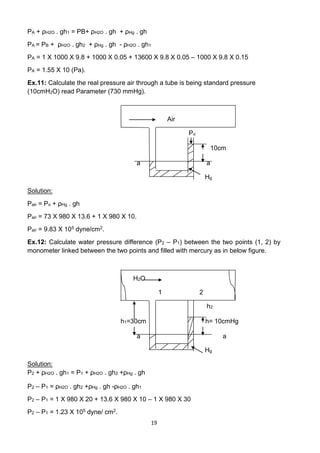
Ex.10: Find the pressure in the tank (A) note that the pressure in the tank (B=100
cmH2O) as in figure.
Tank A=B
A H2O H2O
B
h1=15cmh2
h = 5 cmHg
Solution:
At the level of (a-a) equal pressure.
19
PA + ρH2O . gh1 = PB+ ρH2O . gh + ρHg . gh
PA = PB + ρH2O . gh2 + ρHg . gh - ρH2O . gh1
PA = 1 X 1000 X 9.8 + 1000 X 0.05 + 13600 X 9.8 X 0.05 – 1000 X 9.8 X 0.15
PA = 1.55 X 10 (Pa).
Ex.11: Calculate the real pressure air through a tube is being standard pressure
(10cmH2O) read Parameter (730 mmHg).
Air
Po
10cm
a a
Hg
Solution:
Pair = Po + ρHg . gh
Pair = 73 X 980 X 13.6 + 1 X 980 X 10.
Pair = 9.83 X 10⁵ dyne/cm2.
Ex.12: Calculate water pressure difference (P2 – P1) between the two points (1, 2) by
monometer linked between the two points and filled with mercury as in below figure.
H2O
1 2
h2
h1=30cm h= 10cmHg
a a
Hg
Solution:
P2 + ρH2O . gh1 = P1 + ρH2O . gh2 +ρHg . gh
P2 – P1 = ρH2O . gh2 +ρHg . gh -ρH2O . gh1
P2 – P1 = 1 X 980 X 20 + 13.6 X 980 X 10 – 1 X 980 X 30
P2 – P1 = 1.23 X 10⁵ dyne/ cm2.
20
C H A P T E R 3
Fluid flow
In this chapter we take the movement of fluids and the forces that affect them and cause
the flow, and depends on the laws of fluid dynamic, is:
1. Conservation of Mass: the law of conservation of mass (continuity equation
represents).
2. Conservation of Energy: Energy Conservation Act (representing the Bernoulli
equation).
Law of conservation of mass (mass not perish not born out of nowhere) This represents
the flow of fluid in the pipe or the wind etc..
3.1 Conservation of Mass
Mass Flow rate (mo): is quantity fluid flow through the unit time through the tube section
or surface.
The unit of mass flow rate in (SI) unit (Kg/sec), (g/sec).
Flow rate depends on the density and speed of the fluid passing the tube section,
whenever the velocity or density or sectional area of the pipe increased flow rate.
The flow rate of the fluid = velocity X density X sectional area of the pipe [3].
mo = ρ . u . A ……………………….………..(28)
Since the circular tube section, the cross-section area equal to the square radius:
A =
𝜋
4
. d2
mo = ρ . u . (
𝜋
4
. d2)
Ex.13: Find mass flow rate water in units (kg/min) flowing in a pipe diameter of 10 cm
and velocity 1 (
m
sec
).
mo = ρ . u . A
mo = 1000
Kg
m3
X 1
m
sec
X
π
4
(
10
100
)2
mo = 7,85
Kg
sec
= 471
Kg
min
3.1.1 Flow rate (Q)
Is the volume of the fluid through the unity of time and used in the case of more fluid
because the density of the liquid nearly constant with temperature change and pressure,
21
units (SI) (
m3
sec
),(
lit
hr
), (
Cm3
sec
) and English (
Gal
hr
), (British gallon = 4.546 Liter),
English gallon = 3.78 Liter.
Q = Flow velocity X sectional area of the pipe.
Q = u . A
Ex.14: Calculate the flow rate crude oil through a tube diameter of 8 cm velocity 2 (
m
sec
),
units (
m3
hr
), and (
Lit
hr
).
Q = u . A
Q = 2
𝑚
𝑠𝑒𝑐
X
3600𝑠𝑒𝑐
ℎ𝑟
X
𝜋
4
X (
8
100
)2 m2
Q = 36.2
𝑚3
ℎ𝑟
Q = 36.2
𝑚3
ℎ𝑟
X1000
𝑙𝑖𝑡
m3
= 36.2 X 10³𝑙𝑖𝑡
hr
.
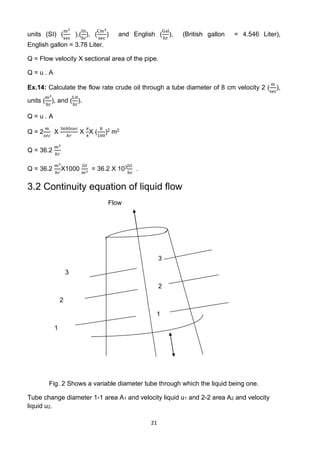
3.2 Continuity equation of liquid flow
Flow
3
3
2
2
1
1
Fig. 2 Shows a variable diameter tube through which the liquid being one.
Tube change diameter 1-1 area A1 and velocity liquid u1 and 2-2 area A2 and velocity
liquid u2.
22
And 3-3 area A3 and velocity liquid u3.
Mass flow rate through unit time in 1-1 mo = ρ1 . u1 . A1.
Mass flow rate through unit time in 2-2 mo = ρ2 . u2 . A2.
Mass flow rate through unit time in 2-2 mo = ρ3 . u3 . A3.
Quantity liquid through unit time for three section equal
mo
1 = mo
2 = mo
3
ρ1 . u1 . A1 = ρ2 . u2 . A2 = ρ3 . u3 . A3.
ρ1 = ρ2 = ρ3.
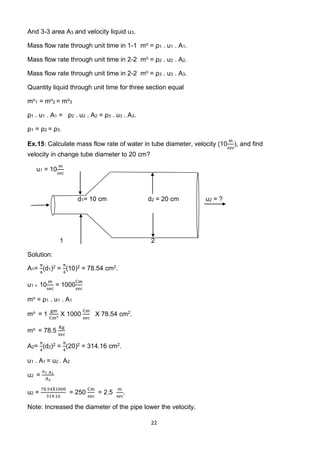
Ex.15: Calculate mass flow rate of water in tube diameter, velocity (10
m
sec
), and find
velocity in change tube diameter to 20 cm?
u1 = 10
𝑚
𝑠𝑒𝑐
d1= 10 cm d2 = 20 cm u2 = ?
1 2
Solution:
A1=
π
4
(d1)2 =
π
4
(10)2 = 78.54 cm2.
u1 = 10
m
sec
= 1000
Cm
sec
mo = ρ1 . u1 . A1
mo = 1
gm
Cm3
X 1000
Cm
sec
X 78.54 cm2.
mo = 78.5
Kg
sec
A2=
π
4
(d2)2 =
π
4
(20)2 = 314.16 cm2.
u1 . A1 = u2 . A2
u2 =
u1 .A1
A2
u2 =
78.54X1000
314.16
= 250
Cm
sec
= 2.5
m
sec
.
Note: Increased the diameter of the pipe lower the velocity.
23
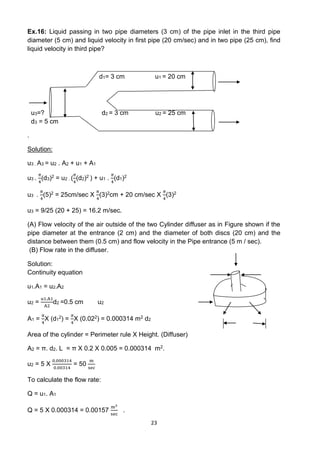
Ex.16: Liquid passing in two pipe diameters (3 cm) of the pipe inlet in the third pipe
diameter (5 cm) and liquid velocity in first pipe (20 cm/sec) and in two pipe (25 cm), find
liquid velocity in third pipe?
d1= 3 cm u1 = 20 cm
u3=? d2 = 3 cm u2 = 25 cm
d3 = 5 cm
.
Solution:
u3 . A3 = u2 . A2 + u1 + A1
u3 .
𝜋
4
(d3)2 = u2 . (
𝜋
4
(d2)2 ) + u1 .
𝜋
4
(d1)2
u3 .
𝜋
4
(5)2 = 25cm/sec X
𝜋
4
(3)2cm + 20 cm/sec X
𝜋
4
(3)2
u3 = 9/25 (20 + 25) = 16.2 m/sec.
(A) Flow velocity of the air outside of the two Cylinder diffuser as in Figure shown if the
pipe diameter at the entrance (2 cm) and the diameter of both discs (20 cm) and the
distance between them (0.5 cm) and flow velocity in the Pipe entrance (5 m / sec).
(B) Flow rate in the diffuser.
Solution:
Continuity equation
u1.A1 = u2.A2
u2 =
u1.A1
A2
d2 =0.5 cm u2
A1 =
𝜋
4
X (d1
2) =
𝜋
4
X (0.022) = 0.000314 m2 d2
Area of the cylinder = Perimeter rule X Height. (Diffuser)
A2 = π. d2. L = π X 0.2 X 0.005 = 0.000314 m2.
u2 = 5 X
0.000314
0.00314
= 50
m
sec
To calculate the flow rate:
Q = u1. A1
Q = 5 X 0.000314 = 0.00157
m3
sec
.
24
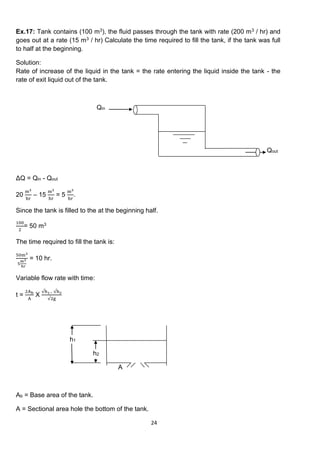
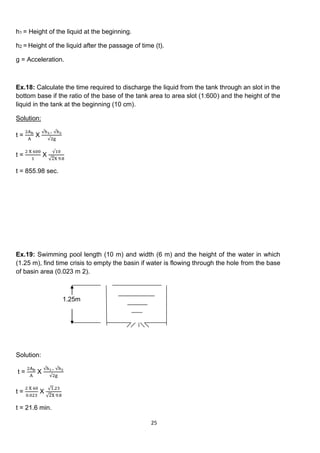
Ex.17: Tank contains (100 m3), the fluid passes through the tank with rate (200 m3 / hr) and
goes out at a rate (15 m3 / hr) Calculate the time required to fill the tank, if the tank was full
to half at the beginning.
Solution:
Rate of increase of the liquid in the tank = the rate entering the liquid inside the tank - the
rate of exit liquid out of the tank.
Qin
Qout
ΔQ = Qin - Qout
20
m3
hr
– 15
m3
hr
= 5
m3
hr
.
Since the tank is filled to the at the beginning half.
100
2
= 50 m3
The time required to fill the tank is:
50m3
5
m3
hr
= 10 hr.
Variable flow rate with time:
t =
2Ab
A
X
√h1− √h2
√2g
h1
h2
A
Ab = Base area of the tank.
A = Sectional area hole the bottom of the tank.
25
h1 = Height of the liquid at the beginning.
h2 = Height of the liquid after the passage of time (t).
g = Acceleration.
Ex.18: Calculate the time required to discharge the liquid from the tank through an slot in the
bottom base if the ratio of the base of the tank area to area slot (1:600) and the height of the
liquid in the tank at the beginning (10 cm).
Solution:
t =
2Ab
A
X
√h1− √h2
√2g
t =
2 X 600
1
X
√10
√2X 9.8
t = 855.98 sec.
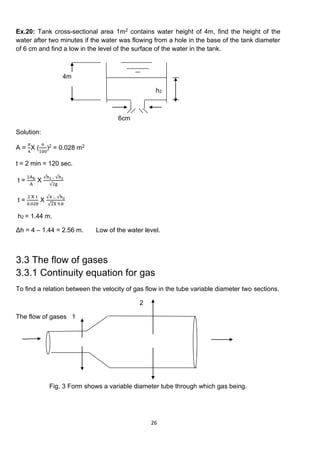
Ex.19: Swimming pool length (10 m) and width (6 m) and the height of the water in which
(1.25 m), find time crisis to empty the basin if water is flowing through the hole from the base
of basin area (0.023 m 2).
1.25m
Solution:
t =
2Ab
A
X
√h1− √h2
√2g
t =
2 X 60
0.023
X
√1.23
√2X 9.8
t = 21.6 min.
26
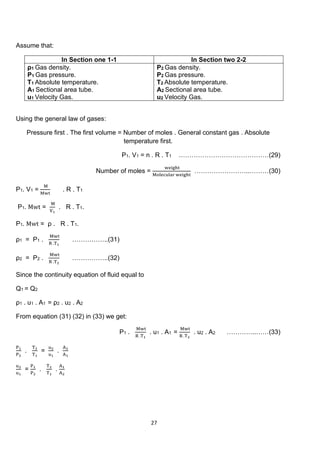
Ex.20: Tank cross-sectional area 1m2 contains water height of 4m, find the height of the
water after two minutes if the water was flowing from a hole in the base of the tank diameter
of 6 cm and find a low in the level of the surface of the water in the tank.
4m
h2
6cm
Solution:
A =
𝜋
4
X (
6
100
)2 = 0.028 m2
t = 2 min = 120 sec.
t =
2Ab
A
X
√h1− √h2
√2g
t =
2 X 1
0.028
X
√4 − √h2
√2X 9.8
h2 = 1.44 m.
Δh = 4 – 1.44 = 2.56 m. Low of the water level.
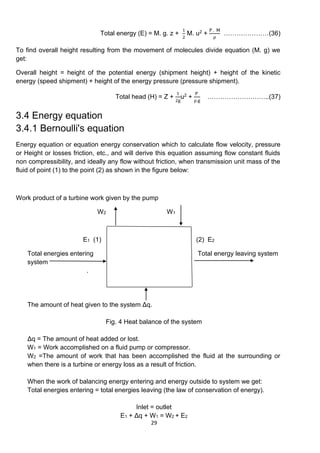
3.3 The flow of gases
3.3.1 Continuity equation for gas
To find a relation between the velocity of gas flow in the tube variable diameter two sections.
2
The flow of gases 1
Fig. 3 Form shows a variable diameter tube through which gas being.
27
Assume that:
In Section one 1-1 In Section two 2-2
ρ1 Gas density.
P1 Gas pressure.
T1 Absolute temperature.
A1 Sectional area tube.
u1 Velocity Gas.
Ρ2 Gas density.
P2 Gas pressure.
T2 Absolute temperature.
A2 Sectional area tube.
u2 Velocity Gas.
Using the general law of gases:
Pressure first . The first volume = Number of moles . General constant gas . Absolute
temperature first.
P1. V1 = n . R . T1 ……………………………………(29)
Number of moles =
weight
Molecular weight
……………………..………(30)
P1. V1 =
M
Mwt
. R . T1
P1. Mwt =
M
V1
. R . T1.
P1. Mwt = ρ . R . T1.
ρ1 = P1 .
Mwt
R .T1
……………..(31)
ρ2 = P2 .
Mwt
R .T2
……………..(32)
Since the continuity equation of fluid equal to
Q1 = Q2
ρ1 . u1 . A1 = ρ2 . u2 . A2
From equation (31) (32) in (33) we get:
P1 .
Mwt
R .T1
. u1 . A1 =
Mwt
R .T2
. u2 . A2 …………..……(33)
P1
P2
.
T2
T1
=
u2
u1
.
A2
A1
u2
u1
=
P1
P2
.
T2
T1
.
A1
A2
28
Ex.21: Find the ratio between my velocity gas pipe variable diameter if the pipe diameter in
the first section (2m) and when the second section (3m) and pressure in the first section (90
N/m2) In the second section (40 N/m2), either the temperature in the first section was (200
⸰F) and the second section (150 ⸰F).
Solution:
𝑢2
u1
=
𝑃1
P2
.
𝑇2
T1
.
𝐴1
A2
𝑢2
u1
=
90
40
.
150+460
200+460
.
π
4
X 22
π
4
X 32
𝑢2
u1
=
61
66
= 87.46
3.3.2 Fluid energy (Conservation of energy)
Energy cannot perish but transformed from one form to another equation that we get by
using this law called energy or Bernoulli equation, take different forms depending on the type
and the fluid flow and dimensions used in the analysis.
Types of energies that lead to the movement of fluids. Energy generally known as the
susceptibility to achievement work and divided into:
1 - Potential energy (Ez): This type of energy is produced often from the effect of the power
of gravity, for example, we find that the water stored in tanks high even have adequate
capacity for flow in pipelines for distribution, and downhill car from the top of the slope to the
bottom without running the engine powered underlying Depends on body mass and height
for a certain level [4].
Ez = M . g . Z ………………………..……………….(34)
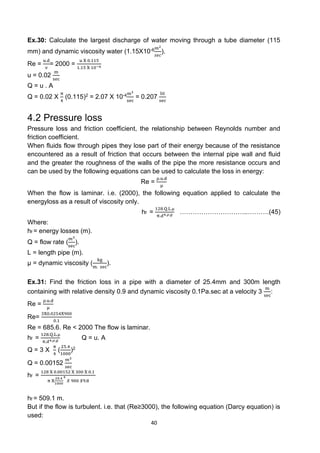
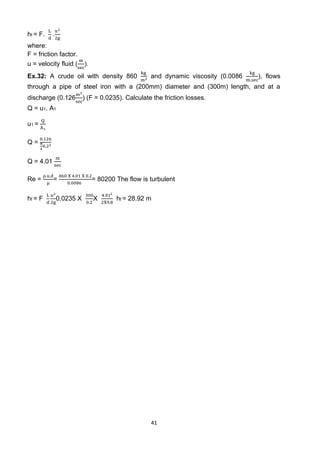
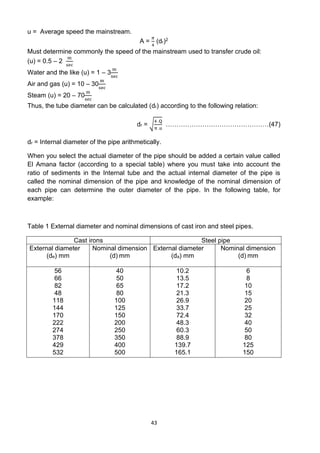
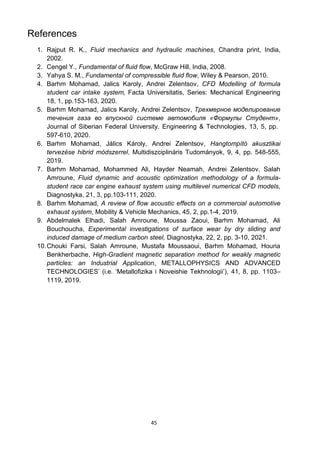
2 - Energy Pressure (Ep): Energy is those owned liquid molecules as a result of pressure If
the mass of the fluid pressure (P), and density (ρ).
Ep =
𝑃 . 𝑀
ρ
= P . V
V = volume of the fluid directed pressure admitted to the system to get work.
3. Kinetic energy: Kinetic energy: is energy consisting of body mass (M) movement depends
on the velocity (u).
Eh =
1
2
M. u2 ………………………..………………(35)
All energies measured in units of (force * Distance), (N. M) and is called the Joule. The total
energies of fluid particles in motion equal to the potential energy and kinetic energy and
pressure energy.
29
Total energy (E) = M. g. z +
1
2
M. u2 +
P . M
ρ
…………………(36)
To find overall height resulting from the movement of molecules divide equation (M. g) we
get:
Overall height = height of the potential energy (shipment height) + height of the kinetic
energy (speed shipment) + height of the energy pressure (pressure shipment).
Total head (H) = Z +
1
2g
u2 +
P
ρ.g
………………………..(37)
3.4 Energy equation
3.4.1 Bernoulli's equation
Energy equation or equation energy conservation which to calculate flow velocity, pressure
or Height or losses friction, etc., and will derive this equation assuming flow constant fluids
non compressibility, and ideally any flow without friction, when transmission unit mass of the
fluid of point (1) to the point (2) as shown in the figure below:
Work product of a turbine work given by the pump
W2 W1
E1 (1) (2) E2
Total energies entering Total energy leaving system
system
.
The amount of heat given to the system Δq.
Fig. 4 Heat balance of the system
Δq = The amount of heat added or lost.
W1 = Work accomplished on a fluid pump or compressor.
W2 =The amount of work that has been accomplished the fluid at the surrounding or
when there is a turbine or energy loss as a result of friction.
When the work of balancing energy entering and energy outside to system we get:
Total energies entering = total energies leaving (the law of conservation of energy).
Inlet = outlet
E1 + Δq + W1 = W2 + E2
30
E2 – E1 = Δq + W1 + W2
Since the fluid is ideal (no friction)
There are no Add and there is no drag of the temperature of the system. (Δq = 0)
There is no pump or compressor. W1 = 0
E2 – E1 = 0 …………………………………..……(38)
Where (E1) (E2) are Total of the energies of the molecules of the fluid at the point (38)
and (36) are entering the system and leaving the system and which have been collected
at one equation:
E = M. g. z +
1
2
M. u2 +
P . M
ρ
Substitute equation (2) in (1) we get:
[M. g. z2 +
1
2
M. u2
2 +
P2 . M
ρ
] - [M. g. z1 +
1
2
M. u1
2+
P1 . M
ρ
] = 0
And dividing the equation (M. g) we get:
[Z2 +
1
2g
. u2
2 +
P2
ρg
] - [Z1 +
1
2g
. u1
2+
P1
ρg
] = 0
Z1 +
u1
2
2g
+
P1
ρg
= Z2+
u2
2
2g
+
P2
ρg
Or [ΔZ +
Δu2
2g
+
ΔP
ρg
] = 0
This equation is called the Bernoulli equation.
ΔZ = Height product (Height shipment).
Δu2
2g
= Velocity height, (shipment velocity).
ΔP
ρg
= Pressure head, (shipment Pressure).
3.4.2 Limitation of Bernoulli's equation
1 - the speed of each liquid molecules cross-section tube be regular.
2 - not the effect of external forces, except for the effect of gravity on the liquid.
3 - not part of the energy loss during the flow of the liquid.
4 - If the flow of fluid through a curved path when it should be calculated the loss of
energy as a result of centrifugal forces, and this is when using the Bernoulli equation [5].
Application examples of the Bernoulli equation:
31
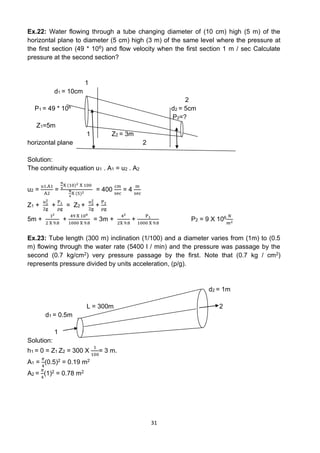
Ex.22: Water flowing through a tube changing diameter of (10 cm) high (5 m) of the
horizontal plane to diameter (5 cm) high (3 m) of the same level where the pressure at
the first section (49 * 106) and flow velocity when the first section 1 m / sec Calculate
pressure at the second section?
1
d1 = 10cm
2
P1 = 49 * 106 d2 = 5cm
P2=?
Z1=5m
1 Z2 = 3m
horizontal plane 2
Solution:
The continuity equation u1 . A1 = u2 . A2
u2 =
u1.A1
A2
=
π
4
X (10)2 X 100
π
4
X (5)2
= 400
cm
sec
= 4
m
sec
Z1 +
u1
2
2g
+
P1
ρg
= Z2 +
u2
2
2g
+
P2
ρg
5m +
12
2 X 9.8
+
49 X 106
1000 X 9.8
= 3m +
42
2X 9.8
+
P1
1000 X 9.8
P2 = 9 X 10⁶ 𝑁
𝑚2
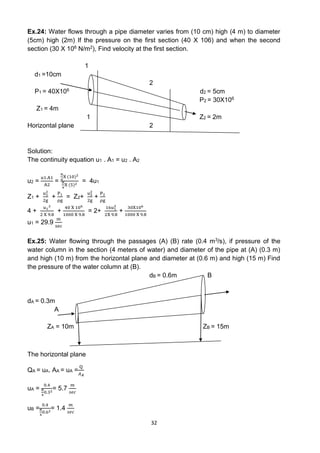
Ex.23: Tube length (300 m) inclination (1/100) and a diameter varies from (1m) to (0.5
m) flowing through the water rate (5400 l / min) and the pressure was passage by the
second (0.7 kg/cm2) very pressure passage by the first. Note that (0.7 kg / cm2)
represents pressure divided by units acceleration, (p/g).
d2 = 1m
L = 300m 2
d1 = 0.5m
1
Solution:
h1 = 0 = Z1 Z2 = 300 X
1
100
= 3 m.
A1 =
𝜋
4
(0.5)2 = 0.19 m2
A2 =
𝜋
4
(1)2 = 0.78 m2
32
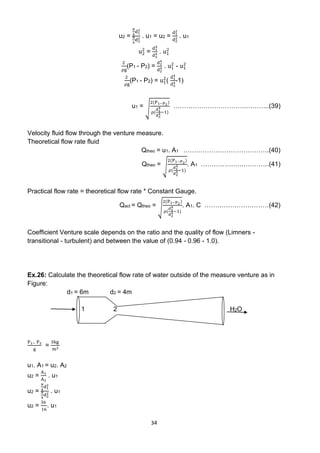
Ex.24: Water flows through a pipe diameter varies from (10 cm) high (4 m) to diameter
(5cm) high (2m) If the pressure on the first section (40 X 106) and when the second
section (30 X 106 N/m2), Find velocity at the first section.
1
d1 =10cm
2
P1 = 40X106 d2 = 5cm
P2 = 30X106
Z1 = 4m
1 Z2 = 2m
Horizontal plane 2
Solution:
The continuity equation u1 . A1 = u2 . A2
u2 =
u1.A1
A2
=
π
4
X (10)2
π
4
X (5)2
= 4u1
Z1 +
u1
2
2g
+
P1
ρg
= Z2+
u2
2
2g
+
P2
ρg
4 +
u1
2
2 X 9.8
+
40 X 106
1000 X 9.8
= 2+
16u1
2
2X 9.8
+
30X106
1000 X 9.8
u1 = 29.9
m
sec
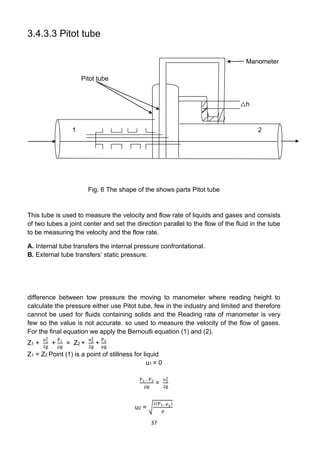
Ex.25: Water flowing through the passages (A) (B) rate (0.4 m3/s), if pressure of the
water column in the section (4 meters of water) and diameter of the pipe at (A) (0.3 m)
and high (10 m) from the horizontal plane and diameter at (0.6 m) and high (15 m) Find
the pressure of the water column at (B).
dB = 0.6m B
dA = 0.3m
A
ZA = 10m ZB = 15m
The horizontal plane
QA = uA. AA = uA =
Q
𝐴𝐴
uA =
0.4
𝜋
4
0.32
= 5.7
𝑚
𝑠𝑒𝑐
uB =
0.4
𝜋
4
0.62
= 1.4
𝑚
𝑠𝑒𝑐
33
ZA +
uA
2
2g
+
PA
ρg
= ZB+
uB
2
2g
+
PB
ρg
10 +
5.72
2 X 9.8
+
ρghA
1000 X 9.8
= 15+
1.42
2X 9.8
+
PB
1000 X 9.8
𝑃𝐵
𝜌𝑔
= 0.6 mH2O PB = 5880
N2
m
3.4.3 Bernoulli's equation applications
The basic equation of Bernoulli equation has many applications in fluid movement and
the most important of these applications:
1- Venturi meter.
2- Orifice meter.
3- Pitot tube.
4- Measuring the velocity of the liquid flow of a circular hole in the tank.
5- Bernoulli's equation when there is a pump.
3.4.3.1 Venturi meter
Used to measure the flow rate of the liquid which consists of the following parts:
a - Convergent cone:
Is a short pipeline starts from the tube diameter associated with (d1) and take its walls
convergent to the small diameter (d2).
b - Throat
The walls are parallel and have a diameter equal to (d2) and constant.
3 - Divergent cone
Is the last part of the measure you take walls divergent the diameter (d2) to diameter
(d1), have a length of about (3-4) weaken length of the cone of convergence, when the
flow of fluid through the scale of the first section (d1) to the second section (d2) during
the convergence cone, As a result accelerate the liquid increases flow velocity at (d2)
and this increase quickly lead to a decrease in pressure, there is fixed ratio are relying
upon between (d1/d2) and preferably be (1/3) (1/2) until you get to read a set of column
manometer not get other problems, after the arrival of the liquid to the last section (cone
spacing) less speed and pressure and increases rapidly when decries the lead to break
the course of this fluid works spacing along the cone (3-4) times the length of the cone
of convergence as well as to reduce the loss due to friction [6].
To find a formula to measure the flow rate in this measure apply Bernoulli's equation
when the colon (1) (2) in the scale in its horizontal so that it is equal height (Z1 = Z2) we
get:
Z1 +
u1
2
2g
+
P1
ρg
= Z2+
u2
2
2g
+
P2
ρg
P1− P2
ρg
=
u2
2−u1
2
2g
2
ρg
(P1 - P2) = u2
2
-u1
2
u1. A1 = u2. A2
u2 =
A1
A2
. u1
34
u2 =
π
4
d1
2
π
4
d2
2 . u1 = u2 =
d1
2
d2
2 . u1
u2
2
=
d1
4
d2
4 . u1
2
2
ρg
(P1 - P2) =
d1
4
d2
4 . u1
2
- u1
2
2
ρg
(P1 - P2) = u1
2
(
d1
4
d2
4-1)
u1 = √
2(P1−P2)
ρ(
d1
4
d2
4−1)
…………………………….………..(39)
Velocity fluid flow through the venture measure.
Theoretical flow rate fluid
Qtheo = u1. A1 ………………………………….(40)
Qtheo = √
2(P1−P2)
ρ(
d1
4
d2
4−1)
. A1 ……………….………….(41)
Practical flow rate = theoretical flow rate * Constant Gauge.
Qact = Qtheo = √
2(P1−P2)
ρ(
d1
4
d2
4−1)
. A1. C …………………………(42)
Coefficient Venture scale depends on the ratio and the quality of flow (Limners -
transitional - turbulent) and between the value of (0.94 - 0.96 - 1.0).
Ex.26: Calculate the theoretical flow rate of water outside of the measure venture as in
Figure:
d1 = 6m d2 = 4m
1 2 H2O
P1− P2
g
=
3kg
m2
u1. A1 = u2. A2
u2 =
A1
A2
. u1
u2 =
π
4
d1
2
π
4
d2
2 . u1
u2 =
36
16
. u1
35
Z1 = Z2
P1− P2
g
=
u2
2−u1
2
2g
3
kg
m2
1000
kg
m3
=
1
2x9.8
(
362
162
. u1
2
- u2
2
)
u1 = 0.12
m
sec
Qtheo = u1. A1
Qtheo =
π
4
(6)2 X 0.12
Qtheo = 3.4
m3
sec
Ex.27: Calculate the height of a column of mercury in manometer linked measure
Venturi horizontal the situation which diameter entrance (160 mm) diameter necked (80
mm) and being through which oil and weight Specific (0.8) knowing that constant
measure (C = 1) and the rate of oil flow practical (50 liters /seconds).
d1 = 160mm d2 = 80mm
1 2 H2O
h
Hg
A1 =
π
4
d1
2
=
π
4
(
160
10
)2 = 201.06 cm2
A2 =
π
4
d1
2 = π
4
(
80
10
)2 = 50.26 cm2
Qact = 50
lit
sec
X
1
1000
m3
lit
X
(100cm)3
m3
= 50 X103 cm3
lit
Qact = C.Qtheo
Qtheo = C.A √
2△P
⍴[(
A1
2
A2
2)−1]
50 X103= 1 X 201.06 √
2△𝑃
0.8[(
201.062
50.262 )−1]
△P = 3.7 X 10⁵ 𝑑𝑦𝑛𝑒
𝑐𝑚2
△P = ⍴Hg.g.h
h =
3.7 𝑋 105
13.6
𝑔
𝑐𝑚3𝑋 980 𝑐𝑚/𝑠𝑒𝑐2
= 27.8 cm Hg
36
3.4.3.2 Orifice meter
Advantage of this measure accuracy and simplicity and ease of installation and
maintenance and low cost, which is a plate with a small hole at its center, is placed in
the course of the fluid and the hole narrow lead to an increase in the velocity of the fluid
(according to the equation of continuity), leading to reduced pressure (according to
equation Bernoulli) and is measuring pressure by manometers the links between the two
points (1) and (2) to obtain the final the equation of continuity same the derivation
measure of Venturi by applying Bernoulli's equation and the continuity equation:
Qact= C.A √
2△P
⍴[(
D1
4
D2
4)−1]
……………..……………….(43)
Value of the constant is different in this measure, ranging from 0.61 - 0.62, and
sometimes to 0.65 depending on the type and flow according to the ratio
D2
D1
.
O Orifice plate
1 2
Manometer
h
Fig. 5 The shape of the shows parts measure of orifice
Ex.27: Calculate the flow rate of oil the practical (density 0.8 g/cm3) through a tube
diameter (20 cm) contains on Orifice plate diameter (10cm) (C=0.64) the read
manometer (10 mmHg).
d1 = 20 cm d2 = 10cm P1-P2 = ⍴gh C=0.64
Qact= C.A √
2△P
⍴[(
D1
4
D2
4)−1]
Qact = 0.64 X π/4(20)2 X√
2(13.6 X 980 X 10)
0.8[(
204
104 )−1]
Qact = 9461 cm3/sec
37
3.4.3.3 Pitot tube
Manometer
Pitot tube
△h
1 2
Fig. 6 The shape of the shows parts Pitot tube
This tube is used to measure the velocity and flow rate of liquids and gases and consists
of two tubes a joint center and set the direction parallel to the flow of the fluid in the tube
to be measuring the velocity and the flow rate.
A. Internal tube transfers the internal pressure confrontational.
B. External tube transfers’ static pressure.
difference between tow pressure the moving to manometer where reading height to
calculate the pressure either use Pitot tube, few in the industry and limited and therefore
cannot be used for fluids containing solids and the Reading rate of manometer is very
few so the value is not accurate. so used to measure the velocity of the flow of gases.
For the final equation we apply the Bernoulli equation (1) and (2).
Z1 +
u1
2
2g
+
P1
ρg
= Z2 +
u2
2
2g
+
P2
ρg
Z1 = Z2 Point (1) is a point of stillness for liquid
u1 = 0
P1− P2
ρg
=
u2
2
2g
u2 = √
2(P1−P2)
ρ
38
This equation is used to measure the velocity of the flow rate gas by Pitot tube, and to
calculate the flow rate theoretical = velocity X area Section of the tube [7].
Qtheo = u2.A2
Qtheo= A2 X √
2(P1−P2)
ρ
Qtheo = Qact
C = 1
Ex.28: Pitot Tube is used to measure the velocity of the flow of kerosene density (0.8
g/cm3) The read manometer (5 cmHg). Calculate the velocity u2 = √
2(P1−P2)
ρ
, u2 =
√
2(5 X 13.6 X 980)
0.8
= 182.5 cm/sec.
39
C H A P T E R 4
Real fluid flow and pressure loss in pipes
4.1 Reynolds number (Re)
Reynolds Number of a flowing fluid obtained by dividing the inertia force of the fluid
(velocity X diameter) into the kinematic viscosity (viscous force per unit length).
Re =
u.d
ν
=
ρ.u.d
μ
……………….………………(44)
Where:
d =diameter of flow section (m).
ν = kinematic viscosity (
m3
sec
).
ρ= Mass density of fluid (
kg
m3).
μ = dynamic velocity of fluid (
N.sec
m2 ). or (Pa. sec).
4.1.1 Types of flow
A. Laminar flow
This type of flow when the flow rate is slowly and velocity at any fixed point does not
change with time.
B. Turbulent flow
This type of flow when the flow rate is high and the speed at any point variable with time
and equal to the velocity [8].
Note:
We can find the flow of the fluid laminar flow or turbulent flow or transitional flow
according to Reynolds number, we depend on the following:
1- Laminar flow: Re ≤ 2000.
2- Transitional flow: 2000<Re<3000.
3- Turbulent flow: Re≥3000.
Ex.29: Determine the type of flow in a pipe with a diameter of (25.4mm) containing with
relative density (0.9) and dynamic viscosity (0.1Pa.sec) at a velocity (3
m
sec
)?
Re =
ρ.u.d
μ
Re
3X0.0254X900
0.1
Re = 685.6. Re < 2000The flow is laminar.
40
Ex.30: Calculate the largest discharge of water moving through a tube diameter (115
mm) and dynamic viscosity water (1.15X10⁻⁶𝑚2
𝑠𝑒𝑐
).
Re =
u.d
ν
= 2000 =
u X 0.115
1.15 X 10⁻⁶
u = 0.02
m
sec
Q = u . A
Q = 0.02 X
π
4
(0.115)2 = 2.07 X 10⁻⁴m3
sec
= 0.207
lit
sec
4.2 Pressure loss
Pressure loss and friction coefficient, the relationship between Reynolds number and
friction coefficient.
When fluids flow through pipes they lose part of their energy because of the resistance
encountered as a result of friction that occurs between the internal pipe wall and fluid
and the greater the roughness of the walls of the pipe the more resistance occurs and
can be used by the following equations can be used to calculate the loss in energy:
Re =
ρ.u.d
μ
When the flow is laminar. i.e. (2000), the following equation applied to calculate the
energyloss as a result of viscosity only.
hf =
128.Q.L.µ
π.𝑑4.𝜌.𝑔
…………………………..……….(45)
Where:
hf = energy losses (m).
Q = flow rate (
𝑚3
sec
).
L = length pipe (m).
µ = dynamic viscosity (
kg
m. sec
).
Ex.31: Find the friction loss in a pipe with a diameter of 25.4mm and 300m length
containing with relative density 0.9 and dynamic viscosity 0.1Pa.sec at a velocity 3
m
sec
:
Re =
ρ.u.d
μ
Re=
3X0.0254X900
0.1
Re = 685.6. Re < 2000 The flow is laminar.
hf =
128.Q.L.µ
π.𝑑4.𝜌.𝑔
Q = u. A
Q = 3 X
π
4
(
25.4
1000
)2
Q = 0.00152
𝑚3
sec
hf =
128 X 0.00152 X 300 X 0.1
π X
25.4
1000
4
𝑋 900 𝑋9.8
hf = 509.1 m.
But if the flow is turbulent. i.e. that (Re≥3000), the following equation (Darcy equation) is
used:
41
hf = F.
L
d
.
𝑢2
2g
where:
F = friction factor.
u = velocity fluid (
m
sec
).
Ex.32: A crude oil with density 860
kg
m3
and dynamic viscosity (0.0086
kg
m.sec
), flows
through a pipe of steel iron with a (200mm) diameter and (300m) length, and at a
discharge (0.126
m3
sec
) (F = 0.0235). Calculate the friction losses.
Q = u1. A1
u1 =
Q
A1
Q =
0.126
π
4
0.22
Q = 4.01
m
sec
Re =
ρ.u.d
μ
=
860 X 4.01 X 0.2
0.0086
= 80200 The flow is turbulent
hf = F
L
d
𝑢2
2g
0.0235 X
300
0.2
X
4.012
2X9.8
hf = 28.92 m
42
C H A P T E R 5
Pipes and valves
5.1 Pipe
Pipe is one of the transfer of liquids and gases. In chemical plants must transfer a lot of
liquids and gases, so it cannot dispense pipes, in addition to the solid material can be
transferred dust. General Pipe systems consist of a cylindrical pipe of circular section,
where it has compared to piped box-section [9].
Provides the correct conditions in the cylinders with the following circular
section:
1 - Less than the thermal Stream loss.
2 - high resistance.
3 - In an economic Production.
Before the construction of pipeline systems should provide the following:
1 - Type of material to be transferred to this system.
2 - The amount of material.
3 - Pressure in the system.
4 - Temperature.
5.1.1 Pipe industries
Pipe Industries used in the transfer of crude oil are steel pipes made of open hard steel
like electric steel furnaces.
5.1.2 Mainstream continuity equation
Q = u. A
Q =
m
⍴
………………….………………………(46)
Q = Volumetric mainstream transferred material.
m = The amount of material transferred per unit time.
⍴ = Density transferred material.
A = Section of the pipeline area.
43
u = Average speed the mainstream.
A =
𝜋
4
(dr)2
Must determine commonly the speed of the mainstream used to transfer crude oil:
(u) = 0.5 – 2
m
sec
Water and the like (u) = 1 – 3
m
sec
Air and gas (u) = 10 – 30
m
sec
Steam (u) = 20 – 70
m
sec
Thus, the tube diameter can be calculated (dr) according to the following relation:
dr = √
4 .Q
π .u
…………………………………………(47)
dr = Internal diameter of the pipe arithmetically.
When you select the actual diameter of the pipe should be added a certain value called
El Amana factor (according to a special table) where you must take into account the
ratio of sediments in the Internal tube and the actual internal diameter of the pipe is
called the nominal dimension of the pipe and knowledge of the nominal dimension of
each pipe can determine the outer diameter of the pipe. In the following table, for
example:
Table 1 External diameter and nominal dimensions of cast iron and steel pipes.
Cast irons Steel pipe
External diameter
(de) mm
Nominal dimension
(d) mm
External diameter
(da) mm
Nominal dimension
(d) mm
56
66
82
48
118
144
170
222
274
378
429
532
40
50
65
80
100
125
150
200
250
350
400
500
10.2
13.5
17.2
21.3
26.9
33.7
72.4
48.3
60.3
88.9
139.7
165.1
6
8
10
15
20
25
32
40
50
80
125
150
44
Ex.33: Pipe transfer of kerosene was designed flow rate of kerosene (12
cm3
sec
) and the
velocity of the passage of kerosene in the tube (1.5
cm
sec
) Calculate the outer diameter of
the tube and the tube of steel.
dr = √
4 .𝑄
𝜋 .𝑢
dr = √
4 𝑋 12
𝜋 𝑋 1.5
= 3.56 cm
dr = 35.6 mm
Nominal dimension from the table = 40
External diameter(de) from the table = 48.3 mm.
5.3 Types of pipes for the metal inside in its industry
1- Steel pipe: high-pressure-resistant and have a good ability to form and can be
transferred effect weak materials such as water and air.
2- Cost irons: of those pipes are made in the case of underground transport because
it has the ability to resist corrosion, and this kind be heavy and expensive at the
same time, the transfer of materials used acidic, and it is difficult to form these
tubes.
3- Plastic pipe: often used PVC pipe and be corrosion resistant and easy to operate
when heated and can be welded as well as paste them. Because of the high
resistance to corrosion fit used for the transport of gases severe reaction. Adverse
impact resistance, mechanical low temperatures [10].
5.4 Valves
Valves by which is controlled by opening and closing the gates, as well as to control the
flow of liquids and gases in the Pipe.
5.4.1 The most important purposes of valves
1- Allow total and total stop of the flow.
2- Amend flow.
3- Prevent flow in the adverse the trend.
4- Safety valve.
5.4.2 Type of valves
1- Gate valve.
2- Plug valve.
3- Diaphragm valve.
4- Ball valve
5- Globe valve.
6- Butterfly valve.
7- Check valve.
8- Safety valve.
45
References
1. Rajput R. K., Fluid mechanics and hydraulic machines, Chandra print, India,
2002.
2. Cengel Y., Fundamental of fluid flow, McGraw Hill, India, 2008.
3. Yahya S. M., Fundamental of compressible fluid flow, Wiley & Pearson, 2010.
4. Barhm Mohamad, Jalics Karoly, Andrei Zelentsov, CFD Modelling of formula
student car intake system, Facta Universitatis, Series: Mechanical Engineering
18, 1, pp.153-163, 2020.
5. Barhm Mohamad, Jalics Karoly, Andrei Zelentsov, Трехмерное моделирование
течения газа во впускной системе автомобиля «Формулы Студент»,
Journal of Siberian Federal University. Engineering & Technologies, 13, 5, pp.
597-610, 2020.
6. Barhm Mohamad, Jálics Károly, Andrei Zelentsov, Hangtompító akusztikai
tervezése hibrid módszerrel, Multidiszciplináris Tudományok, 9, 4, pp. 548-555,
2019.
7. Barhm Mohamad, Mohammed Ali, Hayder Neamah, Andrei Zelentsov, Salah
Amroune, Fluid dynamic and acoustic optimization methodology of a formula-
student race car engine exhaust system using multilevel numerical CFD models,
Diagnostyka, 21, 3, pp.103-111, 2020.
8. Barhm Mohamad, A review of flow acoustic effects on a commercial automotive
exhaust system, Mobility & Vehicle Mechanics, 45, 2, pp.1-4, 2019.
9. Abdelmalek Elhadi, Salah Amroune, Moussa Zaoui, Barhm Mohamad, Ali
Bouchoucha, Experimental investigations of surface wear by dry sliding and
induced damage of medium carbon steel, Diagnostyka, 22, 2, pp. 3-10, 2021.
10.Chouki Farsi, Salah Amroune, Mustafa Moussaoui, Barhm Mohamad, Houria
Benkherbache, High-Gradient magnetic separation method for weakly magnetic
particles: an Industrial Application, METALLOPHYSICS AND ADVANCED
TECHNOLOGIES’ (i.e. ‘Metallofizika i Noveishie Tekhnologii’), 41, 8, pp. 1103–
1119, 2019.

Lecture Notes in Fluid Mechanics

  • 1.
    1 Lecture Notes in FluidMechanics Barhm Abdullah Mohamad Erbil Polytechnic University LinkedIn: https://www.linkedin.com/in/barhm-mohamad-900b1b138/ Google Scholar: https://scholar.google.com/citations?user=KRQ96qgAAAAJ&hl=en ResearchGate: https://www.researchgate.net/profile/Barhm_Mohamad YouTube channel: https://www.youtube.com/channel/UC16-u0i4mxe6TmAUQH0kmNw
  • 2.
    2 C H AP T E R 1 Fluid mechanics Fluid mechanics is a science in study the fluid of liquids and gases in the cases of silence and movement and the forces acting on them can be divided materials found in nature into two branches. A- Solid Matters. B-Fluid Matters: Fluid material is divided into two parts: 1- Liquid Matters. 2- Gaseous Matters. Fluid mechanics include fluid materials such as water, air and other while unique science (Hydraulics) in the water as a liquid within the fluid material. Hydrodynamics science is the study of the (Flow Fields) for materials may be not the viscosity or compression or correlation but may even be a few special the weight important and fluid called (Ideal fluid). A fluid: is any substance that conforms the shape of its container and does not permanently resist distortion. Gases, liquids and vapors are considered to have the characteristic of fluids. If a fluid affected by changes in pressure, it is called compressible fluid otherwise, it is called incompressible fluid [1]. 1.1 Units The basic dimensions in fluid mechanics are below: Property Symbol SI Unit English Unit Force F N Ib Length L m, cm Ft, in Mass M Kg Slug Time T S, min, hr S, min, hr Temperature t Co Fo
  • 3.
    3 1.2 Derived units Someunits are expressed in terms other units which are derived from fundamental units. They are known derived units and they are: Quantity symbol SI unite Area A m2 Density ρ Kg/m3 Force F N Kinematic viscosity U,ν m2/sec Liner velocity u m/sec Acceleration g m/sec2 Mass flow rate mo Kg/sec Power ƿ N.m/sec= J/sec=W Pressure P N/m2=Pa Shear stress Ʈ N/m2=Pa Surface tension Ơ N/m Viscosity µ Kg/m.sec, Pa.sec Specific Volume Ѵ m3/N Flow Q m3/sec Moment M N.m Specific heat constant pressure Cp J/Kg.ko Specific heat constant volume Cv J/Kg.ko diameter D m diameter cylinder d m Energy E N.m Force F N Length L m Mass M,m N.sec2/m Vapor pressure Pv N/m2 Radius r m Reynolds number Re. Temperature t Co Second T sec Volume V m3 Weight W N 1.2.1 Greek symbols Specific weight ɣ gamma N/m3 Viscosity µ mu N.sec/m2 Kinematic viscosity U, ν nu m2/sec Mass density e rho N.sec2/m4 Surface tension Ơ sigma N/m Shear stress Ʈ tau N/m2 beta β beta alpha α alpha
  • 4.
    4 1.2.2 Conversion factor Dischargeor flow: 1 m3/sec = 35.31 ft3/sec. Acceleration: 9.80665 m/sec2 = 980 cm/sen2= 32 ft/sec2. Volume: 1 m3 = 1000 liter = 35.31 ft3. Temperature (T) Fo = 1.8Co+ 32 Ro = Fo+ 460 Ko = Co + 273o Force: 1N = 0.2248 Ibf. Velocity: 1 m/sec = 3.281 ft/sec. Work: 1 N.m = 1 Joules. Pressure: 1 KN/m2 = 1Kpa = 0.145 Ib/in2. Vapor pressure: 1 atm = 1.013 x 10⁵ N/m2 (1mm) Hg = 0.0394 in Hg. (1mm) H2O = 9.807 pa. Mass: 1 Kg = 1000gm = 0.068 slug. Length: 1 mm = 0.0394 in; 1m = 3.281 ft. 1in = 0.0254 m 1Km = 0.62 mil; 1mil = 1609.3 m Area: 1m2 = 0.00155 in2. Power: N.m/sec = J/sec = Watt. 1KW = 1.341 HP = 737.5 Ib.ft/sec. 1 hp = 550 Ib.ft/sec. Force: Newton = 0.2248 Ib. Dynamic viscosityµ (mu) = N.sec/m2 = Pa.sec = 10 poise =0.02 Lb.sec/ft2. Kinematic viscosity U (nu) L2T.= m2.sec = 10000 stokes (Cm2/sec) = 10.7 ft2/sec. Mass (M) Kg = 1000gm = 0.068 slug
  • 5.
    5 Lean body massLbm = 454 gm Ton = 1000 kg Mass density (M/L3) Kg/m3 = 0.00194 slug/ft3 Weighted density ɣ (W/L3) = N.m3 = 0.006 Lbf/ ft3. Ex.1: What all units of the system quantity: 1- Force 2- Pressure 3- Work 4-Power 5- Mass density. Solution: 1- Force: Force = Mass X Acceleration F = M x g F= M x Length/ time2. 2- pressure: P = Force / area 3- Work: W = F x Distance. 4- Power: Power = work time 5- mass density: ρ = Mass Volume H.W: Find the units for viscosity, Sp.wt., pressure, mass, density. 1.3 Characteristics of flow and fluid property 1- mass density: or density [symbol: ρ (rho)] It is ratio of mass of fluid to its volume. ρ= mass of fluid volume of fluid = m v ……………………..…………(1) The common units used of density are kg/m3, g/cm3, Ib/ft3. 2- Weight density: or specific weight or: [symbol: (Sp. wt.)] The ratio of weight of fluid to it is volume at standard temperature and pressure. Sp. Wt. = weight of fluid volume of fluid = w V …………………………(2) The common units used of density are N m3 , dyne cm3 , Ib ft3 .
  • 6.
    6 The common weightdensity of water is 9.81 KN 𝑚3 . Can express the relationship between the density of the equation: ɣ = ρ . g Resulting from the Newton equation: (F = M . g). The use of the force of attraction and accelerating (W= M. g) And dividing the parties to volume (W/V=M/V. g). We get (ɣ=ρ. g). 3- Relative density: is the ratio between the density of the material and the density of water at 4Co, where the great water density under normal atmospheric pressure. Relative density = Density of the material The density of water ………..…………(3) 4- Specific volume: [symbol: V] The ratio of volume of fluid to it is mass. It is the reverse of mass density. V = Volume of fluid Mass of fluid ……………………………….(4) The common units used of density are m3 kg , cm3 g , ft3 Ib . 5- Compressibility Is the portability size of the fluid to change the impact of external forces located the fluid. Liquid its portability (Incompressibility). Gas its portability compressibility to resize and reason is to the distances between the molecules of the fluid. 6- Viscosity: resistance is carried out by the layers of the fluid to the external force. That all of the fluid in nature has a viscosity resulting from fractions cohesion and momentum exchange between the different layers of the fluid rises and these fluids called fluid true or viscous fluid where the friction between the layers flow when and where you get two cases of the flow: A-laminar flow: Does not occurs blending. B -turbulent flow: Occurs rotational blending between the fluid layers. Ideal fluid: No viscosity they are not found in nature, but a portion of the fluid viscosity is too small to the extent that it ignored in the calculations and the viscosity of the types: 1- Dynamic viscosity: [symbol: µ (mu)] Dynamic viscosity: know is the shear stress and speed slope Change vilocity Change distance ( du dy ). µ= Shear strain Rate of shear strain = τ du dy ………………………..(5) τ = µ. du dy ………………………………….(6)
  • 7.
    7 shear strain: Isthe force acting on a body fluid or solid in unit area of the body. Shearing strain j = f A , force area ……………………(7) Viscosity of any fluid depends only on temperature. Vigorous and increases molecular mixing, thus the viscosity, increases. In case of a liquid, we find that increasing. Its temperature separates the molecules from each other, weakening. The attraction between them so the viscosity decreases. Thus, the relation between temperature and the viscosity is shown in figure below. The relation between shear stress & velocity gradient ( du dy ). Consider a, fluid confined between two plats as shown in, figure below. Which are situated at a very short distance (y) a part show in fig. the fluid motion is assumed to take place in a series of infinitely then layers, free to slide one over the other is no turbulence; the layer adjacent to the stationary plate is at rest while the layer adjacent to the moving plate has a velocity (u). F A τ u L u Oil Where: u: Velocity of the moving plate (varies linearly from at the stationary surface to maximum at the contact surface between the moving plate and oil). A: Contact area between the moving plate and oil. F: Applied force to the moving plate. L: Thickness of oil layer. This expression for the viscous stress was first proven by Newton equation of viscosity. Almost all fluids have a constant coefficient of proportionality and are referred to as Newtonian fluids and the fluids that do not follow this law are non- Newtonian fluids. The figure below shows these types of fluids. 2- Kinematic viscosity: [symbol: U (nu)]
  • 8.
    8 The ratio ofthe dynamic viscosity to the fluid mass density. U= µ ρ = M L.T . L3 M ……………………….…………….(8) The common units used of kinematic viscosity are ( m2 sec , cm2 sec , ft2 sec , stoke). m2 sec = 10 stoke. 1.4 Flow Characteristics The term flow Characteristics refers to a quantity that may change from one point to another or from one space to another: 1- Shear stress: [symbol: τ (tau)] It is the force per unit surface area that resists the sliding of the fluid layers. The common units for shear stress are N/m2 = Pa, dyne/cm2. 2- Pressure: [symbol: P] It is the force per unit cross sectional area normal to the force direction. The common units used for pressure is N/m2 = Pa, dyne/cm2, atm, bar, psi, The pressure difference between two points refers to (ΔP). The pressure could be expressed as liquid height (or head). Where: P = ρ.g.h and ΔP = ρ.g.Δh h: is the liquid height or head, units (m, cm, and ft). 3- Velocity: [symbol: u] is defined as average distance achieved for the time of units ( 𝑚 𝑠𝑒𝑐 ). 4- Discharge or Flow rate: [symbol: Q] Discharge is the volume of fluid transferred per unit time. Q = A. u where A: is the cross sectional area of the flow normal to the flow direction. And the common units used for volumetric flow are m3/sec, cm3/sec, ft3/sec. 5- Force: [symbol: F] Is all that is produced or is tries to produce or stop or change movement. Units Newton, dyne. N = 100000 dyne. 6- Time: [symbol: T, t] the Units is second.
  • 9.
    9 7- Acceleration: [symbol:g] is the Rate of change of speed per unit time, the Units 𝑚 𝑠𝑒𝑐2 . 1.5 Dimensional analysis Is an important means of modern science of Fluid Mechanics is a field of mathematics fields where deals with mathematics dimensions quantities. The methods of dimensional analysis set out on the basis of Fourier for homogeneity dimensional known since 1822, which show that the equation that express normal relations between the quantities must be homogeneous and any that the dimensions of the left side are the same dimensions right side, used to check the examples mathematical through the dimensions of quantities required. Analyses dimensional helps to know the way to get a lot of information from the experiences of a few. In order to clarification the steps we take one sporting equations, but the expressive power equation on the surface in a liquid consonant. F = ɣ. h. A ………………………….……………..(9) assume that the dimensions of the specific weight and height and area known and unknown dimensions of force. The dimensions of the force made up of mass, length and time can be know from the equation. F = M. L / T2 ……………………………………..(10) Dimensions (F) = Dimensions(ɣ). Dimensions(h). Dimensions(A). M1. L1. T-2 = (ML-2T-2). (L1). (L2) ……………………………..(11) Where the unknowns are (a, b, c). If applied to the base of the homogeneity analysis ^ basic be conform on each side of the equation. a= 1, b= -2 + 1 + 2 = 1, c= -2. So, the Dimensions (F) Equals. M1. L1. T-2 = ML/T2 Equal to the force that can be the directly simplification and without mathematical operations, but what work above is the usual way to get dimensional information for any amount. Another example of the solution assumes the force that can be received from the circular hole depends on the flow rate Q and average speed u and mass density of the
  • 10.
    10 liquid, but therelationship between the variables is not known with this simple defined about these variables can be written mathematical equation: F α (ρ, Q, u) From the base of dimensional homogeneity shows that the quantities cannot be subtracted from each other or combine with each other because the dimensions are different, this rule determines the form of the equation be multiplied quantities raised to an unknown foundation can be expressed mathematically as: F = C (ρ)a (Q)b (u)c Where C is a constant posttest, any existence cannot posttest analysis as: ML/T2 = C (M/L3)a (L3/T)b (L/T)c M: 1 = a L: 1 = -3a + 3b + c T: -2 = -b – c Of the three equations a = 1, b =1, c=1 Compensation again in the equation F = C. ρ. Q. u …………………..……………..(12) Ex.2: How to derive the law of viscosity (µ): flow rate(Q) appropriate with the dynamic viscosity coefficient (µ) and the radius (r) of the tube and the ratio between the pressure change and the length of the tube, ΔP/L. Solution: Q αµ. R.ΔP/L Q = K (µ)a (R)b (ΔP/L)c Where (K) Is the constant of proportionality and its dimensionless. L3/T = K (M/L.T)a (L)b (M/L2T2)c L: 3 = - a + b – 2c M: 0 = a + c T: -1 = -a – 2c a= -1, b = 4, c = 1. Q = K. (µ)-1 (R)4 (ΔP/L)
  • 11.
    11 Q = K.R4. (ΔP/L)/µ µ = K. R4. (ΔP/L)/ Q. Ex.3: Velocity fluid flow(u)appropriate with the tube(d) and dynamic viscosity(µ) and density(ρ) of the fluid Find the value of the (Re) constant use of dimensional analysis: u. α, d, µ, ρ. L/T = Re. (L)a (M/L.T)b (M/L3)c. L: 1 = a – b – 3c, M: 0 = b + c, L: -1 = -b, a= -1, b= 1, c= -1. u=Re. (d-1) (µ) (ρ), u= Re. µ / d. ρ , Re. = u . d. ρ / µ. Re. = (L/T)( L)(M/ L3) / (M/ L. T). Ex.4: Find Law flow fluid velocity of hole for tank (u) appropriate with acceleration (g) and head hole (Z) use of dimensional analysis. u. α g, Z. u= K (g)a (Z)b L/T = K (L/T2)a (L)b L: 1 = a + b T: -1 = -2 a a= 1/2 b= 1/2 u= k√(𝑔)(𝑍) .
  • 12.
    12 C H AP T E R 2 Static fluid Is a state of the fluid at rest and there is no relative movement between the different layers, shall be velocity is zero and as a result have zero shear stress no matter how the viscosity of the fluid and the workforce static fluid pressure forces only. The term pressure in the fluid to signify the force of the fluid pressure located on the unit area of the real surface. P = 𝐹 𝐴 ……………………..………………..(13) Amount of pressure is directed it is located on all sides to a point in the fluid, whether moving or static which is equal in all those points in the fluid static and proof of that can take a very small body of fluid in the form of a right-angled triangle. Fz A Fx B C Fy Px = Pressure that affects the fluid direction the horizontal. Py = Pressure that affects the fluid direction the Vertical. Pz = Pressure that affects the fluid direction the slop (AB). P = F A Px = Fx AC
  • 13.
    13 Fx = Px. AC …………………….………(14) Fz = Pz . AB …………………………….(15) Since the fluid in the stagnant, and so could be the result of the forces acting direction the horizontal and vertical = zero. Composite vertical θ Composite horizontal A: Is the result of horizontal forces = zero. Sinθ =Composite horizontal. Fz Composite horizontal = Fz . Sinθ Fz . Sinθ – Fx = 0 Fx = Fz . Sinθ ………..(16) Compensation equations (14) (15) in (16). Px . AC = Pz . AB . Sinθ ..………(17) By reference to the triangle ABC. Sinθ = AC AB AC = AB . Sinθ …………….(18) Compensation equal (18) in (17). Px . AB . Sinθ = Pz . AB . Sinθ Px = Pz ……………(19) B: Is the result of vertical forces = Zero. Cosθ = Composite vertical Fz Composite vertical = Cosθ . Fz Forces to top = force to the bottom Fy – Fz . Cosθ = 0 Fy = Fz . Cosθ ………….(20) Compensation equations (14) (15) in (20). Py . BC = Pz . AB . Cosθ ……….(21) By reference to the triangle ABC.
  • 14.
    14 BC AB = Cosθ BC =AB . Cosθ …………….(22) Compensation equal (22) in (21). Py . AB . Cosθ = Pz . AB . Cosθ Py = Pz …………………………..(23) Equal equations (19) and (23). Px = Py = Pz. 2.1 Atmospheric pressure - pressure and absolute standard Atmospheric pressure - is the pressure that Directs air on the earth's surface as a result of weight, but this pressure changes with height and temperature and humidity, so it is a way to calculated different by calculating fluid pressure. And uses Barometer to measure atmospheric pressure and there are several types of metal Barometer and (Barometer Torricelli’s). 2.2 Barometer Torricelli’s A tube length of 90 cm dictates the mercury and degeneration of in the basin of mercury decreases of mercury in the tube and then stop at a certain height has been the experience at sea level. Vacuum or vapor pressure of water (according on temperature) Po a b ------------------X-----------X---------------------------- ------------------------------------------------------------- Hg Fig. 1 Barometer mercury Torricelli’s one horizontal level Pa = Pb Pa = Po Pb = ρHg . g . h Po = ρHg . g . h This equation shows that the atmospheric pressure is the weight of a column of mercury equal length (760 cm), where the density of mercury (13.6 gm / cm 3) and accelerate the (980 cm / sec2). h
  • 15.
    15 Po = ρHg. g . h Po = 13.6 gm / cm 3 X 980 cm/sec2 X 760 cm Po = 1.013 X 10⁶ dyne/cm2. =1.013 N/m2 (Pa) = 1 atm = 0.987 bar = 1 bar = 33.9 Ft H2O = 29.9 in Hg = 14.7 Psi (Ib/in2). 2.3 Standard pressure and absolute pressure Standard pressure is the pressure that can be measured by devices such as manometer pressure Borden gauge where atmospheric pressure is based. Standard pressure at a point in a liquid is the pressure of the fluid only without adding atmospheric pressure. If we add atmospheric pressure to standard pressure is considered absolute pressure. Abs. Pressure = Gage Pressure + Atm. Pressure ……….………(24) Note: 1- Gage pressure = Abs. Pressure – Atm. Pressure 2- Vacuum Pressure + Abs. Pressure = Atm. Pressure. 3- Vacuum Pressure = Negative pressure relative. 2.3.1 Pressure Gauges 1- Bourdon Gage: Used to measure the standard pressure (relative) for air and gases confined as in the wheel cars and consists of a metal tube curved (A) and one end closed and relate screw (D) and other reach the source of the pressure causing pressure open slightly across the tube moves the cursor (C) shows the amount of compression. 2- Aneroid Gage: Used to measure the absolute pressure is a mechanical device consists of a short cylinder empty (A) is surrounded by high light sensitive membrane (Diaphragm) (B) and related arm (D) which indicator is installed (C) and read zero when the index does not exist any pressure, so it measures the absolute pressure. 3- Open Manometer: Is a tube-shaped transparent uses the height of the liquid surface in the tank open and if the tank is closed and under particular pressure fluid then measure the height of the liquid surface in Manometer plus rising output of the pressure off the liquid. Used manometer also to measure the pressure in the water pipes and fluids the ongoing and it must be contact angle in the pipe (90⸰) and Manometer openings should be flush
  • 16.
    16 with the innertube to get the correct reading. It may be the pressure in the pipe or tank High, improves the use of heavy liquid such as mercury, for example in Manometer to avoid excessive for Manometer [2]. Ex.5: Measured pressure fluid tank by manometer simple open and be shaped (U) and connect tank containing fluid to be measured pressure is being fluid in the tube and touching mercury in manometer and the advantage of mercury high and specific weight is calculated pressure after it gets balance level liquid ends of manometer and at (a - a). Solution: Patm Tank A h1 h2 a a Hg P = F A = W A = M .g A P = M V .V .g A = ρ .A .h g A P = ρ . g . h Since the pressure at a level equal (a-a) PA + ρA . gh1 = Patm + ρHg . gh2 PA = Patm+ ρHg . gh2 – ρA . gh1 Ex.6: Monometer normal simple open pressure when (A) less than atmospheric pressure (unstable). Patm Tank A Hg a a Solution: At the level of (a-a) equal pressure. 1 h 2 h
  • 17.
    17 PA = Patm– ρA .gh1 – ρHg. gh2 PA + ρA .gh1 + ρHg . gh2 = Patm 2.3.3 Differential manometer A transparent tube character (U) of up between tubes or 2 tank to measure the pressure difference between two points and use heavier or lighter fluids of the fluid in the tubes or 2 tank. Ex.7: Measure the pressure difference between the two reservoirs by differential monometer. Equal pressure at the level of (a-a) PA + ρA . gh3 + ρHg . gh2 = PB + ρB . gh1 PB - PA = ρA . gh3 + ρHg. gh2 – ρB . gh1 2.3.4 Italics Monometer exact Is a very accurate capillary tube italics angle (α) and be more efficient to measure the pressure of the very few of vertical monometer because slop pipeline and thus become (α) the distance that rises heavy liquid bigger and be reading of monometer explained. Sinα = h/h h. = h Sinα ………………………………………(25) ΔP = P1 – P2 = ρ . g . h ……………..…………..…….(26) ΔP = ρ . g . h . Sinα ………………………………..(27) ---------------------------------------------------------------------------------------------------- Ex.8: Monometer normal as in the figure used to measure the pressure in the tank that contains a liquid density (0.8 gm/cm3), find the pressure in the tank units (N/m2), (Pa), and units (mH2O). Po Tank A 4 cm 8 cm a a Hg Solution: At the level of (a-a) equal pressure.
  • 18.
    18 PA +ρA .gh = Po + ρHg . gh PA = Po + ρHg . gh – ρA . gh PA = 1.013 X 10⁵ N m2 + 13600 Kg m3 X 9.8 m sec2 X 0.08 m – 800 Kg m3 X 9.8 m sec2 X 0.04 m. PA = 11.164 X 10⁴ N m2 (Pa). 11.164 X 10⁴ N m2 = ρHg . gh = 11.164 X 104 = 1000 Kg m3 X 9.8 m sec2 X h hH2O = 11.4 mH2O. Ex.9: Simple monometer containing mercury was used to measure the pressure in the tank (A), which contains water either side of Monometer open to the normal atmospheric pressure. Find the value of the pressure inside the tank units ( N m2 ). H2O Po Tank A 20 mm 50 mm a a Hg At the level of (a-a) equal pressure: PA + 1000 Kg m3 X 9.8 m sec2 X 0.02 m + 13600 X 9.8 X 0.05 = 1.013 X 10⁵ N m2 PA = 9.4 X 10⁴ N m2 Ex.10: Find the pressure in the tank (A) note that the pressure in the tank (B=100 cmH2O) as in figure. Tank A=B A H2O H2O B h1=15cmh2 h = 5 cmHg Solution: At the level of (a-a) equal pressure.
  • 19.
    19 PA + ρH2O. gh1 = PB+ ρH2O . gh + ρHg . gh PA = PB + ρH2O . gh2 + ρHg . gh - ρH2O . gh1 PA = 1 X 1000 X 9.8 + 1000 X 0.05 + 13600 X 9.8 X 0.05 – 1000 X 9.8 X 0.15 PA = 1.55 X 10 (Pa). Ex.11: Calculate the real pressure air through a tube is being standard pressure (10cmH2O) read Parameter (730 mmHg). Air Po 10cm a a Hg Solution: Pair = Po + ρHg . gh Pair = 73 X 980 X 13.6 + 1 X 980 X 10. Pair = 9.83 X 10⁵ dyne/cm2. Ex.12: Calculate water pressure difference (P2 – P1) between the two points (1, 2) by monometer linked between the two points and filled with mercury as in below figure. H2O 1 2 h2 h1=30cm h= 10cmHg a a Hg Solution: P2 + ρH2O . gh1 = P1 + ρH2O . gh2 +ρHg . gh P2 – P1 = ρH2O . gh2 +ρHg . gh -ρH2O . gh1 P2 – P1 = 1 X 980 X 20 + 13.6 X 980 X 10 – 1 X 980 X 30 P2 – P1 = 1.23 X 10⁵ dyne/ cm2.
  • 20.
    20 C H AP T E R 3 Fluid flow In this chapter we take the movement of fluids and the forces that affect them and cause the flow, and depends on the laws of fluid dynamic, is: 1. Conservation of Mass: the law of conservation of mass (continuity equation represents). 2. Conservation of Energy: Energy Conservation Act (representing the Bernoulli equation). Law of conservation of mass (mass not perish not born out of nowhere) This represents the flow of fluid in the pipe or the wind etc.. 3.1 Conservation of Mass Mass Flow rate (mo): is quantity fluid flow through the unit time through the tube section or surface. The unit of mass flow rate in (SI) unit (Kg/sec), (g/sec). Flow rate depends on the density and speed of the fluid passing the tube section, whenever the velocity or density or sectional area of the pipe increased flow rate. The flow rate of the fluid = velocity X density X sectional area of the pipe [3]. mo = ρ . u . A ……………………….………..(28) Since the circular tube section, the cross-section area equal to the square radius: A = 𝜋 4 . d2 mo = ρ . u . ( 𝜋 4 . d2) Ex.13: Find mass flow rate water in units (kg/min) flowing in a pipe diameter of 10 cm and velocity 1 ( m sec ). mo = ρ . u . A mo = 1000 Kg m3 X 1 m sec X π 4 ( 10 100 )2 mo = 7,85 Kg sec = 471 Kg min 3.1.1 Flow rate (Q) Is the volume of the fluid through the unity of time and used in the case of more fluid because the density of the liquid nearly constant with temperature change and pressure,
  • 21.
    21 units (SI) ( m3 sec ),( lit hr ),( Cm3 sec ) and English ( Gal hr ), (British gallon = 4.546 Liter), English gallon = 3.78 Liter. Q = Flow velocity X sectional area of the pipe. Q = u . A Ex.14: Calculate the flow rate crude oil through a tube diameter of 8 cm velocity 2 ( m sec ), units ( m3 hr ), and ( Lit hr ). Q = u . A Q = 2 𝑚 𝑠𝑒𝑐 X 3600𝑠𝑒𝑐 ℎ𝑟 X 𝜋 4 X ( 8 100 )2 m2 Q = 36.2 𝑚3 ℎ𝑟 Q = 36.2 𝑚3 ℎ𝑟 X1000 𝑙𝑖𝑡 m3 = 36.2 X 10³𝑙𝑖𝑡 hr . 3.2 Continuity equation of liquid flow Flow 3 3 2 2 1 1 Fig. 2 Shows a variable diameter tube through which the liquid being one. Tube change diameter 1-1 area A1 and velocity liquid u1 and 2-2 area A2 and velocity liquid u2.
  • 22.
    22 And 3-3 areaA3 and velocity liquid u3. Mass flow rate through unit time in 1-1 mo = ρ1 . u1 . A1. Mass flow rate through unit time in 2-2 mo = ρ2 . u2 . A2. Mass flow rate through unit time in 2-2 mo = ρ3 . u3 . A3. Quantity liquid through unit time for three section equal mo 1 = mo 2 = mo 3 ρ1 . u1 . A1 = ρ2 . u2 . A2 = ρ3 . u3 . A3. ρ1 = ρ2 = ρ3. Ex.15: Calculate mass flow rate of water in tube diameter, velocity (10 m sec ), and find velocity in change tube diameter to 20 cm? u1 = 10 𝑚 𝑠𝑒𝑐 d1= 10 cm d2 = 20 cm u2 = ? 1 2 Solution: A1= π 4 (d1)2 = π 4 (10)2 = 78.54 cm2. u1 = 10 m sec = 1000 Cm sec mo = ρ1 . u1 . A1 mo = 1 gm Cm3 X 1000 Cm sec X 78.54 cm2. mo = 78.5 Kg sec A2= π 4 (d2)2 = π 4 (20)2 = 314.16 cm2. u1 . A1 = u2 . A2 u2 = u1 .A1 A2 u2 = 78.54X1000 314.16 = 250 Cm sec = 2.5 m sec . Note: Increased the diameter of the pipe lower the velocity.
  • 23.
    23 Ex.16: Liquid passingin two pipe diameters (3 cm) of the pipe inlet in the third pipe diameter (5 cm) and liquid velocity in first pipe (20 cm/sec) and in two pipe (25 cm), find liquid velocity in third pipe? d1= 3 cm u1 = 20 cm u3=? d2 = 3 cm u2 = 25 cm d3 = 5 cm . Solution: u3 . A3 = u2 . A2 + u1 + A1 u3 . 𝜋 4 (d3)2 = u2 . ( 𝜋 4 (d2)2 ) + u1 . 𝜋 4 (d1)2 u3 . 𝜋 4 (5)2 = 25cm/sec X 𝜋 4 (3)2cm + 20 cm/sec X 𝜋 4 (3)2 u3 = 9/25 (20 + 25) = 16.2 m/sec. (A) Flow velocity of the air outside of the two Cylinder diffuser as in Figure shown if the pipe diameter at the entrance (2 cm) and the diameter of both discs (20 cm) and the distance between them (0.5 cm) and flow velocity in the Pipe entrance (5 m / sec). (B) Flow rate in the diffuser. Solution: Continuity equation u1.A1 = u2.A2 u2 = u1.A1 A2 d2 =0.5 cm u2 A1 = 𝜋 4 X (d1 2) = 𝜋 4 X (0.022) = 0.000314 m2 d2 Area of the cylinder = Perimeter rule X Height. (Diffuser) A2 = π. d2. L = π X 0.2 X 0.005 = 0.000314 m2. u2 = 5 X 0.000314 0.00314 = 50 m sec To calculate the flow rate: Q = u1. A1 Q = 5 X 0.000314 = 0.00157 m3 sec .
  • 24.
    24 Ex.17: Tank contains(100 m3), the fluid passes through the tank with rate (200 m3 / hr) and goes out at a rate (15 m3 / hr) Calculate the time required to fill the tank, if the tank was full to half at the beginning. Solution: Rate of increase of the liquid in the tank = the rate entering the liquid inside the tank - the rate of exit liquid out of the tank. Qin Qout ΔQ = Qin - Qout 20 m3 hr – 15 m3 hr = 5 m3 hr . Since the tank is filled to the at the beginning half. 100 2 = 50 m3 The time required to fill the tank is: 50m3 5 m3 hr = 10 hr. Variable flow rate with time: t = 2Ab A X √h1− √h2 √2g h1 h2 A Ab = Base area of the tank. A = Sectional area hole the bottom of the tank.
  • 25.
    25 h1 = Heightof the liquid at the beginning. h2 = Height of the liquid after the passage of time (t). g = Acceleration. Ex.18: Calculate the time required to discharge the liquid from the tank through an slot in the bottom base if the ratio of the base of the tank area to area slot (1:600) and the height of the liquid in the tank at the beginning (10 cm). Solution: t = 2Ab A X √h1− √h2 √2g t = 2 X 600 1 X √10 √2X 9.8 t = 855.98 sec. Ex.19: Swimming pool length (10 m) and width (6 m) and the height of the water in which (1.25 m), find time crisis to empty the basin if water is flowing through the hole from the base of basin area (0.023 m 2). 1.25m Solution: t = 2Ab A X √h1− √h2 √2g t = 2 X 60 0.023 X √1.23 √2X 9.8 t = 21.6 min.
  • 26.
    26 Ex.20: Tank cross-sectionalarea 1m2 contains water height of 4m, find the height of the water after two minutes if the water was flowing from a hole in the base of the tank diameter of 6 cm and find a low in the level of the surface of the water in the tank. 4m h2 6cm Solution: A = 𝜋 4 X ( 6 100 )2 = 0.028 m2 t = 2 min = 120 sec. t = 2Ab A X √h1− √h2 √2g t = 2 X 1 0.028 X √4 − √h2 √2X 9.8 h2 = 1.44 m. Δh = 4 – 1.44 = 2.56 m. Low of the water level. 3.3 The flow of gases 3.3.1 Continuity equation for gas To find a relation between the velocity of gas flow in the tube variable diameter two sections. 2 The flow of gases 1 Fig. 3 Form shows a variable diameter tube through which gas being.
  • 27.
    27 Assume that: In Sectionone 1-1 In Section two 2-2 ρ1 Gas density. P1 Gas pressure. T1 Absolute temperature. A1 Sectional area tube. u1 Velocity Gas. Ρ2 Gas density. P2 Gas pressure. T2 Absolute temperature. A2 Sectional area tube. u2 Velocity Gas. Using the general law of gases: Pressure first . The first volume = Number of moles . General constant gas . Absolute temperature first. P1. V1 = n . R . T1 ……………………………………(29) Number of moles = weight Molecular weight ……………………..………(30) P1. V1 = M Mwt . R . T1 P1. Mwt = M V1 . R . T1. P1. Mwt = ρ . R . T1. ρ1 = P1 . Mwt R .T1 ……………..(31) ρ2 = P2 . Mwt R .T2 ……………..(32) Since the continuity equation of fluid equal to Q1 = Q2 ρ1 . u1 . A1 = ρ2 . u2 . A2 From equation (31) (32) in (33) we get: P1 . Mwt R .T1 . u1 . A1 = Mwt R .T2 . u2 . A2 …………..……(33) P1 P2 . T2 T1 = u2 u1 . A2 A1 u2 u1 = P1 P2 . T2 T1 . A1 A2
  • 28.
    28 Ex.21: Find theratio between my velocity gas pipe variable diameter if the pipe diameter in the first section (2m) and when the second section (3m) and pressure in the first section (90 N/m2) In the second section (40 N/m2), either the temperature in the first section was (200 ⸰F) and the second section (150 ⸰F). Solution: 𝑢2 u1 = 𝑃1 P2 . 𝑇2 T1 . 𝐴1 A2 𝑢2 u1 = 90 40 . 150+460 200+460 . π 4 X 22 π 4 X 32 𝑢2 u1 = 61 66 = 87.46 3.3.2 Fluid energy (Conservation of energy) Energy cannot perish but transformed from one form to another equation that we get by using this law called energy or Bernoulli equation, take different forms depending on the type and the fluid flow and dimensions used in the analysis. Types of energies that lead to the movement of fluids. Energy generally known as the susceptibility to achievement work and divided into: 1 - Potential energy (Ez): This type of energy is produced often from the effect of the power of gravity, for example, we find that the water stored in tanks high even have adequate capacity for flow in pipelines for distribution, and downhill car from the top of the slope to the bottom without running the engine powered underlying Depends on body mass and height for a certain level [4]. Ez = M . g . Z ………………………..……………….(34) 2 - Energy Pressure (Ep): Energy is those owned liquid molecules as a result of pressure If the mass of the fluid pressure (P), and density (ρ). Ep = 𝑃 . 𝑀 ρ = P . V V = volume of the fluid directed pressure admitted to the system to get work. 3. Kinetic energy: Kinetic energy: is energy consisting of body mass (M) movement depends on the velocity (u). Eh = 1 2 M. u2 ………………………..………………(35) All energies measured in units of (force * Distance), (N. M) and is called the Joule. The total energies of fluid particles in motion equal to the potential energy and kinetic energy and pressure energy.
  • 29.
    29 Total energy (E)= M. g. z + 1 2 M. u2 + P . M ρ …………………(36) To find overall height resulting from the movement of molecules divide equation (M. g) we get: Overall height = height of the potential energy (shipment height) + height of the kinetic energy (speed shipment) + height of the energy pressure (pressure shipment). Total head (H) = Z + 1 2g u2 + P ρ.g ………………………..(37) 3.4 Energy equation 3.4.1 Bernoulli's equation Energy equation or equation energy conservation which to calculate flow velocity, pressure or Height or losses friction, etc., and will derive this equation assuming flow constant fluids non compressibility, and ideally any flow without friction, when transmission unit mass of the fluid of point (1) to the point (2) as shown in the figure below: Work product of a turbine work given by the pump W2 W1 E1 (1) (2) E2 Total energies entering Total energy leaving system system . The amount of heat given to the system Δq. Fig. 4 Heat balance of the system Δq = The amount of heat added or lost. W1 = Work accomplished on a fluid pump or compressor. W2 =The amount of work that has been accomplished the fluid at the surrounding or when there is a turbine or energy loss as a result of friction. When the work of balancing energy entering and energy outside to system we get: Total energies entering = total energies leaving (the law of conservation of energy). Inlet = outlet E1 + Δq + W1 = W2 + E2
  • 30.
    30 E2 – E1= Δq + W1 + W2 Since the fluid is ideal (no friction) There are no Add and there is no drag of the temperature of the system. (Δq = 0) There is no pump or compressor. W1 = 0 E2 – E1 = 0 …………………………………..……(38) Where (E1) (E2) are Total of the energies of the molecules of the fluid at the point (38) and (36) are entering the system and leaving the system and which have been collected at one equation: E = M. g. z + 1 2 M. u2 + P . M ρ Substitute equation (2) in (1) we get: [M. g. z2 + 1 2 M. u2 2 + P2 . M ρ ] - [M. g. z1 + 1 2 M. u1 2+ P1 . M ρ ] = 0 And dividing the equation (M. g) we get: [Z2 + 1 2g . u2 2 + P2 ρg ] - [Z1 + 1 2g . u1 2+ P1 ρg ] = 0 Z1 + u1 2 2g + P1 ρg = Z2+ u2 2 2g + P2 ρg Or [ΔZ + Δu2 2g + ΔP ρg ] = 0 This equation is called the Bernoulli equation. ΔZ = Height product (Height shipment). Δu2 2g = Velocity height, (shipment velocity). ΔP ρg = Pressure head, (shipment Pressure). 3.4.2 Limitation of Bernoulli's equation 1 - the speed of each liquid molecules cross-section tube be regular. 2 - not the effect of external forces, except for the effect of gravity on the liquid. 3 - not part of the energy loss during the flow of the liquid. 4 - If the flow of fluid through a curved path when it should be calculated the loss of energy as a result of centrifugal forces, and this is when using the Bernoulli equation [5]. Application examples of the Bernoulli equation:
  • 31.
    31 Ex.22: Water flowingthrough a tube changing diameter of (10 cm) high (5 m) of the horizontal plane to diameter (5 cm) high (3 m) of the same level where the pressure at the first section (49 * 106) and flow velocity when the first section 1 m / sec Calculate pressure at the second section? 1 d1 = 10cm 2 P1 = 49 * 106 d2 = 5cm P2=? Z1=5m 1 Z2 = 3m horizontal plane 2 Solution: The continuity equation u1 . A1 = u2 . A2 u2 = u1.A1 A2 = π 4 X (10)2 X 100 π 4 X (5)2 = 400 cm sec = 4 m sec Z1 + u1 2 2g + P1 ρg = Z2 + u2 2 2g + P2 ρg 5m + 12 2 X 9.8 + 49 X 106 1000 X 9.8 = 3m + 42 2X 9.8 + P1 1000 X 9.8 P2 = 9 X 10⁶ 𝑁 𝑚2 Ex.23: Tube length (300 m) inclination (1/100) and a diameter varies from (1m) to (0.5 m) flowing through the water rate (5400 l / min) and the pressure was passage by the second (0.7 kg/cm2) very pressure passage by the first. Note that (0.7 kg / cm2) represents pressure divided by units acceleration, (p/g). d2 = 1m L = 300m 2 d1 = 0.5m 1 Solution: h1 = 0 = Z1 Z2 = 300 X 1 100 = 3 m. A1 = 𝜋 4 (0.5)2 = 0.19 m2 A2 = 𝜋 4 (1)2 = 0.78 m2
  • 32.
    32 Ex.24: Water flowsthrough a pipe diameter varies from (10 cm) high (4 m) to diameter (5cm) high (2m) If the pressure on the first section (40 X 106) and when the second section (30 X 106 N/m2), Find velocity at the first section. 1 d1 =10cm 2 P1 = 40X106 d2 = 5cm P2 = 30X106 Z1 = 4m 1 Z2 = 2m Horizontal plane 2 Solution: The continuity equation u1 . A1 = u2 . A2 u2 = u1.A1 A2 = π 4 X (10)2 π 4 X (5)2 = 4u1 Z1 + u1 2 2g + P1 ρg = Z2+ u2 2 2g + P2 ρg 4 + u1 2 2 X 9.8 + 40 X 106 1000 X 9.8 = 2+ 16u1 2 2X 9.8 + 30X106 1000 X 9.8 u1 = 29.9 m sec Ex.25: Water flowing through the passages (A) (B) rate (0.4 m3/s), if pressure of the water column in the section (4 meters of water) and diameter of the pipe at (A) (0.3 m) and high (10 m) from the horizontal plane and diameter at (0.6 m) and high (15 m) Find the pressure of the water column at (B). dB = 0.6m B dA = 0.3m A ZA = 10m ZB = 15m The horizontal plane QA = uA. AA = uA = Q 𝐴𝐴 uA = 0.4 𝜋 4 0.32 = 5.7 𝑚 𝑠𝑒𝑐 uB = 0.4 𝜋 4 0.62 = 1.4 𝑚 𝑠𝑒𝑐
  • 33.
    33 ZA + uA 2 2g + PA ρg = ZB+ uB 2 2g + PB ρg 10+ 5.72 2 X 9.8 + ρghA 1000 X 9.8 = 15+ 1.42 2X 9.8 + PB 1000 X 9.8 𝑃𝐵 𝜌𝑔 = 0.6 mH2O PB = 5880 N2 m 3.4.3 Bernoulli's equation applications The basic equation of Bernoulli equation has many applications in fluid movement and the most important of these applications: 1- Venturi meter. 2- Orifice meter. 3- Pitot tube. 4- Measuring the velocity of the liquid flow of a circular hole in the tank. 5- Bernoulli's equation when there is a pump. 3.4.3.1 Venturi meter Used to measure the flow rate of the liquid which consists of the following parts: a - Convergent cone: Is a short pipeline starts from the tube diameter associated with (d1) and take its walls convergent to the small diameter (d2). b - Throat The walls are parallel and have a diameter equal to (d2) and constant. 3 - Divergent cone Is the last part of the measure you take walls divergent the diameter (d2) to diameter (d1), have a length of about (3-4) weaken length of the cone of convergence, when the flow of fluid through the scale of the first section (d1) to the second section (d2) during the convergence cone, As a result accelerate the liquid increases flow velocity at (d2) and this increase quickly lead to a decrease in pressure, there is fixed ratio are relying upon between (d1/d2) and preferably be (1/3) (1/2) until you get to read a set of column manometer not get other problems, after the arrival of the liquid to the last section (cone spacing) less speed and pressure and increases rapidly when decries the lead to break the course of this fluid works spacing along the cone (3-4) times the length of the cone of convergence as well as to reduce the loss due to friction [6]. To find a formula to measure the flow rate in this measure apply Bernoulli's equation when the colon (1) (2) in the scale in its horizontal so that it is equal height (Z1 = Z2) we get: Z1 + u1 2 2g + P1 ρg = Z2+ u2 2 2g + P2 ρg P1− P2 ρg = u2 2−u1 2 2g 2 ρg (P1 - P2) = u2 2 -u1 2 u1. A1 = u2. A2 u2 = A1 A2 . u1
  • 34.
    34 u2 = π 4 d1 2 π 4 d2 2 .u1 = u2 = d1 2 d2 2 . u1 u2 2 = d1 4 d2 4 . u1 2 2 ρg (P1 - P2) = d1 4 d2 4 . u1 2 - u1 2 2 ρg (P1 - P2) = u1 2 ( d1 4 d2 4-1) u1 = √ 2(P1−P2) ρ( d1 4 d2 4−1) …………………………….………..(39) Velocity fluid flow through the venture measure. Theoretical flow rate fluid Qtheo = u1. A1 ………………………………….(40) Qtheo = √ 2(P1−P2) ρ( d1 4 d2 4−1) . A1 ……………….………….(41) Practical flow rate = theoretical flow rate * Constant Gauge. Qact = Qtheo = √ 2(P1−P2) ρ( d1 4 d2 4−1) . A1. C …………………………(42) Coefficient Venture scale depends on the ratio and the quality of flow (Limners - transitional - turbulent) and between the value of (0.94 - 0.96 - 1.0). Ex.26: Calculate the theoretical flow rate of water outside of the measure venture as in Figure: d1 = 6m d2 = 4m 1 2 H2O P1− P2 g = 3kg m2 u1. A1 = u2. A2 u2 = A1 A2 . u1 u2 = π 4 d1 2 π 4 d2 2 . u1 u2 = 36 16 . u1
  • 35.
    35 Z1 = Z2 P1−P2 g = u2 2−u1 2 2g 3 kg m2 1000 kg m3 = 1 2x9.8 ( 362 162 . u1 2 - u2 2 ) u1 = 0.12 m sec Qtheo = u1. A1 Qtheo = π 4 (6)2 X 0.12 Qtheo = 3.4 m3 sec Ex.27: Calculate the height of a column of mercury in manometer linked measure Venturi horizontal the situation which diameter entrance (160 mm) diameter necked (80 mm) and being through which oil and weight Specific (0.8) knowing that constant measure (C = 1) and the rate of oil flow practical (50 liters /seconds). d1 = 160mm d2 = 80mm 1 2 H2O h Hg A1 = π 4 d1 2 = π 4 ( 160 10 )2 = 201.06 cm2 A2 = π 4 d1 2 = π 4 ( 80 10 )2 = 50.26 cm2 Qact = 50 lit sec X 1 1000 m3 lit X (100cm)3 m3 = 50 X103 cm3 lit Qact = C.Qtheo Qtheo = C.A √ 2△P ⍴[( A1 2 A2 2)−1] 50 X103= 1 X 201.06 √ 2△𝑃 0.8[( 201.062 50.262 )−1] △P = 3.7 X 10⁵ 𝑑𝑦𝑛𝑒 𝑐𝑚2 △P = ⍴Hg.g.h h = 3.7 𝑋 105 13.6 𝑔 𝑐𝑚3𝑋 980 𝑐𝑚/𝑠𝑒𝑐2 = 27.8 cm Hg
  • 36.
    36 3.4.3.2 Orifice meter Advantageof this measure accuracy and simplicity and ease of installation and maintenance and low cost, which is a plate with a small hole at its center, is placed in the course of the fluid and the hole narrow lead to an increase in the velocity of the fluid (according to the equation of continuity), leading to reduced pressure (according to equation Bernoulli) and is measuring pressure by manometers the links between the two points (1) and (2) to obtain the final the equation of continuity same the derivation measure of Venturi by applying Bernoulli's equation and the continuity equation: Qact= C.A √ 2△P ⍴[( D1 4 D2 4)−1] ……………..……………….(43) Value of the constant is different in this measure, ranging from 0.61 - 0.62, and sometimes to 0.65 depending on the type and flow according to the ratio D2 D1 . O Orifice plate 1 2 Manometer h Fig. 5 The shape of the shows parts measure of orifice Ex.27: Calculate the flow rate of oil the practical (density 0.8 g/cm3) through a tube diameter (20 cm) contains on Orifice plate diameter (10cm) (C=0.64) the read manometer (10 mmHg). d1 = 20 cm d2 = 10cm P1-P2 = ⍴gh C=0.64 Qact= C.A √ 2△P ⍴[( D1 4 D2 4)−1] Qact = 0.64 X π/4(20)2 X√ 2(13.6 X 980 X 10) 0.8[( 204 104 )−1] Qact = 9461 cm3/sec
  • 37.
    37 3.4.3.3 Pitot tube Manometer Pitottube △h 1 2 Fig. 6 The shape of the shows parts Pitot tube This tube is used to measure the velocity and flow rate of liquids and gases and consists of two tubes a joint center and set the direction parallel to the flow of the fluid in the tube to be measuring the velocity and the flow rate. A. Internal tube transfers the internal pressure confrontational. B. External tube transfers’ static pressure. difference between tow pressure the moving to manometer where reading height to calculate the pressure either use Pitot tube, few in the industry and limited and therefore cannot be used for fluids containing solids and the Reading rate of manometer is very few so the value is not accurate. so used to measure the velocity of the flow of gases. For the final equation we apply the Bernoulli equation (1) and (2). Z1 + u1 2 2g + P1 ρg = Z2 + u2 2 2g + P2 ρg Z1 = Z2 Point (1) is a point of stillness for liquid u1 = 0 P1− P2 ρg = u2 2 2g u2 = √ 2(P1−P2) ρ
  • 38.
    38 This equation isused to measure the velocity of the flow rate gas by Pitot tube, and to calculate the flow rate theoretical = velocity X area Section of the tube [7]. Qtheo = u2.A2 Qtheo= A2 X √ 2(P1−P2) ρ Qtheo = Qact C = 1 Ex.28: Pitot Tube is used to measure the velocity of the flow of kerosene density (0.8 g/cm3) The read manometer (5 cmHg). Calculate the velocity u2 = √ 2(P1−P2) ρ , u2 = √ 2(5 X 13.6 X 980) 0.8 = 182.5 cm/sec.
  • 39.
    39 C H AP T E R 4 Real fluid flow and pressure loss in pipes 4.1 Reynolds number (Re) Reynolds Number of a flowing fluid obtained by dividing the inertia force of the fluid (velocity X diameter) into the kinematic viscosity (viscous force per unit length). Re = u.d ν = ρ.u.d μ ……………….………………(44) Where: d =diameter of flow section (m). ν = kinematic viscosity ( m3 sec ). ρ= Mass density of fluid ( kg m3). μ = dynamic velocity of fluid ( N.sec m2 ). or (Pa. sec). 4.1.1 Types of flow A. Laminar flow This type of flow when the flow rate is slowly and velocity at any fixed point does not change with time. B. Turbulent flow This type of flow when the flow rate is high and the speed at any point variable with time and equal to the velocity [8]. Note: We can find the flow of the fluid laminar flow or turbulent flow or transitional flow according to Reynolds number, we depend on the following: 1- Laminar flow: Re ≤ 2000. 2- Transitional flow: 2000<Re<3000. 3- Turbulent flow: Re≥3000. Ex.29: Determine the type of flow in a pipe with a diameter of (25.4mm) containing with relative density (0.9) and dynamic viscosity (0.1Pa.sec) at a velocity (3 m sec )? Re = ρ.u.d μ Re 3X0.0254X900 0.1 Re = 685.6. Re < 2000The flow is laminar.
  • 40.
    40 Ex.30: Calculate thelargest discharge of water moving through a tube diameter (115 mm) and dynamic viscosity water (1.15X10⁻⁶𝑚2 𝑠𝑒𝑐 ). Re = u.d ν = 2000 = u X 0.115 1.15 X 10⁻⁶ u = 0.02 m sec Q = u . A Q = 0.02 X π 4 (0.115)2 = 2.07 X 10⁻⁴m3 sec = 0.207 lit sec 4.2 Pressure loss Pressure loss and friction coefficient, the relationship between Reynolds number and friction coefficient. When fluids flow through pipes they lose part of their energy because of the resistance encountered as a result of friction that occurs between the internal pipe wall and fluid and the greater the roughness of the walls of the pipe the more resistance occurs and can be used by the following equations can be used to calculate the loss in energy: Re = ρ.u.d μ When the flow is laminar. i.e. (2000), the following equation applied to calculate the energyloss as a result of viscosity only. hf = 128.Q.L.µ π.𝑑4.𝜌.𝑔 …………………………..……….(45) Where: hf = energy losses (m). Q = flow rate ( 𝑚3 sec ). L = length pipe (m). µ = dynamic viscosity ( kg m. sec ). Ex.31: Find the friction loss in a pipe with a diameter of 25.4mm and 300m length containing with relative density 0.9 and dynamic viscosity 0.1Pa.sec at a velocity 3 m sec : Re = ρ.u.d μ Re= 3X0.0254X900 0.1 Re = 685.6. Re < 2000 The flow is laminar. hf = 128.Q.L.µ π.𝑑4.𝜌.𝑔 Q = u. A Q = 3 X π 4 ( 25.4 1000 )2 Q = 0.00152 𝑚3 sec hf = 128 X 0.00152 X 300 X 0.1 π X 25.4 1000 4 𝑋 900 𝑋9.8 hf = 509.1 m. But if the flow is turbulent. i.e. that (Re≥3000), the following equation (Darcy equation) is used:
  • 41.
    41 hf = F. L d . 𝑢2 2g where: F= friction factor. u = velocity fluid ( m sec ). Ex.32: A crude oil with density 860 kg m3 and dynamic viscosity (0.0086 kg m.sec ), flows through a pipe of steel iron with a (200mm) diameter and (300m) length, and at a discharge (0.126 m3 sec ) (F = 0.0235). Calculate the friction losses. Q = u1. A1 u1 = Q A1 Q = 0.126 π 4 0.22 Q = 4.01 m sec Re = ρ.u.d μ = 860 X 4.01 X 0.2 0.0086 = 80200 The flow is turbulent hf = F L d 𝑢2 2g 0.0235 X 300 0.2 X 4.012 2X9.8 hf = 28.92 m
  • 42.
    42 C H AP T E R 5 Pipes and valves 5.1 Pipe Pipe is one of the transfer of liquids and gases. In chemical plants must transfer a lot of liquids and gases, so it cannot dispense pipes, in addition to the solid material can be transferred dust. General Pipe systems consist of a cylindrical pipe of circular section, where it has compared to piped box-section [9]. Provides the correct conditions in the cylinders with the following circular section: 1 - Less than the thermal Stream loss. 2 - high resistance. 3 - In an economic Production. Before the construction of pipeline systems should provide the following: 1 - Type of material to be transferred to this system. 2 - The amount of material. 3 - Pressure in the system. 4 - Temperature. 5.1.1 Pipe industries Pipe Industries used in the transfer of crude oil are steel pipes made of open hard steel like electric steel furnaces. 5.1.2 Mainstream continuity equation Q = u. A Q = m ⍴ ………………….………………………(46) Q = Volumetric mainstream transferred material. m = The amount of material transferred per unit time. ⍴ = Density transferred material. A = Section of the pipeline area.
  • 43.
    43 u = Averagespeed the mainstream. A = 𝜋 4 (dr)2 Must determine commonly the speed of the mainstream used to transfer crude oil: (u) = 0.5 – 2 m sec Water and the like (u) = 1 – 3 m sec Air and gas (u) = 10 – 30 m sec Steam (u) = 20 – 70 m sec Thus, the tube diameter can be calculated (dr) according to the following relation: dr = √ 4 .Q π .u …………………………………………(47) dr = Internal diameter of the pipe arithmetically. When you select the actual diameter of the pipe should be added a certain value called El Amana factor (according to a special table) where you must take into account the ratio of sediments in the Internal tube and the actual internal diameter of the pipe is called the nominal dimension of the pipe and knowledge of the nominal dimension of each pipe can determine the outer diameter of the pipe. In the following table, for example: Table 1 External diameter and nominal dimensions of cast iron and steel pipes. Cast irons Steel pipe External diameter (de) mm Nominal dimension (d) mm External diameter (da) mm Nominal dimension (d) mm 56 66 82 48 118 144 170 222 274 378 429 532 40 50 65 80 100 125 150 200 250 350 400 500 10.2 13.5 17.2 21.3 26.9 33.7 72.4 48.3 60.3 88.9 139.7 165.1 6 8 10 15 20 25 32 40 50 80 125 150
  • 44.
    44 Ex.33: Pipe transferof kerosene was designed flow rate of kerosene (12 cm3 sec ) and the velocity of the passage of kerosene in the tube (1.5 cm sec ) Calculate the outer diameter of the tube and the tube of steel. dr = √ 4 .𝑄 𝜋 .𝑢 dr = √ 4 𝑋 12 𝜋 𝑋 1.5 = 3.56 cm dr = 35.6 mm Nominal dimension from the table = 40 External diameter(de) from the table = 48.3 mm. 5.3 Types of pipes for the metal inside in its industry 1- Steel pipe: high-pressure-resistant and have a good ability to form and can be transferred effect weak materials such as water and air. 2- Cost irons: of those pipes are made in the case of underground transport because it has the ability to resist corrosion, and this kind be heavy and expensive at the same time, the transfer of materials used acidic, and it is difficult to form these tubes. 3- Plastic pipe: often used PVC pipe and be corrosion resistant and easy to operate when heated and can be welded as well as paste them. Because of the high resistance to corrosion fit used for the transport of gases severe reaction. Adverse impact resistance, mechanical low temperatures [10]. 5.4 Valves Valves by which is controlled by opening and closing the gates, as well as to control the flow of liquids and gases in the Pipe. 5.4.1 The most important purposes of valves 1- Allow total and total stop of the flow. 2- Amend flow. 3- Prevent flow in the adverse the trend. 4- Safety valve. 5.4.2 Type of valves 1- Gate valve. 2- Plug valve. 3- Diaphragm valve. 4- Ball valve 5- Globe valve. 6- Butterfly valve. 7- Check valve. 8- Safety valve.
  • 45.
    45 References 1. Rajput R.K., Fluid mechanics and hydraulic machines, Chandra print, India, 2002. 2. Cengel Y., Fundamental of fluid flow, McGraw Hill, India, 2008. 3. Yahya S. M., Fundamental of compressible fluid flow, Wiley & Pearson, 2010. 4. Barhm Mohamad, Jalics Karoly, Andrei Zelentsov, CFD Modelling of formula student car intake system, Facta Universitatis, Series: Mechanical Engineering 18, 1, pp.153-163, 2020. 5. Barhm Mohamad, Jalics Karoly, Andrei Zelentsov, Трехмерное моделирование течения газа во впускной системе автомобиля «Формулы Студент», Journal of Siberian Federal University. Engineering & Technologies, 13, 5, pp. 597-610, 2020. 6. Barhm Mohamad, Jálics Károly, Andrei Zelentsov, Hangtompító akusztikai tervezése hibrid módszerrel, Multidiszciplináris Tudományok, 9, 4, pp. 548-555, 2019. 7. Barhm Mohamad, Mohammed Ali, Hayder Neamah, Andrei Zelentsov, Salah Amroune, Fluid dynamic and acoustic optimization methodology of a formula- student race car engine exhaust system using multilevel numerical CFD models, Diagnostyka, 21, 3, pp.103-111, 2020. 8. Barhm Mohamad, A review of flow acoustic effects on a commercial automotive exhaust system, Mobility & Vehicle Mechanics, 45, 2, pp.1-4, 2019. 9. Abdelmalek Elhadi, Salah Amroune, Moussa Zaoui, Barhm Mohamad, Ali Bouchoucha, Experimental investigations of surface wear by dry sliding and induced damage of medium carbon steel, Diagnostyka, 22, 2, pp. 3-10, 2021. 10.Chouki Farsi, Salah Amroune, Mustafa Moussaoui, Barhm Mohamad, Houria Benkherbache, High-Gradient magnetic separation method for weakly magnetic particles: an Industrial Application, METALLOPHYSICS AND ADVANCED TECHNOLOGIES’ (i.e. ‘Metallofizika i Noveishie Tekhnologii’), 41, 8, pp. 1103– 1119, 2019.